
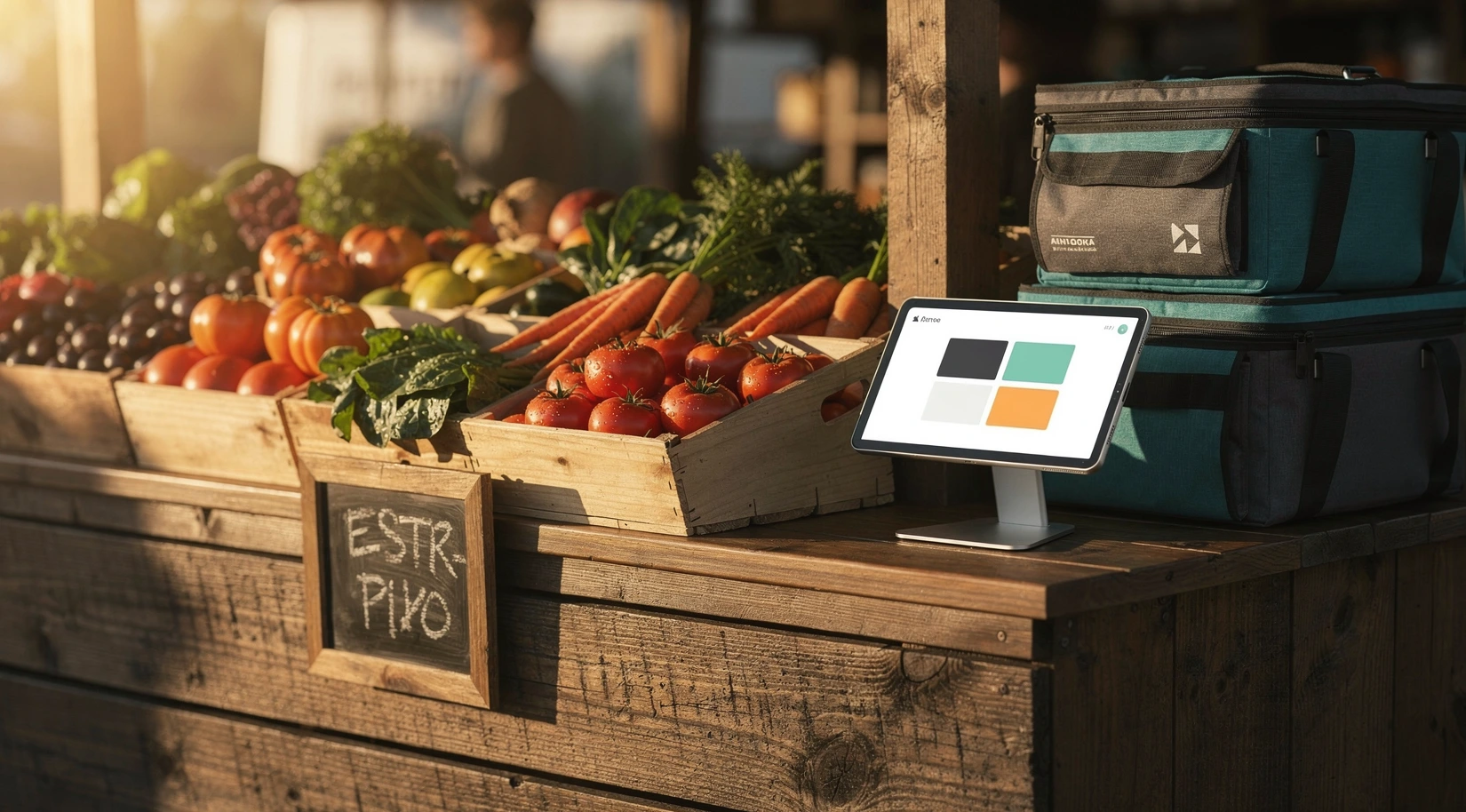
A farmers market stall is one of the most efficient retail formats ever invented. Rent is a table fee, foot traffic arrives on a schedule, and the customer can taste the product before paying. The problem is that the format only works for the hours the market is open, in the weather the market happens to get, during the weeks the crop is actually in season.
Selling online is the obvious patch. It is also where a lot of market vendors quietly lose money, because they copy the playbook of a national e-commerce brand instead of building something shaped like a stall. This piece looks at which online models genuinely fit a market vendor, which ones fail predictably, and where the break-even sits.
In short
- Pre-order with market pickup is the highest-margin online model for most vendors, because it moves the transaction online while leaving fulfillment exactly where it already happens.
- Shipping perishable goods is where stalls lose money. Cold packaging, dimensional weight and spoilage claims routinely exceed the gross margin on a produce box.
- Local delivery only works above a minimum order value that most vendors set far too low, and above a route density that a single stall rarely reaches alone.
- Subscriptions solve the forecasting problem, not the revenue problem. Their real value is knowing how much to harvest, which cuts waste before it cuts cost.
- The break-even is labor, not software. A $29 monthly platform is irrelevant next to six unpaid hours a week of packing and messaging.
What a market vendor actually needs online
Most advice aimed at small food businesses assumes a warehouse, a stable SKU list and a year-round catalog. A market vendor has none of those. Inventory changes weekly, some items are sold by weight, and the person packing the order is the same person who grew or made the product.
That changes the requirements. What a stall needs is not a store in the conventional sense. It needs a way to take commitments before the market, and a way to tell people what will actually be on the table.
Those two functions cover the majority of realistic online revenue for a vendor. Everything else, including a full catalog with search and filters, is scaffolding that costs time to maintain and returns very little. This is the same structural point that runs through the future of local retail and main street commerce: the winning digital tools for small operators are the ones that reduce friction around an existing physical transaction rather than replacing it.
The three jobs an online presence has to do
First, availability. Customers want to know whether the thing they drove for will be there. A weekly list that goes out reliably is worth more than a polished storefront that is never updated.
Second, commitment. A pre-order converts a maybe into a reserved unit, which is what lets a vendor harvest, bake or butcher to actual demand instead of guessing.
Third, continuity. Markets are seasonal and weather-dependent. A channel that keeps the customer relationship alive through a rained-out Saturday or a February gap is worth building, even if it does modest volume.
What almost never pays back
A custom-built website with a bespoke checkout is close to the top of the list. So is nationwide shipping of anything that needs refrigeration, and any catalog that requires the vendor to write and photograph fifty product pages before the first sale.
Paid advertising also tends to disappoint at this scale. The addressable audience is a fifteen-minute drive wide, and the cost of reaching it through an auction designed for national advertisers rarely clears the margin on a $24 order.
Pre-order and pickup: the model that fits a stall best
Pre-order with pickup at the market is the model that consistently works. The customer orders online during the week, pays or reserves, then collects at the stall during normal market hours. Nothing about the physical operation changes except that some units are already spoken for.
The margin math is unusually good because the online layer adds almost no cost. There is no courier, no shipping box, no cold chain and no delivery window to miss. The vendor is already going to be standing at that table.
Why it beats shipping on every axis that matters
Shipping perishables is a different business with different economics. A vendor selling a $35 produce box discovers that insulated liners, gel packs and a two-day service can consume most of the gross margin, before accounting for the boxes that arrive warm and get refunded.
Pickup removes all of that. It also removes the single largest source of customer service work, which is tracking down parcels and adjudicating spoilage claims. Vendors who have run both models usually describe shipping as the channel that generated the revenue and consumed the weekend.
Reservation versus prepayment
There are two ways to run pre-order, and the choice matters more than the software. A reservation holds the item and collects payment at the stall. Prepayment collects at checkout.
Prepayment is better for the vendor because it eliminates no-shows, which run high on free reservations. Reservation is easier to launch because it sidesteps refunds on weight variance and substitutions. A common path is to start with reservations, measure the no-show rate for a month, and switch to prepayment once the order flow is stable.
Cut-off times are the operational hinge
The cut-off is the moment the order list closes so the vendor can harvest and pack. Set it too late and the vendor is packing at midnight. Set it too early and customers who decide on Friday cannot buy.
Most vendors converge on a cut-off roughly 24 to 36 hours before the market opens. The important part is that the cut-off is stated in every message and enforced without exception, because a single accommodated late order teaches the whole list that the deadline is soft.
| Model | Fulfillment cost per order | Main failure mode | Fits a stall? |
|---|---|---|---|
| Pre-order, market pickup | Effectively zero, packing labor only | No-shows on unpaid reservations | Yes, strongest fit |
| Pre-order, separate pickup point | Low, but adds a staffed window | Vendor waits for late collectors | Sometimes, if the window is short |
| Local delivery, own vehicle | Moderate, driven by route density | Too few stops per hour | Only above a minimum order |
| Local delivery, third-party courier | High, often 15% to 30% of order value | Margin disappears on small baskets | Rarely, unless baskets are large |
| Shipping perishables nationally | Very high, cold pack plus freight | Spoilage refunds and dimensional weight | No for most vendors |
| Shipping shelf-stable goods | Moderate and predictable | Low order values against flat postage | Yes, for jams, honey, dry goods |
The pattern in that table is consistent. The further fulfillment moves from the stall, the faster margin erodes, and the shift is not gradual. It steps down sharply the moment a third party has to touch the order.
Local delivery routes and the minimum order that makes them work
Local delivery is the model vendors most want to work and most often get wrong. The appeal is obvious: the customer who cannot make Saturday morning still buys. The trap is that delivery cost is driven by time per stop, and a stall’s order book is usually too thin to make the route efficient.
The arithmetic that decides it
Delivery economics come down to stops per hour. A driver covering a compact neighborhood might manage six to eight stops per hour. Spread the same number of orders across a county and that falls to two or three, which triples the labor cost carried by each order.
Work it through with real numbers. If a vendor values their time at $25 an hour and achieves four stops per hour, each delivery carries roughly $6.25 in labor plus fuel and vehicle wear. On a $30 order with a 35% gross margin, that is $10.50 of margin against more than $7 of delivery cost, which leaves almost nothing for packaging or the vendor.
That is why the minimum order threshold is the single most important number in a delivery program. Most vendors set it around $25 when the arithmetic supports something closer to $50 or $60.
Density beats radius
A tight delivery zone with many customers is far more profitable than a wide zone with few. Vendors who cap delivery at a handful of specific zip codes, or at a single day per week per neighborhood, tend to reach viable density faster than those who promise to deliver anywhere within twenty miles.
An alternative that works well is the neighborhood drop point. One host address per area, a 30-minute collection window, and every order for that area moves in a single stop. It is a compromise between pickup and delivery, and it often carries the convenience benefit at close to pickup cost.
Sharing a route with other vendors
A single stall rarely generates route density on its own. Several vendors at the same market, selling complementary goods, frequently can. Shared delivery arrangements, where one operator runs the route and the others pay a per-stop fee, are one of the more durable structures in this space and a practical example of what community commerce really means beyond the slogan.
The coordination cost is real. Someone has to consolidate orders, settle payments between vendors, and own the customer complaint when a bag is short. Arrangements that survive usually put one named person in charge and pay them for it rather than treating it as a favor.
Subscriptions and boxes for predictable produce
Community supported agriculture and weekly box schemes are the oldest subscription model in food retail, and they long predate anything a software vendor would call a subscription. The customer commits to a season or a month, and the vendor gets predictable demand.
The benefit that matters most is not recurring revenue. It is planning. Knowing that 40 boxes go out every Thursday tells a grower what to plant and a baker what to prep, which is the difference between selling out and composting.
Where box schemes actually fail
The common failure is choice. Vendors add customization to reduce churn, then discover that every swap, skip and substitution multiplies packing time. A scheme with four fixed box types is manageable. A scheme where every customer builds their own is a warehouse operation running out of a garage.
The second failure is season length. A box scheme sold as a 20-week commitment collides with a growing season that delivers abundance in weeks 6 to 14 and very little at either end. Customers who receive three items in week 2 and eleven in week 9 experience the average as inconsistency.
The third is billing. Charging the full season upfront gives the vendor working capital exactly when input costs land, but it also raises the barrier to signing up. Monthly billing converts better and funds worse, which is a genuine trade-off rather than a solved problem.
Sizing the offer against the calendar
Vendors who run subscriptions well tend to build the offer around the calendar first and the price second. That means mapping which weeks have surplus, which have gaps, and what filler is available (storage crops, preserves, a partner vendor’s goods) before publishing a schedule.
This is the same discipline described in the account of a garden center that built a year-round revenue calendar, where the operator worked backward from the dead months rather than forward from the busy ones.
Skip weeks and vacation holds
Allowing skips reduces cancellations, but only if the deadline is enforced and the credit is automatic. Manual credits are the hidden labor cost of subscriptions, and they scale badly. A hard skip deadline that matches the harvest cut-off keeps the system honest.
Payments, weight-based pricing and last-minute substitutions
The operational details that break online selling for market vendors are almost always the ones that come from selling food rather than the ones that come from selling online. Weight variance, substitutions and refunds are where a clean checkout meets a messy reality.
Charging for something you cannot weigh in advance
A checkout wants a fixed price. A butcher, a fishmonger or a grower selling by the pound cannot always give one. There are three workable approaches, and each has a cost.
The first is fixed portions: sell a “roughly 1.2 lb” cut at a flat price and absorb the variance. Simple, customer friendly, and it eats margin on the heavy end unless the portioning is disciplined.
The second is an authorization hold at checkout with a final charge after weighing. Accurate, but it requires payment tooling that supports adjustment after capture, and it surprises customers who do not read the note.
The third is a deposit online with the balance settled at pickup. It works well for reservation models and poorly for delivery, since nobody wants a driver taking payment at the door.
| Pricing approach | Best for | Customer friction | Vendor risk |
|---|---|---|---|
| Fixed portion, flat price | Bakery, preserves, standard cuts | Lowest | Margin loss on heavy portions |
| Authorization then adjusted charge | Meat, fish, bulk produce | Moderate, needs clear wording | Disputes if the note is missed |
| Deposit online, balance at pickup | Reservation and pickup models | Moderate, two payment steps | Cash handling at the stall |
| Credit balance or wallet | Weekly regulars and box members | Low once established | Liability to track and refund |
| Price by unit, not weight | Eggs, plants, jars, bunches | Lowest | None, where the product allows it |
Substitution policy is a trust decision
Crops fail, batches burn, and a storm on Thursday can remove an item from Saturday’s list. The vendor has to decide in advance whether the default is a substitution, a credit or a refund, and then say so plainly at checkout.
Vendors who publish the policy up front report far fewer disputes than those who handle each case individually. Customers of a market stall are generally tolerant of a swapped item and intolerant of being surprised by one.
Fees, chargebacks and the cost of getting paid
Card processing on small baskets is proportionally expensive because of the fixed per-transaction component. A flat 30 cent fee on a $12 order is 2.5% before the percentage rate is applied, which is why small-basket online selling looks worse on paper than the same sale at the table.
Raising average order value fixes this more effectively than shopping for a lower rate. Bundles, minimum orders and box schemes all push the basket up, which is a large part of why they appear repeatedly in vendor playbooks.
Marketing to a customer who already visits weekly
The marketing problem for a market vendor is unusual: the best customers are already standing in front of the stall every week. The job is not acquisition in the conventional sense. It is converting a physical regular into someone who also orders between markets.
Collect the contact at the table
The highest-yield marketing action available to a stall is a signup sheet or a QR code at the point of sale, offered while the customer is holding the product they just decided they liked. Response rates there are unmatched by any paid channel at this scale.
Email remains the workhorse because it is owned, cheap and well suited to a weekly availability list. Messaging apps and SMS convert better for cut-off reminders but cost more per send and carry stricter consent rules in the United States.
Get found by the people already searching locally
Local search is where most incremental discovery happens for market vendors, and it is largely a data-completeness exercise rather than a creative one. Hours, category, service area and photos do most of the work, as set out in the breakdown of Google Business Profile fields that matter for retailers.
Market vendors have a specific complication here, which is that the stall address is the market address and the market is open six hours a week. Vendors generally handle this by listing a service area rather than a storefront and by keeping the market schedule current in the profile.
Events do more than ads
Pop-ups, tastings and collaborations with nearby businesses reliably outperform paid media for stalls, because they put the product in front of people in the same physical context that made the market work. The dynamics are covered in more depth in this look at pop-up markets and the rise of community-led retail events.
What to send, and how often
One message a week, sent on the same day, carrying the actual availability list and the cut-off time, is the format that works. Vendors who send more tend to see unsubscribes rise without orders following.
The content that drives orders is concrete: what is ready this week, what is nearly gone, and when ordering closes. Narrative posts about the farm build affection and rarely move the same week’s numbers.
Costs and the point where it stops being worth it
Vendors evaluating an online channel almost always benchmark the wrong number. They compare platform subscription fees, which are small and visible, and ignore labor, which is large and invisible because it is their own.
The real cost stack
A realistic accounting has four layers. Software is the smallest: a hosted store or ordering tool typically lands somewhere between free and roughly $40 a month at this scale. Payment processing is a percentage plus a fixed fee per order.
Packaging is next, and it is where perishable goods diverge sharply from shelf-stable ones. A paper bag costs cents; an insulated shipper with gel packs is a different order of magnitude.
Labor is the layer that decides viability. Building the weekly availability list, answering messages, packing to a list, reconciling substitutions and handling pickup or delivery is commonly six to ten hours a week once a program has real volume. Priced at even a modest hourly rate, that is the dominant line item.
A worked break-even
Take a vendor running pre-order pickup at $28 average order value with a 40% gross margin, so $11.20 of margin per order. Assume $25 a month in software, 2.9% plus 30 cents in processing (about $1.11 per order), and 6 hours a week of work valued at $25 an hour, which is $650 a month.
Per order, margin after processing is about $10.09. Covering $675 in fixed monthly cost therefore takes roughly 67 orders a month, or about 17 a week. Below that, the vendor is subsidizing the channel with unpaid time. Above it, each additional order is nearly all contribution, because the labor is not strictly linear.
Run the same numbers on a delivery model and the picture changes hard. Add $6.50 per order in delivery labor and fuel and contribution falls to about $3.59, which pushes break-even past 180 orders a month. That is the arithmetic behind the recurring advice to raise the delivery minimum or drop the channel.
| Cost line | Pickup model, monthly | Own-vehicle delivery, monthly | Notes |
|---|---|---|---|
| Software and ordering tool | $0 to $40 | $0 to $60 | Route tools add cost |
| Payment processing (70 orders) | About $78 | About $78 | Fixed fee hurts small baskets |
| Packaging | $20 to $50 | $40 to $90 | Insulation and totes add up |
| Vendor labor (6 to 10 hrs/wk) | $650 to $1,080 | $1,080 to $1,600 | Dominant, usually unpriced |
| Fuel and vehicle | $0 | $60 to $150 | Route density dependent |
| Approximate break-even volume | About 17 orders a week | About 45 orders a week | At $28 average order value |
The honest exit criteria
Some vendors should not sell online, and there is no shame in the conclusion. If the product is low-value, highly perishable, sold entirely by weight and produced by one person with no spare hours, the online channel will consume time that the stall converts more efficiently.
Useful stop conditions are concrete: if weekly online orders have not passed roughly 15 after three full months of consistent promotion, if online customers are the same people who would have bought at the stall anyway, or if packing time has started cutting into production, the channel is not paying for itself.
The strategic argument for persisting anyway is resilience rather than immediate profit. A vendor with a direct customer list and a working pre-order habit survives a cancelled market, a bad-weather season or a market closure far better than one whose entire demand lives in a Saturday morning. That resilience case is the throughline in the wider argument about the future of local retail and main street commerce.
Starting small on purpose
The lowest-risk entry point is a weekly email with an availability list and a simple order form, fulfilled at the stall. No storefront, no catalog, no shipping. It costs almost nothing, tests real demand rather than imagined demand, and can be abandoned in a week if the answer is no.
Vendors who start there and grow into a proper ordering system rarely regret it. Vendors who start with a full storefront and nationwide shipping frequently do.
Rules, food safety and tax: where to check before you sell
Selling food online touches several bodies of rule that differ by state, by product and sometimes by county, and they change. This section is general information and education about how the landscape is structured. It is not legal, tax or food safety advice, and it should not be treated as a substitute for guidance on a specific business.
Anyone planning to sell food beyond a market stall should confirm their own position with their state department of agriculture, their local health department, and a licensed tax professional or attorney where the amounts justify it. The relevant rules and any figures cited by third parties should be verified directly at the official source, because thresholds and definitions are revised regularly.
Cottage food, licensing and what changes when you ship
Most states operate some form of cottage food framework covering low-risk products made in a home kitchen, typically with limits on what can be sold, where it can be sold and how much revenue is permitted. Those frameworks are set at state level, so the scope varies substantially and the details live with each state’s department of agriculture or health.
Selling across state lines is a materially different question, because interstate food commerce brings federal requirements into scope. The US Food and Drug Administration publishes the federal framework for food facility registration and labeling, and the US Department of Agriculture handles meat, poultry and egg products. Whether a given vendor is covered, exempt or partially exempt is a fact-specific question worth asking before the first shipment rather than after it.
Sales tax on food is not uniform
Sales tax treatment of food varies by state, and several states tax prepared food differently from grocery staples. Adding delivery can change the analysis again, since some states treat delivery charges as taxable and others do not.
Online selling can also raise economic nexus questions if a vendor sells into other states at volume, although most market vendors operate far below the thresholds involved. State revenue departments publish the current rules and rates, and those are the authoritative source rather than any summary, including this one.
Weights, measures and how you advertise price
Selling by weight brings state weights and measures rules into play, covering scale certification and how prices are displayed. These are enforced locally and are usually straightforward to comply with, but they are worth confirming before advertising a per-pound price online, since a published price makes a labeling error more visible than a chalkboard does.
For background on how the direct-to-consumer market is structured and tracked in the United States, the Agricultural Marketing Service at the US Department of Agriculture maintains the national directory of farmers markets and related direct marketing outlets.
FAQ on selling market produce online
Do I need a full e-commerce website to sell online as a market vendor?
No. Most vendors do better with a weekly availability email and a simple order form fulfilled at the stall. A full storefront adds maintenance work that only pays back once order volume is consistently high and the catalog is stable enough to be worth building.
Should I ship my produce nationally?
For fresh perishables, usually not. Cold packaging and expedited freight typically consume most of the gross margin, and spoilage refunds hit the rest. Shelf-stable goods such as jams, honey, dry mixes and preserves ship well and are a much better fit if you want a national channel.
What minimum order should I set for local delivery?
Work it backward from your own numbers rather than copying someone else’s. Estimate your realistic stops per hour, price your time honestly, and set the minimum so the margin on a threshold order comfortably covers the per-stop cost. For many vendors that lands well above the $25 minimum they first pick.
How do I handle items sold by weight in an online checkout?
The three common approaches are fixed portions at a flat price, an authorization at checkout with the final charge adjusted after weighing, and a deposit online with the balance paid at pickup. Fixed portions are simplest and work for most vendors who can portion consistently.
Is a subscription box worth it for a small grower?
Its main value is demand forecasting rather than revenue. Knowing your weekly box count tells you what to plant and harvest, which reduces waste. The risk is customization: every skip, swap and hold adds packing labor, so keep the number of box variants small.
How far in advance should I close orders?
Most vendors settle on a cut-off around 24 to 36 hours before the market so there is time to harvest and pack. What matters more than the exact number is enforcing it consistently, because accommodating late orders once trains customers to treat the deadline as optional.
How many online orders per week do I need to break even?
It depends on your average order value and how you price your own time, but a pickup model with a $28 basket and six weekly hours of work typically needs somewhere around 17 orders a week. A delivery model can need two to three times that, which is why delivery minimums matter so much.
Do I need a special license to sell food online?
It depends on the product, your state and whether you ship across state lines. Cottage food rules are set at state level, and interstate shipping can bring federal requirements into scope. Check with your state department of agriculture and local health department before you start, since this article is general information rather than legal or food safety advice.
What is the fastest way to build an email list from the stall?
Ask at the point of sale, while the customer is buying. A signup card or QR code at the table converts far better than anything online, because you are asking someone who has already chosen your product. Then send one useful message a week on the same day with the availability list and the cut-off time.