
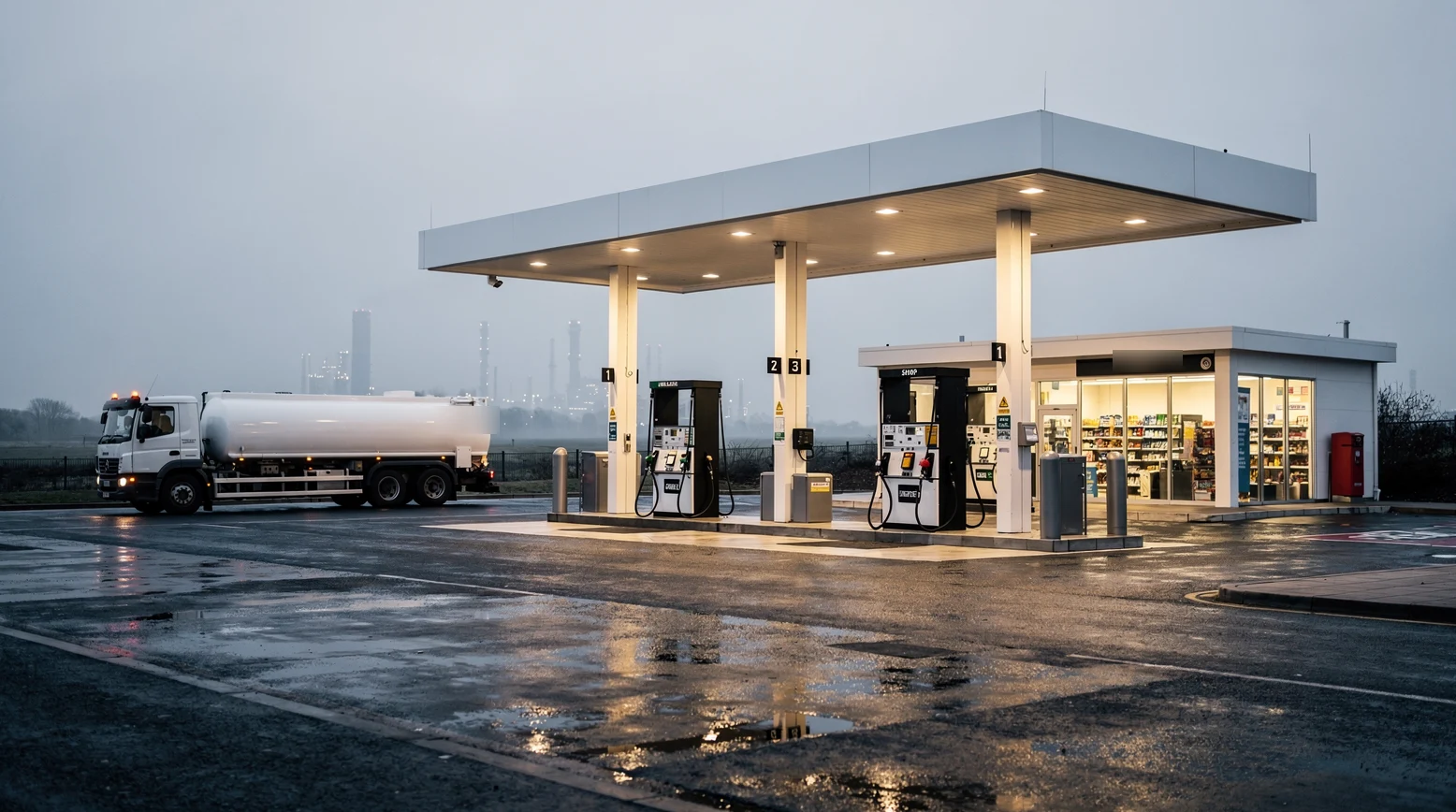
Essar’s UK fuel arm has agreed to buy SGN Retail, one of the country’s largest independent petrol station operators, in a deal that doubles its forecourt estate overnight and puts fuel refined at Stanlow in Cheshire straight onto 235 UK forecourts. The announcement, made from Stanlow on the morning of 14 September 2026, is the biggest single move yet in Essar’s plan to rebuild a refinery-to-pump supply chain that Britain’s oil majors walked away from over the past two decades.
EET Retail Limited, the retail division of Essar Energy Transition Fuels, said it will take 100% of SGN Retail, an Essex-based company founded in 2016 by Graham Peacock and Susan Tobbell that runs 118 roadside sites across the UK. No price was disclosed. Reuters, citing two people with knowledge of the matter, put the value at £400 million to £450 million (about USD 541 million to USD 608 million at a rate of 1.352), while the Press Association reported a figure of around £400 million. Essar declined to comment on the valuation.
In short
- The deal: EET Retail, Essar’s UK forecourt business, is buying 100% of SGN Retail and its 118 petrol stations, taking its estate from 117 to 235 sites with annual throughput above 650 million litres.
- The price: undisclosed by the company; Reuters sources say £400 million to £450 million. The purchase is funded with cash plus a new £250 million senior debt facility from eight lenders.
- The strategy: Essar wants a “refinery-to-forecourt” model, with its Stanlow refinery supplying 800 forecourts (roughly 9% of the UK market) by 2031, up from a 600-site ambition stated earlier this year.
- For shoppers: the sites carry convenience, food-to-go, valeting and EV charging; the company promises “competitive prices at the pump” but the regulator says forecourt margins remain historically high.
- What to watch: the CMA’s autumn road-fuel review, the 28 October Budget decision on fuel duty (frozen at 52.95p a litre until 31 December), and how quickly SGN sites are rebranded.
What exactly has Essar agreed to buy?
According to the company statement, EET Retail has signed an agreement to acquire the whole of SGN Retail, described as “a leading UK independent forecourt operator”. SGN Retail manages 118 “strategic roadside locations nationwide alongside leading retail, convenience, and food-to-go brands”, the statement says, without naming those partner brands. The Business Desk reported the seller as Essex-based and confirmed the transaction value has not been made public.
Combined with EET Retail’s existing 117 sites, the purchase creates what Essar calls “a scaled, nationwide mobility platform of 235 fuel forecourts”. The company says the enlarged network will pump more than 650 million litres of fuel a year, and that it becomes “the second largest UK forecourt network that is backwardly integrated with fuel production”, meaning a forecourt chain that owns or is owned by the refinery supplying it.
The acquisition is being funded through a mix of cash and a new £250 million senior debt facility. The lending group comprises First Abu Dhabi Bank, Macquarie Bank, Mizrahi Tefahot Bank, Natixis, OakNorth Bank, Royal Bank of Canada, SMBC Bank International and Sound Point Capital Management. RBC Capital Markets acted as financial adviser to EET Fuels and EET Retail, with Herbert Smith Freehills Kramer and Weightmans as legal advisers.
| Deal element | Detail | Source |
|---|---|---|
| Buyer | EET Retail Limited (retail division of Essar Energy Transition Fuels / Essar Oil UK) | Company statement |
| Target | SGN Retail, founded 2016 by Graham Peacock and Susan Tobbell, Essex-based | Company statement; Business Desk |
| Sites acquired | 118 forecourts | Company statement |
| Combined estate | 235 forecourts, 650m+ litres a year | Company statement |
| Price | Undisclosed; £400m to £450m per Reuters sources (about USD 541m to USD 608m); around £400m per PA | Reuters; Press Association |
| Funding | Cash plus £250m senior debt from eight lenders | Company statement |
| Advisers | RBC Capital Markets (financial); Herbert Smith Freehills Kramer, Weightmans (legal) | Company statement |
| Stated goal | 800 forecourts (~9% UK share) by 2031 | Company statement |
Who are the people behind SGN Retail?
SGN Retail was built over a decade by Graham Peacock and Susan Tobbell, who founded the business in 2016 and grew it to 118 sites, a rapid expansion in a market where the total number of forecourts has been falling for fifty years. The company statement describes the estate as “one of the highest-quality forecourt networks in the UK”. Neither founder was quoted in the announcement, and the statement does not say whether they will stay on after completion.
Why does an Indian conglomerate want British petrol stations?
The answer is Stanlow. Essar has owned the Stanlow Manufacturing Complex at Ellesmere Port since it bought the refinery from Shell in 2011, and the site now produces around 18% of the UK’s transport fuels, according to the company. Reuters puts its capacity at about 200,000 barrels a day. For most of that period, Stanlow has sold its petrol and diesel into a wholesale market and let other companies own the relationship with the motorist.
Essar now wants to close that gap. Its statement argues that “over the last two decades, the UK market has fragmented between fuel retail and fuel production, as oil majors have significantly reduced their domestic refinery investments, leading to a complex and inefficient supply chain, often dependent on imports”. By owning forecourts outright, the company says it can send UK-refined fuel directly to UK pumps and “eliminate cost inefficiencies for motorists”.
Arvan Ruia, chief executive of EET Retail, said in the statement: “Building a scaled, vertically integrated retail forecourt platform is a critical pillar of our long-term UK strategy. SGN Retail is one of the highest-quality forecourt networks in the UK well ahead of the market. This acquisition accelerates our plan to build a nationwide, vertically integrated platform of 800 sites, backed by direct refinery supply and delivering competitive prices at the pump for UK motorists.”
How the target has grown from 600 to 800 sites
The 800-site ambition is new. As recently as April 2026, when EET Retail opened a flagship leased forecourt on Sefton Street in Liverpool, Forecourt Trader reported the company’s long-term target as 600 Essar-branded sites. At that point the business was supplying fuel to more than 150 forecourts but operated only 17 of them under its 15-year lease model, a programme launched in February 2024 whose uptake had been slower than planned: the company had once hoped to have 100 leased forecourts by October 2025.
Buying 118 sites in one transaction changes the arithmetic. Essar says the SGN Retail purchase will “substantially accelerate” its roadmap and that it sees “demographic growth, the rise of multi-car households and the declining number of forecourts in the UK” as reasons to invest in the sector.
| Date | EET Retail milestone | Estate |
|---|---|---|
| 2011 | Essar buys Stanlow refinery from Shell | Wholesale supply only |
| February 2024 | 15-year forecourt lease model launched | Target: 100 leased sites by October 2025 |
| April 2026 | Liverpool flagship opens (Spar shop, Post Office, car wash) | 17 leased sites; 150+ supplied; 600-site goal |
| 14 September 2026 | Agreement to buy SGN Retail | 117 + 118 = 235 sites; 650m+ litres |
| 2031 (target) | Nationwide integrated platform | 800 sites, ~9% UK market share |
What is “backward integration” and why did Britain lose it?
For most of the twentieth century, the companies that refined petrol in Britain also sold it. Shell, BP, Esso and Texaco branded forecourts were supplied from their owners’ own refineries, and the motorist rarely thought about where the fuel came from. Essar’s statement describes the unwinding of that model: as oil majors “significantly reduced their domestic refinery investments”, refining and retailing split apart, and the supply chain became “multi-layered” and “import-dependent”.
Stanlow itself is an example. Shell sold the refinery to Essar in 2011 and, over the following decade, the majors also sold most of their company-owned forecourts to independent groups, keeping the brand on the canopy but not the freehold. Supermarkets meanwhile used fuel as a footfall driver, and today the RAC says they dominate fuel volumes while operating only about a fifth of sites. The result is a market where the refiner, the brand, the site owner and the shop operator can be four different companies.
Essar’s argument is that each layer adds cost and fragility. Its statement says the integration of fuel production and sale will “allow EET Retail to eliminate cost inefficiencies for motorists at the pump”, and that routing Stanlow output straight to its own forecourts “boosts domestic supply security”. Sceptics will note that the company also benefits from a guaranteed outlet for its refinery at a time when UK refining capacity has been shrinking.
| Forecourt model | Who owns the fuel supply | Who owns the site | Typical UK example | Where EET Retail sits |
|---|---|---|---|---|
| Supermarket forecourt | Bought wholesale | Supermarket or its buyer | Tesco, Sainsbury’s, Asda | Not applicable |
| Oil-major branded dealer | Brand owner’s contract | Independent dealer | Shell, BP, Esso fascias | Not applicable |
| Independent group | Bought wholesale, various brands | Group or leased | Motor Fuel Group, SGN Retail (pre-deal) | SGN Retail moves out of this model |
| Refinery-integrated | Own refinery | Owned or long-leased | Essar-branded sites supplied by Stanlow | Combined 235-site network, “second largest” per Essar |
How big is 235 forecourts in the UK market?
Britain had 8,349 petrol filling stations in the 2025 Fuel Market Review compiled by Forecourt Trader from Experian Catalist data, and the 2026 edition recorded a small further fall. The RAC notes that the figure is down from more than 37,000 in 1970. On those numbers, 235 sites is roughly 2.8% of the network and 800 sites would be a little under 10%, consistent with Essar’s own 9% estimate.
Ownership of those sites is unusually fragmented. The RAC says independents operate around two-thirds of the country’s forecourts, while supermarkets run about a fifth of sites yet dominate fuel volumes. The largest independent groups, led by Motor Fuel Group, own well over a thousand sites each, so even at 235 EET Retail remains a mid-sized player by site count. Its distinction is supply rather than scale: very few UK forecourt owners also own a refinery.
Which other UK forecourts are refinery-backed?
Essar describes the enlarged EET Retail as the “second largest” backward-integrated forecourt network in Britain, without naming the largest. The UK’s remaining refineries are concentrated in a handful of hands, and the closure of Grangemouth and the collapse of the Prax-owned Lindsey refinery in 2025 left even fewer domestic sources of finished fuel. That context is central to Essar’s pitch that a refinery-to-pump chain “strengthens domestic energy security against global supply shocks and regional refinery closures”.
What does the deal mean for pump prices?
Essar’s headline promise is “competitive prices at the pump for UK motorists”. The company says integrating production and sale will let it strip out cost inefficiencies, and that rerouting Stanlow fuel directly into its own forecourts will make distribution more efficient. It has not quantified any saving per litre, and the statement contains no pricing commitment beyond the word “competitive”.
The deal lands in a tense pricing environment. Petrol prices rose by about 5p a litre in a single week in early September as the conflict involving Iran pushed oil higher, the BBC reported on 9 September, and industry trackers have described unleaded at a four-year high with diesel well above 180p a litre. Diesel had already peaked near 192p in mid-April before a ceasefire brought sharp falls in June.
Regulators are watching margins closely. In its enhanced road fuel monitoring update of 18 August 2026, the Competition and Markets Authority said retailer margins were at or above the historically high levels seen in 2025, and that some retailers “did not immediately pass reductions in wholesale diesel prices on to drivers” when costs fell between May and June. The CMA remains concerned that “passive pricing strategies” by most retailers are “contributing to sustained high margins”, and has promised a more detailed review this autumn covering pricing strategies, pass-through speed and why prices differ between local areas. Details are on the CMA’s monitoring update page.
Fuel Finder and the transparency test
Any price advantage Essar delivers will be visible in real time. The government-backed Fuel Finder scheme requires forecourts to publish live prices, and the CMA said in August that around 97% of petrol stations, accounting for about 99% of fuel sold, are now registered. Since the grace period ended in April the regulator has sent 1,166 letters and issued compliance notices covering 53 sites, though it has not yet fined anyone. If Stanlow-supplied forecourts really are cheaper, comparison apps will show it; if they are not, the same apps will show that too.
Fuel duty stays frozen until December, then it is the Chancellor’s call
Duty is the other moving part. The rate stands at 52.95p a litre after the government extended the 5p cut, first introduced in March 2022, to at least 31 December 2026, reversing a plan announced in the November 2025 Budget for staged 1p, 2p and 2p rises from September 2026. What happens from January is a matter for the Autumn Budget on 28 October, the same fiscal event at which independent retailers are pressing the Chancellor on business rates, a cost line that weighs on forecourt shops as heavily as on any high street unit.
What changes for the local shop on the forecourt?
For most people, a petrol station is now a convenience store that happens to sell fuel. Essar says it is “scaling the Essar brand’s forecourt offer”, listing hot food, convenience, valeting and EV charging as the four pillars. The Liverpool flagship opened in April gives a sense of the template: a 3,000 sq ft Spar shop with an in-store bakery, eight fuelling bays, two jet washes, a rollover car wash, a Post Office counter, an ATM and parcel lockers on a 0.85-acre former BP site on a main route into the city centre.
SGN Retail’s sites already trade “alongside leading retail, convenience, and food-to-go brands”, according to the statement, though it does not say which. That leaves an open question for shoppers: whether existing shop fascias and food partners at the 118 sites will be kept, switched to Essar’s own format, or run as a mix. The company gave no timetable for rebranding and no completion date for the deal itself.
The stakes for local communities are real. The Association of Convenience Stores counts forecourt shops within a sector it says has invested less this year as costs rise, a picture laid out in its Local Shop Report 2026, which shows rates bills doubling across the convenience channel. A well-capitalised owner willing to refit sites is good news for the towns that host them; a distant owner focused on fuel volume is less so.
Post Offices, parcels and the services that keep a site useful
Forecourt shops increasingly carry services that have been retreating from high streets. Post Office counters are a case in point: EET Retail’s Liverpool site opened with one at a time when chains such as TG Jones are closing shops and leaving towns without a Post Office counter. Parcel lockers, cash machines and bakery counters follow the same logic. Whether Essar rolls that model across the SGN estate will matter more to most residents than who refines the diesel.
How does this fit the wider run of UK retail deals?
September has already been a busy month for consolidation in British physical retail. Fortress Investment Group, owner of Poundstretcher, opened early talks to buy Poundland and its roughly 900 shops, and Associated British Foods bought an automated fulfilment centre from Debenhams for Primark. The Essar deal is different in one respect: it is a manufacturer buying its route to market, not a retailer buying a rival.
Viral Gathani, head of strategic transactions at Essar Energy Transition, framed it that way: “This is a unique, best-in-class opportunity and advances a core part of our M&A strategy. The transaction is backed by a top-tier group of banks spanning four continents, several supporting the UK forecourt sector for the first time, underscoring confidence in our backward-integrated growth model and in the UK fuels and convenience markets.”
The lender list supports that claim of new money entering the sector. Alongside established UK forecourt financiers, the facility brings in Abu Dhabi’s largest bank, an Israeli lender and a US credit fund. That mix suggests a view among lenders that fuel and convenience retail, despite the shift to electric vehicles, remains bankable over the length of a senior debt facility.
Could the CMA take an interest?
The statement does not mention regulatory approval, and at 235 sites out of more than 8,000 the combined network is unlikely to raise concentration concerns at national level. Local overlaps are the usual pressure point in forecourt deals, and the CMA has shown a willingness to intervene in retail property this year, for example by moving to curb Aldi and Lidl land deals that block rival stores. The more relevant scrutiny is probably the autumn road-fuel review, which will examine regional price differences across every operator, Essar included.
What is Essar’s wider UK plan for Stanlow?
The forecourt push sits inside a larger programme. Essar Energy Transition says it has an investment pipeline of £4.3 billion for low-carbon projects in the UK to 2035, centred on turning the Ellesmere Port site into an energy transition hub for north-west England, with hydrogen at its core. The company marked 15 years of Stanlow ownership in August, and in May published a report claiming the site could deliver £1.9 billion to the UK economy by 2035.
The refinery has not been without controversy. BBC reporting in March 2026 found Stanlow had breached environmental rules nearly 500 times, and the Guardian reported in April on the owner’s handling of Russian-linked loans through an offshore subsidiary. Neither issue features in the acquisition announcement, but both form part of the backdrop against which a much larger consumer-facing Essar brand will now be judged.
Why forecourts and EVs are not a contradiction for Essar
EV charging is one of the four pillars of the Essar forecourt offer, and rivals such as Motor Fuel Group have built ultra-rapid charging networks at scale across their sites. Essar’s bet is that forecourt land on arterial roads remains valuable whatever powers the car, and that the shop and the coffee pay the rent while the fuel mix changes underneath. With multi-car households cited in the statement as a growth driver, the company is clearly not planning for a fast decline in petrol and diesel demand.
What should shoppers and forecourt operators watch next?
Several dates will show whether this deal delivers what it promises. Completion has not been announced, and the founders’ role after the sale is unknown. Rebranding of the 118 SGN sites, and any change to their shop and food-to-go partners, will become visible on the forecourts themselves over the coming months.
| Date | Event | Why it matters for this deal |
|---|---|---|
| Autumn 2026 | CMA detailed road fuel review | Tests every operator’s pass-through speed and regional pricing, including Essar sites |
| 28 October 2026 | Autumn Budget | Fuel duty path from January; business rates relief for retail premises |
| 31 December 2026 | Fuel duty freeze at 52.95p expires unless extended | Direct impact on pump prices across the 235-site network |
| Not yet announced | Deal completion and SGN site rebranding | Determines when shoppers see any change in fascia, shop offer or price |
| 2031 | Essar’s 800-site target | Requires more than doubling again from 235 sites |
For independent forecourt owners, the transaction also sends a signal about exit values. A £400 million-plus price for 118 sites, if the Reuters figures are right, implies well over £3 million per forecourt, a benchmark that every family-owned petrol station in the country will now have in mind. Essar’s 15-year lease scheme, which offers owners a guaranteed monthly income without day-to-day operation, is the other route it has been using to grow, and the SGN deal does not replace it.
The lease route for owners who want out
Forecourt Trader has described Essar’s lease initiative as giving site owners a monthly income over a guaranteed 15 to 20 years, with “relief or exit” for operators who want to retire or invest elsewhere. Uptake was slow at first, reaching 17 sites by April 2026 against an original hope of 100 by October 2025, but the company said at the time that it wanted more than two-thirds of its eventual network to be company-owned or leased. Buying SGN Retail delivers a large block of operated sites in one step; the lease scheme is how it expects to keep adding the rest.
Staffing is the one area the announcement leaves entirely blank. The statement gives no employee numbers for SGN Retail, no commitment on jobs and no detail on whether site teams transfer. In practice, forecourt acquisitions in the UK usually see shop and pump staff move across with the sites under transfer rules, but shoppers and workers at the 118 locations will have to wait for confirmation from the company.
Frequently asked questions
Who is buying SGN Retail?
EET Retail Limited, the retail division of Essar Energy Transition Fuels (Essar Oil UK), which operates the Stanlow refinery in Cheshire. Essar Energy Transition is part of the India-based Essar Group.
How many petrol stations does the deal involve?
SGN Retail runs 118 forecourts. Added to EET Retail’s existing 117 sites, the combined network is 235 forecourts with annual throughput above 650 million litres, according to the company statement.
How much is Essar paying for SGN Retail?
The price has not been disclosed. Reuters reported, citing two people with knowledge of the matter, that the deal is worth £400 million to £450 million (about USD 541 million to USD 608 million at 1.352). The Press Association reported around £400 million. Essar declined to comment on the figure.
Will petrol be cheaper at Essar forecourts?
Essar says direct supply from Stanlow will let it remove cost inefficiencies and deliver “competitive prices at the pump”, but it has not quantified any saving. The CMA said in August that forecourt margins across the market remain historically high, and live prices are visible through the Fuel Finder scheme, so any difference will be easy to check.
Will the SGN petrol stations be rebranded as Essar?
The company says it is scaling the Essar brand’s forecourt offer of hot food, convenience, valeting and EV charging, but it has given no timetable for rebranding the 118 sites or said whether existing shop and food-to-go partners will be kept.
What is Essar’s long-term target?
800 forecourts supplied directly from Stanlow by 2031, which the company estimates at about 9% of the UK market. Earlier in 2026 the stated goal was 600 Essar-branded sites.
How is the acquisition funded?
Through cash and a new £250 million senior debt facility arranged by First Abu Dhabi Bank, Macquarie Bank, Mizrahi Tefahot Bank, Natixis, OakNorth Bank, Royal Bank of Canada, SMBC Bank International and Sound Point Capital Management.
How many petrol stations are there in the UK?
8,349 in the 2025 Fuel Market Review compiled from Experian Catalist data, with a small further fall reported in 2026. The RAC notes the total was above 37,000 in 1970.
Does the deal need regulatory approval?
The announcement does not mention any approvals or a completion date. With 235 sites out of more than 8,000 nationally, the combined business is small by site count, though local overlaps are the usual focus in forecourt mergers.