
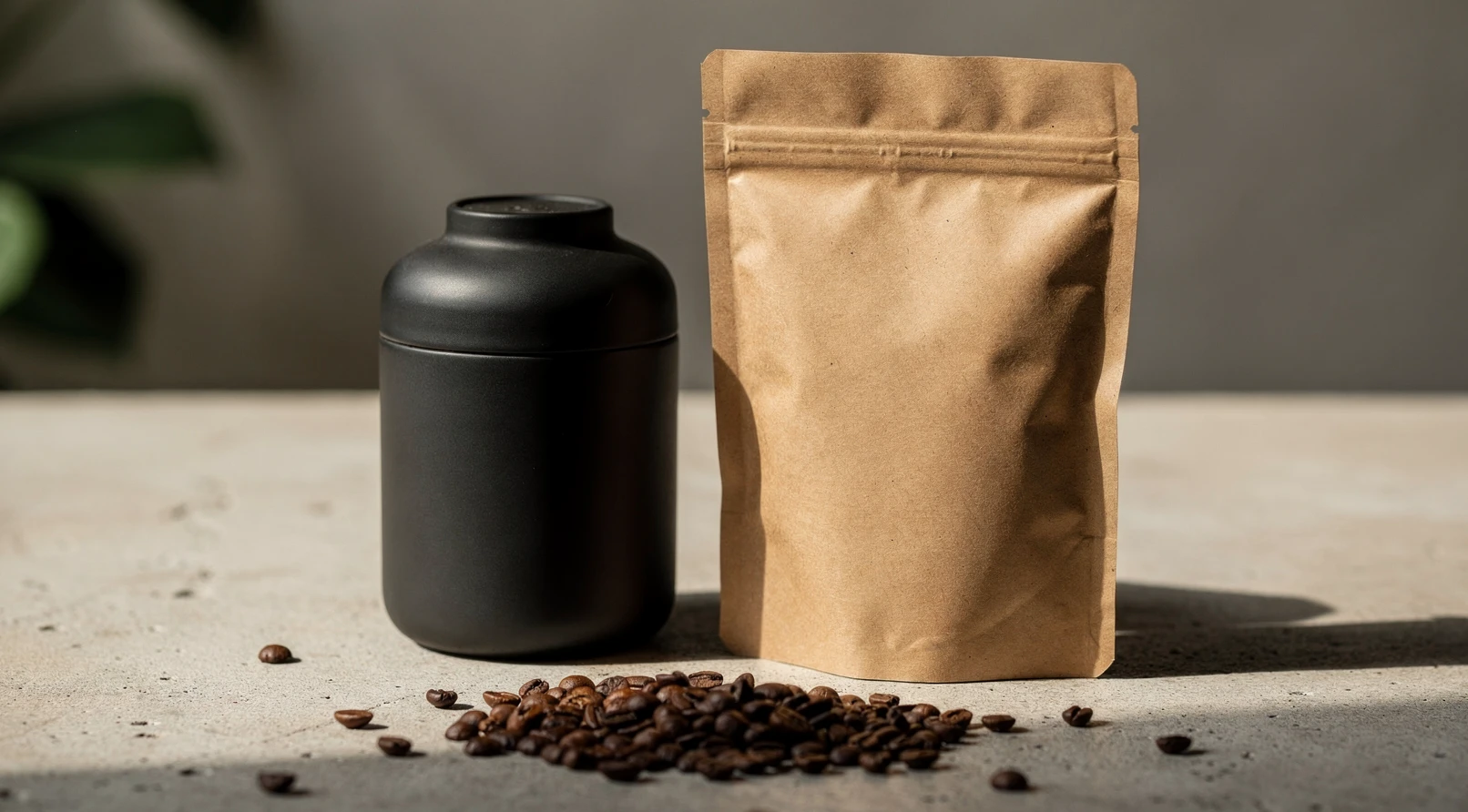
Can a coffee brand break a discount habit without cutting its headline price? The short answer is yes, but not by asking shoppers to pay more for the same thing. The brand in this case study stopped competing with itself on promotion and instead changed the format of the second purchase, selling a refill pouch at a lower unit price while the original pack held its shelf price. Repeat rate moved. Contribution margin moved further.
This refill program retail case study follows a composite US specialty coffee brand assembled from patterns we have seen repeatedly across roasters and consumer packaged goods teams between 2019 and 2026. Figures are indexed and illustrative rather than one company’s audited accounts, because the useful part is the decision sequence and the unit economics, not the logo. Every mechanic described here (refill pouches, return credits, dispenser refills, deposit models) exists in the market today in programs run by roasters, grocers and reuse platforms such as Loop and Algramo. Treat it as a working model to test against your own cost sheet.
In short
- Discounting was the only lever left: promotional volume reached roughly 61 percent of units, and gross margin on the hero bag had fallen about 9 points in two years.
- Refills beat a subscription push because the brand’s churn profile made a subscription an expensive way to buy the same customers it already had.
- Packaging cost per serving fell about 38 percent in the refill format, which funded a lower unit price without touching the original pack’s shelf price.
- Repeat purchase rate at 90 days rose from about 19 percent to 31 percent across the refill-eligible base, while promotional units fell to roughly 34 percent.
- The failures were operational: a return credit almost nobody redeemed, a pouch that leaked in transit, and a sustainability claim that had to be rewritten before launch.
If you are rebuilding a brand’s economics rather than its logo, this sits inside the same territory as the modern brand playbook that specialty categories now demand. Format innovation has quietly become a pricing strategy.
Why refill programs are getting a second look in 2026
Refills are not new. What changed is the cost stack around them. Rigid packaging, freight and paid acquisition all became more expensive across 2022 to 2026, which pushed brands to look for margin inside the box rather than outside it. A refill removes material and air from a shipment, and both of those carry cost.
The second driver is regulatory. Several US states have adopted extended producer responsibility frameworks for packaging, including Maine, Oregon, Colorado, Minnesota and California, which shift some end-of-life packaging cost onto producers. Fee schedules and covered-material definitions differ by state and are still being implemented, so any brand reading this should confirm current obligations with the relevant state agency rather than relying on a summary. The direction of travel, however, makes lighter packaging a financial question and not only a marketing one.
The third driver is simpler. Shoppers have become fluent in unit price. Once a category trains its customers to read cost per serving, a format that genuinely lowers cost per serving is a more durable offer than a recurring 20 percent code.
The starting point: discount dependence and flat repeat rate
The brand sold a 12 ounce whole bean bag as its hero, plus three rotating single-origin bags and a decaf. Revenue was split across its own site, Amazon and a regional grocery account. By the start of the reset, roughly 61 percent of units moved on some form of promotion: a welcome code, a seasonal sale, a subscribe-and-save equivalent, or a grocery feature.
What the discount ladder actually cost
Discount dependence rarely shows up as one line. It accumulates. The welcome code trained first-time buyers to expect a lower entry price, so the second purchase at full price felt like an increase. The seasonal sales then clustered demand into four weeks a year, which made the intervening weeks look weak and triggered more promotion to fill them.
Gross margin on the hero bag fell roughly 9 points across two years, and about two thirds of that decline came from promotional depth rather than input costs. Green coffee prices did rise over the period, and anyone modelling their own numbers should pull the current series from the Bureau of Labor Statistics rather than assume a figure, but input inflation was the smaller share of the damage here.
The repeat rate that would not move
Repeat purchase rate at 90 days sat at about 19 percent and had not improved in six quarters despite three separate lifecycle email rebuilds. That is the number that reframed the problem. The brand was not failing to communicate. It was asking customers to repeat an identical transaction at a price they had already been taught to discount.
A useful diagnostic here is to separate customers who bought once on a code from those who bought once at full price. In this case the full-price cohort repeated at roughly twice the rate of the code cohort, which meant the acquisition engine was manufacturing its own retention problem. That kind of cohort split is the difference between a case study that teaches something and one that lists tactics, which is the standard a good retail case study should actually contain before anyone acts on it.
Why refills were chosen over a subscription push
The obvious response to a weak repeat rate is a subscription. The team modelled it and declined, for three reasons that are worth stating plainly because they will apply to a lot of brands in similar categories.
The subscription math that did not clear
First, the discount required to convert a one-time buyer into a subscriber in this category was meaningful, commonly in the 10 to 20 percent range, which meant the program started by conceding the margin the reset was supposed to recover.
Second, the brand’s existing subscription cohort churned heavily inside the first three cycles. A program that loses most of its members before cycle four is not a retention engine, it is a deferred discount with extra logistics. Category-level fatigue is real, and the reasons shoppers walk away from recurring retail plans are well documented in the pattern of subscription fatigue that has spread well beyond coffee.
Third, coffee consumption is uneven. A fixed cadence either runs the customer out early or buries them in stale bags, and both outcomes generate cancellations rather than habit.
What a refill offers that a subscription does not
A refill is a pull mechanic instead of a push mechanic. The customer decides when to reorder, which suits irregular consumption, and the value exchange is legible: a cheaper unit price in return for accepting a less convenient package. Nothing is hidden, and nothing auto-charges.
It also preserves the headline price. This matters more than it sounds. Cutting the price of the original pack is close to irreversible and resets the reference price for every channel, including wholesale. Introducing a cheaper second format leaves the anchor intact while still giving the loyal customer a reason to consolidate spend.
The cannibalisation question is genuine. Pricing a cheaper secondary format without undermining the primary one is the same discipline a brand needs when it introduces refurbished or used stock alongside new, and the discipline is identical even where the mechanics differ.
Designing the refill format and its packaging cost
The design brief was narrow on purpose: the refill had to protect the coffee for the same stated shelf life, cost materially less per serving, and ship without a new pick process in the brand’s existing third-party warehouse.
The format shortlist
Four options were costed. A lighter stand-up pouch. A flat multi-layer sachet. A bulk 2 kilogram bag intended for decanting at home. And a returnable rigid canister on a deposit, in the style of reuse platforms such as Loop.
The deposit canister was eliminated early, not on customer appeal but on reverse logistics. Collecting, sanitising and redeploying rigid containers is a genuine operations business, and it is the reason most deposit-based reuse schemes in the US and Europe have scaled through grocers and dedicated platforms rather than through single brands. The bulk bag was eliminated on quality risk, since decanting 2 kilograms at home degrades the product the brand spends its margin protecting.
That left the pouch and the sachet. The pouch won on perceived quality and on a resealable closure that preserved the freshness story. The sachet was cheaper but read as disposable, and the brand judged that a format signalling lower quality would eventually pull the hero bag’s price down with it.
Landed packaging cost per serving
The table below is indexed to the original rigid-bottom bag at 100 so the relationships are readable without pretending to publish a real supplier quote. Any brand running this exercise should build it from its own quotes, because closure type, barrier film and order quantity move these numbers substantially.
| Format | Packaging cost per serving (indexed) | Shipping weight vs original | Stated shelf life | Outcome |
|---|---|---|---|---|
| Original 12 oz rigid-bottom bag with valve | 100 | Baseline | 12 months sealed | Retained as the anchor product |
| Lighter stand-up refill pouch, resealable | 62 | About 17 percent lighter | 12 months sealed | Selected |
| Flat multi-layer sachet, single use | 41 | About 24 percent lighter | 9 months sealed | Rejected on brand perception |
| Bulk 2 kg bag for home decanting | 28 | Lower per serving | 12 months sealed, shorter once opened | Rejected on quality risk |
| Returnable rigid canister on deposit | Variable, plus reverse logistics | Heavier outbound | Not tested | Rejected on operations |
The selected pouch cut packaging cost per serving by roughly 38 percent against the original. Roughly two thirds of that saving came from material and one third from the lighter shipment, which is why the format performed better on direct orders than on the grocery account.
The shelf and shipping problem
Two practical constraints surfaced late. A stand-up pouch without a rigid base does not merchandise well on a grocery shelf, which effectively made the refill a direct and marketplace product rather than a retail one. And the first pouch specification failed a drop test in transit, which is covered in the failures section below because it cost the launch three weeks.
Pricing the refill against the original pack
This was the decision that determined whether the program earned money or simply moved it. The brand tested three models across an eight week window on its own site, with the original pack’s price fixed throughout.
The three pricing models tested
| Model | Refill price vs original pack | What it optimised for | Observed effect | Verdict |
|---|---|---|---|---|
| Shallow gap | About 8 percent lower | Protecting the original pack | Weak switching, refill read as a rounding error | Too small to change behaviour |
| Cost-passthrough gap | About 15 percent lower | Passing the packaging saving to the shopper | Clear switching, contribution per order broadly held | Adopted |
| Aggressive gap | About 25 percent lower | Maximising switching volume | Heavy cannibalisation of full-price first purchases | Rejected as a rebranded discount |
The middle model won because the gap was roughly the size of the real cost difference. That alignment matters for a reason that goes beyond optics: a gap larger than the cost saving is a discount wearing a sustainability costume, and it will eventually be read that way by both customers and wholesale partners.
One structural guardrail proved important. The refill was gated to customers who had already bought the original pack at least once, presented as a reorder option rather than an entry product. That kept the cheaper format away from first-time acquisition, where it would have reset the reference price for new customers exactly the way the old welcome code did.
Where the return credit fits
The program also offered a small credit for returning used pouches through a prepaid mail-back. It was designed as the environmental proof point. In practice it became the program’s clearest failure, and the numbers are in the results section.
Launch mechanics and the messaging that worked
The launch was deliberately unglamorous. No hero campaign, no influencer seeding, no sustainability manifesto. The refill was introduced as an option inside existing reorder moments.
Sequencing the launch
Week one placed the refill on the product page of the original pack as a secondary buying option, below the primary add-to-cart rather than competing with it. Week two added it to the post-purchase confirmation page and the shipping notification, both of which reach a customer who has already committed. Week three introduced it into the replenishment email that fires on an estimated depletion date. Week five added a bundle: one original pack plus two refills, positioned as a starter set.
The bundle was the single highest-converting placement, which is worth noting because it was the least obvious. A customer who has never bought the brand needs the rigid pack for storage, and pairing it with refills at the point of first purchase sells the habit rather than the product.
Language that converted, language that did not
Three framings were tested in email subject lines and on-site copy. “Same coffee, lighter package, lower price per cup” outperformed both “Refill and save” and the environmental framing built around waste reduction. The cost-per-cup construction did the work, because it named the unit the customer was already using to judge value.
The environmental framing underperformed on conversion but was retained in the secondary body copy, for a reason worth being honest about: it mattered to a minority of customers who were disproportionately likely to buy repeatedly. Optimising the headline for the majority and keeping the substance available for the minority was the compromise, and it held.
Results: margin, repeat rate and channel mix
The measurement window ran 12 months from launch, compared against the 12 months prior, on the refill-eligible customer base rather than the whole business, since a large share of grocery volume could never access the format.
| Metric | 12 months before | 12 months after | Direction |
|---|---|---|---|
| Units sold on promotion | About 61 percent | About 34 percent | Improved |
| Repeat purchase rate at 90 days | About 19 percent | About 31 percent | Improved |
| Blended contribution margin per order | Baseline | Up about 6 points | Improved |
| Average order value | Baseline | Down about 4 percent | Worse |
| Refill share of direct units | Zero | About 29 percent | New |
| Return credit redemption | Not offered | Under 3 percent of eligible pouches | Failed |
Reading the numbers honestly
Average order value fell, and that is the honest cost of the program. A cheaper format lowers the value of a given basket. The program worked because order frequency rose enough to more than offset it, which is the only condition under which a lower-priced format is a good idea. If frequency had stayed flat, this would have been a straightforward margin giveaway.
Channel mix shifted too. Direct sales grew as a share of the business because the refill was a direct-first product, while the grocery account was broadly flat. That concentration is not automatically good news, and a brand that becomes more dependent on its own site inherits more of its own acquisition cost. The channel context is worth holding alongside the wider picture, since the e-commerce share of total US retail sales is published quarterly by the US Census Bureau and is a better baseline than anecdote.
One more caveat on attribution. The 12 month window included a category-wide price rise, so some of the repeat improvement is likely environmental rather than causal. The brand ran no holdout group, which is the single biggest methodological weakness in the whole exercise.
What did not work and would be done differently
Four failures are worth recording, because they were more instructive than the wins.
The return credit. Under 3 percent of eligible pouches came back. Mail-back recycling asks a customer to print a label, find a box and visit a carrier in exchange for a credit worth a fraction of that effort. The credit was retired after nine months. If the goal is genuine material recovery, in-store collection through a retail partner is the realistic route, and it requires a partner who wants it.
The first pouch specification. The original film failed transit testing and three pallets had to be rejected before launch. Drop and vibration testing should have happened before the artwork was finalised, not after, and it delayed the launch by three weeks.
No holdout group. Without a randomised holdout, the repeat rate improvement cannot be separated cleanly from seasonality and category pricing. A 10 percent holdout would have cost almost nothing and would have made the result defensible.
Launching the claim before the substantiation. The first draft of the marketing copy asserted a specific percentage reduction in plastic use that the team could not support with a documented calculation. It was rewritten before launch. This is the failure most likely to be repeated by other brands, and it leads directly into the next section.
Compliance and claims: what to check before marketing a refill
A refill program touches three areas where the rules matter more than the marketing. This section describes how they generally work, not what any particular brand should do.
Environmental marketing claims. In the United States, environmental claims in advertising fall under the Federal Trade Commission’s Guides for the Use of Environmental Marketing Claims, commonly called the Green Guides, codified at 16 CFR Part 260. The general principle the FTC sets out is that claims should be substantiated and qualified rather than broad and unqualified, so a specific, documented reduction figure sits on firmer ground than a general assertion that a product is environmentally friendly. The FTC has been conducting a review of the Guides, and their current status and text should be checked at ftc.gov before copy is finalised.
Packaging producer responsibility. As noted earlier, several US states have enacted extended producer responsibility laws covering packaging, with Maine, Oregon, Colorado, Minnesota and California among them. Obligations, covered materials, reporting duties and fee schedules vary by state and have been phasing in on different timelines, so current requirements need to be confirmed with the administering state agency or the relevant producer responsibility organisation rather than taken from any secondary summary, including this one.
Food-contact materials. Packaging that contacts a food product is regulated in the US by the Food and Drug Administration under its food-contact substance rules. A change of film or closure is a change of food-contact material, and confirming compliance is normally a conversation with the supplier and, where appropriate, a qualified regulatory consultant.
To be explicit: this article is general information and commentary for retail and e-commerce teams. It is not legal, tax or regulatory advice, and no part of it should be relied on as such. Rules, rates, thresholds and deadlines change, and they differ by state and country. Before launching a refill program, a brand should confirm current requirements with the relevant regulator and take advice from a qualified attorney, regulatory consultant or tax advisor on its own specific situation.
How to run a smaller version of this test
Most brands reading this do not need a full program to learn whether the mechanic works. A narrower test answers the important question faster.
Start with the cost sheet, not the concept. Get a real quote on a lighter format for your single highest-volume SKU and calculate packaging cost per serving against your current pack. If the saving is under roughly 10 percent, the pricing gap will be too small to change behaviour and the program probably does not exist.
Then gate the test to existing customers and run it inside reorder touchpoints only, with a genuine holdout group. Keep the original pack’s price fixed for the entire window, because moving both variables at once produces a result nobody can interpret.
Measure frequency and contribution margin per customer over at least two purchase cycles rather than conversion rate on the page. A refill can look like a conversion win and still be a margin loss if it only shifts volume that was coming anyway. That distinction is what separates a defensible result from a slide, and it is the same discipline visible in brands that outgrew larger competitors on fundamentals, as in the case of the regional grocer that beat Amazon Fresh by compounding operational advantages rather than chasing headline growth.
Finally, decide in advance what result would make you stop. A program with no kill criteria tends to survive on narrative long after the numbers have stopped supporting it, which is how brands end up with a second discount channel they cannot close. Format work of this kind belongs to the same broader shift in how brands defend price and margin that runs through the modern brand playbook, and a related trajectory is visible in how a small skincare brand scaled to nine figures on margin discipline rather than spend.
Frequently asked questions
Does a refill program cannibalise full-price sales?
Partly, by design. The goal is for the frequency gain to exceed the basket loss. In this case average order value fell about 4 percent while repeat rate rose from roughly 19 percent to 31 percent, so contribution per customer improved. If frequency does not move, cannibalisation is the whole story and the program is a discount.
How large should the price gap between a pack and its refill be?
Approximately the size of the genuine cost difference. In this case a roughly 15 percent gap tracked a roughly 38 percent packaging saving spread across total unit cost. A gap materially larger than the cost saving is a promotion rather than a format, and customers and wholesale partners eventually read it that way.
Why not just launch a subscription instead?
Subscriptions suit predictable consumption and tolerate an acquisition discount. This brand had irregular consumption and heavy early churn, so the subscription would have conceded margin to retain customers it already had. A refill lets the customer choose the timing, which fits uneven usage better.
Do refill pouches work in grocery stores?
Rarely without a fixture. A flexible pouch without a rigid base merchandises poorly on a standard shelf, so refills tend to be a direct and marketplace format unless a retail partner provides a dedicated display or dispenser. That constraint should be established before any retail commitments are made.
Is a mail-back return credit worth running?
On this evidence, usually not. Redemption stayed under 3 percent because the effort outweighed the credit. In-store collection through a retail partner or a dedicated reuse platform is the more realistic route to actual material recovery, and it requires a willing partner rather than a marketing line.
How long before a refill program shows a reliable result?
At least two full purchase cycles for the category, which for coffee typically means four to six months, and ideally a 12 month window to absorb seasonality. Anything shorter measures launch novelty rather than changed behaviour.
What claims can a brand safely make about a refill’s environmental benefit?
Specific, documented and qualified claims sit on firmer ground than broad ones. In the US the FTC’s Green Guides at 16 CFR Part 260 set out the agency’s general expectation that environmental claims be substantiated, and their current text should be checked at ftc.gov. A brand should have the underlying calculation on file before publishing any figure and take advice on its own claims.
Does a refill reduce total packaging cost or just shift it?
It reduces it when material weight and shipment weight both fall, which is what happened here. It shifts cost when a returnable container is introduced, because reverse logistics, cleaning and replacement absorb the material saving. The two models should be costed separately.
What is the most common reason these programs fail?
Launching them as sustainability marketing rather than as pricing and format work. Programs built on a claim tend to lack the cost discipline to survive contact with the margin sheet, and they are also the ones most likely to create a substantiation problem before a single unit ships.