
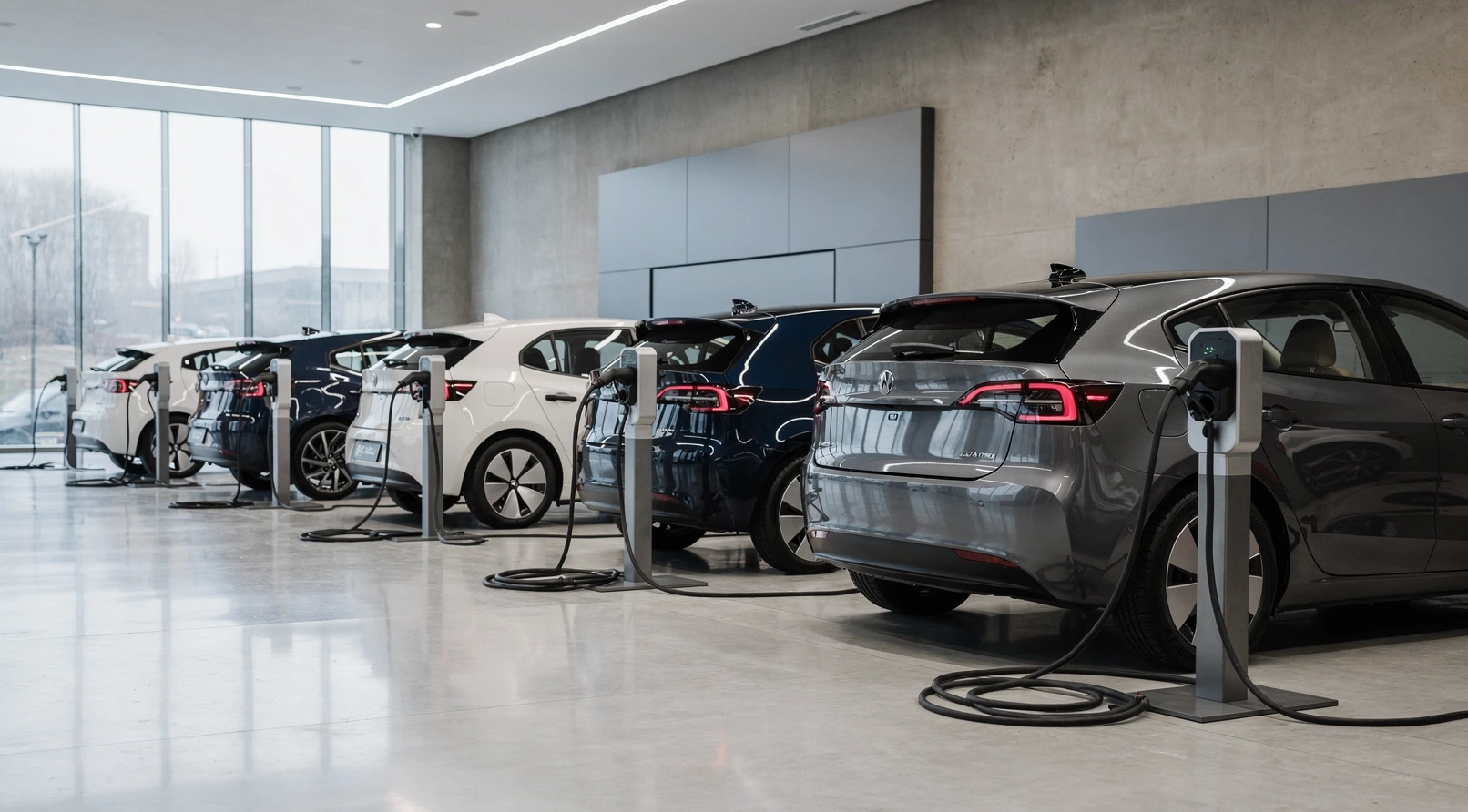
Britain is drawing up its first dedicated tariff on Chinese electric cars, and the pressure behind the decision is coming from Brussels rather than from British carmakers. The Times reported late on October 4, 2026 that the government is expected to impose duties on Chinese-built electric vehicles, with Reuters and Bloomberg carrying the report within the hour. The Financial Times followed on the morning of October 5 with its own account of Jonathan Reynolds, the Business and Trade Secretary, weighing the options.
The figure attached to the reporting is striking: ministers are described as willing to align with the European Union’s effective ceiling of roughly 45 percent on Chinese electric vehicles. That would be a reversal of the position Britain has held since the EU acted in October 2024, when London conspicuously declined to follow.
What makes the story a trade-policy story rather than a motoring story is the trigger. Brussels has signalled that an untariffed Britain functions as an open side door into the single market, and that the UK risks exclusion from the “Made in Europe” framework now being built unless it closes that door. For importers of any Chinese consumer product, the precedent matters more than the vehicles do.
In short
- What is happening: the UK Business and Trade Secretary is preparing options for additional duties on Chinese electric vehicle imports, reported first by The Times on October 4, 2026 and corroborated by Reuters, Bloomberg, the Financial Times and the Guardian.
- The number in play: alignment with the EU’s effective maximum of about 45 percent, built from a 10 percent standard car duty plus countervailing duties of 7.8 to 35.3 percent.
- The real driver: the EU’s proposed Industrial Accelerator Act and its “Made in EU” content rules, which could shut UK-built cars and batteries out of European procurement and support schemes.
- The market context: Chinese-owned brands took 27.5 percent of the UK new car market in September 2026, with BYD second among all marques and the Jaecoo 7 the month’s best seller.
- The missing step: no formal Trade Remedies Authority investigation has been opened and no UK industry complaint has been filed, which is normally a precondition for a countervailing duty.
What is Britain actually preparing?
The reporting describes a drafting exercise, not a decided policy. Reynolds is said to be assembling options for additional duties on Chinese vehicle imports, with the EU’s schedule as the reference point. Nothing has been laid before Parliament and no rate has been published.
A government spokesperson gave the kind of statement that confirms activity without conceding direction: “We continue to engage closely with industry so that our approach reflects the sector’s and UK’s national interests.” That formulation leaves room for a duty, for a quota, or for no measure at all.
Reynolds returned to the Business and Trade brief on July 20, 2026, taking over from Peter Kyle, who had held it since September 5, 2025. He has a record on this question. In earlier rounds of the debate he argued that tariffs on Chinese cars “would likely be reciprocal”, costing British manufacturers sales in China.
That argument has not disappeared. What has changed is the counterweight on the other side of the ledger, and it is now large enough that officials are reported to have reached a different conclusion about which loss hurts more.
Why the timing landed this week
Two clocks converged. The first is the September registration data, published at the start of October, which showed Chinese-owned brands crossing a quarter of the UK market for the first time. The second is the EU legislative calendar, where the content rules that would penalise UK production are moving from proposal toward negotiation.
Breaking stories of this type usually surface through a single well-briefed outlet before the official track catches up. The Times had it first, at roughly 20:55 UTC on October 4, and the independent confirmations followed quickly enough to rule out a stray kite-flying exercise.
Why is Brussels, not Beijing, driving this decision?
The European Commission proposed its Industrial Accelerator Act in March 2026. The instrument introduces “Made in EU” and low-carbon requirements for public procurement and for public support schemes in strategic sectors, with cars and batteries among them. Procurement requirements are scheduled to bite from January 2029.
For electric vehicles, the draft requirements are specific. A qualifying vehicle would need to be assembled in the Union, carry at least 70 percent EU content measured on ex-works price excluding the battery, and meet phased-in thresholds for battery and e-powertrain components of Union origin.
British-built vehicles, batteries and components would fall outside that definition unless the UK secures an appropriate relationship with the framework. Brussels has made clear it is reluctant to extend that relationship to a country whose tariff schedule leaves Chinese imports a cheaper route into Europe than its own.
Mike Hawes, chief executive of the Society of Motor Manufacturers and Traders, has put the industry position bluntly: “Excluding the UK from ‘Made in Europe’ would be an own goal, weakening competitiveness, reducing scale and limiting consumer choice.” The trade body’s problem is that the own goal would be scored against British plants, not European ones.
What a wall around the single market now looks like
The content rules are one layer of a broader European turn toward conditioned market access. The bloc has spent 2026 rebuilding the terms on which non-EU goods reach European consumers, from industrial inputs down to parcels. The EU customs reform that lands a parcel handling fee on November 1 is the retail-facing end of the same programme.
That reform has already produced measurable volume effects. The flat charge on low-value consignments introduced on July 1 did what it was designed to do, and the EUR 3 parcel duty that halved Chinese parcel flows into Belgium and the Netherlands is the closest available read on how quickly Chinese supply reroutes when a price wedge appears.
The strategic logic is consistent across both files. Brussels is willing to accept higher landed costs for European buyers in exchange for closing arbitrage routes, and it expects neighbours that want inside the wall to align with it.
How large have Chinese brands become in the UK market?
The September 2026 registration figures are the reason this debate stopped being hypothetical. Total UK new car registrations reached 350,536 in the month, up about 12 percent year on year, a tenth consecutive month of growth and the strongest September since 2017. Battery-electric registrations hit a record 99,201, up 36.3 percent, for 28.3 percent of the month.
Chinese-owned brands accounted for 27.5 percent of September registrations, taking their year-to-date share above 21 percent. BYD alone registered 20,140 cars for a 5.75 percent share, making it the second-largest marque in the month. Chery recorded 2.79 percent on 9,788 registrations, a record for the group.
The single most quoted data point is the Jaecoo 7. The Chery-owned model was Britain’s best-selling new car in September on more than 15,000 registrations, ahead of the Tesla Model 3. A Chinese nameplate topping a plate-change month is the sort of fact that moves a policy file.
Care is needed with competing share figures, because publishers are measuring different things. The 12 percent figure that appeared in earlier coverage refers to BYD, Omoda and Jaecoo combined over the first eight months of 2026, roughly tripled year on year. The 21 percent-plus figure covers all Chinese-owned brands, including SAIC-owned MG and Geely-owned Polestar and Lotus.
| Measure | September 2026 | Year to date 2026 | Comparison |
|---|---|---|---|
| Total UK new car registrations | 350,536 | Tenth straight month of growth | Up about 12% year on year; strongest September since 2017 |
| Battery-electric registrations | 99,201 (record) | 26.16% share | Up 36.3% year on year; 22.14% share in 2025 |
| BEV share of the month | 28.3% | 26.16% | 2026 ZEV mandate target is 33% of cars |
| Chinese-owned brands | 27.5% | Above 21% | Includes BYD, Chery, SAIC, Geely brands |
| BYD brand | 20,140 units, 5.75% | Second-largest marque in September | Behind only the market leader for the month |
| Chery group | 9,788 units, 2.79% | Group record share | Owns Jaecoo and Omoda |
What would matching the EU schedule actually mean?
The EU’s definitive countervailing duties on Chinese battery-electric vehicles entered into force on October 30, 2024, for a five-year term. They are company-specific and they stack on top of the bloc’s standard 10 percent duty on cars.
Tesla, which applied for individual examination of its Shanghai-built exports, received 7.8 percent. BYD received 17.0 percent, Geely 18.8 percent, other cooperating producers 20.7 percent, and SAIC and all non-cooperating producers 35.3 percent. Added to the 10 percent base, the effective maximum reaches roughly 45.3 percent.
Britain today applies only the 10 percent most-favoured-nation duty on cars, with no anti-subsidy layer. Aligning with the EU would therefore mean importing not just a headline rate but a company-by-company schedule derived from a European investigation into Chinese subsidy programmes, which is legally awkward for a jurisdiction that has run no investigation of its own.
The rate dispersion matters commercially. A 17 percent duty on BYD and a 35.3 percent duty on SAIC would reorder the UK price ladder rather than lift it uniformly, handing relative advantage to the producers that cooperated with Brussels two years ago.
| Producer | EU countervailing duty | Plus EU base car duty | Effective EU rate | Current UK rate |
|---|---|---|---|---|
| Tesla (China-built exports) | 7.8% | 10% | 17.8% | 10% |
| BYD | 17.0% | 10% | 27.0% | 10% |
| Geely (incl. Polestar, Lotus) | 18.8% | 10% | 28.8% | 10% |
| Other cooperating producers | 20.7% | 10% | 30.7% | 10% |
| SAIC (incl. MG) and non-cooperating | 35.3% | 10% | 45.3% | 10% |
Readers tracking the wider pattern will recognise the shape of the instrument. Washington has been building a comparable tool on a different legal base, and the 7.5 percent China overcapacity tariff that pushes retail goods toward a 20 percent cap is the US analogue of what Brussels achieved through an anti-subsidy case.
Why does the missing legal step matter so much?
A countervailing duty is not a political gesture in UK law. It is the output of a process, and that process has not started.
How a UK trade remedy normally works
The Trade Remedies Authority investigates whether dumped or subsidised imports, or an unforeseen surge in imports, are injuring domestic producers. Remedies normally take the form of ad valorem duties calculated as a percentage of product value. The sequence begins with a formal complaint from affected domestic industry.
No such complaint has been filed on Chinese electric vehicles. The UK automotive industry has not asked the TRA to open an anti-subsidy investigation, and the authority has not opened one on its own initiative. Without that step there is no injury finding, no subsidy calculation and no company-specific rate.
Why an alignment duty is a different animal
That absence pushes ministers toward instruments that sit outside the trade-remedy framework, which carry their own costs. A duty imposed to satisfy a third party’s content rules, rather than on a domestic injury finding, is more exposed to challenge and harder to defend at the World Trade Organization.
It also reverses the usual political economy of protection. Normally a government is lobbied into a tariff by producers who claim harm. Here the SMMT’s central concern is losing European market access, not Chinese competition at home, and British dealers have been among the clearest beneficiaries of Chinese volume.
The dumping question itself remains genuinely contested at the multilateral level. The failure of the G20 ministerial to agree language on industrial excess capacity showed how little consensus exists on when subsidised capacity becomes an actionable trade injury.
What happens to UK car prices and to car retailers?
The immediate consumer effect of a 17 to 35.3 percent duty layer would be higher list prices on the cheapest electric cars in the market. Chinese brands have been competing hardest at the entry end, which is also where price elasticity is highest and where margin cushions are thinnest.
Dealers and online retailers face a different exposure. Chinese franchises have been the fastest-growing part of the UK retail network over two years, with new showrooms, new aftersales commitments and new stock finance lines all underwritten by volume assumptions that a tariff would invalidate.
There is also a timing asymmetry that favours nobody. Vehicles already on the water or in stock would be sold against prices set under the old regime, while replacement stock arrives at the new landed cost. Retailers absorb that gap in a market where discounting is already heavy.
Importers in adjacent categories have learned to read these transitions by watching which product lines get relief and which do not. The American experience this year, where 77 categories of Chinese consumer goods were named for tariff cuts while the rest of the schedule held, is a reminder that duty relief arrives selectively and slowly.
How much of a duty actually reaches the shelf
Pass-through on consumer durables is rarely complete in the first months. Producers with localisation options, large order books or exchange-rate headroom typically absorb part of the increase to defend share, especially where a market has become strategically important.
BYD’s UK position suggests exactly that kind of defence. A brand that has just become the second-largest marque in a plate-change month has a strong incentive to hold price and surrender margin rather than cede the position it has spent two years buying.
What does Britain risk in China?
The reciprocity argument that Reynolds has made in the past rests on real numbers. The UK exported 35,017 cars to China in 2025, about 6 percent of total UK car exports, and cars were the UK’s single largest goods export to China, worth about GBP 3.5 billion in the four quarters to the end of March 2026, or roughly USD 4.6 billion at GBP 1 equals USD 1.3233 on October 5, 2026.
The exposure is concentrated in premium and luxury nameplates. Jaguar Land Rover, Bentley, Rolls-Royce, Aston Martin and McLaren all sell into China, and those are the brands a retaliatory measure would find. UK officials are reported to have weighed potential Chinese retaliation against Jaguar Land Rover and judged the loss of EU market access more damaging.
That judgement is defensible on arithmetic alone. The EU takes about 58 percent of UK car exports, nearly ten times the Chinese share, and the content rules threaten that larger flow structurally rather than episodically.
Beijing’s playbook is nonetheless documented. After the EU imposed its EV duties, China opened cases that produced duties of up to 34.9 percent on EU brandy from July 2025, up to 19.8 percent on pork that December, and provisional duties of up to 42.7 percent on EU dairy, later cut to 11.7 and 9.5 percent around mid-February 2026 as the dispute cooled.
| Market | Share of UK car exports | Scale | Nature of the risk |
|---|---|---|---|
| European Union | About 58% | Largest destination by far | Structural: “Made in EU” content rules plus the 2027 rules-of-origin step-up |
| China | About 6% (35,017 cars in 2025) | Largest single UK goods export to China, about GBP 3.5bn | Retaliatory: targeted duties on premium and luxury nameplates |
| United States | Material but tariff-impaired | UK production fell in 2025 on US duties and the JLR cyber incident | Already priced in through existing US measures |
What is the January 2027 rules-of-origin cliff?
Running underneath the tariff story is a separate deadline that European carmakers consider more urgent. From January 1, 2027, stricter rules of origin for electric vehicles apply under the UK-EU Trade and Cooperation Agreement.
From that date a vehicle needs at least 55 percent UK or EU value content to trade duty-free. On batteries, either the cathode active material must originate in the UK or EU, or the pack must stay within a 30 percent non-originating cap, with cells themselves capped at 35 percent. Vehicles that miss the thresholds face a 10 percent tariff in both directions.
The projected cost is concentrated on the European side. In 2027 the EU is expected to export about 520,000 battery-electric cars and vans to the UK, worth an estimated EUR 17.9 billion, or roughly USD 20.1 billion at EUR 1 equals USD 1.1225 on the European Central Bank reference rate of October 2, 2026. An estimated 426,000 of those vehicles, about 82 percent, would fail the new rules.
That implies roughly EUR 1.47 billion of duty in 2027 alone, about USD 1.65 billion at the same rate. The figure explains why the European industry has been lobbying for delay rather than celebrating a British alignment on Chinese imports.
The ACEA request for a three-stage delay
The European Automobile Manufacturers’ Association wrote to Commission President Ursula von der Leyen and European Council President Antonio Costa in a letter dated September 16, 2026, signed by Director General Sigrid de Vries and President Ola Kallenius, who is also chief executive of Mercedes-Benz.
The association asked for the battery rules to be postponed from 2027 to the end of 2029, with a staged tightening thereafter. Until the end of 2029, battery packs using third-country cells would count as EU or UK origin if assembled in those territories. From 2030 cells would have to be made in the EU or UK, and from 2032 cathode active materials would have to originate there too.
ACEA framed the request as a sequencing problem rather than a retreat. Its stated position is that it supports expanding European battery cell and material production, but that investments already initiated will only reach full capacity in the coming years.
How would Chinese brands respond to a UK duty?
The honest answer is that they have been preparing for this for two years, because the EU already did it. Localisation is the structural response and price absorption is the tactical one.
BYD’s European manufacturing clock
BYD’s plant at Szeged in southern Hungary, a roughly EUR 4 billion investment and the company’s first European car factory, is scheduled to begin production in the fourth quarter of 2026. Output in the first full year is expected to be in the tens of thousands, well below the plant’s 150,000-unit nameplate capacity, which is intended to rise to 300,000 when fully commissioned.
The second site has slipped. BYD announced a roughly USD 1 billion plant in Turkey in 2024 with a 2026 start, but construction has not begun and the company has given no timeline. Turkish-built vehicles are also exempt from EU import duties, which is part of why the site was attractive.
The economics are straightforward. BYD currently pays about 27 percent in combined EU duty on China-built exports, and Hungarian production removes that entirely. A UK duty would simply extend the same calculation to a market where BYD has just taken 5.75 percent share in a month.
The gaps a tariff would not close
A duty on finished vehicles does nothing about components, software or battery cells sourced from the same supply base. Nor does it address the brands that assemble outside China, which is the direction every major Chinese manufacturer is already moving.
That is the recurring weakness of finished-goods tariffs across retail categories. They reprice the last step in the chain while leaving the earlier steps, and the cost advantage embedded in them, untouched.
Does a tariff contradict Britain’s own electric vehicle targets?
This is the sharpest internal tension in the file. The zero-emission vehicle mandate requires 33 percent of new cars and 24 percent of new vans to be zero-emission in 2026, and the September BEV share of 28.3 percent sits below the car target with three months left.
Chinese brands have been the main reason the gap is not wider. BYD, SAIC, Chery, Geely and XPeng are all complying with the mandate, and their affordable models have carried much of the volume that legacy manufacturers have struggled to shift.
Research cited in the UK debate suggests newer entrants enjoy a structural advantage in how compliance is measured. Legacy manufacturers can earn credits by selling vehicles below their own pre-2021 emissions average, while manufacturers that arrived after that point are measured against an industry-wide target instead.
Subsidy policy already pulls the other way. Chinese-manufactured cars do not currently meet the sustainability criteria attached to the UK’s electric car purchase grant, so models such as the BYD Dolphin are excluded despite sitting well below the price cap, because the criteria penalise battery manufacturing in countries with carbon-intensive grids. Full registration data for the month is published by the SMMT on its UK car registrations page.
What should importers and retailers watch next?
The first signal is procedural. If the government intends a defensible duty it needs either a TRA complaint from UK industry or a decision to use a non-remedy instrument, and either choice will be visible before any rate is published.
The second is the European calendar. The Industrial Accelerator Act is still a proposal, and the terms on which third countries can associate with its content requirements are exactly what UK negotiators are trying to shape. A British tariff announced without a reciprocal assurance on “Made in EU” eligibility would be a concession without a purchase.
The third is the rules-of-origin decision. If Brussels grants the ACEA delay, the January 2027 cliff softens for EU exporters and the UK loses some urgency; if it refuses, both sides face a 10 percent duty on most electric vehicle trade within months.
The fourth is Beijing. China’s response to the EU duties took roughly nine months to produce its first measure on brandy, which suggests British exporters would have a window rather than an immediate shock, and that the window would most likely close on premium nameplates first.
Frequently asked questions
Has the UK actually imposed tariffs on Chinese electric vehicles?
No. As of October 5, 2026 no UK tariff on Chinese electric vehicles has been announced or published. The reporting from The Times, Reuters, Bloomberg, the Financial Times and the Guardian describes the Business and Trade Secretary drawing up options, and the government has confirmed only that it is engaging with industry.
What rate is being discussed and where does 45 percent come from?
The 45 percent figure is the EU’s effective maximum, not a UK proposal. It is built from the bloc’s standard 10 percent duty on cars plus a countervailing duty of up to 35.3 percent on non-cooperating Chinese producers, giving about 45.3 percent in total. Lower rates apply to named producers, including 17.0 percent for BYD.
Why would Britain tariff Chinese cars to satisfy the European Union?
Because the EU takes about 58 percent of UK car exports and is building content rules that could exclude British-built vehicles, batteries and components from European procurement and support schemes. Brussels has indicated it is reluctant to extend favourable treatment to a market that leaves Chinese imports a cheaper route into Europe than its own.
What is the Industrial Accelerator Act?
It is a European Commission proposal from March 2026 that introduces “Made in EU” and low-carbon requirements for public procurement, from January 2029, and for public support schemes in strategic sectors including cars and batteries. For electric vehicles it would require Union assembly, at least 70 percent EU content on ex-works price excluding the battery, and phased thresholds for battery and e-powertrain components.
How much of the UK market do Chinese brands hold?
Chinese-owned brands took 27.5 percent of UK new car registrations in September 2026 and more than 21 percent year to date. BYD registered 20,140 cars for a 5.75 percent share, the second-largest marque in the month, and the Chery-owned Jaecoo 7 was Britain’s best-selling car on more than 15,000 registrations.
Would a tariff make electric cars more expensive in Britain?
At the entry end of the market, most likely yes, though not by the full duty amount in the first months. Producers with localisation plans and share to defend typically absorb part of an increase, and BYD in particular has strong incentives to hold price after reaching second place among all marques in September.
What could China do in response?
Beijing’s documented pattern after the EU duties was to open trade cases against European agricultural and food exports, producing duties of up to 34.9 percent on brandy from July 2025, up to 19.8 percent on pork that December, and provisional duties of up to 42.7 percent on dairy that were later cut. British exposure would fall mainly on premium and luxury cars, about 6 percent of UK car exports in 2025.
What happens on January 1, 2027?
Stricter rules of origin for electric vehicles take effect under the UK-EU Trade and Cooperation Agreement, requiring at least 55 percent UK or EU value content plus battery-specific conditions. Non-compliant vehicles face a 10 percent tariff in both directions, and about 82 percent of the 520,000 EU-built electric cars and vans projected for export to the UK in 2027 would fail the test absent a delay.
Could the UK impose a duty without a Trade Remedies Authority case?
It would be unusual and legally exposed. A countervailing duty normally follows a domestic industry complaint, a TRA investigation and an injury and subsidy finding, none of which exists here. A duty imposed to satisfy a third country’s content rules would sit outside that framework and would be harder to defend at the World Trade Organization.