
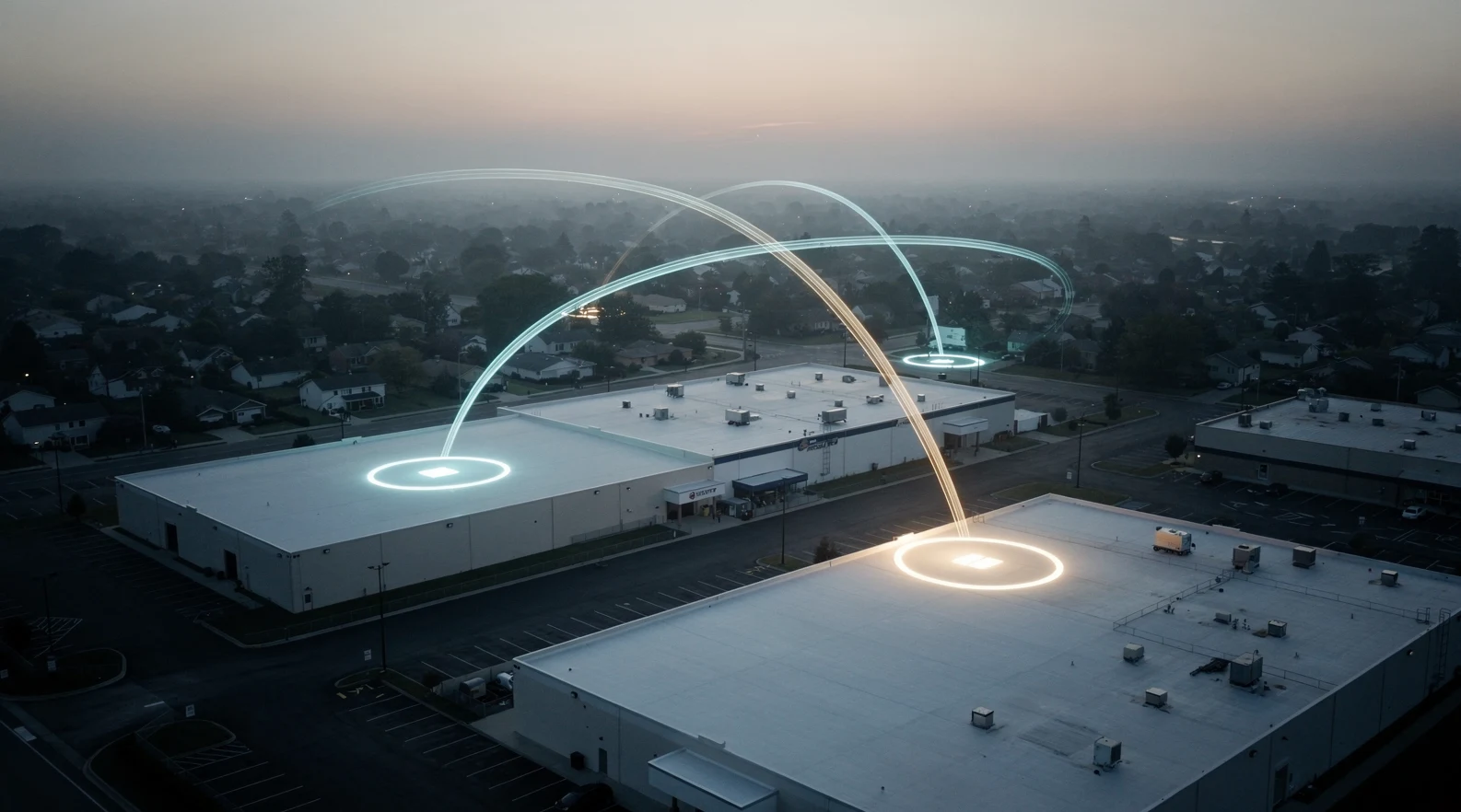
The base case here is that DoorDash begins flying its own aircraft for paying customers in Dallas-Fort Worth and Charlotte, with at least one of the two metros live by 30 June 2027 and both plausible by 30 September 2027. It almost certainly does not happen in calendar 2026. The evidence is not a press release: it is two field-operations job posts dated 5 October 2026, an aircraft unveiled five days earlier, and a federal rule that has been sitting at the White House since July.
Read together, those three things describe a company that has finished building and has started staffing. The interesting part is which two metros it picked, because they are the two places where DoorDash already sells drone delivery using somebody else’s aircraft.
In short
- The prediction: DoorDash Air, the company’s in-house drone program, likely carries paid consumer orders in Dallas-Fort Worth or Charlotte by 30 June 2027, with both metros live by 30 September 2027 as the stretch case. A 2026 launch in either metro looks unlikely.
- Signal 1 (hiring): Two DoorDash Labs field-operations roles were first published on 5 October 2026, one in Fort Worth and one in Charlotte. Both state that the work supports “an emerging drone delivery service,” and the Fort Worth post carries an explicit fill-by date of 30 November 2026.
- Signal 2 (product): DoorDash unveiled its own six-rotor aircraft on 30 September 2026 and had already secured FAA Part 135 air carrier certification, announced 29 July 2026, making DoorDash Labs roughly the eighth US drone operator to hold one.
- Signal 3 (regulatory): The FAA’s Part 108 beyond-visual-line-of-sight final rule (RIN 2120-AL82) has been at the Office of Information and Regulatory Affairs since 10 July 2026. The standard 90-day review window closes on 8 October 2026 and can be extended once, to 7 November.
- Why it matters: Fort Worth and Charlotte are precisely where DoorDash’s drone demand already exists, served today by partners. Staffing its own crews in those metros points to in-sourcing the flying, not merely adding capacity.
Why this matters now
Drone delivery has spent a decade as a demonstration business. Operators flew small numbers of orders from a handful of nests, mostly to prove the hardware worked and the regulator would tolerate it. The economics were never the point, which is why the sector has produced many launch announcements and very few network maps.
Something changed in the second half of 2026. Multiple operators moved from demonstration to certificated commercial operation, and the FAA’s long-delayed routine-BVLOS framework finally reached its last procedural stop before publication. We argued in our analysis of Amazon’s 500-town drone target that stated ambition and deployed site count have diverged badly across this industry. The useful question is no longer who announces, but who staffs.
That is why a pair of hourly operations roles matters more than most press events. Field-operations headcount is the point at which a program stops being capitalised as research and starts being run as a service. It is also the earliest externally visible artefact of a market decision, because the requisition has to name a city.
For retailers and restaurant operators, the practical question is narrow and near-term. If DoorDash is about to fly its own aircraft in two specific metros, merchants in those metros will be asked to change how an order leaves the kitchen, and the handoff standard will be set by DoorDash rather than negotiated with a third-party operator. That is a merchandising and staffing change, not an IT project.
Signal 1: two field-operations posts name Fort Worth and Charlotte
On 5 October 2026, DoorDash first published two nearly identical requisitions on its public job board: “Senior Operations Specialist, Labs” in Fort Worth, Texas, and “Sr Operations Specialist, Labs” in Charlotte, North Carolina. They went live roughly eight minutes apart. Neither title names a program, which is why they are easy to miss.
The body text removes the ambiguity. Both posts close with a section headed “What You’ll Learn,” and the first line reads: “How workforce and scheduling operations power an emerging drone delivery service.” The same posts open with the DoorDash Labs team blurb used for the aviation group, which invites candidates “passionate about applying autonomous aviation technologies.”
The role described is unmistakably ground operations for a multi-site network. The successful candidate will “own day-to-day scheduling across every site in the region,” monitor “flexible staffing platforms,” onboard workers joining “the temporary staffing network,” and personally step in “as a runner between sites and merchant locations.” A reliable personal vehicle and a valid driver’s license are listed as requirements because the job involves regional travel between those sites.
Two details sharpen the timing. The Fort Worth post states: “We expect this position to be filled by 11-30-2026.” The listed national base pay range is $28.40 to $41.80 per hour, which places this firmly in the operational layer rather than the engineering one.
The board context that makes the cluster meaningful
A two-post cluster means nothing without a base rate. DoorDash’s US board carried 467 open requisitions when we pulled it on 8 October 2026, of which 145, or roughly 31%, were first published within the prior 30 days. On a board refreshing at that pace, two posts landing the same minute in two cities is not remarkable on its own.
What makes it remarkable is the company. These are the only two Labs field roles outside California and Arizona on the entire board, and they are the first Labs postings ever to name either city. Every prior Labs field requisition has sat in the Phoenix East Valley (Tempe, Mesa, Chandler), the Bay Area (Fremont, San Jose, Sunnyvale, Dublin), or the aviation test sites at Bay Point and Concord.
The aviation side of the board has been filling out quickly in the same window. A “UAS Operations Specialist (Pilot)” post for Concord and Bay Point went live on 30 September, a “UAS Operations Specialist, Labs” role in San Francisco the same day, a “Staff Security Engineer, DoorDash Labs (Air)” on 1 October, and a “UAS Operations Specialist (Ground Support)” for Bay Point and Concord on 8 October. A “Senior Manufacturing Engineer, DoorDash Air” opened on 29 September.
Taken together the pattern is a program building two distinct layers at once: flight operations concentrated at the Northern California test and pilot sites, and a new regional ground-operations layer in two out-of-state metros. The second layer is the one that predicts a launch, because flight test does not need a runner driving between merchant locations.
Signal 2: the aircraft and the certificate already exist
On 30 September 2026, at its annual Dash Forward product event, DoorDash unveiled the aircraft behind DoorDash Air. It is a six-rotor design that lowers orders to the ground on a winch, and the company says it designs and assembles the aircraft in San Francisco. The first pilot program runs in Northern California’s East Bay with Chipotle, Popeyes and a local restaurant, Momo N Curry, among the launch partners.
The disclosed performance envelope is deliberately unambitious, which is itself informative. DoorDash says roughly 80% of its typical restaurant orders are light enough and small enough for the aircraft to carry, and that early tests put restaurant-to-door times at under five minutes on average. Harrison Shih, who leads DoorDash Air, framed the design choice directly: “We didn’t start with a drone and ask what would fit. We started with what people order and how local businesses actually operate, then built the entire system from there.”
The regulatory groundwork was laid two months earlier. DoorDash announced on 29 July 2026 that DoorDash Labs had earned FAA Part 135 air carrier certification, the approval that permits commercial drone delivery for compensation in the United States. Reporting at the time placed DoorDash as roughly the eighth operator in US history to clear that five-stage process, which examines aircraft airworthiness, maintenance programs and operating procedures.
This combination matters because it removes the usual excuses for delay. The company is not waiting on a certificate, and it is not waiting on hardware. What it has been waiting on, until very recently, is the operational apparatus to run the thing in a city it does not already occupy.
Signals matrix
| Signal | Date | What it is | What it implies | Independence |
|---|---|---|---|---|
| Field-ops requisitions, Fort Worth and Charlotte | 5 Oct 2026 | Two DoorDash Labs operations roles naming “an emerging drone delivery service” | Market selection has been made; staffing precedes service | Company job board, first-party and dated |
| Aircraft reveal and East Bay pilot | 30 Sep 2026 | Six-rotor winch aircraft, Northern California pilot with named chains | Hardware and merchant integration are production-ready | Company product event, independently reported |
| Part 135 air carrier certification | 29 Jul 2026 | FAA approval for commercial drone delivery, held by DoorDash Labs | Legal authority to carry for compensation exists today | FAA certification action |
| Part 108 final rule at OIRA (RIN 2120-AL82) | Received 10 Jul 2026, pending 8 Oct 2026 | BVLOS framework under White House review | Sets whether scale is site-by-site or metro-wide | Federal rulemaking record |
| Fort Worth fill-by date | Stated 30 Nov 2026 | Explicit hiring deadline inside the requisition | Anchors the earliest plausible operational start | Same requisition, separately verifiable |
Signal 3: the BVLOS rule sits at the White House, and the clock just ran out
The third signal is the one DoorDash does not control. The FAA’s final rule, titled “Normalizing Unmanned Aircraft Systems Beyond Visual Line of Sight Operations” and carried under RIN 2120-AL82, arrived at the Office of Information and Regulatory Affairs on 10 July 2026. As of 8 October 2026 it is still listed as “Pending Review” on the OIRA pending review list, with its legal deadline flagged as statutory.
The arithmetic is simple and unusually legible. Executive Order 12866 gives OIRA 90 days for a review of this kind, which from a 10 July receipt lands on 8 October 2026, and the review can be extended once by 30 days, to 7 November. The proposed rule was published on 7 August 2025 at 90 FR 38212 under docket FAA-2025-1908, so the record has been closed for over a year.
The rule is already badly late against its own political schedule, having missed an executive-order deadline set for early 2026. FAA officials said publicly in September that the agency hopes to publish before the end of 2026. Until it does, beyond-visual-line-of-sight flight continues to run on waivers and exemptions granted case by case.
This is why the regulatory signal cuts both ways, and why a careful reading does not make Part 108 a launch gate. A Part 135 holder with the right waivers can fly commercially today, which is exactly what the incumbent operators have been doing for years. Part 108 is a scale gate: it determines whether one certificated operator can stand up many sites on a common rulebook, or whether each new site remains its own negotiation with the FAA.
The practical consequence for this prediction is a wide but bounded window. If the rule publishes in December 2026 or January 2027, the usual compliance transition periods still put routine operation under the new framework somewhere in the second half of 2027. If it slips to mid-2027, DoorDash can still launch in Fort Worth and Charlotte on the waiver path, but at a slower per-site cadence.
What the pattern suggests
DoorDash Labs has now run this play twice in public, and both runs are datable from the same job board. That gives us a crude but real base rate for the lag between the first field-operations requisition in a metro and the first consumer-visible service there.
In Phoenix, a “Robot Operations Specialist (DoorDash Dot)” post for Tempe and Mesa appeared on 26 June 2025. Dot was unveiled at Dash Forward on 30 September 2025, with early-access deliveries beginning in those same two cities. That is a lag of roughly three months.
In the Bay Area, an “Operations Specialist, Robot (DoorDash Dot)” post covering Dublin and San Francisco went up on 17 April 2025. Dot’s first official Bay Area delivery, out of a Fremont facility, came on 5 March 2026, a lag closer to eleven months. The spread between those two cases is the honest uncertainty in this forecast.
A third case is still open and worth watching. An “Associate Ops Manager, Robot (DoorDash Dot)” requisition for the Greater Salt Lake Area was published on 20 July 2026, and we can find no public Dot service in Salt Lake City as of 8 October 2026. At eleven weeks and counting, Salt Lake City sits comfortably inside the historical range rather than contradicting it.
Requisition to service: the precedents
| Metro | First dated Labs field requisition | Public service start | Lag |
|---|---|---|---|
| Tempe and Mesa, AZ (Dot) | 26 Jun 2025 | 30 Sep 2025 early access | ~3 months |
| Bay Area, CA (Dot) | 17 Apr 2025 | 5 Mar 2026, first Fremont delivery | ~11 months |
| Salt Lake City, UT (Dot) | 20 Jul 2026 | Not public as of 8 Oct 2026 | Open at ~2.6 months |
| East Bay, CA (Air) | 9 Jul 2026 ground support | 30 Sep 2026 pilot announced | ~3 months |
| Fort Worth, TX (Air) | 5 Oct 2026 | Open | Implied Jan to Sep 2027 |
| Charlotte, NC (Air) | 5 Oct 2026 | Open | Implied Jan to Sep 2027 |
Applying the observed three to eleven month range to a 5 October 2026 requisition yields a window running from January to September 2027. The Fort Worth fill-by date of 30 November 2026 argues against the fast end, because a specialist who starts in December has to build a staffing bench, a training record system and a merchant handoff routine before anything flies commercially.
That reasoning produces the prediction rather than decorating it. Mid-2027 is the centre of the distribution, 30 September 2027 is a reasonable outer bound for at least one metro, and anything inside calendar 2026 would require DoorDash to compress a process it has never compressed before. The same requisition-to-launch method underpinned our read on Amazon Now’s US dark-store buildout, where hiring geography led the public site map by a comparable margin.
Wider context: the partner metros are the tell
The strongest part of this thesis is not that DoorDash is hiring in two cities. It is which two cities, because neither is greenfield for drone delivery and both are already DoorDash drone markets served by other people’s aircraft.
DoorDash and Wing launched drone delivery in Charlotte in May 2025, serving customers within roughly four miles of The Arboretum Shopping Center in the south of the city. In Dallas-Fort Worth, the same partnership operates from mall sites including Stonebriar Centre in Frisco and Hulen Mall in Fort Worth, with more than 50 restaurants and retailers available between them. A separate partnership with Flytrex covers parts of Little Elm and Frisco on a daily schedule.
That footprint creates an uncomfortable question for the partner model. DoorDash now owns an aircraft, a Part 135 certificate and a merchant integration stack, and it has just started hiring its own regional ground crews in the two metros where it has the longest run of partner-generated demand data. Companies do not usually staff a function they intend to keep outsourcing.
There is a quieter corroborating detail. DoorDash has been staffing DashMart sites in Charlotte through 2026, including kitchen shift lead and kitchen operations roles in late July and a DashMart district manager covering Raleigh and Charlotte in August. A DashMart is a DoorDash-controlled building with a loading area and a roof, which is a materially easier launch site to negotiate than a third-party mall parking lot.
The market-selection logic also reads as risk reduction rather than ambition. Both metros sit in states with permissive operating environments and, crucially, with established drone-delivery airspace already worked through by incumbents. Choosing where somebody else has already solved the hardest approvals is the same conservative pattern we described in our read on Costco’s UK delivery-partner decision, where the winner was whoever had already absorbed the local operating cost.
Implications for restaurants, retailers and platforms
For restaurant operators in the two named metros, the change arrives at the back door rather than in the app. First-party drone delivery means DoorDash sets the handoff standard: packaging dimensions, weight ceilings, a staging location and a tolerance for dwell time while an aircraft waits. A newly created DoorDash role, “Associate Manager Product Operations, Autonomy Commercialization,” published on 30 September 2026, exists specifically to define “handoff success rate, dwell time, dasher/robot interaction quality, merchant CSAT” and to hold partners to those benchmarks.
That is a meaningful operational imposition on a kitchen running at peak. The upside is a delivery product that arrives in under five minutes on the company’s own early estimates, which changes what a restaurant can credibly sell at 12:30pm. The downside is that a merchant who fails the handoff benchmark may simply be excluded from the fastest tier of the marketplace.
For grocery and convenience retailers the implication is narrower, because the disclosed payload envelope is built around restaurant orders. An aircraft sized so that roughly 80% of typical restaurant baskets fit will carry a forgotten-item convenience order comfortably and a weekly shop not at all. The likely retail use case is the small urgent basket, not the replacement of a van.
For the partner operators the read is more awkward than a simple displacement story. Wing and Flytrex are likely to keep flying in these metros through 2027, because DoorDash needs the coverage while its own fleet is small, and because an abrupt switch-off would hand the marketplace a service gap. The realistic pattern is coexistence, with first-party aircraft taking the densest and most profitable corridors first.
For investors the signal to watch is not drone revenue, which will be immaterial for years. It is whether Labs spending appears in commentary as a scaling cost rather than a research line. DoorDash guided Q3 2026 to Marketplace gross order value of $33bn to $34bn and adjusted EBITDA of $950m to $1.1bn, and the Q3 results expected in November 2026 are the first natural checkpoint for any change in how autonomy is described.
The broader strategic point is that DoorDash is assembling a portfolio of delivery modes rather than betting on one. Dot handles the three to five mile ground route, Air handles the short hop, and Dashers handle everything neither can. Our earlier survey of the 2026 last-mile outlook for US retailers set out why mode-mixing, rather than mode-replacement, is the configuration that survives contact with real order data.
Scenarios and rough weights
| Scenario | What happens | Indicative likelihood | Earliest tell |
|---|---|---|---|
| Base case | One of Fort Worth or Charlotte flies first-party DoorDash Air orders by 30 Jun 2027; the second follows by 30 Sep 2027 | ~50% | Local permit or site activity in Q1 2027 |
| Fast case | A metro goes live by 31 Mar 2027, on the Phoenix three-month precedent and reuse of existing airspace approvals | ~15% | Part 108 published by Jan 2027 plus a Q4 earnings mention |
| Slow case | Neither metro is live by 30 Sep 2027; DoorDash deepens the Northern California pilot instead | ~25% | Part 108 slipping past Q1 2027; no further Labs posts in either metro |
| Off-pattern | The two roles support partner-operated flights only; no first-party aircraft in either metro | ~10% | New Wing or Flytrex site announcements in the same ZIP codes |
Caveats: what could go wrong
The most serious objection is that these two requisitions are ground-handling roles for somebody else’s aircraft. Nothing in either post says DoorDash will be the operator, and a plausible alternative reading is that DoorDash wants to industrialise the merchant-side handoff inside Wing’s existing Charlotte and Dallas-Fort Worth footprints. On that reading the hiring is a quality-control investment in the partner model, not a replacement of it.
Two things argue against that reading without eliminating it. The posts describe a regional network of sites that the specialist schedules and staffs, which is operator language rather than merchant-liaison language. And DoorDash has spent eighteen months building an aircraft, a certificate and a manufacturing line that would be redundant if it intended to keep buying flight hours.
The second caveat is templating risk. DoorDash reuses requisition text aggressively, as we found when the same “Operations Specialist, Labs” title in Chandler carried the robotics team blurb while Fort Worth and Charlotte carried the aviation one. If the aviation framing were boilerplate, these two cities could be Dot robot markets instead. The “emerging drone delivery service” line in the learning section is what makes that explanation hard to sustain, since it appears in the body rather than the inherited team header.
Third, the regulatory path could slip in a way that reshapes rather than delays the plan. If Part 108 stalls past mid-2027, the per-site waiver economics may push DoorDash to concentrate on a single metro and treat the other as a holding pattern. The contested right-of-way provision that has reportedly held the rule up is not a detail that resolves quickly once reopened.
Fourth, DoorDash could choose a different metro entirely. The Salt Lake City requisition from July 2026 shows the company staffing a market it has not yet launched, and Riverside, California received Dot service in August 2026 without a comparably visible hiring trail. Hiring geography is a leading indicator with real false-positive risk, not a schedule.
Fifth, cost discipline could intervene. The platform sector spent the autumn of 2026 trimming corporate headcount, and a Labs program that is pre-revenue by construction is an obvious candidate for slower sequencing if marketplace margins come under pressure. Nothing in the current guidance suggests that, but it is the kind of decision that is announced after it is made.
Finally, this is a two-observation base rate. Three months in Phoenix and eleven months in the Bay Area is not a distribution, it is two points and a line drawn between them. The prediction is stated with a wide window precisely because the underlying evidence does not support a narrow one, a discipline we tried to hold to in our earlier piece on when autonomous delivery reaches everyday retail.
Frequently asked questions
What exactly is being predicted, and how would someone check it?
The prediction is that DoorDash-operated aircraft, flown under DoorDash Labs’ own Part 135 certificate, will carry paid consumer orders in either Dallas-Fort Worth or Charlotte by 30 June 2027, and in both by 30 September 2027. It is checkable from DoorDash’s own consumer help page listing drone-delivery cities, from the company newsroom, and from whether the service in those metros is described as DoorDash Air rather than as a Wing or Flytrex partnership.
Is it not more likely that these jobs are just for the existing partner service?
That is the strongest counter-argument and it cannot be dismissed. The posts never name an operator, and DoorDash has a real interest in standardising merchant handoff for partner flights. The reason we weight it at roughly 10% rather than higher is that the roles describe scheduling and staffing a network of sites across a region, which is the work of the party that owns the sites.
Why would DoorDash fly its own aircraft where Wing already flies?
Because the partner footprint is where the demand data is. Launching a first-party service in a metro with eighteen months of observed order density, merchant familiarity and worked-through airspace approvals is considerably lower risk than opening a market cold. The pattern also lets DoorDash compare first-party and partner unit economics on the same streets.
Does the FAA’s Part 108 rule have to publish before any of this can happen?
No, and this is a common misreading. DoorDash Labs already holds Part 135 certification, and beyond-visual-line-of-sight flight is available today through waivers and exemptions, which is how incumbent operators run. Part 108 governs how cheaply and quickly a certificated operator can replicate sites, so it determines the slope of the expansion rather than whether it starts.
What would falsify the prediction early?
Three things. A DoorDash announcement of first-party drone service in a metro other than these two before mid-2027 would show the hiring trail is not the market map. Both requisitions being withdrawn without a hire would suggest the plan changed. And a new Wing or Flytrex site announcement in the same suburbs would support the partner-support reading instead.
How much delivery volume could this realistically represent by the end of 2027?
Very little, on any reasonable assumption. A new metro operating from a small number of sites with an aircraft sized for single restaurant orders is a rounding error against a marketplace guided to $33bn to $34bn of gross order value in a single quarter. The significance is strategic, in that it determines whether DoorDash owns its fastest delivery mode or rents it.
What does this mean for Dashers in those metros?
In the near term, almost nothing measurable. The disclosed aircraft envelope covers short-hop single-restaurant orders, which is a slice of a Dasher’s route mix rather than the whole of it, and the program is simultaneously creating ground roles including runners between sites and merchants. The medium-term risk is real but it is concentrated in the shortest and densest routes, which are not usually the best-paid ones.
Why treat job postings as evidence at all?
Because they are dated, first-party and costly to publish, which makes them a better forward signal than most corporate communication. A company can describe an ambition without consequence, but it cannot staff a city it does not intend to operate in without paying for it. The weakness is that hiring indicates intent rather than schedule, which is why the prediction carries a nine-month window and an explicit false-positive scenario.
What is the single most important checkpoint between now and mid-2027?
Whether the Part 108 final rule leaves OIRA by 7 November 2026, the end of the single permitted 30-day extension. Publication inside 2026 would support the faster end of the window and would likely pull forward any public commitment from DoorDash. A further stall would push the base case toward the back half of 2027 without invalidating it.