
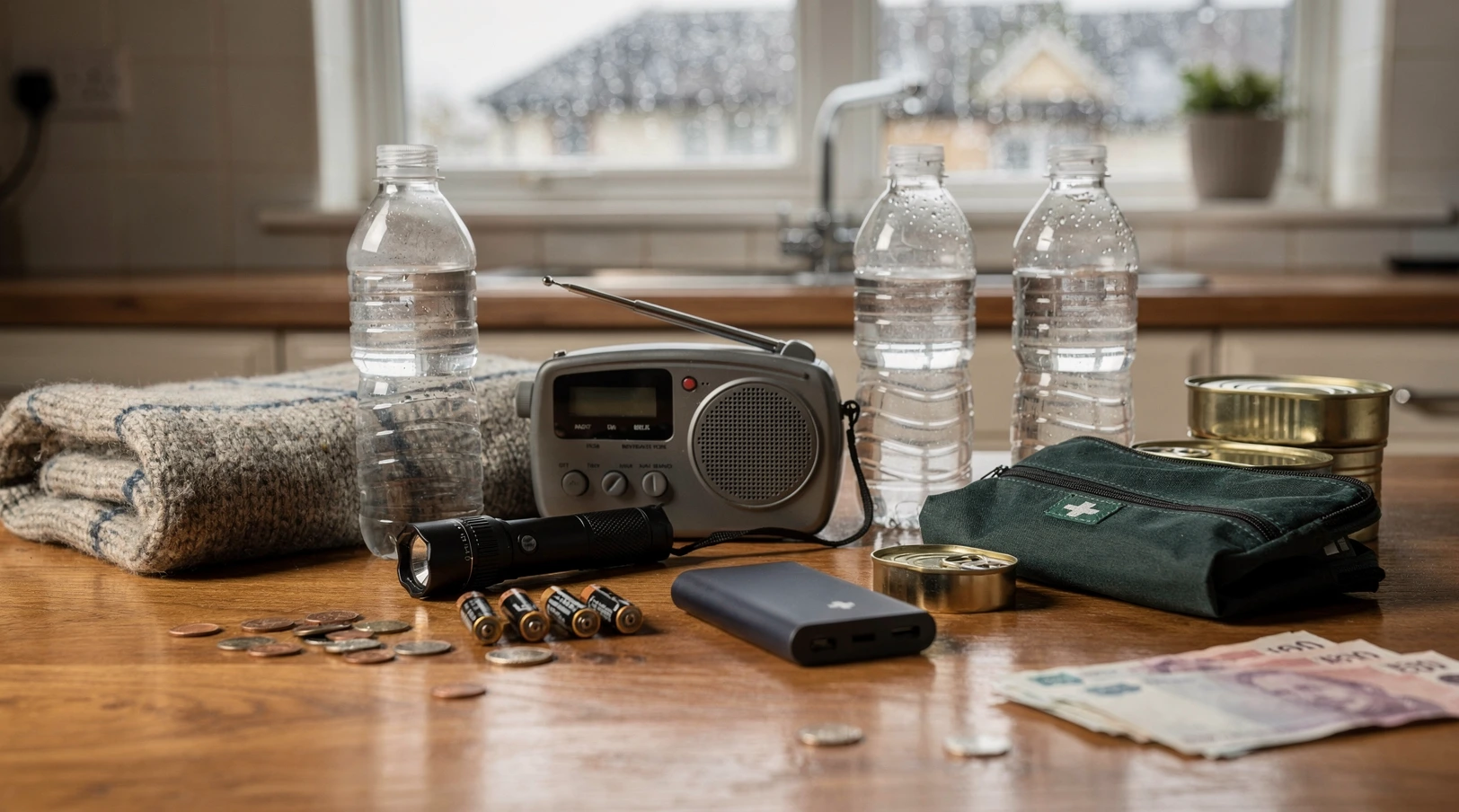
Wind-up radios, torches and power banks are selling out across the UK after the government published its Be Ready checklist, which asks every household to keep three days of essential supplies at home. Within roughly 48 hours of the guidance going live, electronics retailer Maplin reported torch sales up 284 per cent and power bank sales up 106 per cent, and several high street and online chains reportedly ran out of radio stock over the weekend.
This article sets out what the official checklist actually asks for, which products are under pressure, what retailers have said, and how UK shoppers can build a kit without paying over the odds or joining a rush they do not need to join. It also looks at why the government chose this moment, and what the episode tells British retailers about demand that can be switched on by a single press conference.
In short
- Be Ready campaign: launched on Thursday 22 October 2026, it asks UK households to hold three days of water, food, light, warmth, cash and information supplies, and runs as a three-year public drive.
- Sell-out: at least seven radio models sold out at four outlets on Saturday 24 October, according to the Telegraph, and Maplin says its wind-up radio stock was entirely depleted.
- Demand spike: Maplin reported torch sales up 284 per cent and power bank sales up 106 per cent; the Sun named Currys, John Lewis, Screwfix, Tesco, Debenhams and The Range among chains seeing stock fly off shelves.
- No rush needed: the official guidance tells people to build the kit gradually during regular shopping trips, check cupboards first and avoid buying everything at once.
- Real-world test: the advice landed as Storms Austen and Boelo left tens of thousands of UK homes without power, which is exactly the kind of outage the kit is designed for.
What is the Be Ready checklist and why was it published now?
The Be Ready campaign is a Cabinet Office led public information drive that asks households across the UK to be able to manage for three days if everyday services are disrupted. Security Minister Dan Jarvis set out the campaign in a written statement to Parliament, and Defence Secretary Wes Streeting promoted it in a speech in Telford on Thursday 22 October, where the government was also announcing that tank gun barrel production would return to Britain, according to Eastern Eye.
The official site, hosted on a gov.uk campaign domain, carries a downloadable checklist and a printable household emergency plan. Its central message is simple: “Being ready for 3 days helps you manage while support reaches those most in need.” The guidance stresses that many steps cost nothing and take only a few minutes.
Ministers framed the timing around a run of disruptions. Dan Jarvis said in his statement that “the storms of last winter and the wildfires of this summer have shown how extreme weather events can disrupt our daily lives and affect the services we rely on, such as telephone, electricity, water, and the Internet.” Last month Environment Secretary Dame Angela Eagle had already urged households to prepare for extreme weather as a strong El Niño develops in the Pacific, Eastern Eye reported.
The campaign also arrived in the same week as a critical security flaw in the PHP programming language, which underpins a large share of the world’s websites. The Guardian reported that the National Cyber Security Centre sent around 50,000 alerts to affected organisations, and GB News reported that some government portals, hospital resources and school websites went offline while fixes were applied.
What ministers said about shops and supermarkets
The retail angle was explicit from the start. Wes Streeting asked, in remarks widely reported by WalesOnline and others, “How would we cope if the payment systems at the local supermarket went down?” He added that the country needed to ask whether it was “prepared for the eventuality that there may be disruption to essential supply chains caused by hostile state actors or terrorists.”
On BBC One’s Question Time, Mr Streeting said there was no “specific thing” in mind and that people should be “alert but not alarmed”. When an audience member suggested the campaign could push people towards Covid-style panic buying, he replied that the government had debated the risk and looked at what European neighbours were doing: “They are way ahead of us on some of this stuff.”
What exactly does the government want UK households to buy?
The checklist is organised into nine categories. It is worth reading the original wording, because several items are more specific than the headlines suggest. The radio, for example, is listed as an FM radio (battery or wind up), and the guidance asks people to write down the frequencies of the national or local stations they use for news.
| Category | What the official checklist lists | Practical note for shoppers |
|---|---|---|
| Water | Bottled water for 3 days: 3 litres per person per day for drinking, more for cooking and washing | That is at least 9 litres per person, or 36 litres for a household of four, before cooking and washing |
| Food | Non-perishable food for 3 days that needs no fridge or cooking, such as tinned meat, fish or vegetables, dried fruit and nuts | The guidance says to buy food you would usually eat; remember a tin opener |
| Hygiene | Hand sanitiser, wet wipes and bathroom products | Most homes already hold some of this |
| Light and warmth | Torch and spare batteries; blankets, sleeping bags and warm clothing | Torches are listed as safer than candles |
| Communication | FM radio (battery or wind up); a charged power bank | Check the radio has FM, not only DAB or internet radio |
| Money and documents | Cash in a mix of coins and notes, plus cards; copies of IDs and documents; written phone numbers | Cash is there in case card payments or ATMs are disrupted |
| Medical | First aid kit; essential medication, with repeat prescriptions requested up to 5 working days ahead | Plan prescription timing rather than stockpiling medicines |
| Baby products | Ready-to-feed formula, nappies and wipes | Ready-made formula is advised because you may not be able to boil water |
| Pets | Pet food and bottled water | Easy to forget when sizing the water supply |
The government also points eligible households towards the Priority Services Register, which tells energy and water suppliers that a customer needs extra help during an interruption. Households with children under five are among those who can qualify. The plan template asks people to note the 105 power cut number used in England, Scotland and Wales.
Readers who want the full text, including advice for disabled people and carers, can find it on the official Be Ready checklist page. Separate guidance applies through Ready Scotland and NI Direct.
One line in the official guidance has been lost in much of the coverage: “You don’t need to do it all at once.” The government’s suggested method is to check cupboards first, note what is missing, then “pick up missing items when you can during your regular shopping trips to help spread the cost.” It also recommends a reminder every six months to check expiry dates.
That framing matters for shoppers. The kit is designed to be accumulated over weeks, not bought in a single weekend trip. GB News reported that Labour has insisted it is not setting out a “shopping list” for households, even though the checklist names specific products.
Which products are selling out, and where?
The clearest data so far comes from Maplin, the electronics brand that relaunched as an online retailer after its high street chain collapsed in 2018. Managing director Ollie Marshall told the Telegraph that demand soared “within hours” of the government’s announcement. GB News reported that Maplin’s stock of wind-up radios was entirely depleted roughly 24 hours after the advice was published.
The Independent, citing the Telegraph, reported that at least seven radio models had sold out at four outlets on Saturday 24 October, two days after the checklist went live. Metro and the Sun have run similar reports, with the Sun naming several large chains.
| Retailer or source | What was reported | Reported by |
|---|---|---|
| Maplin | Torch sales up 284% in a few days; power bank sales up 106% | The Telegraph, cited by the Independent and GB News |
| Maplin | Wind-up radio stock entirely depleted about 24 hours after the advice | GB News, citing the Telegraph |
| Four outlets (not all named) | At least seven radio models sold out on Saturday 24 October | The Telegraph, cited by the Independent |
| Currys, John Lewis, Screwfix, Tesco, Debenhams, The Range | Stock “flying off the shelves entirely” | The Sun, cited by GB News |
| Search data (The Prepared Household) | Scotland has the highest per-person search interest in preparedness supplies; the West Midlands is strong for torches, power banks and outage kits | The Independent |
None of the large chains named by the Sun has published sales figures, so the scale of the spike outside Maplin is not yet clear. Retail sell-outs of a niche product can also look dramatic because stock levels of items such as wind-up radios are normally small. A shop that carries a handful of units can sell out in an afternoon.
Torches, batteries and power banks are everyday lines held in volume by supermarkets, DIY sheds and electrical chains. Wind-up and hand-crank radios are not. They are a specialist product, typically stocked by outdoor shops, online marketplaces and a few electricals retailers, which is why a sudden surge empties shelves quickly.
There is also a mismatch between what people may search for and what the checklist asks for. Many modern portable radios are DAB only, and searches for “wind up radio” on some trade retailers’ websites return mains or battery site radios rather than crank-powered sets. The checklist is specific about FM, so shoppers should read product listings carefully before paying.
Is this panic buying, or a sensible response?
The evidence so far points to a sharp but narrow spike rather than a broad run on shops. The Guardian reported on Friday that the UK public was “responding calmly” to the campaign, and the products that have sold out are mainly low-volume electronics rather than food or water.
Some local newspapers in Essex reported queues and empty shelves at individual stores over the weekend, with headlines using the phrase “panic buying”. Those reports coincided with storm warnings and local power cuts, so it is hard to separate the effect of the checklist from people simply preparing for bad weather. National data on grocery sales will not be available for several weeks.
Political reaction has been mixed. Shadow foreign secretary Tom Tugendhat called the advice “a perfectly reasonable thing to ask people”, while his Conservative colleague Alicia Kearns criticised it as “lecturing the public”, according to WalesOnline. The Independent reported that one minister admitted he had not yet followed the stockpiling advice himself.
What happened during the Covid rush, and why this is different
In March 2020, UK supermarkets imposed purchase limits on items such as toilet roll, pasta and hand sanitiser as shoppers stocked up ahead of the first lockdown. That episode involved essential groceries that every household buys weekly, and it was driven by fear of shortages.
The Be Ready checklist is different in two ways. It covers mostly non-food items that households buy rarely, and the government is explicitly asking people to spread purchases over time. Unless the food and water elements trigger a wider rush, supermarkets are unlikely to need the rationing seen six years ago.
How much does a Be Ready kit cost, and how can shoppers keep the bill down?
The government has not published a cost estimate, and prices vary widely by product and retailer. A household that already has torches, blankets, a first aid kit and a well-stocked cupboard may need to spend very little. One that has none of these could face a noticeably larger bill, particularly if it buys branded emergency bundles.
Shoppers have several ways to keep costs down without cutting corners on safety:
- Audit first. The official guidance starts with checking what you already own; many homes have torches, spare batteries, blankets and tinned food.
- Use the weekly shop. Add one or two items per trip, as the guidance suggests, rather than buying everything in one go.
- Buy food you eat anyway. Rotating tins and dried food through normal meals avoids waste and spreads cost.
- Do not pay a panic premium. If a wind-up radio is out of stock, wait for restocks rather than paying inflated prices from unknown marketplace sellers.
- Look at multi-function devices. Many crank radios include a torch and a USB charging output, which can replace two separate purchases.
Household budgets are already under pressure. Official figures showed UK retail sales volumes fell in September, with online sales also slipping, as covered in our report on UK retail sales falling 0.4% in September. A sudden, unplanned spend of tens or hundreds of pounds is exactly what the gradual approach is meant to avoid.
Choosing a radio and a power bank
AOL’s consumer guidance notes that wind-up radios are sold by Amazon, Argos, Currys and specialist outdoor shops, and recommends checking reception, battery life and charging options. Models with several power sources, such as a hand crank, a solar panel and replaceable batteries, offer more flexibility if the power is off for days.
For power banks, the key questions are capacity, the type of cable your phone needs, and whether the unit holds its charge in storage. The checklist says “charged power bank”, so it is worth setting a reminder to top it up when you check expiry dates. Buying from a known retailer or a reputable brand on a marketplace also reduces the risk of poor-quality lithium batteries, a long-standing concern for UK product safety campaigners.
Why does the checklist tell people to keep cash?
The money section is one of the most practical parts of the guidance for shoppers. It advises keeping “cash (mix of coins and notes) and cards” in case “electronic payments or ATMs are disrupted”, and notes that the right amount depends on each family’s needs.
The advice comes as access to cash continues to shrink in many towns. Bank branches keep closing, and Post Office counters, which provide everyday banking for many customers, are under pressure too. In one recent example, our coverage of TG Jones shutting 70 post offices showed how quickly a town can lose its counter.
Small denominations matter. In an outage, a local shop that can still trade may not be able to give change for a £50 note, and card terminals will not work without power or connectivity. A mix of £5 and £10 notes and coins is more useful than a single large note.
Most UK shoppers now pay by card or phone, and a growing share use digital wallets. Contactless payments depend on the shop’s terminal, its connection and the payment networks behind it, so a local power cut or a cyber incident at a retailer can stop them working even if your bank is fine.
Competition in mobile payments is also changing. The Competition and Markets Authority is moving to open iPhone contactless technology to rival wallets, as set out in our report on the CMA’s plan to open iPhone contactless. None of that removes the need for a small cash reserve when systems are down.
What would a supermarket outage look like for UK shoppers?
Mr Streeting’s question about supermarket payment systems was not hypothetical. In 2025 a cyber attack on Marks and Spencer halted its online orders for weeks, and an attack on the Co-op left gaps on some store shelves, according to widely reported company statements at the time. Both showed how quickly a digital incident becomes a physical shopping problem.
The pattern is not unique to the UK. Our analysis of the Ahold Delhaize cyberattack this month looked at how a major grocery group handles a disruption to its systems and what it costs. For shoppers, the practical effects tend to be the same: paused deliveries, missing lines, and in the worst cases tills that cannot take cards.
A three-day kit does not solve those problems, but it reduces the need to queue at a store that is struggling to trade. It also eases pressure on shops during the first hours of an incident, which is when shelves empty fastest.
The storms gave the advice a real-world test
The campaign landed in the middle of two named storms. Storm Austen left more than 10,000 homes without power across southern England and Wales late last week, and Storm Boelo then left more than 80,000 customers without power on Sunday, according to the Telegraph. In Largs, on the Ayrshire coast, shops were flooded overnight, STV News reported.
Local papers in Essex also reported that hundreds of shoppers had home deliveries cancelled after a power cut. Events like these are where torches, a charged power bank and a battery radio stop being abstract checklist items and start being useful.
How does the UK guidance compare with earlier advice and with Europe?
This is not the first time a UK minister has told households to prepare. In May 2024, then deputy prime minister Oliver Dowden urged families to keep emergency supplies, alongside the launch of a government preparedness website. The 2026 campaign goes further: it is a named, multi-year drive with a printable checklist and household plan, and it is being backed by advertising on social media and radio, according to the Guardian.
Dan Jarvis said similar advice was already a normal part of life in countries including France, Ireland and the Netherlands. Sweden’s long-running “If crisis or war comes” brochure, sent to households, is often cited as the model for this kind of public preparedness, and the European Union published its own preparedness strategy in 2025 that encouraged citizens to be self-sufficient for at least 72 hours.
| Measure | United Kingdom, 2024 | United Kingdom, 2026 (Be Ready) | European Union, 2025 strategy |
|---|---|---|---|
| Headline ask | Keep basic emergency supplies | Three days of supplies at home | At least 72 hours of self-sufficiency |
| Format | Ministerial speech and website | Three-year campaign, downloadable checklist and household plan | EU-level strategy, national campaigns vary |
| Named items | General supplies | Water (3 litres per person per day), food, torch, FM radio, power bank, cash, documents, medication | Left largely to member states |
| Main risks cited | Broad civil emergencies | Extreme weather, cyber attacks, supply chain disruption, hostile states | Natural disasters, cyber attacks, conflict |
What does the sell-out mean for UK retailers?
For retailers, the past four days are a lesson in how fast policy can create demand. A single checklist turned a niche category into a weekend best seller, and the businesses that could respond fastest were those with stock already in their warehouses. Maplin, which already sells an “Emergency Tech Essentials Kit” on its website, was well placed to capture the first wave.
Larger chains face a different question: whether to range dedicated “Be Ready” bundles, or to signpost existing lines such as torches, batteries and power banks. Grouping products by the checklist’s categories, online and in store, would make life easier for shoppers who want to buy gradually. Clear labelling on whether a radio supports FM would also cut returns.
There is a reputational risk too. Retailers and marketplace sellers that hike prices sharply on scarce items during a government safety campaign could attract criticism. UK law has no general ban on high prices, but during the Covid stockpiling wave the CMA set up a taskforce to examine price rises on essential goods and wrote to traders it suspected of exploiting the situation.
Many shoppers will buy radios and power banks online, especially while store shelves are empty. Delivery networks are entering their busiest season, with Black Friday weeks away and Christmas parcel volumes building. Anyone ordering a kit online should allow extra time, particularly if they are also buying gifts; our guide to Royal Mail’s Christmas 2026 posting dates sets out the key deadlines.
For retailers, a pre-Christmas spike in electronics demand is welcome, but it also competes with peak stock and warehouse capacity. Restocking specialist radios quickly may be harder than restocking torches, which could keep some models out of stock into November.
What rights do shoppers have if they regret a rushed purchase?
If you bought online, by phone or by mail order, the Consumer Contracts Regulations generally give you 14 days to cancel after the goods arrive, and a further 14 days to send them back, for most items. That means a rushed online order for a radio or power bank you no longer need can usually be returned for a refund, though you may have to pay return postage.
In a physical shop, there is no automatic legal right to return goods simply because you changed your mind. Many retailers offer a goodwill returns policy, so check the receipt. If an item is faulty, the Consumer Rights Act 2015 gives you a 30-day short-term right to reject it for a full refund.
Food is different. Perishable goods are excluded from the online cancellation right, and tins or bottled water bought in store are rarely returnable. That is one more reason to follow the official advice to buy food you would normally eat.
What should UK shoppers do this week?
The practical message is to treat the Be Ready list as a project for the next few months, not a weekend emergency. A sensible order of work looks like this:
- Download the checklist and household plan, and tick off what you already own.
- Write down important phone numbers, your radio station frequencies and the 105 power cut number on paper.
- Check whether anyone in your household is eligible for the Priority Services Register, and sign up if so.
- Add water and long-life food you already eat to your regular shop, a little at a time.
- Buy a torch, batteries and a power bank if you lack them; these are widely available.
- If wind-up radios are out of stock, wait for restocks from reputable retailers rather than paying inflated prices.
- Set a six-month reminder to check expiry dates and recharge the power bank.
For most households, the kit will sit unused in a cupboard. That is the point: the government’s stated aim is to help people cope with disruptions that are becoming more common, not to warn of a specific crisis. The storms of the past week are a reminder that a power cut is the most likely test.
Frequently asked questions
What is the Be Ready campaign?
It is a UK government public information campaign, launched on 22 October 2026, that asks households to keep enough supplies to manage for three days if services such as power, water, phones or the internet are disrupted. It is planned as a three-year drive and is overseen by the Cabinet Office.
What is on the Be Ready checklist?
Bottled water (3 litres per person per day for drinking), non-perishable food, hygiene products, a torch and spare batteries, blankets and warm clothing, an FM radio (battery or wind up), a charged power bank, cash and cards, copies of documents, a first aid kit, essential medication, and baby and pet supplies where needed.
Why are wind-up radios selling out?
The checklist names a battery or wind-up FM radio, and these are specialist products that most retailers stock in small numbers. The Telegraph reported that at least seven models sold out at four outlets on 24 October, and Maplin said its wind-up radio stock was entirely depleted.
Do I need to buy everything at once?
No. The official guidance says you do not need to do it all at once and recommends picking up missing items during regular shopping trips to spread the cost. It also suggests checking what you already have before buying anything.
How much water should I store for three days?
The checklist asks for 3 litres per person per day for drinking, which is at least 9 litres per person over three days. A household of four would need at least 36 litres, plus extra for cooking, washing and any pets.
Does a DAB radio count?
The checklist specifically lists an FM radio powered by batteries or a wind-up mechanism, and asks people to write down the FM frequencies of stations they use for news. Many radios support both DAB and FM, so check the specification before buying.
Why does the government want me to keep cash?
Cash is listed in case electronic payments or cash machines are disrupted, for example during a power cut or a cyber attack on a retailer. A mix of notes and coins is more useful than large notes, because shops may not be able to give change.
Can I return a radio or power bank I bought in a rush?
If you bought online, you usually have 14 days after delivery to cancel and a further 14 days to return most goods under the Consumer Contracts Regulations. In store, there is no automatic right to return unwanted items unless the retailer offers one, though faulty goods can be rejected within 30 days under the Consumer Rights Act 2015.
Is the government warning of a specific threat?
No. Wes Streeting told BBC One’s Question Time there was no “specific thing” in mind and that people should be “alert but not alarmed”. Ministers have linked the campaign to extreme weather, cyber attacks and possible supply chain disruption in general.