
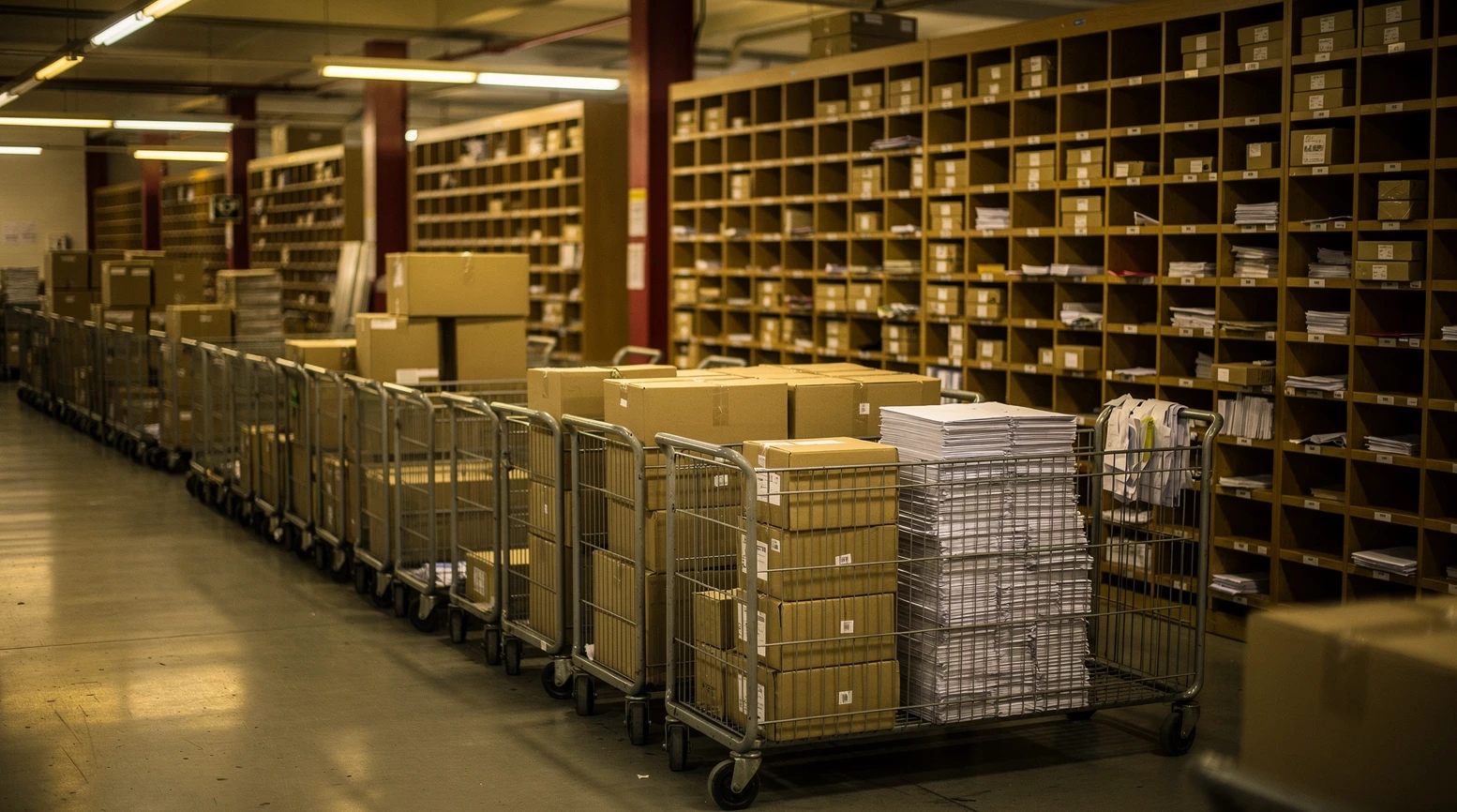
Royal Mail has paused the final stage of its second-class post overhaul until after Christmas. The company confirmed on Monday 26 October 2026 that its remaining 107 delivery offices will not switch to the new delivery model until 11 January 2027, a decision it says it agreed with the Communication Workers Union (CWU) so that postal staff can concentrate on the festive peak.
The move matters to anyone who posts or receives letters, cards and small items in the run-up to Christmas, and especially to small online sellers who still rely on second-class post. It also lands in a week of mounting political pressure, after the Prime Minister warned Royal Mail that the government could take “further measures” if delivery performance does not improve quickly.
In short
- Rollout paused: the last 107 delivery offices will move to the new model on 11 January 2027, not before Christmas as Royal Mail had planned.
- Most of the country has already switched: just under 1,100 of about 1,200 offices run the new model, with 15 more due to convert by 2 November.
- What the new model means: second-class letters arrive on alternate weekdays and there is no Saturday second-class delivery; first-class letters continue six days a week.
- Targets still missed: in the first quarter of 2026–27, Royal Mail delivered 85% of first-class mail the next working day against a 90% target, and 91.4% of second-class within three working days against 95%.
- Christmas deadlines unchanged: the recommended last posting dates remain Friday 18 December for second class and Monday 21 December for first class.
What has Royal Mail announced?
Royal Mail said it would delay expanding its new delivery model to the remaining 107 delivery offices until 11 January 2027. According to the Evening Standard, which reported the decision on Monday morning, the company had planned to have the model running across all of its roughly 1,200 delivery offices by Christmas, after earlier disagreements with the union had already slowed the programme.
The changes have now been completed in just under 1,100 offices, Brit Brief and the Evening Standard both report, with 15 more scheduled to convert by 2 November. That leaves the final 107 offices on the old pattern through the whole of the Christmas peak, which runs from the Black Friday weekend through to the last posting dates in late December.
Royal Mail described the pause as a “pragmatic approach”. The company said it had agreed the timing with the CWU so that staff could focus on handling the extra cards, letters and parcels that arrive every November and December, rather than learning new walks and duty patterns in the busiest weeks of the year.
Who decided, and why now?
The decision follows two weeks of escalating criticism. On 14 October, the Press Association reported that the CWU had called for an emergency summit on the future of Royal Mail, describing the company as “on the brink of collapse” and asking for the rollout of the new delivery model to be paused because of operational problems and heavy workloads. CWU general secretary Dave Ward blamed Royal Mail’s own recruitment and retention problems, according to that report.
A week later, Prime Minister Andy Burnham told Royal Mail to improve. “Let’s be clear, they need to bring forward a plan to restore service standards to the level they need to be at. They need to do it quickly, or we will consider further measures,” he said, as reported by several outlets on 21 October. London Loves Business reported that he also described the service as unacceptable for far too long.
The pause therefore gives the union one of the things it asked for, while allowing Royal Mail to argue that it is protecting Christmas service. A UK Parliament notice published on Monday also said MPs are due to debate Royal Mail’s performance, so the decision is likely to be raised in Westminster.
What is the new delivery model, and what changes for households?
The new delivery model is Royal Mail’s implementation of the universal service reforms approved by Ofcom, the communications regulator, in 2025. The core change is simple: first-class letters keep a six-day service, while second-class letters move to an every-other-weekday schedule and lose Saturday delivery altogether.
For a household, that means a second-class birthday card may now arrive on a Monday, Wednesday or Friday one week and a Tuesday or Thursday the next, depending on how the local office organises its rounds. Royal Mail argues that the change frees up postmen and postwomen to deliver first-class letters and parcels more reliably every day.
| Feature | Old model (still used in 107 offices until 11 January) | New model (in place at just under 1,100 offices) |
|---|---|---|
| First-class letters | Monday to Saturday | Monday to Saturday |
| Second-class letters | Monday to Saturday | Alternate weekdays only |
| Saturday second-class delivery | Yes | No |
| Second-class target | Within three working days | Within three working days |
| Share of addresses reached each day (Royal Mail figure) | About 88% before rollout | About 95% on average |
The 88% and 95% figures come from Royal Mail chief executive Alistair Cochrane, who said offices operating the new model deliver to about 95% of addresses each day on average, compared with 88% before the rollout. Those are company figures and have not been independently audited in the reports published on Monday.
Does the pause change anything for my address?
If you live in an area served by one of the 107 offices still on the old model, your second-class post will keep arriving on the existing six-day pattern until 11 January. If your office has already switched, nothing changes: you will keep receiving second-class letters on alternate weekdays through Christmas.
Royal Mail has not published a list of the 107 offices in the reports seen by shopappy.com. The simplest way to tell is practical: if you have stopped receiving second-class letters on Saturdays, your local office is almost certainly already on the new model.
How badly is Royal Mail missing its targets?
Royal Mail’s latest published quality of service figures cover the first quarter of the 2026–27 regulatory year, from 30 March to 28 June 2026. They show improvement on the year before, but the company remains below the targets set by Ofcom.
| Measure | Ofcom target | Q1 2026–27 result | Gap |
|---|---|---|---|
| First class, next working day | 90% | 85.0% | 5 points short |
| Second class, within three working days | 95% | 91.4% | 3.6 points short |
| First class, within three working days (backstop) | 99% | 98.1% | 0.9 points short |
According to Parcel and Postal Technology International, the first-class result was up 9 points on the same quarter a year earlier, and second-class performance rose by 2.1 percentage points. Royal Mail’s own improvement plan had pencilled in a first-quarter first-class range of 77–79%, so the company finished ahead of its internal expectations while still falling short of the regulator’s bar.
Cochrane has framed the delivery model as the reason for the improvement. He said first-class quality of service had risen by 9% and that “there is still more to do”, according to London Loves Business.
Royal Mail has been fined before. Ofcom fined Royal Mail £21 million in October 2025 after finding that it had missed its first-class and second-class targets in the 2024–25 regulatory year. That followed earlier penalties for missed targets in previous years, and it is one reason why the regulator agreed to reform the universal service rather than simply keep issuing fines.
Reports this week say Royal Mail missed the targets again in the first quarter, even after Ofcom lowered them as part of its reforms. Whether Ofcom opens fresh enforcement action on the 2025–26 year, or waits for full-year 2026–27 data, will shape the political temperature in early 2027, just as the final 107 offices convert.
Why does this matter for online shoppers?
Most online orders do not travel as second-class letters, but a meaningful slice of small e-commerce does. Marketplace sellers on eBay, Vinted, Etsy and Depop often post lightweight items such as clothing, books, trading cards and jewellery as large letters or small parcels, and second class is the cheapest way to do it.
When second-class delivery drops to alternate weekdays, the realistic delivery window for those items stretches. A second-class large letter posted on a Thursday in a new-model area may not arrive until the following Tuesday, even though it is still within Royal Mail’s three-working-day target on paper.
The pause helps buyers and sellers in the 107 offices still on the old model, because second-class delivery will continue on Saturdays there until January. For everyone else, which is the vast majority of the UK, the alternate-day pattern is already the reality for Christmas 2026, and the pause changes nothing.
What about tracked parcels?
Royal Mail has said the reforms concern letters, and that parcel services, including its Tracked 24 and Tracked 48 products, continue to be delivered on their usual days. That is why most retailers and marketplaces will not see a direct change in their parcel delivery times from Monday’s announcement.
The indirect effect is about capacity. Royal Mail says it plans to recruit 22,000 temporary workers to sort and deliver the extra mail and parcels expected over Christmas, and any repeat of the staffing pressures the CWU has described would affect parcels as well as letters. Rival carriers are also preparing: Evri, for example, has set out a large pre-Christmas programme, which we covered in our report on Evri’s £32.2m Christmas peak investment.
What are the Christmas 2026 posting deadlines?
The pause does not change Royal Mail’s recommended last posting dates for Christmas 2026. Those were set out earlier this month and remain the dates to work to, whether your local office is on the old model or the new one.
| Service | Recommended last posting date | Notes |
|---|---|---|
| Second Class and Second Class Signed For | Friday 18 December | Most exposed to the alternate-day pattern |
| Royal Mail Tracked 48 | Saturday 19 December | Parcel service, delivered on usual days |
| First Class and Royal Mail Tracked 24 | Monday 21 December | Six-day letter service retained |
| Special Delivery Guaranteed | Wednesday 23 December | Guaranteed next-day service |
For a fuller breakdown, including Parcelforce and the courier services sold at Post Office counters, see our guide to the Royal Mail Christmas 2026 last posting dates. The practical advice is the same as every year: these are the latest recommended dates, not the safest ones, and posting a few days earlier gives a buffer if a local office falls behind.
Should I switch from second class to first class for cards?
If your card or parcel must arrive by a specific date, first class is the more predictable choice in any area already on the new model, because it keeps six-day delivery. The trade-off is cost, since first-class stamps are considerably more expensive than second class.
For cards that only need to arrive “before Christmas”, second class posted in the first half of December remains a reasonable option. The risk rises sharply for anything posted close to 18 December, because a missed alternate-day delivery can push an item into the following week.
A worked example: when will a second-class card arrive?
Royal Mail’s second-class standard is delivery within three working days of collection, and the alternate-day pattern is designed to fit inside that window. In an office on the new model, each address receives second-class letters on roughly half of the weekdays in a fortnight, so the day you post can matter as much as the class of stamp.
Take a card posted before the last collection on a Thursday in a new-model area. The three working days that follow are Friday, Monday and Tuesday, so a delivery on Tuesday would still meet the target, even though a sender used to the old six-day pattern might have expected it on Saturday. The same card posted on a Monday would be due by Thursday under the same rule.
| Day posted (before last collection) | Three working days after collection | Latest on-target delivery |
|---|---|---|
| Monday | Tuesday, Wednesday, Thursday | Thursday |
| Wednesday | Thursday, Friday, Monday | Monday |
| Thursday | Friday, Monday, Tuesday | Tuesday |
| Friday | Monday, Tuesday, Wednesday | Wednesday |
This table is illustrative: it shows the latest date that still counts as on target, not the date any individual item will arrive. Many items arrive sooner, and items posted in mid-December face the extra volume of the Christmas peak, which is exactly the period Royal Mail says the pause is designed to protect.
The key difference for senders is the loss of Saturday. Under the old model, a second-class item posted early in the week had a realistic chance of arriving by Saturday; under the new model, the weekend becomes a gap, and items posted from Wednesday onwards will typically arrive the following week.
What should small online sellers do now?
Small sellers are the group most directly affected by the second-class reform, and the Christmas peak is when a late item hurts most. A buyer who receives a gift on 27 December is likely to leave a poor review, open a “not received” case, or ask for a refund, whatever the carrier’s service standard says.
Three practical adjustments are worth considering before the peak starts in late November:
- Update stated delivery times. If your listings promise “2–3 days” for second-class items, consider widening that window for December so buyers’ expectations match the alternate-day pattern.
- Set your own cut-off dates. Publish an earlier “order by” date for second-class items than Royal Mail’s 18 December recommendation, and a separate, later date for first class and tracked services.
- Price the upgrade. Offer first class or Tracked 24 as a paid option, so buyers who need certainty can choose it, and keep second class as the budget choice.
Sellers who use Post Office counters should also check that their local branch is still open in December. Counter closures are accelerating in some towns, as our report on TG Jones shutting 70 post office counters explains, and a lost counter can add a car journey to every drop-off.
The pause helps sellers only modestly. Sellers whose buyers live in areas served by the 107 offices will benefit from continued Saturday second-class delivery through Christmas. But sellers cannot see which office serves a buyer’s address, and almost all addresses are already on the new model, so the safest assumption for planning is that every second-class item will travel on the alternate-day pattern.
The more important date for sellers is 11 January 2027. From then, the whole network should run on the same model, and the January returns and sales period will be the first peak handled entirely under the new rules.
What is happening inside Royal Mail?
The delivery model is one part of a broader restructuring under Royal Mail’s owner, International Distribution Services (IDS). IDS was taken over by Czech billionaire Daniel Kretinsky’s EP Group in a deal completed last year, and the new owner has committed to keeping the Royal Mail brand, its UK headquarters and the universal service.
London Loves Business reported that about 2,500 head-office and support roles, roughly 2% of the workforce, are set to be cut, with frontline postal staff excluded. Royal Mail has also pledged £500 million over five years to improve service quality, according to the same report.
At the same time, it is recruiting 22,000 temporary staff for the Christmas period. That combination, cutting central roles while hiring seasonal frontline workers, reflects a business trying to shift resources towards delivery while it is still being criticised for missing delivery targets.
The CWU has asked for an emergency summit involving the government, Royal Mail management and the union, to agree how to stabilise the service. Its warning that the company is “on the brink of collapse” is stark language for a union that signed up to the delivery reforms in principle, and it reflects tension over workloads in offices that have already switched.
Agreeing a pause with the union is therefore partly an industrial relations decision. A disrupted rollout in December, or a dispute in the busiest weeks of the year, would cost Royal Mail far more in reputation and in Ofcom scrutiny than a six-week delay.
What could the government do next?
Burnham’s warning of “further measures” did not spell out what the government has in mind, and no detail has been published since. Options discussed in Westminster in the past have included tougher regulatory powers for Ofcom, changes to the universal service obligation itself, and closer oversight of the company under its new ownership.
The timing is also politically sensitive. The Budget is due on Wednesday 28 October, and the Prime Minister has chosen to make postal performance a public issue, so a Christmas marked by late cards and missing parcels would land on a government that has already said the service must improve.
Any intervention would also have to take account of the regulatory framework Ofcom has just rebuilt. The regulator approved the second-class reform on the basis that a slimmer universal service would be more sustainable and more reliable, and a government move to reverse it would reopen questions about how the universal service is funded.
For shoppers and sellers, the most likely near-term outcome is more scrutiny rather than immediate structural change. Ofcom’s next quality of service data, the MPs’ debate and any summit with the union are the events to watch over the coming weeks.
How does this fit with other changes to how the UK shops?
The postal overhaul is happening alongside a wider shift in how UK consumers buy and receive goods. Online sales have been a stable share of retail spending, with the Office for National Statistics putting the online share at about 28.8% in September, as our report on UK retail sales falling 0.4% in September sets out.
That means the reliability of the postal network is not a niche concern. It affects millions of deliveries a week, and the small sellers who use second-class post are also facing other changes, including proposals in the Budget to make marketplaces collect sellers’ VAT, as our report on Amazon and eBay collecting sellers’ VAT explains.
For shoppers, the practical point is that the post is now one of several delivery routes, and choosing the right one matters more in December than at any other time of year. Tracked services, click and collect, parcel lockers and in-store collection all reduce reliance on the second-class letter network, which is the part of the system that is changing.
For retailers, the reform is a reminder to be precise about delivery promises. Under the Consumer Rights Act 2015, goods should be delivered within the time agreed with the customer, or within 30 days if no time was agreed, and the retailer remains responsible for goods until they reach the buyer. A clear, realistic Christmas delivery promise is therefore better than an optimistic one.
What happens on 11 January 2027?
On 11 January, the remaining 107 offices are due to move to the new model, completing the national rollout. From that date, second-class letters should be delivered on alternate weekdays everywhere in the UK, with no Saturday second-class service anywhere.
Royal Mail says it expects to meet its regulated quality of service targets by April 2027. If it does, the reform will have done what Ofcom and the company said it would: trade a slower second-class service for a more reliable first-class one. If it does not, the pressure from the government, the regulator and the union is likely to intensify.
| Date | Event |
|---|---|
| 14 October 2026 | CWU calls for an emergency summit on Royal Mail’s future |
| 21 October 2026 | Prime Minister Andy Burnham warns of “further measures” |
| 26 October 2026 | Royal Mail pauses the final stage of the rollout |
| 28 October 2026 | Budget |
| 2 November 2026 | 15 more offices due to switch to the new model |
| 18 December 2026 | Recommended last posting date for second class |
| 21 December 2026 | Recommended last posting date for first class and Tracked 24 |
| 11 January 2027 | Final 107 delivery offices switch to the new model |
| April 2027 | Royal Mail’s target date for meeting its regulated quality of service targets |
Frequently asked questions
Has Royal Mail stopped the second-class changes?
No. It has paused the final stage only. Just under 1,100 of about 1,200 delivery offices have already switched to alternate-weekday second-class delivery, and the remaining 107 will follow on 11 January 2027.
Is second-class post still delivered on Saturdays?
Only in areas served by the 107 offices still on the old model, and only until 11 January 2027. Everywhere else, Saturday second-class delivery has already ended under the new model.
Is first-class post affected?
No. First-class letters continue to be delivered six days a week, Monday to Saturday, under both the old and new models.
Are parcels affected by the second-class changes?
Royal Mail has said the reforms concern letters and that parcel services, including Tracked 24 and Tracked 48, continue to be delivered on their usual days. Staffing pressures over Christmas could still affect parcel times indirectly.
What is the last day to post second class for Christmas 2026?
Royal Mail’s recommended last posting date for second class is Friday 18 December 2026. For first class and Tracked 24 it is Monday 21 December, and for Special Delivery Guaranteed it is Wednesday 23 December.
Why did Royal Mail delay the rollout?
Royal Mail said it agreed the delay with the Communication Workers Union so that staff could focus on the Christmas peak. It described the decision as a “pragmatic approach”. The pause also follows a CWU call for the rollout to be paused and a warning from the Prime Minister about missed targets.
Is Royal Mail meeting its delivery targets?
Not yet. In the first quarter of 2026–27 it delivered 85% of first-class mail the next working day against a 90% target, and 91.4% of second-class mail within three working days against 95%. Royal Mail says it expects to meet its targets by April 2027.
How can I tell if my area is on the new delivery model?
Royal Mail has not published a list of the 107 offices in the reports issued on Monday. If you have stopped receiving second-class post on Saturdays, your local delivery office has very likely already switched.
What should small online sellers change for Christmas?
Sellers who post items second class should widen their stated delivery times, set an earlier Christmas cut-off for second-class orders than 18 December, and offer first class or tracked services as a paid upgrade for buyers who need certainty.