
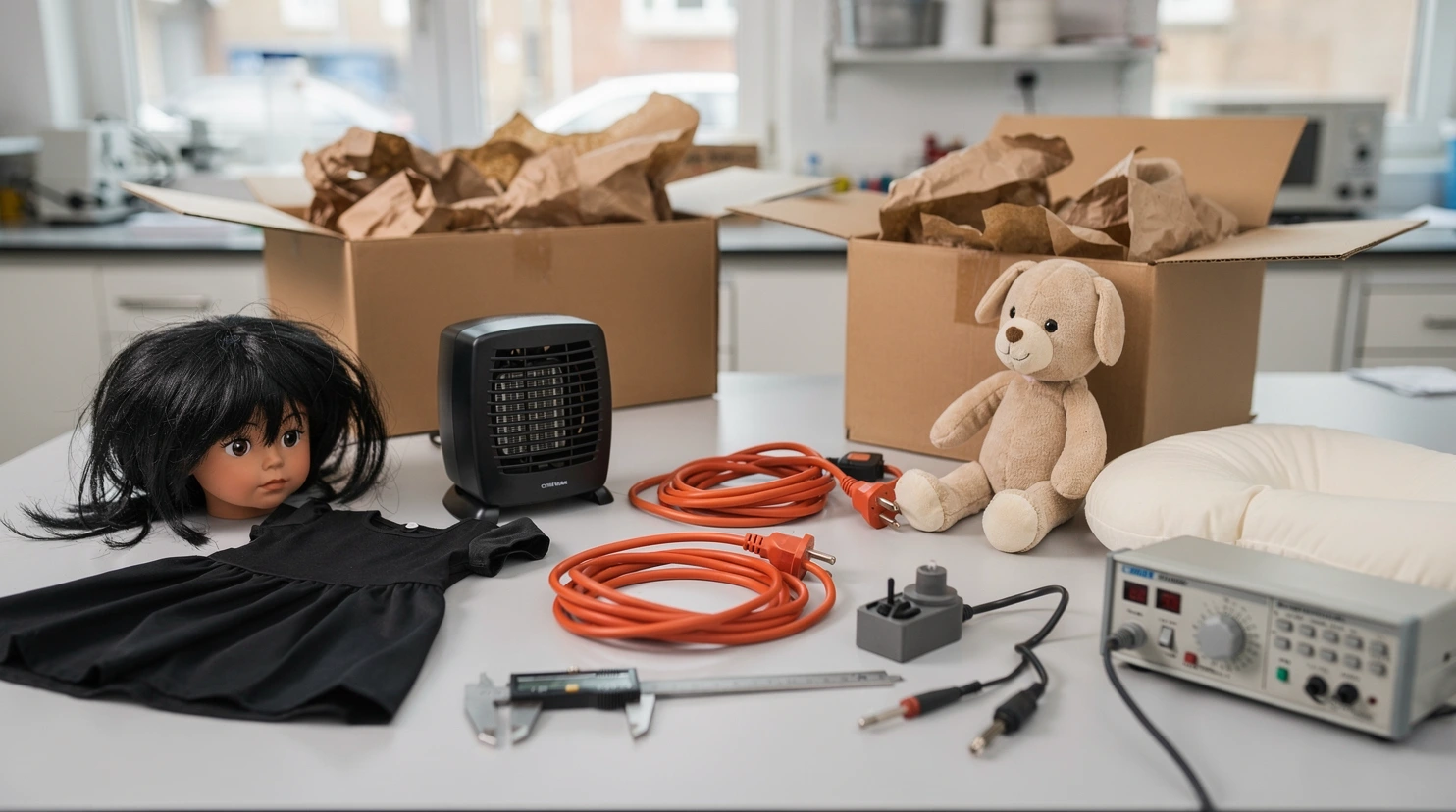
Britain’s biggest consumer group has taken its fight against unsafe goods on online marketplaces to the door of Parliament, and the timing is pointed. With Halloween on Saturday, Black Friday on 27 November and the Christmas peak behind it, Which? says shoppers are still being offered products that official safety alerts have already flagged. A government response that could finally put a legal duty on platforms such as Amazon, eBay and TikTok Shop has been due for weeks and has still not appeared.
In short
- Which? found 40 potentially dangerous products from third-party sellers in a few hours, across Alibaba, AliExpress, Amazon, B&Q, eBay, OnBuy, The Range and TikTok Shop, including scam “energy-saving” plugs and baby sleep products that risk suffocation.
- The group drove its campaign to Westminster (via Amazon’s UK headquarters) and urged Prime Minister Andy Burnham to impose a clear legal duty on marketplaces, backed by heavy fines.
- The government consulted on exactly that between 31 March and 23 June 2026, proposing a duty of “due care to prevent, identify and remove dangerous products”, but its response has not been published.
- Our count of official notices shows 28 of the 64 product safety reports and recalls published by the Office for Product Safety and Standards (OPSS) between 1 and 26 October name an online marketplace, double September’s 14 of 60.
- Halloween items feature heavily: a Wednesday Addams costume on eBay whose wig kept burning for up to 15 seconds, a toddler ghost costume on Amazon with a strangulation risk and an alien mask with too little ventilation.
What did Which? find on online marketplaces this month?
Which? published the results of what it called a “quick sweep” on 22 October, written by senior researcher Hannah Walsh. Using simple techniques such as reverse image searches and keyword checks, a single researcher found 40 products for sale from third-party sellers that the organisation had serious concerns about. The checks took a matter of hours, a point Which? uses to argue that platforms with far greater resources could do the same work at scale.
The products fell into familiar categories. They included scam “energy-saving” plugs that are the subject of official safety alerts, baby pillows and baby sleeping bags that risk asphyxiation, plug-in heaters that appeared to match models carrying a risk of electric shock, explosion and fire, reciprocating saws that looked identical to those in safety alerts, and a smoke alarm that repeatedly failed Which? safety tests.
Which? described these as “low-hanging fruit”. Many of the items had already been the subject of previous Which? investigations or OPSS notices, and some, such as baby sleeping bags with hoods or without arm holes, can be identified as non-compliant from a photograph alone.
The scam energy plugs that keep coming back
The clearest example in the report is the plug-in device that claims to cut electricity bills by “smoothing” household voltage. Which? says these gadgets do nothing of the sort, have repeatedly failed basic UK electrical safety standards and pose a fire and electric shock risk, as set out in several OPSS safety alerts.
According to Which?, senior Amazon staff were shown unsafe plugs for sale on the site at a Business and Trade Committee session in June 2026. Amazon said a “technical error”, since corrected, had stopped them being detected. Which? says that weeks later it could still find dozens, and that a House of Commons letter in September again raised the issue with Amazon, alongside other listings that appeared identical or very similar to products under OPSS warnings.
In the latest sweep Which? found more than a dozen of the plugs available to UK shoppers across Amazon, AliExpress, Alibaba, OnBuy and TikTok Shop. On Amazon, the group says, the items were listed via the US site Amazon.com but offered quick shipping to the UK with no import charges and a reasonable delivery fee, and matched the images in safety alerts exactly.
Baby sleep products and other repeat offenders
Which? says it contacted marketplaces as recently as July about unsafe baby sleeping bags. Using a reverse image search from a 2023 safety alert issued to Amazon, it found five hooded sleeping bags without arm holes for sale on Amazon, with listing images matching the alert. A baby could slip down inside such a bag, or the hood could cover the face.
The group also found bolster pillows for cots and side-sleeping pillows on Amazon and TikTok Shop. In December 2025 the OPSS issued an alert stating that baby pillows pose a risk of “suffocation, overheating and death to babies”. Elsewhere, Which? found five plug-in heaters of a design that has repeatedly failed its electrical tests, four reciprocating saws that appeared identical to unsafe models on B&Q Marketplace, Amazon and eBay, a telescopic ladder similar to a model that seriously injured electrician Joffrey Bogemans, and a smoke alarm on eBay that Which? says it has flagged to the platform twice before.
| Product type | Risk cited by Which? or OPSS | Where Which? found it |
|---|---|---|
| “Energy-saving” plugs | Fire and electric shock; no energy saving | Amazon (via Amazon.com), AliExpress, Alibaba, OnBuy, TikTok Shop |
| Hooded baby sleeping bags without arm holes | Suffocation | Amazon (five listings) |
| Cot bolster and side-sleeping pillows | Suffocation, overheating | Amazon, TikTok Shop |
| Plug-in heaters | Electric shock, explosion, fire | Five listings of the same design |
| Reciprocating saws | Fire, electric shock | B&Q Marketplace, Amazon, eBay |
| Telescopic ladder | Serious injury | Amazon |
| Smoke alarm | Failed smoke detection tests | eBay |
Why has Which? taken the campaign to Westminster now?
The sweep was published alongside a campaign stunt: Which? drove its message to Westminster after what it called “a quick detour past Amazon HQ”. The group says it is “sick of tech giants like Amazon profiting when dangerous products turn up at our front doors” and has launched a petition calling on the government to protect online shoppers.
The political target is explicit. Which? says Prime Minister Andy Burnham “has a once-in-a-generation chance to make this right”, because the government consulted earlier this year on rewriting the UK’s product safety framework and is due to publish new rules. The group wants ministers to “urgently impose a clear legal duty on online marketplaces to take responsibility for the safety of products sold through their platform, including proactive measures to prevent unsafe products from being listed and sold”, backed by heavy fines.
Which? is not alone. Trade titles Professional Jeweller and Retail Jeweller reported on 22 and 23 October that the National Association of Jewellers had also called for stronger online marketplace responsibilities, and on 25 October the environmental news site The Cool Down carried Which?’s argument that marketplaces will not stop dangerous products until the law steps in. On Monday the BBC added a human dimension with an owner’s account headlined “A £12 dog toy bought from Amazon killed my dog”.
“Safety is a top priority”: the phrase Which? has stopped believing
Which? says that since 2019 it has reported hundreds of unsafe products to platforms across dozens of investigations, and that on at least 90 occasions marketplaces have replied that safety is “a top priority”, “taken very seriously” or a variation of that claim. Its complaint is not that listings are left up after a report; most are removed. It is that the same products reappear.
That pattern runs through the group’s recent work. On 16 October Which? reported finding 171 inflatable baby swim floats on online marketplaces including Amazon, eBay and Vinted, 115 of them with canopies across AliExpress, Amazon, eBay, OnBuy and Shein. It said 25 appeared to be the same as a float involved in the drowning of a two-year-old in the US, and that there are at least 14 UK government alerts covering canopy floats, plus a voluntary category-wide recall notice from TikTok Shop.
What does the official safety data show this month?
The OPSS publishes every product safety report, alert and recall on gov.uk, and each notice states how the product was sold. To test whether the Which? findings are an outlier, shopappy counted the notices published between 1 and 26 October 2026 and compared them with September. The titles of 28 of the 64 October notices name an online marketplace as the sales channel, compared with 14 of 60 in September.
Amazon appears most often, which partly reflects its scale as the UK’s largest online retailer. The October list also shows how many different platforms the regulator now has to deal with, from global giants to smaller UK-facing marketplaces.
| Marketplace named in OPSS notice title | 1–26 October 2026 | September 2026 |
|---|---|---|
| Amazon | 15 | 13 |
| Wish | 4 | 0 |
| eBay | 3 | 0 |
| AliExpress | 2 | 0 |
| Fruugo | 2 | 0 |
| OnBuy | 1 | 0 |
| Alibaba | 1 | 0 |
| TikTok Shop | 0 | 1 |
| Total naming a marketplace | 28 of 64 | 14 of 60 |
Two caveats apply. The count is based on notice titles, so a notice for a product sold online that does not name the platform in its title is not included. And one October batch (squishy “pimple popping” toys supplied with needles) produced separate notices for six marketplaces on 9 October plus a recall on AliExpress on 16 October, which inflates the month. Even without that batch, more than a fifth of October’s notices still name a platform.
The notices that matter most this week
Several of the most recent notices involve products that are in demand right now. On 23 October the OPSS published a report on a “Goose Patting Baby Sleep Pillow” sold via Wish, marketed as suitable from birth to 12 months and fitted with an electronic warming device, which it said presents a risk of suffocation; the listing was removed. The same day it reported that an import of Rully children’s bikes sold via Amazon had been rejected at the border because the stabilisers bent under testing and did not return to their original position.
On 20 October it reported that Todimart T1 and T3 children’s electric scooters sold via Amazon came with a plug that did not meet the dimensional requirements of BS 1363 and had no fuse, creating a fire risk. A 25-metre caravan extension lead sold via Amazon was rejected at the border because the cable had excessive electrical resistance and could overheat on a 16 A supply.
Which Halloween products have been flagged?
With Halloween falling on Saturday 31 October, fancy dress is where the official data and the Which? campaign meet. Households were already expected to spend heavily this year, as our report on UK Halloween spending forecast at £705m set out, and much of that money goes on cheap costumes bought online.
Three fancy dress items appear in October OPSS notices, all rated as a serious risk:
| Product | Marketplace | Hazard (per OPSS) | Action taken |
|---|---|---|---|
| Wednesday Addams costume with black plaited wig | eBay | Burns: the wig burnt for 10–15 seconds after the flame was removed, against a 2-second maximum under BS EN 71-2 | Listing removed by eBay (22 October) |
| Toddler ghost costume | Amazon | Strangulation: supplied with a cord longer than permitted for toys for young children | Listing removed by Amazon (13 October) |
| Soft plastic alien mask | Amazon | Asphyxiation: insufficient ventilation under BS EN 71-1 | Import rejected at the border (16 October) |
Flammability is the main risk with costumes. UK toy safety standards set limits on how quickly a costume or wig may burn, because children often wear them near candles in pumpkins and on doorsteps. A listing removal stops new sales, but a parent who bought the eBay costume before 22 October will only know about the problem if they check the recall list or the seller contacts them.
What parents can check before Saturday
Trading Standards advice for fancy dress is simple: look for a UKCA or CE mark and the supplier’s name and address on the label or packaging, keep children away from naked flames, and choose battery tea lights over candles. A listing with no seller address, no safety marking in the photographs and a price far below comparable items is the kind of profile that appears again and again in OPSS notices.
What are online marketplaces legally responsible for today?
This is the heart of the Which? complaint. A high street shop that sells you a product is a “distributor” or “producer” under the General Product Safety Regulations 2005 and has duties to supply only safe goods. When you buy from a third-party seller on a marketplace, the platform is usually treated as an intermediary hosting someone else’s listing, and the legal duties sit with the seller, who may be based overseas and hard to reach.
Which? argues that this leaves marketplaces without “the same responsibilities for the items sold on their platforms that high street retailers have had for years”. It also frames the change as a competition issue: new rules would “level the playing field for responsible high street retailers and UK businesses being undercut by online shopping giants”.
| Question | High street or own-stock online retailer | Online marketplace (third-party seller) today | Marketplace under the proposals |
|---|---|---|---|
| Who must make sure the product is safe? | The retailer, as producer or distributor | Mainly the seller; the platform acts on notice | Platform must take “due care to prevent, identify and remove dangerous products” |
| Must the seller’s identity be checked? | Not applicable (retailer is the seller) | Platform policies vary | Mandatory verification of seller contact details proposed |
| Who handles repeat offenders? | Not applicable | Platform’s own rules | Due diligence duty to act against “bad actors” |
| Penalties | Criminal sanctions under existing law | Limited direct liability | Civil monetary penalties proposed, modelled on the DMCC Act regime |
| Who do you claim a refund from? | The retailer | The seller, plus any platform guarantee | Unchanged in principle; enforcement stronger |
Northern Ireland is a partial exception. Under the Windsor Framework, the EU’s General Product Safety Regulation, which took effect on 13 December 2024 and places specific obligations on online marketplaces, applies there. That means a shopper in Belfast already has a different set of platform rules from a shopper in Birmingham.
What did the government propose, and why is it late?
The legal tool exists. Parliament passed the Product Regulation and Metrology Act in 2025, which gives ministers powers to update product safety law by secondary legislation rather than a new Act. On 31 March 2026 the Department for Business and Trade and the OPSS opened two consultations: “Product regulation: the UK’s new product safety framework” and “Product regulation: market surveillance and enforcement framework”. Both closed at 23:59 on 23 June 2026.
According to an analysis by law firm Cooley, the government planned to respond within 12 weeks of the consultations closing, which would have meant mid-September. As of 26 October, the gov.uk pages for both consultations show no update since first publication on 31 March, and Which? describes the new rules as still “due to publish”.
The proposed duties for marketplaces
Legal summaries of the consultation, including those from Cooley and Herbert Smith Freehills Kramer, describe a shift from reactive takedowns to proactive risk management. The main proposals for online marketplaces are:
- a duty to act with “due care to prevent, identify and remove dangerous products”;
- a due diligence duty to identify and act against “bad actors” who repeatedly sell dangerous goods;
- mandatory verification of seller contact details;
- interface design that lets third-party sellers display the new online offer information, including safety markings;
- possible access for regulators to marketplace interfaces for online compliance-checking tools, and a registered single point of contact for authorities.
Both duties are described as high-level and outcomes-based, which gives platforms flexibility over how they comply. That is exactly the point of tension: Which? wants proactive measures to stop unsafe listings appearing in the first place, while platforms have historically preferred notice-and-takedown systems they control.
The enforcement toolkit
The second consultation proposes to consolidate enforcement powers that are currently spread across more than 71 pieces of legislation into a single toolkit. It includes civil sanctions such as authority-issued civil monetary penalties and enforcement undertakings, similar to the regime introduced for consumer law under the Digital Markets, Competition and Consumers Act. The consultation also floats EU-style online interface orders that could block non-compliant businesses or marketplaces from selling to UK consumers, and a UK presence requirement for some marketplaces.
Other proposals would require a UK-based responsible person for certain high-risk products, with fulfilment service providers not counting as that person, and could introduce pre-listing assurance for higher-risk categories. The consultation documents did not set penalty amounts, so any figures for maximum fines will only become clear when the government responds.
How did the marketplaces respond?
Which? published responses from each platform it named. Amazon had not responded in full by publication but was investigating. eBay said the listings were “similar to previously recalled items but are not identical”, that it had asked sellers for product safety documentation and would act if none arrived, and that its teams use “technology and AI-supported monitoring” to block millions of unsafe items each year.
AliExpress said it “promptly removed the reported listings from sale in the UK as a precautionary measure” and was strengthening safety controls in the relevant categories. Alibaba.com said it removed the non-compliant listing and penalises sellers who breach its rules, up to account termination. TikTok said the listings were removed for violating its product safety policies and that recall notices had been issued to customers.
B&Q said it proactively checks that no products subject to an OPSS recall are offered on its marketplace and that the items Which? shared differ from those previously investigated. OnBuy said product safety is “a top priority” and that its risk team works closely with the OPSS. The Range said the product flagged was no longer for sale.
The pattern behind the statements
Nearly every response confirms the core of the Which? argument: the listings came down once a consumer group or regulator pointed to them. The proposed duties would move that burden to the platform before a listing goes live, or at least before a known unsafe product returns under a new seller name. Whether that happens depends on the wording of the secondary legislation, which nobody outside government has yet seen.
How does this connect to the Budget and Black Friday?
The safety debate is part of a wider shift in how ministers treat online marketplaces. Chancellor John Healey is expected to use Wednesday’s Budget to make platforms responsible for collecting VAT from UK business sellers, as we reported in our analysis of plans for Amazon and eBay to collect sellers’ VAT. Both measures move responsibility for what is sold on a marketplace from the individual seller to the platform that profits from the sale.
The growth of cross-border platforms also raises the stakes. Temu’s UK business has expanded rapidly, as our report on Temu’s UK sales jump and the end of the £135 duty relief showed, and much of what UK shoppers now buy online ships directly from overseas sellers. Several of October’s OPSS notices were “import rejected at the border” cases, which means the products were intercepted before reaching customers; the rest were found after sale.
Black Friday falls on 27 November. It is the busiest period of the year for marketplace sales and for low-priced electrical goods, toys and gifts, the categories that dominate safety notices. Which? and Trading Standards both advise shoppers to treat unusually cheap electricals and children’s products from unknown sellers with caution.
What should UK shoppers do before buying from a marketplace?
Until the rules change, the practical burden falls on the buyer. The steps below are drawn from Which?, Trading Standards and OPSS guidance and apply to any marketplace purchase.
- Check who the seller is. Look at the seller profile, not just the platform name. A listing “sold by” the platform itself gives you a UK retailer to claim against; a third-party seller may be overseas.
- Look for safety markings and a UK address. Electrical goods, toys and childcare products should carry a UKCA or CE mark and the name and address of the manufacturer or importer.
- Be wary of plugs and chargers. UK plugs must meet BS 1363 and be fused. A two-pin plug with an adaptor, or a plug that looks lightweight, is a warning sign; the Todimart scooter notice turned on exactly this point.
- Search the recall list. The gov.uk product safety alerts, reports and recalls page lets you search by product name. Check it before buying children’s products, heaters or chargers.
- Avoid baby sleep accessories. The OPSS has repeatedly warned against baby pillows, cot bumpers and hooded sleeping bags without arm holes.
- Pay by credit card for larger purchases. Section 75 of the Consumer Credit Act makes your card provider jointly liable for purchases between £100 and £30,000.
If you have already bought a flagged product
Stop using it. If the OPSS notice says the product has been recalled from end users, follow the recall instructions. If the listing was only removed, contact the seller through the marketplace’s messaging system and ask for a refund, citing the OPSS notice reference. Our guide to the Arla Protein Pudding recall shows how a formal recall refund works when the producer is a UK company; marketplace cases are usually harder because the seller may not respond.
Under the Consumer Rights Act 2015, goods must be of satisfactory quality, fit for purpose and as described, and an unsafe product fails that test. You have a 30-day short-term right to reject faulty goods for a full refund. If the seller does not respond, use the marketplace’s own guarantee (Amazon’s A-to-z Guarantee or eBay’s Money Back Guarantee) and then your card provider. Report the product to Trading Standards through the Citizens Advice consumer helpline on 0808 223 1133.
What happens next
The next milestone is the government’s response to the March consultations. When it arrives, the details to watch are whether the “due care” duty is backed by specific obligations such as pre-listing checks for high-risk categories, how large civil penalties can be, and whether online interface orders become law. Draft regulations would then go to Parliament, so even a prompt response is unlikely to change the rules before Christmas.
Which? will keep up the pressure through its petition and further sweeps. Consumer law is moving in the same direction elsewhere: new UK subscription rules come into force on 1 January 2027, as set out in our report on the new right to cancel subscriptions online, and the Competition and Markets Authority already has fining powers under the DMCC Act. Product safety is the area where online platforms still have the least direct responsibility.
For shoppers, the immediate advice does not change. Before Saturday, check any costume bought online for safety markings and keep it away from flames. Before Black Friday, check who you are actually buying from, and check the recall list before you buy anything for a baby or a child.
Frequently asked questions
What did the Which? unsafe products investigation find?
In a sweep published on 22 October 2026, Which? found 40 potentially dangerous products from third-party sellers in a few hours, across Alibaba, AliExpress, Amazon, B&Q, eBay, OnBuy, The Range and TikTok Shop. They included scam energy-saving plugs, baby sleep products, plug-in heaters, reciprocating saws, a telescopic ladder and a smoke alarm.
Are Amazon and eBay legally responsible for unsafe products sold by third-party sellers?
Not in the way a high street retailer is. In Great Britain the main product safety duties sit with the seller, and marketplaces generally act once they are told about a problem. The government consulted in 2026 on a new duty for marketplaces to take due care to prevent, identify and remove dangerous products, but has not yet published its decision.
When will the new online marketplace safety rules come in?
No date has been set. The consultations closed on 23 June 2026 and a response was expected within about 12 weeks, but it had not been published by 26 October. The rules would then need secondary legislation under the Product Regulation and Metrology Act, so they are unlikely to apply before 2027.
Which Halloween costumes have been flagged as unsafe?
In October 2026 the OPSS published notices on a Wednesday Addams costume sold via eBay whose wig failed flammability tests, a toddler ghost costume sold via Amazon with a strangulation risk from an over-long cord, and a soft plastic alien mask sold via Amazon that lacked ventilation. All three were rated serious risk.
How can I check if a product has been recalled in the UK?
Search the product safety alerts, reports and recalls page on gov.uk, which lists every OPSS notice with product names, identifiers such as Amazon ASINs or eBay item numbers, the hazard and the action taken. The Which? website also publishes a regularly updated list of recalls.
Can I get a refund for an unsafe product bought on a marketplace?
Yes. An unsafe product is not of satisfactory quality under the Consumer Rights Act 2015, so you can ask the seller for a refund, using the 30-day right to reject where it applies. If the seller does not respond, use the marketplace’s buyer guarantee and, for card purchases, Section 75 or a chargeback through your card provider.
Where do I report a dangerous product bought online?
Call the Citizens Advice consumer helpline on 0808 223 1133, which passes reports to Trading Standards. You should also report the listing to the marketplace so it can be reviewed and removed.
Do the rules differ in Northern Ireland?
Yes. Under the Windsor Framework the EU General Product Safety Regulation, which has applied since 13 December 2024 and includes specific obligations for online marketplaces, applies in Northern Ireland. Great Britain still relies on the older General Product Safety Regulations 2005 until the new framework is in place.