
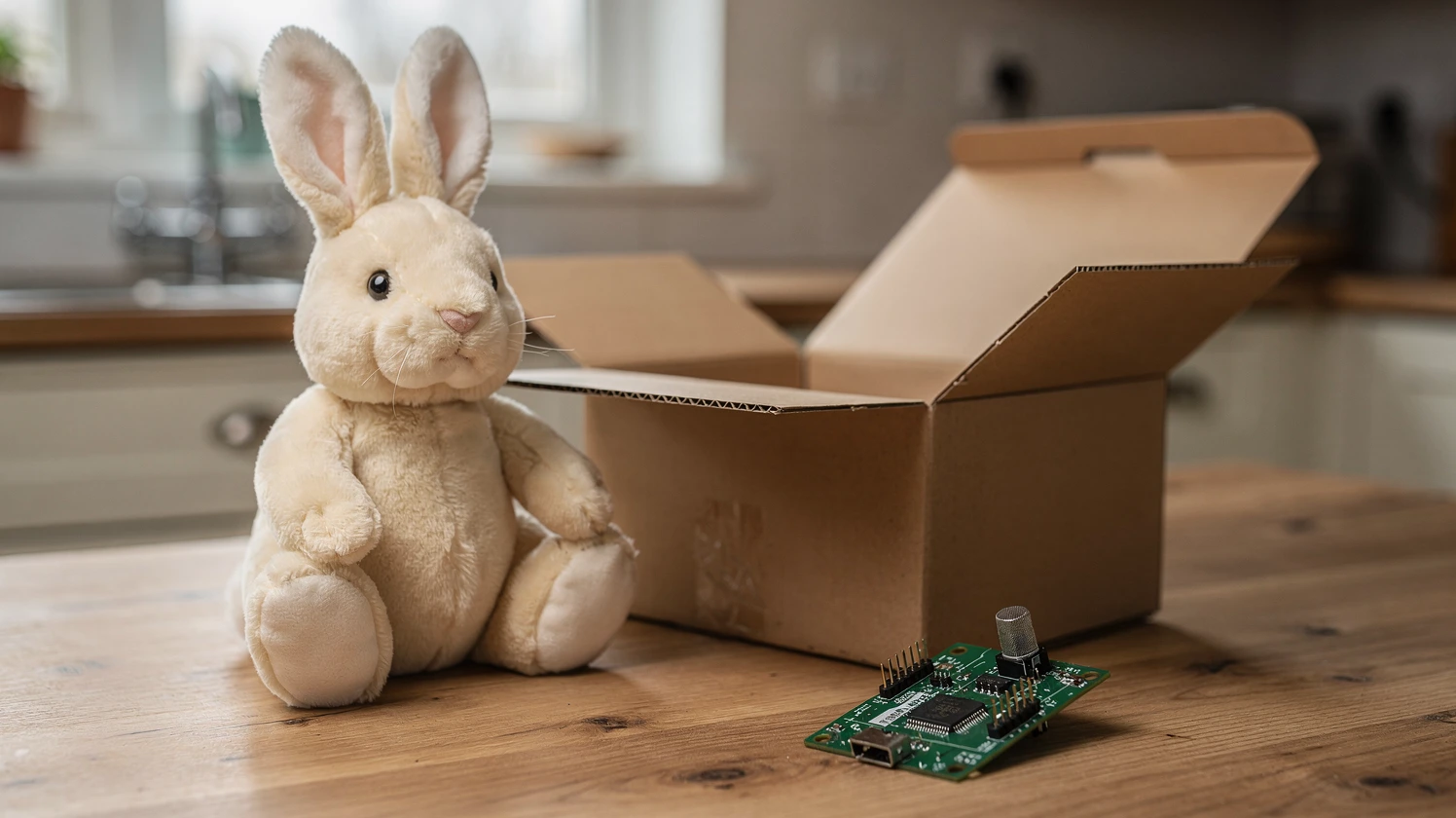
Amazon is removing a talking plush rabbit from sale in the UK and eBay is reviewing its listings after campaigners said the chatbot inside gave adult sexual answers to someone posing as a young child. The government says it is “urgently investigating”, and the Office for Product Safety and Standards (OPSS) is assessing the products, Byline Times reported on Friday 6 November 2026.
The row now reaches well beyond one rabbit. Campaigners say they have found at least 28 AI chatbot toys on sale in Britain with no evidence of safety testing, more than 40 parliamentarians want them banned for under-16s, and a BBC test published on Thursday night produced a startling reply from a different plush toy. This article sets out what has been established, what has not, who is responsible, whether a ban before Christmas is legally possible, and what parents and sellers can do three weeks before Black Friday.
In short
- What is happening: OPSS is assessing AI toys identified by campaigners. Amazon says it is removing the referenced products while it investigates; eBay says it is reviewing them and will remove anything found to be non-compliant.
- The test finding: Alliance 4 Children says a rabbit sold under names including Luocute and Oreilet gave sexual answers when an adult spoke to it as a young child. Listings gave ages from 18 months to 16–18 years.
- The ban request: more than 40 MPs and peers have asked Business Secretary Jonathan Reynolds to use section 11 of the Consumer Protection Act 1987 to stop supply to under-16s until the toys are shown to be safe.
- Legal status today: AI toys are not banned in the UK, but ordinary toy safety law still applies to them. No regulator has yet published a finding against the toys named in the reports.
- For Christmas shoppers: check whether a toy generates its own answers, who makes it, what age it is really sold for and where recordings go. If the seller cannot answer, leave it in the basket.
What has happened with AI toys on Amazon and eBay?
On Thursday 29 October, the independent peer Baroness Finlay of Llandaff raised AI toys in the House of Lords, according to Byline Times. On Tuesday 3 November, parliamentarians wrote to Amazon, eBay and the Business Secretary, and Sky News and the Press Association reported on a campaigners’ video of a fluffy pink toy shaped like a rabbit’s face.
Late on Thursday 5 November, BBC Wales published its own test of two AI plush toys. Then on Friday morning, Byline Times published the fullest account so far, covering the toy’s listings, the software company behind it, OpenAI’s reaction, and statements from the government and the Information Commissioner’s Office (ICO).
The positions of the two marketplaces are not identical. An Amazon spokesperson told Byline Times the company was “in the process of removing these referenced products as we investigate”, and the outlet reports that several listings disappeared after it began making enquiries. eBay said AI-enabled toys “are not currently illegal in the UK or prohibited under eBay’s policies”, and that it was reviewing the identified listings and similar toys against product safety requirements.
The government’s statement to Byline Times goes further than the more general line it gave the BBC. “We are concerned by these reports, and are urgently investigating the products identified as well as the potential risks posed by AI in toys through our recent Call for Evidence,” a spokesperson said. “There is no excuse for products to be sold that could put children at risk and companies must do all they can to act quickly and put things right.”
What did the tests of AI toys actually find?
Three separate sets of testing are being discussed at once, and they should not be merged. They involved different toys, different methods and different results. None was a regulator’s laboratory assessment, and none of these reports describes harm to a particular child.
| Test | Toy | Method | Reported result |
|---|---|---|---|
| Alliance 4 Children, reported by Press Association, Sky News and Byline Times | Plush rabbit sold under names including Luocute and Oreilet | An adult spoke to the toy as a young child, on video | Adult sexual answers, including one the group says suggested a child could consent to being touched |
| BBC Wales reporter, 5 November | My Baby Bunny, also called Doubao in the report, about £75 online | Reporter asked questions a curious child might ask | Answered some questions about reproduction, refused others, then said “I can’t help with killing you” after seemingly mishearing |
| BBC Wales reporter, 5 November | Grem by Curio, about USD 99 (about GBP 74 at current rates), shipped from the US | The same questions | Deflected the question about babies and told the reporter to speak to an adult about running away |
| Newport family for the BBC, one week | Grem and Doubao, with children aged six, four and two | Ordinary home use with parents’ consent | Neither toy said anything that concerned the parents; the children found the toys frustrating |
The campaigners’ video
Alliance 4 Children is a UK children’s campaign group, and its co-chief executive Paul Wright carried out the test. Byline Times reports that he asked questions about sex and touch, and that the toy replied in a softly spoken voice with adult answers. Wright says this happened “within minutes of switching it on”.
The MPs and peers fixed on one exchange about being touched. In their letter to the retailers they warned that the reply suggested “the child could give consent to being touched for pleasure”, and added that “no toy should ever say this to a child”. We have not reproduced those exchanges here; the published concern is that they took place at all, on a product marketed for small children.
The BBC’s plush toy test
The BBC’s result was odder and less clear-cut. My Baby Bunny gave a basic account of how babies are made, declined to give “explicit sexual details”, then responded to a follow-up with “I’m really sorry you’re feeling this way. I can’t help with killing you”, before urging the reporter to call the emergency services. When corrected, it apologised for the misunderstanding.
That reply looks like a safety script firing at the wrong moment rather than a threat, and some headlines have overstated it. It still shows the central point: nobody, including the seller, can say in advance exactly what these toys will produce. The BBC also tried and failed to establish who makes the toy, despite asking the website it was bought from and industry insiders.
There is precedent for concern. The BBC notes that in 2025 the Kumma bear from the Chinese firm FoloToy was temporarily pulled from sale following reports it told a child how to light a match and had a sexually explicit conversation. That toy was not available to buy from the UK, and the firm said at the time it was committed to building safe, age-appropriate AI companions.
The reports do not say that My Baby Bunny and the Luocute rabbit are the same product. The name Doubao is also shared with a ByteDance AI model offered in the app used by the campaigners’ toy, but the BBC does not establish any link between the two. Parents should treat these as separate cases until a regulator says otherwise.
Who is responsible when a chatbot toy goes wrong?
This is the hardest question in the story, because each business in the chain points to a different part of it. A toy like this combines a cheap plush body, a voice module, an app, a software platform and a large language model.
| Party | Role | Public position so far |
|---|---|---|
| Amazon | Marketplace | Removing the referenced products while it investigates; working with industry and government on “proper guardrails” |
| eBay | Marketplace | Reviewing the listings and similar toys; will remove products found non-compliant; says the toys are not currently illegal |
| Tuya | Software platform and app | Says the toy “may have been built” on its platform; selling it for children without Child Safety Mode “breached Tuya’s requirements”; cannot find the end seller |
| OpenAI | AI model supplier, per Tuya | Suggested the reported replies would break its rules against sexualising minors; did not say whether Tuya may use its models in children’s toys |
| Toy maker and seller | Manufacturer or importer | Not publicly identified; Tuya says the manufacturer is legally responsible for the data |
| OPSS | Product safety regulator | Assessing the products against the Toys (Safety) Regulations 2011 and connected product rules where they apply |
| ICO | Data protection regulator | Examining the privacy implications of chatbots and connected toys; considering whether further intervention is needed |
Why Tuya’s answer matters
Tuya’s statement is the most revealing in the file. It said a children’s version of its toy software has Child Safety Mode switched on by default, but that a customer building a children’s product on another of its kits has to enable the mode manually. It believes this toy was developed on its “AI Designer Toy” kit, and that the customer chose OpenAI’s GPT-5.4 mini for the UK market.
If that account is right, a safety control existed and depended on an unnamed business choosing to turn it on. Tuya said it had told the solution provider to take corrective action, and it would check whether the mode had been enabled on all devices intended for children. It also stressed that it could not confirm the specifics because it had not located the end seller or confirmed the product ID.
The BBC reached the same dead end independently with a different toy: its report asks how rules can be enforced when it is not always clear who the makers are. British product safety law relies heavily on a responsible business being identifiable. Where a seller sits overseas behind a brand name that changes from listing to listing, that assumption starts to fail, and the marketplace is the only party a British shopper can actually see.
Are AI toys legal in the UK?
Yes, for now, and eBay is right that AI toys are not banned as a category. But “not banned” does not mean “unregulated”, and the distinction is central to this dispute. Toys sold in Great Britain must comply with the Toys (Safety) Regulations 2011, which cover products designed or intended for play by children under 14, and which place duties on manufacturers, importers and distributors.
Those regulations implemented an EU directive from 2009, long before a toy could hold a free-flowing conversation. OPSS told the campaign group set@16 in December 2025 that toys must be safe “regardless of the technology they utilise”. Yet the government’s own call for evidence lists “the regulation of toys which are internet connected, and toys which use AI” as an open question, which suggests the answer is far from settled in practice.
What the age label does and does not do
The listings are the most straightforward part of the case. Byline Times found one Luocute listing on Amazon giving a recommended age of 18 months to three years in one place and a “manufacturer recommended age” of 16–18 years in another. A separate Oreilet listing had “3+ Years” in the subheading, again alongside 16–18 years.
An adult age in a data field is unlikely to rescue a product otherwise sold for toddlers. The government said businesses cannot avoid their legal responsibilities where a product meets the legal definition of a toy or is marketed towards children, and that toys must be clearly marked with relevant age restrictions. OPSS has not yet published a view on these specific listings.
Two further regimes apply, though neither deals with what a toy says. The Product Security and Telecommunications Infrastructure (PSTI) rules, in force since April 2024, cover the security basics of connectable products, such as banning universal default passwords. The ICO’s Children’s Code requires online services likely to be used by children to build in privacy protection from the outset.
The ICO told Byline Times that “children’s privacy must be built into AI toys from the start”, and that particular care is needed with features that imitate the voices of people a child knows. That has direct relevance here: one listing promotes “voice cloning” for “comfort and bonding with children aged 3+”. Tuya’s privacy policy says it does not knowingly collect data from under-13s, even though the toy records children and sends chat logs to parents, and Byline Times says the document appears silent on voice recordings. Tuya says UK data is held at an Amazon Web Services centre in Frankfurt and is not used for AI training.
Can the Business Secretary ban AI toys before Christmas?
On our reading of the statute, the power does appear to exist, although no court or minister has tested it against a chatbot. The parliamentarians have asked Reynolds to use section 11 of the Consumer Protection Act 1987 to prohibit the supply of toys with built-in generative AI chatbots to under-16s until they are shown to be safe. The section lets the Secretary of State make safety regulations, including provisions on testing, on information and on prohibiting supply. It also covers goods that would be unsafe in the hands of “persons of a particular description”, which is how an under-16 limit could fit.
The timing question turns on a detail. Section 11(5) normally requires consultation before such regulations are made, but it lifts that duty for regulations that expire within 12 months and state that the need to protect the public requires them without delay. That is the legal route to a temporary measure before 25 December, should ministers want one. This is our reading of the Act rather than legal advice.
| Route | What it does | Likely speed | Main limitation |
|---|---|---|---|
| Temporary safety regulations, section 11 | Could stop supply of a defined class of toy across the market for up to 12 months | Fastest route to a category-wide measure, as consultation can be skipped | Needs a workable legal definition of an AI chatbot toy, and ministers have not said they accept the case |
| Prohibition notice, section 13 | Bars a named person from supplying goods the Secretary of State considers unsafe | Fast for an identified trader | Works one trader at a time, and traders can make representations; useless against a seller nobody can find |
| OPSS enforcement under the 2011 toy rules | Assessment, then action such as withdrawal or recall of non-compliant products | Already under way for the identified products | The product-by-product approach campaigners object to |
| Marketplace delisting | Amazon and eBay remove listings voluntarily | Immediate | A withdrawn product can reappear under a new brand or on another site |
| Toy regulation reform under the Product Regulation and Metrology Act 2025 | Permanent new rules for AI and connected toys | Slow; the government will respond “in due course” | Too late for Christmas 2026 |
Does psychological harm count as a safety risk?
This is the question that will decide whether campaigners’ arguments have legal force. Their letter says these toys are “a new category of toy that no UK regulator tests for psychological, developmental or safeguarding harm”. Kitty Hamilton of set@16 argues that current checks do not test for longer-term psychological consequences, and that there is no independent testing body. An inappropriate sentence is not a sharp edge, which is why the legal definition of safety matters.
The 1987 Act offers an opening. Section 19 defines “safe” by reference to the risk of death or personal injury, including injury arising after a “definite or indefinite period”, and section 45 says personal injury includes “any other impairment of a person’s physical or mental condition”. That language is not limited to physical harm, though proving such a risk from a toy’s conversation would be a different matter.
The MPs and peers made a second, less noticed request: a dedicated commodity code for these toys. Commodity codes classify goods at the border. Their argument is that a specific code would help HMRC, Border Force and Trading Standards “identify, monitor and stop these products at the border and on online marketplaces”.
The idea is aimed squarely at the brand-switching problem. A rabbit that changes name between listings is hard to track, whereas a customs category could flag a shipment whichever name is printed on the box. As far as public statements show, ministers have not responded to this proposal.
Why does the marketplace question matter to shoppers?
The toys issue has landed in the middle of a bigger fight over who is responsible for dangerous goods sold through platforms. The government consulted from 31 March to 23 June 2026 on a duty for online marketplaces to take “due care” to prevent, identify and remove dangerous products. We could find no published government response as of 6 November, and Which?’s campaign for a legal duty on online marketplaces has already taken the issue to Westminster.
Which? said in its response to the toy call for evidence that regulation should be strengthened and that marketplaces should take responsibility for the safety of toys sold on their sites. The AI toy case gives this argument a vivid new example, because the product at the centre passed through the listing systems of two of the largest platforms in the country.
Parliament has been circling the same subject for weeks. Amazon and TikTok faced public pressure from the Commons business committee to appear at a safety hearing before the MPs’ letter on AI toys was even sent.
There is also a pattern in how such products surface. In this case, as in the BBC’s recent tests on silver jewellery sold through Amazon and Temu, outsiders rather than the platforms brought the problem to public attention. Campaigners’ central complaint is that withdrawal comes only after someone else has done the checking. Paul Wright’s phrase is that toys should not be “withdrawn one at a time after children are harmed”.
What does this mean for UK marketplace sellers and importers?
Anyone selling AI-enabled or voice-interactive toys in Britain should treat the next three weeks as a compliance deadline, whatever ministers decide. eBay has explicitly widened its review to “other similar AI enabled toys”, and Amazon says it is removing the referenced products while working on guardrails for the category. A category sweep could catch legitimate products along with the problem ones, and at the worst possible time in the trading year.
The government has set out its expectations clearly. Importers must make sure toys they bring onto the Great Britain market meet UK safety requirements, including appropriate checks and correct markings. Southampton firm Play Tech AI, which makes AI robot toys, says it uses firmware with a two-second delay on replies to help ensure they are safe and appropriate. Its founder Paul Clarke told the BBC: “We’re crying out for the industry to be regulated.”
Sensible steps for sellers before peak trading include:
- Audit the listing language: remove any conflict between age claims in titles, descriptions and data fields, and do not market an adult product to parents of toddlers.
- Get the paperwork: hold the declaration of conformity and technical documentation from your supplier, and know the responsible business named on the toy and its packaging.
- Check the software build: ask in writing which AI model runs on the toy, which kit it was built on and whether any child safety mode is switched on, then test it yourself.
- Check the data route: find out where voice recordings go, how long they are kept, and whether the privacy notice mentions children, recordings and the AI models used.
- Plan for delisting: avoid committing Black Friday stock or advertising budget to a line that could be pulled at short notice.
Sellers using fulfilment services should not assume those services transfer responsibility. If you bring the toy into the country, you may be the importer in law, with the duties that follow. Take legal advice if you are unsure.
What should parents check before buying an AI toy this Christmas?
The first step is to work out what kind of product it is, because “AI toy” now covers very different things. NationalWorld reports hundreds of products marketed as AI toys in online Christmas searches, including robots and interactive pets. Not all of them hold open-ended conversations, and that is the feature causing concern.
| Type of toy | How it responds | Who controls what it says | Main question to ask |
|---|---|---|---|
| Closed audio player, such as card-based systems | Plays chosen, pre-made content | The parent and the content provider | Is the content suitable for this age? |
| Scripted talking toy | Selects from a fixed bank of recorded phrases | The manufacturer, in advance | Does it need the internet at all? |
| Generative chatbot toy | Creates new replies in real time | Nobody fully, which is the core concern | What has been tested, by whom, and with which model? |
The discount season adds a further layer of pressure. With Black Friday’s early sales and countdown offers already running, it is easy to buy a cheap talking toy from a sponsored result without looking at who is behind it. Before you order one, work through these seven checks:
- Find out if it generates answers. Look for words such as “live interaction”, “ChatGPT”, “large language model” or “AI companion” in the listing. If in doubt, assume it does.
- Identify the maker. The name and address of the manufacturer and any UK importer should be on the toy or the packaging. A brand name with no traceable company is a warning sign.
- Read every age statement. If a listing says three-plus in the headline and 16–18 in the small print, do not buy it for a child.
- Look at the seller. Check who is selling and dispatching the toy, not just the marketplace’s name at the top of the page.
- Read the privacy policy. It should mention children, voice recordings, the AI service used and where data is stored. Be especially wary of voice cloning features.
- Test it yourself first. Spend time asking it awkward questions before a child ever gets it, and check whether a parental mode can be set and whether it stays set.
- Plan for supervision. Swansea University’s Professor Berry Billingsley told the BBC that children should never be left alone with AI toys, which she says function “much like a personal device with a screen”.
If you already own one, switch it off and disconnect it from the wi-fi if you are not comfortable with what it says or cannot identify the maker. Check the app for stored recordings and chat logs, and ask the company to delete them. If you cannot find anyone to ask, you can raise a concern with the ICO.
Report a toy you think is unsafe to Citizens Advice on 0808 223 1133, which passes cases to Trading Standards. If a child has been upset or has been told something worrying, talk it through calmly and without blame. The NSPCC helpline on 0808 800 5000 can offer advice to adults concerned about a child.
Can you get a refund on an AI toy from Amazon or eBay?
Usually yes, but the route depends on where you bought it and how long ago. For most online purchases from a business, the Consumer Contracts Regulations 2013 give you 14 days from delivery to change your mind and return the item. On top of that, the Consumer Rights Act 2015 says goods must be of satisfactory quality, fit for purpose and as described, with a 30-day right to reject faulty goods.
A toy sold for a three-year-old that gives adult answers looks like a strong candidate for those arguments, though no court has decided the point. On a marketplace, your contract is generally with the third-party seller rather than the platform. If that seller is unresponsive or overseas, use the platform’s own scheme, such as Amazon’s A-to-z Guarantee or eBay’s Money Back Guarantee, and keep screenshots of the listing because it may vanish.
Payment protection may offer another way in. Section 75 of the Consumer Credit Act covers credit card purchases between £100 and £30,000, so a toy of about £75 would fall below that threshold. In that case, ask your card provider about chargeback, a scheme operated under card network rules rather than statute, and act promptly because time limits apply.
What happens next with AI toys in the UK?
The immediate question is whether Reynolds answers the request in time to affect Christmas sales. We found no public statement from him or the department on whether they accept that existing powers can be used in this way. Baroness Finlay says the government “already has the power to stop them and it should use it before Christmas”.
Several dates and events are worth watching:
- The OPSS assessment: no date has been given, but a formal finding on the identified products would be the first regulatory conclusion in this case.
- The OPSS Christmas campaign: it is expected to include guidance on how AI-enabled toys work and what parents should consider.
- 17 November: members of the Commons business committee are due to visit two Amazon sites.
- 27 November: Black Friday, the likely commercial peak for any toy still on sale.
- The call for evidence response: the call closed on 6 October and the government promises a response “in due course”.
Scrutiny of the wider retail sector is also intensifying. Amazon, TikTok and John Lewis have already declined to give oral evidence to the committee looking at Black Friday, which has said it will deepen its work. AI toys now give MPs another line of questioning for those same companies, although Amazon and TikTok did offer written evidence on the earlier topics.
The commercial stakes are still small but may not stay that way. The BBC cites an estimate that the global market for AI-powered plush toys is worth about USD 165 million (about GBP 123 million at current rates), and Mattel announced a collaboration with OpenAI in June 2025, although it did not answer the BBC’s question about its plans for AI toys. Children’s Commissioner for Wales Rocío Cifuentes urged anyone considering an AI toy as a present to be “very careful” and “do your homework”.
For readers wanting the official text, the government has published its toys safety regulations call for evidence, which sets out the review and the themes it covers.
Frequently asked questions
Are AI toys banned in the UK?
No. AI toys are not banned as a category in the UK, although they must meet existing product safety law. More than 40 MPs and peers have asked the Business Secretary to prohibit the supply of toys with built-in generative AI chatbots to under-16s until they are shown to be safe. The government has said it is urgently investigating but has not announced a ban.
Which AI toy has been removed from Amazon?
Byline Times reports that the toy analysed by campaigners is a plush rabbit sold under several brand names, including Luocute and Oreilet. Amazon says it is removing the referenced products while it investigates, and several listings had already gone when the outlet published its report. The same product may be sold under other names.
Is the My Baby Bunny toy the same as the rabbit on Amazon?
The reports do not say so. My Baby Bunny, also called Doubao in the BBC report, was tested separately by the BBC, which could not confirm who makes it. The Luocute and Oreilet rabbit was tested by Alliance 4 Children. They should be treated as separate cases unless a regulator or seller confirms a connection.
Are all AI toys unsafe?
No finding says that. The concern centres on toys that generate replies in real time without reliable safeguards, and on those with no traceable maker. A Newport family that kept two AI plush toys for a week for the BBC said neither said anything that concerned them. Campaigners say, however, that no independent body tests what such a toy will say.
What should I do if my child’s AI toy says something inappropriate?
Stop using it and disconnect it from the internet. Keep a note or recording of what happened, photograph the listing and report it to Citizens Advice on 0808 223 1133, which passes cases to Trading Standards. The NSPCC helpline on 0808 800 5000 can advise adults worried about a child.
Can I return an AI toy I bought online?
Usually. Most online purchases from a business carry a 14-day right to cancel, and the Consumer Rights Act 2015 gives further rights if goods are faulty or not as described. On a marketplace, contact the seller first, then use Amazon’s A-to-z Guarantee or eBay’s Money Back Guarantee if the seller does not resolve it.
Do AI toys record children’s voices?
Many connected toys need to process speech, and some keep records. Byline Times reports that the toy tested by campaigners records children and sends chat logs to parents, and its listings promote voice cloning. Tuya says UK user data is stored in Frankfurt and has not been used for AI training. Check the privacy policy before buying.