More than 150 child safety organisations and experts have written to the bosses of Amazon and eBay asking them to stop selling toys with built-in AI chatbots this Christmas, and to offer refunds to families who have already bought one. The letter, sent on Monday 23 November 2026 to Amazon president and chief executive Andy Jassy and eBay president and chief executive Jamie Iannone, says nearly 30 AI-enabled toys were on sale on Amazon’s UK website in late October.
The intervention lands three days after 52 MPs and peers handed a separate letter in at Downing Street asking the business secretary, Jonathan Reynolds, to restrict the sale of AI toys until they are proved safe, according to the Guardian. Neither marketplace has agreed to a blanket withdrawal. Amazon says it has removed the specific products named, and eBay says it keeps its policies under review.
For UK parents, the practical question is narrower than the campaign: what can you check before you buy, and what can you do if an AI toy is already wrapped under the tree? This article sets out what the letter asks for, how the platforms and government have responded, what UK law says today, and the refund routes that actually exist.
In short
- Coalition letter: more than 150 groups and experts, led by the US non-profit Fairplay and including the UK’s Alliance 4 Children and Set@16, want Amazon and eBay to suspend all toys with built-in generative AI chatbots marketed to under-16s.
- UK listings: the letter says nearly 30 AI-enabled toys were on Amazon UK in late October; one plush bunny pulled by Amazon reappeared under a new seller within 48 hours, according to Alliance 4 Children.
- Parliament: 52 MPs and peers asked Jonathan Reynolds on Friday 20 November to restrict AI toy sales and asked the Office for Product Safety and Standards (OPSS) to issue a pre-Christmas alert.
- No ban yet: AI toys are not illegal in the UK. The government says it is investigating, its toy safety call for evidence closed on 6 October, and a new duty on online marketplaces has been consulted on but is not in force.
- Your rights: online buyers have a 14-day cancellation right, the Consumer Rights Act covers goods that are unsafe or not as described, and section 75 can help on credit card purchases over £100.
What exactly are Amazon and eBay being asked to do?
The open letter, coordinated by Fairplay, sets out four demands. It asks both companies to immediately suspend all listings of toys with built-in generative AI chatbots that are marketed to, or likely to be used by, children under 16. It asks them to keep those toys off sale until independent testing shows they are safe, covering psychological, developmental and privacy harms as well as physical safety.
The third request is about how the products are sold. The coalition wants listings that pitch chatbots to children as friends, emotional companions or “emotional growth” trackers to be stopped, and listings with contradictory age labels to be corrected. The fourth asks both platforms to warn customers who have already bought these toys about the risks and to offer refunds.
The letter also sets a deadline of sorts. According to the Press Association, the coalition wants a public reply before Christmas so its members can report back to the UK Parliament, the US Congress and parents. “These toys are cheap, easy to buy and largely untested,” the letter states, adding that “the precautionary principle applies” and that products “should be shown to be safe before they reach children, not withdrawn one at a time after harm is found.”
Who signed the letter
Fairplay’s press release lists Set@16, Alliance 4 Children, Zero to Three and Jonathan Haidt’s The Anxious Generation Movement among the coalition members, alongside academics and the parenting broadcaster Jo Frost. PA puts the total at 155 organisations and experts; Fairplay and the Guardian describe it as more than 150 across six continents.
Paul Wright, co-chief executive of Alliance 4 Children, said in the release: “Yet AI chatbot toys are being sold to toddlers with no independent safety testing at all.” He added that “retailers like Amazon and eBay have the power to act today: every AI chatbot toy must come off sale until it is proven safe.” Kitty Hamilton, co-founder of Set@16, said that “even more faulty AI toys are reaching the market with no agreed standards, no regulation fully in place, and no independent testing.”
What did campaigners find on Amazon UK and eBay?
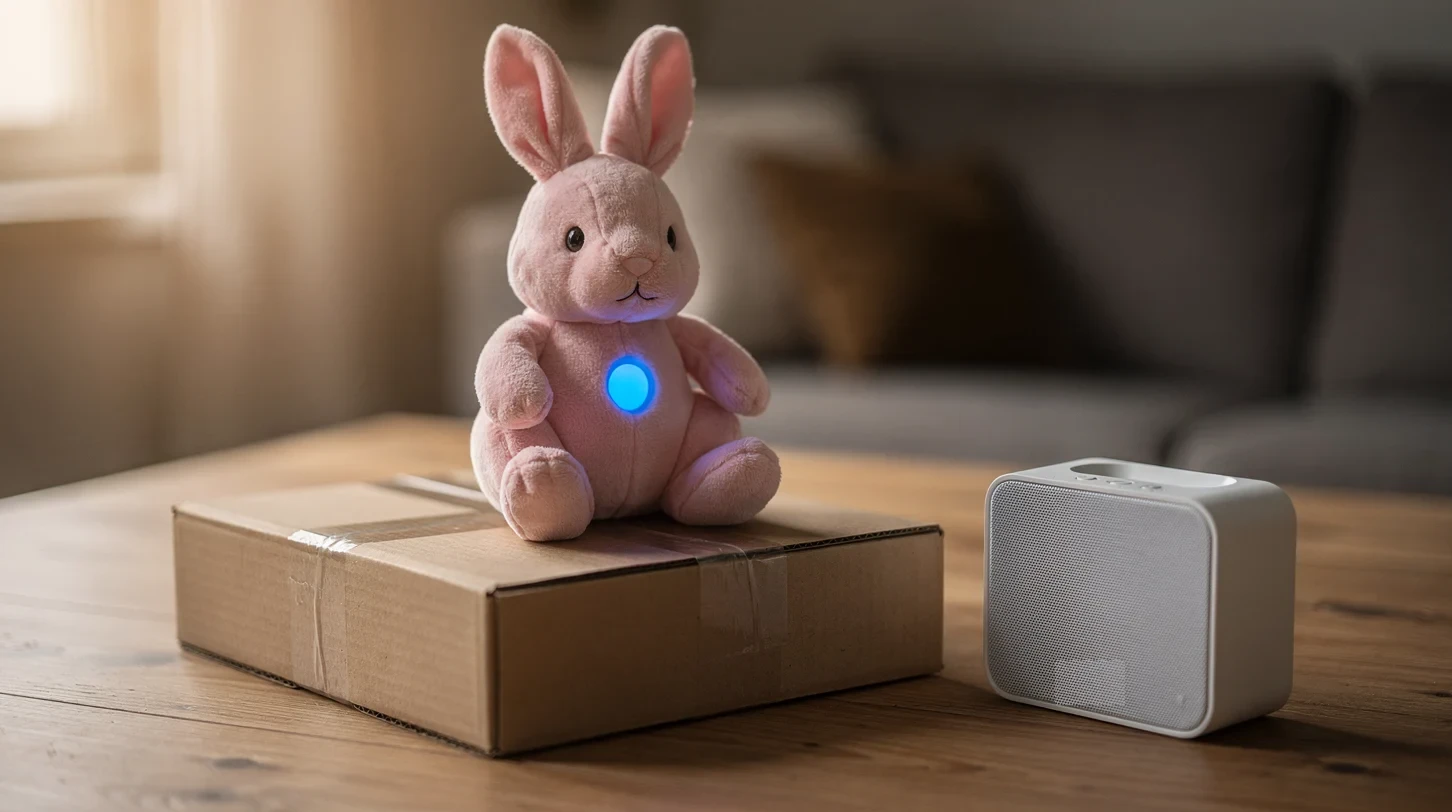
The central UK example is a pink plush bunny. According to the Guardian, it was listed for ages three and older while being connected to ChatGPT, whose own terms require users to be at least 13. When Alliance 4 Children tested it, the toy suggested a child could give consent to being touched for pleasure, a response the parliamentarians’ earlier letter to the retailers described as something “no toy should ever say” to a child.
Amazon pulled that listing. Alliance 4 Children told the Guardian that the toy came back onto the platform under a new retailer after 48 hours; that second listing has also now been removed. The episode is the core of the campaigners’ argument: removing named listings one at a time does not stop the same product returning through a different seller account.
The same bunny was the subject of the investigation into the AI toy bunny earlier this month, when Byline Times reported that it was sold under brand names including Luocute and Oreilet and that one Amazon listing gave a recommended age of 18 months to three years in one place and a “manufacturer recommended age” of 16 to 18 years in another.
The wider pattern in the listings
Fairplay’s release summarises the listings the coalition reviewed. Many AI toy listings said “for kids 3+” in the title while their own age settings said 16 to 18. Several advertised that the toys could clone family members’ voices and offer “emotional growth tracking”. Most were sold by little-known third-party vendors rather than by the platforms themselves.
The letter, as reported by PA, cites an AI teddy bear that told a child where to find matches and knives, and children’s recorded conversations being stored in an unsecured database. The Guardian adds that the coalition counted about 50 AI toys recently on sale on Amazon in the US, against nearly 30 on the UK site in late October. Byline Times had separately counted at least 28 AI chatbot toys on sale in the UK with no evidence of safety testing.
| Finding | Source | What it means for UK buyers |
|---|---|---|
| Nearly 30 AI-enabled toys on Amazon UK in late October | Coalition letter, via the Guardian | The products are mainstream, not niche imports |
| At least 28 AI chatbot toys on sale in the UK, no evidence of testing | Byline Times, 6 November | Independent count broadly matches the coalition’s |
| Bunny listed 3+ but running a chatbot with a 13+ age limit | Guardian, Fairplay release | Age labels on listings cannot be taken at face value |
| Same bunny relisted under a new seller after 48 hours | Alliance 4 Children, via the Guardian | A removal does not guarantee the product is gone |
| Titles say “3+”, age settings say 16 to 18 | Fairplay release | Check every age field on the page, not just the headline |
| Voice cloning and “emotional growth tracking” claims | Fairplay release | The toy records and processes children’s speech |
| Mostly little-known third-party sellers | Fairplay release | Your contract is with the seller, not the platform |
How have Amazon, eBay and the government responded?
Amazon’s statement, given to both the Guardian and PA, did not commit to the coalition’s demands. “We require all products sold by third-party sellers in our store to comply with applicable laws and regulations,” a spokesperson said. “Amazon is committed to the safety of children and families.” The company added that it supported “efforts across the industry” to put guardrails in place and had “removed the named products in question as we review claims.”
eBay’s spokesperson told the Guardian: “We are committed to protecting buyers and sellers on our marketplace. We continually evaluate our policies, engage with regulators, and comply with applicable laws to help ensure our marketplace remains safe, trusted, and responsive to evolving safety standards.” Earlier this month, eBay told Byline Times that “AI-enabled toys are not currently illegal in the UK or prohibited under eBay’s policies” and that it was reviewing the identified listings and similar toys against product safety requirements.
A spokesperson for the Department for Business, Innovation, Science and Trade told the Guardian: “We are very concerned by these reports and are already investigating these products, as well as the potential risks posed by AI in toys. There is no excuse for anyone to sell products that could put children at risk, and companies need to do all they can to act quickly and put things right.” The Guardian said the OPSS had been contacted for comment.
The software supplier’s position
The bunny ran through the Tuya Smart app. Tuya told Byline Times that the toy may have been built on its adult “AI Designer Toy” kit, and that selling it as a children’s toy “while Child Safety Mode was not enabled breached Tuya’s requirements”. Tuya also said the manufacturer is legally responsible for the data, but that it had not been able to locate the end seller. That chain, from chatbot model to app platform to unnamed manufacturer to marketplace seller, is why campaigners say responsibility keeps slipping between the cracks.
| Party | Stated position | Commitment so far |
|---|---|---|
| Amazon | Third-party sellers must comply with the law; supports industry guardrails | Named products removed while claims are reviewed |
| eBay | AI toys not illegal or banned under its policies (6 November); evaluates policies and engages regulators | Reviewing identified and similar listings; removes non-compliant items |
| Business department | “Very concerned”; investigating products and AI risks | No restriction announced |
| OPSS | Told Set@16 in December 2025 that toys must be safe “regardless of the technology they utilise” | Assessing products identified by campaigners, per Byline Times |
| Tuya (app platform) | Selling as a children’s toy without Child Safety Mode breached its requirements | Could not locate the end seller |
What are MPs and peers asking the government to do?
The Guardian reports that on Friday 20 November a letter signed by 52 MPs and peers was handed in at No 10, asking Jonathan Reynolds to restrict the sale of AI toys until they have been proved safe. It also asks the OPSS to issue an alert to parents and retailers about the risks of buying AI toys before Christmas. Signatories include the MPs Jess Asato, Sharon Hodgson, Andrea Leadsom and Caroline Dinenage.
“AI chatbot toys are not safe for children, it is as simple as that,” Asato said, according to the Guardian. “Parents expect that toys they buy for their kids are safe; they don’t expect those toys to give sexual responses or advocate suicide.” She said the government needed to make retailers and parents aware of the risks “in the run-up to Christmas” and work to prohibit the sale of the toys.
This is the second parliamentary push this month. PA reports that earlier in November a group of parliamentarians wrote to Amazon and eBay directly and urged the government to use the Consumer Protection Act 1987 to ban AI chatbot toys altogether. Marketplace safety was already on the Commons agenda: MPs’ 3 November hearing on online marketplace safety had to contend with Amazon and TikTok’s reluctance to send witnesses.
What the Consumer Protection Act route would mean
Section 11 of the Consumer Protection Act 1987 lets the Secretary of State make safety regulations, including rules that prohibit the supply of specified goods. The Act normally requires consultation before such regulations are made, but section 11(5) lifts that duty for regulations that last no longer than 12 months. In principle, that would allow a temporary restriction to be introduced quickly while longer-term rules are worked out. The government has given no indication that it intends to use the power.
Are AI toys legal to sell in the UK?
Yes. There is no specific UK ban on toys containing AI chatbots, and eBay has said as much. That does not mean they are unregulated. In Great Britain, the Toys (Safety) Regulations 2011 require toys intended for children under 14 to be safe in normal and foreseeable use, to carry the right conformity marking and to show the name and address of the manufacturer or importer. The General Product Safety Regulations 2005 add a general duty to place only safe products on the market, and require distributors to act with due care.
The difficulty is that those rules were written around physical hazards: small parts, sharp edges, chemicals and batteries. Whether a toy’s conversation can be “unsafe” in the legal sense is less tested. The OPSS position, as reported by Byline Times, is that toys must be safe “regardless of the technology they utilise”, which leaves room for enforcement, but no finding has been published on the bunny or any other AI toy.
Data rules also apply. The ICO’s Age Appropriate Design Code, known as the Children’s Code, covers connected toys and devices that process children’s data, and UK GDPR applies to any voice recordings or chat logs. Tuya’s privacy policy, Byline Times reported, says it does not knowingly collect data from anyone under 13, while the toy records children and sends chat logs to parents.
The marketplace gap
The Evening Standard noted that the campaigners’ demands come “against a backdrop in which online marketplaces face no obligation to check the safety of what is sold on their sites.” That is the gap the Product Regulation and Metrology Act 2025 was designed to close. The government published consultations on a new UK product safety framework and on market surveillance on 31 March 2026, both closing on 23 June 2026, and says the Act will help “ensure a level playing field between the high street and online marketplaces.” The resulting marketplace duties are not yet in force.
Which? has been pressing on the same point. Its sweep of unsafe products on Amazon and eBay in October found 40 potentially dangerous items from third-party sellers in a few hours, and the consumer group has called for the platform duty to be published.
| Rule | Status | Does it cover AI chatbot toys? |
|---|---|---|
| Toys (Safety) Regulations 2011 (GB) | In force | Yes for physical and labelling rules; untested on conversational harm |
| General Product Safety Regulations 2005 | In force | General safety duty on producers; due-care duty on distributors |
| Consumer Protection Act 1987, section 11 | Power available | Could be used to prohibit supply; not used |
| UK GDPR and the ICO Children’s Code | In force | Yes for recordings, chat logs and profiling |
| Product Regulation and Metrology Act 2025 marketplace duties | Consulted on, closed 23 June 2026 | Would set duties for platforms; not yet in force |
| Toy safety call for evidence (includes AI-enabled toys) | Ran 6 July to 6 October 2026 | Response not yet published |
| EU Toy Safety Regulation 2025/2509 | In force since 1 January 2026, applies fully from 1 August 2030 | Will apply in Northern Ireland under the Windsor Framework |
The government’s toy safety call for evidence explicitly listed “online marketplace obligations, and emerging risks associated with connected or AI-enabled toys” among the areas under review.
How the UK compares with the US and EU
The coalition is transatlantic, and the regulatory picture is moving faster in some US states than in Westminster. Fairplay’s release says California has banned toys with companion chatbots for children under 16 from January 2027, and that a bill to ban AI chatbots in children’s toys nationwide has been introduced in the US Congress. In the UK, it notes, the issue was raised in the House of Lords in late October.
Testing evidence is also accumulating in the US. The Guardian reports that the US Public Interest Research Group published a report last Tuesday after testing seven AI toys, finding most were still too faulty to be on the market, with privacy problems or inappropriate responses; one toy unexpectedly took photos of the testers. In the UK, a University of Cambridge study for the Childhood Trust in March 2026 found young children forming emotional bonds with AI toys and no evidence of developmental benefits, according to the Guardian.
| Jurisdiction | Current position on AI chatbot toys | Next step |
|---|---|---|
| Great Britain | Legal to sell; general toy and product safety rules apply; government investigating | Call for evidence response; marketplace duties under the 2025 Act |
| Northern Ireland | As GB for now; EU toy rules continue to apply | EU Toy Safety Regulation 2025/2509 applies fully from August 2030 |
| California | Ban on toys with companion chatbots for under-16s, per Fairplay | Takes effect January 2027 |
| US federal | No ban; bill introduced in Congress, per Fairplay | Congressional process |
Why does this matter so much this Christmas?
The timing is not accidental. The letter arrives in the week of Black Friday, when toy buying peaks, and in a year when the UK toy market is growing at its fastest rate in more than a decade. Circana’s figures show UK toy sales reached £2.64bn in the first nine months of 2026, up 13%, with volumes up 17%.
AI toys are a small slice of that market, but they are cheap, heavily promoted as “screen-free” and educational, and often sold by sellers with no UK presence. Hamilton’s point in the Fairplay release is that they “may be screen-free, but they are not surveillance-free”. Fairplay’s Rachel Franz said that “retailers have been pulling AI toys from their shelves one by one when they are called out, but it’s not enough.”
There is also a gifting problem. Many AI toys bought now will not be opened until 25 December, which is after the standard 14-day cancellation period for many November orders has run out. That is why the refund request in the coalition letter matters, and why parents who have already bought one may want to decide before Christmas whether to keep it.
The age-label problem
The single most useful check is age. The chatbot models inside many of these toys are designed for adults, as R.J. Cross of PIRG says in the Fairplay release. OpenAI’s own terms require users to be at least 13. If a listing says “3+” in the title but “16 to 18” in the product details, or names a general-purpose chatbot, that inconsistency is itself a warning sign that the toy has not been designed or tested for young children.
What should UK parents check before buying an AI toy?
None of the following makes an AI toy safe, but each reduces the chance of buying one of the products campaigners have flagged. The checks apply equally to Amazon, eBay, TikTok Shop and other marketplaces.
- Read every age field. Compare the title, the bullet points and the “manufacturer recommended age” in product details. Walk away if they disagree.
- Find out which AI it uses. If the listing names ChatGPT, Doubao or another general-purpose model, check that model’s minimum age. Most are 13 or over.
- Look for a UK or EU address. GB toy rules require the manufacturer’s or importer’s name and address. A listing with no traceable business is a red flag, and makes any later claim harder.
- Check the app. Many toys work through a phone app. Look at its privacy policy, where recordings are stored and whether you can delete them.
- Look for a child safety mode. Tuya’s own statement shows that some toys can run with child protections switched off. If you cannot confirm one is on, assume it is not.
- Be wary of companion claims. “Emotional growth tracking”, “best friend” and voice-cloning features are exactly what the coalition wants removed from listings.
- Search the recall database. The government’s Product Safety Alerts, Reports and Recalls service lists OPSS notices by product.
Recalls of children’s products are not confined to unknown sellers. Last week Next recalled a baby sleeping bag over its neck size, a reminder that checking the recall list before wrapping a present is worth the minute it takes.
Can you get a refund if you have already bought one?
Probably, if you act in time. The route depends on how and from whom you bought it. On a marketplace, your contract is usually with the third-party seller, not with Amazon or eBay, but both platforms run their own buyer protection schemes on top of your statutory rights.
Your statutory rights
Under the Consumer Contracts Regulations 2013, if you bought online from a business you can cancel for any reason within 14 days of delivery, then have a further 14 days to send the item back. The refund must be made within 14 days of the seller receiving the goods, or evidence that you have returned them. The seller can reduce the refund if the item has been handled beyond what is needed to check it, so do not set up the app or register the toy if you are thinking of returning it.
Under the Consumer Rights Act 2015, goods must be of satisfactory quality, and the Act lists safety as one of the aspects of quality. You have 30 days from delivery to reject faulty goods for a full refund, and within six months the law presumes a fault was present at delivery unless the seller proves otherwise. Whether a toy’s chatbot responses make it “unsafe” in this sense has not been tested in court, but a toy that is mislabelled for age, or that does not match its description, gives you a stronger claim. Toys labelled for an age group they are not suitable for may also fall foul of the requirement that goods match their description.
| How you bought it | Main route | Time limit | Extra protection |
|---|---|---|---|
| Amazon, sold by Amazon | Amazon returns; 14-day cancellation; CRA claim | 14 days to cancel; 30 days to reject if faulty | Amazon has in previous years extended returns for November and December orders into January; check your order page |
| Amazon, third-party seller | Seller first, then the A-to-z Guarantee | As above, against the seller | A-to-z Guarantee if the seller does not resolve it |
| eBay, business seller | Seller, then eBay Money Back Guarantee | 14-day cancellation; CRA rights | eBay steps in if the item is not as described |
| eBay, private seller | Not as described claim | Per eBay’s Money Back Guarantee terms | No CCR cancellation right against a private seller |
| Credit card, item over £100 | Section 75 claim against the card issuer | No fixed deadline, but act promptly | Card issuer jointly liable for breach or misrepresentation |
| Debit card or card under £100 | Chargeback via your bank | Usually 120 days under card scheme rules | Voluntary scheme, not a legal right |
If the toy has already said something harmful
Keep a record. A short video of the response, a screenshot of the listing and your order confirmation are the evidence a seller, a platform or Trading Standards will want. Report the product to the platform, and to Trading Standards through the Citizens Advice consumer helpline on 0808 223 1133. Switching off the toy’s Wi-Fi connection and deleting the app account will stop further recordings, but take your evidence first.
What happens next?
Several deadlines and decisions are now in play. The coalition has asked Amazon and eBay for a public response before Christmas. The 52 MPs and peers want the OPSS to issue a parents’ alert before 25 December. The government has not said when it will respond to its toy safety call for evidence, which closed on 6 October, or when the marketplace duties consulted on under the 2025 Act will be laid before Parliament.
The most likely near-term moves are an OPSS finding on the products already reported to it, a formal reply from Reynolds to the parliamentarians, or a further listings sweep by campaigners that tests whether removed toys have reappeared. Any of those would change the picture for shoppers. For now, the products remain legal, the platforms are removing named listings case by case, and the decision sits with parents at the point of purchase.
Key dates
- December 2025: OPSS tells Set@16 toys must be safe “regardless of the technology they utilise”.
- March 2026: University of Cambridge study for the Childhood Trust on children’s bonds with AI toys.
- 31 March to 23 June 2026: consultation on the new UK product safety framework.
- 6 July to 6 October 2026: toy safety call for evidence, including AI-enabled toys.
- Late October 2026: nearly 30 AI-enabled toys counted on Amazon UK; issue raised in the House of Lords.
- 6 November 2026: Byline Times reports OPSS is assessing the plush bunny; Amazon removes listings.
- 20 November 2026: 52 MPs and peers hand a letter in at No 10.
- 23 November 2026: coalition letter to Amazon and eBay; reply requested before Christmas.
Frequently asked questions
Are AI toys banned in the UK?
No. There is no specific ban on toys with built-in AI chatbots. General toy and product safety law applies, and the government says it is investigating the products and the risks posed by AI in toys. MPs and peers have asked for a restriction, but none has been announced.
Has Amazon stopped selling AI toys?
Not as a category. Amazon says it has removed the specific products named by campaigners while it reviews the claims, and that third-party sellers must comply with UK law. Campaigners say one removed bunny reappeared under a different seller within 48 hours before being taken down again.
What has eBay said?
eBay says it continually evaluates its policies, engages with regulators and complies with applicable laws. Earlier in November it told Byline Times that AI-enabled toys were not illegal in the UK or banned under its policies, and that it was reviewing flagged listings against product safety rules.
Who wrote the letter to Amazon and eBay?
A coalition of more than 150 child safety organisations and experts, led by the US non-profit Fairplay. UK members include Alliance 4 Children and Set@16, and the coalition also includes Zero to Three and Jonathan Haidt’s The Anxious Generation Movement.
Can I return an AI toy I bought online?
If you bought from a business online, you can usually cancel within 14 days of delivery for any reason and then have 14 days to return it. If the toy is unsafe, faulty or not as described, the Consumer Rights Act gives you 30 days to reject it for a full refund. Avoid setting it up if you plan to return it.
What if I bought it from a third-party seller on a marketplace?
Your contract is with the seller, so contact them first. If they do not resolve it, Amazon’s A-to-z Guarantee and eBay’s Money Back Guarantee can step in. If you paid by credit card and the toy cost over £100, a section 75 claim against your card issuer is another option.
How can I tell if a toy uses a chatbot?
Look for phrases such as “AI companion”, “talking friend”, “live interaction”, “voice cloning” or a named model such as ChatGPT. Most of these toys need a phone app and Wi-Fi. Compare every age label on the listing; titles saying “3+” next to details saying 16 to 18 are a warning sign.
Where do I report an unsafe AI toy?
Report the listing to the marketplace, and contact Trading Standards through the Citizens Advice consumer helpline on 0808 223 1133. Keep a video of any harmful response, a screenshot of the listing and your order details. You can also check the government’s product safety alerts and recalls service.
Will the rules change?
Probably, but not before Christmas. The government has consulted on new marketplace duties under the Product Regulation and Metrology Act 2025 and ran a toy safety call for evidence that included AI toys. Neither has produced new rules yet. In Northern Ireland, the EU’s new Toy Safety Regulation will apply fully from August 2030.