
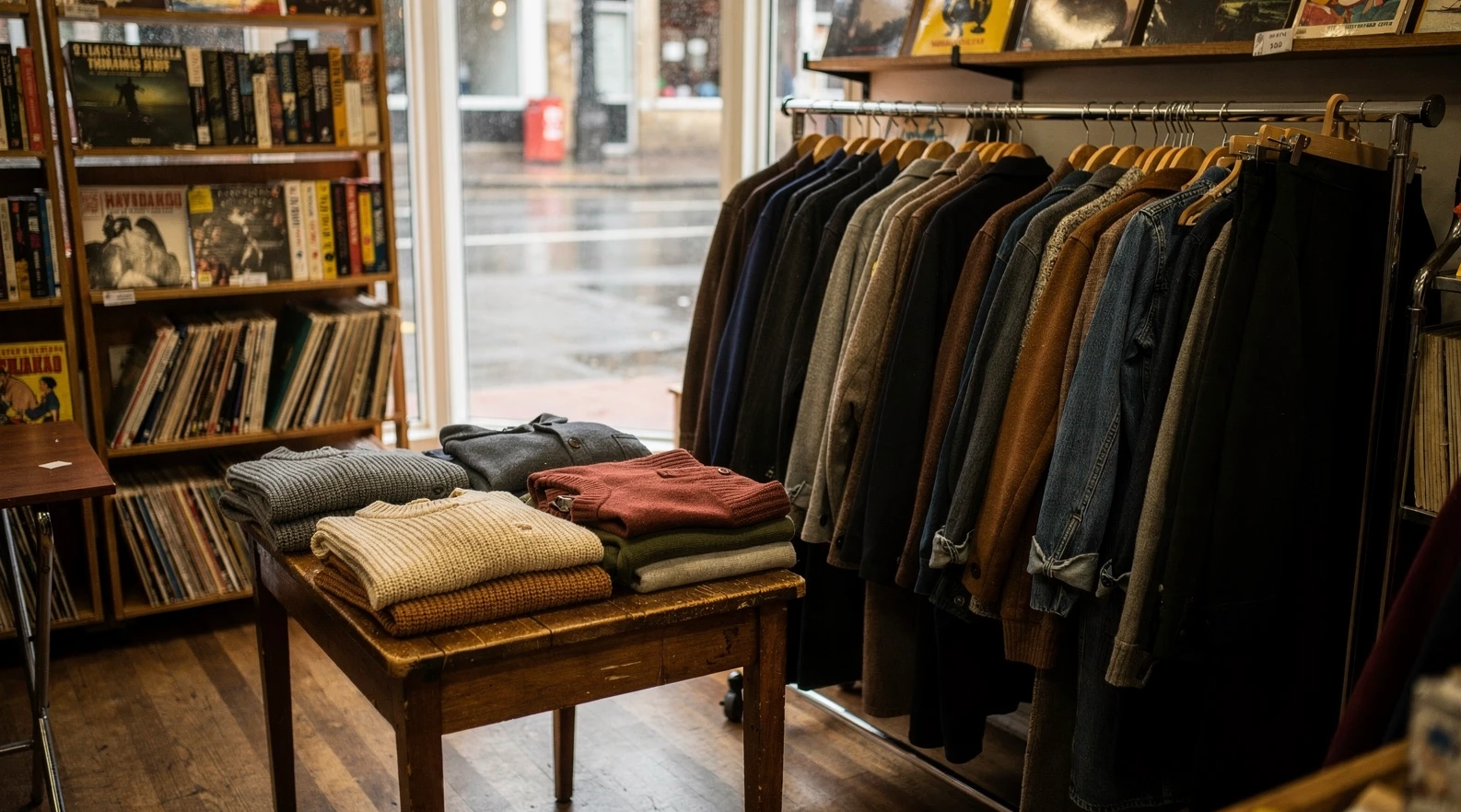
Profits at some of Britain’s best-known charity shops have fallen sharply, even as the UK spends more on secondhand clothing than ever before. According to unpublished accounts seen by the Financial Times and reported by the Guardian on Saturday 31 October 2026, Oxfam’s retail profit fell 23% to £4.9m in its last financial year, down from £6.4m the year before. The British Heart Foundation, which has the largest high street presence of any UK charity, is already working through a plan to close 150 shops.
The figures land at an awkward moment for the sector. Secondhand fashion has never been more popular, yet the money is increasingly flowing to peer-to-peer apps such as Vinted and Depop rather than to the charity tills that once had the market largely to themselves. This article sets out what the new numbers say, why the charity shop model is under strain, how it compares with the online platforms, and what it means for donors, shoppers and the high streets that rely on these shops to fill units.
In short
- Oxfam’s retail profit fell 23% to £4.9m in its last financial year, from £6.4m, according to accounts seen by the Financial Times.
- Of every £100 spent in an Oxfam shop, just £6 now reaches the charity’s work, down from £22 as recently as 2022, the FT reports.
- The British Heart Foundation is closing 150 shops: about 90 by the end of March 2027 and a further 60 by March 2028, after retail profit fell from £18.8m to £3.6m.
- UK spending on secondhand clothing has quadrupled in a decade to £8.8bn a year, according to GlobalData, but much of that growth is going to apps such as Vinted and Depop.
- The Charity Retail Association says the bigger hit has come from costs, particularly the employer national insurance changes announced in the November 2024 Budget, rather than from online resale.
What has happened to Oxfam’s charity shop profits?
The headline number comes from Oxfam’s latest filings, which had not been formally published when the Financial Times reviewed them. Retail profit, the money left over from the charity’s shops once the cost of running them is paid, fell by 23% to £4.9m. In the previous year the figure was £6.4m. The Guardian, which reported the FT’s findings on Saturday, said Oxfam described trading as exceptionally challenging.
The more striking measure is how little of each pound spent in an Oxfam shop now reaches the charity’s programmes. According to the FT, for every £100 that customers spend in Oxfam’s shops, just £6 now goes towards its work on global poverty. As recently as 2022, the figure was £22. In other words, the shops are still taking money at the till, but a far greater share of it is being absorbed by rent, wages, energy, logistics and the cost of handling donated stock.
Oxfam is not signalling a retreat from the high street, at least not yet. The Guardian reports that the charity’s focus on books and music means it has no plans to reduce its number of shops. That matters: Oxfam has long run one of the UK’s largest secondhand bookselling operations, and books and records tend to hold their value far better than the fast-fashion clothing that now dominates donation bags.
The voices from inside the sector
“It has been challenging … and it is going to be painful for the sector,” Lorna Fallon, who heads Oxfam’s retail operation, told the Financial Times. Civil Society reported in August that Fallon had been appointed as the Charity Retail Association’s next chief executive, which gives her comments added weight across the wider industry.
Richard Hawkes, Oxfam GB’s chief executive, struck a more hopeful tone in comments reported by the Guardian. “Whilst there is no getting away from the fact that the charity retail sector has been impacted by the cost-of-living crisis, like the rest of the high street, there is still much to be hopeful and positive about for the future,” he said. “The growth of secondhand presents real opportunities for the whole sector, but it also means we need to think differently about the traditional charity retail model.”
Hawkes also pointed to the role the shops play beyond income. He said they give Oxfam a presence in communities where it might not otherwise be, while providing opportunities to engage with more than 20,000 volunteers.
The fall did not come out of nowhere. In August, the Guardian quoted an inside source who claimed Oxfam was considering closing up to a fifth of its 500-plus UK outlets, citing weaker donations and competition from online sellers of secondhand goods. Oxfam denied that it had any plans to close shops or its Batley warehouse, home to its main textile recycling centre, according to Civil Society.
At the time, Civil Society reported that Oxfam had recorded a £6.3m net profit from its 515 shops, warehouses and online retail teams in the year to March 2025. That is close to the £6.4m prior-year figure in the FT’s account; the small gap is most likely down to how the two measures are defined. Either way, the direction of travel is clear: the latest year shows a further, sharper decline.
Why is the British Heart Foundation closing 150 shops?
The British Heart Foundation (BHF) is the UK’s largest charity retailer, and its numbers show the strain more starkly than Oxfam’s. In June, the charity carried out a major review of its retail arm, which employs almost 3,700 staff, after profit from its shops plunged from £18.8m in 2024 to £3.6m in the year to 31 March 2025, the Guardian reports. Some other reports, citing the accounts, put the decline even steeper, so the exact figure depends on which line of the accounts is used.
The charity cited “an exceptionally challenging trading environment” and said it aimed to close 90 stores by the end of March 2027 and another 60 by the following March. Civil Society put the size of the BHF estate at 640 charity shops when the plan was announced, which means roughly one shop in four is going.
In July, Retail Gazette reported that BHF had named the first 87 shops set to close, with a further 63 stores still under review. BHF has said that donations can still be made at affected shops until they shut, and that the charity’s overall financial position remains healthy. The closures are a retail decision rather than a sign that the charity itself is in trouble.
BHF and Oxfam are not alone. The Guardian reports that Cancer Research UK and Scope have also closed, or are closing, some of their shops. Neither charity has framed this as a wholesale retreat, and charity retailers routinely open and close sites as leases expire. But the pattern across several of the biggest names suggests the economics of a typical high street unit have shifted.
| Charity | Latest reported retail position | Shop estate | Stated plan |
|---|---|---|---|
| Oxfam GB | Retail profit down 23% to £4.9m (from £6.4m), per accounts seen by the FT | 515 shops (Civil Society, year to March 2025) | No plans to reduce shop numbers; focus on books and music |
| British Heart Foundation | Shop profit down from £18.8m (2024) to £3.6m (year to 31 March 2025), per the Guardian | About 640 shops before closures | Close about 90 shops by March 2027 and 60 more by March 2028 |
| Cancer Research UK | Not disclosed in the latest reports | Not stated in the latest reports | Has closed, or is closing, some shops |
| Scope | Not disclosed in the latest reports | Not stated in the latest reports | Has closed, or is closing, some shops |
If secondhand is booming, why are charity shops struggling?
This is the paradox at the heart of the story. UK spending on secondhand clothing has quadrupled over the past decade to £8.8bn a year, according to the data and analytics company GlobalData, as quoted by the Guardian. On any normal reading, a market growing that quickly should lift every operator in it, including the 11,000 or so charity shops commonly estimated to trade across the country.
Instead, the growth has been captured mainly by platforms that connect sellers directly with buyers. The Guardian’s analysis suggests that people who might previously have donated clothes to a charity shop are now selling them on Vinted or Depop and keeping the proceeds themselves. A wardrobe clear-out that once meant a bin bag dropped off at the local BHF shop now often means a dozen listings photographed on the bedroom floor.
Several other pressures are stacking up at the same time. Each one on its own would be manageable; together they explain why profit margins have narrowed so quickly.
Donation quality has fallen
The clothes that do reach charity shops are increasingly poor quality. Speaking to the Guardian earlier in October, Tansy Hoskins, the author of Charity Shop World, described the sector as dealing with “avalanches” of poor-quality clothes, as people use charity shops as convenient dumping grounds for unwanted purchases. “Quality is the big change marker: it’s gone through the floor. You’re just fighting against the waste,” she said.
Robin Osterley, chief executive of the Charity Retail Association, agreed on this point. “Fast fashion has had an impact on donations quality, there’s no question about that,” he told the Guardian. Cheap garments that barely survive a few washes rarely sell on a rail, so charities must sort, store and dispose of a growing volume of stock that never earns its keep.
The rag market has collapsed
Clothing that cannot be sold in store has traditionally been sold on by the tonne as “rag” for reuse abroad or recycling. That once provided a dependable secondary income stream. Civil Society reports that the price of rag has fallen dramatically in recent years.
Part of the reason, according to the Guardian, is that Chinese companies are selling more new clothes into developing countries, particularly in Africa, which has long been a major destination for unwanted secondhand garments from the UK. When cheap new clothing is available in those markets, demand for bales of used British clothing weakens, and the price charities receive falls with it.
How much have costs added to the pressure?
The Charity Retail Association argues that cost inflation, not online competition, is the main story. Osterley told the Guardian that the November 2024 Budget had a much larger impact on bricks and mortar charity shops than Vinted. He pointed to the increase in employer national insurance contributions and the lowering of the threshold at which employers start paying, which pulls in more part-time staff, and said the effect on charity shop costs had been “really significant”.
Those changes took effect in April 2025, when the employer rate rose from 13.8% to 15% and the secondary threshold fell from £9,100 to £5,000 a year. For a sector that relies on many part-time paid managers and assistants alongside volunteers, the lower threshold matters as much as the higher rate. Osterley also cited inflationary pressures across the economy, from energy bills to transport costs for collecting and moving stock between shops and warehouses.
Wages are set to rise again. The government has confirmed the next National Living Wage increase, and shopappy has set out what the £13.20 National Living Wage means for shops from April 2027. Charity retailers pay the same statutory rates as any other employer, so each uplift feeds straight into the cost base of every shop that employs paid staff.
Rent is the other fixed cost charities cannot easily escape. As the Guardian notes, charity shops remain at the mercy of high street and warehouse rents, along with the costs and inefficiencies of collecting, sorting, pricing and storing clothes. Charity shops do benefit from 80% mandatory charitable rate relief on business rates, which landlords and councils often cite as a reason charities can take on units other retailers cannot.
Recent changes to the rates system have mostly targeted ordinary small retailers rather than charities. The Budget on 28 October widened small business relief, a measure covered in detail in shopappy’s report that the Budget lifts rates relief to £18,000 for high street firms. That helps independent shops compete for the same units charities occupy, which may make vacant premises less of a gift for charity retailers than in the past.
How do charity shops compare with Vinted, Depop and eBay?
The structural difference between the two models explains much of the profit squeeze. A charity shop is a full retail business: it rents a unit, pays a manager, heats the building, moves stock between sites and sorts every bag that comes through the door. A peer-to-peer platform carries none of those costs. The seller does the photographing, pricing, packing and posting, and the platform earns a fee on each transaction.
Vinted’s own results show how much money is moving through that model. The company reported revenue of about €1.1bn (around £960m, by its own conversion) for 2025, up 38% on the year before, while the gross value of goods traded on the platform rose 47% to €10.8bn (about £9.4bn). Reports at the time said net profit fell 19% as it invested in expansion. The UK is widely reported to be Vinted’s second biggest market.
| Factor | Charity shop | Vinted / Depop | eBay (private sellers) |
|---|---|---|---|
| Who keeps the sale price | The charity, after shop running costs | The individual seller | The individual seller |
| Main costs borne by the operator | Rent, wages, energy, sorting, storage, collection | Technology, marketing, customer support | Technology, marketing, customer support |
| Who pays the fee | No fee; donor gives the item free | Mainly the buyer, through a buyer protection fee | Most UK private sellers no longer pay selling fees; buyers pay a protection fee |
| Effort required from the person clearing a wardrobe | Drop off a bag | Photograph, list, message, pack and post each item | Photograph, list, message, pack and post each item |
| What happens to unsold items | Sold as rag or recycled, at falling prices | Stay with the seller | Stay with the seller |
| Typical strength | Books, music, bric-a-brac, impulse browsing | Branded fashion and children’s clothing | Collectables, electronics, branded fashion |
Is Vinted really to blame?
The Charity Retail Association does not think so. “We don’t see Vinted or any of the other online platforms as an issue at all,” Osterley told the Guardian. “It might be having a little bit of an effect, where people have one bag for charity shop donations and one for Vinted, but we believe these effects are significantly mitigated by two things.”
The first, he said, is that Vinted and other platforms are having a very positive effect on attitudes towards secondhand shopping, making it far more normal. “A rising tide floats all ships,” he said. The second is that many people buy items from charity shops specifically to resell them online. “Our members get a significant income from them,” Osterley said.
Both arguments carry some weight. Secondhand shopping has lost much of its old stigma, and charity shops do benefit from footfall among resellers hunting for underpriced branded pieces. But the “two bags” effect he describes is precisely the problem for profit: if the most valuable items go into the Vinted bag and the rest goes to the charity shop, the shop’s average stock quality, and therefore its average sale price, falls.
What does this mean for people who donate to charity shops?
For donors, the numbers raise an obvious question: how much of the value of a donation actually reaches the cause? Oxfam’s own filings, as reported by the FT, show that £6 of every £100 spent in its shops now goes to its programmes. That is a sharp fall from £22 in 2022, but it is not zero, and charities stress that shops bring in other benefits, including volunteering, local visibility and the chance to recruit regular donors.
Donors who want to make a bigger difference can think about what they give, not just whether they give. Items that sell quickly and at a good price on the shop floor carry far more value than bags of worn, low-grade clothing that end up sold as rag.
- Books, records, CDs and good-quality homeware tend to sell well and hold value.
- Clean, wearable clothing from durable brands is more useful than heavily worn fast fashion.
- Check whether the shop is a Gift Aid participant: signing up for Gift Aid on donated goods can add 25% to the value the charity receives when an item sells, under the HMRC retail Gift Aid scheme.
- Avoid using charity shops as a disposal route for items that are damaged or soiled, which cost the charity money to process.
Selling versus donating
Some people will decide to sell their better items and donate the rest, which is exactly the behaviour the Charity Retail Association describes. Anyone doing so at scale should be aware of the tax position. From 6 April 2027, the Income Tax trading allowance rises from £1,000 to £3,000, as shopappy explained when the trading allowance triples to £3,000 for Vinted and eBay sellers. Selling your own unwanted belongings is generally not trading, but buying to resell is.
There is also a middle path. Several charities, Oxfam included, now sell online through their own sites and through marketplaces. Civil Society reported in August that Oxfam had begun piloting an online occasion-wear rental service and was running shopping events on eBay Live, which allows charities to reach buyers who no longer browse a high street rail.
What does it mean for UK high streets?
Charity shops play an outsized role in many town centres. When national chains have pulled out, charities have often been the tenants willing to take on vacant units, helped by rate relief and volunteer staffing. A wave of charity shop closures would therefore leave gaps in precisely the places that can least afford them.
The government’s new high streets strategy, published on 28 October, is aimed at filling empty units and cracking down on rogue operators, as shopappy reported in its explainer on how the high streets strategy targets dodgy shops and empty units. Charity shops, which are generally welcome tenants, are not the target, but the policy push to bring new retail into empty units will sit alongside charities withdrawing from some of them.
Which towns are most exposed?
BHF’s closure list, as reported by Retail Gazette, runs across England, Scotland, Wales and Northern Ireland, and charities have generally said closures are about individual shop performance rather than a regional strategy. The shops most at risk are those where rent and staffing costs are high relative to donations and footfall. In practice, that tends to mean smaller units in weaker secondary locations, and some higher-rent sites in larger centres where sales have not kept pace with costs.
Charities are likely to concentrate on shops with strong donation catchments and on specialist formats. Oxfam’s bookshops are the clearest example: a well-stocked bookshop with a loyal local following generates reliable sales from donated stock that the online clothing apps largely ignore.
How are charities changing the model?
Hawkes’s comment that the sector needs to “think differently about the traditional charity retail model” is the clearest signal of where things are heading. The broad direction is a smaller, more selective estate with more of the value captured online, rather than a retreat from retail altogether.
- Fewer, better shops. BHF’s two-year closure programme is the clearest case of an estate being cut to the sites that pay their way.
- Specialist formats. Books, music, furniture and electrical shops tend to perform better than general clothing outlets.
- Online sales. Higher-value donations are increasingly photographed and listed online, reaching buyers nationally rather than relying on local footfall.
- New services. Oxfam’s rental pilot and eBay Live events show charities experimenting with formats borrowed from commercial resale.
- Warehouse review. Civil Society reported in August that Oxfam was reviewing its UK warehouse footprint across its three sites in Batley, Milton Keynes and Bicester, describing it as a routine cycle carried out every three to five years.
The shift mirrors the wider growth of recommerce, in which brands, marketplaces and specialist resellers compete for the same pool of used goods. For background on how that market has developed, shopappy’s guide to how resale became a real retail channel covers the main business models and the economics behind them.
What happens next?
Oxfam’s full accounts for the latest financial year will be filed with the Charity Commission and Companies House in due course, and will give a clearer breakdown of where the costs have risen. BHF’s closure programme continues through to March 2028, with 63 shops still under review according to Retail Gazette’s July report. The Charity Retail Association will be under new leadership once Fallon takes over as chief executive.
The run-up to Christmas is usually a strong period for charity shops, as shoppers look for cheaper gifts, books and seasonal clothing. A poor festive season on top of the cost pressures already in the accounts would make further closures more likely next year. Conversely, a strong one would support the charities’ argument that the model can adapt.
The bigger question is structural. As long as the highest-value secondhand clothing is sold person to person online, charity shops will be left with lower-value stock, and their margins will depend on keeping costs under control. The sector’s challenge is to show donors that a bag left at the local shop still does more good than a few pounds earned on an app.
Frequently asked questions
How much did Oxfam’s charity shop profits fall?
According to unpublished accounts seen by the Financial Times and reported by the Guardian on 31 October 2026, Oxfam’s retail profit fell 23% to £4.9m in its last financial year, from £6.4m the year before.
How much of the money spent in an Oxfam shop goes to charity?
The FT reports that for every £100 spent in Oxfam’s shops, about £6 now goes to the charity’s work on global poverty. In 2022, the figure was £22. The rest covers the costs of running the shops, including rent, wages, energy and handling donated stock.
Is Oxfam closing its charity shops?
Oxfam has said it has no plans to reduce its number of shops, with its focus on books and music cited as a strength. In August it denied reports that it was considering closing up to 100 shops and its Batley warehouse, while saying it could not give guarantees in a difficult economic climate.
How many British Heart Foundation shops are closing?
BHF plans to close 150 shops: about 90 by the end of March 2027 and another 60 by March 2028. The first 87 shops have been named, with 63 more under review. The charity says donations can still be made at affected shops until they close.
Is Vinted killing charity shops?
It is one factor among several. Peer-to-peer apps let people sell their best items rather than donate them, which reduces the quality of donated stock. However, the Charity Retail Association argues that rising costs, especially employer national insurance changes from the November 2024 Budget, have had a bigger impact, and that apps have helped make secondhand shopping more popular.
How big is the UK secondhand clothing market?
GlobalData estimates that UK spending on secondhand clothing has quadrupled over the past decade to £8.8bn a year. Much of the recent growth has gone to online platforms such as Vinted, Depop and eBay rather than to charity shops.
Why does donation quality matter so much?
Charity shops make most of their money from items that sell quickly at a good price. Low-quality fast fashion often does not sell and has to be sold as rag, and the price of rag has fallen sharply. Poor donations therefore cost charities money to sort, store and dispose of.
How can I make my donation worth more?
Give clean, wearable items, books, music and good-quality homeware, and sign up for Gift Aid on donated goods where the shop offers it. Under the HMRC retail Gift Aid scheme this can add 25% to the value the charity receives when your item sells.
Do charity shops pay business rates?
Charities using premises wholly or mainly for charitable purposes, including charity shops selling donated goods, receive 80% mandatory rate relief, and councils can award discretionary relief on the remainder. They still pay rent, wages and energy costs in full.