
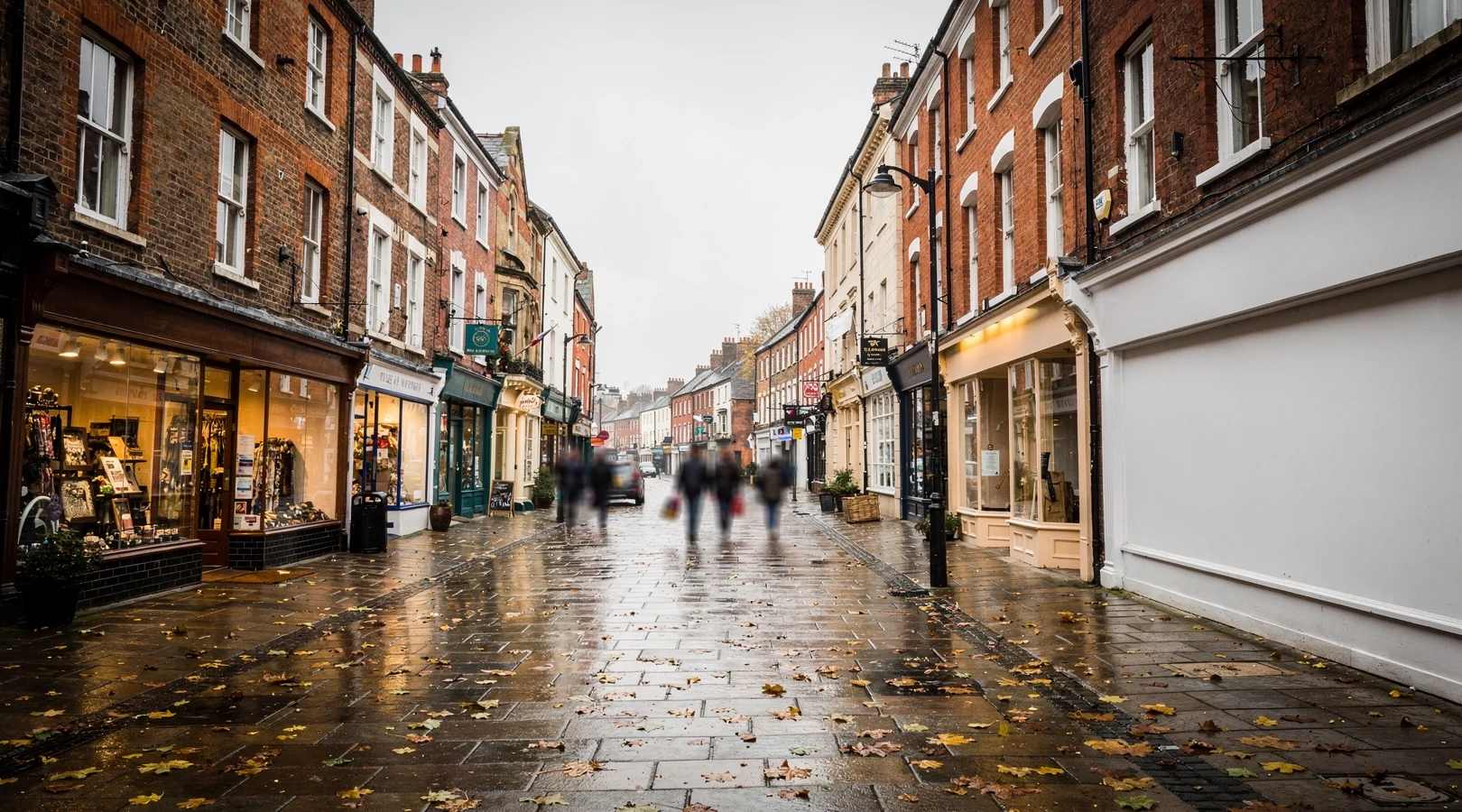
The government’s new high streets strategy, Hope on the High Street, is moving from a Budget-day document into a political promise. In an interview reported by the Guardian on Friday 30 October, Housing Secretary Angela Rayner said Britain’s blighted high streets would visibly improve before the next general election, pointing to business rates cuts that begin in April 2027 and a fresh round of funding for derelict buildings. On the same morning the Association of Convenience Stores (ACS) welcomed the strategy’s crackdown on “dodgy shops”, the cash-intensive mini-marts, barbers, vape stores and sweet shops that ministers say are being used to launder criminal money.
The 90-page policy paper, published by the Ministry of Housing, Communities and Local Government (MHCLG) on 28 October and laid before Parliament alongside the Budget, applies to England. It is the most detailed statement yet of how the government wants councils to deal with empty units, gambling and vape shop clusters, shop theft and failing town centres. For shoppers and independent traders the practical question is simple: what will actually change on your local high street, and when?
In short
- Hope on the High Street is a cross-government strategy for England, published on 28 October 2026 and built around six “pillars” that range from leadership to housing above the shops.
- A £125 million Derelict Buildings Fund goes to 60 councils to bring prominent empty buildings back into use, alongside £10 million to speed up High Street Rental Auctions.
- Subject to consultation, councils will gain more say over new betting shops, adult gaming centres and vape shops, and from April 2027 vape shops lose small business rates relief.
- The strategy targets organised crime on the high street, citing a National Crime Agency estimate that around £1 billion a year is laundered through high street businesses.
- Angela Rayner told the Guardian that shoppers will see a difference before the next election, but most measures depend on consultations, council capacity and money that arrives from 2027.
What is the Hope on the High Street strategy?
Hope on the High Street is a policy paper rather than a single new law. MHCLG describes it as “a new cross-government strategy to rejuvenate high streets and empower local leaders, businesses and communities”. It pulls together measures from several departments, including the Treasury, the Home Office, the Department for Culture, Media and Sport and the Department for Business and Trade, and sets them out against one framework for what a successful town centre looks like.
In her foreword, Angela Rayner writes that “while the high streets of the past aren’t coming back, we have a chance to reimagine a better future for them”. She also says that “when you see boarded up shops and rogue businesses, it’s hard not to be reminded of what once was”, which sets the tone for a document that is as much about safety and the mix of shops as about rates and rents.
The six pillars
The strategy says six pillars “must guide this partnership” between central government, councils, businesses and communities. Each comes with a short justification in brackets, which reads almost like a checklist for a shopper deciding whether to visit a town:
- Active leadership and management (reasons to have confidence)
- Strong businesses, anchors and amenities (reasons to visit)
- Vibrant culture, leisure and entertainment (reasons to get together)
- Easy access and connectivity (reasons to explore)
- Safe, clean and welcoming (reasons to return)
- A place to call home (reasons to move in)
The paper also sorts larger high streets (those with more than 50 units) into four types. Office hubs make up 15%, major shopping destinations 15%, tourism destinations 13% and “everyday high streets” 57%. That last group, which serves local residents with a blend of food shops, services, cafés and personal care, is the one most shoppers will recognise, and it is where most of the new council powers are likely to be felt.
Where it sits next to the Budget
The strategy was published on Budget day, and some of its headline measures are Budget measures restated. The biggest is the business rates package for retail, hospitality and leisure (RHL) properties, which shopappy covered in detail when the Budget lifted small business rates relief to £18,000. The strategy adds a layer on top: how councils should use those savings, which kinds of shops should not benefit, and what happens to the empty units in between.
The full document is available from MHCLG on the GOV.UK publication page. It runs to 90 pages, including case studies from places such as Birmingham, Liverpool, Hastings and Bexley.
What did Angela Rayner promise on Friday?
The fresh development on Friday came from Rayner herself. According to the Guardian, which interviewed her two days after the Budget, she said there had been “a real sense of decline” in many towns and that “people see it as part of the identity of their town and area, and that’s why we’ve got our high streets strategy”.
Asked whether voters would notice a difference before the next election, Rayner said: “The money will start to come through. Already we’ve put the £5.8bn in.” She was referring to the Pride in Place programme, which the strategy describes as a £5.8 billion investment in community-led regeneration. She added that “next year, from April, business rates [cuts] will apply and you’ll see [other] money in more areas”.
Backing for the Chancellor’s rates package
Rayner also defended the Budget’s support for town centre businesses. “The chancellor has shown he’s backing our high streets, backing our businesses that have been struggling and giving them the breathing space,” she told the Guardian, adding: “And he’s going to continue with that.” The Guardian reported that Chancellor John Healey earmarked more than £1 billion for retail, hospitality and leisure businesses, partly funded by higher taxes on gambling and vape shops.
The same report noted that the Resolution Foundation and the Institute for Fiscal Studies had warned on Thursday that the Budget was poorly targeted and paved the way for a “brutal” spending review next year. That matters for the strategy, because many of its commitments rely on funding streams that will be tested in that review.
The online sales tax question
The Guardian also reported that Andy Haldane, the former Bank of England chief economist, has called for online sales to be taxed at higher rates than in-store purchases to “level the playing field”. According to the newspaper, Budget documents say ministers are exploring “how the business rates system could better target online retailers in ways that minimise any indirect impacts for wider retail businesses”. No decision has been announced, and the strategy itself does not set out a new online sales tax.
How bad is the state of England’s high streets?
The strategy is unusually frank about the scale of the problem. It says national vacancy rates stand at around 13%, but have reached more than 30% in some parts of the country. Persistent vacancy, meaning premises unused for more than three years, rose from 3.7% in 2015 to more than 5.2% in 2023, and the regional gap is wide: below 3% in London, but above 8% in the North East.
Footfall in England remains around 13% below pre-pandemic levels, the paper says. Over the same period online shopping has kept growing. The strategy puts e-commerce at around 28% of total UK retail sales in the second quarter of 2026, up from 18% in the second quarter of 2019 and 4% in 2008. That shift is visible in the latest trading data: the BDO High Street Sales Tracker this week showed UK online sales up 10.1% in October while stores grew just 2.2%.
| Indicator | Earlier figure | Latest figure in the strategy |
|---|---|---|
| Online share of UK retail sales | 4% (2008); 18% (Q2 2019) | Around 28% (Q2 2026) |
| Persistent vacancy (empty 3+ years) | 3.7% (2015) | More than 5.2% (2023) |
| Bank and building society branches | 21,643 (1986) | 6,870 (2024) |
| Department stores of the largest chains | 2016 estate | Around 80% closed since 2016 |
| Footfall in England | Pre-pandemic baseline | Around 13% below |
| National vacancy rate | n/a | Around 13% (over 30% in some places) |
What shoppers say is wrong
The strategy draws on several surveys of public attitudes. Four in five people say they are concerned about local high street decline, and nearly three in four say they have an emotional attachment to their high street. In 2023, 38% of people agreed their high street was “a shell of what it used to be”.
When asked what makes a high street worse, “too many empty units” is the most commonly cited factor, at 63%. In February 2026, 19% of people said concerns about anti-social behaviour limited their visits to a town or city centre, and 16% said the same about crime. Around 31% now say they visit high streets mainly for social reasons rather than shopping.
The vape and betting shop map
One statistic in the strategy has drawn particular attention. Outside London, 76% of households can reach a vape shop or gambling shop within 20 minutes, compared with 83% who can reach a GP in the same time. The paper says access to these businesses is “now almost as widespread as access to essential services”, and that many councils, MPs and residents have raised concerns about clustering, especially in areas already facing economic and social problems.
What happens to empty shops and derelict buildings?
Empty units are the clearest target. The strategy says the £210 million Community Assets Programme includes £125 million for 60 local authorities to tackle prominent vacant and derelict buildings, and £10 million to expand High Street Rental Auctions. A separate £65 million fund will help communities buy and run local assets under the new Community Right to Buy powers.
The paper frames the Derelict Buildings Fund as a way to create “new anchors” to replace the department stores and bank branches that once drew people into town. It says the money will support councils “to transform these buildings into what their communities need, from health centres to civic spaces”. Regional press have begun reporting allocations: Place North West said the North West would receive £33 million, Place North East reported £13 million for the North East, the Doncaster Free Press reported a £3 million share for Doncaster, and Rotherham was reported to be receiving £2.63 million.
How High Street Rental Auctions work
High Street Rental Auctions allow councils to auction leases of up to five years on eligible commercial premises that have been vacant for at least 366 days within a 24-month period. According to the strategy, more than 50 local authorities are actively implementing the scheme, and more than 80 vacant properties have been brought back into use or are being fitted out.
The strategy argues that “the prospect of an auction can itself encourage a landlord to engage and secure a letting voluntarily”. For independent retailers this is potentially the most useful measure in the document, because it can put a shop on the market at a realistic rent where an absentee landlord has kept it empty. The extra £10 million will pay for practical support, including surveying expertise, to help councils actually run auctions.
Compulsory purchase and meanwhile use
Where an auction is not enough, the paper points councils to strengthened compulsory purchase powers and reformed Empty Dwelling Management Orders. It also says the government will explore refreshed guidance and template leases to encourage “meanwhile use”, the short-term occupation of empty units by pop-up shops, community groups or cultural projects. Councils are encouraged to keep commercial vacancy registers so they can act early.
Which shops will councils be able to block?
This is the section most likely to change what shoppers see on their local parade. The strategy says the government is “restoring control to local authorities so they can better shape their high streets”, and lists several measures aimed at gambling premises and vape shops. Several are still subject to consultation, so they are not yet in force.
| Business type | Measure | Timing and status |
|---|---|---|
| Betting shops and gambling premises | Remove the “aim to permit” principle that limits councils’ ability to refuse new licences | Subject to consultation |
| Gambling premises | Gambling Impact Assessments let licensing authorities weigh crime, deprivation, health data and clustering | Coming into force in November 2026 |
| Adult gaming centres | New centres to need planning permission; lose RHL business rates multipliers | Planning: consultation. Rates: from April 2027 |
| Vape shops | New shops to need planning permission; lose RHL multipliers and Small Business Rates Relief | Planning: subject to consultation. Rates: from April 2027 |
| Tobacco, vape and nicotine retailers | Retail licensing scheme; restrictions on display of products | Licensing: to be consulted on. Display: already consulted on |
| Pubs, social clubs, music venues | Extra 20% rates relief, taking total relief to 35% | From 1 April 2027 |
The “aim to permit” change
Under the Gambling Act, licensing authorities have long been told to “aim to permit” gambling premises, which councils say has made it very hard to refuse a new betting shop even where a street already has several. The strategy says that, subject to consultation, the government will remove that principle and give “greater weight to local concerns”. It builds on Gambling Impact Assessments, which the paper says will come into force in November and will allow councils to designate areas where “aim to permit” no longer applies.
Vape shops after the Tobacco and Vapes Act
Vape retailers face several changes at once. On 29 October the age of sale rules under the Tobacco and Vapes Act took effect, which shopappy explained in its guide to the new vape and nicotine pouch rules for shops. The strategy adds a proposal that new vape shops will need planning permission, subject to consultation, and confirms that from April 2027 vape shops in England will no longer qualify for the RHL multipliers or Small Business Rates Relief. Adult gaming centres also lose the RHL multipliers from the same date.
How will the government tackle dodgy shops and organised crime?
The section on organised crime is the part of the strategy that the ACS and the convenience trade press seized on. It opens bluntly: “Legitimate businesses are the engine of successful high streets.” It then says that “criminally controlled businesses are used to launder illicit funds, evade tax, exploit workers and sell illegal goods”.
The strategy cites a National Crime Agency estimate that at least £12 billion of criminal cash is generated in the UK each year, with around £1 billion laundered through high street businesses including mini-marts, barber shops, vape stores and sweet shops. It says this activity “hollows out communities, undercuts honest traders and corrodes public confidence”.
The enforcement toolkit
Several of the measures were announced earlier in 2026 and are restated here. The paper lists:
- A £30 million crackdown, announced in May 2026, on organised crime operating through cash-intensive businesses, including a new multi-agency intelligence and coordination cell in the National Crime Agency and a High Street Organised Crime Unit in the Home Office.
- Stronger powers for councils and police to close premises linked to criminal activity, supported by better access to data across agencies.
- The Abusive Phoenixism Taskforce, in which the Insolvency Service, Companies House and HMRC act against directors who use successive companies to avoid debts and sanctions, so that a closed shop cannot simply reopen under a new name.
- Companies House reform, including mandatory identity verification for directors.
- More than 30,000 high street-linked HMRC compliance interventions during 2026/27.
- New front-line training for Trading Standards staff on organised crime, to be extended to other agencies.
On funding, the strategy says the government is investing up to £30 million of new money a year until 2028/29 for enforcement agencies including Trading Standards, Border Force and HMRC, to tackle illicit and underage tobacco and vape sales. That includes recruiting 120 new Trading Standards apprentices. A further £2 million a year until 2028/29 will support Trading Standards work against high street organised crime. The government also says it will “make it harder for criminal enterprises to set up on the high street”, including by looking at approaches used in other countries and at the role of landlords.
What the ACS said
Ed Woodall, chief executive of the ACS, said: “We can only revitalise our high streets if they are safe places for people to shop, work and invest. It is absolutely right that the Government has put safety at the heart of its new high streets strategy.” He added that “cracking down on rogue traders and tackling the shop theft that blights communities and undermines legitimate businesses are essential steps towards restoring confidence in our high streets and helping them thrive”.
According to C-Talk, the ACS’s 2026 crime research found that 85% of independent retailers had seen an increase in illicit activity in their area over the past year. The association’s earlier work on the sector’s costs is covered in shopappy’s report on the ACS Local Shop Report 2026, which found rates bills rising as investment stalled.
What the strategy does about shop theft
Shop theft sits under the “safe, clean and welcoming” pillar. The strategy says retail crime cost businesses more than £583 million in known theft and damage in 2024/25, and that around 510,000 shop theft offences were recorded in England and Wales in the year ending March 2026. That was a 4% fall on the previous year, but levels remain 48% higher than in 2023.
The paper points to measures already in place or under way: a standalone offence of assaulting a retail worker, the removal of the previous £200 threshold that treated low-value theft as a summary-only offence, £5 million for the national retail crime intelligence unit OPAL, and improvements to online crime reporting. It also refers to “a clearer legal framework for facial recognition and biometric technologies”, which some retailers already use in stores.
New anti-social behaviour powers
From 26 October, the strategy says, a package of measures in the Crime and Policing Act gives police, councils and local partners new tools. These include Respect Orders, an extension of the maximum duration of dispersal directions from 48 to 72 hours, stronger closure powers for premises linked to persistent nuisance and disorder, and higher penalties for breaching anti-social behaviour orders. The Neighbourhood Policing Guarantee is meant to give every neighbourhood named, contactable officers.
The strategy also notes that a small number of prolific offenders account for 52% of convictions while representing only 9% of offenders, and says the government will take a “targeted and coordinated approach” to them. A further £2 million goes to the National Business Crime Centre for an action plan on tool theft.
What changes for independent shops and traders?
For small independent retailers, the most tangible change is still the rates package. From April 2027, Small Business Rates Relief thresholds for qualifying RHL properties in England rise to £18,000 for full relief (from £12,000) and £21,000 for tapered relief (from £15,000). The government says this will take around 70,000 more high street businesses out of business rates altogether, and that, combined with a real-terms freeze in 2027-28 and 2028-29, “half of all RHL properties in England will not pay business rates at all”.
Beyond rates, the strategy promises a General Anti-Avoidance Rule to help councils tackle business rates avoidance, a ban on upward-only rent reviews in commercial leases, removal of fees for valuation appeals and an exploration of “community enterprise zones” to help new businesses start on the high street. It also restates wider finance measures: a larger British Business Bank with capacity of £30.6 billion, £1 billion of Start Up Loans over five years and a £6.5 billion uplift to the Growth Guarantee Scheme.
Business Improvement Districts and landlords
The strategy commits to reforming Business Improvement Districts (BIDs), the schemes in which businesses pay a levy to fund local improvements. Proposed changes include better voting procedures, more transparency and accountability, and extending the property-owner BID model beyond London so that landlords contribute directly. For independent traders who pay a BID levy, the transparency changes could make it easier to see where the money goes.
Markets, pavements and the evening economy
Several smaller measures could change how a high street feels. The government says it will increase the maximum term for pavement licences, explore a statutory minimum term and give outdoor hospitality more recognition in licensing, to support “al fresco dining and café culture”. It will look at putting the National Licensing Policy Framework for hospitality on a statutory footing and is enabling digital proof of age. The strategy also says markets can increase footfall by between 15% and 27%, and promises to look at any barriers stopping councils using markets and street trading more flexibly.
Will banks, Post Offices and public services return?
The strategy argues that the loss of “structural anchors” such as banks, department stores and public offices has drained footfall. It notes that around 80% of the department stores run by the UK’s largest chains have closed since 2016, and that the number of bank and building society branches fell from 21,643 in 1986 to 6,870 in 2024.
Its main answer is a “high streets first” principle that will encourage public bodies to consider the effect of their estate decisions on town centres. The government is co-designing Local Asset Management Plans with mayoral authorities, with Liverpool City Region Combined Authority and South Yorkshire Mayoral Combined Authority as the first two pathfinder areas. Public bodies will also be encouraged to review leases coming up for renewal with a view to moving into town centre locations.
Post Office and banking hubs
The paper restates support for a £100 million Post Office transformation programme and the Post Office Plus pilot, which is testing whether branches can host a wider range of public, private and voluntary services. It says the network receives around 10 million visits each week and generates more than £3 billion of annual spending in nearby businesses. The government is also supporting the rollout of 350 banking hubs by the end of this Parliament. For shoppers in towns that have lost their last bank, those hubs matter more than most of the strategy’s headline numbers.
Will shoppers really see a difference before the next election?
Rayner’s pledge sets a clear political test, but the strategy’s own timetable suggests the changes will arrive gradually. The rates cuts start in April 2027. The Derelict Buildings Fund depends on 60 councils buying, refurbishing or redeveloping prominent buildings, which in practice can take years. The gambling, adult gaming centre and vape shop planning changes are all still subject to consultation, and new controls on where shops can open will not remove shops that are already trading.
There are also pressures the strategy cannot control. The Guardian noted that Poundland’s owners filed a notice of intention to appoint administrators this week, putting up to 12,000 jobs at risk, and shopappy has followed Poundland’s administration filing closely. If a large share of its roughly 600 shops close, many towns could see new vacancies well before any derelict building is restored.
What critics and trade bodies are watching
Three issues are likely to decide how the strategy is judged. The first is council capacity: the paper itself notes that around 40% of high streets studied by the High Streets Task Force between 2019 and 2024 lacked effective partnership arrangements. The second is funding, given the Resolution Foundation and IFS warnings about next year’s spending review. The third is the balance between online and physical retail, where the Guardian reports that ministers are exploring business rates changes targeting online retailers but have made no decision.
Retail groups have welcomed the safety focus while continuing to argue that the overall tax burden on shops is too high. Business leaders want Labour’s manifesto pledge to replace business rates entirely to be honoured, the Guardian reported, rather than adjusted through reliefs.
What should shoppers and local traders do now?
For most shoppers, nothing changes immediately. The strategy is a framework for councils, and the most visible effects (empty units reopening, fewer new betting or vape shops on a parade, more police patrols) will depend on decisions made by your local authority over the next two years. That makes local engagement more important than it was: consultations on gambling licensing and vape shop planning will be published nationally, and councils will draw up their own plans for Derelict Buildings Fund money and rental auctions.
Independent traders can take several practical steps now:
- Check whether your property’s rateable value falls under the new £18,000 or £21,000 thresholds from April 2027, and confirm your RHL classification with your council.
- Ask your council whether it is running High Street Rental Auctions; a long-empty unit nearby could become available on a lease of up to five years.
- Report suspected illicit tobacco, vape or counterfeit sales to Trading Standards, which is receiving new funding and training to deal with them.
- If your area has a Business Improvement District, watch for the planned reforms to voting and transparency.
- Respond to the forthcoming consultations on gambling licensing and vape shop planning if clustering affects your street.
For shoppers, the most direct lever is still the simplest: where you choose to spend. The strategy’s own numbers show how far habits have moved online, and its success will ultimately depend on whether people find enough reasons to visit, gather, explore and return, the language of its six pillars, on the high street at the end of their road.
Frequently asked questions
What is Hope on the High Street?
It is the government’s high streets strategy for England, published by the Ministry of Housing, Communities and Local Government on 28 October 2026 alongside the Budget. It sets out six pillars for successful high streets and brings together funding, council powers and enforcement measures from several departments.
Does the strategy apply in Scotland, Wales and Northern Ireland?
The policy paper applies to England. Some underlying measures, such as parts of crime and company law, have wider reach, but planning, licensing and business rates relief are devolved, so the high street measures described in the strategy are for English councils.
How much money is in the strategy?
The headline figure is a £210 million Community Assets Programme. It includes a £125 million Derelict Buildings Fund for 60 councils, £10 million to expand High Street Rental Auctions and a £65 million fund to help communities buy local assets. The strategy also restates larger existing programmes, such as the £5.8 billion Pride in Place programme.
Can councils now ban new vape shops and betting shops?
Not yet. The plans to remove the “aim to permit” principle for gambling premises and to require planning permission for new vape shops and adult gaming centres are subject to consultation. Gambling Impact Assessments, which let councils weigh local evidence such as crime and clustering, come into force in November 2026.
When do the business rates changes start?
From April 2027. Small Business Rates Relief thresholds for qualifying retail, hospitality and leisure properties in England rise to £18,000 for full relief and £21,000 for tapered relief. Vape shops lose Small Business Rates Relief and the lower RHL multipliers from the same date, and adult gaming centres lose the RHL multipliers.
What is a High Street Rental Auction?
It is a power that lets councils auction a lease of up to five years on a commercial high street property that has been empty for at least 366 days within a 24-month period. More than 50 councils are using or preparing to use the power, and over 80 empty properties have been brought back into use or are being fitted out.
What are “dodgy shops” in the strategy?
The term refers to businesses controlled by organised crime, which the strategy says are used to launder money, evade tax, exploit workers and sell illegal goods. It cites mini-marts, barber shops, vape stores and sweet shops as common fronts and a National Crime Agency estimate that around £1 billion is laundered through high street businesses each year.
Will the strategy stop shops like Poundland closing?
No. The strategy does not rescue individual retailers. It aims to make it easier for councils to fill empty units, attract new anchors such as health centres and public services, and reduce costs for smaller businesses through rates relief from April 2027.
How can I report illegal vapes or suspected criminal shops?
You can report suspected illegal tobacco or vape sales, or underage sales, to your local Trading Standards service, usually through Citizens Advice. Crime and anti-social behaviour should be reported to the police, either online or by calling 101, or 999 in an emergency.