
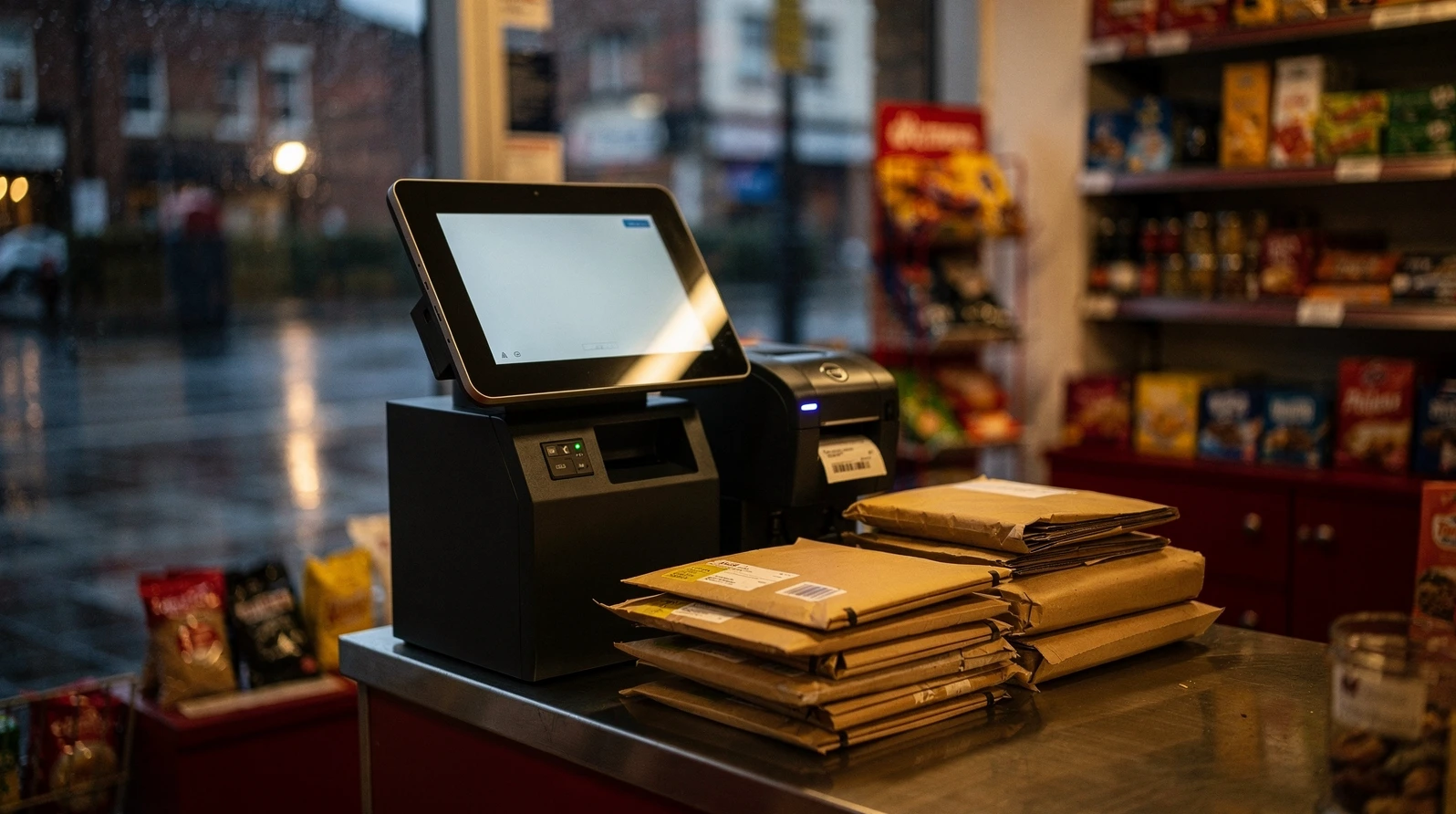
Royal Mail has started testing self-service kiosks that let customers buy postage and print a parcel label without waiting at the counter. The trial runs for three months across 26 of its branded convenience stores, known as Royal Mail Shops, with locations named so far in Manchester, Sunderland and Cornwall. The company announced the test on 16 November 2026, and the trade titles Talking Retail, Retail Times and Logistics Manager carried the details on 16 and 17 November.
The launch lands in an awkward week. On 17 November the BBC reported that seven MPs from Kent and Sussex had written to Royal Mail and the government about “persistent failures” in letter deliveries, and on the same day the former business secretary Peter Kyle told the BBC that ministers must act now or risk Royal Mail becoming unviable. This article explains how the kiosks work, what they change for online shoppers and marketplace sellers, where they fit in Royal Mail’s wider parcel network, and what remains unanswered.
In short
- What is new: self-service kiosks in 26 Royal Mail Shops let customers enter a parcel’s size, contents and destination, buy Tracked 24 or Tracked 48 postage and print a label before handing the parcel to staff.
- How long: a three-month trial, with named sites in Manchester, Sunderland and Cornwall; Royal Mail has not published the full list of 26 stores.
- Why it matters: Royal Mail says it now runs the UK’s largest out-of-home network, with 30,000 parcel points, and wants 45,000 by 2030 as Vinted and eBay sellers drive demand for drop-off points.
- The backdrop: MPs across the South East report weeks without letters, Royal Mail is still missing its first class target, and the government says it will weigh further parcel market reforms after Ofcom’s December report.
- What is unknown: whether kiosk prices match counter or online prices, whether they accept prepaid marketplace labels, and whether the trial will be extended before Christmas.
What exactly is Royal Mail testing?
The kiosk is a self-service terminal placed inside a Royal Mail Shop. According to Royal Mail’s announcement, customers enter the parcel’s size, its contents and where it is going, then buy either Tracked 24 or Tracked 48 postage and print a label “in seconds”. The parcel is then handed to a member of staff, so the shop worker still takes physical custody of the item.
That last step matters. The kiosk is not a locker and it is not a drop box; it replaces the conversation at the till, not the hand-over. In practice the change is that the shopkeeper no longer has to key in the details and take payment for postage while other customers wait for lottery tickets, newspapers or groceries.
Royal Mail framed the trial as a queue-busting measure. Mike Richmond, the company’s chief customer officer, said in the statement: “We know our customers value speed and convenience, so we’re making it quicker and easier to send parcels. Our new Kiosks offer a simple way to reduce queueing and give customers more choice.” He added that the trial was “another step in making our services as convenient as possible, alongside our growing network of parcel points across the UK.”
Which services can be bought at the kiosk?
The announcement names only two products: Royal Mail Tracked 24 and Royal Mail Tracked 48. Those are the company’s main tracked parcel services for personal customers and small sellers. Royal Mail says Tracked 24 aims to deliver the next working day and Tracked 48 aims to deliver in 2–3 working days, both including Saturdays, and both include compensation cover up to £75.
Nothing in the statement mentions First Class or Second Class stamps, Special Delivery Guaranteed, international postage or signed-for options. Shoppers who need those services should assume, for now, that they still need to be served at the counter or buy postage online.
Where are the 26 trial stores?
Royal Mail has named three locations: Manchester, Sunderland and Cornwall. It has not published the addresses of the other stores, and none of the trade reports we have read lists them. Shoppers who want to try a kiosk will, at least for now, have to rely on spotting one in their local Royal Mail Shop.
The geographic spread is telling. A large northern city, a north-east city and a rural county give Royal Mail three very different test environments: dense urban footfall, a mid-sized city and a market where the nearest counter may be a long drive away. That fits the company’s stated aim of serving urban, suburban and rural customers on different terms, which we come back to below.
What is a Royal Mail Shop?
A Royal Mail Shop is not a Royal Mail-owned outlet. Talking Retail describes it as “a local convenience store, newsagent, petrol station or supermarket that partners with Royal Mail to handle parcel services”. The brand was created by rebadging thousands of Collect+ and PayPoint locations, the network of corner shops that already handled parcel drop-offs and collections.
The relationship with PayPoint goes back further. In July 2025 PayPoint told its retailer partners to expect “a further ramp up in parcels volumes in partnership with Royal Mail through Collect+”, promising “more parcels”, “more customers” and “more commission” ahead of the peak trading season. Nick Williams, PayPoint’s parcel services director, said at the time that the company was committed to supporting stores “with a comprehensive programme of tips and training”.
For independent shopkeepers the parcel counter is a double-edged business. It brings footfall and commission, but it also ties up staff at the till for every label printed and every payment taken. A kiosk that shifts the data entry and payment onto the customer could, in principle, let a single member of staff handle more parcels without the queue spilling out of the door. Whether it does in practice is precisely what a trial is for.
Royal Mail and the Post Office have been separate companies since 2012, although Royal Mail still works with the Post Office’s branch network. Royal Mail says it partners with 11,500 Post Office branches, which sell Royal Mail services over the counter alongside banking, bill payments and government services. The pressure on that counter network is real: we reported earlier this autumn that TG Jones is shutting 70 post offices, about a third of its counters, by early 2027.
The Royal Mail Shop brand gives Royal Mail its own badge on the high street without owning the shops. The kiosk trial is, in effect, a test of how much of the counter’s work can be handed to a machine inside a partner store.
How big is Royal Mail’s parcel point network now?
In its 16 November announcement Royal Mail said it now offers “the UK’s largest out-of-home network”, made up of 30,000 parcel points. It broke that total down into five types of location.
| Type of parcel point | Number (Royal Mail, November 2026) | What it does |
|---|---|---|
| Post Office branches | 11,500 | Counter service for Royal Mail products, run by the separate Post Office company |
| Royal Mail Shops | 8,500 | Partner convenience stores, newsagents, petrol stations and supermarkets; former Collect+ and PayPoint sites |
| Parcel lockers | 3,300 | 24/7 self-service send and collect points |
| Parcel postboxes | 1,400 | Postboxes adapted to take small parcels |
| Customer service points | 1,200 | Counters at Royal Mail delivery offices |
| Total | About 30,000 | Royal Mail also collects from and delivers to every UK address |
The listed categories add up to 25,900, short of the 30,000 headline. Royal Mail did not explain the gap in its statement; the round figure may include other partner points or simply be rounded up. Readers comparing networks should treat 30,000 as the company’s own description rather than an audited count.
The growth has been rapid. In December 2024, when Royal Mail launched its own lockers, the company said customers could drop off parcels at 1,000 shared lockers and “more than 5,000 Collect+ points”. Its first 250 own-brand lockers were due to roll out in early 2025, starting outside the Mount Pleasant mail centre in London.
By the company’s own figures that means locker numbers have more than trebled, and the shop network has grown from roughly 5,000 to 8,500 in under two years. Royal Mail said at the time that 82 per cent of younger millennials living in cities wanted retailers to offer more click and collect options, based on its own research.
In October 2025 Royal Mail set a goal of almost doubling its out-of-home parcel points to 45,000 locations by 2030. The stated aim is that customers in urban areas will be within a five-minute walk of a parcel point, with maximum drive times of five minutes in suburban areas and 15 minutes in rural ones.
The same announcement listed self-service kiosks among the “new innovations” Royal Mail would explore, alongside retailer partnerships and a broader rollout of parcel dropboxes. The November trial is therefore not a surprise; it is the first public test of an idea the company flagged a year ago. Alistair Cochrane, then Royal Mail’s interim chief executive, said in October 2025: “For many, nothing beats the ease of home delivery or collection, but we’re seeing a clear shift towards more people choosing lockers and shops.”
Why is Royal Mail pushing parcels out of the home?
The economics are straightforward. A courier who drops 30 parcels into a single locker bank or shop does far less driving and walking than one who knocks on 30 doors, and failed first-time deliveries disappear. For shoppers, a locker or shop means no missed-delivery card and no waiting in for a van.
Royal Mail’s own forecasts suggest the shift is only beginning. In October 2025 it said about 15 per cent of UK parcels were delivered to out-of-home points, a share it expected to rise to around one third within five years. It linked the change directly to “the continued rise of online shopping and the rapid growth of marketplaces like Vinted”.
Second-hand marketplaces have changed who sends parcels. A decade ago most parcels flowed one way, from retailers to homes. Today millions of private sellers on Vinted, eBay and Depop post items themselves, usually with a prepaid label or QR code generated by the platform. Those senders need somewhere close, quick and open late, and they are exactly the customers who clog up a corner shop counter at 6pm.
The irony is that while Royal Mail races to build parcel capacity, its letters service is under heavy criticism. The BBC’s South East political editor Helen Catt reported on 17 November that one woman near Dorking had sometimes gone weeks without a delivery and then received 35 pieces of post in one go. She told the BBC she had missed a medical appointment and paid a credit card bill late as a result.
Another resident, in Tonbridge, told the BBC she went four weeks without receiving letters, while “plenty of vans had arrived with parcels”. That contrast, parcels arriving while letters do not, is exactly the complaint that MPs and the Communication Workers Union have raised for months. We covered how Royal Mail delays hit online sellers earlier this month, including who carries the risk when a parcel arrives late.
What does the kiosk change for online shoppers?
For most online shoppers, the kiosk changes little about receiving parcels and something about sending them. The obvious use case is returns: a shopper sending back a jumper or a pair of trainers who has not been given a prepaid label could, in a trial store, buy tracked postage at the kiosk rather than queue.
The bigger question for returns is whether the kiosk accepts labels and QR codes generated by retailers and marketplaces. Royal Mail’s statement only describes buying new postage. Many retailers now provide printer-free returns, where the shopper shows a code in the shop and staff print the label. Until Royal Mail says otherwise, shoppers with a prepaid return code should expect to show it to staff as usual.
A three-month trial starting in mid-November covers the entire Christmas peak and the January returns season. That is deliberate or at least convenient: it means Royal Mail will see how the kiosks cope at the busiest point of the year, when queues are longest and staff are most stretched.
For shoppers planning gifts, the kiosks do not change Royal Mail’s delivery timetable. The last recommended posting dates still apply whichever way the postage is bought, and we have set out every Royal Mail Christmas 2026 posting deadline in a separate guide. Buying postage faster at a kiosk does not make a parcel travel faster.
Is it cheaper?
Royal Mail has not said what kiosk postage costs, and that is the most important gap in the announcement. Royal Mail has historically charged more for some services bought over a counter than online, and the company changed its prices for personal customers and marketplace sellers again on 5 October 2026, according to its price change page.
At the time of writing, the Post Office’s comparison page lists Royal Mail Tracked 24 “from £4.15” and Tracked 48 “from £3.45”, both with compensation up to £75. Those are entry prices for the smallest format; larger and heavier parcels cost more. If kiosks charge the counter rate, the saving for customers is time, not money. If they match online prices, the kiosk becomes a way for people without a printer to get online-level pricing, which would be a meaningful change.
What does it mean for eBay and Vinted sellers?
Marketplace sellers are the group Royal Mail most needs to keep. Small sellers on eBay, Vinted and Etsy are heavy users of Tracked 48 because it balances price with tracking, which most platforms require as proof of delivery when a buyer opens a dispute.
For a seller who already buys postage online through Royal Mail’s Click and Drop or through the marketplace’s own shipping integration, the kiosk adds little: the label is already paid for and printed, or sits on a phone as a QR code. The kiosk helps the occasional seller, the one who sells a few items a month, has no printer and currently buys postage at the counter.
| Seller type | Typical current routine | Does the kiosk help? |
|---|---|---|
| Occasional private seller, no printer | Buys postage at a Post Office or shop counter | Yes, if a trial store is nearby: less queueing for Tracked 24 or 48 |
| Vinted or eBay seller using platform labels | Shows a QR code or prepaid label at a drop-off point | Unclear: Royal Mail has not said whether kiosks handle prepaid labels |
| Regular small business seller | Uses Click and Drop or a business account, often with collections | Little: postage and labels are already handled online |
| Seller needing international or Special Delivery | Counter service | No: only Tracked 24 and Tracked 48 are named |
There is also a data angle. The kiosk asks for the parcel’s contents. That is standard for tracked services, which exclude prohibited and restricted items, but it means the kiosk applies the same rules at the point of sale that a counter clerk would. Sellers of items such as aerosols, perfumes and lithium batteries should check Royal Mail’s prohibited and restricted goods rules before relying on any self-service route.
Sellers have more choice than ever. InPost said in June 2026 that it had passed 15,000 UK lockers, sited at supermarkets, retail parks, transport hubs and residential areas. Evri reports more than 11,000 ParcelShops and lockers combined, with a stated plan to reach 25,000 locations by 2030, and launched its first owned lockers in early 2026.
| Network | Reported size | 2030 ambition | What is counted |
|---|---|---|---|
| Royal Mail | About 30,000 parcel points (Nov 2026) | 45,000 locations | Post Office branches, Royal Mail Shops, lockers, parcel postboxes, delivery office counters |
| InPost UK | 15,000+ lockers (June 2026) | Not stated in the reports we read | Lockers only |
| Evri | 11,000+ ParcelShops and lockers | 25,000 locations | ParcelShops and lockers combined |
The figures are not like for like. Royal Mail’s total includes 11,500 Post Office branches it does not run, InPost counts only lockers, and Evri combines shops with lockers. What the comparison does show is that every major carrier is chasing the same thing: more points, closer to home, open for longer.
Why is the government under pressure over Royal Mail?
The kiosk trial is a small operational change announced in the middle of a large political argument. On 17 November Peter Kyle, who was business secretary until he was replaced by Jonathan Reynolds in July, told the BBC that the government must act urgently to “level the playing field” for Royal Mail or risk the business becoming unviable.
Kyle said he was concerned that Royal Mail was being “undercut” by rival parcel firms that do not employ staff on the same terms. “If we leave it another few years then Royal Mail will just become unviable and it will just collapse under the weight of having full-time employees,” he said. According to Royal Mail, 98 per cent of its 130,000 workers are permanent employees with rights to pensions, sick pay and holiday pay, whereas some rivals use self-employed drivers.
What has the government said?
A government spokesperson told the BBC that ministers would consider whether further reforms to the parcel market are needed after Ofcom publishes its annual monitoring report in December. The spokesperson said the current business secretary had met Royal Mail and the Communication Workers Union the previous week “to seek timely progress on improving their quality of service”.
The Department for Business and Trade has also opened a consultation on what it calls “bogus” self-employment, “a practice whereby some businesses mislabel staff as self-employed to avoid statutory obligations”. Royal Mail welcomed the consultation, with a spokesperson saying parts of the delivery industry were “driving a race to the bottom” on employment standards. We set out the background to those talks, including the role of owner Daniel Křetínský, in our report on Royal Mail’s crisis talks and the undertakings given at the takeover.
Shadow business minister Bradley Thomas told the BBC that Royal Mail’s management, not its staff, was to blame. “Customers are being asked time and time again to pay increased prices, yet the service they’re receiving is not improving,” he said, adding that “nationalisation isn’t the solution to this problem.”
The Communication Workers Union is pushing in a different direction. Its general secretary, Dave Ward, has called for “a new model of ownership”, according to the BBC. The positions are far apart, but all sides agree that the status quo is under strain.
How is Royal Mail performing on its targets?
Royal Mail’s legal obligations are demanding. It must deliver letters to every UK address six days a week and offer a “one price goes anywhere” service across the country. Ofcom agreed last year to scrap Second Class deliveries on Saturdays and to set the target for First Class post delivered the next working day at 90 per cent.
Even against that reduced target, the company is falling short. The BBC reported that, according to Royal Mail’s own performance statistics for April to June 2026, it missed its First Class targets in all but two of the postcode areas serving Kent, Sussex and Surrey. The company was fined £21 million in October 2025 for missing delivery targets in 2024/25.
| Date | Development | Source |
|---|---|---|
| October 2025 | Royal Mail fined £21m for missing 2024/25 delivery targets; 45,000 parcel point target set for 2030 | BBC; Royal Mail |
| July 2026 | Jonathan Reynolds replaces Peter Kyle as business secretary | BBC |
| April to June 2026 | First Class target missed in all but two postcode areas serving Kent, Sussex and Surrey | Royal Mail statistics via BBC |
| Week before 17 November 2026 | Business secretary meets Royal Mail and the CWU | Government spokesperson via BBC |
| 16 November 2026 | Self-service kiosk trial announced in 26 Royal Mail Shops | Royal Mail via Talking Retail, Retail Times |
| 17 November 2026 | Seven Kent and Sussex MPs write over “persistent failures”; Kyle warns Royal Mail could become unviable | BBC |
| December 2026 | Ofcom annual monitoring report due; government to consider parcel market reforms afterwards | Government spokesperson via BBC |
Royal Mail said in response to the South East complaints that it knew “how important it is that customers receive their mail when expected” and that “individual routes can occasionally be affected by short-term local issues”. It added that it was “continuing to make changes across our network to provide customers with a more reliable and consistent service”. Local reports from Peterborough, Worcester and Eastbourne this week describe similar complaints from residents and MPs.
Does the parcel push explain the letter problems?
Royal Mail has not said that parcels are being prioritised over letters, and there is no published evidence that the kiosk programme diverts resources from deliveries. The kiosks sit in partner shops staffed by those shops, not by postal workers.
But the perception problem is real. When residents see parcel vans arriving and letters not, and the company’s announcements focus on lockers, shops and kiosks, it feeds a narrative that Royal Mail is becoming a parcel company that happens to deliver letters. That is one reason the regulatory picture matters: Ofcom has already warned about service quality across the parcel sector, and its last consumer survey named Evri and Yodel as the worst parcel firms for customer satisfaction.
What happens after the three-month trial?
Royal Mail has not published success criteria. The obvious measures would be queue times, transaction volumes, the share of parcel customers who use the kiosk instead of the counter, and feedback from shop owners. A three-month window from mid-November runs to roughly mid-February 2027, which would give the company data from both the Christmas peak and the post-Christmas returns surge.
If the kiosks work, the 2030 network target gives a clear route to scale. Royal Mail already plans to put its brand into nearly 8,000 convenience stores, and a kiosk that lets those shops handle more parcels with the same staff would make the network more attractive to shop owners. If they do not work, the trial is small enough to quietly end.
Three things would turn this from a trade story into a shopper story. First, the price: if kiosk postage matches online prices, people without printers gain access to cheaper postage. Second, prepaid labels: if kiosks can print marketplace and retailer return labels, they could take a large share of the corner-shop queue. Third, the list of stores: until Royal Mail publishes the 26 locations, most shoppers cannot try the service at all.
The other date in the diary is Ofcom’s December monitoring report. The government has said it will consider parcel market reforms after it is published, and the report is likely to shape how much patience ministers have with Royal Mail’s management.
What should shoppers and sellers do now?
For most people, nothing changes this Christmas. The vast majority of Royal Mail Shops do not have a kiosk, and the trial is limited to Tracked 24 and Tracked 48. Shoppers and sellers should keep using the routes they already rely on.
- Buy postage online where you can. Online postage is often cheaper than counter postage, and it lets you skip the queue entirely if you can print the label or use a QR code.
- Use lockers for drop-offs if you have a prepaid label. Royal Mail, InPost and Evri all run locker networks; check which carrier your marketplace label is for.
- If you spot a kiosk, compare the price. Check the price against Royal Mail’s online price for the same service before you pay.
- Keep proof of postage. Tracked services include tracking, but the receipt is still the evidence you need if a buyer opens a dispute or a parcel goes missing.
- Allow extra time for letters in areas with known delays. If important post such as medical appointments or bills arrives late, the BBC’s reporting suggests it is worth contacting the sender to ask for email or online alternatives.
For sellers, the bigger risk over the next six weeks is delivery performance, not how postage is bought. Building a day or two of slack into dispatch promises, and keeping customers informed when parcels run late, will do more to protect feedback scores than any kiosk.
Frequently asked questions
What are Royal Mail’s new self-service kiosks?
They are terminals inside selected Royal Mail Shops that let customers enter a parcel’s size, contents and destination, buy Tracked 24 or Tracked 48 postage and print a label, before handing the parcel to a member of staff. Royal Mail announced the trial on 16 November 2026.
Where can I find a Royal Mail kiosk?
The three-month trial runs in 26 Royal Mail Shops. Royal Mail has named locations in Manchester, Sunderland and Cornwall but has not published the full list of stores.
Can I send any parcel from a kiosk?
Only Royal Mail Tracked 24 and Tracked 48 are named in the announcement. There is no mention of First Class or Second Class stamps, Special Delivery or international services, so assume those still need the counter or online postage.
Is kiosk postage cheaper than the Post Office?
Royal Mail has not said. The Post Office lists Tracked 24 from £4.15 and Tracked 48 from £3.45 for the smallest format at the time of writing. Royal Mail last changed its personal and marketplace seller prices on 5 October 2026.
Can I use the kiosk for a Vinted or eBay label?
The announcement only describes buying new postage. Royal Mail has not said whether kiosks handle prepaid labels or QR codes from marketplaces, so show those to staff as usual.
What is a Royal Mail Shop?
A partner convenience store, newsagent, petrol station or supermarket that handles Royal Mail parcel services. The brand was created by rebadging thousands of Collect+ and PayPoint locations, and Royal Mail says there are now 8,500 of them.
How many parcel points does Royal Mail have?
Royal Mail says about 30,000, including 11,500 Post Office branches, 8,500 Royal Mail Shops, 3,300 lockers, 1,400 parcel postboxes and 1,200 customer service points. It aims to reach 45,000 by 2030.
Why are Royal Mail letters delayed in some areas?
Royal Mail says individual routes can be affected by short-term local issues and that its service has improved, but its own figures for April to June 2026 show missed First Class targets across most of Kent, Sussex and Surrey. MPs and unions dispute the company’s explanation, and Ofcom’s December report is the next major checkpoint.