
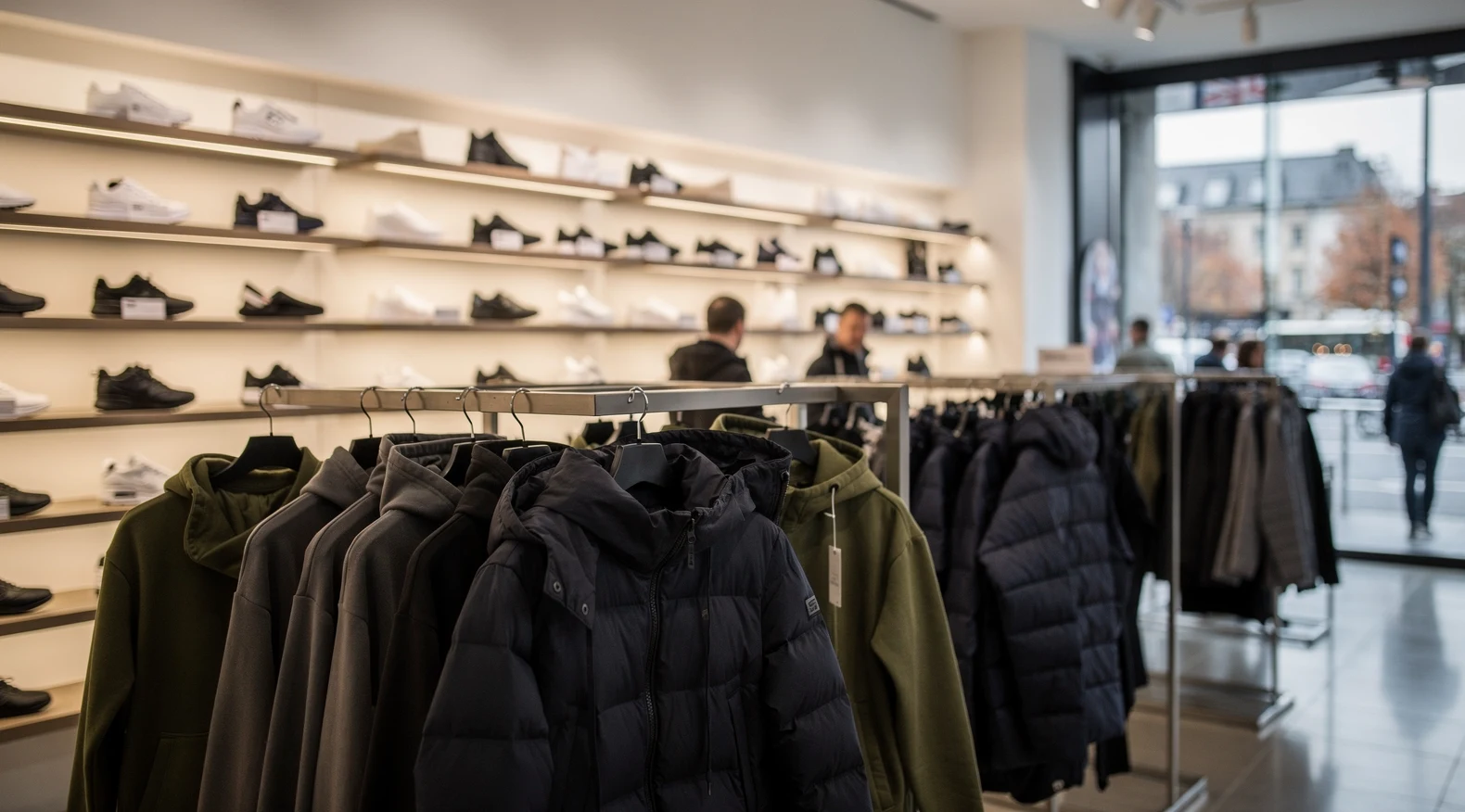
JD Sports Fashion has trimmed the top of its profit forecast for the second time this year, after UK sales cooled following a World Cup lift in the summer and a warm September held back demand for winter coats and hoodies. The retailer, which owns the JD fascia that dominates British high streets and retail parks for trainers and sportswear, published its third-quarter trading statement at 7am on Thursday 19 November 2026.
The group now expects profit before tax and adjusting items of £700m to £750m for the year to January 2027, down from a range of £700m to £800m. Shares fell by about 4% on the day. For UK shoppers, the more useful detail sits beneath the headline: JD describes a “continued promotional market” in footwear, lower footfall in its shops, and an online business that improved after a new e-commerce platform went live in August, all a week before Black Friday.
In short
- Guidance narrowed: JD Sports now expects full-year profit of £700m to £750m, cutting £50m from the top of the £700m to £800m range it set in August.
- UK sales slipped: UK like-for-like sales fell 2.6% in the 13 weeks to 31 October, and comparable sales fell 1.3% after rising 2.2% in a World Cup-boosted second quarter.
- Trainers are the weak spot: footwear “remained soft” because of end-of-cycle product lines and a promotional market, while women’s ranges, own brands and the Outdoor business did better.
- Online improved in the UK: the company says UK online trading got better after its new e-commerce platform launched in August, while shops saw lower footfall but better conversion.
- Shares fell about 4%: the stock dropped from 94.32p to around 90.3p, and brokers Peel Hunt and UBS both flagged a slower recovery than investors had hoped.
What did JD Sports announce on 19 November?
The statement covers the 13 weeks to 31 October 2026, the third quarter of JD’s financial year. Group sales for the quarter were £2,909m. On a like-for-like basis, which strips out new and closed stores, sales fell 2.6%, an improvement on the 3.1% fall in the second quarter.
JD also reports two other measures. Comparable sales, a newer metric that includes relocated and enlarged stores, fell 1.8% against a 2.2% decline in the second quarter. Organic sales, which include new space but exclude acquisitions and currency effects, fell 1.1% after a 1.3% fall in the previous quarter.
Chief executive Régis Schultz said in the statement that trading at group level was “in line with our expectations”. He pointed to an improvement in North America, good performances from the Sporting Goods and Outdoor businesses and “resilient” apparel and accessories sales. In the UK and Europe, he said, cooler weather in October “began to bring through some of the autumn/winter demand delayed by unseasonably warm weather earlier in the quarter”.
The guidance change in plain numbers
The narrowing removes the top £50m of the profit range. The lower end of £700m is unchanged, so the company is not saying profit will be lower than its worst case in August; it is saying the best case is no longer realistic. The midpoint of the new range is £725m, compared with £750m before.
JD noted that, according to company-compiled data as of 29 October, the consensus of 16 sell-side analysts for the year was £723m, with forecasts ranging from £703m to £750m. In other words, the new range now sits almost exactly around what the City already expected. Free cash flow guidance was left unchanged at £460m to £520m, against a consensus of £486m.
How the August warning set this up
This is the second guidance move in about three months. In August, after a weak second quarter in North America, JD cut its profit range to £700m to £800m from £750m to £850m. AJ Bell reported at the time that the shares slumped 14% to 80.74p, making JD the worst performer on the FTSE 100 that morning.
For context, JD made £852m of profit before tax and adjusting items in the 52 weeks to 31 January 2026, according to the same AJ Bell report. The new midpoint of £725m would be roughly 15% below that figure. At its half-year results on 23 September, the company held the August range, and Interactive Investor noted that it had “refrained from cutting guidance” at that stage.
How did JD’s UK shops and website trade?
The UK made up 24% of group sales in the quarter, at £686m. UK like-for-like sales fell 2.6%, comparable sales fell 1.3% and organic sales fell 4.2%. The gap between those measures matters: organic sales fell further because JD has been closing more UK stores than it opens.
The company says sales at JD were softer “following a World Cup-boosted Q2” and that underlying performance was “broadly consistent”. In the second quarter, UK comparable sales rose 2.2% and, according to AJ Bell, UK like-for-like sales rose 0.8%, comfortably ahead of analyst forecasts at the time. The football tournament pushed replica shirts and related sportswear in the summer, which makes the autumn comparison harder.
| JD Sports UK | Q2 (13 weeks to 1 August) | Q3 (13 weeks to 31 October) | Nine months to 31 October |
|---|---|---|---|
| Like-for-like sales | +0.8% | -2.6% | -1.8% |
| Comparable sales | +2.2% | -1.3% | -0.2% |
| Organic sales | -0.2% | -4.2% | -2.5% |
| Total UK sales | Not separately restated | £686m | £2,124m |
| Share of group sales | n/a | 24% | about 24% |
Sources: JD Sports Q3 2026/27 trading statement; Q2 like-for-like and organic figures as reported by AJ Bell in August 2026.
Footfall down, conversion up
JD says UK store sales were “supported by good conversion despite lower footfall”. Put simply, fewer people walked into JD shops, but a higher share of those who did came out with something. That pattern is common across non-food retail this autumn, with shoppers making fewer browsing trips and more deliberate visits.
The wider data points the same way. The BRC-KPMG monitor showed that UK retail sales rose 1.5% in October, with non-food flat as households held back larger purchases until Black Friday. JD’s mix of trainers and clothing sits squarely in the categories where shoppers have been waiting for discounts.
The new website made a difference
JD says its UK online business, which accounts for a higher share of sales than in other regions, “improved following the launch of the new e-commerce platform in August”. The statement adds that technology re-platforming in Europe is now complete, so the new e-commerce platforms are live across all regions.
For shoppers, a platform change usually shows up as a different checkout, new account and order tracking pages and changes to how stock is shown across shops and the warehouse. JD did not publish UK online sales figures. At group level, online sales grew 0.8% in the quarter, which the company called “resilient”, with the strongest growth in North America.
Store closures are part of the story
The RNS says UK organic sales “also reflect net store closures in JD and Outdoor as we optimise our estate”. JD did not name the stores or give a number of closures in the update. The Outdoor business includes the Go Outdoors and Blacks chains in the UK, and JD says Outdoor “continued to deliver a good performance, benefiting from refreshed ranges and a broader assortment”.
That combination, closing weaker shops while the remaining ones convert better, is the main reason comparable sales fell less than organic sales. It also means some towns may lose a JD or Outdoor store as leases come up, although the company has not published a closure list.
Why are trainers selling more slowly?
Footwear is JD’s largest category and the main source of weakness this year. Across the UK, Europe and North America, the company says footwear “remained soft, reflecting end-of-cycle product lines and a promotional market”. In plain English, several of the trainer styles that drove sales in recent years are past their peak, and other retailers are discounting heavily to clear stock.
There are bright spots. JD says “performance-based running” and “seasonal fashion lines” did better, and in North America it mentions “newer footwear styles”. Running shoes have been one of the steadier parts of the trainer market, and JD has been leaning on them while it waits for the next big lifestyle trend to arrive.
Price investment means sharper prices
JD says it “made controlled price investments in Q3 to remain competitive”, and that the group gross margin for the quarter was in line with expectations. In retail language, a price investment means accepting lower margins on some lines to match or beat rivals. For shoppers, it is a signal that JD is prepared to compete on price in the run-up to Christmas.
Peel Hunt, which kept its buy rating and 180p target price, said it was cutting its longer-term earnings forecasts by about 5%, according to Proactive Investors. The broker cited persistent consumer weakness and a lack of compelling new footwear products. That is a direct read-across to what JD will have on its shelves for Black Friday and Christmas: plenty of stock in established styles, and less excitement about new launches.
Which parts of the business held up?
JD splits its business three ways. The core JD fascia (including JD stores worldwide) made £1,804m of sales in the quarter. “Complementary Athleisure”, its other sportswear and streetwear fascias, made £714m. “Sporting Goods and Outdoor”, which covers Go Outdoors and Blacks in the UK and Sporting Goods businesses in Iberia, Greece and Cyprus, made £391m.
| Segment (Q3, 13 weeks to 31 October) | Total sales | Like-for-like | Comparable | Organic |
|---|---|---|---|---|
| JD | £1,804m | -3.7% | -2.5% | -1.6% |
| Complementary Athleisure | £714m | -3.6% | -3.6% | -3.3% |
| Sporting Goods and Outdoor | £391m | +5.1% | +5.2% | +6.2% |
| Group | £2,909m | -2.6% | -1.8% | -1.1% |
Source: JD Sports Q3 2026/27 trading statement, appendix 1. The company says JD excluding Finish Line had comparable sales down 1.5%.
Outdoor kit is the growth engine
Sporting Goods and Outdoor was the only segment to grow, with comparable sales up 5.2%. In the UK, that is mainly Go Outdoors and Blacks, where JD says refreshed ranges and a broader assortment helped. Cooler weather in October usually supports coats, walking boots and base layers, so the timing helped too.
For UK shoppers, that suggests outdoor clothing and footwear are not where the deepest discounts will be. Retailers tend to protect margin on lines that are already selling well, and push promotions harder on slower categories such as last season’s trainers.
Women’s ranges and own brands
JD repeatedly highlights women’s ranges and own brands across the UK, Europe and North America. In the UK, it says these lines “performed well, supported by faster launches of new product”. Own-brand clothing usually carries a higher margin than branded goods, so a shift in that direction helps profit even when total sales fall.
How does the UK compare with JD’s other regions?
North America is now JD’s biggest region, at 37% of quarterly sales, after it bought Hibbett in 2024. Europe makes up 34%, the UK 24% and Asia Pacific 5%. The table below shows how each region traded in the third quarter.
| Region | Q3 sales | Share of group | Like-for-like | Comparable | Organic | Comparable sales in Q2 |
|---|---|---|---|---|---|---|
| North America | £1,086m | 37% | -2.2% | -1.3% | +0.5% | -6.0% |
| Europe | £1,003m | 34% | -2.7% | -2.3% | -0.9% | -2.1% |
| UK | £686m | 24% | -2.6% | -1.3% | -4.2% | +2.2% |
| Asia Pacific | £134m | 5% | -5.3% | -5.6% | +2.3% | Not stated in the Q3 release |
| Group | £2,909m | 100% | -2.6% | -1.8% | -1.1% | -2.2% |
Source: JD Sports Q3 2026/27 trading statement. Growth rates are at constant exchange rates.
The direction of travel is the key point. North America improved sharply, from a 6.0% comparable fall in the second quarter to a 1.3% fall, partly because some back-to-school demand moved from July into August. The UK went the other way, from growth to decline, because the World Cup comparison dropped out. Europe was broadly flat in trend, with trading in October “affected by civil unrest, especially in France”, according to the company.
What currency moves mean for the forecast
Because more than three quarters of JD’s sales now come from outside the UK, the pound matters. The company says its guidance assumes exchange rates of 1.34 US dollars and 1.15 euros to the pound. A stronger pound reduces the value of overseas profits when they are converted back into sterling, which is one reason a British retailer can narrow its profit range even when its biggest market improves.
How did the City react?
JD shares fell by about 4% on Thursday. Market data shows the stock at around 90.3p, compared with a previous close of 94.32p. Proactive Investors reported that JD “sheds 4% as brokers warn of prolonged trading weakness”.
UBS kept its neutral rating and 86p price target, according to Proactive Investors. The broker said the 2.6% fall in third-quarter like-for-like sales broadly matched expectations, but suggested that market profit forecasts could edge lower despite the better US performance. Deutsche Bank was also among the brokers highlighting continued pressure on trading, Proactive reported.
Expectations versus delivery
Ahead of the update, IG’s chief technical analyst Axel Rudolph wrote that the market’s mean estimate for third-quarter revenue was around £2.92bn, about 1% below the £2.95bn of the same quarter last year. JD’s actual sales of £2,909m came in slightly below that figure. IG also noted that company-compiled consensus pointed to full-year revenue of £12.55bn, down from £12.66bn in the previous year.
The share price is still above the August low of 80.74p reported by AJ Bell, which suggests investors had already priced in a difficult year. The completion of the annual £200m share buyback on 16 November, confirmed in the statement, removes one source of support for the shares from here.
How does JD compare with other UK retailers this autumn?
JD’s update lands in a week full of retail news, and the picture across UK chains is mixed. Clothing and footwear have been weaker than food, and the gap between online and shop sales has widened. The table below sets JD’s latest UK numbers alongside other recent updates covered by shopappy.com.
| Retailer | Update date | Period | Headline UK measure | Read for shoppers |
|---|---|---|---|---|
| JD Sports | 19 November 2026 | 13 weeks to 31 October | UK like-for-like -2.6%, comparable -1.3% | Footwear promotions, lower footfall, better online |
| Next | 5 November 2026 | Third quarter | UK growth slowed to 2.0%, shops -1.7% | Growth coming from overseas, not UK stores |
| B&M | 12 November 2026 | Second quarter | UK like-for-like +3.2% | Discount chain back to growth |
| ASOS | Results for year to August | Since 6 October | Cyber attack cost about 2% to 4% of group sales, mainly UK | Online fashion disrupted before peak |
| BRC-KPMG monitor | October 2026 data | October | Total retail sales +1.5%, online non-food +1.8% | Households waiting for Black Friday |
Sources: company statements and the BRC-KPMG Retail Sales Monitor, as reported in shopappy.com coverage.
Next is the closest comparison for clothing. Its third-quarter update showed UK growth slowing to 2.0%, with all of its sales beat coming from overseas. JD’s UK decline is steeper, but the theme is similar: British shoppers are spending carefully on clothes and shoes, and international businesses are carrying the growth.
Confidence among young shoppers is falling
JD’s core customer is young, and that group is under particular pressure. Retail Sector reported on 19 November that a sharp drop in confidence among Gen Z consumers dragged UK economic sentiment lower for the third consecutive month in November, according to BRC-Opinium data. The same report said savings expectations hit a record low, while festive retail spending plans edged higher.
That mix matters for JD. Young shoppers say they still plan to spend at Christmas, but they feel less secure, which tends to make them more price-sensitive. It helps explain why JD is investing in price rather than relying on new product launches to bring customers in.
What does this mean for Black Friday trainer deals?
Black Friday falls on 27 November 2026, with Cyber Monday on 30 November. JD’s statement does not set out its Black Friday plans, and the company did not publish discount levels. But three points in the update are a reasonable guide for UK shoppers.
- The footwear market is already promotional. JD itself describes “a promotional market” in the UK and Europe, which means trainer discounts are likely to continue rather than appear only on the day.
- End-of-cycle styles are where discounts land. Retailers clear older lines first, so the deepest reductions are more likely on established styles than on new running shoes or limited releases.
- Outdoor and own brands are selling well. Lines that are already performing, such as outdoor kit and JD’s own-brand clothing, are less likely to see aggressive cuts.
Adobe has forecast record UK Christmas online spending of £28.5bn, with Cyber Week among the biggest days. JD’s improved UK website will be tested at that peak, when order volumes and delivery demand are at their highest of the year.
Checking whether a deal is real
Under UK consumer law, and the Digital Markets, Competition and Consumers Act 2024 in particular, retailers must not mislead shoppers about prices, including through misleading “was” prices or fake urgency. The Competition and Markets Authority can now fine firms directly for breaches. Before buying, shoppers can compare the current price with what the same product cost at other retailers in recent weeks, rather than relying on the reference price shown next to it.
A simple rule is to set a budget and a short list of specific models before the sales start. Trainers are an easy category for impulse buying, because sizes sell out fast and countdown timers encourage quick decisions.
What are your rights when buying trainers online or in store?
JD’s results do not change anything about consumer rights, but the busy sales period is when most returns problems happen. The rules differ depending on whether you buy online or in a shop, and whether the item is faulty.
| Situation | Your legal position in the UK | What to do |
|---|---|---|
| Bought online, changed your mind | 14-day cancellation period under the Consumer Contracts Regulations, starting the day after delivery; then 14 days to send it back | Tell the retailer in writing, keep proof of postage |
| Bought in store, changed your mind | No automatic legal right to return; depends on the shop’s own returns policy | Check the policy and receipt, especially for Christmas extensions |
| Faulty within 30 days | Short-term right to reject for a full refund under the Consumer Rights Act 2015 | Return promptly with proof of purchase |
| Faulty after 30 days, within 6 months | Right to a repair or replacement; fault presumed to have existed at delivery | Ask for repair or replacement first, then a refund if that fails |
| Paid £100 to £30,000 on a credit card | Section 75 of the Consumer Credit Act makes the card provider jointly liable | Claim through the card provider if the retailer will not help |
One practical point for online shoppers: if a retailer has recently changed its website, as JD did in the UK in August, it is worth checking that order confirmations, delivery tracking and returns links all arrive by email. Save the confirmation emails until the cancellation and returns periods have passed, so you have a record if anything goes wrong.
Christmas returns windows
Many UK retailers extend returns windows for items bought in the weeks before Christmas, so gifts can be returned in January. These extensions are a goodwill policy, not a legal requirement, and the dates vary between retailers. JD’s update does not mention its Christmas returns policy, so shoppers should check the terms shown at checkout or on the receipt.
What happens next for JD Sports?
The final quarter, covering November, December and January, is the most important of the year for sportswear. JD has not said when it will publish its next update, but UK retailers typically report Christmas trading in January. That update will show whether the cooler October weather carried through into winter clothing sales, and whether price investment protected market share in trainers.
The company’s priorities, as set out in the statement, are strengthening product ranges, driving store productivity, scaling digital, AI and loyalty capabilities, and keeping tight control of costs and capital. It also mentions further supply chain efficiencies from automation at its Heerlen distribution centre in the Netherlands, which serves Europe.
Questions still open
- Which UK JD and Outdoor stores are closing, and how many, as the estate is “optimised”.
- Whether the new UK e-commerce platform holds up during Black Friday and Christmas volumes.
- Whether new trainer launches arrive in time to lift footwear sales in 2027.
- How far the City trims forecasts after UBS suggested consensus could edge lower.
Elsewhere in the sector, the ONS is due to publish its official retail sales figures for October on 20 November, which will give a wider view of how clothing and footwear performed across Britain. Peers have been reporting through November, including B&M, which returned to UK sales growth in its second quarter, and online retailers such as ASOS, where a cyber attack dented UK trading ahead of peak.
Why this matters beyond JD
JD is one of the largest sportswear retailers in Britain, and its stores anchor many shopping centres and retail parks. When it describes lower footfall and a promotional footwear market, it is describing conditions that affect landlords, smaller independent trainer shops and brands as well.
For independent retailers, a big chain investing in price makes it harder to compete on the same branded products. Many smaller shops respond by focusing on niche brands, running specialists or services such as gait analysis, where price comparisons are less direct. For shoppers, the effect is likely to be competitive trainer prices this winter, but fewer new styles to choose from until the product cycle turns.
The update also shows how much JD has changed. Ten years ago it was mostly a UK business. Today, the UK is less than a quarter of sales, and the group’s results depend more on American shoppers and the value of the pound than on British high streets. That makes UK-specific details, such as store closures and the new website, easier to overlook in the headlines, even though they matter most to people who shop at JD in Britain.
Frequently asked questions
Did JD Sports issue a profit warning on 19 November 2026?
JD narrowed its full-year profit range to £700m to £750m from £700m to £800m, removing £50m from the top. The lower end was unchanged, so the company has not lowered its worst-case figure, but it has ruled out the higher end. Many market reports described it as a cut to guidance.
How much did JD Sports’ UK sales fall?
UK like-for-like sales fell 2.6% in the 13 weeks to 31 October 2026. Comparable sales fell 1.3% and organic sales fell 4.2%, partly because of net store closures. UK sales for the quarter were £686m.
Why did JD Sports’ UK sales slow down?
The company says the second quarter was boosted by the World Cup, which made the autumn comparison harder. A warm September also delayed demand for winter clothing, and footwear stayed soft because of end-of-cycle styles and heavy discounting in the market.
Is JD Sports closing UK stores?
The statement says UK organic sales reflect net store closures in JD and Outdoor “as we optimise our estate”. JD did not name any stores or say how many have closed, so there is no published closure list.
Will JD Sports have Black Friday deals on trainers?
JD has not published its Black Friday plans. However, it describes the footwear market as promotional and says it has made “controlled price investments” to stay competitive, which suggests trainer discounts are likely to continue through the sales period.
What happened to JD Sports’ share price?
The shares fell by about 4% on 19 November, to around 90.3p from a previous close of 94.32p. In August, after the earlier guidance cut, AJ Bell reported that the shares fell 14% to 80.74p.
Has JD Sports changed its website?
Yes. JD says a new UK e-commerce platform launched in August and that its UK online business improved afterwards. Its re-platforming in Europe was completed towards the end of the third quarter, so the new platforms are now live in all regions.
Can I return trainers bought from JD Sports online?
For online purchases, UK law gives you 14 days from delivery to cancel for any reason, then 14 days to send the item back. If the trainers are faulty, the Consumer Rights Act 2015 gives you 30 days to reject them for a full refund. For in-store purchases that are not faulty, returns depend on the shop’s own policy.
When is JD Sports’ next trading update?
JD has not confirmed a date in the Q3 statement. UK retailers usually report Christmas trading in January, and JD’s financial year ends in late January 2027, with full-year results due after that.