B&M has returned to like-for-like sales growth in the UK for the first time in more than a year, and the City liked what it saw. The discount chain, which runs 797 B&M stores across the UK, said on Thursday 12 November that like-for-like sales at its UK business rose 3.2% in the second quarter, reversing a 2.3% fall in the first. Group adjusted profit before tax rose 16.6% to £121m in the 26 weeks to 26 September 2026, comfortably ahead of what analysts had pencilled in.
The shares responded accordingly. Reuters reported that they rose as much as 19.5% to 333.4p by 08:33 GMT, a high not seen in more than a year, and Alliance News listed B&M as the biggest riser in the FTSE 250 by mid-morning. For shoppers, the more interesting part of the announcement sits beneath the headline numbers: cheaper prices on everyday basics, fewer product lines on the shelves, a first trial of self-checkouts, and a decision to open fewer new UK stores this year while existing ones are refitted.
In short
- UK sales are growing again: B&M UK like-for-like sales rose 3.2% in the second quarter and 0.4% across the half, after a 2.3% fall in the first quarter, according to the company’s interim results.
- Profit beat forecasts: group adjusted profit before tax rose 16.6% to £121m on revenue up 3.6% to £2.85bn; Alliance News put the analyst consensus at £87m.
- Christmas has started well: B&M says early Golden Quarter trading has been positive in all three businesses, with UK like-for-like growth in both food and general merchandise.
- Fewer new shops, more refits: B&M now plans 15 to 20 new UK stores this financial year, down from 25 to 35, and will spend more re-laying and refitting existing branches after a “B&M 2.0” trial in Wigan.
- Self-checkouts arrive: the Wigan concept store has the first self-checkouts in any B&M, plus wider aisles and a new entrance “landing zone”, and its best features will be copied into new and refitted stores.
What did B&M report on 12 November?
B&M European Value Retail, the Jersey-registered owner of the B&M, Heron Foods and B&M Express chains, published its unaudited results for the first half of its 2027 financial year through the London Stock Exchange at 7am on Thursday. The period covers the 26 weeks to 26 September 2026, so it captures the spring and summer garden season but not the Christmas run-in. The company called the statement “A Return to UK Like-for-Like Growth, driven by ‘Back to B&M Basics'”.
Group revenue rose 3.6% to £2,848m, or 3.5% at constant currency, from £2,749m a year earlier. Adjusted earnings before interest, tax, depreciation and amortisation (on the older pre-IFRS 16 basis the company prefers) rose 6.0% to £203m. Adjusted profit before tax climbed 16.6% to £121m, and statutory profit before tax jumped 53.7% to £115m, from £75m.
The statutory jump is larger because last year’s figure carried £28m of one-off charges, against £6m this time. Those charges this half were mainly £9m of store and fixed asset impairments, partly offset by a £3m foreign exchange gain. Adjusted diluted earnings per share rose 24.3% to 8.9p.
The headline numbers at a glance
| Measure | H1 FY27 (to 26 Sep 2026) | H1 FY26 | Change |
|---|---|---|---|
| Group revenue | £2,848m | £2,749m | +3.6% |
| Adjusted EBITDA (pre-IFRS 16) | £203m | £191m | +6.0% |
| Adjusted profit before tax | £121m | £103m | +16.6% |
| Statutory profit before tax | £115m | £75m | +53.7% |
| Adjusted diluted EPS | 8.9p | 7.2p | +24.3% |
| Post-tax free cash flow | £132m | £51m | +158.1% |
| Net debt | £613m | £859m | (28.7%) |
| Interim dividend | 3.6p | 3.5p | +2.9% |
Source: B&M European Value Retail interim results, 12 November 2026.
The interim dividend of 3.6p a share will be paid on 18 December to shareholders on the register on 20 November; the shares go ex-dividend on 19 November. The company also confirmed that its incoming chief financial officer, Atheeq Akbar, whose appointment was announced in June, will start on 25 January 2027. Peter Waterhouse remains interim finance chief until then.
How far ahead of expectations were the results?
A long way, on most measures. Alliance News reported that consensus had pointed to adjusted profit before tax of £87m, against the £121m delivered, and adjusted diluted earnings of 6.5p a share, against 8.9p. Adjusted EBITDA of £203m compared with a consensus of £184m, and revenue of £2.85bn edged past the £2.83bn expected.
The number that moved the shares, though, was the UK second quarter. Alliance News said analysts had expected UK like-for-like growth of about 1.0% in the quarter; B&M delivered 3.2%. The Grocer reported that analysts had anticipated shrinking sales in B&M’s home market over the half, and that the French business beat expectations by three percentage points.
The broker Peel Hunt, in a note quoted by Proactive Investors, described the UK quarter as slightly ahead of consensus, despite food and other everyday goods being broadly flat. It said the combination of resilient sales and a better gross margin was particularly encouraging given the pressure from higher operating costs. Peel Hunt kept its buy recommendation and a 300p price target, which the shares overshot during Thursday’s rally.
Reuters put the intraday peak at 333.4p, up 19.5%, by 08:33 GMT. By mid-morning Alliance News listed B&M up 16% at 323.40p, the leading riser in the FTSE 250, ahead of the software company Alfa Financial. The move followed a difficult year in which, as Reuters noted, B&M had been a turnaround story rather than the automatic winner it used to be when household budgets tightened.
Investors had reason to be nervous going in. Yahoo Finance reported on 19 October that J.P. Morgan had put the stock on negative watch ahead of the results, and the first quarter, published in July, had shown UK like-for-like sales falling 2.3% as a cool spring hit garden furniture and barbecues.
Why are UK sales at B&M growing again?
The company gives the credit to Back to B&M Basics, the four-part plan that chief executive Tjeerd Jegen launched in October 2025, a few months after taking charge in June that year, according to Reuters. Jegen, who previously ran the Dutch variety chain HEMA, set himself 12 to 18 months to show results. Thursday’s figures land at the 13-month mark.
“Back to B&M Basics is starting to deliver,” Jegen said in the statement. “Over the past year, we have sharpened our pricing, improved the on-shelf availability of our best-selling brands, revamped our in-store promotions and reduced SKU count across our stores.” He added that the goal was to restore sustainable like-for-like growth “while making everyday life more affordable for customers facing mounting cost-of-living pressures”.
Strip out the retail jargon and the plan reads like a list of complaints B&M customers have made for years. Prices on a basket of key value items (the staples that shoppers use to judge whether a shop is cheap) were cut. Best-selling branded lines were kept in stock more reliably. Promotions were redesigned. And the number of different products, especially in food, drink and household goods, was reduced, so shelves carry fewer near-duplicate lines.
The results statement shows those changes came at a cost to B&M’s margins on everyday goods. Trading margins on fast-moving consumer goods (FMCG: food, drink, toiletries and cleaning products) remained below the prior year, which the company attributes to “continued price investment in key value items” and to clearance sales of lines being dropped. The price investment on key value items annualised in August, which means the cuts have now been in place for a full year and the comparison gets easier from here.
The return to growth was led by general merchandise: the homeware, garden, toys, seasonal and DIY ranges that make up most of a typical B&M store. B&M says the category benefited from an extended garden season after a slow, weather-hit start in the first quarter, but that non-seasonal ranges such as home also grew. General merchandise like-for-likes rose on both average selling price and volume, so shoppers were buying more items as well as spending more per item.
Food and household essentials were weaker but improving. FMCG like-for-like sales ended the second quarter flat, after a softer first quarter. The company says the improvement continued into the third quarter, with FMCG like-for-likes turning positive in early Christmas trading. Retail Gazette noted that B&M continues to compete for customers against supermarket loyalty schemes, a point Reuters also made: the big grocers’ member prices have taken the edge off the discounters’ traditional price gap.
What does B&M 2.0 mean for shoppers?
The most visible change for customers is the second phase of the plan, which B&M calls boosting the productivity of the UK estate. Until now B&M has used essentially one store format, whether the shop was a retail park box or a town-centre unit. The company now says it has identified six clusters of stores with common customer profiles and shopping missions, and it is re-laying stores to match them.
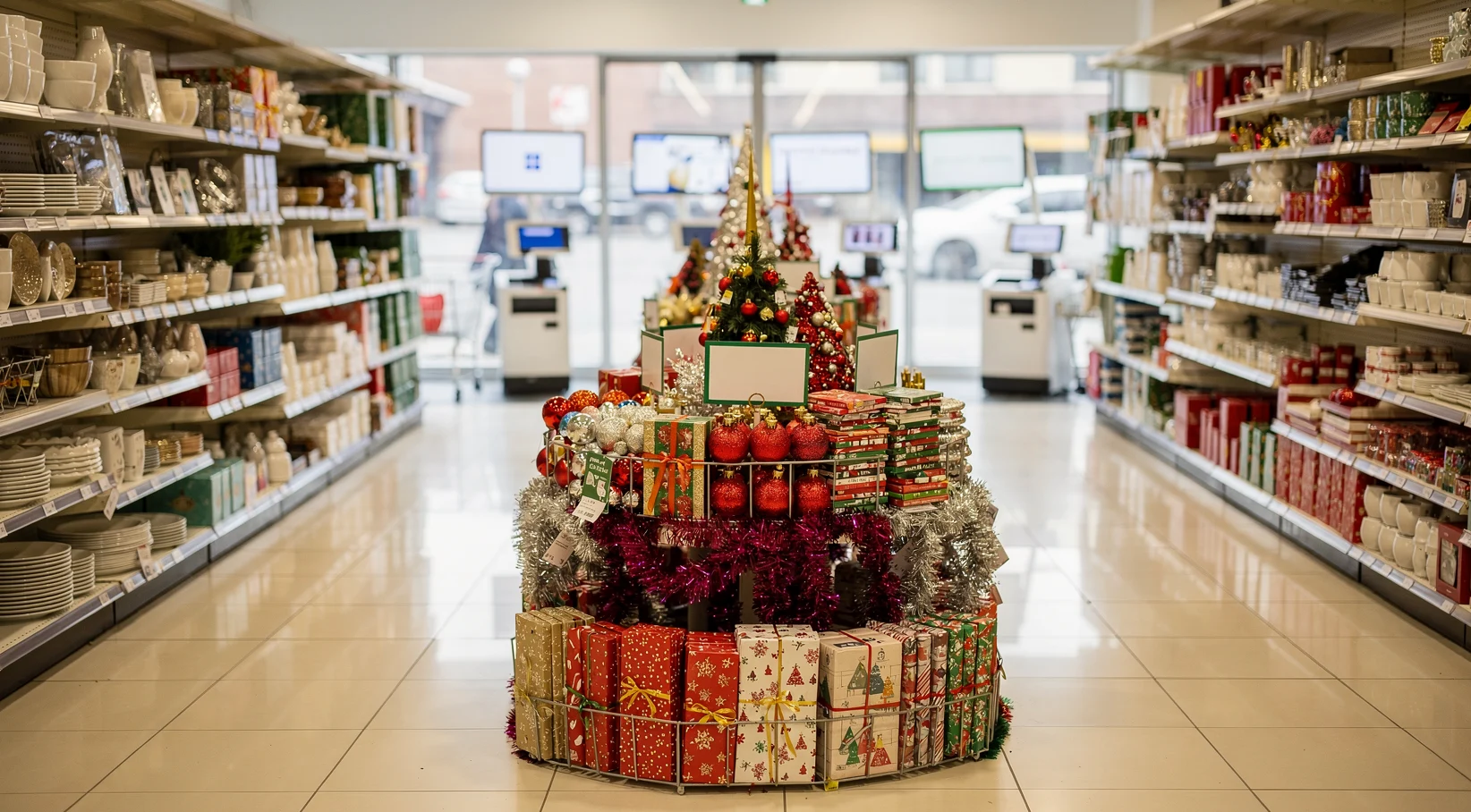
The template is a new concept store in Wigan, which opened on 28 August 2026. According to the results statement, Wigan 2.0 introduces a “landing zone” near the entrance, a more intuitive route through the shop that puts general merchandise and seasonal ranges first, wider aisles, and “a more efficient checkout experience enabled by the first installation of self-checkouts in B&M”. The Institute of Grocery Distribution named it Store of the Month for November 2026, the company said.
Will my local B&M get self-checkouts?
Not immediately, and not necessarily. B&M describes its approach as “test-and-learn”, and says it will adopt “the most successful format elements from Wigan 2.0” in all new UK stores as they open and in each store it refits. It has not said which elements count as successful, how many stores will be refitted, or whether self-checkouts will be part of every refit. Early trading in Wigan has been “encouraging”, with strong like-for-likes and a better category mix, but the store has been open for less than three months.
Self-checkouts are a choice other chains have made and, in some cases, scaled back. For a discounter whose model depends on keeping staff costs low per pound of sales, the attraction is obvious, particularly after this year’s rises in the statutory minimum wage. The results show B&M UK’s adjusted operating costs rose 5.2% to £662m, or 29.4% of revenue, with the company citing the National Minimum Wage increase, new stores, a new third-party distribution centre in Rugby and broader cost inflation.
Why is B&M opening fewer new stores?
To pay for the refits. B&M now expects to open 15 to 20 gross new UK stores in the financial year to March 2027, against the 25 to 35 it previously guided. It says it will revert to 25 to 35 a year in the 2028 financial year. Most of this year’s openings will happen in the second half, so the bulk of new branches will arrive between now and the end of March.
The first half was quiet. B&M UK opened one new store and closed three, leaving 797 at 26 September. Heron Foods, the frozen food and convenience chain that also trades as B&M Express, opened none and closed three, ending the half with 339, though it expects to open five by the year end. In France, where B&M is still building scale, nine net new stores took the total to 156, and the company has raised its French target to 15 to 20 openings this year, from 15.
| Business | Stores at 26 Sep 2026 | H1 openings / closures | FY27 opening plan | H1 revenue | H1 like-for-like |
|---|---|---|---|---|---|
| B&M UK | 797 | 1 opened, 3 closed | 15–20 gross (was 25–35) | £2,248m (+2.4%) | +0.4% (Q2 +3.2%) |
| Heron Foods and B&M Express | 339 | 0 opened, 3 closed | 5 gross | £281m (+3.0%) | +2.9% (Q2 +3.1%) |
| B&M France | 156 | 10 opened, 1 closed (9 net) | 15–20 (was 15) | £319m (+13.7%) | +5.9% (Q2 +6.5%) |
Source: B&M interim results; “gross” counts openings before closures.
Closures are part of the picture too. Our report on the B&M County Road store closure in Walton showed how the chain handles a relocation: staff were offered jobs at nearby branches and shoppers were pointed to larger stores about a mile away. B&M booked £9m of store and fixed asset impairments in the half, a sign that a handful of sites are being written down, though the statement does not list individual stores.
What happens to Heron Foods and B&M Express?
Heron Foods, the frozen food and convenience chain that B&M owns alongside the B&M Express fascia, posted a second consecutive quarter of like-for-like growth. Total sales rose 3.0% to £281m, like-for-likes rose 2.9% over the half and 3.1% in the second quarter, and adjusted EBITDA rose 21.7% to £13m. B&M says ambient ranges, the cupboard foods that do not need refrigeration, drove the growth.
The company describes Heron’s everyday low price model as relevant in “some of the UK’s most economically challenged urban areas”, and says it plans to widen the range of front-of-store convenience categories. Heron has a new managing director: Michael Fletcher, who previously held senior roles at Tesco, Co-op and SPAR, started on 2 November, replacing Tony Dobbs, who has stepped down after 35 years with the business.
For Heron shoppers, a wider convenience range is the practical change to watch. No new Heron stores opened in the half, while three closed, but the company expects five gross openings by the end of March 2027.
How does B&M compare with other UK retailers this autumn?
B&M’s half-year sits in a crowded week of UK retail numbers, and the comparison is flattering on momentum but less so on the half as a whole. Its 0.4% UK like-for-like growth over six months is modest; the 3.2% second quarter is the stronger figure. The table below sets B&M’s UK figures alongside the most recent updates from other chains and the wider market, with the caveat that each company measures sales differently and over different periods.
| Retailer or source | Period | UK measure | Result |
|---|---|---|---|
| B&M UK | 26 weeks to 26 Sep 2026 | Like-for-like sales | +0.4% (Q2 +3.2%) |
| Primark (ABF) | 52 weeks to 12 Sep 2026 | Like-for-like sales | +0.5% |
| Next | 13 weeks to 31 Oct 2026 | Full price sales | +2.0% |
| BRC-KPMG monitor | 4 weeks to 31 Oct 2026 | Total retail sales | +1.5% |
| Worldpanel by Numerator | 12 weeks to 1 Nov 2026 | Take-home grocery sales | +1.7% (inflation 2.6%) |
Sources: company statements, BRC-KPMG Retail Sales Monitor, Worldpanel by Numerator.
The closest comparison is Primark, which, as we reported when Primark profits fell 12% after price cuts, also chose to invest in lower prices and accepted thinner margins to win back volume. Primark’s UK like-for-likes edged up 0.5% for its full year; B&M’s edged up 0.4% for the half. The difference is direction: B&M’s quarterly run rate has moved from minus 2.3% to plus 3.2% within six months.
Sales growth in pounds is not the same as growth in volume. Worldpanel’s latest grocery figures put like-for-like grocery price inflation at 2.6% in the four weeks to 1 November, while the total take-home market grew 1.7% over 12 weeks, which implies shoppers bought slightly less in volume terms. B&M’s statement says general merchandise grew on volume as well as price, but it does not give a volume figure for food and household goods, where sales were flat in the second quarter.
The wider high street was not booming either. The BRC-KPMG monitor showed non-food sales flat in October, with shoppers delaying big-ticket purchases until Black Friday. Against that backdrop, a value chain posting positive like-for-likes in both food and general merchandise in the first weeks of the Christmas quarter is a better-than-average performance, even if B&M has not put a number on it.
What does this mean for Poundland and the rest of the value market?
The timing is awkward for B&M’s struggling rival. On the same morning, Poundland’s directors were seeking a further 10 working days of protection from creditors, as our report on the Poundland 10-day reprieve explains, after its original notice of intention to appoint administrators expired at midnight. The BBC has reported that owner Gordon Brothers has released £9m on top of an earlier £10m, after roughly £50m was frozen.
B&M has been named in press reports among the retailers that could take individual Poundland stores in a break-up, alongside Tesco, Lidl, Iceland, The Range and Poundstretcher. Thursday’s results did not mention Poundland, and B&M has made no public statement about bidding. What the results do show is that B&M has the balance sheet to act if it wanted to: net debt fell 28.7% to £613m, leverage dropped to 1.3 times earnings, and post-tax free cash flow rose to £132m.
The Sun ran a feature on 7 November asking whether B&M had “killed” Poundland by taking over retail parks and social media. The honest answer from today’s numbers is more limited. B&M’s own UK sales were falling as recently as the spring, and its growth over the half is less than half a percentage point. Poundland’s problems, including its owner’s restructuring and the freezing of cash, are specific to that business; B&M has been a competitor, not the cause.
Where the two chains overlap most is general merchandise: seasonal goods, homeware, toys and cleaning products. If Poundland shops close or change hands in December, B&M stores nearby are well placed to pick up some of that spending, and the company’s statement that general merchandise like-for-likes “remained positive” in early Christmas trading suggests it has the stock to do so.
Is B&M still the cheap option it used to be?
B&M’s own statement says the first priority of the turnaround was sharpening price, and the margin pressure on everyday goods suggests it followed through on key lines. But the company does not publish a price index, and it does not say how many products were cut or by how much. Shoppers comparing B&M with supermarkets should look at the products they actually buy, rather than assuming the discount gap is the same on every line.
The supermarkets have narrowed that gap in two ways. First, loyalty pricing: Tesco Clubcard Prices, Sainsbury’s Nectar Prices and similar schemes now offer member discounts on many of the branded snacks, drinks and household products that used to be B&M’s strongest draw. Second, the discounters Aldi and Lidl continue to grow; Worldpanel’s latest data showed Lidl’s market share rising 0.4 points to 8.6%, as covered in our report on UK grocery inflation and supermarket market share.
The SKU cuts matter for regular shoppers. A stock-keeping unit is each distinct product, so a single brand of washing-up liquid in three sizes counts as three. B&M says it has reduced SKU count across its FMCG ranges, with the clearance of discontinued lines weighing more on margins in the second quarter. In practice, that means some familiar products may have disappeared from your local store in recent months, and end-of-line clearance deals were part of what shoppers saw over the summer.
The company’s argument is that a tighter range lets it keep best-sellers in stock more consistently. On-shelf availability of best-selling brands was one of the four Basics workstreams, and empty shelves were a common customer complaint during the chain’s weak trading period. Whether the trade-off works for an individual shopper depends on whether the products they relied on survived the cut.
Can I shop at B&M online?
Not for home delivery. Retail Gazette reported in April 2023 that B&M had scrapped its online home delivery service, and the chain remains overwhelmingly a physical store business. Thursday’s results make no mention of a return to online delivery, and the investment priorities listed (re-lays, refits, new stores and distribution centres) are all aimed at the store estate.
That sets B&M apart from rivals that are pushing harder online. Primark has said it will offer home delivery in Great Britain in the future, using a depot it bought in Sheffield, while Next reported that its UK online sales grew 4.4% in the third quarter as shop sales fell 1.7%. For B&M, the bet is that low prices, a fast-changing seasonal range and big edge-of-town stores do not need an online channel; the half-year numbers give that bet some support for now.
Because B&M sells in person, the familiar in-store rules apply. Under the Consumer Rights Act 2015, goods must be of satisfactory quality, fit for purpose and as described, and you have a short-term right to reject faulty goods for a full refund within 30 days. A retailer’s own returns policy for unwanted, non-faulty items is a goodwill gesture on top of that, so check the receipt or the store’s policy before buying Christmas gifts that might need swapping in January.
Products in the general merchandise range also sit at the centre of a separate legal fight. As we reported, B&M sued Morrisons at the High Court on 29 October over alleged copyright and design right infringement and breach of confidence. Thursday’s results did not refer to the case, no particulars of claim have been published, and there is no injunction affecting what either chain can sell.
What has B&M said about Christmas and the full year?
B&M says early Golden Quarter trading, the October to December period when it makes a large share of its annual profit, has been positive in each of its three businesses. In the UK, it reported continued like-for-like growth in both FMCG and general merchandise. It did not give a percentage for the current quarter.
For the first time this year, the company also issued formal guidance. It expects full-year adjusted EBITDA (pre-IFRS 16) of £450m–£500m, against £459m in the year to March 2026, and adjusted profit before tax of £280m–£330m, against £284m. Reuters noted that the top of the profit range would be a rise of about 16%, and put the LSEG analyst consensus at £290.41m; Alliance News said the consensus for EBITDA had been £466m.
| Guidance measure | FY26 actual (to 28 Mar 2026) | FY27 guidance | Consensus before results |
|---|---|---|---|
| Adjusted EBITDA (pre-IFRS 16) | £459m | £450m–£500m | £466m (Alliance News) |
| Adjusted profit before tax | £284m | £280m–£330m | £290.41m (LSEG via Reuters) |
| UK gross new stores | n/a | 15–20 (was 25–35) | n/a |
Source: B&M interim results; Reuters; Alliance News.
The range is wide, and the bottom of it would mean profit slightly below last year. Peel Hunt said in its note that it expects the outcome to move towards the upper end if current trends continue. The next formal update is likely to be B&M’s Christmas trading statement, which in recent years has been published in January.
B&M says it is aiming to restore the UK business’s adjusted EBITDA margin to “low double-digit” levels over the medium term. In the half just reported, that margin was 7.5%, unchanged on the restated figure for last year. Yahoo Finance’s summary of the results noted that this remains a management ambition rather than formal guidance, and the gap between 7.5% and the low teens shows how much of the recovery is still ahead.
What should shoppers and local high streets watch next?
The next few weeks will test whether the second quarter was a turning point or a good summer. Black Friday falls on 27 November, and B&M’s general merchandise ranges compete directly with Poundland, The Range, Home Bargains and the supermarkets’ non-food aisles for seasonal and gift spending. The company’s January trading statement will give the first hard number on Christmas.
For high streets and retail parks, the store plan matters more than the profit figure. Fewer new UK openings this year means fewer new jobs and fewer new shops than B&M had planned, but more refitted stores. If the Wigan format spreads, customers in refitted branches can expect wider aisles, more seasonal space by the door and, possibly, self-checkouts. The company has not published a list of stores due for refits, so local announcements will be the first sign.
Key dates
- 19 November 2026: B&M shares go ex-dividend for the 3.6p interim payment.
- Around 26 November 2026: the extended Poundland protection period is expected to end, on our count, which could put individual stores on the market.
- 27 November 2026: Black Friday, the first big test of B&M’s Christmas general merchandise range.
- 18 December 2026: interim dividend paid.
- January 2027: expected Christmas trading statement.
- 25 January 2027: new chief financial officer Atheeq Akbar starts.
The full results statement and presentation are available on B&M’s investor results page.
Frequently asked questions
Did B&M make a profit in the first half of 2026?
Yes. In the 26 weeks to 26 September 2026, B&M reported adjusted profit before tax of £121m, up 16.6%, and statutory profit before tax of £115m, up 53.7%. Profit after tax for the period was £84m, against £53m a year earlier.
Why did B&M shares jump on 12 November?
Profit and sales beat analyst forecasts by a wide margin. Alliance News put the profit consensus at £87m against £121m delivered, and the UK second-quarter like-for-like figure of 3.2% compared with an expected 1.0%. Reuters reported that the shares rose as much as 19.5% to 333.4p.
Is B&M closing stores?
B&M closed three UK stores in the first half and opened one, leaving 797. It still plans to open 15 to 20 new UK stores this financial year, fewer than the 25 to 35 previously planned, because it is spending more on refitting existing stores. It has not announced a wider closure programme.
What is the B&M 2.0 store in Wigan?
It is a concept store that opened on 28 August 2026 with a landing zone near the entrance, a new layout that puts general merchandise and seasonal ranges first, wider aisles and the first self-checkouts in any B&M store. B&M says the best-performing features will be added to new and refitted stores.
Is B&M getting self-checkouts in every store?
B&M has not said so. The Wigan store is the only one with self-checkouts so far, and the company describes its approach as test-and-learn. Elements that work will be adopted in new and refitted stores, but no list of stores or timetable has been published.
Does B&M deliver online?
No. Retail Gazette reported in April 2023 that B&M scrapped its online home delivery service, and the latest results do not mention any plan to restart it. B&M remains a store-based retailer.
Is B&M buying Poundland stores?
B&M has been named in press reports among retailers that could take individual Poundland shops if the chain is broken up, but it has not confirmed any bid and its results did not mention Poundland. Poundland’s directors are seeking a further 10 working days of protection from creditors.
When is B&M’s next trading update?
B&M usually publishes a Christmas trading statement in January. The company has not yet confirmed the date for 2027. Its interim dividend of 3.6p will be paid on 18 December 2026.