
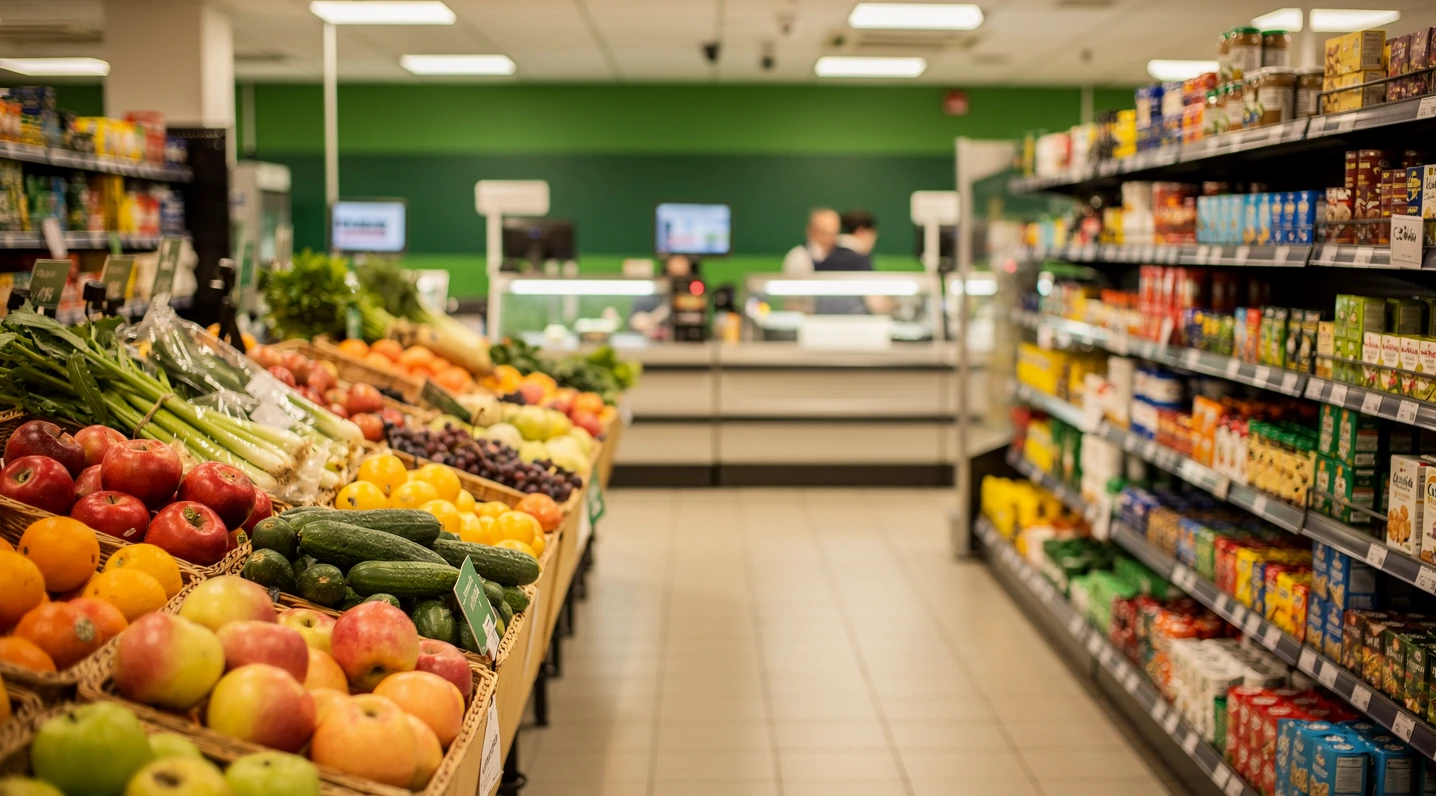
Asda’s food sales have grown again, but only just. In a third-quarter trading update published on Friday 13 November 2026, the supermarket said like-for-like food sales rose 0.1% in the 13 weeks to 30 September, its first quarterly food growth since 2024, while online grocery sales jumped 6.9%. Total like-for-like sales excluding fuel slipped 0.1%, and group revenue including fuel rose 3.1% to £6.5bn.
The figures are the first set of numbers published since David Potts took over as chief executive on 3 November, and they arrive at an awkward moment. Independent market data released three days earlier showed Asda as the only big British supermarket whose sales fell over the 12 weeks to 1 November. This article sets out what Asda reported, what the numbers leave out, how Asda compares with its rivals, and what the update means for people who do their weekly shop or their Christmas order with Asda.
In short
- Food back in growth: Asda’s like-for-like food sales rose 0.1% in the 13 weeks to 30 September 2026, against a 1.9% fall in the previous quarter, according to the company statement.
- Online up 6.9%: online grocery sales grew 6.9% like for like, with the Asda Rewards loyalty scheme now linked to 74% of online orders.
- Flat overall: group like-for-like sales excluding fuel fell 0.1% on revenue of £5.1bn; revenue including fuel rose 3.1% to £6.5bn, helped by higher pump prices.
- Momentum faded: Asda had reported 0.7% food growth for the first seven weeks of the quarter in August, which implies the last six weeks were negative on shopappy’s arithmetic.
- Shopper changes: more than 1,000 price cuts held until Christmas, a 4p-a-litre fuel cut from 12 November and more staffed checkouts ordered by new chief executive David Potts.
What did Asda report for the third quarter?
Asda published its third-quarter trading update on its corporate newsroom on the afternoon of Friday 13 November, under the headline “Asda reports group sales growth in Q3“. The update covers the 13 weeks from 1 July to 30 September 2026. As a privately owned company, Asda does not publish a full set of accounts every quarter, and this release contained sales figures only, with no profit, cash or debt numbers.
The company led on its group revenue. Including fuel, revenue rose 3.1% year on year to £6.5bn. Excluding fuel, revenue was £5.1bn and like-for-like sales, which strip out new and closed stores, were “broadly flat” at minus 0.1%. Food sales grew 0.1%, which Asda said reflected continuing “investment in price and availability”.
Two parts of the business did better than the whole. Online grocery sales rose 6.9% on a like-for-like basis, and the Asda Express convenience chain grew like-for-like sales by 2.7%, which the company said was ahead of the wider convenience market. Asda also said it plans to open 15 new Express stores next year.
What the chief financial officer said
The statement was fronted by Michael Gleeson, Asda’s chief financial officer, rather than the new chief executive. “The work we’ve done through the period to deliver against our strategy was reflected in our third-quarter performance,” he said. “Like-for-like food sales returned to growth in Q3, online sales grew strongly and group sales increased, despite the challenging economic backdrop.”
Gleeson also leaned on the breadth of the group. “Asda’s key strength is the breadth of our business, spanning food, clothing, fuel, pharmacy and other services,” he said, adding that “our disciplined approach to managing costs and cash means we can keep investing in value today and in sustainable growth in the long-term.” The figures were reported by Reuters, the PA news agency, City AM, This is Money and Asian Trader within hours of the release.
The headline numbers in one table
| Measure (13 weeks to 30 Sep 2026) | Figure | Year-on-year change |
|---|---|---|
| Group revenue including fuel | £6.5bn | +3.1% |
| Revenue excluding fuel | £5.1bn | not stated as a total change |
| Like-for-like sales excluding fuel | n/a | −0.1% |
| Like-for-like food sales | n/a | +0.1% |
| Online grocery, like for like | n/a | +6.9% |
| Asda Express, like for like | n/a | +2.7% |
| Online orders linked to Asda Rewards | 74% | no comparison given |
Source: Asda third-quarter trading update, 13 November 2026. Asda did not publish clothing (George), fuel volume, pharmacy or profit figures for the quarter.
Is Asda really back in growth?
The answer depends on which line you read. Food sales did grow, which is the first time that has happened in a quarter since early 2024, as This is Money and the PA news agency both noted. But the growth was 0.1%, and total like-for-like sales excluding fuel still fell. Reuters headlined its report “Sales at UK supermarket Asda stall as new boss takes reins”, while City AM wrote that “Asda sales growth slowed ahead of leadership shake-up”.
Both readings are fair. Compared with the second quarter, when like-for-like sales fell 2.3% and food sales fell 1.9%, the third quarter is a clear improvement. Compared with what Asda told the market in August, however, it is a step back.
What Asda said in August, and what it implies now
On 28 August, alongside its second-quarter results, Asda gave an early read on the third quarter. For the seven weeks to 18 August, it said revenue including fuel was up 2.1%, like-for-like sales excluding fuel were up 0.2% and like-for-like food sales were up 0.7%. Allan Leighton, then executive chairman, called it “a major milestone” and said the business was “in the foothills of recovery”.
The full 13-week figures now show food at plus 0.1% and total like-for-like at minus 0.1%. If the first seven weeks ran at plus 0.7% for food, the remaining six weeks to 30 September must have been weaker. On a simple time-weighted calculation by shopappy, which assumes each week carries similar sales, food like-for-like sales in the last six weeks of the quarter fell by roughly 0.6%, and total like-for-like sales by roughly 0.4% to 0.5%. Asda did not publish a split, and the true figures depend on the weekly sales mix, so these should be read as an estimate rather than a reported number.
City AM drew the same conclusion in plainer terms, reporting that the “uplift has since tailed off”. That matters because it is the trend, not the quarterly average, that tells shoppers and suppliers where the business is heading into Christmas.
An easy comparison with last year
There is a further reason to treat the third-quarter growth with caution. The same quarter in 2025 was one of the worst in Asda’s recent history. In its 2025 third-quarter update, published on 28 November last year, Asda reported a 2.8% fall in like-for-like sales and said trading had been “impacted by severe disruption to systems” after it moved off Walmart’s technology under a programme called Project Future.
At the time, Asda said the cutover had caused “inconsistent availability” in stores and “a poor customer experience online and through the app”, hitting its home shopping business in particular. Growing against a quarter that was depressed by empty shelves and a faulty app is easier than growing against a normal one. Asda itself said in November 2025 that it did not expect to “re-establish our Q2 2025 position until Q2 of 2026”.
| Period | Like-for-like sales ex fuel | Like-for-like food | Asda Express LFL | Context |
|---|---|---|---|---|
| Q3 2025 (Jul–Sep 2025) | −2.8% | not stated | +3.5% | Project Future IT cutover disrupts stock and online |
| Q2 2026 (Apr–Jun 2026) | −2.3% | −1.9% | not stated | Market share stable at 11.5%, per Asda |
| First 7 weeks of Q3 2026 (to 18 Aug) | +0.2% | +0.7% | not stated | Leighton: “foothills of recovery” |
| Full Q3 2026 (Jul–Sep 2026) | −0.1% | +0.1% | +2.7% | First quarterly food growth since 2024 |
| Last 6 weeks of Q3 2026 (shopappy estimate) | about −0.4% to −0.5% | about −0.6% | n/a | Implied by the two published figures |
Sources: Asda trading updates of 28 November 2025, 28 August 2026 and 13 November 2026. The final row is a shopappy calculation, not an Asda figure.
Why is Asda’s revenue up 3.1% if sales are flat?
The gap between the 3.1% rise in revenue and the flat like-for-like figure is almost entirely about petrol and diesel. Asda’s revenue including fuel was £6.5bn, and revenue excluding fuel was £5.1bn, which puts fuel sales at roughly £1.4bn for the quarter on shopappy’s subtraction. Fuel is a large, low-margin part of the business, and when pump prices rise, revenue rises with them even if drivers buy the same number of litres.
This is Money reported that fuel prices have risen sharply since the outbreak of war in the Middle East in February. That pushes up the value of every tank Asda sells. The company’s headline of “group sales growth” is therefore accurate, but the like-for-like figure excluding fuel is the better measure of how many people are choosing Asda for their food and household shopping.
Revenue excluding fuel was £5.1bn, the same rounded figure Asda reported for the third quarter of 2025. Asda did not give a percentage change for that line, which is consistent with a broadly flat result once new stores, mainly Express convenience shops, are taken into account.
How did online grocery grow 6.9%?
Online was the strongest part of the update, and it is the part most relevant to shoppers who order their groceries for delivery or click and collect. Asda said online grocery sales grew 6.9% on a like-for-like basis, “supported by strong participation in Asda Rewards, which is now linked to 74% of online orders”.
Asda Rewards is the supermarket’s loyalty scheme, which pays cashpot money into a shopper’s account on selected products rather than offering lower member-only shelf prices. Linking three in four online orders to a loyalty account gives Asda detailed data on what each household buys, which it can use for personalised offers and, increasingly, for selling advertising to brands. In its August update, Asda said it had become the first retailer outside the United States to partner with Amazon Ads, with that partnership “rolling out from Q4 onwards” to create a new revenue stream and “a more personalised online shopping experience”.
A recovery from last year’s broken app
The 6.9% rise should be read against the 2025 comparison. In the third quarter of last year, Asda said its online business was hit by “functionality issues following the launch of a new app and website in August” 2025, on top of the stock problems caused by the systems cutover. Some of this year’s online growth is therefore customers returning after a poor experience, rather than new demand.
Even so, the figure is ahead of the wider grocery market. Worldpanel by Numerator data published on 10 November showed total take-home grocery sales rising 1.7% over 12 weeks, and online-only grocer Ocado growing 12.3%. Our report on UK grocery inflation and the latest supermarket market shares has the full table, which shows that online specialists are still taking business from store-led grocers, even as Asda’s own online sales recover. Across all retail categories, UK online sales have also been outpacing stores this autumn.
What comes next online: the Ocado pilot
Asda has a partnership with Ocado’s technology business, which it said in August “remains on track, with a pilot launching towards the end of the year, ahead of a wider rollout in 2027”. The third-quarter release did not mention it, and Asda has not said where the pilot will run or which customers will see it. For now, shoppers will order through Asda’s existing app and website, and delivery slots, minimum basket rules and charges are unchanged by the update.
How does Asda compare with Tesco, Sainsbury’s, Aldi and Lidl?
Asda’s own figures cover July to September. The most recent independent data, from Worldpanel by Numerator, covers the 12 weeks to 1 November, so it overlaps the end of Asda’s quarter and runs a month past it. It does not paint a flattering picture. According to that data, Asda’s sales fell 0.5% to about £4bn and its market share slipped from 11.6% to 11.3%, making it the only major supermarket whose sales fell.
| Grocer | Market share, 12 weeks to 1 Nov 2026 | Share a year earlier | Sales growth |
|---|---|---|---|
| Tesco | 27.8% | 27.9% | +1.2% |
| Sainsbury’s | 15.5% | 15.6% | +0.8% |
| Asda | 11.3% | 11.6% | −0.5% |
| Aldi | 10.4% | 10.5% | +0.4% |
| Lidl | 8.6% | 8.2% | +6.6% |
| Morrisons | 8.3% | not reported | +2.0% |
| Waitrose | 4.5% | 4.4% | +2.2% |
| Ocado | 2.3% | 2.1% | +12.3% |
| Total market | 100% | 100% | +1.7% |
Source: Worldpanel by Numerator, 12 weeks to 1 November 2026, as reported by Business Live, City AM, Sharecast and Alliance News on 10 November 2026.
The gap to Aldi
The most watched number in the table is the gap between Asda and Aldi. At 11.3% against 10.4%, Asda remains Britain’s third largest grocer, but the margin is under a percentage point. On the Worldpanel figures, every 0.1 points of share is worth roughly £36m of sales over 12 weeks, so the gap is equivalent to about £320m of sales over a quarter. Lidl, growing at 6.6%, is also closing in on both.
The two sets of numbers are not directly comparable. Asda’s own figures are like for like and exclude fuel, while Worldpanel measures take-home grocery spending by a panel of households and includes new stores. But they point the same way: Asda grew less than the market in the third quarter, and the weeks after the quarter ended were weaker still. City AM reported “suggestions that the grocer’s takings have slumped back into negative territory in recent weeks”.
What has David Potts changed since he arrived?
David Potts, the former Morrisons chief executive who spent almost four decades at Tesco, was appointed Asda’s group chief executive with immediate effect on 3 November. Allan Leighton, who had run the business as executive chairman since November 2024, became non-executive chairman. Our earlier piece on Asda’s appointment of David Potts covers his career and what the change meant at the time.
The third-quarter figures cover a period before he joined, so they are a baseline for his tenure rather than a verdict on it. In his first fortnight, however, Potts has made three changes that shoppers can see.
More staffed checkouts and fuller shelves
On what Asda described as his first official day in the role, Monday 10 November, Potts wrote to Asda’s 1,100 store managers from the Pudsey store in West Yorkshire. He asked them to open more full-service checkouts, “especially” for customers doing bigger shops, to spend more time on the shop floor, and to get more product on shelves and “presented well” throughout the day.
“We’re making it harder than it should be for customers to get what they want, move around the store and pay for their shopping,” he said, according to the company. “We need to change that, starting now.” He added: “The shopping trip is everything and by making Asda easier to shop so customers can find what they came for and get through the checkouts easily, they’ll come back and shop more with us.”
The instruction runs against the industry trend of the past decade, in which supermarkets have replaced staffed tills with self-service machines to cut labour costs. Other grocers have also been rethinking in-store technology this year; Morrisons, which Potts used to run, recently scrapped its AI smart trolleys. Asda has not said how many extra staffed tills it expects to open, whether staff hours will rise, or how the change will be paid for.
A 4p cut at the pumps
On Thursday 12 November, the day before the trading update, Asda cut the price of unleaded and diesel by an average of 4p a litre at the petrol stations attached to its large stores. It said drivers would pay no more than 159.7p a litre for unleaded and 189.7p for diesel at those sites, and that a typical 55-litre family car would save up to £2.20 a tank. City AM reported the cut applies at 321 forecourts.
“When we get the fundamentals right, customers notice,” Potts said in the fuel announcement, adding that “4p off every litre helps families where they’re feeling it most”. The cut came into force at 5pm on 12 November. Asda has not said how long it will last; pump prices can move again at any time.
What does the update mean for Asda shoppers?
For most households, nothing in the trading update changes prices, delivery slots or store opening hours by itself. The update describes a past quarter. But several commitments made alongside it are directly relevant to the Christmas shop.
| Change | What Asda has said | Start date | What is not known |
|---|---|---|---|
| Price cuts held until Christmas | More than 1,000 everyday products cut and “guaranteed to hold” until Christmas | Already in place | Full product list; whether the guarantee runs to 25 December or a set date |
| Fuel price cut | Average 4p a litre off; cap of 159.7p unleaded and 189.7p diesel at superstore forecourts | 5pm, 12 November 2026 | How long the cap lasts; whether Express forecourts are included |
| More staffed checkouts | Store managers told to open more full-service checkouts | From 10 November 2026 | Number of tills, opening times, any change to staffing levels |
| Fuller shelves | Managers told to get more product on shelves throughout the day | From 10 November 2026 | Any published availability target |
| New Express stores | 15 new Asda Express shops planned | Next year (2027) | Locations |
Sources: Asda statements of 10, 12 and 13 November 2026.
Prices and the Christmas basket
Asda continues to describe itself as “the lowest-priced full-range supermarket”. In the update, it said it had won The Grocer 33 weekly price comparison nine times since July and that Which? had named it cheapest supermarket for branded groceries in eight of the last nine months.
Asda also cited its own Income Tracker, which it said showed household spending power at a six-month low, with the lowest-earning households on average £76 a week short of covering essential bills. That is Asda’s own research, published by the company, and it is used here to explain why the supermarket is putting money into prices. Shoppers comparing supermarkets for their Christmas order should check prices on the specific items they buy, since basket surveys only cover a sample.
Booking a Christmas delivery
Nothing in the update changes Asda’s festive delivery arrangements. Tesco opened its Christmas delivery slots on 3 November, and the busiest dates at every grocer sell out quickly. Our guide to Christmas delivery slot dates for Tesco and other supermarkets sets out when each chain opened its booking window. If you shop online with Asda, linking your order to an Asda Rewards account is how you collect the loyalty cashpot on qualifying items; three in four online orders already do so, according to the company.
Why does Asda’s turnaround matter to the wider UK market?
Asda is not a listed company, but its performance still matters well beyond its own stores. It has 116,296 colleagues, according to Potts’s statement on his appointment, and it buys from thousands of British food and drink suppliers. Its pricing also sets a benchmark that Tesco, Sainsbury’s and Morrisons respond to.
Private equity ownership and debt
Asda was bought from Walmart in a debt-funded takeover in 2021. Reuters reports that TDR now owns a majority of the business and that Walmart, its former owner, keeps a 10% stake. This is Money noted that Asda has “grappled with debt pressures” since the takeover, and that Morrisons, Potts’s former employer, has struggled in similar fashion after its own debt-funded buyout.
The cost of Asda’s price investment has shown up in its profits. For 2025, Asda reported a pre-tax loss of £989m, wider than the £599m loss a year earlier, while adjusted earnings fell by a third to about £761m, the PA news agency reported. Those figures cover the year before Potts arrived. The third-quarter release did not update profit, cash or net debt, so there is no way to tell from Friday’s figures whether the business is now funding its price cuts more comfortably.
More than a supermarket
Asda says nearly half its revenue comes from businesses outside traditional grocery, including George clothing, fuel, convenience, pharmacy, optical and online. In the August update, it described this mix as its “more than a supermarket” strategy. Gleeson repeated the theme on Friday, saying the breadth of the business “gives us more opportunities to grow”.
The third-quarter update gave no figures for George clothing. This is Money reported that Asda said it was seeing “green shoots” across the business, including George, and that Helen Connolly, the former chief executive of New Look, took over running the clothing range this summer. Without published numbers, shoppers and suppliers cannot judge how George performed against fashion rivals over the summer.
What the update does not tell us
Short trading statements are useful for what they include, but also for what they leave out. Friday’s update contained no figures on profit, earnings before interest, tax, depreciation and amortisation (EBITDA), cash flow or net debt. It gave no market share figure, although the August release had cited a “stable” share of 11.5% for the second quarter.
The release also gave no outlook for Christmas and no update on the cost of the 1,000-plus price cuts. It did not mention the shelf-edge availability cameras that Asda said in August were being piloted, the Glasgow wholesale pilot with the independent retailer One-O-One, or the Amazon Ads partnership due to start in the fourth quarter. None of these omissions is unusual for a private company’s quarterly update, but they mean the headline “group sales growth” is the most positive possible framing of a set of numbers that, on the like-for-like line, show a business standing still.
The questions to watch
There are four things that will show whether the third quarter was a turning point. First, the next Worldpanel market share release, due in early December, which will show whether Asda’s sales fall of minus 0.5% has deepened or reversed. Second, Asda’s next trading update, which will cover the Christmas quarter. Third, whether the staffed checkout and fuel commitments are backed by visible changes in stores. Fourth, the full-year 2026 results, which will show what all of this has done to profit and debt.
Leighton said in August that Asda was about a third of the way through its turnaround. Potts has not yet set out a new timetable, a new strategy or a financial target. His first public statements have focused on the basics of the shopping trip rather than on numbers.
How should investors, suppliers and shoppers read this update?
Different readers will take different things from the same release. For shoppers, the practical news is the fuel cut, the price guarantee to Christmas and the promise of more staffed tills. Whether those changes are noticeable will vary by store, and the update gives no store-by-store detail.
For suppliers, the flat like-for-like line and the weaker Worldpanel data are a reminder that Asda’s volumes are under pressure and that its price investment is likely to continue. Suppliers to Asda will be watching closely for signs that the new chief executive wants to renegotiate terms to fund lower prices, although nothing of the kind has been announced.
For bondholders and lenders, who are the main financial audience for a private company’s trading update, the numbers are mixed. Revenue is up, online is growing and food has returned to growth, but the trend inside the quarter weakened, and there were no profit or cash figures to reassure on the cost of the price cuts. The full picture will only become clear with the year-end results.
The verdict so far
Asda can fairly say that its food sales grew for the first time in more than two years, that online is recovering strongly from last year’s IT failure, and that its convenience stores are outpacing their market. It cannot yet say that it has stopped losing customers to Lidl, Tesco and Morrisons. The best independent evidence, Worldpanel’s data to 1 November, says it has not.
That leaves David Potts with the task he described on his first day: making the shopping trip easier, so that the customers who come for the prices stay for the service. The Christmas quarter, with its peak demand for staffed checkouts, full shelves and reliable online slots, will be his first real test.
Frequently asked questions
What were Asda’s third-quarter 2026 sales?
Asda reported group revenue including fuel of £6.5bn for the 13 weeks to 30 September 2026, up 3.1% year on year. Revenue excluding fuel was £5.1bn, and like-for-like sales excluding fuel fell 0.1%. Like-for-like food sales rose 0.1%, according to the company’s trading update published on 13 November 2026.
Are Asda’s sales growing or falling?
Both, depending on the measure. Food sales grew 0.1% and online sales grew 6.9% in the quarter, but total like-for-like sales excluding fuel fell 0.1%. Independent Worldpanel data for the 12 weeks to 1 November showed Asda’s sales down 0.5%, the only fall among the big supermarkets.
Why did Asda’s revenue rise 3.1% when like-for-like sales fell?
Mainly because of fuel. Revenue including fuel was £6.5bn and excluding fuel £5.1bn, so roughly £1.4bn came from petrol and diesel. Higher pump prices increase that revenue even if drivers buy the same amount of fuel.
How much did Asda’s online grocery sales grow?
Online grocery sales rose 6.9% on a like-for-like basis in the 13 weeks to 30 September 2026. Asda said the Asda Rewards loyalty scheme is now linked to 74% of online orders. The comparison is with a quarter in 2025 when Asda’s new app and website suffered functionality problems.
Is Asda still cheaper than Tesco and Sainsbury’s?
Asda says it is the lowest-priced full-range supermarket. It reported winning The Grocer 33 weekly price survey nine times since July and being named cheapest for branded groceries by Which? in eight of the last nine months. Those surveys compare a sample basket, so it is worth checking the specific items you buy.
How long will Asda’s 4p fuel cut last?
Asda has not given an end date. The cut took effect at 5pm on 12 November 2026 at petrol stations attached to its large stores, with a cap of 159.7p a litre for unleaded and 189.7p for diesel. Pump prices can change again at any time.
Is Asda bringing back staffed checkouts?
New chief executive David Potts told Asda’s 1,100 store managers on 10 November 2026 to open more full-service checkouts, especially for customers doing bigger shops. Asda has not said how many additional staffed tills will open or at what times, so the change may vary from store to store.
Who owns Asda?
Asda is majority owned by the private equity firm TDR Capital, according to Reuters, with Walmart keeping a 10% stake. It was bought from Walmart in 2021 and is not listed on the stock market, which is why it publishes short quarterly trading updates rather than full results each quarter.
When will Asda next report?
Asda has not published a date for its next trading update; last year its full-year 2025 update came at the end of March. The next independent read on its market share is the Worldpanel by Numerator release expected in early December 2026.