
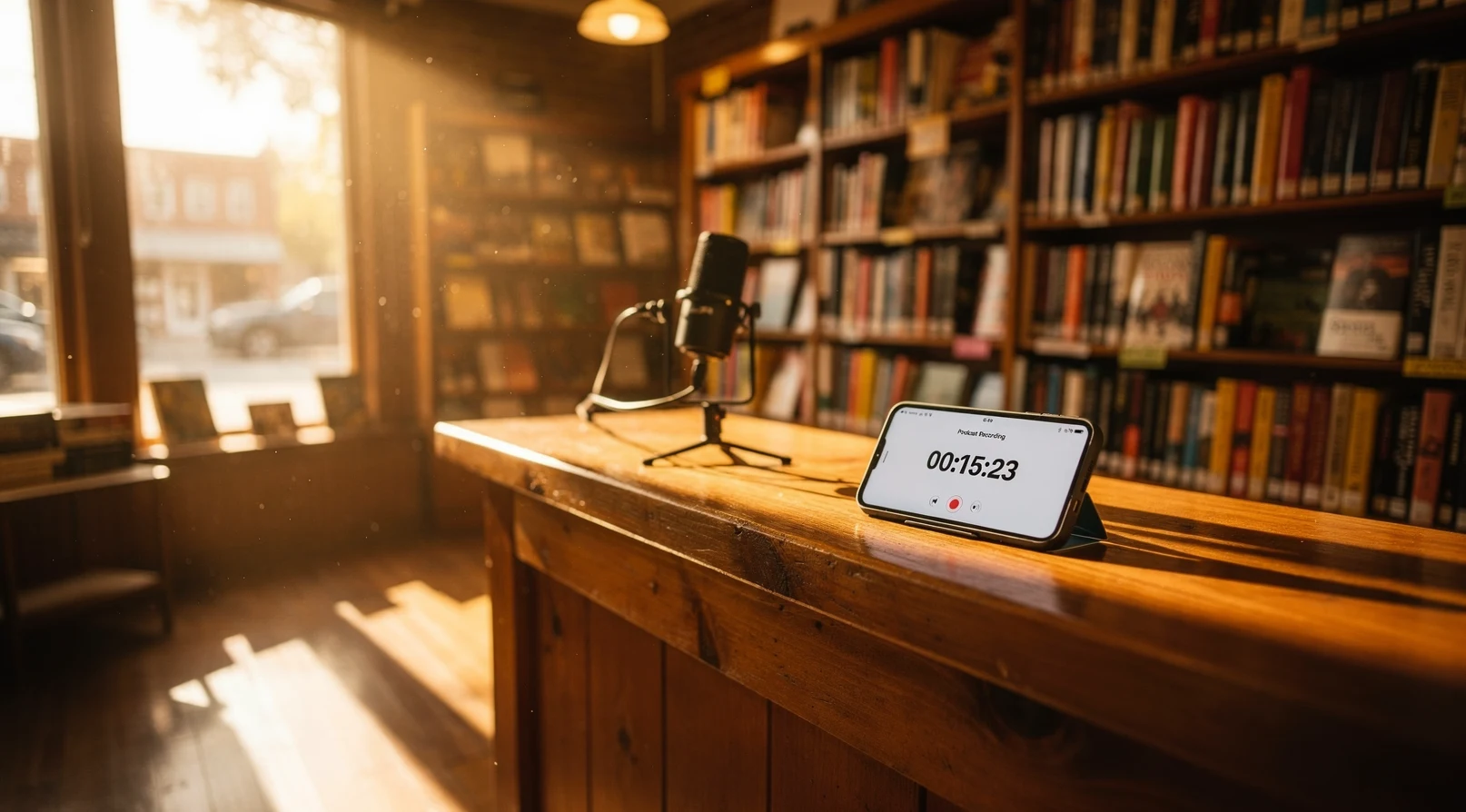
Telling the story of a small retailer used to mean a local newspaper feature, a printed Christmas card list, and a few framed photos behind the counter. In 2026, that work happens across podcasts, short video, email newsletters, customer review platforms, and AI-generated summaries served inside search results. The tooling has changed, and so has what counts as a credible small business retail story in the eyes of customers, suppliers, and lenders.
This guide is a practical map of the vendors and software categories that US retail and e-commerce teams actually use to capture, edit, publish, and measure small business stories. It is written for owners, marketing leads, and editorial partners who want a working setup, not a list of trending apps.
In short
- Story capture in 2026 leans on smartphone-first kits, hosted interview tools like Riverside and Descript, and structured note systems such as Notion or Airtable.
- Publishing still runs through WordPress, Shopify content, and email platforms (Klaviyo, Beehiiv, Mailchimp), with TikTok and YouTube Shorts as the dominant short-video surfaces.
- Measurement blends Google Analytics 4, GA4 server-side tagging, and store-level data from POS vendors like Square, Clover, and Shopify POS.
- AI tools (Claude, ChatGPT, Perplexity) now write first drafts, generate alt text, and surface stories inside answer engines, which makes structured content and schema markup essential.
- Vendor choice matters less than the workflow: the same story can be told well on a $0 stack or a $5,000-per-month stack if the editorial discipline is in place.
Why this topic matters in 2026
Small business storytelling has shifted from being a nice-to-have brand activity into a measurable channel that affects search visibility, customer trust, and even credit decisions. Lenders and franchise networks now read public reviews, podcast appearances, and press coverage as soft signals of operator quality. According to the US Census Bureau small business data, the country had about 33 million small businesses in the most recent count, and the share that maintain an active content presence has climbed steadily since 2020.
The tooling has matured in parallel. What used to require an agency retainer, a film crew, and a print deadline can now be done with a phone, a cloud editor, and a publishing platform that costs less than a single ad campaign. The catch is that the bar for quality has also moved up. Customers compare a corner bakery to a national brand inside the same TikTok feed, and answer engines compare your local case study to a Harvard Business Review case in the same Perplexity result. The pillar guide on the future of local retail and main street commerce goes deeper into the wider trend, and the tooling discussion here sits inside that picture.
For US retail and e-commerce teams in 2026, the practical question is no longer “should we tell stories” but “which stack do we actually run, and who owns it on Monday morning.” That is what this guide answers.
Key terms and definitions
Before comparing vendors, it helps to agree on the words. The same tool can be sold as a “podcast studio,” a “video editor,” and an “AI content platform” depending on the landing page you arrive on.
| Term | What it means in 2026 | Example tools |
|---|---|---|
| Story capture | Recording the raw material (interviews, b-roll, photos, written quotes). | Riverside, Descript, iPhone 16 Pro, Otter.ai |
| Editorial system | Where drafts, transcripts, and assets live before publication. | Notion, Airtable, Google Drive, Frame.io |
| Publishing surface | The owned channel where the story is delivered to readers or viewers. | WordPress, Shopify blog, Substack, Beehiiv, TikTok, YouTube |
| Distribution layer | The push from owned surfaces to email, social, and paid channels. | Klaviyo, Mailchimp, Meta Ads, Google Ads, Buffer |
| Measurement stack | Tools that attribute reads, watches, and revenue back to a story. | GA4, Fathom, Plausible, Triple Whale, Shopify Analytics |
| AI assist layer | Drafting, summarizing, generating alt text, repurposing across formats. | Claude, ChatGPT, Perplexity, Jasper, Castmagic |
Most US retail and e-commerce teams in 2026 use at least one vendor from each row. The real differentiation comes from how those layers are connected, not which logo sits in any single row.
How it works in practice
A working small business stories workflow in 2026 has five repeatable stages: brief, capture, edit, publish, measure. Each stage maps to a small group of vendors, and the same person can often own multiple stages in a team of fewer than ten people.
The five-stage workflow
- Brief. The story angle, audience, length, and target channel are written down in one place before any recording starts. A Notion or Airtable template with five fields (subject, angle, channels, deadline, owner) is enough.
- Capture. Audio or video is recorded with a remote tool (Riverside, Zoom with cloud recording, or a phone). Photos are shot on the same phone or a mirrorless camera and dropped into shared storage.
- Edit. Transcripts are pulled automatically and edited as text (Descript, Castmagic). Photos are edited in Lightroom or directly inside Canva. Written drafts are produced from the transcript, often with an AI first pass.
- Publish. The finished asset is published on the owned site (WordPress or Shopify), then repurposed into TikTok, YouTube Shorts, an email newsletter, and a LinkedIn post.
- Measure. GA4, the POS system, and the email platform are checked weekly. The team reviews which story drove store visits, e-commerce sessions, and revenue, and what the answer engines surfaced.
For supporting context on what happens when a story is about a closure rather than a launch, the case of a retailer that closed gracefully shows how the same workflow holds up under harder circumstances.
A typical week
In a team of three (owner, marketing lead, freelance editor), a typical small business stories week looks like this. Monday is the editorial brief. Tuesday is the recording, often a 45-minute remote interview followed by a 30-minute in-store visit for b-roll. Wednesday is editing. Thursday is review and approval. Friday is publication, with the email going out Saturday morning when open rates are highest for US consumer audiences.
Common mistakes and how to avoid them
Most failed small business stories programs do not fail because of bad tools. They fail because of predictable workflow mistakes. The list below comes from talking to dozens of US retailers over the past two years.
- Buying the stack before writing the brief. Teams sign up for Riverside, Descript, and Castmagic in the same week, then publish nothing for three months because no one decided what the stories are about.
- Treating the website as optional. Stories that live only on TikTok or Instagram disappear from search and from answer engines. The owned site (WordPress or Shopify) is where long-term value compounds.
- Ignoring schema markup. Without Article, LocalBusiness, and Person schema, AI answer engines struggle to attribute a story to a retailer. The pillar guide on the future of local retail covers this in more detail.
- Over-investing in production value. A clean phone recording with good audio outperforms a poorly written, expensively shot studio piece almost every time.
- No measurement loop. If GA4 and POS data are not reviewed monthly, the program drifts into vanity metrics within a quarter.
- Skipping consent and legal. Featuring customers without signed releases is a recurring problem that surfaces only when a story goes viral. A one-page release template solves it.
The single biggest mistake, by frequency, is the first one on this list. Tools are cheap. Editorial discipline is the constraint.
Examples from US retail and e-commerce
The vendor choices below come from real US retail and e-commerce teams in 2026. Names of specific operators are generalized, but the stack patterns are accurate.
Independent bookstore in the Midwest
A two-location independent bookstore runs its small business stories program with Shopify (for the site and POS), Beehiiv (for the weekly newsletter), Riverside (for monthly author interviews), and Descript (for editing). The owner records, the part-time marketing lead edits, and the program costs less than $200 per month in software. Stories drive between 8 and 12 percent of monthly e-commerce revenue, measured through GA4 and Shopify Analytics.
Regional grocery chain in the Southeast
A 14-store regional grocery chain uses WordPress with a custom theme, Klaviyo for email, and a hybrid in-house plus agency model for video. Stories focus on suppliers, not the chain itself, which builds local goodwill and gives the agency a steady flow of source material. The chain uses Castmagic and Claude to repurpose each long-form supplier story into a podcast clip, a recipe card, and an in-store sign.
Direct-to-consumer skincare brand
A 9-person DTC skincare brand uses Shopify, Klaviyo, Triple Whale, and a freelance editorial team. Their small business stories are customer-led: every month they publish two long-form customer stories on the blog and repurpose each into a 60-second TikTok and a 4-email Klaviyo sequence. They measure attribution through Triple Whale and find that customer story content has the highest lifetime value of any acquisition source.
Pop-up retail operator in a major city
A pop-up retail operator that runs short-term stores in several US cities uses storytelling as a permanent thread across temporary locations. Their stack is built around Notion for editorial planning, a shared Frame.io workspace for video review, and Beehiiv for the city-specific newsletters. The work pairs naturally with the planning detail in choosing a pop-up location in a major US city, since the right city choice is itself a story angle.
Tools, partners or vendors worth knowing
The vendor list below is grouped by workflow stage. Pricing reflects publicly available US plans in early 2026 and is intended as an order-of-magnitude guide, not a quote.
Capture and recording
| Vendor | Best for | Approximate cost |
|---|---|---|
| Riverside | Remote video and podcast interviews with local-quality audio. | $15 to $29 per month |
| Descript | Text-based audio and video editing, transcripts included. | $15 to $50 per month |
| Zoom Workplace | Quick interviews when guests are not technical. | $13 per month and up |
| Otter.ai | Live transcription for in-store interviews. | $10 to $20 per month |
| iPhone 16 Pro or Samsung S25 Ultra | B-roll, vertical video, photo capture. | One-time hardware cost |
Editorial systems
| Vendor | Best for | Approximate cost |
|---|---|---|
| Notion | Editorial calendars, briefs, source notes. | $0 to $10 per user per month |
| Airtable | Structured content pipelines with status fields. | $10 to $20 per user per month |
| Google Drive | Shared raw files and asset libraries. | $6 to $18 per user per month |
| Frame.io | Video review with timecoded comments. | $15 to $25 per user per month |
Publishing and distribution
| Vendor | Best for | Approximate cost |
|---|---|---|
| WordPress (self-hosted) | Long-form, SEO-friendly story site with full schema control. | $10 to $100 per month for hosting |
| Shopify | Stories tied directly to e-commerce inventory. | $29 to $399 per month |
| Beehiiv | Newsletter with built-in growth tools. | $0 to $99 per month |
| Klaviyo | Retail and e-commerce email tied to POS data. | $45 per month and up by list size |
| TikTok and YouTube | Short video distribution. | Free |
Measurement
| Vendor | Best for | Approximate cost |
|---|---|---|
| Google Analytics 4 | Site analytics and conversion paths. | Free |
| Fathom or Plausible | Privacy-friendly site analytics. | $15 to $35 per month |
| Triple Whale | DTC attribution across Meta, TikTok, and Google. | $129 per month and up |
| Shopify Analytics | Built-in e-commerce reporting. | Included in Shopify |
| Square or Clover dashboards | In-store sales reporting for non-Shopify retailers. | Included with POS |
AI assist
| Vendor | Best for | Approximate cost |
|---|---|---|
| Claude (Anthropic) | Long-form drafting, editing, schema generation. | $20 per user per month |
| ChatGPT | Brainstorming, headline testing, FAQ drafting. | $20 per user per month |
| Perplexity | Research and source discovery for stories. | $20 per user per month |
| Castmagic | Turning long podcasts into clips, posts, and newsletters. | $23 to $59 per month |
| Jasper or Copy.ai | Brand-voice training for repeated story formats. | $49 per month and up |
The pattern most US retail and e-commerce teams settle on in 2026 is one vendor per row, chosen for fit with the rest of the stack rather than for individual features. The single most leveraged choice is the publishing surface, because changing it later costs the most.
Integration patterns that hold up
The vendors on this list are only useful when they talk to each other. A small business story that lives in three disconnected systems is harder to update, harder to attribute, and harder to repurpose. The integration patterns below are the ones that hold up in production at US retail and e-commerce teams in 2026.
The “owned-site first” pattern
The canonical version of every story is a long-form page on WordPress or Shopify. Short video, audio, and social posts all link back to that page. Email newsletters quote excerpts and link to the canonical URL. AI answer engines index the canonical URL and cite it. This pattern compounds search ranking and protects against platform risk: if TikTok suspends an account or Instagram changes its algorithm, the canonical story still earns sessions for years.
The “POS-aware content” pattern
Stories that mention specific products link directly to product pages, and the POS or e-commerce platform tracks which sessions came from which story. Shopify, Square Online, and BigCommerce all support this natively. WordPress sites that use WooCommerce or that integrate with a separate POS can do the same with GA4 events and UTM parameters. The payoff is the ability to answer the most important question a small business stories program faces: did the work move product.
The “AI-in-the-loop” pattern
AI tools generate the first draft, summarize the transcript, draft the FAQ, write alt text, and produce repurposed posts. A human writes the lede, the kicker, and the customer quotes, and a human edits everything before publish. This pattern saves about 40 to 60 percent of the editing time without sacrificing voice. The risk is laziness: if no human reads the final version, AI hallucinations slip through and damage credibility. The fix is a one-page editorial standard that every contributor signs.
How to choose between similar vendors
Once a team has decided which workflow stages to cover, the choice between two similar vendors usually comes down to three questions. First, where does the data live, and can it be exported. Second, who on the team will actually use the tool every week. Third, does it integrate with the publishing surface and the POS system without custom engineering.
Teams that follow these three questions tend to land on stable stacks within a quarter. Teams that buy on feature lists tend to churn vendors every six months and never compound editorial value. The discipline applies just as much to AI tools as it does to traditional software, because the cost of switching a content stack mid-program is high in lost search ranking, broken email automations, and confused contributors.
What to do in your first 90 days
If you are starting a small business stories program from scratch in 2026, the first 90 days are about building a habit, not buying every tool on this page. Aim to publish four stories in three months, measure them honestly, and only then expand the stack.
- Days 1 to 15. Write the editorial standard. Pick one publishing surface (WordPress or Shopify). Add Article and LocalBusiness schema. Set up GA4 and a single email platform.
- Days 16 to 45. Publish two stories using only your phone, a free AI tool, and your existing site. Send each as a newsletter and a short video. Track sessions and revenue in GA4.
- Days 46 to 75. Review what worked. Buy the two or three tools that would have saved the most time (usually Riverside, Descript, and Castmagic). Publish two more stories with the upgraded stack.
- Days 76 to 90. Lock in a monthly cadence, sign a contract with a freelance editor if needed, and document the workflow in a one-page playbook that any new team member can read in 10 minutes.
The teams that follow this 90-day arc tend to still be publishing two years later. The teams that buy the full stack on day one tend to give up by month four. Compounding editorial value, like compounding interest, depends on consistency more than initial investment.
A useful sanity check at the 90-day mark is to ask whether a new hire could pick up the program tomorrow and ship the next story without you in the room. If the answer is yes, the tooling is doing its job. If the answer is no, the gap is almost always documentation and process rather than software. Fixing documentation is also the cheapest possible upgrade to a small business stories stack in 2026, and the one most teams put off the longest. Do it now, and the tools on this page will deliver everything they promise.
FAQ
What is the cheapest viable stack for small business stories in 2026?
A $0 stack is possible: WordPress.com or a free Shopify trial, the phone you already own, Otter.ai free tier, Google Drive, Mailchimp free tier, and Claude or ChatGPT on the consumer plan you may already pay for. The constraint is time, not money. Most retailers spend $50 to $250 per month once they want better audio, transcripts, and email deliverability.
Do I need a podcast to do small business stories well?
No. A monthly long-form blog post with strong photography and an email distribution is a complete program. Podcasts are a useful repurposing format if you already do interviews, but they are not the primary surface for most US small retailers.
How do AI answer engines change the tooling choices?
They raise the value of structured content (schema markup), clear headings, and concise summaries near the top of every story. They also reward owned-site publishing over social-only distribution, because answer engines index public web pages, not closed feeds. Tools that make schema and structure easy (modern WordPress themes, Shopify storefront 2.0, Yoast or RankMath plugins) become more valuable in 2026.
Should I let AI write the story?
Use AI for the first draft, the FAQ, alt text, and repurposing. Do not let AI write the interview or the photo selection. The credibility of a small business story sits in the specific human detail, which AI cannot invent without hallucinating.
What does the typical budget look like for a 10-person retail team?
A typical 2026 budget is $300 to $1,200 per month in software, plus a part-time editor (in-house or freelance) at $1,500 to $4,000 per month. Larger DTC brands add a video producer and pay $5,000 to $15,000 per month total. The return is measured in attributed revenue and reduced paid acquisition cost.
How do I keep contributors happy on a long program?
Pay on time, give credit publicly, share traffic numbers honestly, and keep the brief short. Most editorial freelancers leave because of slow approval cycles, not because of low rates. A clear brief, a 48-hour review window, and same-week publication go further than a 10 percent rate increase.
How do I measure whether stories are working?
Track three numbers per month: organic sessions to story pages, email subscribers attributed to stories, and revenue from customers whose first session was on a story page. GA4, Klaviyo, and Shopify or your POS provide all three. Avoid measuring on social vanity metrics alone, which do not predict store or e-commerce outcomes.
Where does this fit inside the wider Local Retail picture?
Small business stories are one of the most durable channels in the broader shift covered in the future of local retail and main street commerce. They are slower than paid acquisition and harder to fake than reviews, which is exactly why customers, lenders, and answer engines trust them.