
In short
- Chapter 11 filing: Sleep Number Corporation filed for bankruptcy protection in the U.S. Bankruptcy Court for the Southern District of New York on June 12, 2026, under case number 26-11399.
- $415 million sale: A subsidiary of Canada’s Sleep Country has agreed to act as the stalking-horse bidder for substantially all of the company’s assets in a court-supervised sale.
- $260 million lifeline: The Minneapolis company secured up to $260 million in debtor-in-possession financing and said stores and online ordering will keep operating.
- Equity wiped out: Sleep Number warned that common shares are “significantly out of the money,” and a Nasdaq delisting is expected as the stock trades near $0.54.
- Why it broke now: Years of falling mattress demand, roughly $672.5 million in accelerated debt, and unpredictable tariffs left the capital-heavy retailer without room to refinance.
What Sleep Number filed, and why it matters now
Sleep Number Corporation, the maker of the adjustable air-chamber “smart beds” sold under the same name, filed voluntary Chapter 11 petitions on the morning of June 12, 2026. The filings, lodged in the U.S. Bankruptcy Court for the Southern District of New York under case number 26-11399, cover the parent company and its subsidiaries. A securities filing disclosing the petition was submitted to regulators at 9:26 a.m. Eastern time, according to the company’s 8-K.
The move converts one of the better-known names in American bedding into the latest large specialty retailer to seek court protection. Sleep Number entered Chapter 11 with a deal already in hand: an agreement to sell substantially all of its assets to a vehicle controlled by Sleep Country, the Canadian bedding chain. Bloomberg, the Star Tribune, and Chain Store Age all reported the filing, and the petition details match the company’s own regulatory disclosure.
For the retail sector, the case is more than one struggling chain. It is a reading on how quickly a debt-laden, store-heavy model can unravel when demand softens and refinancing windows close. It also tests whether a cross-border buyer can consolidate a fragmented mattress market that has already pushed several rivals through restructuring.
The company said it “fully expects” to keep operating through the process. Stores remain open during normal business hours, and the online channel continues to accept orders, a point the company stressed to reassure customers mid-purchase.
Inside the $415 million stalking-horse deal with Sleep Country Canada
The centerpiece of the filing is a $415 million cash purchase agreement for substantially all of Sleep Number’s assets, plus the assumption of certain liabilities. The buyer named in court papers is SNBR, Inc., described as a subsidiary of Sleep Country Canada Inc. The deal is structured as a Section 363 sale, the standard bankruptcy mechanism that lets a debtor sell assets free and clear of most claims.
Crucially, the $415 million figure is a floor, not a final price. As the stalking-horse bidder, the Sleep Country vehicle sets the opening valuation that any rival must beat in a court-supervised auction. That mirrors the structure used in other recent distressed transactions, including the way control battles play out in conventional takeovers such as the Frasers Group takeover offer for Hugo Boss, where a lead bid frames the negotiation.
How the Section 363 process works
A Section 363 sale separates the healthy operating business from the legacy balance sheet. Buyers acquire stores, inventory, intellectual property, and contracts without inheriting the full stack of old debt and disputed claims. That clean break is why distressed buyers prefer bankruptcy court to a private deal struck before filing.
The trade-off is time and uncertainty. The court must approve bidding procedures, set an auction date, and ultimately bless the winning offer. Competing bidders, landlords, and unsecured creditors all get a say, which can reshape the final terms.
What a stalking-horse bid actually does
A stalking horse locks in a credible baseline so the company is not auctioning assets into a vacuum. It typically comes with breakup protections, meaning the lead bidder is compensated if it is outbid. That reduces the risk of a “fire sale” price while still allowing higher offers to surface.
For Sleep Number, naming Sleep Country up front signals that the operating business has a willing strategic acquirer, not just liquidators circling the inventory. It also tells suppliers and store staff that a going-concern outcome is the base case.
Who Sleep Country and Fairfax are
Sleep Country is Canada’s largest specialty mattress retailer. It was taken private in 2024 by Fairfax Financial, the Toronto-based insurance and investment conglomerate led by Prem Watsa. Backing from a deep-pocketed parent gives the bid financial credibility that a thinly capitalized rival would struggle to match.
A successful acquisition would hand Sleep Country a U.S. retail footprint and the Sleep Number brand, its proprietary smart-bed technology, and a direct-to-consumer base. It would also mark a notable cross-border consolidation in a category where scale increasingly decides who survives.
For Fairfax, the logic is opportunistic value investing applied to retail. Buying a distressed but recognizable brand through a court process limits the price paid and strips out legacy liabilities, leaving a cleaner platform to expand the Sleep Country model into the United States. The risk is integration: blending two store cultures and supply chains across the border while demand is still soft is far from automatic.
The $260 million lifeline keeping stores open
To fund operations during the case, Sleep Number arranged up to $260 million in debtor-in-possession (DIP) financing. DIP loans are the oxygen of a Chapter 11: they pay wages, suppliers, and rent while the sale plays out, and they sit ahead of almost every other claim in priority.
The package is split into two parts, according to the company’s disclosure. There is $65 million of new-money superpriority term loans and $195 million in “roll-up” loans that convert existing debt into the DIP facility. The financing carries interest of SOFR plus 8.00% or a base rate plus 7.00%, and matures roughly three months from the amendment date.
What the financing costs, and what it signals
An interest spread of 700 to 800 basis points over benchmark rates is expensive money, reflecting the risk lenders are taking on a distressed borrower. The short maturity, around three months, underlines that this is bridge capital meant to carry the business to a sale, not a long-term fix.
The large roll-up portion is also telling. It suggests existing lenders are protecting their position by folding prior exposure into the senior DIP facility, a common move when secured creditors want to steer the outcome of the case.
How a smart-bed pioneer ran out of room
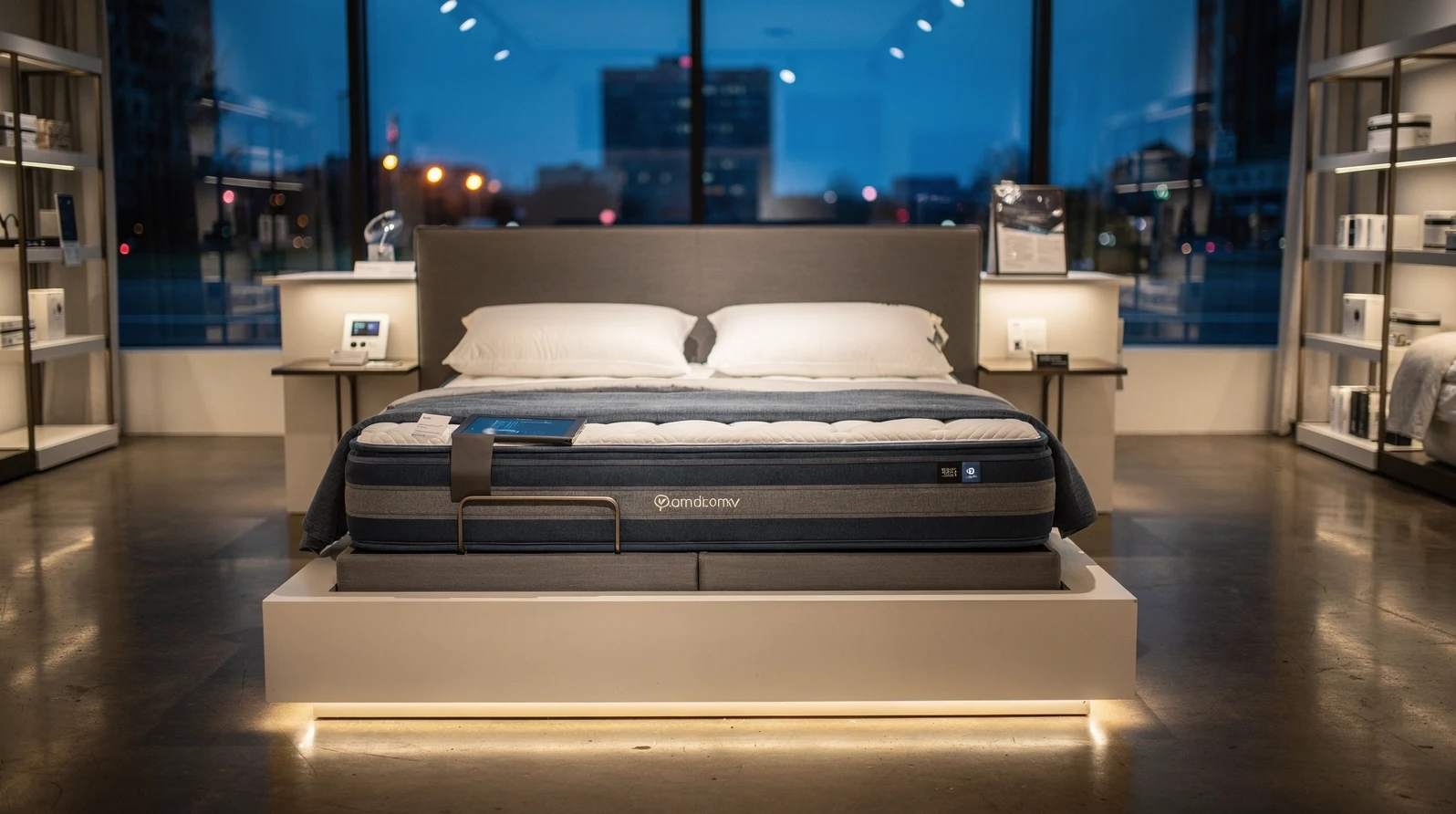
Sleep Number built its identity on a single idea: a bed whose firmness can be dialed up or down by adjusting air pressure, later wrapped in sleep-tracking sensors and an app. That premium, technology-led pitch commanded higher prices and a network of mall and strip-center showrooms. The model worked when households were willing to pay up for big-ticket sleep upgrades.
That willingness faded. As discretionary spending tightened, demand for $3,000-plus smart beds fell faster than for entry-level mattresses, and the company’s store-heavy cost base became a liability. The same pressure that has pushed traditional chains to shutter locations, a dynamic explored in our analysis of department store closures and how to read the signals, hit a specialty retailer with thinner margins for error.
Linda Findley’s turnaround math
Linda Findley took over as president and chief executive on April 7, 2025, succeeding long-time leader Shelly Ibach. She moved quickly, targeting $80 million to $100 million in cuts and eliminating roughly 21% of corporate management positions within weeks. Company disclosures pointed to more than $185 million in annualized cost reductions across overhead, headcount, technology, and store operations.
The cuts improved the cost line but could not offset shrinking sales. First-quarter revenue came in around $319 million, down roughly 19% year over year, according to company filings, and the business continued to post quarterly losses reported in the tens of millions.
The debt wall
Behind the operating losses sat a balance sheet that left little margin. The bankruptcy disclosure pointed to approximately $672.5 million in aggregate principal debt being accelerated by the filing. Earlier coverage had flagged the risk tied to the company’s revolving credit facility, with borrowing capacity reported near $588 million.
When a revolver is heavily drawn and covenants tighten, a retailer loses the flexibility to ride out a soft patch. Sleep Number listed assets of between $500 million and $1 billion and liabilities of between $1 billion and $10 billion in its petition, the standard ranges debtors check on court forms.
The demand problem under everything
No amount of cost cutting fixes a category in retreat. The broader bedding market has been soft since the pandemic-era buying surge unwound, and premium players felt it most. The warning signs, weak comparable sales, mounting losses, and a stretched balance sheet, are the same ones we mapped in our guide to the retail bankruptcy warning signs to read early.
Mattresses are a classic “deferrable” purchase. When confidence dips, households stretch the life of an existing bed by a year or two, and the replacement cycle lengthens across the whole market. That hits premium brands hardest because the price gap between a smart bed and a serviceable alternative is widest exactly when shoppers are trading down.
The DTC experiment and the Costco trial
Sleep Number long sold almost exclusively through its own showrooms, a model that gave it control over the customer experience but loaded the business with fixed lease and staffing costs. Under pressure, the company trialed an exclusive “Ultimate Smart Bed” on Costco.com, a notable break from its store-only approach. The experiment signaled a willingness to chase volume through third-party channels rather than defend a premium-only stance.
The pivot came late relative to the scale of the revenue decline. A store-heavy footprint is slow and expensive to unwind, and lease obligations do not shrink as fast as sales, which is part of why a court-supervised restructuring became the cleaner path to resize the network.
Tariffs, financing, and the squeeze on a capital-heavy model
Sleep Number and its lenders pointed to unpredictable tariffs as one accelerant of the crisis, a theme Bloomberg highlighted in its filing coverage. Mattresses and their components rely on imported foams, electronics, and textiles, and shifting duty schedules complicate both pricing and inventory planning. When input costs jump without warning, a retailer either absorbs the hit on already thin margins or raises prices into weak demand.
That tariff squeeze is not unique to bedding. Apparel and footwear sellers have flagged the same pressure this earnings season, including the margin hit detailed in our coverage of J.Jill’s Q1 sales decline as tariffs squeezed margins. The common thread is import-dependent supply chains meeting cautious consumers.
For a capital-heavy model like Sleep Number’s, the timing was unforgiving. Higher financing costs, a drawn revolver, and unstable input prices arrived together, closing off the usual escape routes of refinancing or trading through the cycle.
There is a sequencing problem in tariffs that hurts importers most. Duties are paid at the border, well before a product is sold, so working capital is tied up in higher landed costs months ahead of any recovery at the register. For a retailer already short on liquidity, that cash-flow timing can be as damaging as the headline rate.
What the deal means for suppliers, landlords, and lenders
A Chapter 11 sale reorders who gets paid and in what order, so the filing ripples well beyond the headline buyer. Suppliers, landlords, and lenders each face a different calculus as the case moves toward auction.
Suppliers and trade creditors
Vendors that shipped foams, fabrics, electronics, and components before the filing become unsecured creditors for those pre-petition invoices, a class that typically recovers cents on the dollar. Goods delivered after the filing are generally paid in the ordinary course, protected by the DIP budget. Many suppliers will keep shipping to preserve a going-concern customer, while tightening terms to cash-on-delivery to limit fresh exposure.
Landlords and the store network
Leases are among the most consequential contracts in any retail bankruptcy. A buyer can choose which stores to keep by assuming profitable leases and rejecting weak ones, which lets the network shrink to its strongest locations. Landlords of rejected sites join the unsecured creditor pool, while those with assumed leases gain a healthier tenant under new ownership.
Lenders steering the outcome
The heavy roll-up in the DIP facility shows secured lenders consolidating control. By folding pre-petition debt into a senior, court-blessed loan, they gain influence over bidding procedures, the auction timeline, and the definition of an acceptable sale. That is a familiar pattern in fast-moving Chapter 11 cases where the credit group, not equity, sets the pace.
What it means for shareholders, customers, and warranties
For equity holders, the message was blunt. The company said common shares are “significantly out of the money,” language that all but guarantees existing shareholders are wiped out or left with negligible value. The stock closed Thursday near $0.66 and fell roughly 18% in premarket trading toward $0.54, with a Nasdaq delisting anticipated as the case proceeds.
For customers, the near-term picture is steadier. Sleep Number said stores stay open and online orders continue to be accepted and fulfilled, the going-concern posture the DIP financing is meant to support. Warranty and service obligations typically continue through a Section 363 sale when a strategic buyer intends to keep the brand operating, though customers should track court notices for any changes.
The risk customers should watch
The honest caveat is that auctions can change outcomes. If a higher bidder emerges with different plans, or if the sale stalls, store networks and service terms can be revisited. For now, the structure points to continuity rather than liquidation, but mid-purchase buyers of big-ticket beds should keep receipts and warranty documents handy.
The mattress market: who is strong, who is exposed
Sleep Number’s filing lands in an industry that has already thinned its ranks. Serta Simmons Bedding restructured through bankruptcy in 2023, and direct-to-consumer disruptor Casper was taken private in 2022 after its public-market debut disappointed. Scale and balance-sheet strength increasingly separate survivors from casualties.
Tempur Sealy remains the dominant public player by revenue, with a diversified brand portfolio and significant U.S. manufacturing that softens some tariff exposure. Sleep Number, by contrast, paired a premium niche with heavy debt, a combination that proved fragile when demand turned.
| Company | 2024 revenue (approx.) | Position | Recent status |
|---|---|---|---|
| Tempur Sealy | $4.89 billion | Market leader, multi-brand | Largest public mattress maker |
| Sleep Number | $1.73 billion | Premium smart beds | Chapter 11 filed June 2026 |
| Purple Innovation | $0.50 billion | DTC and retail hybrid | Persistent losses, turnaround push |
| Serta Simmons | Private | Mass-market manufacturer | Restructured via Chapter 11 in 2023 |
| Casper | Private | DTC pioneer | Taken private in 2022 |
A pattern across distressed retail in 2026
The Sleep Number case fits a wider 2026 storyline: brands with strong recognition but weak balance sheets are being recycled through restructuring and consolidation rather than disappearing outright. Buyers want the brand and the customer base, not the legacy liabilities, and bankruptcy courts provide the mechanism to separate the two.
That logic is visible in deals beyond bedding. Asset-light pivots and stake sales are reshaping global retail, as seen in our coverage of Starbucks weighing a sale of its Japan stake, where an established operator monetizes a unit to sharpen focus. The common thread is capital discipline replacing growth-at-any-cost.
For the bedding category specifically, a Sleep Country acquisition of Sleep Number would create a larger North American specialist with cross-border scale. That could pressure remaining independents and intensify competition with Tempur Sealy at the premium end.
| Filing detail | Terms disclosed |
|---|---|
| Court | U.S. Bankruptcy Court, Southern District of New York |
| Case number | 26-11399 |
| Filing date | June 12, 2026 |
| Stalking-horse bidder | SNBR, Inc. (Sleep Country Canada subsidiary) |
| Asset purchase price | $415 million cash, plus assumed liabilities |
| DIP financing | Up to $260 million ($65m new money, $195m roll-up) |
| DIP interest | SOFR + 8.00% or base rate + 7.00% |
| Accelerated debt | Approximately $672.5 million principal |
| Listed assets / liabilities | $500m to $1bn / $1bn to $10bn |
| Equity outcome | “Significantly out of the money,” delisting expected |
What investors and the credit market are watching
Equity investors have largely moved on, given the “out of the money” warning, but the credit side of the story is far from settled. The split between the $415 million asset value and roughly $672.5 million in accelerated principal frames a recovery question for lenders. Where each creditor class sits in priority will determine who is made whole and who takes a haircut.
The auction is the key variable. A competing bid above the stalking-horse floor would lift recoveries for creditors and validate the brand’s value, while a single-bidder outcome at $415 million would confirm that scarcity of buyers, not just balance-sheet stress, defined the case.
Signals that would change the math
Three signals would move recovery estimates. A surprise rival bidder, a larger-than-expected pool of assumed leases (which preserves enterprise value), and the treatment of customer deposits and gift-card liabilities all feed the final waterfall. Each will surface in court filings over the coming weeks.
Comparable cases suggest brand and customer data can carry real value even when the physical footprint is shrinking. That is why a strategic buyer like Sleep Country, rather than a liquidator, set the opening bid: the intellectual property and direct-to-consumer relationships are the prize.
What happens next: timeline and milestones
The immediate steps are procedural. The court will review “first day” motions covering wages, vendor payments, and the DIP financing, then set bidding procedures and an auction date for the assets. Given the roughly three-month DIP maturity, the sale process is likely to move on a compressed timeline.
From there, three milestones matter most. First, whether any rival bidder tops the $415 million floor at auction. Second, court approval of the winning bid and the assumption of leases and contracts. Third, the treatment of unsecured creditors and the formal delisting of the stock.
If the Sleep Country bid prevails, the brand would likely continue under new ownership with a leaner store footprint. If a higher bid or a snag emerges, the structure could shift, which is why customers and suppliers should follow court filings rather than headlines alone.
Frequently asked questions
Did Sleep Number go out of business?
No. Sleep Number filed for Chapter 11 bankruptcy protection, which is a reorganization and sale process, not a liquidation. The company said stores remain open and online orders continue while it pursues a court-supervised sale of its assets.
Who is buying Sleep Number?
A subsidiary named SNBR, Inc., controlled by Canada’s Sleep Country, has agreed to be the stalking-horse bidder for substantially all assets at $415 million in cash. Sleep Country was taken private by Fairfax Financial in 2024. The price is an opening bid that other parties can top at a court-supervised auction.
What does Chapter 11 mean for my Sleep Number warranty?
Warranty and service obligations generally continue when a strategic buyer intends to keep the brand operating, which appears to be the plan here. That said, outcomes can change during an auction, so customers should keep purchase and warranty documents and watch official court notices for updates.
Why did Sleep Number file for bankruptcy?
The company faced years of falling demand for premium smart beds, a heavy debt load with roughly $672.5 million in accelerated principal, and unpredictable tariffs on imported components. Cost cuts of more than $185 million annualized were not enough to offset shrinking sales.
What happens to Sleep Number shareholders?
The company said common shares are “significantly out of the money,” meaning shareholders are likely to be wiped out or left with negligible value. A Nasdaq delisting is anticipated, and the stock traded near $0.54 around the filing.
How much financing did Sleep Number secure to keep operating?
It arranged up to $260 million in debtor-in-possession financing, made up of $65 million in new-money superpriority term loans and $195 million in roll-up loans. The facility carries a high interest rate and matures in about three months, signaling a fast sale timeline.
What is a stalking-horse bid?
It is an initial offer that sets a floor price for assets in a bankruptcy sale. The stalking-horse bidder usually receives protections if it is outbid, and rival buyers must beat its offer at auction. The structure aims to prevent fire-sale prices while still allowing competition.
Is the mattress industry in trouble?
Several players have been stressed since pandemic-era demand faded. Serta Simmons restructured through Chapter 11 in 2023 and Casper was taken private in 2022, while Purple has posted persistent losses. Tempur Sealy remains the strongest public player, with scale and significant domestic manufacturing that cushions some of the tariff and demand pressure weighing on smaller rivals.
When will the Sleep Number sale be completed?
No closing date has been confirmed. Given the roughly three-month DIP financing maturity, the auction and sale-approval process is expected to move quickly, with the court setting bidding procedures and an auction date in the early stages of the case.