
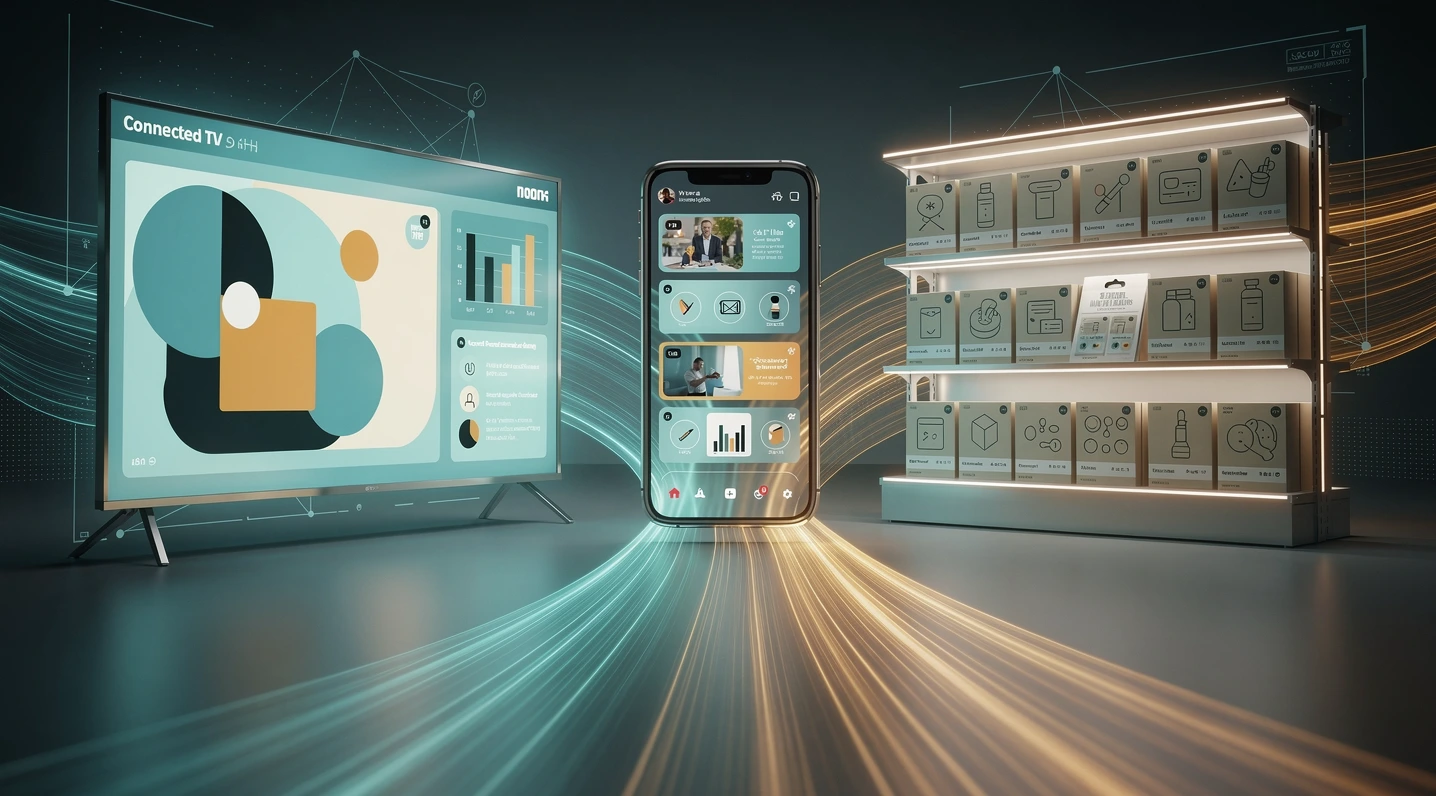
An integrated retail campaign is a single commercial idea executed across television, social video and the physical store at the same time, with shared creative, shared measurement and a shared offer. For US retailers and e-commerce teams in 2026, the question is no longer whether to run channels together but how to make a thirty-second connected-TV spot, a creator-led TikTok clip and an end-cap display in 1,800 stores feel like one campaign rather than three departments spending in parallel. Done well, the effect compounds: reach from broadcast, intent from social and conversion from the shelf. Done poorly, it fragments budget, confuses shoppers and produces dashboards that nobody can reconcile.
This guide walks through what an integrated retail campaign actually is, how the pieces connect operationally, the mistakes that quietly drain return on ad spend, and the tools and partners worth knowing before you brief an agency or build it in-house. It is written for marketing leads, brand managers and commerce teams who own a number and have to defend it.
In short
- An integrated retail campaign coordinates TV (increasingly connected TV), social video and in-store activation around one idea, one offer and one measurement framework, instead of running each channel as a silo.
- The structural shift in 2026 is that retail media networks now close the loop between upper-funnel video and the actual basket, so brand and performance budgets answer to the same sales data.
- Sequencing beats simultaneity: broadcast and connected TV build reach, social converts attention into intent, and the store (or the product page) closes the sale. The creative has to carry the same message through all three.
- The most common failure is channel-level optimization, where each team hits its own metric while the blended campaign underperforms because attribution double-counts and the in-store offer never matches the ad.
- You do not need a giant budget to integrate. You need one creative platform, one promotional calendar, one source of truth for sales, and a named owner who can say no when a channel wants to go its own way.
Why integrated retail campaigns matter more in 2026
The shopper path stopped being linear years ago, but the budget structures inside most retailers did not keep up. A customer now sees a connected-TV ad on a Tuesday night, gets retargeted on Instagram on Wednesday, searches the brand on a retailer app on Thursday, and buys in store on Saturday because the product was on an end cap. If the TV team, the social team and the store merchandising team each claim that sale, the business has paid three times for one conversion and still cannot tell you which exposure mattered.
Three forces make integration urgent this year. First, connected TV has become a measurable performance channel rather than a pure awareness buy, which means it can be tied to lower-funnel outcomes for the first time. Second, retail media networks operated by the largest US chains now expose closed-loop sales data, so a brand can see whether a campaign actually moved units at that retailer. Third, the cost of fragmented media has risen as signal loss from cookie deprecation pushes spend toward platforms that own first-party purchase data.
The practical upshot is that the retailers winning in 2026 treat a campaign as one plan with three delivery surfaces, not three plans that happen to share a logo. The teams that still budget by channel are the ones discovering, at quarter end, that their blended return on ad spend is lower than any single channel report suggested.
The economics that force the issue
Media inflation in premium video and the steady climb of in-store retail media rates mean every dollar has to work across more than one objective. A connected-TV impression that only builds awareness is hard to justify when the same budget could build awareness and feed a measurable lift study at a retailer. Our analysis of how those shelf-adjacent budgets are scaling sits in this look at in-store retail media moving from pilot to scale, which is where a lot of integrated dollars now land.
Integration is also a hedge against platform risk. When a single channel changes its algorithm, its ad policy or its measurement methodology, a campaign that lives across TV, social and store absorbs the shock instead of collapsing. Diversification at the campaign level is no longer a nice-to-have. It is risk management.
Key terms and definitions
Integrated retail campaigns carry a lot of jargon, and teams often use the same word to mean different things. The table below sets a common vocabulary before we get into mechanics. Agreeing on these definitions in the kickoff meeting saves weeks of confusion later.
| Term | What it means | Why it matters |
|---|---|---|
| Omnichannel | One continuous experience across all touchpoints, with shared data and inventory | The end state; integration is how you build toward it campaign by campaign |
| Connected TV (CTV) | Streaming video delivered through smart TVs and apps, bought programmatically | Brings TV reach with digital targeting and measurement |
| Retail media network (RMN) | A retailer’s own ad platform selling placements against its first-party shopper data | Closes the loop between ad exposure and the actual basket |
| Closed-loop measurement | Tying a specific ad exposure to a verified purchase at a known retailer | Replaces guesswork attribution with sales-based proof |
| Incrementality | The extra sales a campaign caused versus what would have happened anyway | The only honest measure of whether the spend worked |
| Shoppable media | Video or social content with a built-in path to purchase | Collapses discovery and conversion into one session |
| Creative platform | The single big idea and look that every channel adapts | What makes three channels feel like one campaign |
Brand versus performance is a false split
For a decade, teams separated brand spend (awareness, no direct sales target) from performance spend (clicks, conversions, strict return on ad spend). Integrated campaigns reject that wall. A connected-TV spot can build the brand and be measured for incremental lift at a retailer. A creator video can tell a brand story and carry a shoppable link. The skill in 2026 is designing one campaign that serves both jobs and reporting it that way.
How an integrated retail campaign works in practice
The mechanics come down to four shared assets: one idea, one offer, one calendar and one measurement framework. Get those four aligned and the channels mostly take care of themselves. Miss any one and the campaign fragments no matter how good the individual executions are.
It starts with the creative platform. The team agrees on a single organizing idea, a hero message and a visual system flexible enough to live in a thirty-second broadcast spot, a nine-second vertical social cut and a printed shelf talker. The store version, the social version and the TV version should be instantly recognizable as the same campaign even with the sound off and the logo cropped.
Then comes sequencing. Reach channels go first to build awareness and prime recognition. Social and shoppable media follow to turn that awareness into intent and clicks. The store, or the product detail page for pure e-commerce, closes the loop with the matching offer in stock and merchandised where the campaign promised it would be. The single most damaging break in any integrated campaign is the ad that drives a shopper to a shelf where the product is out of stock or the promotion does not match.
Mapping channels to funnel jobs
Each surface has a job it does best. Trying to make every channel do everything is how budgets get wasted. The cleaner model assigns a primary job to each, while accepting that good creative bleeds across the boundaries.
| Channel | Primary job | Best metric | Typical share of budget |
|---|---|---|---|
| Broadcast and connected TV | Reach and recognition | Incremental reach, brand lift, store-visit lift | 35 to 50 percent |
| Social and creator video | Intent and engagement | Engagement rate, shoppable click-through, view-through | 25 to 35 percent |
| Retail media and search | Conversion at the point of decision | Closed-loop return on ad spend, new-to-brand sales | 15 to 25 percent |
| In-store activation | Final conversion and basket size | Sell-through, units per transaction, redemption rate | 10 to 20 percent |
The role of connected and shoppable TV
Connected TV is the hinge of the modern integrated campaign because it combines the reach of broadcast with the targeting and measurement of digital. The shift toward shoppable formats, where a viewer can act on a TV ad directly, is accelerating as media owners chase commerce revenue. The clearest signal of how seriously the industry takes this is the scramble for streaming and shoppable-TV assets, which we covered in the analysis of Fox acquiring Roku to scale shoppable-TV commerce. For an integrated campaign, CTV is where the idea is established at scale before social and store do the converting.
Closing the loop with retail media
The reason integrated campaigns are measurable in 2026 in a way they were not five years ago is retail media. When a brand runs media on a retailer’s network, that retailer can match exposure to purchases inside its own loyalty and basket data. That closed loop lets the team see whether the TV and social spend actually drove incremental units at the shelf. The same first-party-data logic that makes search and paid social efficient now extends to the store, a shift we unpack in this guide to what still works in paid ads for retailers in 2026.
Common mistakes and how to avoid them
Most integrated campaigns fail in predictable ways. The failures are rarely about creative quality. They are about coordination, measurement and the unglamorous operational details that decide whether the shopper experience holds together.
The first and most expensive mistake is channel-level optimization. Each team chases its own target, the social team pushes cheap clicks, the TV team buys the broadest reach, the retail media team harvests existing demand, and every dashboard looks green while the blended campaign loses money. The fix is a single shared north-star metric, usually incremental sales, that every team is accountable to together.
The second mistake is attribution double-counting. When three channels each claim the same conversion, leadership sees reported return on ad spend that sums to far more than actual revenue. The fix is one source of truth for sales and a measurement approach built on incrementality testing rather than last-touch credit.
The offer-mismatch trap
A shopper sees an ad promising twenty percent off, walks into the store, and the shelf says fifteen percent, or the product is not stocked at that location at all. This single break destroys trust and wastes every upstream dollar that drove the visit. Avoiding it requires the merchandising, supply chain and marketing teams to lock the offer and the inventory plan before any media goes live. The campaign calendar and the planogram have to be the same document, effectively.
Briefing channels in isolation
When the TV agency, the social shop and the in-store team each receive a separate brief, they each invent their own interpretation of the idea. The campaign ends up looking like a family resemblance rather than a single voice. The fix is one master brief, one creative platform, and channel adaptations that descend from it rather than competing originals. A short internal style guide for the campaign, covering tone, hero claim and visual rules, pays for itself.
Ignoring the AI-driven discovery layer
Increasingly, shoppers begin with an AI assistant rather than a search bar, and integrated campaigns now have to account for whether their brand and offers surface in those answers. Teams that treat large language model visibility as a separate, optional channel miss a growing slice of discovery. The practical steps for making a retailer legible to AI systems are laid out in the 2026 retailer AIO checklist, and they belong inside the integrated plan, not bolted on afterward.
Examples from US retail and e-commerce
The clearest way to understand integration is to look at how it shows up in practice across different retail models. The patterns below are composites drawn from how leading US retailers and brands structure these campaigns, rather than confidential specifics, but they reflect real and observable mechanics.
Consider a national big-box retailer launching a seasonal home line. The campaign opens with connected-TV and broadcast spots two weeks before the in-store reset, establishing the look and the headline promotion. In the launch week, creator videos on TikTok and Instagram show the products styled in real homes with shoppable links, while the retailer’s own media network runs sponsored placements on its app and site. In store, the same creative appears on end caps, and the promotion matches the ad to the cent. Sales lift is measured against control stores that received only the baseline plan.
For a direct-to-consumer brand without its own stores, the store role is played by the product detail page and by retail partners. A sportswear brand might run the same sequence: connected-TV reach, creator-led social, and conversion through both its own site and a retail media buy at the chains that carry it. The way a single athlete or brand partnership can anchor that kind of cross-channel push is visible in the mechanics of deals like the Stephen Curry and Li-Ning global brand partnership, where one figure carries the idea across markets and surfaces.
What social-first launches teach traditional retailers
Social-native commerce platforms have compressed the distance between discovery and checkout to almost nothing, and that pace is reshaping expectations for every integrated campaign. The launch dynamics we documented when TikTok Shop launched in Poland show how a single content session can carry a shopper from first exposure to paid order, which is exactly the loop traditional retailers try to recreate by linking their TV reach to shoppable social and a frictionless shelf.
Reading the modern brand playbook
Integrated campaigns are one chapter of a broader operating model, and they work best when they sit inside a coherent brand strategy rather than standing alone. The full framework, covering positioning, channel architecture and measurement, lives in our pillar on the modern brand playbook for retail and e-commerce, which is the natural next read for any team formalizing how it runs campaigns.
Building the team and the workflow
Integration is as much an organizational problem as a marketing one. The campaign structure has to survive contact with how budgets, teams and approval chains actually work inside a retailer. The single most reliable predictor of an integrated campaign succeeding is whether one named person owns the blended outcome.
That owner, often a campaign or brand lead, holds the master brief, the shared calendar and the north-star metric. They are empowered to overrule a channel team that wants to optimize for its own number at the expense of the whole. Without that authority, integration degrades into coordination meetings that produce alignment in theory and silos in practice.
The workflow runs in four phases. Planning locks the idea, offer, calendar and measurement design. Production builds the creative platform and its channel adaptations from one master. Activation launches in sequence, reach first, with inventory and offers verified before media spends a dollar. Measurement reads incrementality, not channel vanity metrics, and feeds the next campaign.
Where in-house ends and partners begin
Most retailers keep strategy, the offer and the measurement framework in-house, and lean on partners for production scale and channel execution. Connected-TV buying, creator sourcing and retail media operations are common areas to outsource, while the creative platform and the sales source of truth stay internal. The line you should not cross is handing measurement entirely to a partner who also sells you the media, because that is how attribution quietly inflates.
Tools, partners and vendors worth knowing
The vendor landscape for integrated campaigns spans four categories: media buying and connected-TV platforms, retail media networks, measurement and incrementality providers, and creative production tools. You do not need one of everything. You need one capable choice in each category that talks to the others.
| Category | What to look for | Question to ask the vendor |
|---|---|---|
| Connected-TV and video | Programmatic reach with measurable outcomes, not just impressions | Can you tie exposure to store visits or retailer sales? |
| Retail media networks | Closed-loop sales data and clean incrementality reporting | Do I see incremental lift or just last-touch return on ad spend? |
| Measurement and analytics | Independent incrementality testing across channels | Are you independent of the media you measure? |
| Creative and content | One platform adaptable to many formats efficiently | Can you ship TV, vertical social and print from one master? |
The integration layer that matters most
The tool that quietly decides success is the one that unifies sales data across channels into a single view. Whether that is a clean room, a customer data platform or a retailer’s own analytics suite, the principle is the same: every channel reports against the same verified sales number. Without that layer, no amount of clever buying produces a campaign you can actually evaluate.
For deeper, regularly updated guidance on the specific platforms in this space, our running coverage of tools and vendors for marketing campaigns in 2026 tracks the category as it evolves, and the broader shifts in format and channel mix are collected in our piece on the 2026 retail campaign trends worth borrowing.
How to measure an integrated retail campaign
Measurement is where integrated campaigns are won or lost, because the whole point is to evaluate the blend rather than the parts. The discipline is to define success before launch, in terms of incremental sales and a small set of supporting diagnostics, and to resist the pull of channel-level vanity metrics during the campaign.
The gold standard is a holdout or geo-based incrementality test. A set of comparable markets or audiences receives the campaign while a control group does not, and the difference in sales is the true contribution. This is more rigorous than any last-touch model and immune to the double-counting that plagues channel reporting. According to general analyses of US retail and consumer spending published by the US Census Bureau, retail sales patterns are seasonal and noisy enough that only controlled comparison reliably isolates a campaign’s effect.
Supporting diagnostics still matter for in-flight optimization: incremental reach from CTV, shoppable click-through from social, sell-through at the shelf and new-to-brand share from retail media. But these feed decisions, they do not define success. The number that goes in front of the finance team is incremental sales and the blended return on ad spend that follows from it.
FAQ
What is an integrated retail campaign in simple terms?
It is one marketing campaign, built around a single idea and offer, that runs across television (especially connected TV), social video and the physical store at the same time. The goal is for a shopper to experience it as one coherent message no matter where they encounter it, with all channels measured against the same sales outcome rather than separate channel metrics.
How is this different from omnichannel marketing?
Omnichannel is the end state, a seamless experience across every touchpoint with shared data and inventory. An integrated campaign is a specific, time-bound execution that moves you toward that state. You build omnichannel capability one integrated campaign at a time, and the campaigns get easier as the underlying data and team structures mature.
Do I need a large budget to run an integrated campaign?
No. Integration is about coordination, not spend. A regional retailer can run one creative idea across a modest connected-TV buy, organic and paid social, and in-store signage with a matching offer. What you need is one idea, one calendar, one source of truth for sales and one owner. Budget determines reach, not whether the campaign is integrated.
Which channel should lead the campaign?
Sequence by funnel job rather than picking a single leader. Reach channels like broadcast and connected TV typically go first to build awareness, social and shoppable media follow to convert attention into intent, and the store or product page closes the sale. The creative platform leads conceptually; the channels each play their part in order.
How do I measure whether an integrated campaign actually worked?
Use incrementality testing, ideally a geo holdout where comparable markets run with and without the campaign, and measure the difference in sales. Retail media closed-loop data lets you tie exposure to verified purchases. Avoid last-touch attribution, which double-counts conversions across channels and overstates return on ad spend.
What is the most common reason these campaigns fail?
Channel-level optimization, where each team hits its own metric while the blended campaign loses money, combined with an offer mismatch between the ad and the shelf. The fix for the first is a shared north-star metric of incremental sales. The fix for the second is locking the offer and inventory plan before any media goes live.
How does retail media fit into an integrated campaign?
Retail media networks are what make integration measurable in 2026. Because a retailer can match ad exposure to purchases in its own basket and loyalty data, you finally get a closed loop that tells you whether upper-funnel TV and social spend drove incremental units at the shelf. It is both a conversion channel and the measurement backbone.
Where does AI-driven discovery fit in?
Shoppers increasingly start with AI assistants rather than search engines, so an integrated campaign should ensure the brand, products and offers surface correctly in those answers. Treat AI visibility as part of the discovery layer, planned alongside TV and social, not as a separate afterthought. The practical steps live in a dedicated AIO checklist for retailers.
Who should own an integrated campaign internally?
One named campaign or brand lead who holds the master brief, the shared calendar and the blended metric, and who has the authority to overrule individual channel teams. Integration without a single accountable owner degrades into coordination meetings that produce theoretical alignment and practical silos.