
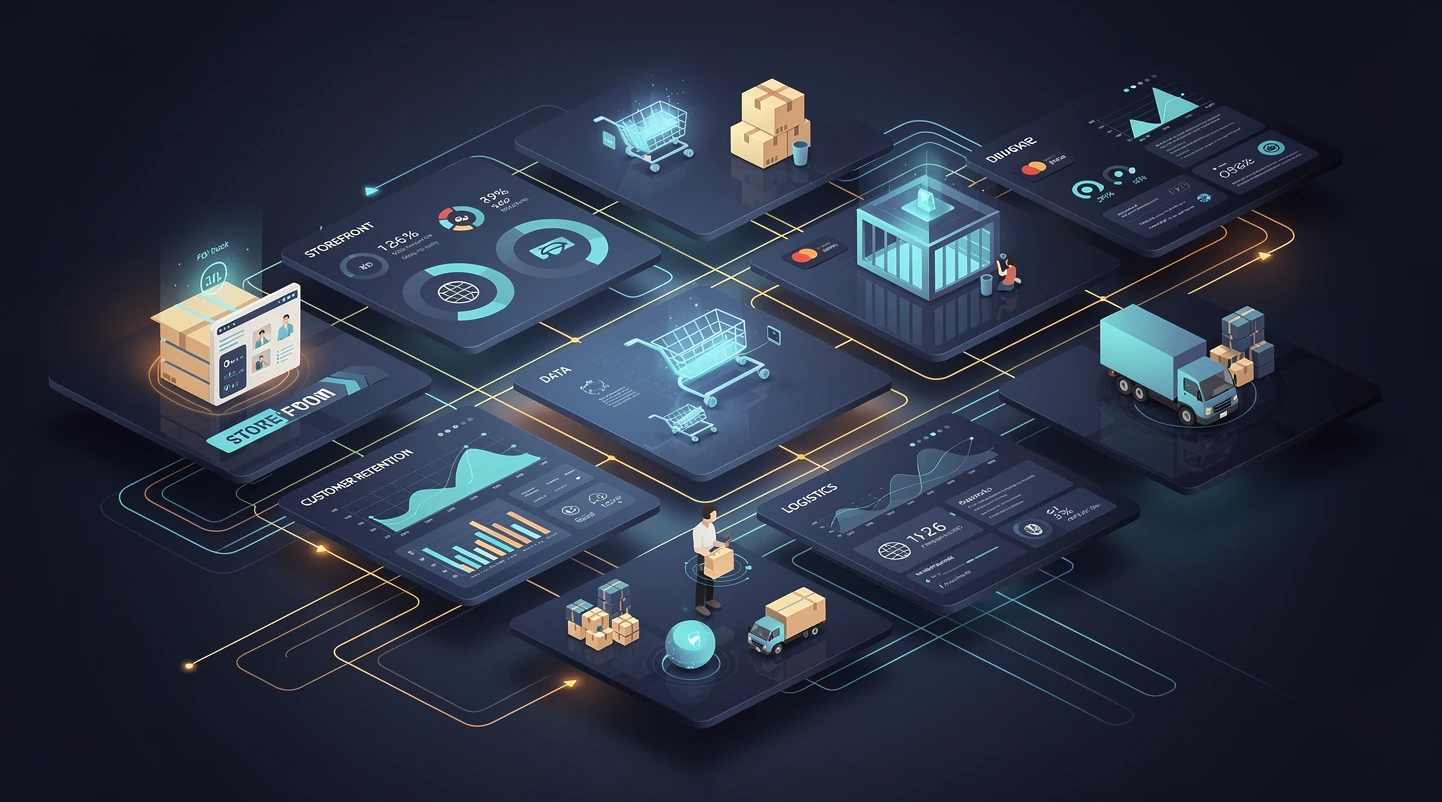
Scaling a direct-to-consumer brand stopped being a software problem years ago. By 2026 it is a systems problem, and the systems are made of tools. The brands that move cleanly from seven figures to eight are rarely the ones with the most apps installed. They are the ones who picked the right vendors at the right stage, wired them together so data actually flows, and resisted the urge to buy their way out of every operational gap.
This guide maps the tooling and vendor landscape for scaling D2C in 2026. It is written for operators and founders who already have product-market fit and now need the stack to stop being the bottleneck. The focus is practical: what each layer does, when to add it, what it costs in money and attention, and where teams most often get it wrong.
In short
- Stack maturity beats stack size. The winning 2026 D2C brands run fewer tools that share clean data, not more tools that silo it.
- Buy by growth stage, not by hype. A brand at one million dollars in revenue needs a different stack than one approaching ten million, and overbuying early is the most common expensive mistake.
- Retention tooling is now the highest-leverage spend. With paid acquisition costs still elevated, email, SMS, loyalty, and subscription vendors drive more incremental profit than another ad platform.
- Data infrastructure is the quiet differentiator. A customer data platform or a warehouse-first setup turns scattered tools into a coherent picture and makes every other vendor work harder.
- Total cost of ownership hides in integration and people. The license fee is rarely the real price; implementation, maintenance, and the headcount to run a tool usually cost more.
Why scaling D2C tooling matters more in 2026
The economics that made D2C look easy in the late 2010s are gone. Customer acquisition costs rose sharply after privacy changes reduced ad targeting precision, and shipping plus fulfillment expenses climbed with wages and fuel. The result is a margin squeeze that punishes brands relying on a single growth lever.
Tooling is how brands respond. Better retention software lifts repeat purchase rates, which is the cheapest revenue a D2C brand can earn. Smarter logistics platforms cut the cost to deliver each order. Cleaner data lets teams find the unprofitable segments they were quietly subsidizing. None of this is glamorous, and all of it compounds.
The stakes are higher than they look because tooling decisions are sticky. A platform choice can lock a brand in for years, an email vendor accumulates historical data that is painful to migrate, and a 3PL relationship shapes your cost structure long after the contract is signed. Choosing well early avoids a category of expensive rework later. Choosing badly does not show up as a line item; it shows up as a team that spends its weeks fighting its own software instead of growing the business.
There is also a structural shift in how shoppers discover and buy. Marketplaces, social commerce, and retail media now sit alongside the owned storefront, so a 2026 stack has to coordinate across channels rather than optimize a single funnel. Founders who learned this the hard way, like the operator profiled in our piece on a founder who moved a brand from Amazon to owned D2C, tend to describe the transition as rebuilding the plumbing while the water is still running.
The thread running through every section below is the same idea explored across our wider retail business landscape guide: tools are means, not ends. The question is never whether a vendor is good. It is whether this vendor, at this stage, moves a metric you actually care about.
The vocabulary: key terms worth getting right
Vendors love jargon because it makes commodity software sound proprietary. A shared vocabulary helps you cut through pitches and compare like with like.
Tech stack describes the full set of software a brand runs, from the storefront to the back office. Headless commerce separates the front end customers see from the commerce engine behind it, which buys flexibility at the cost of complexity. Composable is the broader idea that you assemble best-of-breed tools rather than buy one monolithic suite.
CDP, the customer data platform, unifies customer records from every source into one profile. CRM manages the relationship and communication layer. 3PL is a third-party logistics provider that stores and ships your inventory. OMS, the order management system, routes each order to the right fulfillment point and tracks it to delivery.
LTV (lifetime value) and CAC (customer acquisition cost) are the two numbers most tooling decisions ultimately serve. A tool that raises LTV or lowers CAC earns its place. A tool that does neither, however clever, is overhead. Keep that ratio in mind through every category below.
How a modern D2C stack actually fits together
It helps to picture the stack in layers rather than as a list of logos. Each layer has a job, and the value comes from how cleanly they hand data to one another.
The storefront and commerce engine
This is where the transaction happens. For most scaling brands the platform is Shopify, increasingly Shopify Plus once order volume justifies it, with BigCommerce and a long tail of composable setups for teams with specialized needs. The 2026 trend is the platform absorbing features that used to be apps, which lowers cost but raises lock-in. The recent Shopify Summer 26 editions push, moving AI merchandising into the core, is a clear example of the platform expanding its footprint.
The data and identity layer
Underneath the storefront sits the data layer, and this is where scaling brands separate from stalling ones. A CDP or a warehouse-first approach (piping events into a central store like a cloud data warehouse) gives every other tool a single source of truth. Without it, your email platform, your ad accounts, and your analytics each tell a slightly different story, and nobody trusts the numbers.
The retention and lifecycle layer
Email, SMS, loyalty, reviews, and subscriptions live here. This layer is where repeat revenue is won, and in 2026 it is usually the highest-return software spend a brand makes. The reason is simple arithmetic: acquiring a customer is expensive and getting harder, so the brands that win are the ones that turn a first order into a third and a fourth.
The operations and fulfillment layer
Inventory, warehousing, shipping, returns, and customer support sit at the base. This layer rarely grows revenue directly, but it is where margin is preserved or lost. As volume climbs, the cost of getting fulfillment wrong scales with it, which is why brands invest in an OMS and a serious 3PL relationship before they think they need to.
Choosing tools by growth stage, not by hype
The single most useful framing is to match tooling to revenue stage. Buying enterprise software at one million dollars in revenue wastes cash and attention; clinging to starter tools at eight figures caps your ceiling. The table below sketches a sensible progression.
| Stage | Annual revenue | Priority tooling | What to avoid |
|---|---|---|---|
| Foundation | Under $1m | Core platform, email, basic analytics, a single 3PL or self-fulfillment | CDPs, headless builds, heavy BI tools |
| Traction | $1m to $3m | SMS, reviews, loyalty, a helpdesk, post-purchase logistics tracking | Custom data pipelines, multi-warehouse OMS |
| Scale | $3m to $10m | CDP or warehouse-first data, subscription tooling, OMS, retention analytics | Replatforming for its own sake |
| Expansion | $10m and up | Composable or headless where it pays, ERP, advanced attribution, dedicated data team | Tool sprawl without an owner per system |
The pattern is deliberate. Early stages reward simplicity and cash discipline. Later stages reward integration and dedicated ownership. The transition from traction to scale is where most brands either professionalize or plateau, a turning point we examine in depth in our look at scaling D2C from one million to ten million revenue.
One nuance worth stating plainly: revenue is a rough proxy, not a rule. A brand with high order volume and low average order value hits operational complexity sooner than a luxury brand at the same revenue. Read the table as a starting hypothesis, then adjust for your unit economics.
The categories of vendors worth knowing in 2026
Rather than name a winner in each slot, it is more useful to understand the categories, because the right pick depends on your stage and constraints. The table below groups the landscape and flags what to watch when evaluating any vendor in that category.
| Category | What it does | When to add it | What to scrutinize |
|---|---|---|---|
| Commerce platform | Runs the storefront and checkout | Day one | Transaction fees, app dependency, exit cost |
| Email and SMS | Owned lifecycle messaging | Under $1m | Deliverability, segmentation depth, pricing as your list grows |
| Reviews and UGC | Social proof and content | $1m to $3m | Syndication, moderation, integration with product pages |
| Loyalty and subscriptions | Repeat purchase mechanics | $1m to $3m | Churn analytics, failed-payment recovery, flexibility of rules |
| Customer data platform | Unifies customer profiles | $3m and up | Identity resolution, real cost, time to value |
| Logistics and 3PL | Stores and ships orders | From launch, upgraded at scale | Network coverage, error rates, returns handling |
| Order management | Routes and tracks orders | $3m and up | Multi-location logic, returns, system of record clarity |
| Analytics and attribution | Measures what works | $1m and up | Methodology honesty, integration with your data layer |
The retention cluster is where 2026 budgets are shifting
If there is one observable trend in how scaling brands allocate software spend this year, it is the move toward retention tooling. Email and SMS remain the backbone, but loyalty programs and subscription mechanics are taking a larger share because they directly lift LTV. The math favors any tool that turns occasional buyers into predictable repeat revenue.
Logistics tooling is consolidating
On the operations side, the story is consolidation. Brands are trimming the number of fulfillment partners and order tools to reduce the seams where errors hide. The broader market is moving the same way, with platforms pulling fulfillment in-house, a shift we traced in our analysis of why TikTok Shop is pushing in-house fulfillment across Europe before holiday 2026. The lesson for independent brands is to value reliability and clean integration over a marginally cheaper rate.
Common mistakes when buying and integrating D2C tools
The failure modes are remarkably consistent across brands. Knowing them in advance is the cheapest insurance you can buy.
Buying ahead of need. The most expensive mistake is purchasing enterprise tooling, a CDP or a headless rebuild, before the business has the volume or the team to use it. The software sits half-implemented while the bill arrives monthly. If you cannot name the metric a tool will move this quarter, you are buying ahead of need.
Underpricing total cost of ownership. The license fee is the visible price. The real cost includes implementation, ongoing maintenance, and the human time to operate the tool. A cheaper platform that needs a full-time specialist is often more expensive than a pricier one that runs itself.
Letting tools own data instead of the business. When each vendor holds its own copy of customer data, you end up renting access to your own information and fighting integration battles forever. A data layer you control, however modest, keeps leverage on your side of the table.
Adding tools without an owner. Every system needs a person accountable for it. Tool sprawl without clear ownership produces dashboards nobody reads and automations nobody trusts. This is also why hiring sequencing matters; the right operational hire often unlocks more than the next app, a point we develop in our guide to hiring your first ops leader as a scaling retail brand.
Replatforming as procrastination. Teams sometimes rebuild the storefront to avoid harder problems like weak retention or poor unit economics. A new platform rarely fixes a demand problem. Diagnose the actual constraint before signing a six-figure migration.
Chasing integrations that do not exist. A tool that looks perfect in isolation can be useless if it does not connect to the rest of your stack. Founders regularly sign contracts on the strength of a feature list, then discover the promised integration is a roadmap item, a brittle third-party connector, or a manual export disguised as automation. Always confirm the integration works today, with your specific configuration, before you commit. The gap between a vendor’s marketing site and its actual API is where many scaling headaches are born.
Examples from US retail and e-commerce
Concrete cases ground the principles. A few patterns recur across US D2C brands that scaled successfully through 2025 and into 2026.
Apparel and footwear brands that survived the margin squeeze tended to invest early in returns tooling, because in those categories return rates can quietly erase profit. They treated reverse logistics as a first-class system, not an afterthought, and the brands that delayed paid for it later. A 30 percent return rate on a category with thin margins is not a customer service problem; it is an existential one, and the tooling that flags sizing issues, automates exchanges, and recovers value from returned stock pays for itself quickly.
A recurring detail in these stories is restraint on the acquisition side. The brands that scaled profitably did not simply pour more money into ads as their tooling improved. They used better data to spend the same budget more precisely, cutting the channels and audiences that never converted into repeat buyers. The tool did not grow the business by enabling more spend; it grew the business by exposing waste. That distinction separates a stack that compounds margin from one that merely accelerates a cash burn.
Consumables and beauty brands leaned hardest into subscription and loyalty mechanics, because repeat purchase is the natural shape of the category. Their stacks were built around lifecycle messaging and predictable replenishment, and they measured success in repeat rate as much as in new orders. Rental and resale models, like the one behind Rent the Runway’s sales jump after the Hyman exit, push this even further, since the entire business depends on retention infrastructure working flawlessly.
Higher-ticket brands found that payment flexibility moved conversion more than another discount. Offering installment options at checkout reduced the friction on large carts, a dynamic we cover in detail in our piece on BNPL for high-ticket retail and when it pays for itself. The tooling lesson is that the checkout layer deserves as much optimization attention as the top of the funnel.
Across all of these, the brands that scaled cleanly shared one habit. They added tools deliberately, one constraint at a time, and they killed tools that stopped earning their keep. The discipline of removing software turned out to matter as much as the discipline of choosing it. The macro backdrop supports the urgency, with the US Census Bureau retail data showing online sales taking a steadily larger share of total retail.
A practical playbook for evaluating any vendor
When a new tool tempts you, run it through a short, consistent evaluation. The goal is to make buying decisions boring and repeatable rather than driven by a good demo.
- Name the metric. Write down the single number this tool will move and by roughly how much. If you cannot, stop here.
- Estimate total cost of ownership. Add license, implementation, and the human hours per month to run it. Compare that number, not the sticker price.
- Check the data flow. Confirm the tool reads from and writes to your data layer cleanly. A tool that creates a new silo starts with a penalty.
- Define the exit. Know how hard it is to leave before you arrive. Lock-in is fine when chosen knowingly and dangerous when discovered later.
- Assign an owner. Name the person accountable for the tool before you buy it. No owner, no purchase.
- Set a review date. Calendar a check three to six months out to confirm the tool earned its keep. Renew deliberately, not by default.
This playbook will feel slow the first few times and then save you from a string of expensive subscriptions you forgot you were paying for. It pairs naturally with the broader operating discipline in our 2026 D2C scaling playbook, which treats tooling as one input among people, capital, and channel strategy. Make it the default gate, and keep the rare exception for when speed genuinely matters more than discipline.
None of this works without an owner who treats the stack as a living thing. The best D2C operators schedule a quarterly stack review the way a finance team schedules a close: every tool gets a line, a cost, a metric, and a verdict to keep, cut, or consolidate. Over a year that ritual tends to remove as many tools as it adds, and the stack gets simpler even as the business gets bigger. That counterintuitive outcome, a leaner toolset at higher revenue, is one of the clearest signals of a brand that has learned to scale on purpose rather than by accumulation.
If you take one principle from this guide, make it this: a tool is a hypothesis about how you will make more money, and a hypothesis you never test is just a cost. The full context for those decisions, including how tooling interacts with funding, hiring, and channel choices, sits in our broader retail business landscape guide. Treat every vendor as accountable to a number, review them on a schedule, and let the stack earn its place quarter after quarter.
Frequently asked questions
How many tools should a scaling D2C brand run?
Fewer than you think. Most brands between one and ten million dollars in revenue run well on a focused stack of eight to fifteen core tools that share data cleanly. The number matters less than the integration; a dozen connected tools beat thirty siloed ones. If a tool does not feed your data layer or move a named metric, it is a candidate for removal.
When should I invest in a customer data platform?
Usually around three million dollars in revenue, when scattered data across email, ads, and analytics starts producing conflicting numbers that no one trusts. Below that, a warehouse-first setup or even disciplined use of your platform’s native data is often enough. Buying a CDP too early is a common and costly mistake because the team rarely has the capacity to use it well.
Is headless commerce worth it for a scaling brand?
For most brands, not until well past ten million dollars in revenue, and only when a specific need (extreme customization, a unique front-end experience, or multi-region complexity) justifies the engineering cost. Headless buys flexibility and charges complexity for it. The majority of scaling brands are better served by a strong platform and selective best-of-breed apps.
What is the highest-return software category in 2026?
Retention tooling, broadly: email, SMS, loyalty, and subscriptions. With acquisition costs elevated, the cheapest revenue is a repeat purchase from an existing customer, and these tools directly drive that. A dollar spent improving repeat rate typically outperforms a dollar spent on another acquisition channel for brands that already have product-market fit.
How do I avoid overpaying for tools as I scale?
Estimate total cost of ownership rather than the license fee, assign an owner to every tool, and set a review date three to six months out. The hidden costs are implementation, maintenance, and the human time to operate the software. A formal renewal review, where the default is to cancel unless the tool proves its keep, prevents the slow accumulation of forgotten subscriptions.
Should I replatform if my current setup feels limiting?
Only after confirming the platform is the actual constraint. Teams often replatform to avoid harder problems like weak retention or poor unit economics, and a migration rarely fixes a demand problem. Diagnose the real bottleneck first. If the platform genuinely caps your growth, migrate with eyes open to the cost in time and risk.
What logistics tooling matters most as order volume grows?
An order management system and a reliable 3PL relationship, plus returns handling, in that rough order. As volume climbs, the cost of fulfillment errors scales with it, so reliability and clean integration matter more than a marginally cheaper shipping rate. Consolidating fulfillment partners to reduce the seams where errors hide is a common move among brands scaling past three million dollars.
How do I integrate new tools without breaking my data?
Decide where your single source of truth lives before adding anything, typically a CDP or a cloud data warehouse, then require every new tool to read from and write to it. Avoid tools that insist on owning their own copy of customer data with no clean export. The discipline of protecting your data layer is what keeps a growing stack coherent rather than chaotic.
Do I need separate tools for each sales channel?
Not separate stacks, but you do need tooling that coordinates across channels. As marketplaces, social commerce, and retail media sit alongside your owned storefront, the priority is unified inventory, order management, and customer data across all of them. The goal is one view of the customer and the inventory, regardless of where the sale happened, rather than parallel systems that never reconcile.