
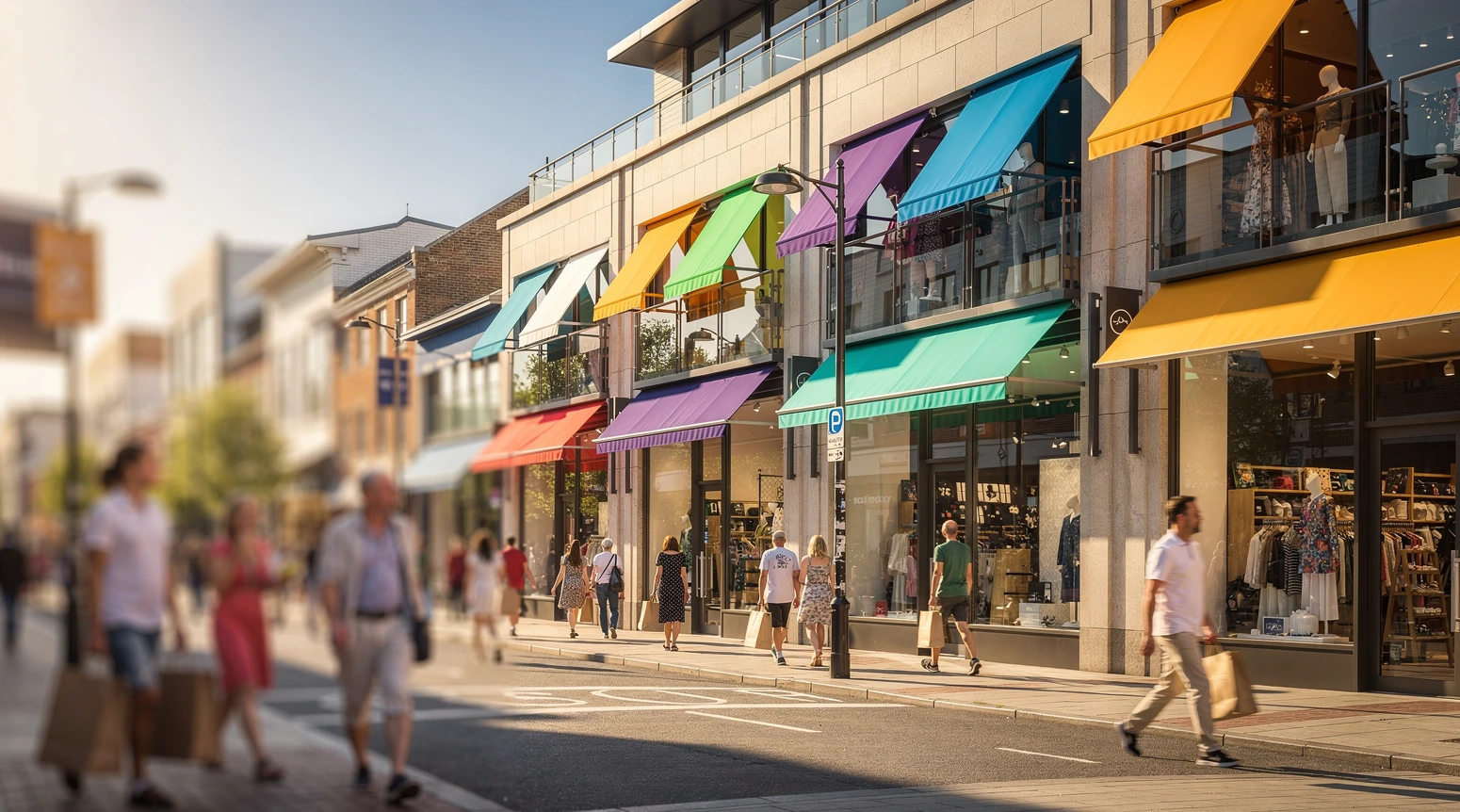
UK retail sales rose more than expected in May 2026, with volumes up 1.2% on the month, as a near-record warm spell and a wave of summer promotions pulled shoppers back into stores and onto retail apps. The figures, published by the Office for National Statistics on 19 June, comfortably beat the 0.5% monthly gain economists had pencilled in and marked a clear rebound from a weak April. The online channel did most of the heavy lifting: non-store retail volumes jumped 6.1% in the month and the internet’s share of total spending climbed to 28.8%, the strongest reading so far this year. For a sector that spent the first quarter of 2026 worrying about squeezed household budgets and soft big-ticket demand, the May numbers offer a rare upside surprise, though the detail underneath the headline is more nuanced than the rebound suggests.
In short
- UK retail sales volumes rose 1.2% in May 2026, more than double the 0.5% monthly gain economists expected and a sharp recovery from a revised 1.0% fall in April.
- Online led the rebound: non-store retail volumes jumped 6.1% on the month, the fastest since February 2025, and online’s share of total sales rose to 28.8% from 28.1% in April.
- Weather and promotions drove the upside, with the Met Office calling May the joint-third warmest on record, lifting sales of outdoor furniture, fans and other seasonal goods.
- Year-on-year, volumes were up 3.2%, and 4.6% excluding fuel, signalling that the recovery is broad rather than a pure weather artefact, even as consumer confidence stays fragile.
- The data complicates the rate outlook: the Bank of England has held its policy rate at 3.75%, and resilient spending gives policymakers little reason to ease quickly, even after the wider economy shrank in April.
What did the ONS report for May 2026?
The headline figure is a 1.2% rise in retail sales volumes in May compared with April, on a seasonally adjusted basis. That is the measure economists watch most closely because it strips out price changes and shows whether shoppers are actually buying more goods rather than simply paying more for the same basket. The consensus forecast going into the release was for a 0.5% gain, so the outcome was a meaningful beat.
On an annual basis, volumes were 3.2% higher than in May 2025, against a forecast nearer 1.9%. Excluding automotive fuel, the picture was stronger still, with volumes up 1.2% on the month and 4.6% on the year. That gap between the headline and the ex-fuel figure points to softer demand at the forecourt, where prices and volumes have both been volatile, while core retail held up well.
Sales values, which include the effect of price changes, also rose, but the volume gain is the more important signal for the health of the sector. When volumes and values move up together, as they did in May, it suggests genuine demand rather than inflation flattering the topline.
| Measure | May 2026 change | Comparison | Note |
|---|---|---|---|
| Volumes, month-on-month | +1.2% | vs +0.5% forecast | Rebound from -1.0% in April |
| Volumes, year-on-year | +3.2% | vs +1.9% forecast | Broad-based gain |
| Volumes excluding fuel, year-on-year | +4.6% | Stronger than headline | Softer demand at the forecourt |
| Three-month volumes | +0.4% | vs prior three months | Trend back in positive territory |
| Non-store (online) volumes, month-on-month | +6.1% | Fastest since Feb 2025 | Online led the rebound |
| Online sales values, year-on-year | +12.2% | Far above total market | Online share at 28.8% |
The spread across these measures is the key takeaway. A 1.2% monthly volume gain alongside a 12.2% annual rise in online values tells a layered story: a cyclical bounce in the month sitting on top of a structural channel shift that continues year after year. Both are real, and both matter for how retailers allocate capital between stores and digital.
How May compares with April
April had been a poor month. The ONS revised its earlier estimate of a 1.3% volume decline to a smaller 1.0% fall, but the direction was still negative, and the spring had looked shaky after a soft March. The May rebound therefore does more than offset April: it lifts the three-month trend back into positive territory, with volumes in the three months to May up 0.4% on the previous three months.
Month-to-month retail data is notoriously noisy, and the ONS itself routinely cautions against reading too much into a single print. A 1.0% fall followed by a 1.2% rise can reflect timing effects, such as the placement of bank holidays or the exact week a heatwave lands, as much as any durable shift in consumer behaviour. The smoother three-month series is the more reliable guide, and it now points gently upward.
Why did retail sales rebound so sharply?
Two forces stand out in the ONS commentary: the weather and promotional activity. Neither is a structural change in consumer finances, which is why analysts have been careful not to over-interpret the bounce. But both are powerful short-term levers, and in May they pulled in the same direction.
The weather effect
The Met Office described May 2026 as the joint-third warmest May on record for the UK. Warm, dry weather reliably shifts retail demand toward seasonal categories, and the ONS specifically flagged stronger sales of outdoor furniture, fans and other warm-weather goods. Garden centres, DIY sheds and homeware retailers tend to benefit first, followed by clothing as shoppers refresh summer wardrobes.
Weather-driven demand is real money, but it is also borrowed from later months in some categories and weakly correlated with underlying confidence. A hot May can pull forward purchases that would otherwise have happened in June or July, which is one reason forecasters expect the summer to look choppy month to month even if the broad trend holds.
Promotions and pricing
Retailers leaned on discounting to convert footfall into baskets. Sandra Prince of Lloyds Bank summarised the dynamic plainly, noting that “retailers are trying to keep prices low for customers despite ongoing cost pressures, using promotions.” That strategy supports volumes, which is what the headline measures, but it can compress margins, so a strong volume print does not automatically translate into a strong profit season for the retailers themselves.
The same tension is visible across global grocery, where chains have traded margin for market share to keep value-focused shoppers loyal. The pattern echoes what played out in the United States, where Kroger held its full-year outlook even as price cuts squeezed grocery margins, a reminder that volume growth and profitability are not the same story in 2026.
Consumer resilience underneath the noise
Beyond weather and discounting, there is a case that households are simply more durable than the gloomy mood music suggests. Rob Wood of Pantheon Macroeconomics argued that “May’s rebound in retail sales was helped by the weather but also shows consumers have been surprisingly resilient to higher energy prices.” Real wage growth has stayed positive through much of 2026, and employment has held up, giving the median household more spending capacity than headlines about cost-of-living strain imply.
That resilience is uneven. Confidence surveys show younger consumers as the most pessimistic, and willingness to make major purchases remains depressed. The result is a spending pattern skewed toward smaller, frequent, often discounted purchases rather than big-ticket commitments, which shapes which retailers win in this environment.
What is happening to online retail’s share?
For an e-commerce audience, the most striking part of the May release is the online detail. Non-store retailers, a category dominated by pure-play online sellers, saw volumes rise 6.1% on the month, the sharpest monthly increase since February 2025. Online sales values were up 3.3% on the month and 12.2% compared with May 2025, a double-digit annual gain that far outpaces the total market.
As a result, the proportion of total retail spending that happens online rose to 28.8% in May, up from 28.1% in April. That share sits well below the pandemic-era peak, when online briefly approached 38% of sales, but the trend has resumed its slow climb after a period of stabilisation. The structural shift toward digital channels never reversed; it simply paused while physical retail recovered footfall.
Why online outperformed the high street
Several factors compounded the online gain in May. Warm weather lifts impulse and seasonal buying, much of which now happens on mobile. Heavy promotional activity is easier to surface and personalise online, where retailers can target discounts and retarget abandoned baskets. And the continued growth of marketplace and social-commerce channels keeps adding incremental online demand that did not exist a few years ago.
The UK remains one of the most digitally mature retail markets in the world, with online penetration consistently among the highest of any large economy. That maturity means each incremental gain in share is harder won than in less-developed markets, which makes a 12.2% annual rise in online values notable rather than routine.
What it means for pure-play and omnichannel retailers
The online strength is good news for digital-first electricals and specialist retailers that depend on the channel. Online electricals specialist AO World, for example, has leaned into exactly this kind of demand, and AO World’s profit climbed to around £50m as the online electricals retailer scaled up, illustrating how a pure-play model can convert digital momentum into earnings when execution is tight.
For omnichannel chains, the lesson is that the online channel is now the growth engine even when stores recover. Department stores posted their best three-month run in over a year, yet the value created online still grew faster, which keeps pressure on retailers to invest in fulfilment, app experience and digital marketing rather than treating online as a defensive add-on.
How do UK retail sales compare with other major markets?
The May rebound looks more impressive when set against the recent run of national retail data elsewhere. China posted a rare contraction this spring, the first national retail sales decline in years, while the United States has seen choppy, value-driven growth as shoppers trade down. The UK’s combination of positive volumes and double-digit online growth stands out against that backdrop.
The contrast with China is especially sharp. Where UK volumes are recovering, China’s retail sales fell 0.6%, the first decline since 2022, a signal that the world’s second-largest consumer market is still struggling with weak domestic demand even as its export and platform economy hums. Different markets are clearly at different points in the consumer cycle.
| Market | Latest national retail read | Direction | Headline driver |
|---|---|---|---|
| United Kingdom | +1.2% month-on-month (May, volumes) | Rebounding | Warm weather, promotions, online |
| China | -0.6% (recent month, value) | Contracting | Weak domestic demand |
| United States | Low single-digit, choppy | Soft and uneven | Trade-down, value-seeking |
Comparisons across markets come with caveats. National statistics agencies measure retail differently, with varying treatment of services, fuel, hospitality and online. The ONS volume measure is one of the cleaner real-terms gauges, but a direct percentage comparison with China’s value-based print or the US Census Bureau’s data is indicative rather than exact. The directional story, however, is robust: the UK consumer is in better shape this spring than several large peers.
What does this mean for retailers heading into summer?
The immediate read for retailers is encouraging but conditional. Demand is there when the weather and the offer line up, but it is price-sensitive and concentrated in seasonal and online categories. That argues for sharp promotional planning, tight inventory on weather-dependent goods, and continued investment in the digital channel that is taking share.
The categories most likely to keep momentum
Seasonal home and garden, summer fashion, and consumer electronics tied to spring product launches all contributed to May’s gain. The ONS noted that computer and telecoms goods continued to benefit from product releases earlier in the year, suggesting tech demand has legs into the summer. Beauty, athleisure and food-to-go typically follow warm weather as well.
Big-ticket and credit-sensitive categories remain the soft spot. Furniture, large appliances and home improvement projects are the purchases consumers defer when confidence is low, and survey data shows willingness to buy expensive items near its weakest since early 2025. Retailers in those categories are leaning on financing and instalment options to bridge the affordability gap.
The payments and checkout angle
Affordability tools are increasingly part of how retailers convert hesitant shoppers, especially for higher-value baskets. Instalment and buy-now-pay-later products have moved from online checkout into physical stores, and that shift is accelerating into the second half of the year. The trend toward in-store BNPL going mainstream before the 2026 holidays is directly relevant to a market where volume growth depends on keeping monthly outlay manageable for cautious households.
How does this fit the Bank of England and interest-rate picture?
The retail figures land at a delicate moment for monetary policy. The Bank of England has held its main policy rate at 3.75%, and resilient consumer spending gives the rate-setting committee little reason to cut quickly. Financial markets are pricing only a small probability, around 15%, of a quarter-point increase at the next meeting, but the balance of risks has shifted with each upside data surprise.
That said, the wider economy is not uniformly strong. UK output contracted in April, the first monthly decline in several months, and the gap between a recovering consumer and a stalling economy is exactly the kind of mixed signal that keeps policymakers cautious. Strong retail volumes argue against rate cuts; a shrinking economy argues against hikes. The likely outcome is a prolonged hold while the data settles.
For retailers, the practical implication is that borrowing costs, both their own and their customers’, are unlikely to fall meaningfully in the near term. Financing-dependent demand will stay constrained, and the cost of capital for expansion or restocking remains elevated, which reinforces the focus on cash generation and margin discipline.
What are the risks and caveats in the data?
Several caveats temper the optimism. The first is volatility: a single strong month after a weak one can overstate the turn, and the ONS regularly revises its early estimates. The April number was itself revised, and May could be too once more complete returns arrive.
The second is the weather. A near-record warm May is, by definition, not repeatable as a growth driver, and some of the seasonal spending was likely pulled forward from later in the summer. If June reverts to cooler, wetter conditions, the month-on-month comparison could swing negative again without any change in underlying demand.
The third is the quality of the growth. Volume gains built on heavy discounting flatter the unit count while pressuring retailer margins, so a strong ONS print does not guarantee a strong reporting season for listed retailers. Investors learned that lesson when retail shares fell sharply this week despite companies posting higher profit and revenue, a reminder that the market prices guidance and margins, not just topline beats.
The confidence gap
Consumer confidence remains the structural worry. Sentiment held broadly steady in June, but younger consumers registered their least optimistic reading in two years, and households remain reluctant to commit to major purchases. Spending is being sustained by employment and real wage gains rather than by optimism, which makes it vulnerable to any deterioration in the labour market.
That fragility is why most analysts frame May as a welcome bounce rather than the start of a boom. The consumer is resilient, not exuberant, and the difference matters for how retailers plan capacity, inventory and promotional depth through the autumn.
What is the outlook for UK retail through year-end?
The base case among forecasters is for modest, uneven growth through the rest of 2026. Real incomes should keep rising gently, supporting volumes, but confidence and big-ticket demand are likely to stay subdued until borrowing costs ease or wage growth accelerates. The online channel is expected to keep gaining share, with digital growth outpacing the total market as it did in May.
The crucial test comes in the autumn and the run-up to the holidays, when discretionary and big-ticket spending normally peaks. Retailers that have rebuilt margin through the summer will have more room to discount aggressively into the key trading period, while those that traded margin for volume early may find themselves squeezed. Department-store and multichannel operators that have restructured are better placed than a year ago, with names such as the reshaped Debenhams Group, which narrowed its loss as its marketplace pivot paid off, showing how a lighter, more digital model can turn modest demand into improving results.
The wider European picture
The UK’s rebound fits a broader European pattern of consumers who are cautious but not collapsing. Eurozone retail has been similarly choppy, with warm-weather and promotional effects flattering individual months, and online penetration rising steadily across the bloc. The common thread is a shopper who responds quickly to value and seasonal triggers but holds back on anything that looks like a long-term financial commitment.
For brands and retailers operating across multiple European markets, the implication is that demand can be activated, but it has to be earned with price, relevance and a frictionless digital experience. The markets rewarding investment are those, like the UK, where online infrastructure is mature enough to convert algorithm-driven discovery into immediate sales.
There is also a planning lesson in the timing. With the holiday trading window opening earlier each year and discounting events now stretching across the calendar, a strong May does not lock in a strong second half. Retailers that read the bounce as permission to ease off promotional intensity risk ceding share to rivals who keep pressing on price and online experience. The more durable strategy is to treat months like May as a stress test of the digital channel, banking the data on which categories, creators and offers convert, and feeding that into autumn planning rather than assuming the consumer mood will simply hold.
The broader signal for the global retail audience is that the UK consumer has not broken, even after years of cost-of-living pressure, but the recovery is being earned rather than handed over. Volume growth that leans on weather and discounts is fragile by nature, and the channel taking the most share is the one that makes value easiest to find. Those two facts will shape retail strategy on both sides of the Atlantic through the rest of 2026.
FAQ: UK May 2026 retail sales questions worth answering
How much did UK retail sales rise in May 2026?
Retail sales volumes rose 1.2% in May compared with April, on a seasonally adjusted basis, according to the Office for National Statistics. That was more than double the 0.5% gain economists had forecast. On an annual basis, volumes were up 3.2%, and 4.6% excluding automotive fuel.
Why did retail sales rebound so strongly?
Two factors dominated: unusually warm weather and heavy promotional activity. The Met Office described May as the joint-third warmest on record, boosting seasonal goods such as outdoor furniture and fans, while retailers used discounts to convert footfall into sales. Underlying consumer resilience to higher energy prices also played a part.
What happened to online retail in May?
Online was the standout. Non-store retail volumes rose 6.1% on the month, the fastest since February 2025, and online sales values were up 12.2% year on year. The internet’s share of total retail spending climbed to 28.8% in May from 28.1% in April, the strongest reading so far in 2026.
Is 28.8% a record share for online sales?
No. Online’s share of UK retail spending briefly approached 38% at the height of the pandemic. The 28.8% figure is the highest of 2026 so far and continues a gradual upward trend, but it remains well below that earlier peak.
Does a strong volume number mean retailers had a strong month financially?
Not necessarily. Much of the volume growth was driven by promotions, which support unit sales while compressing margins. A strong ONS volume print can coincide with weaker profitability, which is why retail share prices do not always rise on good sales data.
How does the UK compare with other major retail markets?
Favourably this spring. China recently posted its first national retail sales decline in years, and US growth has been soft and value-driven. The UK’s combination of positive volumes and double-digit online growth stands out, though national statistics are measured differently and direct comparisons are only indicative.
What does this mean for Bank of England interest rates?
Resilient spending gives the Bank little reason to cut rates quickly. The policy rate is held at 3.75%, and markets price only a small chance of a near-term increase. With the wider economy having contracted in April, the most likely path is a prolonged hold rather than a clear move in either direction.
What should retailers watch for the rest of 2026?
Key signals include whether warm-weather demand was pulled forward, how consumer confidence among younger shoppers evolves, the trajectory of real wages, and the depth of holiday-season discounting. The online channel is expected to keep gaining share regardless of how the high street performs.
Which categories performed best in May?
Seasonal home and garden goods, summer-related products, and computer and telecoms equipment tied to earlier product launches led the gains. Department stores posted their best three-month volume run since September 2024. Big-ticket and credit-sensitive categories such as furniture and large appliances remained the weak spot.
What to read next
For the official data, see the ONS Retail sales, Great Britain bulletin for the full May 2026 release and historical series. For related coverage, our reporting on global retail demand, online channel growth and the payments tools shaping consumer spending puts the UK numbers in a wider context.