
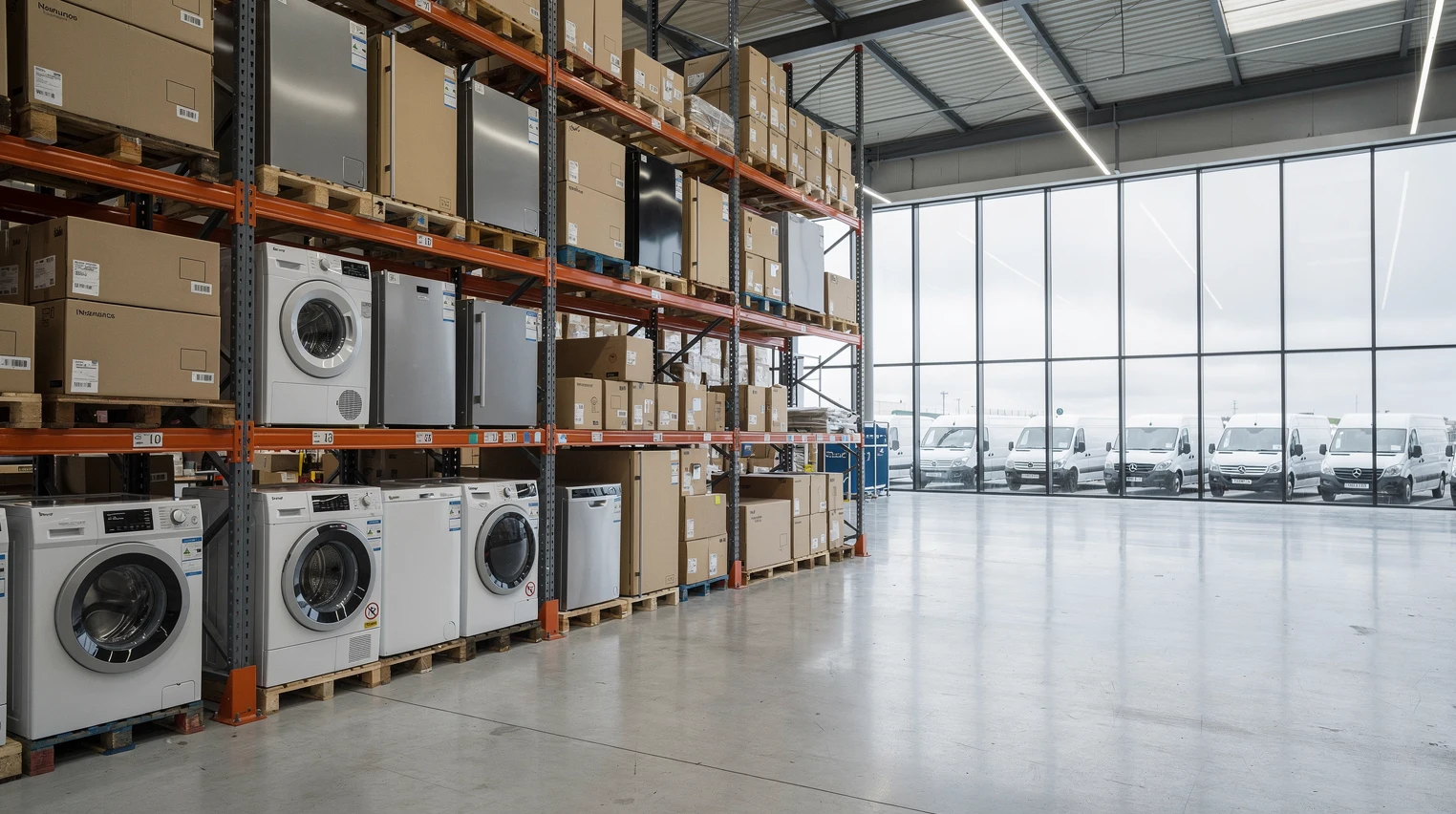
AO World, the Bolton-based retailer that sells washing machines, fridges and televisions almost entirely online, told investors on Wednesday that revenue rose by roughly 11% in the year to 31 March 2026 and that adjusted profit landed at the top of its upgraded guidance range. The results, published to the London Stock Exchange at 7:00 a.m. UK time, cap a year in which the company leaned on market-share gains, a growing business-to-business arm and a paid membership scheme to push earnings ahead of sales.
Founder and chief executive John Roberts struck a confident note, telling reporters the company was “just getting started” and that “the numbers speak for themselves again.” For a business that floated in 2014 and spent several years proving that a pure-play model could sell heavy domestic appliances profitably, the message was less about the single year and more about a five to 10 year ambition that management now wants the market to underwrite.
The figures matter beyond one mid-cap UK retailer. AO World is one of the few large online-only sellers of big-ticket electricals in Europe, and its results offer a clean read on whether households are still upgrading appliances, how delivery-heavy retailers are coping with higher wage costs, and whether loyalty and recommerce can lift margins in a category long defined by thin returns.
What did AO World report for the year to March 2026?
AO said group revenue grew by around 11% for the 12 months to 31 March 2026, with analyst consensus before the release pointing to a figure near £1.26 billion (about USD 1.6 billion at a GBP/USD rate of roughly 1.27). Business-to-consumer revenue, the core retail operation, rose by about 9.5%, which the company attributed to share gains across all key product categories rather than to a buoyant market.
Adjusted profit before tax came in at the top end of a previously upgraded £45 million to £50 million range, implying year-on-year growth of roughly 15%. That puts adjusted pre-tax profit near £50 million (about USD 63 million), a level that would mark a fresh high for the group and outpace the rate of sales growth.
Earnings per share rose by about 12% to a figure near 7.15 pence, according to the guidance the company had set out, while free cash flow climbed sharply to around £65 million (about USD 82 million) from £23 million a year earlier. AO ended the period with roughly £200 million of liquidity, leaving it with a net cash position and room to invest.
The shape of the result, profit and cash growing faster than revenue, is the headline management wanted. It signals that AO is converting more of each sale into earnings even as the top line expands at a high-single-digit to low-double-digit pace.
The numbers at a glance
| Metric (year to 31 March) | FY2026 | FY2025 | Direction |
|---|---|---|---|
| Group revenue | ~£1.26bn | ~£1.14bn | Up ~11% |
| B2C revenue growth | ~9.5% | n/a | Share gains |
| Adjusted profit before tax | ~£50m | ~£44m | Up ~15% |
| Earnings per share | ~7.15p | ~6.4p | Up ~12% |
| Free cash flow | ~£65m | £23m | Up sharply |
| Liquidity at period end | ~£200m | n/a | Net cash |
Prior-year figures are approximate and drawn from the company’s earlier disclosures; AO presents adjusted profit to strip out one-off items such as acquisition fees. Readers should treat the FY2025 comparatives as directional rather than audited point estimates.
How does AO World actually make money?
AO World is a pure-play online retailer of major domestic appliances, consumer electronics and related services. Its catalogue centres on the bulky, delivery-intensive products that most general marketplaces handle awkwardly: fridge-freezers, washing machines, dishwashers, ovens, large-screen televisions and computing. The model depends on owning the hard parts of fulfilment rather than outsourcing them.
Unlike a marketplace that lists third-party sellers, AO buys stock, holds it in its own warehouses and delivers much of it with its own two-person crews. That vertical control lets the company install appliances, take away old units for recycling and manage returns, services that are difficult to replicate and that support both customer trust and repeat purchase.
The company layers several revenue streams on top of product sales. These include protection plans and warranties, financing and credit arrangements at checkout, recycling operations, and a growing advertising and media business funded by suppliers who want visibility on the site. Together these higher-margin services lift the blended economics of a category where hardware margins are slim.
That mix is central to understanding Wednesday’s result. When AO grows services and membership faster than the box-shifting core, profit can rise more quickly than revenue, which is exactly what the FY2026 numbers showed.
The model also explains why AO has historically been valued differently from a pure marketplace. Owning inventory and delivery ties up working capital and carries operational risk, but it builds defensibility. Few competitors can match the combination of next-day delivery on a fridge-freezer, in-home installation, removal of the old appliance and recycling, all booked through a single online checkout.
Scale is what makes those economics work. AO has spent more than a decade building density in its delivery routes and volume through its warehouses, the point at which fixed logistics costs are spread thinly enough to leave room for profit. That long investment runway is one reason new entrants have struggled to challenge AO in heavy appliances, even as marketplaces dominate smaller, parcel-friendly electronics.
Why did profit grow faster than sales?
The simplest explanation is mix. As AO sells more warranties, financing, recycling and advertising alongside each appliance, the average margin on a basket improves even if the price of the underlying washing machine does not move. Management has repeatedly framed this as the path to a structurally higher-margin business.
The margin story
AO has set a medium-term ambition of delivering a profit-before-tax margin above 5%. On revenue near £1.26 billion, a 5% margin would translate to roughly £63 million of pre-tax profit, above the level reported for FY2026. The company therefore still has headroom against its own target, which is part of why Roberts framed the year as a staging post rather than a destination.
Operating leverage also helps. AO carries a large fixed base of warehousing, delivery infrastructure and technology, so incremental sales that use spare capacity drop a higher share through to profit. After several years of cost discipline, the group is now harvesting that leverage as volumes grow.
Cost headwinds from wages and tax
The profit improvement came despite real cost pressure. AO flagged that higher labour-related costs, including increases to the national minimum wage and to employer National Insurance contributions, weighed on the result, with a roughly £4 million impact noted in the first half alone. For a delivery and warehouse-heavy operator, payroll is a major line, so policy changes feed quickly into the cost base.
Those pressures are not unique to AO. Across the sector, employer tax and wage rises announced in the autumn 2024 Budget have squeezed retail margins through the 2025 and 2026 financial years. The strain has been severe enough that some chains have cut headcount, a trend explored in our report on how UK retailers cut about 18,000 jobs as Labour tax rises reshaped the high street. That AO grew profit while absorbing the same headwinds is a point management was keen to stress.
What do the results say about UK consumer demand?
AO’s B2C growth of about 9.5% sits well ahead of the wider electricals market, which has been broadly flat to modestly positive. The company described its top-line performance as driven by share gains rather than by a rising tide, a framing that fits a UK consumer backdrop that remains cautious on big-ticket spending.
Major domestic appliances are partly non-discretionary. When a fridge or washing machine fails, households generally replace it, which gives the category a floor even in weak years. AO benefits from that resilience, but it also means growth above the market has to come from winning customers, not from a demand boom.
The broader promotional calendar is shifting too, with discount events clustering earlier in the year. Our analysis of why the US summer sales peak is moving to June for good reflects a pattern that increasingly applies to UK electricals, where summer promotions and back-to-school demand now overlap. AO’s scale in fulfilment lets it lean into these peaks without the store-network costs that burden omnichannel rivals.
Still, management was careful not to overclaim on demand. The company attributed its outperformance to execution, product range and price, and to the trust signals it has built, including a Trustpilot profile approaching one million reviews at a rating near 4.9.
Trust is more than a marketing point in this category. Buying a £700 appliance online, sight unseen, with a delivery crew due to enter the home, asks a lot of a shopper. Review volume and service ratings function as a substitute for the reassurance a physical store once provided, and they compound over time in a way rivals cannot quickly copy.
The category’s replacement dynamics also shape AO’s planning. Appliances bought during the pandemic-era spike in home spending are now reaching the end of their typical life, which could support a replacement cycle over the coming years. AO’s read on demand will be watched closely as a proxy for whether that cycle is arriving on schedule.
How important is AO Business to the result?
AO Business, the company’s B2B arm, has become one of the more closely watched parts of the group. It sells appliances and electronics to landlords, housebuilders, offices, hospitality operators and other organisations, a customer base with different buying patterns and often larger order values than consumers.
Why B2B matters for margins
B2B revenue has been growing faster than the consumer business, and it tends to carry attractive economics. Corporate buyers value reliability, account management and bulk delivery over the lowest possible price, which supports margin and reduces the discount-driven volatility that characterises consumer electricals.
For AO, every incremental B2B order also uses the same warehousing and logistics backbone that serves consumers, improving asset utilisation. That shared infrastructure is why management sees B2B as a high-return way to grow without proportionally increasing fixed costs.
The build-out of automated fulfilment across the sector strengthens that logic. As we detailed in our look at why a US retail automation-capex wave is likely before the 2026 holidays, retailers are investing heavily to drive cost out of warehousing and last-mile delivery. AO’s owned network positions it to benefit from the same efficiency gains across both its consumer and business channels.
What is the role of membership and recommerce?
Two newer levers featured prominently in the results: the Five Star paid membership scheme and the recommerce business acquired through musicMagpie. Both are designed to deepen customer relationships and lift lifetime value rather than to chase one-off transactions.
The Five Star membership flywheel
Five Star is AO’s paid loyalty programme, offering benefits such as free delivery, faster service and discounts in exchange for an annual fee. The company reported improved renewal rates and higher spending among members, the two metrics that determine whether a paid scheme pays for itself.
The strategic appeal is familiar from other subscription-led retailers. Members tend to consolidate purchases with the provider, buy more often and churn less, which smooths revenue and raises the return on each acquired customer. If renewal and spend continue to climb, membership can become a durable profit engine rather than a marketing cost.
musicMagpie and the recommerce bet
AO’s acquisition of musicMagpie added a recommerce capability in refurbished technology, including phones and other devices. The company said losses from that unit narrowed to around £2 million for the year, down from roughly £6 million at the time of acquisition, a sign that integration is progressing toward profitability.
Recommerce fits the wider sustainability push in retail and gives AO a way to capture value from trade-ins and end-of-life devices. It also supports the recycling operation that already underpins the company’s appliance delivery model, where old units are collected and processed when new ones are installed.
How does AO compare with its rivals?
AO occupies an unusual position. It is larger and more specialised than most pure-play challengers, but smaller than the omnichannel and marketplace giants it competes with on price and range. The comparison below sets out where it sits among UK electricals sellers.
| Retailer | Model | Electricals focus | Store estate |
|---|---|---|---|
| AO World | Pure-play online | Major appliances, TV, computing | None |
| Currys | Omnichannel | Broad electricals and services | Large UK and Nordic estate |
| Amazon UK | Marketplace and retail | Wide, less big-appliance focus | None (fulfilment centres) |
| Marks Electrical | Pure-play online | Major appliances | None |
| John Lewis | Omnichannel premium | Electricals and home | Department stores |
The key contrast is fulfilment ownership versus reach. Amazon wins on breadth and logistics scale but is less specialised in heavy, install-required appliances. Currys and John Lewis bring stores and brand trust but carry property costs that a pure-play avoids. AO’s bet is that owning specialised delivery and service, without store overhead, is the most profitable way to sell big-ticket electricals online.
Currency is one more axis for global readers comparing these businesses. With sterling near USD 1.27, AO’s roughly £1.26 billion of revenue equals about USD 1.6 billion, placing it well below Amazon’s UK electricals turnover but comfortably ahead of smaller pure-play specialists. The table below converts the headline figures for an international audience.
| FY2026 figure | GBP | USD (at ~1.27) |
|---|---|---|
| Group revenue | ~£1.26bn | ~$1.60bn |
| Adjusted profit before tax | ~£50m | ~$63m |
| Free cash flow | ~£65m | ~$82m |
| Addressable market (target) | ~£28bn | ~$35.5bn |
What will AO do with its cash and balance sheet?
Ending the year with around £200 million of liquidity and a net cash position gives AO options that many mid-cap retailers lack. The sharp rise in free cash flow, to about £65 million from £23 million, is arguably as significant as the profit figure because it shows the business funding itself comfortably from operations.
Management has signalled appetite to invest in growth, particularly in logistics capacity, technology and the B2B and membership engines that are lifting margin. Capital can also support selective acquisitions, as the musicMagpie deal showed, where AO adds capability rather than simply buying revenue.
A strong balance sheet matters in a sector where weaker players have stumbled. Across retail, financial distress has driven a run of restructurings and ownership changes, from department-store reinventions to outright insolvency. AO’s cash generation is what keeps it on the front foot rather than the defensive footing that has forced rivals into cost-cutting or sale processes.
What does the five to 10 year plan involve?
Roberts used the results to point past FY2026 toward a longer horizon. He described a clear plan for the next five to 10 years, anchored on the medium-term goal of a pre-tax margin above 5% and on the conviction that AO can take a larger slice of a roughly £28 billion (about USD 35.5 billion) addressable market spanning electricals, services and adjacent categories.
The £28bn addressable market
That market figure is deliberately broad. It includes not only the core appliances and electronics AO sells today but also services, financing, recycling, recommerce and B2B demand. The strategic argument is that AO has built infrastructure, delivery, installation, recycling, membership and media, that can carry far more volume and more categories than it currently handles.
If AO can keep growing B2C share, scale B2B, and expand membership and services, the company believes it can compound revenue and margin together for years. The capital-light nature of adding services to an existing logistics network is what makes the margin target credible to management.
The risks to the plan
The plan is not without hazards. UK consumer demand for big-ticket goods remains sensitive to interest rates, housing activity and confidence, any of which could slow the appliance replacement cycle. Wage and tax costs may keep rising, and competition from Amazon and a recovering Currys could compress prices.
Execution risk also rises as AO layers on membership, recommerce and advertising. Each new revenue stream demands different capabilities, and integration missteps, as the early musicMagpie losses showed, can drag on profit before they add to it. The market will judge the five to 10 year plan on whether margin keeps climbing toward the 5% goal, not on the ambition itself.
What does this mean for shoppers, suppliers and investors?
For shoppers, a financially healthy AO means continued investment in delivery speed, installation, recycling and the membership perks that lower the effective cost of buying online. A profitable pure-play also keeps competitive pressure on omnichannel rivals, which tends to benefit consumers on price and service.
For suppliers and manufacturers, AO is an increasingly important route to market for large appliances, and its growing media business gives brands a new way to reach buyers at the point of decision. The faster B2B arm also opens a channel into landlords, builders and hospitality that complements traditional trade distribution.
For investors, the combination of double-digit profit growth, a jump in free cash flow and a net cash balance sheet is a strong set, tempered by the usual caveats about UK consumer exposure and cost inflation. The longer-term equity case now rests on the margin target and the credibility of the five to 10 year plan rather than on any single year’s beat. As AI-driven checkout and discovery reshape how electronics are bought, AO’s owned data and membership base could prove valuable, a theme we examine in our piece on how agentic checkout is likely to settle on the card networks by autumn 2026.
In short
- Revenue up about 11%: AO World grew group sales to roughly £1.26 billion (about USD 1.6 billion) in the year to 31 March 2026, with B2C revenue up around 9.5% on market-share gains.
- Profit beat sales growth: Adjusted pre-tax profit reached the top of guidance near £50 million, up roughly 15%, as services and membership lifted margin.
- Cash generation jumped: Free cash flow rose to about £65 million from £23 million, leaving AO with around £200 million of liquidity and a net cash position.
- Growth engines: AO Business, the Five Star paid membership scheme and recommerce via musicMagpie are the levers management is using to push margin toward a 5% target.
- “Just getting started”: Founder John Roberts framed the year as a staging post in a five to 10 year plan aimed at a roughly £28 billion addressable market.
Frequently asked questions
What exactly did AO World report on 17 June 2026?
AO World published its full-year results for the 12 months to 31 March 2026, reporting group revenue up about 11% to near £1.26 billion, B2C revenue up around 9.5%, and adjusted profit before tax at the top of its upgraded £45 million to £50 million range. Free cash flow rose to roughly £65 million and the company ended the year with about £200 million of liquidity.
Why did profit grow faster than revenue?
The main driver is sales mix. AO is growing higher-margin services such as warranties, financing, recycling, advertising and paid membership faster than the core appliance business, which lifts the blended margin on each basket. Operating leverage across its fixed warehousing and delivery network also helps incremental sales drop through to profit.
How does AO World differ from Currys or Amazon?
AO is a pure-play online retailer with no stores, specialising in heavy, install-required appliances delivered by its own crews. Currys is omnichannel with a large store estate and broad electricals range, while Amazon offers vast breadth and logistics scale but less focus on big-appliance delivery and installation. AO’s wager is that owning specialised fulfilment without store costs is the most profitable online model for the category.
What is the Five Star membership scheme?
Five Star is AO’s paid loyalty programme, offering perks such as free delivery, priority service and discounts for an annual fee. In the latest year the company reported improved renewal rates and higher spending among members, the signals that a subscription scheme is becoming self-funding and a long-term profit driver.
What happened with the musicMagpie acquisition?
musicMagpie gave AO a recommerce business in refurbished technology such as phones and devices. AO said losses from the unit narrowed to around £2 million in FY2026 from roughly £6 million at the time of acquisition, indicating that integration is moving the business toward profitability.
How did higher UK wages and taxes affect AO?
Increases to the national minimum wage and to employer National Insurance contributions raised AO’s labour costs, with a roughly £4 million impact noted in the first half. Because AO is delivery and warehouse intensive, payroll is a large cost line, so these policy changes feed quickly into the cost base. The company still grew profit despite the headwind.
What is AO World’s longer-term target?
Management has set a medium-term ambition of a pre-tax profit margin above 5% and points to a roughly £28 billion addressable market across electricals, services and adjacent categories. Chief executive John Roberts described a clear five to 10 year plan, saying the company is “just getting started.”
Is AO World profitable and financially stable?
Yes. AO reported adjusted pre-tax profit near £50 million, a sharp rise in free cash flow to about £65 million, and a net cash position with around £200 million of liquidity. That balance sheet gives it room to invest in logistics, technology and selective acquisitions without relying on external funding.
What are the main risks to AO World’s outlook?
Key risks include weaker UK demand for big-ticket appliances if interest rates or confidence deteriorate, continued wage and tax inflation, and intensifying competition from Amazon and a recovering Currys. Execution risk also rises as AO scales membership, recommerce and advertising, where integration and operational missteps could weigh on margin before they add to it.