
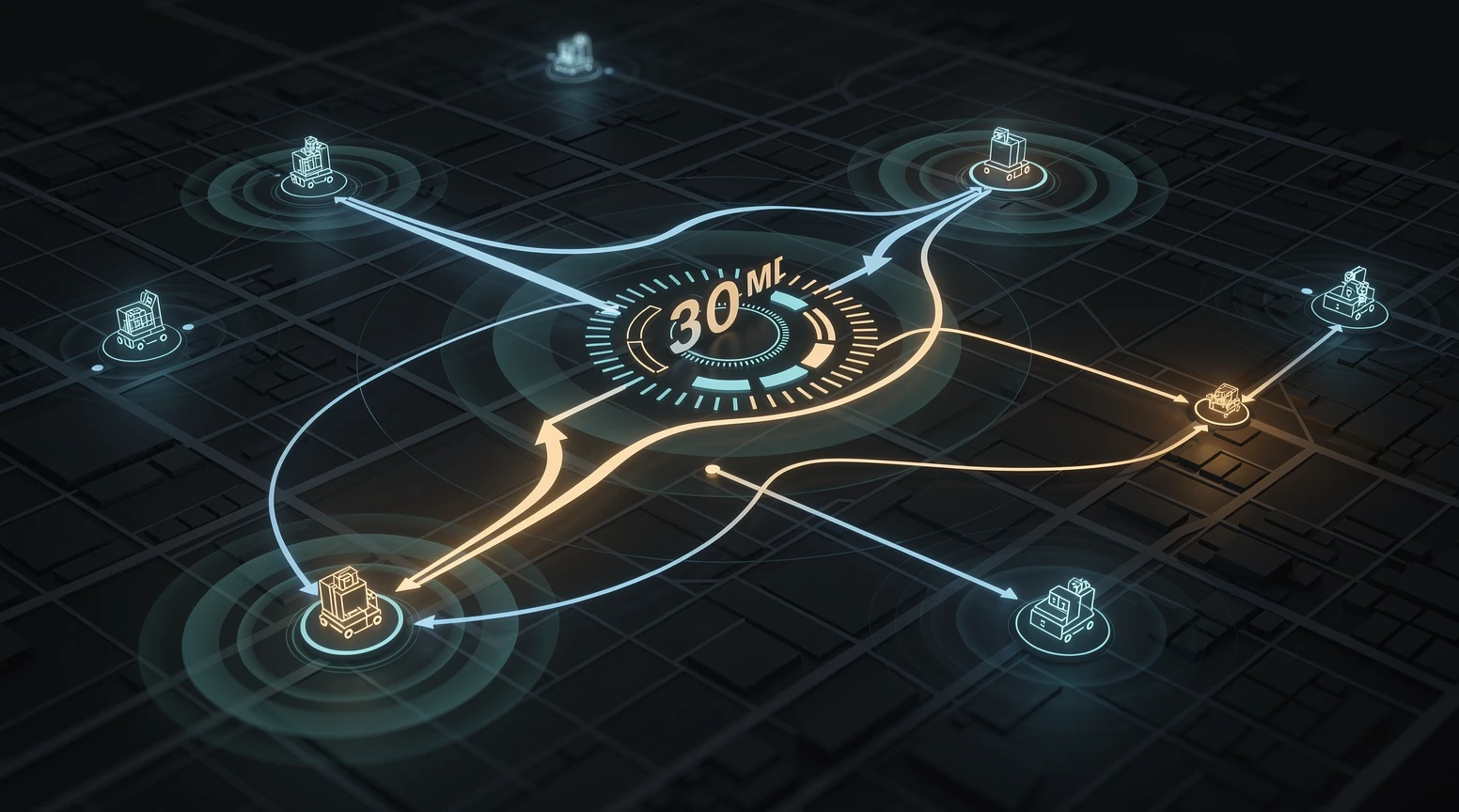
The next phase of the US grocery war will not be won at the shelf or on price. It will be settled at the fulfillment node, and the clock is the new battleground. The pattern of moves over the past six weeks suggests that sub-30-minute grocery delivery is about to cross from a premium feature into a competitive requirement, and that the architecture likely to win is store-and-proximity fulfillment rather than dedicated mega-automation. Our base case: before the 2026 holiday peak, expect at least one more top-tier US grocer to make sub-30-minute express delivery a named strategic offering, while the standalone automated-fulfillment model keeps retreating. That call is testable within 90 to 180 days.
In short
- The prediction: sub-30-minute grocery delivery hardens from feature to table stakes across major US grocery before holiday 2026, with at least one more top-tier grocer announcing a named express tier by Q4 2026 earnings season.
- The architecture call: the winning model is likely store-and-proximity fulfillment (existing stores plus small forward nodes), not dedicated customer fulfillment centers built around heavy automation.
- The signals: Amazon Now launched on May 12, 2026; Walmart formally took its 30-minute-or-less service to 33 markets on May 28; and Kroger has been paying to unwind dedicated automated centers in favor of an asset-light, store-based model.
- The live confirmation: trade coverage from June 24, 2026 framed the Walmart and Amazon moves as an escalating delivery war as same-day demand surges, with delivery now the dominant fulfillment method.
- The main risk: ultra-fast grocery has poor unit economics and a graveyard of failed operators, so speed could stall as a niche premium rather than become universal.
Why this matters now
US grocery e-commerce spent most of the last decade arguing about a single question: build or rent. Build meant dedicated, heavily automated customer fulfillment centers, the model Kroger pursued with Ocado. Rent meant leaning on existing stores and third-party platforms like Instacart, DoorDash and Uber to do the picking and the last mile. For years the debate stayed theoretical, because delivery volumes were not large enough to force a verdict.
That has changed. According to trade analysis published on June 24, 2026, delivery captured close to 65% of online grocery fulfillment in 2025, up from roughly 50% in 2022, and same-day orders made up around 80% of all delivery volume in the first quarter of 2026. When delivery is the majority channel and most of it is same-day, the cost and speed of the last mile stop being a rounding error. They become the margin.
The signals point to three of the largest players resolving the build-versus-rent question almost simultaneously, and in different directions. That divergence is itself the story. When rivals with comparable scale pick opposing architectures inside the same quarter, the market is usually about to learn which one is right, and the laggards are usually about to be forced to choose.
The timing also matters because the decision window is short. Holiday 2026 is the first peak where ultra-fast grocery will be marketed at national scale, and peak season is when fulfillment models either prove they flex or visibly break.
There is a strategic asymmetry worth naming. Amazon enters grocery delivery from logistics strength but relative grocery weakness, while Walmart enters from grocery strength and an unmatched store network. The two are converging on the same 30-minute promise from opposite starting points, which is usually the sign that a capability has stopped being a differentiator and started becoming a baseline expectation.
Consumer behavior is reinforcing that shift rather than merely reflecting it. The same June 2026 analysis found that 70% of shoppers now prefer delivery over pickup, citing time savings, scheduling flexibility and convenience for larger orders, and that delivery is growing close to three times faster than pickup. When the fastest-growing channel is also the one customers say they prefer, retailers tend to invest ahead of the curve rather than behind it.
Signal 1: Amazon Now and the dedicated micro-fulfillment build
On May 12, 2026, Amazon launched Amazon Now, a 30-minute delivery service for fresh groceries, household essentials and locally relevant items. Per Amazon’s own announcement, the service runs from a network of smaller dedicated locations placed close to where customers live and work, with Udit Madan, the company’s senior vice president of worldwide operations, framing it around the convenience of getting an order in 30 minutes or less. You can read the company’s description on its press page.
The structure is the tell. Amazon is not simply speeding up existing warehouses; it is standing up purpose-built forward nodes, the closest thing the US market has seen to the dark-store model since the last quick-commerce cycle. Pricing is tiered: Prime members pay a discounted $3.99 delivery fee per order, while non-Prime customers pay $13.99, with small-order fees layered on below $15.
Coverage is already meaningful and explicitly expansionary. Amazon Now is live in markets including Atlanta, Dallas-Fort Worth, Philadelphia and Seattle, with rollout underway in Austin, Houston, Minneapolis, Orlando, Phoenix, Denver and Oklahoma City. The company has said it intends to reach tens of millions more customers by the end of 2026.
Read as a signal, Amazon Now represents a renewed bet that dedicated, owned ultra-fast infrastructure can work at scale where standalone operators failed. The pattern suggests Amazon believes the missing ingredient last time was not the model but the demand density, the logistics depth and the Prime base to absorb the fixed cost. That is a substantial wager, and it raises the bar for everyone with a grocery ambition.
The Prime flywheel is doing quiet work here. By pricing the service at $3.99 for members against $13.99 for everyone else, Amazon turns ultra-fast grocery into another reason to hold a Prime membership, which spreads the fixed cost of the forward nodes across the broader subscription economics rather than asking each grocery basket to carry it alone. That is a luxury pure-play quick-commerce startups never had.
It is also a hedge against the agentic and same-day future Amazon is building in parallel. A network of small forward nodes close to customers is useful well beyond groceries; it shortens the last mile for any high-frequency category and gives Amazon optionality if shopping behavior shifts toward instant, intent-driven purchases. Viewed that way, Amazon Now is less a grocery product than a proximity-infrastructure play with grocery as the wedge.
Signal 2: Walmart’s store-as-fulfillment counter
Sixteen days later, on May 28, 2026, Walmart formally announced 30-minute-or-less delivery across 33 US markets. According to Walmart’s corporate communications, the service spans more than 100,000 eligible items including fresh groceries, pharmacy, baby essentials, household supplies, pet food and electronics, for a $10 fee tied to its Walmart+ membership.
The contrast with Amazon’s approach is the important part. Walmart is not building dedicated forward nodes. It is using its existing store footprint as the fulfillment network, with an algorithm that weighs basket size, driver availability and distance from the store to decide what can be promised in 30 minutes. The infrastructure is already paid for; the innovation is software and orchestration on top of real estate Walmart already operates.
The scale claim underlines how far this already runs. Walmart says it completed millions of sub-30-minute deliveries across more than 19,000 zip codes in the first quarter of 2026, before the formal launch, meaning the May announcement productized a capability that had quietly been live for over a year. The company is pairing it with a rapidly expanding drone program, including a reported June 12 plan to bring delivery drones to Philadelphia, the same metro Amazon Now serves.
This is the freshest and arguably strongest signal, because it shows the largest US grocer choosing the opposite architecture to Amazon and claiming proof it works at national scale. Walmart already takes close to 40% of US online grocery sales, so its model choice carries unusual weight. The pattern suggests store-and-proximity, not dedicated automation, is the path the volume leader is betting the next phase on.
Signal 3: Kroger’s retreat from dedicated automation
The third signal is a retreat rather than a launch, and that is precisely why it matters. On December 5, 2025, alongside its third-quarter earnings, Kroger disclosed it would pay Ocado roughly $350 million to cancel a planned customer fulfillment center near Charlotte and close three existing automated sites, taking an impairment and related charges of around $2.6 billion. The story has continued to unfold through the first half of 2026 as those closures take effect.
The strategic language is unambiguous. Kroger is pivoting to what it calls an asset-light model: more in-store fulfillment, a pilot of capital-light store-based automation in high-volume markets, and deeper reliance on third-party platforms including Instacart, DoorDash and Uber. The stated goal is to improve digital profitability by about $400 million in 2026, with management guiding that online operations should begin generating profit this year. The strain on the dedicated-automation thesis is visible elsewhere too, as covered in our piece on Ocado’s intensifying CEO succession search.
Kroger is not abandoning automation entirely; it continues operating jointly run centers in Ohio, Texas, Colorado, Michigan and Georgia. But canceling new builds and writing down existing capacity is a clear statement that the standalone, heavily automated mega-center did not deliver the economics promised. Our analysis of Kroger’s margin pressure and 2026 outlook traces how that profitability squeeze has reshaped its priorities.
Taken together with the Amazon and Walmart moves, Kroger’s retreat completes the triangle. One major player is doubling down on dedicated nodes, the volume leader is winning on store-proximity, and the most committed believer in dedicated automation is unwinding it. The signals do not all point the same way, but they converge on a single conclusion about where the weight of evidence is shifting.
The three signals at a glance
| Signal | Date | Player | Fulfillment model | What it implies |
|---|---|---|---|---|
| Amazon Now launch | May 12, 2026 | Amazon | Dedicated forward nodes (build) | Renewed bet that owned ultra-fast infrastructure can scale |
| 30-minute delivery to 33 markets | May 28, 2026 | Walmart | Store-as-fulfillment (proximity) | Volume leader proves speed off existing real estate |
| Ocado center cancellation and closures | Dec 5, 2025, continuing into 2026 | Kroger | Asset-light, in-store and third-party (rent) | Dedicated mega-automation written down as uneconomic |
What the pattern suggests
Three architectures are now being tested in public, and they are not equally matched. The store-and-proximity model carries the lowest marginal cost because the real estate and inventory already exist; its weakness is that picking inside busy stores degrades the shopping experience and caps how much can move quickly. The dedicated-node model offers clean, scalable throughput but demands heavy upfront capital and dense demand to pay for it. The asset-light model minimizes capital but surrenders margin and control to platform partners.
The pattern suggests the market is converging on store-proximity as the default, with dedicated nodes as a selective overlay in the densest metros. Walmart’s ability to serve 19,000-plus zip codes from stores it already owns is hard to beat on cost, and cost is what ultimately decides which delivery promise survives a downturn. The prior precedent points the same way: Kroger spent years and billions proving the standalone center is the harder road.
That logic also raises the bar for the next mover. Once two of the three largest players have made sub-30-minute a headline offering and demonstrated it at scale, the laggards face a familiar choice between matching the promise or ceding the most valuable, highest-frequency shoppers. The same capacity build that underpins this shift is visible in our coverage of the broader US retail automation-capex wave expected before holiday 2026.
It would be a mistake, though, to read the pattern as automation losing. The more precise reading is that the locus of automation is moving from standalone destination centers to the store and the forward node. Kroger’s own pivot includes a pilot of capital-light, store-based automation, which suggests the technology is migrating closer to the customer rather than being abandoned. The bet that failed was the standalone economics, not robotics as such.
The other through-line is software. All three models ultimately compete on the quality of the orchestration layer that decides, in real time, what can be promised in 30 minutes given basket size, driver supply and distance. That intelligence is where the durable advantage is likely to sit, because real estate and robots can be bought or rented, but the data feedback loop that makes a promise reliable at peak compounds with volume. Whoever runs the most orders trains the best model.
Three fulfillment architectures compared
| Dimension | Dedicated nodes (Amazon Now) | Store-proximity (Walmart) | Asset-light (Kroger pivot) |
|---|---|---|---|
| Upfront capital | High | Low (real estate exists) | Lowest |
| Marginal delivery cost | Moderate, improves with density | Low | Higher (platform fees) |
| Speed ceiling | Fastest in dense metros | Fast where stores are close | Variable, partner-dependent |
| Assortment | Curated, narrower | Broad (full store) | Broad but split across partners |
| Control and data | Full | Full | Shared or ceded |
| Risk if demand disappoints | Stranded fixed cost | Low | Low capital, weak margin |
Wider context: the economics that shaped the first quick-commerce wave
None of this is happening in a vacuum, and the history is sobering. The 2021 to 2022 quick-commerce boom produced a wave of venture-funded dark-store operators promising 10 to 15 minute delivery, and most of them collapsed in 2022 and 2023 when the unit economics failed to close. Small baskets, high labor intensity and steep real-estate costs proved fatal once cheap capital disappeared.
What is different now is who is making the bet. The incumbents pushing sub-30-minute delivery in 2026 are not burning venture money to acquire customers; they are extending platforms that already carry hundreds of millions of shoppers and, in Walmart’s case, fulfilling from real estate that is already profitable. That changes the math, because the fixed costs are shared across a much larger base and the demand is already there.
The platform layer is being repriced accordingly. The market has started to treat grocery-delivery enablers as infrastructure rather than gig-economy intermediaries, a shift we explored in our analysis of Instacart’s re-rating as grocery-tech infrastructure. If sub-30-minute becomes table stakes, the companies that supply the orchestration software and last-mile networks stand to benefit regardless of which retailer wins.
There is also a defensive logic. Same-day and ultra-fast delivery is where Amazon and Walmart can close the convenience gap with the corner store and the gas station, capturing the small, frequent, high-margin top-up trip that has historically been hard for big-box grocery to serve profitably. The prize is not just grocery share; it is frequency and habit.
Reading the calendar: why the holiday peak forces a verdict
Predictions need a clock, and the 2026 holiday season supplies one. Peak demand compresses every weakness in a fulfillment model into a few high-stress weeks, which is why model choices made in spring tend to be judged in December. A 30-minute promise that holds in May across 33 markets is a marketing claim; the same promise holding through the December surge is proof.
That pressure cuts in two directions for the store-proximity model. On one hand, stores already staffed and stocked for holiday footfall have surge capacity built in. On the other, the same stores are at their most crowded exactly when express orders spike, so the risk of in-store picking degrading the shopping experience is highest precisely when it is most visible. How Walmart and its peers manage that tension will be the clearest real-world test of the architecture.
For the dedicated-node model, the holiday peak is where density either pays off or exposes the fixed cost. Forward nodes that look underused in a quiet quarter can look brilliant when volume spikes, but only if the demand actually materializes in the metros where Amazon has placed them. The expansion to tens of millions of customers Amazon has promised by year-end is, in effect, a race to reach the density that justifies the build before peak arrives.
The practical implication is that the prediction has a natural verification date. By the time Q4 2026 results are reported in early 2027, the market will have a clean read on whether sub-30-minute became table stakes, whether store-proximity outperformed dedicated nodes under load, and whether any further grocers were forced off the sidelines. Few forward-looking calls in retail come with a checkpoint that crisp.
Implications for retailers, brands, platforms and investors
For regional and mid-tier grocers, the signals point to a narrowing window. Matching a sub-30-minute promise from owned stores is the cheapest path, but it requires order-orchestration software and labor models most do not yet have, which is why the asset-light route through third-party platforms is likely to see another wave of adoption before the holidays.
For consumer brands, ultra-fast fulfillment reshapes the shelf. Curated express assortments favor a smaller set of high-velocity items, so the brands that win placement in the 30-minute basket capture disproportionate frequency, while long-tail products get pushed to slower, scheduled delivery. Pack sizes and promotions tuned for the top-up trip become a distinct merchandising discipline.
For platforms and logistics providers, the prize is the orchestration layer. Whether a retailer builds or rents, someone has to route drivers, balance basket economics and manage promise times in real time, and that software and network capacity is where durable margin is likely to accrue. The drone programs now expanding into shared metros add a further layer of differentiation that only the largest players can fund.
For investors, the near-term tell is language, not press releases. The pattern suggests watching Q4 2026 earnings calls for explicit sub-30-minute or express-tier commitments from grocers beyond Amazon and Walmart, and for any further writedowns or pivots away from dedicated automation. Both would confirm the direction of travel; their absence would weaken it.
A second investor signal is capital allocation disclosure. Retailers that intend to compete on speed will need to disclose where the capital is going, whether into forward nodes, store retrofits, drone programs or orchestration software, and the mix will reveal which architecture each is actually backing. Watch for capex lines that shift from large discrete distribution-center projects toward distributed, store-level and software spend, which would corroborate the store-proximity thesis.
Finally, the competitive set is wider than grocery. Convenience stores, pharmacies and quick-service operators all sit in the same sub-30-minute proximity market, and any of them accelerating their own express push would both validate the trend and intensify it. The boundary between the grocery run and the top-up trip is blurring, and the retailers that own the 30-minute promise are positioning to absorb both.
Caveats: what could go wrong
The strongest counter-argument is that speed alone does not sell groceries. Trade analysis from June 24, 2026 cited a McKinsey observation that consumers overwhelmingly prefer a full assortment over ultra-fast delivery with limited choice. If that holds, sub-30-minute stays a premium convenience layer for top-up trips rather than the main event, and the prediction of it becoming table stakes overstates the case.
The unit economics remain the second risk. Ultra-fast delivery is expensive to fulfill, the fees ($3.99 to $13.99 at Amazon, $10 at Walmart) signal a premium product rather than a mass-market default, and a consumer pullback would make fast delivery one of the first discretionary costs shoppers cut. Our deep dive into grocery delivery economics and who actually makes money lays out how thin these margins really are.
There is also a sample-size caution on the Kroger signal. Kroger’s retreat from Ocado may reflect a specific, strained partnership and its own digital losses rather than a verdict on dedicated automation in general, so reading it as an industry-wide judgment risks over-fitting. A single high-profile unwind is suggestive, not conclusive.
Finally, the store-proximity model has a real ceiling. Picking inside busy stores degrades the in-store experience, caps assortment and runs into labor constraints at peak, which is exactly when the promise is most visible. If those frictions bite during holiday 2026, the narrative could flip toward dedicated nodes faster than expected. The honest read is a strong directional signal with a genuine chance the timing slips past year-end.
Scenarios for the prediction
| Scenario | What happens by Q4 2026 | Rough likelihood |
|---|---|---|
| Base case | At least one more top-tier grocer names a sub-30-minute express tier; dedicated automation keeps retreating | Most likely |
| Bull case | Multiple grocers launch express tiers and sub-30-minute is marketed as standard for the holidays | Plausible |
| Bear case | Speed stalls as a niche premium; assortment and price dominate the holiday message | Lower but credible |
FAQ
What exactly is being predicted, and by when?
That sub-30-minute grocery delivery becomes a competitive requirement across major US grocery before the 2026 holiday peak, with at least one more top-tier grocer beyond Amazon and Walmart announcing a named express tier by Q4 2026 earnings season. It is falsifiable: an observer in 90 to 180 days can check whether that announcement happened.
Why store-proximity over dedicated automation?
Because the volume leader, Walmart, is fulfilling sub-30-minute orders across 19,000-plus zip codes from existing stores it already owns, which is structurally cheaper than building dedicated nodes. Kroger’s costly retreat from dedicated centers reinforces that the standalone automated model has struggled to pay for itself.
Doesn’t Amazon Now contradict that thesis?
Partly, and that tension is the point. Amazon is betting dedicated forward nodes can work where venture-backed operators failed, likely as a dense-metro overlay rather than a national default. The base case is store-proximity winning broadly with dedicated nodes used selectively.
Hasn’t ultra-fast grocery already failed once?
Yes. The 2021 to 2022 quick-commerce wave of venture-funded dark stores largely collapsed in 2022 and 2023 on poor unit economics. The difference now is that incumbents with huge existing customer bases and paid-for real estate are making the bet, which changes the cost math even if it does not guarantee success.
What is the single best counter-argument?
That speed alone does not sell groceries. Survey evidence cited in June 2026 suggests shoppers prefer a full assortment over ultra-fast delivery with limited choice, which would keep sub-30-minute as a premium top-up layer rather than table stakes.
Which companies are most exposed to this shift?
Regional and mid-tier grocers without order-orchestration software face the hardest choice, and are the most likely to lean on third-party platforms. Conversely, the platforms and logistics providers that supply orchestration and last-mile capacity stand to benefit whichever retailer wins.
How will we know if the prediction is right?
Watch Q4 2026 earnings calls for explicit sub-30-minute or express-tier commitments from grocers beyond Amazon and Walmart, and for further writedowns or pivots away from dedicated automation. Both would confirm the direction; their absence within the window would weaken it.
Does this apply outside the US?
The architecture lesson travels, but the timing does not. Markets with denser cities and a stronger existing quick-commerce habit may favor dedicated nodes, while suburban, store-dense markets like the US lean toward store-proximity. This prediction is specific to the US grocery market and its holiday-2026 calendar.
What would make this prediction clearly wrong?
If no major grocer beyond Amazon and Walmart commits to a sub-30-minute express tier through year-end, and the holiday-2026 message centers on price and assortment rather than speed, the call would be wrong on timing. A renewed retreat from delivery speed during a consumer pullback would be the clearest disconfirmation.