
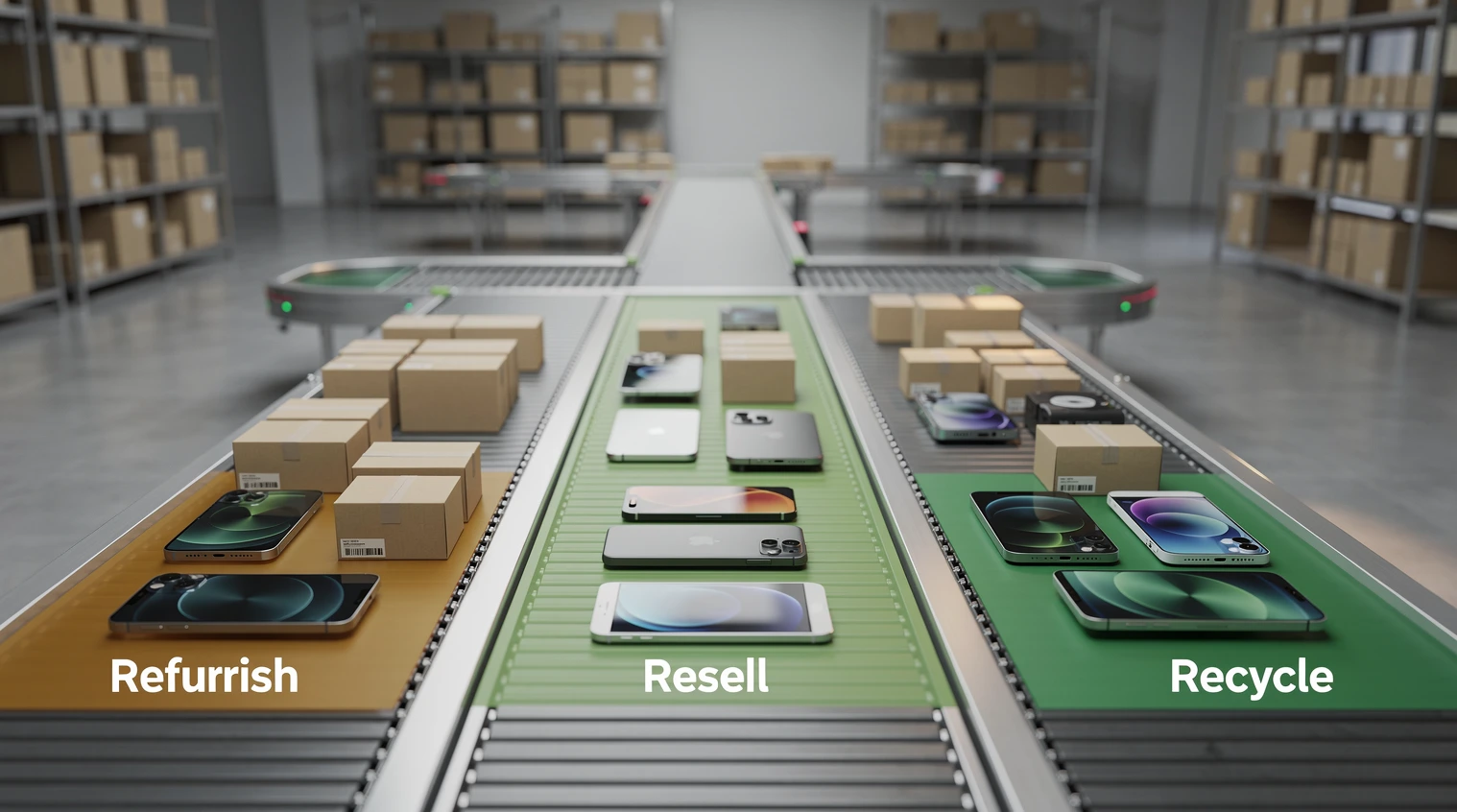
Every returned item lands a retailer with a decision that rarely gets the attention it deserves: what happens to the product now that a customer has sent it back. In 2026, with US return rates hovering near record levels and reverse freight more expensive than ever, that decision is no longer a back-office afterthought. The path a returned unit takes, whether it gets refurbished, resold through a secondary channel, or recycled for materials, often determines whether the return costs the business money or quietly recovers some of it. Getting this triage right is one of the highest-leverage operational improvements available to retail and e-commerce teams this year.
In short
- Refurbish, resell, recycle is the disposition ladder for returned inventory, and the goal is to move each unit to the highest-value path it can realistically support rather than defaulting everything to landfill or liquidation.
- Refurbishment recovers the most value per unit but only pays when labor, parts, and testing cost less than the recovered resale price, which makes it best for higher-ticket and repairable goods.
- Resale through outlet, marketplace, B2B liquidation, or recommerce channels clears volume quickly and is where most returned inventory should end up when it cannot be sold as new again.
- Recycling is the responsible floor, not the target, and a well-run program treats it as the option of last resort for items with no viable resale or refurbishment route.
- The teams that win at returns disposition build a grading and routing system at the point of receipt, measure recovery rate as a core metric, and pick partners deliberately rather than dumping everything with a single liquidator.
Why returned inventory disposition matters in 2026
Returns are structurally large and getting larger. The National Retail Federation has tracked US return rates that, on online orders, regularly run well above the in-store figure, and apparel and consumer electronics sit at the high end. Every one of those units arrives back at a warehouse or store carrying freight cost, handling labor, and a question about its condition. Multiply that across a holiday peak and the disposition decision becomes a material line in the P&L.
The pressure has intensified for three reasons. Reverse freight rates have not softened the way some forward-shipping lanes have, so the cost of moving a returned unit twice keeps climbing. Consumer expectations around free and easy returns remain entrenched, which means volume is not falling. And sustainability reporting now reaches returns, so the destruction or landfilling of perfectly usable goods has become a reputational and, in some jurisdictions, a regulatory liability.
What used to be acceptable, sending returns straight to a liquidator for pennies on the dollar or, worse, to a destruction contract, is now a visible cost center that finance and ESG teams both watch. Retailers that treat reverse logistics as the part of the business nobody wants to look at are leaving recovery on the table. For a broader view of how this fits into the wider reverse flow, our overview of returns and reverse logistics covers the operational backbone that disposition sits on top of.
The opportunity is real. A unit that would have fetched a 10 percent liquidation recovery can often be moved to a 40 to 70 percent recovery path with the right grading and routing. Across thousands of units, that delta funds a returns operation rather than draining it.
There is a competitive dimension too. The same returned-goods volume reaches every retailer in a category, so the ones that extract more value from each unit run a structurally lower cost base than rivals who liquidate by reflex. In thin-margin retail, a few points of recovered value on returns can be the difference between a category that loses money and one that holds its own. Disposition, in other words, is not just an operations question but a margin lever that compounds quietly over a full year of volume.
Refurbish, resell, recycle: the three paths defined
The three words describe a ladder, ordered roughly by the value each path recovers and the effort each demands. Understanding precisely what each one means prevents the common error of treating them as interchangeable or, worse, collapsing them into a single liquidation default.
Refurbish
Refurbishment is the process of restoring a returned or used product to a working, sellable condition, then reselling it, usually under a clearly labeled grade such as “certified refurbished” or “renewed.” It can be light, a clean, repackage, and function test, or deep, involving part replacement, firmware updates, and full cosmetic restoration. The defining feature is that the unit is brought back to a standard a customer will pay close to new-product money for.
Resell
Reselling covers any channel that moves the item to a new owner without full restoration. That includes open-box and outlet sales, third-party marketplaces, B2B liquidation lots, bulk wholesale to jobbers, and increasingly branded recommerce or trade-in programs. The unit may be sold as-is, graded by condition, or lightly processed, but it is not rebuilt to new standard.
Recycle
Recycling means recovering raw materials, metals, plastics, textiles, glass, from products that have no viable resale or refurbishment route. Done responsibly, it diverts goods from landfill and, for electronics, ensures hazardous components are handled correctly. It recovers the least financial value but protects against the cost and reputational damage of destruction or improper disposal.
A fourth option sits quietly alongside these three: do not bring the item back at all. Returnless refunds, where the retailer refunds the customer and lets them keep or locally donate the product, can be cheaper than reverse freight on low-value goods, which is why disposition strategy and returns policy have to be designed together.
How disposition decisions actually get made
The single most important practice is to decide each unit’s path at the point of receipt, not weeks later in a pile of mixed returns. That means grading on arrival, capturing condition data, and routing immediately. Teams that batch everything into a holding area and sort later lose value to time, damage, and obsolescence.
Most mature operations grade incoming returns into a small number of condition tiers and map each tier to a default path. The grade is assigned by a trained associate or, increasingly, by a guided workflow on a handheld device that walks through cosmetic and functional checks. The output is a routing decision the warehouse can act on without escalation.
A working grading-to-path matrix
The table below shows a representative model. The exact thresholds vary by category and margin, but the logic, route to the highest realistic recovery, holds across most retailers.
| Condition grade | Typical state | Default path | Indicative recovery vs. original price |
|---|---|---|---|
| A: as-new | Unopened or unused, sellable packaging | Restock as new | 90–100% |
| B: open-box | Opened, fully functional, minor cosmetic wear | Resell open-box or outlet | 60–85% |
| C: repairable | Functional fault or damage, economically fixable | Refurbish, then resell as renewed | 40–70% |
| D: salvage | Not repairable economically, parts have value | Resell for parts or bulk liquidate | 5–25% |
| E: end-of-life | No resale or repair value, hazardous or broken | Recycle responsibly | 0–5% (cost avoidance) |
Two principles make the matrix work in practice. First, the default is a starting point, not a rule, and associates need authority to bump a unit up a grade when the secondary market is hot or down when a fault is discovered late. Second, the grade must be captured as data so the business can see recovery rates by category and tune the thresholds over time.
This is also where automation increasingly earns its place. AI-assisted visual inspection and pricing engines can grade and price open-box electronics faster and more consistently than manual review, which matters when peak volume floods the dock and labor is the binding constraint.
Refurbish: when it pays and how to run it
Refurbishment recovers the most value per unit, but it is also the most operationally demanding path, and that tension defines where it makes sense. The governing question is simple: does the recovered resale price exceed the fully loaded cost of restoring the unit, including labor, parts, testing, repackaging, and the warranty risk you take on. When the answer is yes by a comfortable margin, refurbish. When it is marginal, resell as-is instead.
Higher-ticket and repairable categories are the natural home for refurbishment. Consumer electronics, power tools, appliances, mobile devices, and branded equipment all carry enough residual value to justify the work. Low-cost commodity goods rarely do, because the labor to test and repackage them eats the entire recovered value.
The economics in one view
A useful discipline is to model the refurbish decision per SKU family rather than per unit. If a returned mid-range headphone recovers $90 as renewed, and the loaded refurbishment cost is $25, the $65 net beats a $20 liquidation recovery handily. Flip the price to a $15 phone case and the same $25 of labor destroys the economics instantly.
Regulation increasingly tilts the math toward refurbishment. The spread of right-to-repair rules is making parts and repair information more available, which lowers the cost and raises the feasibility of in-house or partner-led refurbishment. Our analysis of how right to repair changes the equation for retail brands goes deeper on why this shifts the disposition calculus in 2026.
Practical refurbishment guardrails
- Grade and route to refurbishment only items that pass a quick economic screen, never by default.
- Label refurbished stock honestly with a clear grade, because trust in the renewed tier is the channel’s most fragile asset.
- Offer a short warranty on refurbished goods, since the warranty is often what lets you price near new and protects the brand.
- Track first-pass yield, the share of units that pass refurbishment without rework, as the core efficiency metric.
Resell: where most returned inventory should go
For the bulk of returned inventory that cannot be sold as new again, resale is the workhorse path. The art is matching each grade to the channel that clears it fastest at the best net recovery, because a unit sitting unsold loses value every week through depreciation, storage cost, and obsolescence. Speed of clearance is frequently worth more than squeezing the last few points of price.
The resale landscape has matured into several distinct channels, each with its own economics, and most retailers should use a blend rather than relying on one. The table below compares the main options on the dimensions that matter when you are deciding where to send a graded unit.
| Resale channel | Best for | Typical recovery | Speed to clear | Brand control |
|---|---|---|---|---|
| Owned outlet or open-box store | Grade B open-box, premium brands | High | Medium | High |
| Branded recommerce or trade-in | Apparel, electronics, durable goods | High | Medium | High |
| Third-party marketplace | Single units, broad category demand | Medium to high | Medium | Medium |
| B2B liquidation auction | Mixed lots, bulk volume | Low to medium | Fast | Low |
| Wholesale to jobbers | Overstock, seasonal clear-out | Low | Fast | Low |
The recommerce shift
The most important structural change in resale is the rise of branded recommerce, where the retailer runs its own resale or trade-in program rather than handing inventory to a third party. It captures more margin, keeps the customer relationship, and turns returns into a sustainability story customers respond to. The space is consolidating fast as platforms and retailers acquire capability, a trend we track in our coverage of recommerce consolidation in 2026.
Marketplaces still matter
Third-party marketplaces remain a high-recovery home for single graded units, especially in categories with deep buyer demand. Platform rules and fee structures change often, and those changes directly affect resale economics, so teams reselling at scale need to stay current on the major venues. Sellers leaning on these channels should watch policy shifts closely, because a fee or returns-policy change can quietly reshape the math on every unit.
Recycle and responsible disposal: the floor, not the goal
Recycling is where a unit goes when no resale or refurbishment path makes economic sense, and the mark of a good program is how little inventory ends up here, not how efficiently it processes what does. Treating recycling as the default is the most expensive habit in returns management, because it forfeits all recoverable value. Treating it as a disciplined last resort, by contrast, protects the business from the real costs of careless disposal.
For electronics, responsible recycling is not optional. E-waste contains hazardous materials, and improper disposal carries legal exposure and serious reputational risk. Using a certified electronics recycler, and documenting the chain of custody, is the baseline expectation. The US Environmental Protection Agency’s guidance on electronics donation and recycling is a useful reference point for building a compliant program.
Beyond compliance, recycling and donation feed the sustainability narrative that customers increasingly weigh. Diverting usable goods to charitable donation, and recovering materials from the rest, gives retailers a defensible answer to the question of where their returns end up. That story has commercial value when shoppers choose between brands on values as well as price.
Donation as a middle path
- Donation can be cheaper than reverse freight on low-value goods and generates goodwill plus potential tax benefit.
- It suits items that are usable but not economically resalable, such as last-season apparel or lightly damaged home goods.
- Pair it with returnless refund logic so the customer keeps or locally donates the item, cutting freight entirely.
Common mistakes and how to avoid them
The failure patterns in returns disposition are consistent across retailers, which makes them easy to anticipate. Most stem from treating disposition as a cost to minimize rather than value to recover.
Defaulting everything to liquidation
The most common and most expensive mistake is sending all returns to a single liquidator for a flat low recovery. It feels simple, but it forfeits the 40 to 70 percent recovery that grading and routing would capture. The fix is to grade on receipt and route by condition, even a basic three-tier system beats a single dump.
Deciding too late
Value evaporates while returned units sit ungraded. A phone that was Grade B in week one becomes Grade D after a month of obsolescence and a new model launch. Decide and route at receipt, and treat aged returns inventory as the operational red flag it is.
Ignoring the data
Retailers that do not measure recovery rate by category cannot improve it. Without that data, thresholds stay static, partners go unaudited, and the same low-value SKUs keep getting refurbished at a loss. Recovery rate and disposition mix belong on the operations dashboard next to forward-fulfillment metrics.
Forgetting that prevention beats disposition
The cheapest return to dispose of is the one that never happens. Disposition strategy should feed back into merchandising, sizing guidance, and product detail accuracy, because reducing the return rate at the source lowers the whole disposition burden. Teams focused only on the back end miss this loop, a theme that runs through serious work on cutting the cost of retail returns in 2026.
Building a disposition playbook: tools, partners, and vendors
Turning these principles into a repeatable operation requires a small stack of capabilities and a deliberate choice of partners. The point is not to buy the most software but to close the loop from grading at receipt through routing, channel sale, and measurement.
The capability stack
- Returns management and grading software to capture condition data and route units automatically at receipt.
- Pricing and listing automation to set secondary-market prices and push graded units to the right channel without manual relisting.
- Refurbishment workflow and testing tools for the categories where in-house or partner refurbishment pays.
- Certified recyclers and donation partners with documented chain of custody for the end-of-life tier.
- Analytics that report recovery rate, disposition mix, and aging by category so thresholds can be tuned.
Choosing partners deliberately
The vendor landscape spans returns-platform providers, recommerce-as-a-service operators, B2B liquidation marketplaces, refurbishment specialists, and certified recyclers. No single vendor does all of it well, so most retailers assemble a short roster. When you evaluate a reverse-logistics or disposition partner, weigh net recovery, speed to clear, data transparency, sustainability credentials, and how much brand control you keep.
Liquidation and B2B resale partners deserve particular scrutiny, because the gap between the best and worst on net recovery is wide and easy to overlook when only the headline rate is quoted. Audit the all-in number, including fees and freight, not the gross. The same discipline applies to refurbishment partners, where first-pass yield and warranty terms matter as much as the per-unit price.
Finally, design the playbook to evolve. Return rates, secondary-market demand, freight costs, and regulation all move, and a disposition strategy that was optimal last year can quietly drift out of tune. Review the grading thresholds, channel mix, and partner roster on a regular cadence, and treat the recovery rate as a number you are always trying to lift.
Frequently asked questions
What does refurbish, resell, recycle mean for returned inventory?
It is the disposition ladder for products customers send back. Refurbish means restoring an item to sellable condition and reselling it as renewed. Resell means moving it to a new owner through outlet, marketplace, recommerce, or liquidation without full restoration. Recycle means recovering raw materials when no resale or repair route exists. The aim is to route each unit to the highest-value path it can realistically support.
How do retailers decide which path a returned item should take?
The best practice is to grade each unit at the point of receipt into condition tiers, then map each tier to a default path. As-new items restock, open-box items resell, repairable items refurbish if the economics work, salvage items go to parts or liquidation, and end-of-life items recycle. The grade is captured as data so recovery rates can be measured and thresholds tuned over time.
When is refurbishment worth the cost?
Refurbishment pays when the recovered resale price comfortably exceeds the fully loaded cost of restoring the unit, including labor, parts, testing, repackaging, and warranty risk. That usually means higher-ticket, repairable categories such as electronics, appliances, and power tools. For low-cost commodity goods, the labor to test and repackage typically destroys the economics, so reselling as-is or liquidating is better.
What is recommerce and why does it matter for returns?
Recommerce is the resale of used, returned, or refurbished goods, often run by the retailer itself as a branded resale or trade-in program rather than handed to a third party. It matters because it captures more margin, keeps the customer relationship, and turns returns into a sustainability advantage. The space is consolidating quickly as platforms and retailers build or acquire the capability.
Is recycling returned inventory the same as throwing it away?
No. Responsible recycling recovers raw materials and, for electronics, ensures hazardous components are handled correctly, which is very different from sending goods to landfill or a destruction contract. It recovers the least financial value but protects against the legal, environmental, and reputational costs of improper disposal. A good program treats recycling as the last resort, used only when no resale or refurbishment route exists.
What recovery rate should a returns disposition program aim for?
There is no single benchmark because it varies sharply by category, but the gap between a poor and a good program is large. Sending everything to a single liquidator might recover around 10 percent of original value, while grading and routing often lifts blended recovery to 40 percent or more on resalable goods. The right target is set per category, and the discipline is to measure recovery rate continuously and keep raising it.
How does returns policy affect disposition strategy?
The two have to be designed together. Generous free-returns policies drive volume that the disposition operation has to absorb, while tools such as returnless refunds, where the customer keeps or locally donates a low-value item, can be cheaper than reverse freight and remove the unit from the disposition pipeline entirely. Policy decisions upstream directly shape the cost and mix of disposition downstream.
What tools and partners do retailers need to run disposition well?
A practical stack includes returns-grading software to route units at receipt, pricing and listing automation for secondary channels, refurbishment workflow tools where they pay, and certified recyclers plus donation partners for the end-of-life tier, all tied together by analytics that report recovery rate and disposition mix. Most retailers assemble a short roster of specialist partners rather than relying on one vendor, and audit each on all-in net recovery, not headline rates.
How can retailers reduce the volume of returns they have to dispose of?
The cheapest return to handle is the one that never happens, so disposition data should feed back into merchandising, sizing guidance, and product-page accuracy to cut the return rate at the source. Better detail pages, fit tools, and review transparency reduce mismatch-driven returns, which lowers the entire downstream disposition burden. Prevention and disposition are two halves of the same returns strategy.
The bottom line
Returned inventory is not waste by default, it is value waiting to be sorted. The retailers pulling ahead in 2026 are the ones that grade at receipt, route each unit up the refurbish-resell-recycle ladder to the highest realistic recovery, and measure the result as rigorously as they measure forward fulfillment. The economics reward the discipline, and the sustainability story rewards it again. Treat disposition as a strategy rather than a chore, and the returns dock stops being a drain and starts paying its way.