
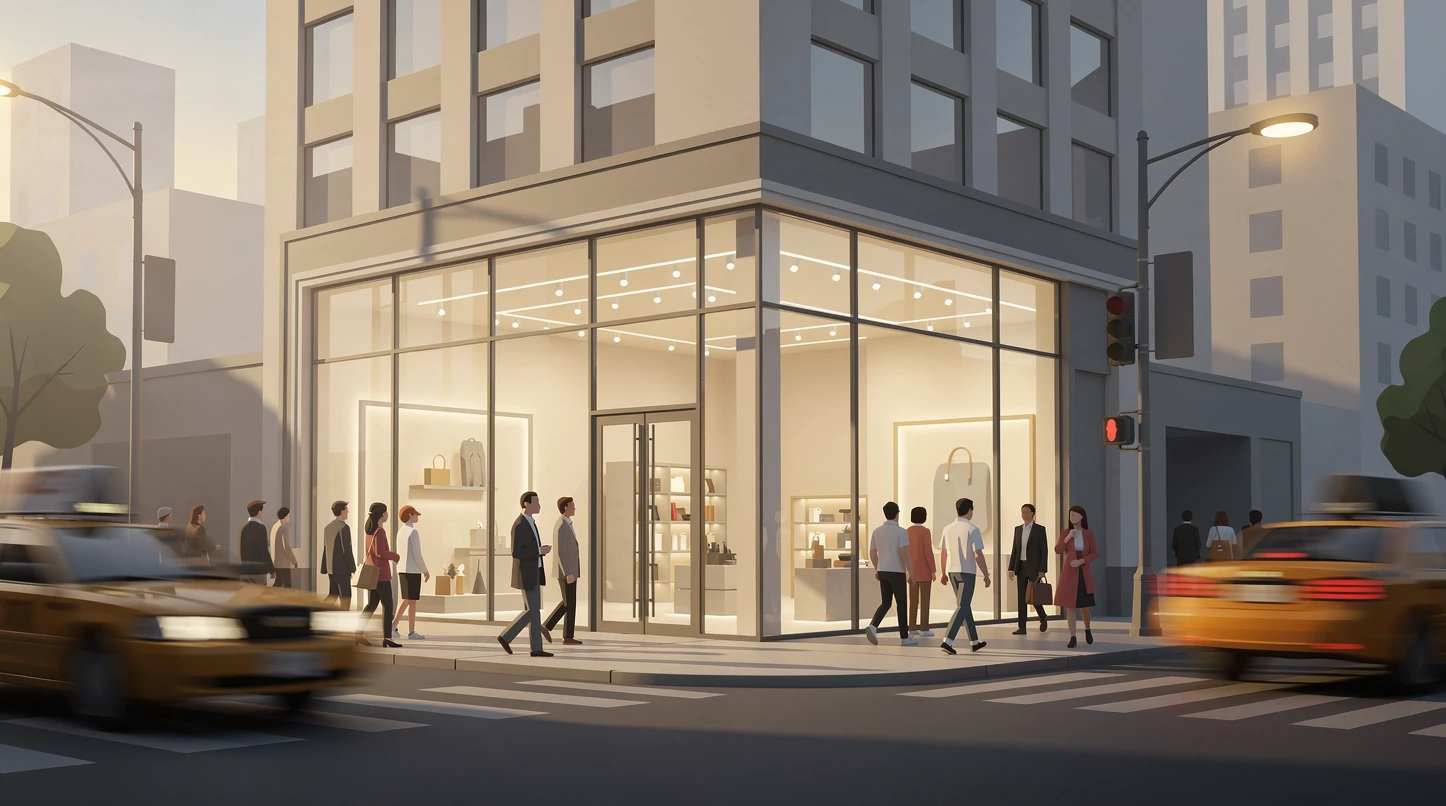
Choosing a pop-up location in a major US city is the single decision that most often decides whether a temporary store returns a profit or quietly drains a marketing budget. The product, the buildout and the creative all matter, but a pop-up lives or dies on the corner it sits on. Get the block, the neighborhood and the timing right, and foot traffic does half the selling for you. Get them wrong, and no amount of clever merchandising rescues a space that the right customers simply never walk past. This guide breaks down how retail and e-commerce teams should choose a pop-up location in a US city, what the trade-offs really are, and how to run the process without guessing.
In short
- Location is the highest-leverage pop-up decision, because a temporary store cannot build organic discovery over time the way a permanent location can, so it has to borrow the foot traffic of the block it rents.
- Match the neighborhood to the goal: brand awareness plays want dense, high-visibility corridors, while sales-per-square-foot plays want proximity to an existing high-intent customer base.
- Cost is more than rent: daily license fees, security deposits, insurance, permits, staffing and buildout can double the headline rate, so model total landed cost before signing anything.
- The best US pop-up districts are well known and priced accordingly, from SoHo in New York to Abbot Kinney in Los Angeles, so second-tier adjacent streets often deliver better return on ad spend.
- Data beats instinct: mobile foot-traffic analytics, local demographic data and your own customer ZIP code map should drive the shortlist, with a site visit as the final gut check before commitment.
Why choosing a pop-up location in a US city matters in 2026
Pop-up retail has moved from novelty to core channel for both digital-native brands and established retailers. What began as a way to clear inventory or test a holiday season has become a permanent fixture of how brands acquire customers, generate content and validate new markets. The reason is structural: paid digital acquisition has gotten more expensive and less predictable, and a physical space offers something a feed cannot, which is a real-world moment that customers photograph and share. That shift is part of the broader story we cover in our overview of pop-up retail as a brand growth lever.
In that context, location is not a logistics footnote. It is the media buy. A pop-up on the right corner in a major US city is effectively renting an audience, and the price of that audience is the lease. Choosing well means understanding exactly whose attention you are buying, how much of it converts, and whether the block delivers the specific customer your economics require. The rest of this guide treats the location decision with the same rigor a marketing team would apply to a channel test.
Physical retail itself is in flux, and pop-ups sit inside that larger shift we map in our overview of the state of retail, where department stores, grocers and experiential formats are all rewriting the rules of the store. A well-placed pop-up is one of the sharpest tools a brand has to test a physical presence without a long lease.
The stakes are higher in 2026 because commercial real estate in prime US retail districts has bifurcated. Trophy corridors command premium short-term rates, while adjacent streets and secondary cities have softened, creating a wider spread of options than existed five years ago. That spread rewards teams that shop carefully and punishes teams that default to the obvious address because a competitor was there last season.
Key terms and definitions
Before comparing options, it helps to standardize the vocabulary, because pop-up leasing has its own language that differs from traditional retail leasing. Getting these terms straight prevents expensive misunderstandings when a broker or landlord quotes a deal.
- Short-term license: The most common pop-up agreement, granting the right to occupy a space for days, weeks or a few months without the tenant protections of a full commercial lease. It is faster to sign and easier to exit.
- Turnkey space: A location delivered ready to trade, with lighting, flooring, HVAC and often fixtures in place, so the tenant avoids a costly buildout. It carries a higher rate but a much lower total cost for a short run.
- Percentage rent or revenue share: An arrangement where the landlord takes a cut of sales instead of, or on top of, a base rate. Common in malls and managed pop-up platforms, it aligns landlord and tenant incentives.
- Foot traffic: The count of people passing a location, usually measured by mobile-device analytics. Raw counts matter less than the fit between who is passing and who you want to reach.
- Trade area: The geographic zone from which a location realistically draws customers, defined by walking distance, transit and natural neighborhood boundaries rather than a simple radius.
Awareness pop-up versus conversion pop-up
A crucial early distinction is whether the pop-up exists mainly to build brand awareness or mainly to convert sales. An awareness pop-up prioritizes visibility, spectacle and shareability, so it wants a busy, photogenic corridor even at a premium rate. A conversion pop-up prioritizes qualified traffic and basket size, so it wants proximity to an audience that already knows or is likely to buy the brand.
These two goals pull toward different addresses, and confusing them is the most common strategic error. A luxury skincare brand chasing content and reach belongs on a design-forward shopping street, while the same brand chasing trial and repeat purchase might do better near a cluster of complementary stores where its target customer already shops. Deciding the primary goal first narrows the map dramatically.
How choosing a pop-up location works in practice
The practical process moves from broad to narrow: pick the city, then the district, then the specific block and unit. Skipping straight to available listings is tempting, but it inverts the logic and lets whatever happens to be vacant drive a decision that should be driven by strategy. The disciplined sequence keeps the goal in charge.
Step one: define the customer and the goal
Start with a precise description of who the pop-up needs to reach and what it needs to achieve. If your e-commerce data already exists, map your customer base by ZIP code and identify where your best buyers cluster. A brand with strong online sales in a specific metro has a built-in argument for a physical location that intercepts those customers, an approach we explore in detail in our piece on how D2C brands use pop-ups to test new cities.
Set a single primary metric before looking at any space. It might be qualified email signups, sales per day, content assets produced, or press mentions. That metric determines which location attributes matter most, and it gives the whole team a shared definition of success that survives the excitement of a great-looking storefront.
Step two: shortlist districts with data
With the goal fixed, build a shortlist of neighborhoods using hard data rather than reputation. Mobile foot-traffic platforms show not just how many people pass a corridor but who they are by rough demographic and where they came from. Local demographic and spending data from public sources such as the US Census Bureau adds household income, age and density context that sharpens the fit assessment.
Cross-reference this against your own customer map and against where comparable brands have run successful activations. The aim is a shortlist of three to five districts, each with a clear rationale tied to the goal, not a long list of famous streets. A tight, well-argued shortlist is far more useful than a broad survey of everywhere that sounds prestigious.
Step three: evaluate specific blocks and units
Districts are not uniform, and a single block can make or break a pop-up. Within a strong neighborhood, the sunny side of the street, the corner unit, proximity to a transit exit and the anchor tenants nearby all move the outcome. A unit next to a beloved coffee shop or a flagship draw inherits spillover traffic, while a unit past the natural end of the shopping stretch sits in dead air.
This is where a physical site visit becomes non-negotiable. Stand on the block at the days and hours you plan to trade, count the traffic, watch where people slow down, and note the sightlines from both directions. A space that photographs beautifully on a listing can feel dead at 2 p.m. on a Tuesday, and only being there reveals it.
Which US cities and neighborhoods fit which goals
There is no single best US city for a pop-up, only the best fit for a given goal, budget and category. The table below summarizes how several well-known pop-up districts tend to perform, though rates and dynamics shift with season and cycle. Treat it as a starting frame, not a substitute for current market data.
| District (city) | Best-fit goal | Strong categories | Relative cost | Watch-out |
|---|---|---|---|---|
| SoHo (New York) | Awareness, press, content | Fashion, beauty, tech, luxury | Very high | Premium rates, saturated with activations |
| Abbot Kinney (Los Angeles) | Brand and lifestyle | Wellness, apparel, D2C | High | Weekday traffic softer than weekend |
| Wicker Park (Chicago) | Balanced awareness and sales | Apparel, home, food and drink | Moderate | Seasonal weather swings |
| Hayes Valley (San Francisco) | Conversion, affluent buyers | Design, tech, premium goods | High | Compact trade area |
| South Congress (Austin) | Discovery and content | Apparel, wellness, food | Moderate | Event-driven traffic spikes |
| Wynwood (Miami) | Content and experiential | Beauty, fashion, art-led brands | Moderate to high | Traffic concentrated around events |
The pattern across these districts is that the most photogenic and famous corridors carry the highest rates and the most competition for attention, while balanced markets like Chicago and Austin can deliver stronger economics for brands that care more about qualified sales than about press. The right choice follows the goal set in step one, not the prestige of the address.
The case for second-tier and adjacent streets
One consistently underrated move is to choose the street next to the famous one. The block just off a marquee corridor often carries a fraction of the rate while capturing much of the same passing audience, especially in walkable districts where shoppers wander. For conversion-focused pop-ups, this arbitrage can transform the return on the location spend.
Secondary cities deserve the same consideration. A pop-up in a strong neighborhood of Nashville, Denver or Portland can reach an engaged, less advertised-to audience at a lower cost, and it can generate the same social content as a coastal flagship district. Brands testing new markets frequently find that a secondary city delivers cleaner learning because the audience is less jaded about pop-ups.
Common mistakes and how to avoid them
Most pop-up location failures trace back to a short list of avoidable errors. Knowing them in advance is the cheapest insurance a team can buy, because each one is easy to spot once named and expensive to discover after the lease is signed.
The first mistake is chasing prestige over fit. A brand rents the famous street because it sounds impressive, then discovers the passing crowd does not match its customer and the premium rate never earns out. The fix is to let the goal and the customer map choose the district, and to treat prestige as a tiebreaker rather than a driver.
The second mistake is underestimating total cost. The headline rate is often less than half the real number once permits, insurance, a certificate of occupancy, security deposit, staffing, buildout and utilities are added. Teams that model only the rent get blindsided, so build a full landed-cost estimate before committing, using the kind of framework laid out in our breakdown of costs and revenue benchmarks for a 30-day pop-up.
The third mistake is ignoring permits and compliance until late. US cities differ sharply in what a temporary retail use requires, from business licenses to signage and occupancy approvals, and rules can vary by neighborhood. This regulatory layer connects to the broader picture of how retail policy in the United States is set and challenged, and it should be checked before a lease is signed, not after.
Timing and seasonality errors
The fourth common error is bad timing. The same location performs very differently in December than in February, and a corridor that thrives during a local festival can feel empty the rest of the season. Aligning the run with the natural rhythm of the neighborhood, and with your own demand peaks, often matters as much as the address itself.
A related error is signing too long or too short. A run that ends before word of mouth builds wastes the ramp, while a run that overstays its welcome bleeds cash after the novelty fades. Matching the duration to the goal, and negotiating an option to extend rather than committing upfront, preserves flexibility that a temporary format is supposed to provide.
Examples from US retail and e-commerce
The strongest way to understand location strategy is to look at how it plays out in real activations. Digital-native beauty and wellness brands have repeatedly used SoHo and Abbot Kinney as content factories, choosing spaces less for direct sales than for the volume of shareable moments they generate. Those brands accept a high rate because they measure the location in earned media and email capture, not in sales per square foot.
At the other end, apparel and home brands chasing conversion have leaned toward balanced markets and adjacent streets, placing pop-ups near complementary retailers where their target customer already shops. These activations often trade in more modest neighborhoods but post stronger sales economics, precisely because the location was chosen for buying intent rather than for reach. The design of the space itself carries the experience, a theme we cover in experiential retail that people actually post about.
Food, beverage and CPG brands show a third pattern, favoring event-driven districts and festival timing where trial volume is the goal. Sampling thousands of units in a weekend in Austin or Miami during a major event can seed a market faster than months of paid ads. The location choice there is inseparable from the calendar, because the audience is the event as much as the neighborhood.
The common thread is that each brand chose its location to serve a clearly defined goal, and measured the result against that goal rather than against a generic idea of pop-up success. When the goal is explicit, the location decision becomes a matter of matching attributes to objectives rather than guessing.
Tools, partners and vendors worth knowing
A team choosing a pop-up location does not have to work alone. A maturing ecosystem of platforms, brokers and data providers has grown up around temporary retail, and using them well shortens the search and reduces risk.
Pop-up leasing marketplaces aggregate short-term spaces across major US cities, letting teams filter by neighborhood, dates, square footage and price. They handle licensing paperwork and often bundle insurance, which removes much of the friction that made short-term retail hard a decade ago. For a first pop-up in an unfamiliar city, they are usually the fastest starting point.
Specialist retail brokers add value when the budget is larger or the requirements are specific, because they know off-market spaces and can negotiate terms a marketplace listing will not. Foot-traffic analytics vendors, meanwhile, turn the location question into a measurable one, providing pass-by counts, dwell times and visitor profiles for specific blocks. Public data from sources such as the Census Bureau complements these paid tools with demographic and economic context.
How the tools fit together
The most effective approach layers these resources rather than relying on any one. Analytics and public data build the district shortlist, a marketplace or broker surfaces the specific available units, and a site visit confirms the final choice. Each tool answers a different question, and skipping one leaves a gap that instinct then has to fill, usually less reliably.
The table below maps the main resource types to the decision stage where each earns its keep, so a team can assemble the right stack for its budget and timeline.
| Resource type | Best used for | Decision stage | Typical cost |
|---|---|---|---|
| Foot-traffic analytics | Sizing and profiling passing audience | District shortlist | Subscription or per-report |
| Public demographic data | Income, density and household context | District shortlist | Free |
| Pop-up marketplaces | Finding and booking short-term units | Unit selection | Rate plus platform fee |
| Retail brokers | Off-market space and negotiation | Unit selection | Commission-based |
| On-site visit | Final validation of block and unit | Commitment | Time only |
A six-week pop-up location playbook
Pulling the pieces together, a disciplined team can move from goal to signed space in roughly six weeks without rushing or drifting. The schedule below is a template to adapt rather than a rigid rule, but the sequence keeps strategy ahead of availability at every step.
- Weeks one to two: Define the customer, set the single primary metric, and map existing e-commerce demand by ZIP code to identify candidate metros.
- Week three: Build a shortlist of three to five districts using foot-traffic analytics and public demographic data, each with a written rationale tied to the goal.
- Week four: Surface available units through a marketplace or broker, and model full landed cost for the top options rather than headline rent alone.
- Week five: Visit the finalist blocks in person at real trading hours, confirm permits and compliance requirements, and pressure-test sightlines and traffic.
- Week six: Negotiate terms, prioritize an extension option over a long commitment, and sign the short-term license for the space that best matches the goal.
Following the sequence matters more than hitting the exact weeks. The point is that the customer and goal are locked before any space is viewed, so the location serves the strategy instead of quietly rewriting it. Teams that run this way rarely regret the address they choose, because the address was chosen for a reason they can defend.
Once a pop-up performs, the natural next question is whether to make it permanent, which is a different calculation with its own math. We walk through that decision in our guide to turning a pop-up into a permanent store, and it belongs in the plan from the start rather than as an afterthought. Location strategy for temporary retail is one thread in the wider fabric of physical retail we track in our overview of the state of retail.
Frequently asked questions
How much does a pop-up location in a major US city cost?
Costs vary enormously by city, district and duration, but the headline rate is only part of the picture. Prime corridors in New York or Los Angeles command premium short-term rates, while adjacent streets and secondary cities cost far less. Always model total landed cost, including permits, insurance, deposit, staffing, buildout and utilities, which together often equal or exceed the base rate for a short run.
What is the single most important factor in choosing a pop-up location?
Fit between the passing audience and your target customer, judged against your primary goal. A famous street with the wrong crowd will underperform a modest block with the right one. Define who you need to reach and what success means before evaluating any space, and let that definition drive the district and unit choice.
Should I choose a location for brand awareness or for sales?
Decide which goal is primary before you start, because the two pull toward different addresses. Awareness pop-ups want busy, photogenic, high-visibility corridors even at a premium. Conversion pop-ups want proximity to a qualified, high-intent audience, often on quieter or adjacent streets where the economics work harder.
How far in advance should I book a pop-up space?
Plan for roughly six weeks from defining the goal to signing, though prime spaces in peak seasons book earlier and can require more lead time. Marketplaces can move faster for standard units, while off-market or trophy spaces through a broker take longer to negotiate. Booking too late narrows your options to whatever happens to be vacant.
Do I need permits for a pop-up store in a US city?
Usually yes, and requirements differ sharply by city and sometimes by neighborhood. Common needs include a business license, a temporary certificate of occupancy, and signage or sidewalk approvals. Check the specific local rules before signing a lease, since compliance can affect both cost and timeline and is difficult to fix retroactively.
Is a second-tier street better than a famous shopping district?
Often, for conversion-focused pop-ups. The block just off a marquee corridor frequently carries a fraction of the rate while capturing much of the same wandering audience. For awareness plays that need the prestige and press of the famous street, the premium can be worth it, but for sales economics the adjacent street usually wins.
How long should a pop-up run?
Long enough for word of mouth to build but not so long that novelty fades and costs outrun sales. Many effective runs last a few weeks to a few months, matched to the goal and the neighborhood’s rhythm. Negotiating an option to extend, rather than committing to a long term upfront, preserves the flexibility a temporary format is meant to offer.
What data should I use to pick a neighborhood?
Layer three sources: your own e-commerce customer map by ZIP code, mobile foot-traffic analytics for pass-by counts and visitor profiles, and public demographic data for income and density context. Cross-referencing all three produces a shortlist grounded in evidence rather than reputation, and a final on-site visit confirms what the numbers cannot show.