
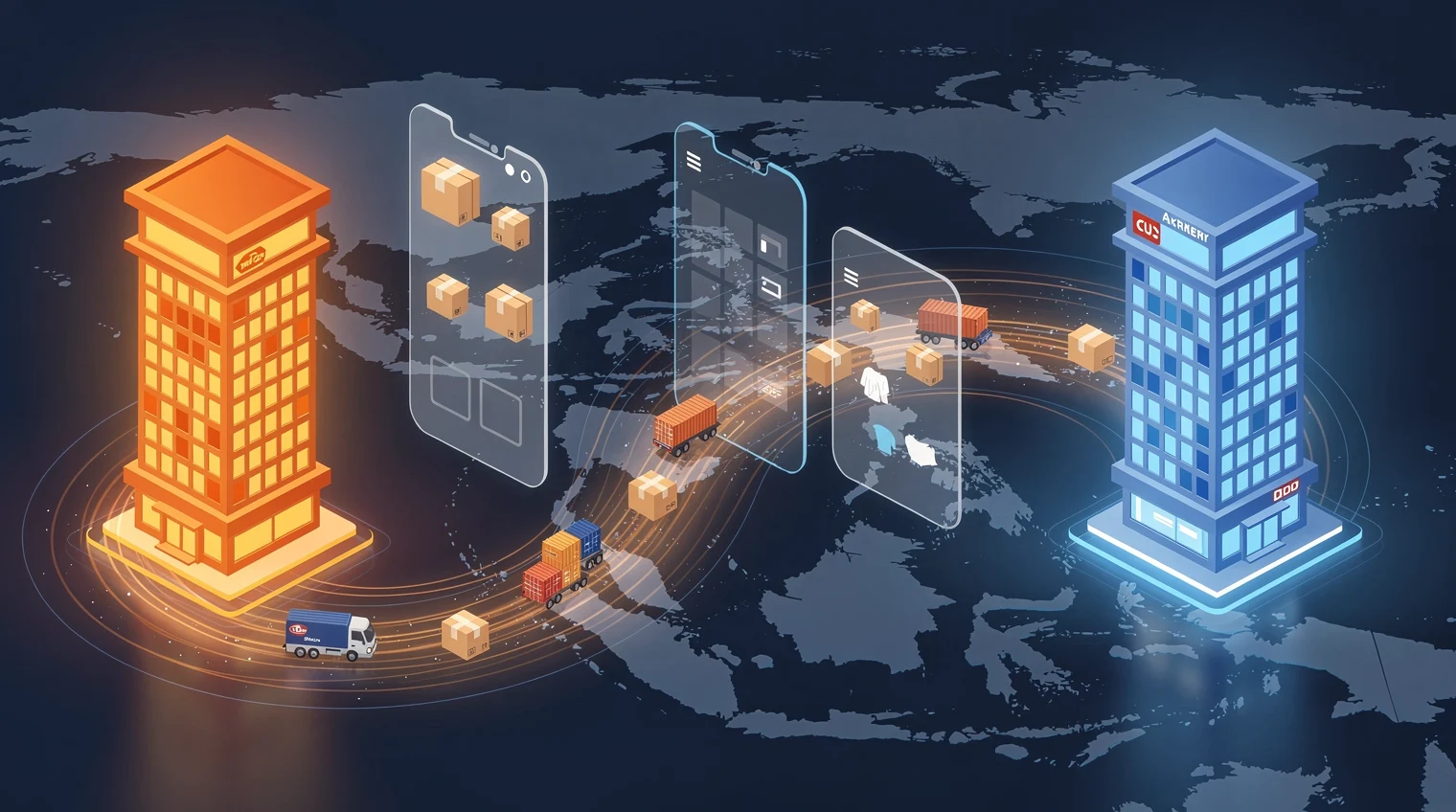
Shopee and Lazada are the two gateways into Southeast Asia’s $200 billion online retail market, and for a cross-border seller the choice between them decides your margins, your logistics headaches and your growth ceiling. The two platforms look similar from the outside: mobile-first apps, aggressive discounting, and a shared footprint across Singapore, Malaysia, Thailand, Indonesia, the Philippines and Vietnam. Underneath, they run on different owners, different buyer psychology and very different cross-border programs. Picking the wrong one wastes six months you will not get back.
This guide breaks down how a US or European brand should evaluate Shopee versus Lazada for cross-border selling in 2026. It covers the onboarding programs, the fee math, the logistics reality, the mistakes that quietly kill new stores, and the tooling that makes a regional launch survivable. Where useful, it points back to the wider playbook in our complete guide to selling on global e-commerce marketplaces.
In short
- Shopee owns the mass-market, discount-driven, mobile-social end of Southeast Asia and usually delivers higher raw order volume for low-to-mid price points.
- Lazada, backed by Alibaba, skews slightly more premium and brand-friendly, with LazMall and a logistics network that many sellers find more predictable.
- Cross-border programs differ: Shopee runs SIP (Shopee International Platform) to auto-list and localize your catalog, while Lazada’s LazGlobal leans on its own fulfillment and Alibaba infrastructure.
- The real cost is not the headline commission (both sit in the 1 to 6 percent range by category) but payment fees, currency conversion, returns and advertising to stay visible.
- Most serious sellers list on both eventually, but starting on one, proving the unit economics, then expanding is far safer than splitting a thin budget across two at once.
Why the Shopee versus Lazada choice matters in 2026
Southeast Asia is the growth story that Western e-commerce keeps circling back to. The region has a young, mobile-native population of more than 675 million people, and online retail penetration is still climbing off a lower base than the US or China. That combination is why brands from Los Angeles to Berlin keep asking which marketplace to enter first.
Shopee and Lazada together account for the large majority of marketplace gross merchandise value across the six core Southeast Asian economies. TikTok Shop has since become a serious third force, but for a classic catalog-and-fulfillment cross-border seller, the Shopee and Lazada duopoly is still where the operational template lives. The decision matters because switching later is expensive: you rebuild listings, reset review histories, and retrain a local team.
In 2026 the stakes are higher than they were even two years ago. Both platforms have pushed toward profitability rather than growth-at-all-costs, which means thinner subsidies, higher advertising costs and stricter seller performance rules. A cross-border seller can no longer rely on platform-funded free shipping to hide a weak margin. You have to pick the marketplace whose economics fit your product, not the one with the flashiest launch promo.
For a broader view of how to weigh any regional platform before committing, our breakdown of Southeast Asia marketplaces compared for Western brands is a useful companion to this head-to-head.
Key terms and definitions
Before comparing the two, it helps to fix the vocabulary. Cross-border marketplace selling has its own jargon, and the same word can mean different things on each platform.
Cross-border versus local seller
A cross-border seller ships from outside the destination country, for example from a US or Chinese warehouse into Indonesia. A local seller holds inventory inside the market. Cross-border is faster to launch but slower to deliver and often carries import friction that shapes the entire buyer experience.
SIP and LazGlobal
Shopee International Platform (SIP) is Shopee’s program that clones a seller’s home-market listings into other Southeast Asian storefronts, handling translation, currency and cross-border logistics. LazGlobal is Lazada’s equivalent cross-border channel, tying into Alibaba’s fulfillment and its own last-mile network.
LazMall and Shopee Mall
Both platforms run a premium, brand-verified tier. LazMall and Shopee Mall give buyers authenticity guarantees, better return terms and a trust badge. For brand owners, these tiers matter more than they look, because Southeast Asian shoppers are wary of counterfeits.
GMV, take rate and net margin
Gross merchandise value is the total sales value passing through your store. Take rate is the share the platform keeps across commission, payment and service fees. Net margin is what survives after take rate, logistics, returns, advertising and currency conversion. New sellers obsess over GMV and ignore net margin, which is exactly backwards.
How Shopee and Lazada actually work for cross-border sellers
On paper the two platforms follow the same loop: you register as a seller, pass verification, list products, price them, and start receiving orders that you fulfill through the platform’s logistics. The differences live in the details of each step.
Onboarding and verification
Shopee tends to prioritize speed and volume, so onboarding for its cross-border program can be quicker, especially if you already sell at scale in a source market. Lazada, with Alibaba’s compliance culture, often asks for more documentation up front but rewards you with a cleaner path into LazMall. Neither process is instant, and both can stall on tax identification and business registration paperwork.
Catalog localization
This is where SIP shines. Shopee will replicate and translate your listings across markets, which saves enormous manual effort if you have hundreds of SKUs. Lazada’s approach is more hands-on, giving you tighter control over how each listing reads in each country but demanding more of your time. High-volume, low-differentiation catalogs favor Shopee’s automation; considered, brand-led catalogs often prefer Lazada’s control.
Pricing and currency
Both platforms display prices in local currency and settle to you after conversion. The exchange spread and payout timing quietly eat margin, and they differ by market and by the payment provider you connect. Setting prices intelligently across currencies is a discipline in itself, and our guide to multi-currency pricing and how to set retail prices abroad covers the mechanics that apply to both marketplaces.
Fulfillment and last mile
Shopee runs Shopee Xpress and a web of third-party couriers; Lazada operates Lazada Logistics, one of the more vertically integrated networks in the region thanks to years of Alibaba investment. Cross-border parcels move through consolidation hubs, clear customs, then enter local delivery. Predictability of that middle leg is where many sellers say Lazada has an edge, though it varies sharply by country.
Fees, commissions and the real cost of selling
The headline commission is the least interesting number. Both Shopee and Lazada charge category-based commissions that typically fall in a low single-digit to mid single-digit percentage range, plus a payment fee, plus optional service and campaign fees. The table below sketches the structure rather than exact rates, because rates change by country, category and program tier.
| Cost component | Shopee (typical) | Lazada (typical) | What actually drives it |
|---|---|---|---|
| Category commission | ~1 to 6% | ~1 to 6% | Product category and Mall status |
| Payment fee | ~2 to 3% | ~2 to 3% | Buyer payment method and country |
| Service or campaign fees | Optional, per program | Optional, per program | Free-shipping and voucher programs you opt into |
| Advertising | Rising, auction-based | Rising, auction-based | Category competition and keyword demand |
| Currency and payout | Spread plus timing | Spread plus timing | FX conversion and settlement cycle |
| Returns and disputes | Seller-funded in many cases | Seller-funded in many cases | Return rate and category |
Notice that the two headline commission columns are close to identical. That is the point. If you choose a platform based on a one-point commission difference, you are optimizing the wrong variable. The variables that separate a profitable store from a bleeding one are advertising efficiency, return rate and fulfillment cost, and those depend far more on your product and execution than on the platform’s rate card.
Advertising deserves special attention. As both marketplaces have chased profitability, organic reach has shrunk and paid placement has become close to mandatory in competitive categories. Budget for a meaningful advertising spend from day one, and treat any month where you rank purely on organic as a lucky exception rather than the plan.
Head-to-head: where each marketplace wins
No single platform is better for every seller. The right answer depends on your price point, your brand positioning and your appetite for hands-on catalog work. The comparison below maps the practical trade-offs.
| Dimension | Shopee | Lazada |
|---|---|---|
| Owner | Sea Limited | Alibaba Group |
| Buyer profile | Mass market, deal-driven, younger, social | Slightly more premium and brand-conscious |
| Best for | High volume, low-to-mid price points, fast fashion, accessories, gadgets | Branded goods, electronics, beauty, considered purchases |
| Cross-border program | SIP, strong catalog automation | LazGlobal, Alibaba-backed fulfillment |
| Premium tier | Shopee Mall | LazMall (strong brand trust) |
| Logistics reputation | Broad courier network, variable by country | More vertically integrated, often more predictable |
| Marketing engine | Gamified, social, campaign-heavy (9.9, 11.11, 12.12) | Campaign-heavy plus Alibaba media reach |
| Learning curve | Lower to launch, automation-led | Higher setup, more control per market |
If your catalog is broad, price-competitive and built for impulse buying, Shopee’s volume and automation usually win the first round. If your product leans premium, if brand trust and anti-counterfeit signaling matter, or if you sell electronics and beauty where LazMall carries weight, Lazada is often the stronger opening move.
Crucially, these are tendencies, not laws. There are premium brands thriving on Shopee Mall and value sellers doing well on Lazada. Treat the table as a hypothesis to test with a small launch, not a verdict.
Country by country, the picture shifts
Southeast Asia is not one market, and the Shopee versus Lazada balance flips depending on where you look. Indonesia, the region’s largest economy, is a fierce Shopee stronghold but also where TikTok Shop’s tie-up with a local player reshaped the field. Thailand and Vietnam lean heavily toward Shopee on raw traffic. The Philippines is competitive. Singapore and Malaysia are more balanced, with Lazada historically strong in the more affluent, brand-driven segments.
The practical implication is that you should not choose a platform in the abstract. Choose it per priority market. A seller whose first target is Indonesia will weigh Shopee more heavily than one aiming at Singapore’s premium electronics buyers. Sequence your launch country by country rather than flooding all six at once, and let early data tell you where to double down. Our note on Southeast Asia marketplaces compared for Western brands goes deeper on the per-country nuances.
Common mistakes and how to avoid them
Most cross-border failures on Shopee and Lazada are self-inflicted and predictable. Here are the ones that recur, and how experienced sellers sidestep them.
Treating cross-border like domestic
Sellers assume that what works at home will translate. It rarely does. Buyer expectations on delivery time, packaging, price psychology and customer service differ sharply. Build a local playbook for each market instead of exporting your home strategy unchanged.
Underestimating logistics and delivery time
Cross-border parcels take longer, and Southeast Asian buyers increasingly expect fast delivery. A ten-day shipping window against local sellers offering next-day is a conversion killer. If a market proves promising, plan to move inventory closer through local stock or a fulfillment partner. The logistics discipline is the same one that separates winners in any regional expansion.
Ignoring the advertising reality
Launching with zero ad budget and hoping for organic sales is the most common way to conclude, wrongly, that a platform does not work. Both marketplaces now require paid visibility in competitive categories. Fund it or pick a niche with genuinely low competition.
Skipping the premium tier when it fits
Brand owners who list only in the standard tier leave trust on the table. In a region wary of fakes, the LazMall or Shopee Mall badge measurably lifts conversion for genuine brands. If you qualify, the fee premium usually pays for itself.
Neglecting reviews and seller metrics
Both platforms weight seller performance heavily in ranking. Late shipments, cancellations and poor ratings suppress your visibility fast. Protect your metrics obsessively in the first ninety days, because a damaged account is hard to rehabilitate.
Examples from US retail and e-commerce
The pattern that plays out for US and European brands entering Southeast Asia is consistent enough to be instructive, even without naming individual companies.
Consider a mid-size US accessories brand with a broad, affordably priced catalog. Its natural fit is Shopee, where impulse buying and deal culture reward volume and low prices. Using SIP, it can push hundreds of SKUs across markets with minimal manual localization, then concentrate its energy on advertising and fulfillment speed. The risk is margin compression from constant discounting, so it must watch net margin, not GMV.
Now consider a premium US beauty or electronics brand. Its priority is protecting brand equity and signaling authenticity in a counterfeit-sensitive region. LazMall’s trust badge and Lazada’s slightly more premium buyer base make it the sharper opening move. The brand accepts a slower, more documentation-heavy onboarding in exchange for a positioning that fits its identity. Our deeper look at Shopee for Western brands entering Southeast Asia shows how the same brand type can still find a home on Shopee Mall when the category demands reach over prestige.
The lesson from both examples is that the product dictates the platform, not the other way around. Value and volume lean Shopee; brand and trust lean Lazada. And the smartest operators run a small paid test on their leading platform before spending on the second.
Tools, partners and vendors worth knowing
A cross-border launch on either platform is an operations problem as much as a marketing one. The right supporting stack turns a chaotic launch into a repeatable process.
Listing and channel management
Channel management tools that sync inventory and orders across Shopee, Lazada and your other sales channels prevent overselling and manual errors. For a seller running dozens of SKUs across six countries, this is not optional. Our roundup of tools and vendors for regional marketplaces in 2026 maps the current options.
Fulfillment and logistics partners
Third-party logistics providers with Southeast Asian coverage can hold local stock, cut delivery times and absorb the customs complexity that trips up direct cross-border shipping. Choosing one early, even before you need it, saves a scramble when a market takes off.
Payments and currency
Cross-border payout providers determine how much of your revenue survives conversion and how quickly you get paid. Small differences in FX spread compound across thousands of orders, so treat payout provider selection as a margin decision, not an afterthought.
Your own storefront as insurance
Marketplaces own the customer relationship, which is a strategic risk. Many sellers run a parallel direct storefront to build first-party data and reduce dependence. If that storefront runs on WooCommerce, keeping it fast matters for conversion, and our guide to speeding up WooCommerce without breaking checkout is a practical starting point. The broader strategic case for balancing marketplaces against owned channels sits in our complete guide to selling on global e-commerce marketplaces.
Market intelligence
Before committing spend, ground your assumptions in real data. Independent research bodies such as Statista track Southeast Asian e-commerce trends, and reading the neutral background on Shopee and Lazada is a quick way to understand each platform’s ownership and history before you build a launch plan around it.
Payments, taxes and compliance you cannot skip
The unglamorous part of cross-border selling is where most of the avoidable pain lives. Payments, import duties and local tax rules do not care which marketplace you chose, and getting them wrong can freeze payouts or trigger listing takedowns. Both Shopee and Lazada expect you to arrive with this sorted, not to figure it out after your first hundred orders.
Getting paid across borders
Each platform settles seller balances in local currency and pays out on a cycle that varies by market and account status. To move that money home you connect a cross-border payout provider, and the spread it charges plus its settlement speed directly shape your cash flow. A seller with tight working capital should weigh payout timing as heavily as headline fees, because a long settlement cycle can strangle inventory reordering even when the store is technically profitable.
Duties, thresholds and the de minimis question
Cross-border parcels cross a customs border, which means import duties, value-added tax and any low-value thresholds come into play. Several Southeast Asian governments have tightened or removed low-value import exemptions to protect domestic sellers, and the direction of travel is toward taxing more, not less. Price your products with landed cost in mind, and make the buyer’s total clear at checkout so a surprise duty charge does not turn into a return or a dispute.
Product registration and restricted categories
Beauty, supplements, electronics and food frequently require local registration, certification or labeling that a cross-border seller cannot shortcut. Listing a restricted product without the right paperwork is the fastest route to a suspended account. Check each target country’s category rules before you localize a single listing, because the effort of translating and pricing a catalog is wasted if half of it cannot legally ship.
Keeping the account healthy
Both platforms enforce seller scorecards covering shipping speed, cancellation rate and buyer satisfaction. Compliance failures, chargebacks and counterfeit complaints feed straight into those scores. Treat account health as a standing operational metric, not a fire to fight when a warning email lands, and build the documentation habits that keep verification renewals painless.
A practical decision framework
If you strip away the noise, the choice comes down to four questions. Answer them honestly and the platform usually picks itself.
- What is your price point? Low-to-mid and impulse-friendly leans Shopee; higher and considered leans Lazada.
- How much does brand trust matter? If counterfeiting risk or premium positioning is central, Lazada’s LazMall gets an edge.
- Which country is your first target? Indonesia, Thailand and Vietnam tilt Shopee; Singapore and Malaysia premium segments tilt Lazada.
- How much manual catalog work can you sustain? Large, low-differentiation catalogs favor Shopee’s SIP automation; curated catalogs favor Lazada’s control.
Run those four questions, launch on the winner with a real budget, prove your unit economics in a single country, and only then expand to the second platform and additional markets. Splitting a thin budget across both from day one is the fastest way to underperform on each.
Frequently asked questions
Is Shopee or Lazada better for a first-time cross-border seller?
For most first-time sellers with affordably priced, broad catalogs, Shopee offers a faster launch through SIP automation and higher raw order volume. Premium brands prioritizing trust and positioning often do better opening on Lazada with LazMall. The honest answer depends on your price point and target country, not on which platform is universally superior.
Can I sell on both Shopee and Lazada at the same time?
Yes, and many established sellers do. The caution is budget. Splitting a limited launch budget across two platforms usually means underperforming on both. Prove the unit economics on one, then expand. A channel management tool becomes essential once you run both to avoid overselling.
What does it actually cost to sell cross-border on these platforms?
Headline category commissions typically sit in a low single-digit to mid single-digit percentage range on both, plus payment fees around 2 to 3 percent. The larger costs are advertising, returns, currency conversion and fulfillment. Model net margin after all of those, not just the commission line, before you commit.
Which platform has better logistics for cross-border parcels?
Lazada’s more vertically integrated Lazada Logistics network, backed by Alibaba investment, is often seen as more predictable, though performance varies sharply by country. Shopee runs Shopee Xpress plus a broad third-party courier network. For any promising market, the real fix is moving inventory closer through local stock or a fulfillment partner.
Do I need to advertise to succeed on Shopee or Lazada?
In competitive categories, effectively yes. As both platforms have shifted toward profitability, organic reach has shrunk and paid placement has become close to mandatory. Budget for advertising from launch, or deliberately target a niche with low enough competition that organic visibility is realistic.
How important are Shopee Mall and LazMall for brand owners?
Very. Southeast Asian shoppers are cautious about counterfeits, so the verified brand tiers measurably lift conversion for genuine brands. If you qualify, the fee premium usually pays for itself through higher trust and better return terms. Standard-tier-only listings leave conversion on the table.
Should I pick a platform for the whole region or per country?
Per country. The Shopee versus Lazada balance shifts by market: Shopee dominates Indonesia, Thailand and Vietnam on traffic, while Lazada is stronger in affluent, brand-driven segments of Singapore and Malaysia. Choose based on your priority market and sequence your launch rather than flooding all six economies at once.
How do TikTok Shop and other platforms change the Shopee versus Lazada decision?
TikTok Shop has become a serious third force, especially in Indonesia, and shifts more discovery toward social and live commerce. For a classic catalog-and-fulfillment cross-border seller, though, Shopee and Lazada remain the operational template. Treat TikTok Shop as a complementary channel to test once your core marketplace economics work, not as a replacement for the decision covered here.
How long before a cross-border store becomes profitable?
Plan for months, not weeks. Onboarding, listing localization, review accumulation and advertising optimization all take time, and both platforms weight new-seller performance heavily. Protect your seller metrics in the first ninety days, keep a tight watch on net margin rather than GMV, and expect a genuine ramp before the unit economics settle.