
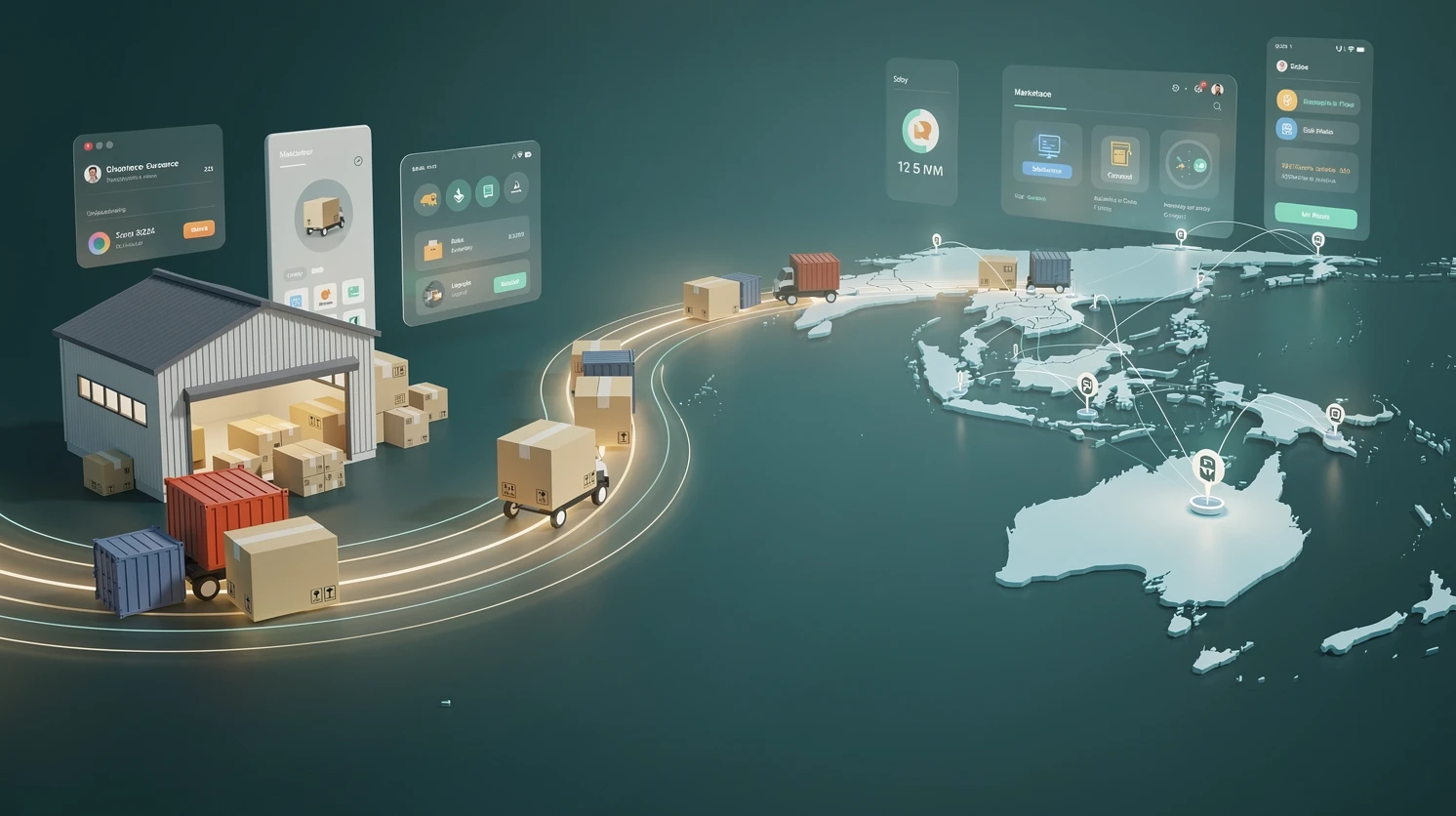
Selling on Shopee from outside Southeast Asia is less a marketing challenge than a logistics one. The catalog, the pricing and the creator content all matter, but the deciding factor for a US, European or Latin American brand entering Shopee’s markets is whether a parcel can move from a warehouse in Los Angeles, Rotterdam or Shenzhen to a buyer in Manila, Jakarta or Bangkok at a delivered cost and speed that a price-sensitive shopper will accept. Shopee logistics outside SEA sits at the intersection of cross-border shipping, customs clearance, local last-mile networks and Shopee’s own fulfillment programs, and getting it wrong quietly kills conversion long before a seller ever sees a bad review.
This guide breaks down how the logistics actually work for a seller with no physical presence in Southeast Asia, what the realistic cost and delivery windows look like in 2026, and where the operational traps sit. It is written for brand, e-commerce and supply-chain teams evaluating Shopee as a channel, not for shoppers.
In short
- Shopee logistics outside SEA runs through three main routes: Shopee’s own cross-border program (SIP and the cross-border seller flow), third-party consolidators and freight forwarders, or a local in-market model using bonded warehouses and Shopee’s supported carriers.
- Delivery speed, not headline price, is the conversion lever. Cross-border parcels from outside the region typically land in 7 to 15 business days, while in-market stock ships in 1 to 4 days, and that gap changes buy-box position and cancellation rates.
- Customs and de minimis rules vary by country across Indonesia, Thailand, Vietnam, the Philippines, Malaysia, Singapore and Taiwan, so a single landed-cost model rarely survives contact with all seven markets.
- Shopee’s SLS (Shopee Logistics Service) abstracts carrier choice once a parcel enters the network, but the leg from your origin warehouse to Shopee’s forwarding hub is your responsibility and your biggest variable cost.
- The winning pattern for scale is hybrid: test demand cross-border, then move proven SKUs into a local or bonded warehouse to compress delivery time and reclaim margin lost to per-parcel international shipping.
Why Shopee logistics from outside Southeast Asia matters in 2026
Shopee is the largest e-commerce platform by traffic across most of Southeast Asia, and the region remains one of the fastest-growing digital retail markets in the world. For a brand outside the region, that scale is the attraction. The barrier is almost never demand and almost always fulfillment: a shopper in Ho Chi Minh City comparing two similar products will pick the one that arrives in three days over the one that arrives in twelve, even at a slightly higher price.
The economics have also shifted. Tightening customs enforcement and the gradual closing of low-value import loopholes have made the old playbook of shipping thousands of untracked small parcels far riskier. Several markets now scrutinize under-declared cross-border parcels, and platform policy increasingly rewards sellers who can guarantee delivery windows. This mirrors the broader tightening in global parcel flows, a pattern also visible in how a handful of carriers shape the cost of shipping from China to Europe, where consolidation and regulation quietly reset landed costs.
For sellers weighing Shopee against the wider marketplace landscape, logistics capability is the real qualifier. The strategic framing sits inside our complete guide to selling on global e-commerce marketplaces, which covers how channel choice, fulfillment model and margin structure interact. Shopee is a strong channel, but only for teams that treat the supply chain as a first-class part of the launch rather than an afterthought.
How Shopee’s cross-border logistics actually works
The core piece to understand is Shopee Logistics Service, usually shortened to SLS. SLS is Shopee’s integrated logistics layer that assigns carriers, generates shipping labels, provides tracking and manages the handoff between international transport and local last-mile delivery. Once a parcel is inside SLS, the buyer sees a unified Shopee tracking experience regardless of which physical carrier moves the box.
The forwarding-warehouse model
For cross-border sellers, Shopee typically operates forwarding warehouses in key origin hubs, most notably in China but also serving other origin regions through partner networks. The seller ships an order to the designated forwarding warehouse, Shopee consolidates and moves it internationally, then the local Shopee network handles customs and delivery in the destination country. The seller’s job ends at the forwarding hub; SLS owns everything downstream.
This is powerful because it removes the need to negotiate individual carrier contracts in seven different countries. It is also constraining, because you inherit Shopee’s routing, its transit times and its customs handling, with limited ability to expedite a specific shipment.
SIP: the Shopee International Platform program
The Shopee International Platform, or SIP, is Shopee’s program that automatically replicates a seller’s listings from a primary market into other Shopee country sites, handling translation, currency and cross-listing. SIP is a merchandising and listing tool rather than a pure logistics one, but it matters here because it changes which fulfillment obligations apply in each replicated market. A seller can be live in five countries through SIP while physically shipping from a single origin, which makes the logistics model behind those listings the thing that determines whether the expansion is profitable or just visible.
Where your responsibility begins and ends
The single most useful mental model is the handoff line. Everything from your factory or 3PL to the Shopee forwarding warehouse is your cost, your carrier and your risk. Everything from the forwarding warehouse to the buyer’s door is SLS. Sellers who lose money on Shopee cross-border almost always underestimate the first leg, especially the cost of moving inventory in small, frequent batches instead of consolidated freight.
The three routes into Shopee from outside SEA
There is no single correct fulfillment model. The right choice depends on order volume, average selling price, product weight and how much working capital you can park in-region. The three practical routes are direct cross-border through Shopee, third-party consolidation, and local or bonded warehousing.
| Route | Typical delivery | Upfront capital | Best for | Main risk |
|---|---|---|---|---|
| Direct cross-border via Shopee SLS | 7 to 15 business days | Low | Testing demand, low-volume launch, lightweight goods | Slow delivery hurts buy-box and raises cancellations |
| Third-party consolidator or freight forwarder | 5 to 12 business days | Medium | Mid-volume sellers wanting cost control on the first leg | Customs errors and split accountability across partners |
| Local or bonded in-market warehouse | 1 to 4 business days | High | Proven SKUs at scale, heavier or higher-value goods | Inventory risk and capital tied up in-region |
Most successful entrants treat these as a sequence rather than a menu. They launch cross-border to validate which SKUs sell, then graduate the winners into local stock once the data justifies the inventory commitment. The mistake is committing to expensive in-market warehousing before demand is proven, or staying cross-border forever and permanently ceding the delivery-speed advantage to local competitors.
Key terms and definitions
Cross-border logistics carries its own vocabulary, and misreading a term can distort a whole landed-cost model. These are the terms that matter most for Shopee logistics outside SEA.
- SLS (Shopee Logistics Service): Shopee’s integrated logistics network that manages carrier assignment, labels, tracking and last-mile delivery once a parcel is inside the system.
- SIP (Shopee International Platform): the program that auto-replicates listings across Shopee country sites, handling translation and currency.
- De minimis threshold: the value below which an imported parcel is exempt from duties or taxes in a given country. These thresholds differ sharply across Southeast Asian markets and change with policy.
- Bonded warehouse: a facility where imported goods sit under customs control without duties paid until they are released for local sale, which improves cash flow and delivery speed.
- Landed cost: the total cost to deliver a unit to the buyer including product, first-leg shipping, international freight, duties, taxes and last-mile fees.
- First leg (first mile): the movement of inventory from your origin warehouse to the Shopee forwarding hub or in-market warehouse. This is the seller’s cost and the biggest lever.
- Last mile: the final delivery from the local distribution point to the buyer’s address, handled inside SLS.
Costs, duties and the landed-price math
The reason so many outside-SEA sellers stumble is that they price against product cost plus a shipping estimate, then discover duties, taxes and last-mile handling have eaten the margin. A disciplined landed-cost model is the difference between a channel that scales and one that bleeds.
The table below is an illustrative structure, not a quote. Real figures depend on product weight, destination country and the carrier mix Shopee assigns, but the shape of the math holds across markets.
| Cost component | Who controls it | Typical share of landed cost | How to reduce it |
|---|---|---|---|
| Product cost (COGS) | Seller | 40% to 55% | Volume sourcing, packaging weight reduction |
| First-leg shipping to hub | Seller | 10% to 20% | Consolidate shipments, use freight not parcel |
| International freight (SLS) | Shopee | 10% to 18% | Reduce dimensional weight, batch orders |
| Duties and import taxes | Destination customs | 0% to 15% | Bonded warehousing, correct HS codes, compliant declaration |
| Last-mile delivery | Shopee | 5% to 12% | Limited; improves with local stock |
Two lessons fall out of this structure. First, the seller controls the two components that most people ignore: first-leg shipping and product weight. Reducing packaging weight and consolidating the first leg often saves more than any negotiation with Shopee. Second, duties are binary in effect. A parcel that clears under a de minimis threshold carries almost no duty, while one that crosses it can jump 10 to 15 percent, which is why declared value and product weight sit at the center of the model.
Free-shipping mechanics add another layer. Shopee heavily promotes free-shipping vouchers, and understanding who actually funds them matters for margin. Our breakdown of how Shopee free shipping really works for sellers covers the split between platform subsidy and seller contribution, which directly changes the landed-cost picture above.
Common mistakes and how to avoid them
Most failures in Shopee logistics outside SEA are not exotic. They repeat across sellers, and each has a straightforward fix once you know to look for it.
Treating all seven markets as one
Indonesia, Thailand, Vietnam, the Philippines, Malaysia, Singapore and Taiwan differ in de minimis thresholds, preferred payment behavior, return expectations and even acceptable delivery windows. A landed-cost model that works in Singapore can lose money in Indonesia. Build the model per country, then decide which markets to enter rather than blasting into all of them through SIP and hoping.
Under-declaring parcel value
Under-declaring to duck duties was a common tactic, and it is increasingly dangerous. Customs enforcement across the region has tightened, penalties can include seizure and account suspension, and Shopee has little patience for compliance risk. Declare correctly and price the duty into the product instead.
Ignoring dimensional weight
International freight is priced on dimensional weight, not just actual weight. A light product in a large box pays for the air it ships. Right-sizing packaging is one of the fastest margin wins available and it costs almost nothing to implement.
Staying cross-border after demand is proven
Once a SKU sells consistently, keeping it on a 12-day cross-border route hands the delivery-speed advantage to local sellers permanently. The fix is to graduate proven SKUs into local or bonded stock. This is the same discipline serious sellers already apply on the platform, as covered in our practical 2026 guide to Shopee for Southeast Asia sellers.
Examples from US retail and e-commerce
The patterns that work on Shopee echo how US and European brands have handled other cross-border marketplaces. A useful reference point is how sellers approached earlier waves of marketplace expansion, where the winners invested in in-region inventory once volume justified it and the losers stayed permanently on slow international shipping.
Consider a mid-size US beauty brand entering the Philippines and Indonesia. The pragmatic sequence is to launch a curated set of best-sellers cross-border through Shopee SLS, watch which SKUs clear a threshold of consistent weekly orders, then move those specific units into a local 3PL or bonded facility. Delivery drops from around twelve days to two or three, the buy-box position improves, and cancellation rates fall because buyers no longer abandon orders waiting on slow parcels.
A second pattern comes from apparel sellers dealing with returns. Cross-border returns are expensive and slow, so brands that succeed either build return costs into pricing or route returns to a local consolidation point rather than shipping every item back to origin. The comparison many teams run is Shopee against its regional rival, and our analysis of Shopee versus Lazada for cross-border sellers lays out how the two platforms differ on exactly these fulfillment and returns dynamics.
A third pattern worth naming is the payment-and-cash-on-delivery reality. Several Southeast Asian markets still see heavy cash-on-delivery usage, which interacts with logistics in ways outside-SEA sellers rarely anticipate. Cash-on-delivery raises the cancellation and failed-delivery rate, ties up cash longer, and makes returns messier, all of which amplify the penalty for slow cross-border transit. Sellers who plan for this build a buffer into their margin assumptions rather than modeling every order as a clean prepaid transaction.
The through-line in every example is that logistics maturity, not catalog size, separates the sellers who scale from the ones who stall. A brand with fifty SKUs and a tight in-region supply chain will outperform a brand with five hundred SKUs stuck on slow cross-border shipping. The catalog gets a shopper’s attention; the supply chain is what actually converts that attention into a delivered, paid, un-returned order.
Tools, partners and vendors worth knowing
No single vendor solves Shopee logistics outside SEA end to end, so the practical stack combines Shopee’s own tools with third-party freight, warehousing and customs partners.
- Shopee Seller Center and SLS: the baseline. Every cross-border seller uses SLS for last-mile, and the Seller Center dashboard for order and inventory management.
- Freight forwarders and consolidators: for the first leg, a consolidator that batches your parcels into international freight almost always beats shipping individual parcels, especially above modest volumes.
- Regional 3PLs and bonded-warehouse providers: the graduation step for proven SKUs. Local fulfillment partners in Indonesia, the Philippines and Vietnam compress delivery to days.
- Customs brokers: for accurate HS classification and compliant declaration, which protects both margin and account standing.
- Listing and analytics tools: to decide which SKUs deserve local stock. Our roundup of tools and vendors for Shopee in 2026 covers the software layer that sits on top of the physical supply chain.
For teams comparing Shopee’s model against building on their own storefront, the platform trade-off is worth understanding too. A self-hosted stack such as Adobe Commerce, still relevant in 2026, gives full control of fulfillment and data but none of Shopee’s built-in regional demand, which is exactly the reason most outside-SEA brands use Shopee as a demand channel while keeping a separate direct storefront.
Background on Shopee’s scale and market position is available through its encyclopedic overview for teams building the internal case for the channel.
How delivery speed shapes the buy box and account health
Sellers coming from Amazon or eBay tend to think of logistics as a cost line. On Shopee it is also a ranking and reputation input, and that changes the calculus for outside-SEA sellers whose parcels move slowly.
Delivery time feeds search and recommendation
Shopee’s discovery surfaces favor listings that convert and fulfill reliably. A product that ships in three days from local stock tends to convert better and cancel less than the same product on a twelve-day cross-border route, and that behavior compounds into better placement over time. In practical terms, slow fulfillment is not just a customer-experience problem; it quietly suppresses reach, which means the seller pays twice, once in lost sales and once in weaker organic visibility.
Cancellations and late-shipment penalties
Cross-border sellers face a structural risk that local sellers do not: longer transit windows leave more room for a buyer to cancel before the parcel arrives, and Shopee tracks late-shipment and cancellation metrics against seller health scores. A run of late cross-border deliveries can push an account into penalty territory, which restricts visibility and, in severe cases, suspends listings. This is why the graduation-to-local-stock decision is as much about protecting account standing as it is about margin.
Peak-season fragility
Shopee’s calendar is built around large sale events, and cross-border supply chains are least reliable exactly when volume spikes. Customs backlogs, carrier congestion and longer transit times all worsen during peak, so a cross-border model that looks fine in a quiet month can collapse during a major campaign. Sellers who intend to participate in flagship sale events almost always need in-market stock to do so credibly.
A realistic 90-day logistics rollout
The abstract advice to test cross-border and then graduate winners is only useful with a concrete sequence. Here is what a disciplined first quarter looks like for a brand entering Shopee from outside the region.
In the first 30 days, the priority is a compliant cross-border launch on a narrow SKU set. Pick eight to fifteen best-sellers, ship them to the Shopee forwarding hub, and get the customs declarations correct rather than optimized. The goal in this phase is clean data, not scale, so resist the temptation to list the entire catalog through SIP on day one.
In days 30 to 60, the work is measurement. Track delivered cost, transit time, cancellation rate and reorder velocity per SKU and per country. This is where a per-market landed-cost model earns its keep, because the same product can be profitable in Singapore and marginal in Indonesia once duties and last-mile costs are counted. By the end of this window you should know which five or six SKUs justify local inventory.
In days 60 to 90, the winners graduate. Move the proven SKUs into a local 3PL or bonded warehouse in your highest-volume market, compress delivery to a few days, and keep the long tail on cross-border. The result is a hybrid model that captures fast delivery where it matters while limiting inventory risk on unproven products. Teams that want to see how this fits the wider channel strategy can revisit the complete guide to selling on global e-commerce marketplaces, which places the Shopee logistics decision inside the broader question of where to hold inventory across every channel a brand runs.
None of this requires exotic infrastructure. It requires the discipline to launch small, measure honestly and move inventory closer to the buyer only when the data says so. The brands that treat those three steps as a repeatable process, market by market and SKU by SKU, are the ones that turn Shopee from a speculative experiment into a durable regional channel.
Frequently asked questions
Can I sell on Shopee without a company or presence in Southeast Asia?
Yes. Shopee’s cross-border seller programs are designed for exactly this, letting you list and fulfill from an origin outside the region. You ship to a Shopee forwarding hub and SLS handles the rest. You do not need a local entity to start, though a local presence becomes valuable once you move to in-market warehousing.
How long does cross-border Shopee delivery actually take?
Typically 7 to 15 business days from an outside-SEA origin, depending on destination country and customs. In-market stock, by contrast, delivers in 1 to 4 days. That gap is the single biggest reason to graduate proven SKUs into local warehousing.
What is the difference between SLS and SIP?
SLS (Shopee Logistics Service) is the physical logistics network that moves and tracks parcels. SIP (Shopee International Platform) is the listing-replication program that copies your products across country sites. SLS handles boxes; SIP handles listings. You often use both together.
Do I have to pay import duties on every parcel?
Not always. Each Southeast Asian market sets a de minimis threshold below which parcels are exempt from duty. Above it, duties and taxes apply. Because thresholds differ by country and change with policy, build a per-market landed-cost model rather than assuming one rule.
Is a bonded warehouse worth it for a new seller?
Rarely at launch. Bonded and local warehousing ties up capital and carries inventory risk, so it pays off only once specific SKUs show consistent demand. The standard sequence is to prove demand cross-border first, then move winners into local or bonded stock to compress delivery time.
How do I keep first-leg shipping costs under control?
Consolidate. Shipping many small parcels internationally is the most expensive way to move inventory. Batching orders into freight through a consolidator or forwarder, and reducing packaging dimensional weight, usually saves more than any other single change.
Which Shopee markets should an outside-SEA brand enter first?
It depends on your category and margins, but Singapore and Malaysia are often the easiest operationally, while Indonesia and the Philippines offer the largest volume at the cost of more complex logistics and customs. Enter selectively based on a per-country landed-cost model rather than switching on every market through SIP at once.
How are returns handled for cross-border Shopee orders?
Cross-border returns are slow and costly, so successful sellers either build return costs into pricing or route returns to a local consolidation point instead of shipping every item back to origin. Once you hold local stock, returns become far cheaper and faster to process.