
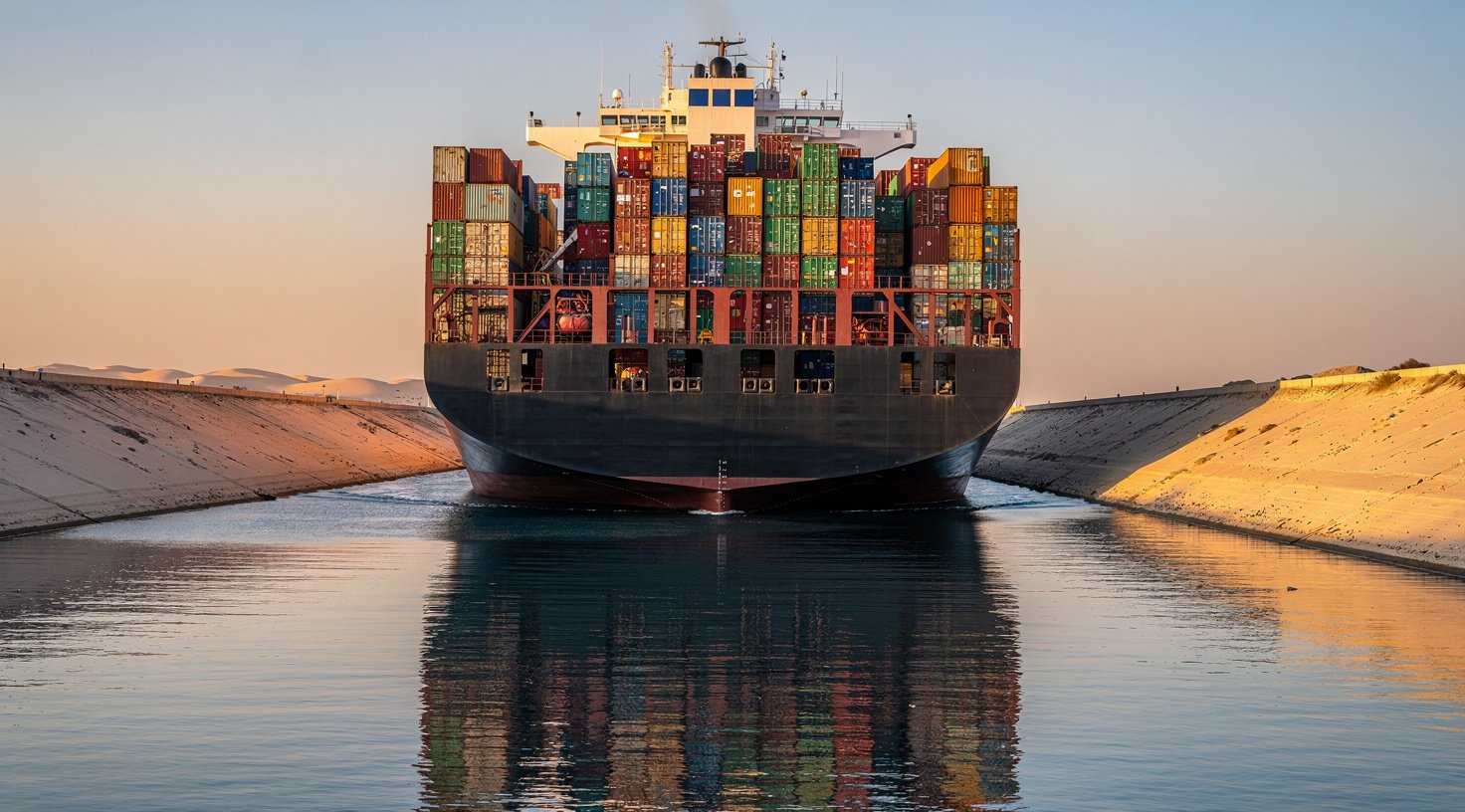
Two of the world’s largest container carriers are steering more of their fleet back toward the Suez Canal. Maersk and Hapag-Lloyd said on August 10 that they will move another service in their Gemini network, the AE19 loop, through the Red Sea and Suez Canal rather than around the Cape of Good Hope. It is the clearest sign yet that ocean shipping is inching back toward the shortcut it abandoned almost three years ago, as retailers lock in freight for the holiday peak.
In short
- Another Gemini service returns to Suez. Maersk (AE19) and Hapag-Lloyd (SE4) shifted the loop off the Cape of Good Hope and back through the Red Sea, effective immediately.
- The change is narrow. Maersk said it applies only to AE19 for now, with no timetable for moving the rest of its East-West network.
- The Cape detour is expensive. It adds roughly 10-14 days to an Asia to Europe voyage and burns about 30% more fuel.
- Rates are already easing. Transpacific and Asia-Europe spot rates have softened from summer highs as capacity loosens.
- Retailers gain planning room. Faster sailings could trim transit times and landed costs ahead of the holiday season, if the return holds.
What Maersk and Hapag-Lloyd actually changed
The two carriers, which run an integrated East-West network under the Gemini Cooperation, announced a structural change to a single service. The AE19 loop (SE4 in Hapag-Lloyd’s schedule) will now transit the trans-Suez corridor instead of routing around the Cape of Good Hope. The switch takes effect immediately, beginning with the vessel Berlin Maersk on westbound voyage 628W and eastbound voyage 637E. Maersk framed it as a way to offer more efficient transit times on the Asia to North Europe trade. The published AE19 rotation runs:
- Xingang
- Qingdao
- Busan
- Ningbo
- Shanghai
- Tanjung Pelepas
- Jeddah
- Suez Canal, then Port Said
- Tangier
- Return via Port Said and the Suez Canal
- Jeddah
- Singapore
- back to Xingang
Why the Cape of Good Hope detour cost so much
The context matters. After Houthi attacks on merchant shipping intensified in the Red Sea in late 2023, most major container lines rerouted their Asia to Europe services around the southern tip of Africa. Industry estimates put the added transit at roughly 10-14 days each way, with fuel burn climbing about 30% per trip as ships sail thousands of extra miles.
The diversion also reshaped the market. By tying up ships on longer rotations, the Cape route soaked up an estimated 6% to 12% of global container capacity, tightening effective supply and keeping freight rates elevated. Suez container traffic collapsed as a result, from roughly 80 ships a week before the crisis to around 26 a week by mid-January 2026, and Asia to North Europe rates ran about 25% to 30% above pre-2023 levels.
| Factor (Asia to North Europe) | Cape of Good Hope | Suez Canal (Red Sea) |
|---|---|---|
| Typical transit added | About 10-14 extra days | Baseline, shorter route |
| Fuel burn per trip | Roughly 30% higher | Lower |
| Effect on fleet capacity | Absorbs surplus ships | Frees ships back into service |
| Security exposure | Minimal | Depends on Red Sea conditions |
A return that is cautious and reversible
This is not a full reopening, and the carriers said so. Maersk stated that the change is limited to AE19 for now, with no plans to alter other Gemini services and no fixed timetable for shifting the rest of its East-West network back to Suez. The AE19 move follows a July change to the AE15 service, linking Asia and the Mediterranean, and to a Middle East to US East Coast service.
The comeback has already stumbled once. In February, Maersk sent some ME11 and MECL sailings back around the Cape, citing unforeseen constraints in the Red Sea operating environment, only weeks after a limited resumption. As freight rate platform Xeneta has put it, unpredictability is toxic for supply chains, because carriers, ports, and cargo owners cannot commit to a route that may flip again on short notice.
What it means for freight rates and capacity
The rate math cuts both ways. Every service that swings back to the shorter route effectively hands ships to the market, since each vessel finishes its loop faster and fewer are needed to hold the same weekly departures. More effective capacity, all else equal, pushes rates down. That pressure is already visible. Drewry’s World Container Index put the Shanghai to Los Angeles spot rate near 5,894 dollars per 40ft container in early August, off the summer peaks, while Asia to Europe rates have slid as the European peak fades. Carriers have leaned on blank sailings, the deliberate cancellation of departures, to keep supply from overwhelming demand.
If a broad Red Sea return arrives alongside softening demand, the risk for carriers is oversupply and a sharper drop in rates. For cargo owners, the same dynamic reads as relief: lower ocean costs, plus fuel savings that may filter through as surcharges recede. For now the market looks balanced, with capacity improving on some lanes while East and Gulf Coast space stays tighter.
What retailers and online sellers should watch
For merchants moving goods from Asia, the headline benefit of a Suez return is time. Shaving up to two weeks off a rotation shortens the gap between placing an order and having sellable stock on the shelf, which matters most heading into the fourth quarter. Shorter, more direct sailings also tend to improve reliability, a metric the Gemini network was built to defend with a stated goal of 90% or better on-time performance.
The practical guidance is to plan for a partial, reversible recovery rather than a clean reopening. Sellers that run tight inventory should keep buffer stock and, where possible, split volume across routes in case a service flips back to the Cape. Freight is also only one line of the landed cost. Cross-border e-commerce into the European Union now carries new customs charges since the bloc began ending duty-free treatment of low-value parcels on July 1, adding a flat levy and per-parcel handling fee on shipments under 150 euros, which retailers should weigh against ocean rates.
Frequently asked questions
What is the Gemini Cooperation?
It is an operational partnership between Maersk and Hapag-Lloyd that runs a shared East-West container network on a hub-and-spoke design, with a stated aim of 90% or higher schedule reliability. AE19 is one of its services, marketed by Hapag-Lloyd as SE4.
Does this mean the Red Sea is fully reopened to shipping?
No. The change applies only to AE19. Maersk said it has no current plans to move its other Gemini services and gave no timetable for a wider return, and earlier in 2026 it reversed some sailings back to the Cape. Treat it as a cautious, conditional step, not a full reopening.
How could this affect the freight rates retailers pay?
Returning to the shorter Suez route lets each ship complete its loop faster, effectively adding capacity back to the market and tending to push spot rates down. Rates were already easing from summer highs, so a broader return could accelerate that, though a fast capacity return into weak demand raises the risk of volatility.
When does the AE19 change take effect?
The carriers said it takes effect immediately, starting with the vessel Berlin Maersk on westbound voyage 628W and eastbound voyage 637E.