
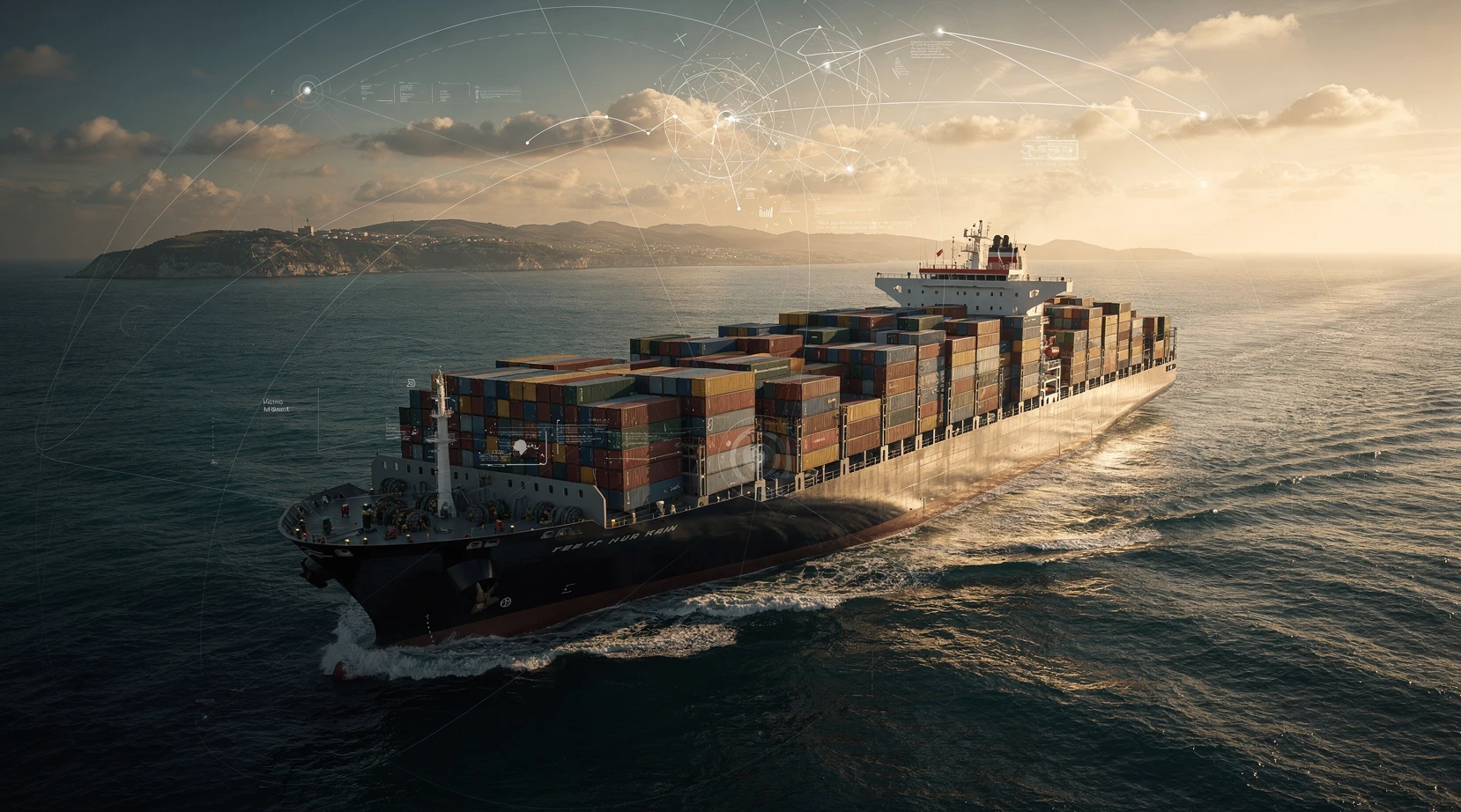
Ocean freight rates are the quiet variable that decides whether an import-based store makes money. A container that cost $1,800 to move from Shanghai to Rotterdam in one quarter can cost several times that in the next, without a single thing changing about the product inside it. Since late 2023, the single largest driver of that swing on Asia to Europe lanes has been the rerouting of vessels away from the Red Sea and around the Cape of Good Hope.
This guide explains how ocean freight pricing actually works, what the Red Sea diversion did to the cost base, and how importers read the market instead of reacting to headlines. It is written for merchants and operations teams, not for chartering desks, so the focus is on the decisions a seller can actually make.
In short
- Ocean freight rates are not a price list. They are a base rate plus a stack of surcharges, and the surcharges move faster than the base.
- The Red Sea effect is mostly a capacity story. Routing around the Cape of Good Hope adds sea days, and those extra days absorb ships that would otherwise be carrying cargo elsewhere.
- Spot and contract rates diverge sharply in a disrupted market. Sellers on pure spot exposure feel every spike; sellers on fixed contracts feel rollovers and space refusals instead.
- Published indices lag and average. Drewry, Freightos and the SCFI describe the market, not your quote, and your lane can move differently.
- Landed cost, not freight cost, is the number that matters. Duty, demurrage, insurance and working capital tied up in longer transits can outweigh the ocean leg itself.
What ocean freight rates and the Red Sea effect mean for online sellers
An ocean freight rate is the price a carrier or forwarder charges to move a container from an origin port to a destination port. It is normally quoted per container: FEU for a forty-foot equivalent unit, TEU for a twenty-foot equivalent. For less-than-container-load cargo, pricing shifts to a per-cubic-meter or per-100kg basis, whichever yields more revenue for the carrier.
The “Red Sea effect” is shorthand for what happened after attacks on commercial shipping near the Bab el-Mandeb strait pushed most major carriers to stop transiting the Suez Canal. Instead of sailing through the Red Sea, ships began routing south around Africa. The Suez Canal Authority reports canal traffic and revenue figures directly, and the IMF’s PortWatch platform publishes independent transit and port call data that anyone can check.
For a merchant, none of this shows up as a geopolitics line item. It shows up as a longer lead time, a higher quote, a peak season surcharge that appeared with two weeks of notice, and a booking that got rolled to the next sailing. Understanding the mechanism is what lets you tell a temporary spike from a structural reset, and that distinction drives everything downstream in your retail logistics planning.
Why the diversion costs money
Sailing from Asia to Northern Europe via the Cape of Good Hope rather than Suez adds thousands of nautical miles to the voyage. Industry estimates of the detour have generally clustered around an extra 3,000 to 3,500 nautical miles and roughly 10 to 14 extra days on a typical Asia to North Europe rotation, though the exact figure depends on the origin port, the destination and the speed the vessel runs.
Those extra days matter more than the extra fuel. A liner service is a loop: ships leave, sail, discharge, return and repeat on a weekly cadence. If the loop gets two weeks longer, the carrier needs additional vessels just to keep the same weekly departure. Ships pulled in to plug that gap are ships no longer available to carry cargo on other trades, which tightens supply across the network rather than only on the affected lane.
Rates move on both supply and demand
Routing disruption is the supply half of the story, and it rarely acts alone. Rate spikes tend to be sharpest when constrained capacity meets a demand surge, and the two often coincide because buyers respond to disruption by ordering earlier and larger. That behavior, sometimes described as pull-forward, converts a moderate supply squeeze into a severe one.
Seasonality compounds it. Peak season on Asia-outbound trades has historically built through the middle of the year as retailers position holiday inventory, and Lunar New Year factory closures create a separate rush before and a lull after. When a disruption lands on top of one of those cycles, the resulting spike is larger than either factor would produce alone. Reading the market therefore means asking two questions rather than one: what is happening to capacity, and where are we in the buying calendar.
How ocean freight rates are actually set
Most sellers see one number on a quote and assume it is the price. In practice that number is assembled from several independent components, each set by a different party on a different clock.
The components of a quote
| Component | What it covers | Who sets it | How fast it moves |
|---|---|---|---|
| Base ocean rate | Port-to-port carriage of the container | Carrier or forwarder | Weekly on spot, annually on contract |
| BAF / fuel surcharge | Bunker fuel price exposure | Carrier, by published formula | Monthly or quarterly |
| Emissions surcharge | EU ETS and FuelEU Maritime compliance costs on EU-touching legs | Carrier, per regulatory phase-in | Annual steps, per EU rules |
| GRI | General rate increase, a broad reset of the base | Carrier, with notice | Announced, often mid-month |
| PSS | Peak season surcharge when demand exceeds space | Carrier, with notice | Weeks of notice, sometimes less |
| War risk / contingency | Insurance and routing risk on affected corridors | Carrier and underwriters | Event-driven |
| THC and port fees | Terminal handling at origin and destination | Terminal operators | Slow, usually annual |
| Inland and drayage | Truck or rail leg beyond the port | Local hauliers | Local market, seasonal |
The practical consequence is that a carrier can leave the advertised base rate untouched and still raise your total cost substantially by adding surcharges. When you compare two quotes, compare the all-in number to the same destination point under the same Incoterm, or you are not comparing anything at all.
Spot, contract and index-linked pricing
Spot rates are what you pay for a booking placed close to sailing. Contract rates are negotiated in advance, typically annually, for a committed volume. Index-linked contracts sit between the two: the price floats against a published index, usually with a floor and a ceiling.
| Pricing model | Best suited to | Main risk in a disruption |
|---|---|---|
| Spot | Low or irregular volume, flexible timing | Full exposure to price spikes and space shortages |
| Fixed annual contract | Steady, forecastable volume | Rollovers and reduced allocation when spot exceeds contract |
| Index-linked with collar | Mid-size shippers wanting predictability without lock-in | Index may not track your specific lane closely |
| Forwarder buy-rate | Sellers without direct carrier relationships | Opacity: the margin split is rarely visible |
One point is regularly misunderstood. A fixed contract is not a guarantee of space. When spot pricing runs well above contract pricing, contract cargo tends to be the first to get rolled, because the carrier earns more on the spot booking that takes the slot. A contract protects your price, not necessarily your sailing date.
Reading the indices without being misled
The commonly cited benchmarks are the Drewry World Container Index, the Freightos Baltic Index and the Shanghai Containerized Freight Index. Each samples a set of lanes and publishes a composite. They are useful for direction and magnitude, and they are poor proxies for your invoice.
Three caveats are worth holding onto. Indices average across lanes, so a composite rise can hide a flat or falling rate on your specific route. They usually reflect spot pricing, so contract shippers see a different reality. And they typically exclude some surcharges and inland legs, which is exactly where cost quietly accumulates. The structural question of how a handful of carriers shape the cost of shipping from China to Europe matters more to a small importer than any weekly index print.
Why carrier structure amplifies every shock
Container shipping is concentrated. A small number of carrier groups operate the bulk of deep-sea capacity, and most of them coordinate service networks through vessel-sharing alliances. Alliances are not price-fixing arrangements, and they are regulated as such in major jurisdictions, but they do mean that decisions about how much capacity to deploy on a corridor are made by a handful of planning teams rather than by hundreds of independent operators.
The alliance landscape itself was reorganized in recent years, with groupings re-forming around new partners and network designs. For a merchant this matters in one specific way: when your carrier reshuffles its alliance, the actual vessels, port rotations and transit times behind your booking can change even though your contract and your carrier’s name did not.
Concentration also means capacity can be withdrawn quickly. Blank sailings, where a scheduled departure is simply cancelled, are the standard tool for matching supply to weak demand. From a shipper’s seat, a blanked sailing looks identical to bad luck, and there is no appeal process. The defense is schedule buffer and a second relationship, not negotiation.
How the Red Sea diversion moves the cost base
The mechanism is capacity absorption, and it is worth walking through slowly because it explains why rates on lanes nowhere near the Red Sea also moved.
Start with the fleet as a fixed pool of ships. Longer voyages mean each ship completes fewer round trips per year. Fewer round trips means less effective capacity, even though not a single vessel has left the water. Analysts have generally estimated that Cape routing absorbed a mid-single-digit to high-single-digit percentage of global effective container capacity, though estimates vary by methodology and by how much of the fleet is diverting at any given time.
That absorbed capacity then competes for the same cargo everywhere. Transpacific rates, which have nothing geographically to do with Suez, moved in sympathy because the ships that might have served those lanes were tied up elsewhere. This is why treating the Red Sea as an Asia to Europe problem understates it.
| Factor | Suez routing | Cape of Good Hope routing |
|---|---|---|
| Typical added distance, Asia to N. Europe | Baseline | Roughly 3,000 to 3,500 nautical miles more |
| Typical added transit time | Baseline | Roughly 10 to 14 days more |
| Canal transit fees | Payable to Suez Canal Authority | None |
| Bunker consumption per voyage | Lower | Higher, though partly offset by slow steaming |
| Ships needed per weekly service | Fewer | More, to maintain the same cadence |
| Working capital in transit | Lower | Higher: inventory sits at sea longer |
| Schedule reliability | Historically higher | Initially degraded, improving as networks restabilize |
The working capital line deserves attention from any seller running lean. Two extra weeks at sea on every shipment means roughly two extra weeks of stock financed and not yet sellable. For a business turning inventory six times a year, that is a real and permanent increase in the cash tied up in the supply chain, independent of what the freight itself costs.
What sellers need to check before importing or shipping
Most of the leverage available to a small or mid-size importer sits in contract terms and process discipline, not in negotiating the base rate down by a few percent.
Confirm the Incoterm and what it actually transfers
The Incoterm decides who pays for which leg and, critically, where risk passes from seller to buyer. An FOB quote and a DDP quote are not comparable numbers. Under DDP the supplier handles duty and delivery, which is convenient and usually more expensive, and it can leave you with less visibility into what was declared on your behalf. The rules themselves are published by the International Chamber of Commerce; our walkthrough of Incoterms 2020 for retail importers covers the practical differences.
Know who is doing what on your behalf
Freight forwarders and customs brokers perform different functions, and many firms do both without making the distinction clear on an invoice. The party filing your customs entry carries specific regulatory obligations, and you remain responsible for the accuracy of what is declared. If you are unsure which role your provider is filling, our breakdown of freight forwarder versus customs broker sets out the split.
Check free time before the container lands
Free time is the window in which you can keep a container at the terminal or in your possession without incurring charges. Once it expires, demurrage and detention accrue daily, and the amounts escalate. In the United States, the Federal Maritime Commission has issued rules governing how demurrage and detention charges must be invoiced, including required information on the bill and who may be billed. The FMC publishes its rules and guidance directly, and current requirements should be confirmed there rather than assumed from a forwarder’s summary. Because these charges are among the easiest avoidable costs in the chain, it is worth reading how demurrage and detention fees turn into a surprise bill before your first container arrives.
Rebuild lead times around the route actually being sailed
Reorder points are usually set once and then quietly inherited for years. If your planning assumes a transit that reflects a routing your carrier no longer uses, every purchase order you raise is late before it is placed. Ask your forwarder for the current port-to-port transit on your specific service string, then add the inland leg and a realistic allowance for port dwell.
Two further buffers are worth carrying explicitly rather than hoping for. Schedule reliability, the share of vessels arriving within a day or so of their published window, has been materially below pre-2020 norms across the industry, so plan against the reliability figure rather than the advertised transit. And rollover risk means the relevant question is not when the ship arrives, but when your box gets on a ship at all.
Read the surcharge clause before you sign anything
The clause that matters in most freight contracts is the one permitting the carrier to introduce or adjust surcharges during the term, and the notice period attached to it. A rate that is fixed except for anything the carrier decides to add is not a fixed rate. Ask for the list of surcharges applicable at signing, the mechanism by which new ones can be introduced, and the notice you are entitled to. Getting that in writing is usually easier than getting the base rate down.
Model the landed cost, not the freight quote
Build a simple landed cost sheet per SKU: unit cost, freight allocated per unit, duty at the applicable rate, brokerage, insurance, inland delivery and a contingency for accessorial charges. Then re-run it at a freight rate double your current one. If the SKU stops working, you have found a product whose margin is really a bet on cheap shipping.
Common mistakes and compliance risks to avoid
Treating a rate quote as a fixed price
Quotes frequently carry validity windows measured in days, and many contain clauses allowing surcharges to be passed through. Read the validity period and the surcharge language before you plan a season around a number.
Chasing the lowest headline rate
The cheapest quote often reflects a slower service, a transshipment with an extra handling point, or a carrier with weaker schedule reliability. On a disrupted network, a service that arrives predictably late is more useful than one that might arrive early and might arrive a month late.
Assuming duty and freight are unrelated
They are not, and this is where compliance risk enters. Customs valuation rules determine which costs form part of the dutiable value, and freight and insurance treatment depends on the valuation basis the destination country applies. Getting this wrong can understate or overstate duty. Rules and rates change, so the applicable rate for a specific product should be confirmed with the destination customs authority or a licensed broker rather than carried over from a prior shipment. For importers with volume, deferral mechanisms such as foreign trade zones can change the cash timing of duty, though eligibility and procedure are specific and regulated.
Leaving cargo insurance to chance
Carrier liability under international conventions is limited and is calculated by package or by weight, not by the value of your goods. In practice that limit can fall far below what a container of consumer electronics is worth. Separate marine cargo insurance covers the gap, and on longer routings with more sea days and more transshipment it becomes harder to justify skipping. Check what your Incoterm obliges each party to insure, because several terms transfer risk at a point where neither side has arranged cover unless someone thought about it.
Single-sourcing the ocean leg
Relying on one carrier or one forwarder is comfortable until the moment you are rolled. Keeping a secondary relationship active, even at low volume, buys optionality that costs almost nothing in a calm market and pays for itself once in a disrupted one.
Ignoring documentation deadlines
Cut-off times for shipping instructions, verified gross mass and export declarations are firm. Missing them can cost a sailing, and in a tight market the next sailing may be two or three weeks out rather than seven days. This is process discipline, not negotiation, and it is entirely within a seller’s control.
What happens if the Red Sea route normalizes
The reopening scenario is worth planning for, because it is not straightforwardly good news for everyone. Carriers have taken delivery of a large volume of newbuild capacity across recent years. If diverted tonnage returns to Suez and voyage times shorten, effective capacity increases quickly while demand does not, which historically puts sharp downward pressure on rates.
Returns have been partial and phased rather than switch-flipped, with individual services moved back as carriers assess risk. Coverage of Maersk and Hapag-Lloyd routing another Gemini service back through Suez illustrates the incremental pattern: one string at a time, network by network, rather than a fleet-wide announcement.
For a seller, three implications follow. Long fixed contracts signed at elevated levels look worse if spot collapses, which argues for shorter terms or index linkage when the market is clearly at a peak. Transit times shortening means inventory arrives earlier than planned, so reorder points calculated on Cape timings will overshoot. And a rate collapse tends to be accompanied by capacity discipline: blank sailings, service suspensions and consolidation, which can make schedules less reliable even as prices fall.
How the rules can change and where to confirm the current details
Nothing in this area is static. Surcharge structures are set by carriers and change with notice periods measured in weeks. Emissions rules affecting EU-touching voyages phase in on schedules set by the European Commission. Demurrage and detention billing requirements in the United States are set by the Federal Maritime Commission and have been revised. Duty rates and trade measures change through their own regulatory processes, published in the Federal Register in the US and in the Official Journal in the EU.
The practical rule is to treat every figure in any guide, including this one, as a starting point for verification rather than an answer. For canal transit conditions and volumes, the Suez Canal Authority and IMF PortWatch publish current data. For US customs matters, US Customs and Border Protection is the authority. For EU maritime emissions obligations, the European Commission publishes the governing rules. For freight benchmarks, the index providers publish their own methodology notes, which are worth reading once so you know what the number does and does not include. Building this verification habit into your wider logistics operation is what separates a resilient importer from a lucky one.
Important: this is general information, not legal, tax or customs advice
This article is published for general information and education about how ocean freight pricing and routing disruption work. It is not legal advice, tax advice or customs advice, and it does not take account of your specific products, contracts, jurisdictions or circumstances.
Duty rates, valuation rules, emissions obligations, surcharge legality and demurrage billing requirements differ by country and change over time, sometimes with very little notice. Any figure, threshold or rule described here may have changed since publication. Before you act on anything in this article, confirm the current position with the relevant official source and, where the stakes justify it, consult a licensed customs broker, a trade attorney or a qualified tax advisor who can review your actual situation.
Where this article describes the conduct of carriers, regulators or other parties, it reports publicly available information and attributed statements. It does not assert that any named company has acted unlawfully.
Frequently asked questions
Why did my freight rate rise when my route does not go near the Red Sea?
Because container capacity is a shared global pool. Longer voyages on one corridor absorb ships that would otherwise serve other trades, which tightens supply network-wide. Rates on lanes with no geographic connection to Suez can move for this reason alone.
Is a contract rate always cheaper than spot?
No. In a soft market, spot can fall below contract, and shippers locked into an annual deal pay above market. In a tight market the reverse holds and contracts look excellent, though space allocation can become the binding constraint rather than price.
What is the difference between demurrage and detention?
Broadly, demurrage relates to a container remaining inside the terminal beyond its free time, and detention relates to the container being outside the terminal in your possession beyond the allowed period. Definitions and billing requirements vary by jurisdiction and carrier tariff, and in the US the Federal Maritime Commission has set specific requirements, so confirm the current rules at the source.
Should I switch to air freight when ocean rates spike?
Occasionally, for high-value or low-weight goods where the per-unit air cost is small relative to margin, or for stock-outs that would cost more than the freight. For typical bulky consumer goods, air rarely closes the gap. Run the comparison per SKU on landed cost, not on the freight number alone.
How far in advance should I book during a disrupted period?
Longer than feels comfortable. When space is tight, bookings placed close to sailing are the ones that get rolled. Many importers move to booking several weeks ahead and accept slightly worse pricing in exchange for a materially higher chance of actually sailing on the intended vessel.
Which index should I follow?
Follow whichever one publishes your specific lane, and read its methodology so you know which surcharges are included. The Drewry World Container Index, the Freightos Baltic Index and the SCFI are all widely cited. Use them for direction and scale, not as a prediction of your invoice.
Does a longer transit time change my duty liability?
Transit duration by itself does not change the duty rate. What can change your liability is the routing, any transshipment, the declared origin and the valuation basis, all of which are governed by the destination country’s customs rules. Confirm the treatment of your specific shipment with a licensed broker or the relevant customs authority.
Can I ask a carrier to remove a surcharge?
You can ask, and with meaningful volume some surcharges are negotiable or can be folded into an all-in rate. Regulatory pass-through costs such as emissions charges are generally less negotiable than commercial ones such as a peak season surcharge. The realistic goal is an all-in quote with the pass-through mechanism written down, not the elimination of every line.
What is the single highest-value habit for controlling freight cost?
Maintaining an accurate landed cost model per SKU and re-running it whenever the market moves. It converts freight volatility from a shock into a pricing and assortment decision you can make deliberately, well before the invoice arrives.