
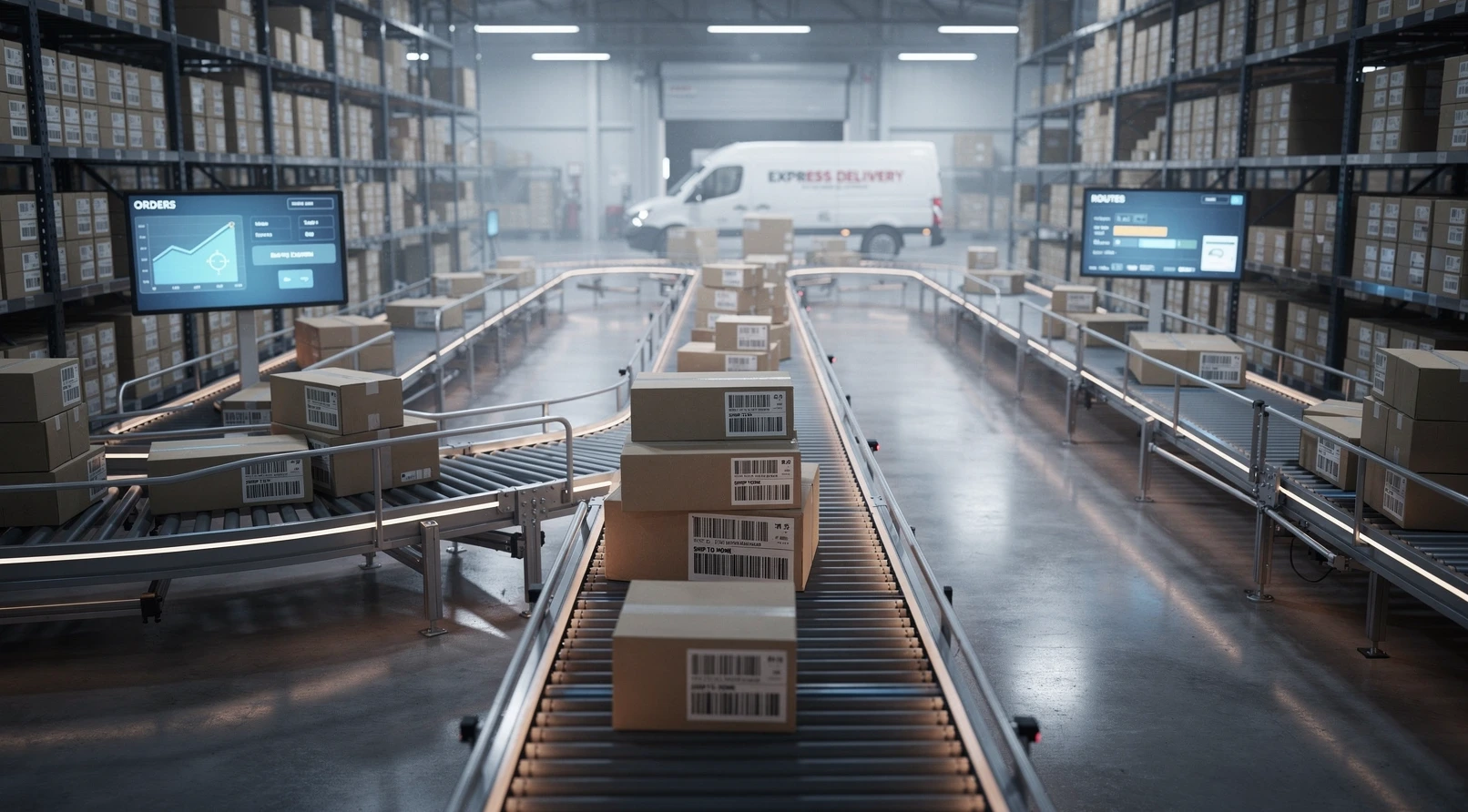
Retail logistics is the machinery that turns a placed order into a package on a doorstep, and in 2026 it has become the part of the business where margins are won or quietly lost. For most brands the storefront is polished and the marketing is measured to the cent, yet the flow of goods from supplier to warehouse to carrier to customer still runs on assumptions, spreadsheets and a few carrier relationships that nobody has renegotiated in years. This guide maps the entire territory, from the first inbound pallet to the returned item that comes back three weeks later, and connects each segment to the practical decisions that determine whether a retailer keeps its promises profitably.
The stakes have risen because customer expectations set in the marketplace era now apply to every seller regardless of size. A two-person brand is judged against the delivery speed, tracking transparency and returns ease that the largest platforms normalized. Meeting that bar without the capital of a global operator is the central logistics problem of the decade, and it is solvable with the right structure rather than the biggest budget.
In short
- Retail logistics spans four connected segments: shipping and fulfillment, last-mile delivery, warehousing and inventory, and returns and reverse logistics. A weakness in any one segment leaks margin and erodes repeat purchase across the whole operation.
- Landed cost, not sticker price, is the number that matters. Freight, duties, fulfillment fees, packaging, carrier surcharges and returns processing routinely add 20 to 40 percent on top of unit cost, and brands that do not calculate it precisely price themselves into losses on their best-selling items.
- The build-versus-buy decision compounds fast. In-house fulfillment offers control and unit economics at scale, while third-party logistics offers speed, geographic reach and variable cost, and the switch point is driven by order volume, SKU complexity and cash position rather than by revenue alone.
- Last-mile delivery is where the customer forms an opinion. Delivery promise reliability, not raw speed, drives repeat purchase, and models like buy online pick up in store frequently beat same-day delivery on both cost and satisfaction.
- Returns are a design problem, not a cost center to minimize. A trusted returns policy lifts conversion, while free returns carry a hidden cost that disciplined retailers offset through restocking logic, refurbishment and fraud controls rather than by hiding the option.
Introduction and the 2026 logistics context
The logistics environment of 2026 is defined by three forces that did not align this way before. Carrier pricing has moved from predictable annual increases to a system of general rate increases layered with dynamic surcharges, so the number on the rate card bears less relation than ever to the amount a retailer actually pays. Fulfillment capacity that ballooned during the pandemic boom has partially normalized, giving smaller brands access to third-party networks that once served only large accounts. And automation that used to require a nine-figure warehouse budget now ships as modular systems that a mid-market retailer can lease.
At the same time customer tolerance has narrowed. Shoppers abandon carts over shipping cost and speed, they judge a brand by the accuracy of its delivery estimate, and they treat a painful return as a reason never to buy again. Logistics has therefore moved from a back-office function to a front-line differentiator, sitting alongside product and price as a reason customers choose one seller over another.
This guide treats logistics as an integrated system rather than a list of vendors. The four segments covered here connect at every handoff: a warehousing decision changes shipping zones, a carrier choice changes the returns experience, an inventory policy changes how often a customer sees an out-of-stock message. Reading the segments in isolation is how retailers end up optimizing one number while quietly damaging three others.
Who this guide is for
The primary audience is the operator at a growing retail brand: the founder who just outgrew fulfilling from a spare room, the operations lead at a brand doing seven or eight figures who inherited a patchwork of carrier contracts, and the merchant weighing whether to bring fulfillment in-house. The frameworks apply equally to a single-channel D2C brand and to a multichannel retailer selling across its own site, marketplaces and physical stores.
Throughout, the guide points to deeper dives on each specific decision. Logistics is broad enough that no single article can carry the full detail on carrier negotiation, warehouse management system selection or reverse logistics partner shortlists, so the aim here is to give the map and the connective logic, then hand off to the focused pieces where the granular playbooks live.
Defining the logistics territory
Retail logistics is the coordinated set of activities that move a product from the point it enters a retailer’s control to the point a customer keeps it, plus everything that happens if the customer sends it back. It begins with inbound freight from suppliers, runs through storage, picking and packing, moves into carrier transport and final delivery, and closes with the reverse flow of returns, exchanges and disposition. Each stage has its own cost structure, its own vendors and its own failure modes.
The discipline sits at the intersection of supply chain management and customer experience. Supply chain is the upstream view, concerned with sourcing, production and the flow of goods into the network. Logistics as retailers use the term is the downstream view, concerned with getting the right product to the right customer at a cost that preserves margin and a speed that preserves the relationship. The two overlap in the warehouse, which is where inbound supply meets outbound demand.
It helps to separate the physical flow from the information flow. The physical flow is pallets, cartons, parcels and returns moving through space. The information flow is the order, the inventory count, the tracking event and the return authorization moving through systems. Modern logistics succeeds or fails on how tightly those two flows stay synchronized, because a physical package with no accurate information attached is the root of most delivery failures and support tickets.
The vocabulary that trips people up
A few terms cause persistent confusion and are worth fixing early. Fulfillment is the whole process of receiving, storing, picking, packing and shipping an order, while shipping is only the transport portion of that process. A fulfillment center is an operation optimized for fast outbound order processing, whereas a warehouse in the classic sense is optimized for bulk storage, and many facilities now blend both roles.
Third-party logistics, usually written 3PL, is an outsourced provider that handles fulfillment on a retailer’s behalf, and it differs from a freight forwarder, which arranges the movement of goods but does not pick and pack orders. The last mile is the final leg of delivery from the local facility to the customer, and it carries a disproportionate share of total delivery cost because it is the least consolidated and most labor-intensive segment. Reverse logistics is everything that happens to a product after a customer decides to return it, a flow that runs opposite to the outbound network and follows different economics entirely.
Key segments and how they connect
The four segments of retail logistics function as a single chain, and the connections between them matter as much as the segments themselves. Shipping and fulfillment is the outbound engine, last-mile delivery is the final handoff, warehousing and inventory is the buffer that absorbs the mismatch between supply and demand, and returns is the reverse flow that recovers value from what comes back. A decision in one segment ripples through the others in ways that are easy to miss when each is managed by a different person or vendor.
Shipping and fulfillment
Shipping and fulfillment is where an order becomes a physical event. It covers how orders are received into the system, how items are picked from shelves, how they are packed and labeled, and how they are handed to a carrier. For any brand past the earliest stage, the fundamentals of shipping and fulfillment determine both cost per order and the speed the customer experiences, so getting the basics right pays back on every single shipment.
The defining strategic choice in this segment is whether to fulfill in-house or through a third party. The tradeoffs in the in-house versus 3PL decision run deeper than cost per order, touching control, cash flow, geographic reach and the ability to scale through a demand spike. Brands frequently switch models more than once as they grow, starting in-house, moving to a 3PL for reach, then bringing high-volume SKUs back in-house for margin.
Carrier cost is the other lever that separates profitable shippers from the rest. Learning to negotiate rates with UPS and FedEx without burning the relationship is one of the highest-return skills an operator can develop, because carrier spend is often the second-largest line item after cost of goods. Rate negotiation compounds with network design: where a brand places inventory changes the zones it ships into, and the math behind fulfillment center locations can cut transit times and cost simultaneously when done deliberately.
None of these decisions can be made well without a precise view of how to calculate landed cost, the all-in figure that includes freight, duties, fulfillment, packaging and returns. Choosing the right carriers ties it together, and the 2026 shipping carrier comparison for US retailers lays out which providers fit which shipment profiles. For the tooling that runs it all, the shipping and fulfillment tools and vendors for 2026 covers the systems that connect orders to labels to tracking.
Last-mile delivery
Last-mile delivery is the segment the customer actually sees, and it is where the abstract promise of a delivery date becomes a concrete moment of trust kept or broken. A retailer new to the topic should start with last-mile delivery explained, because the cost structure and the failure modes are unlike any other part of the chain. This is the leg where a package can be perfectly picked, packed and shipped and still generate a furious customer if the final handoff goes wrong.
The economics here reward realism over ambition. Same-day delivery sounds like a competitive weapon, but the economics of same-day delivery only work under specific density and basket-value conditions that most retailers do not meet. Frequently the smarter play is buy online pick up in store, a model that beats home delivery on cost and often on satisfaction by using existing store footprints as the last-mile node.
Carrier choice in the last mile is broader than the big national names, and last-mile carriers from USPS to gig fleets each carry different cost, speed and reliability profiles. The metric that actually drives loyalty is not raw speed but delivery promise reliability, the gap between the date shown at checkout and the date the package arrives. For where the segment is heading, the 2026 last-mile delivery outlook and the last-mile delivery tools and vendors map the providers and technology reshaping the final leg.
Warehousing and inventory
Warehousing and inventory is the buffer that lets a retailer sell things it does not have to produce on demand, and it is the segment where cash gets tied up fastest. A brand that just outgrew informal storage needs the warehousing basics for growing retail brands before it signs a lease or a 3PL contract it will regret. The core tension is between holding enough stock to never disappoint a customer and holding so little that cash is trapped on shelves.
Inventory health is measured most usefully through inventory turnover, the rate at which stock sells and is replaced, because it exposes both dead stock and the risk of running dry. Turnover is a lagging signal, so it pairs with forward-looking demand forecasting without an enterprise tool, which lets even small teams predict what to reorder and when. Getting the reorder logic right depends on understanding safety stock, reorder points and lead times, the three variables that decide whether a brand stocks out during a demand spike.
As volume grows, the systems and the physical operation both need upgrading. Selecting the right warehouse management system for a growing brand without overpaying is a decision that shapes accuracy and throughput for years. And warehouse automation in 2026 for SMB retailers has moved within reach of mid-market operators, with the full warehousing and inventory tools and vendors landscape covering the software and hardware that keep the buffer efficient.
Returns and reverse logistics
Returns and reverse logistics is the segment most retailers treat as an afterthought and the one that quietly decides customer lifetime value. The reverse flow, covered in returns and reverse logistics, runs opposite to the outbound network and follows completely different economics, because a returned item arrives one at a time, in unknown condition, and needs inspection before it can be resold. Ignoring this flow is how brands lose the margin they worked hard to earn on the sale.
The customer-facing lever is the returns policy, which shapes conversion before a purchase and trust after one. Behind that policy sits a cost most brands underestimate, and the hidden cost of free returns shows how to offer the option customers expect without letting it erode profitability. The recovery lever is disposition, and refurbish, resell, or recycle lays out the smart paths for getting value back from returned inventory rather than writing it off.
Market sizing and growth signals
Retail logistics is a large and structurally growing market, driven by the long shift of retail spend toward channels that require parcel delivery rather than store pickup. Global spending on logistics runs into the trillions of dollars annually, and the retail slice of that total has grown faster than the overall economy for more than a decade as e-commerce penetration climbed. In the United States, e-commerce accounts for a rising share of total retail sales, and every point of that shift adds parcels to the network and pressure to the last mile. For the official baseline, the US Census Bureau publishes quarterly e-commerce figures that operators can track against their own growth.
Several signals indicate where the market is heading in 2026. Parcel volume continues to rise even as growth rates normalize from the pandemic surge, which means capacity that was scarce is now competitively priced for brands that shop around. Fulfillment as a service has matured into a genuine market, with providers competing on speed, geographic coverage and technology rather than only on price. And warehouse automation spending has shifted from a large-enterprise story to a mid-market one, as modular systems lower the entry cost.
The cost side sends its own signals. Carrier general rate increases have run ahead of general inflation for several years, and surcharges for residential delivery, fuel and peak season have become a larger share of the total bill. That trend rewards brands that understand their shipment profile in detail and punishes those that accept published rates. It also pushes volume toward regional carriers and consolidators that can undercut the national networks on specific lanes.
What the numbers mean for a growing brand
For an individual retailer, the macro numbers matter mainly as context for three practical questions. First, is fulfillment capacity available at a competitive price, which in 2026 it generally is for brands willing to compare providers. Second, are carrier costs rising faster than the ability to pass them on, which they often are, making network design and rate negotiation more valuable than before. Third, is automation now affordable at the brand’s volume, which for many mid-market operators it has become.
The strategic takeaway is that the logistics market has become more accessible to smaller players precisely as it has become more expensive to run carelessly. A brand that treats logistics as a deliberate system can now access tools and networks that were out of reach a few years ago. A brand that treats it as an afterthought pays escalating carrier bills and loses customers to competitors that made the effort.
Major players and market dynamics
The retail logistics landscape is populated by several categories of player, and understanding how they compete clarifies where a brand should place its business. The national parcel carriers, primarily UPS, FedEx and the postal service, form the backbone of outbound delivery and compete on network reach, speed tiers and increasingly on surcharge structure. Regional carriers and last-mile specialists have grown by undercutting the nationals on specific geographies and delivery profiles, and they have become a genuine option rather than a fringe experiment.
Third-party logistics providers occupy the fulfillment layer, ranging from large national networks to boutique operators focused on specific categories or service levels. Marketplace fulfillment programs run by the largest platforms compete directly with independent 3PLs, offering speed and reach in exchange for platform lock-in and fee structures that can compress margin. Technology vendors sit across all of it, providing the order management, warehouse management and shipping software that ties the physical operation to the digital storefront.
The dynamic that matters most for retailers is the ongoing shift of leverage. For years the national carriers held pricing power, and brands accepted rate increases as a cost of doing business. The growth of regional carriers, consolidators and fulfillment networks has given brands genuine alternatives, and the leverage has moved measurably toward shippers who are willing to split volume across providers rather than default to a single national relationship.
| Player type | Primary role | Competes on | Best fit for |
|---|---|---|---|
| National parcel carriers | Outbound transport | Reach, speed tiers, tracking | Broad geographic coverage, guaranteed service levels |
| Regional and last-mile carriers | Final delivery on specific lanes | Price, local density, flexibility | High-volume shippers optimizing specific geographies |
| Third-party logistics (3PL) | Full fulfillment | Speed, footprint, technology | Brands needing reach without owning warehouses |
| Marketplace fulfillment programs | Fulfillment plus demand | Speed, platform integration | Sellers already dependent on a single marketplace |
| Logistics technology vendors | Order, warehouse and shipping software | Integration depth, automation | Every operator running more than a trivial order volume |
How the platforms shape the game
The largest marketplace platforms exert an outsized influence on logistics expectations for every seller, not only their own. When a dominant platform normalizes two-day or next-day delivery at no visible cost, that becomes the baseline customers apply to independent brands that lack the same scale economics. This dynamic is examined in depth in the complete guide to selling on global e-commerce marketplaces, which covers how platform logistics programs interact with a brand’s own fulfillment strategy.
Cross-border movement adds another layer of players and rules, from freight forwarders to customs brokers to duty regimes that change the landed cost of every imported unit. Brands sourcing or selling internationally need to understand these mechanics, and the guide to global trade for retail and cross-border commerce details how tariffs, customs and international freight fit into the wider logistics picture. The interaction between domestic fulfillment and cross-border flow is where many otherwise well-run brands lose margin they never see.
Practical playbooks for retailers and brands
The theory of logistics matters only insofar as it changes what an operator does on a Monday morning. This section distills the segments into sequenced playbooks for the situations retailers most commonly face, from the brand fulfilling its first hundred orders to the operator managing a network across multiple facilities. Each playbook points to the deeper article where the granular steps live.
The just-outgrew-the-garage playbook
A brand shipping its first few hundred orders a month should prioritize simplicity and cash preservation over sophistication. The right first moves are to nail the shipping and fulfillment basics, choose a small set of carriers that fit the shipment profile, and calculate landed cost on every SKU so pricing decisions rest on real numbers. Automation and network design come later; at this stage the goal is a repeatable, accurate process that does not depend on the founder personally packing boxes.
Inventory discipline starts here too, even at small scale. Setting basic safety stock and reorder points prevents the twin failures of stocking out on winners and drowning cash in losers. A brand that builds these habits early avoids the painful cleanup that comes from scaling a messy operation.
The scaling-past-a-3PL-decision playbook
When order volume climbs past what a founder-run operation can handle, the in-house versus 3PL question becomes urgent. The decision hinges on volume, SKU complexity, cash position and the geographic spread of customers rather than on revenue alone. A brand with concentrated demand and simple SKUs may keep fulfillment in-house profitably, while a brand with national demand and complex catalog often needs a 3PL’s footprint to hit competitive delivery times.
If the answer is a 3PL, the network math follows immediately. The fulfillment center location math determines how many facilities and where, trading warehousing cost against transit time and shipping zones. Placing inventory closer to demand cuts both cost and delivery time, which is why brands that grow national footprints usually move from one facility to two or three in deliberate steps rather than all at once.
The last-mile optimization playbook
Once fulfillment is stable, the last mile is where the next gains in cost and satisfaction sit. The sequence is to understand the range of last-mile carriers beyond the national names, test them on specific lanes, and measure delivery promise reliability rather than chasing headline speed. For brands with physical stores, layering in buy online pick up in store converts store footprints into last-mile nodes that cut delivery cost to near zero.
Same-day and next-day delivery should be evaluated with the same-day economics in hand, not adopted because a competitor announced it. In most cases the reliability of a slightly slower promise beats the fragility of an aggressive one, and customers reward the brand that says three days and delivers in three over the brand that says one day and delivers in two.
The returns-as-a-system playbook
Returns deserve the same deliberate design as outbound fulfillment. The starting point is a returns policy customers trust, because a clear generous policy lifts conversion more than most on-site optimizations. The offset is operational: understanding the hidden cost of free returns and building restocking, refurbishment and resale paths, and fraud controls that recover value from the reverse flow.
The brands that handle returns best treat the reverse network as a profit-recovery operation rather than a cost to bury. They inspect and grade returned items quickly, route them to the highest-value disposition path, and use return-reason data to fix the product and listing problems that generate returns in the first place. That closed loop turns a leak into a feedback system.
Risks, regulation and what to watch
Logistics carries operational and regulatory risks that can turn a smooth quarter into a crisis, and the disciplined operator plans for them rather than reacting. The most common operational risk is carrier concentration: a brand that routes all volume through a single national carrier is exposed to that carrier’s rate increases, service disruptions and peak-season capacity limits. Splitting volume across providers costs a little complexity and buys meaningful resilience.
Peak season is the recurring stress test. The stretch from late autumn through the holidays compresses a large share of annual volume into a few weeks, and carriers impose peak surcharges and capacity limits precisely when brands most need reliability. Operators who plan inventory positioning, carrier allocation and fulfillment capacity months ahead sail through, while those who improvise pay premium rates and miss delivery promises during their most important selling window.
Regulatory risk sits mostly at the border and in labor. Cross-border shipments are subject to duties, customs rules and de minimis thresholds that change with policy, and a shift in those rules can alter the landed cost of an entire imported catalog overnight. Domestic delivery faces its own regulatory pressure around gig-worker classification and emissions rules in dense urban zones, both of which can raise last-mile costs. The global trade guide covers the cross-border regulatory picture in the detail it deserves.
The risks specific to inventory and cash
Beyond carriers and regulation, the quietest risk in logistics is inventory tying up cash the business needs to grow. Overstocking to guarantee availability feels safe but starves the business of working capital and creates the markdown risk of dead stock. Understocking to preserve cash protects the balance sheet but stocks out on winners and hands sales to competitors.
The tool for managing this tension is the disciplined use of inventory turnover and demand forecasting, which together keep stock levels matched to real demand rather than to fear or optimism. Brands that watch these metrics closely can run leaner without stocking out, freeing cash for growth. Brands that do not tend to lurch between overstock and stockout, paying for both.
| Segment | Biggest risk | Early warning signal | Primary mitigation |
|---|---|---|---|
| Shipping and fulfillment | Carrier concentration and surcharge creep | Rising cost per order with flat volume | Split volume, renegotiate rates, audit surcharges |
| Last-mile delivery | Broken delivery promises | Gap between promised and actual delivery dates | Track reliability, diversify carriers, add pickup options |
| Warehousing and inventory | Cash trapped in dead stock | Falling turnover, aging inventory | Forecast demand, tune reorder points, mark down early |
| Returns and reverse logistics | Value lost on returned goods | Rising return rate, low resale recovery | Grade and route fast, refurbish, control fraud |
Technology and the data layer that ties it together
The physical network only performs as well as the information layer running on top of it, and in 2026 that layer has become the real differentiator between operators of similar size. The order management system sits at the center, receiving orders from every sales channel and routing each to the right fulfillment location based on inventory position, shipping zone and service level. When that routing logic is good, a customer in one region gets served from the nearest stock automatically, cutting cost and transit time without anyone touching the order.
Beneath the order layer, the warehouse management system governs accuracy inside the four walls, directing picking paths, confirming quantities and keeping the inventory count honest. A shipping layer then rate-shops across carriers in real time, selecting the cheapest reliable option for each parcel rather than defaulting to a single account. These three systems, order management, warehouse management and shipping, form the software spine of a modern retail logistics operation, and the shipping tools and warehousing tools landscapes cover the specific vendors that fill each role.
Data closes the loop by turning every shipment into a signal. Delivery performance data reveals which carriers keep their promises on which lanes, feeding back into carrier selection. Return-reason data exposes the product and listing problems that generate avoidable returns. Inventory movement data sharpens demand forecasting so reorder decisions rest on evidence rather than intuition. The operators pulling ahead are the ones treating this exhaust as a management tool rather than letting it sit unread in a dashboard.
Where automation earns its keep
Automation in retail logistics is not a single decision but a spectrum, and the return varies sharply by where a brand applies it. On the software side, automating order routing, rate shopping and label generation pays back almost immediately for any operator past a trivial volume, because it removes manual steps that scale linearly with orders. This is the automation every brand should adopt first, since it requires no capital and cuts both cost and error.
Physical automation is a heavier decision with a longer payback. The warehouse automation options for SMB retailers now range from goods-to-person systems to autonomous mobile robots that a mid-market brand can lease rather than build. The payback is fastest for operations with high pick volume, repetitive workflows and rising labor costs, and slowest for low-volume operations with complex, variable orders. The discipline is to automate the workflow that is both high-volume and repetitive first, then expand only where the numbers justify it.
Recommended deep dives and case studies
This guide is the map; the detail lives in the focused articles for each decision. Before the segment-by-segment list, two illustrative scenarios show how these decisions compound in practice, drawn from patterns common across growing retail brands rather than from any single company.
Scenario one: the D2C brand hitting its first ceiling
A direct-to-consumer brand fulfilling around a thousand orders a month from a single leased space starts missing delivery promises as demand spreads nationally. Shipping everything from one coastal facility means customers on the far side of the country wait four or five days and pay high zone-based rates. The brand applies the fulfillment center location math, adds a second facility in the interior, and splits inventory to serve both halves of the country within two days.
The second-facility move cuts average transit time and lowers blended shipping cost, but it exposes an inventory problem: forecasting for two locations is harder than for one. The brand tightens its demand forecasting and safety stock logic so each facility holds the right mix, then layers in delivery reliability tracking to confirm the new network keeps its promises. Repeat purchase improves within a quarter because the delivery experience finally matches the storefront.
Scenario two: the retailer drowning in returns
A fashion retailer with strong sales watches profit erode as return rates climb past a third of orders, the norm for apparel bought online. The reflex is to tighten the returns policy, but analysis of the reverse flow shows most returns come from sizing confusion on a handful of SKUs, not from policy abuse. Fixing the size guidance and imagery on those listings cuts the return rate more than any policy change would.
On the operational side, the retailer treats returns as a recovery operation rather than a loss. It grades returned items fast, routes resalable stock back to inventory and sends the rest through refurbish, resell, or recycle paths instead of writing it off. Understanding the true cost of free returns lets it keep the generous policy that drives conversion while recovering far more value from what comes back.
Segment-by-segment deep dives
Shipping and fulfillment deep dives
- Shipping and fulfillment basics for new retail brands, the foundation every operator should master first.
- In-house versus 3PL fulfillment, the build-versus-buy decision and when to switch.
- Negotiating shipping rates with UPS and FedEx, the highest-return conversation most brands never have.
- Fulfillment center location math, how to design a network that cuts cost and transit time together.
- The 2026 shipping carrier comparison for US retailers, matching providers to shipment profiles.
Last-mile delivery deep dives
- Last-mile delivery explained, the cost structure that surprises most retailers.
- Same-day delivery economics, when speed pays and when it burns money.
- Buy online pick up in store, the model still beating home delivery on cost.
- The 2026 last-mile delivery outlook, where the final leg is heading.
Warehousing, inventory and returns deep dives
- Warehousing basics for growing retail brands, what to know before signing a lease.
- Choosing a WMS without overpaying, the system decision that shapes accuracy for years.
- Warehouse automation in 2026 for SMB retailers, modular systems now within mid-market reach.
- Returns and reverse logistics, the reverse flow and its distinct economics.
- Refurbish, resell, or recycle, recovering value from returned inventory.
Outlook for the year ahead
The direction of retail logistics in 2026 and beyond is toward accessibility and precision at the same time. The tools, networks and automation that were once the preserve of the largest operators have moved within reach of mid-market and even small brands, which means the gap between what a two-person brand and a global retailer can offer has narrowed on delivery speed and returns ease. That democratization is the defining shift, and it rewards the brands that treat logistics as a deliberate competitive lever.
Cost pressure will keep pushing volume away from default single-carrier relationships and toward diversified networks of national, regional and last-mile providers. Brands that build the capability to route each shipment to the cheapest reliable option, rather than defaulting to one carrier, will hold a durable cost advantage. The technology to do this has moved from custom builds to off-the-shelf software, lowering the barrier to sophistication.
Automation and data will separate the leaders from the followers in warehousing and inventory. Forecasting that once required a data team now ships in accessible tools, and warehouse automation that once required a massive facility now leases in modular form. The brands that adopt these deliberately will run leaner inventory, stock out less and free cash for growth, while those that stick with spreadsheets and intuition will keep paying the tax of overstock and stockout.
The through-line for the year ahead is that logistics has become a place where deliberate operators win. The customer expectations set by the largest platforms are now universal, but so are the tools to meet them. A brand that maps its own logistics as an integrated system, invests in the segments that matter most for its category, and treats returns as a design problem rather than a cost to hide, can deliver an experience that keeps customers coming back without the balance sheet of a giant.
Frequently asked questions
What is the difference between logistics and fulfillment in retail?
Logistics is the whole system that moves goods from supplier to customer and back, including inbound freight, warehousing, transport, last-mile delivery and returns. Fulfillment is the narrower process of receiving, storing, picking, packing and shipping an individual order. Every fulfillment operation is part of logistics, but logistics also covers the network design, carrier strategy and reverse flow that sit around fulfillment.
When should a retail brand switch from in-house fulfillment to a 3PL?
The switch usually makes sense when order volume, SKU complexity or geographic spread outgrows what a founder-run operation can handle profitably. Concentrated demand with simple SKUs can stay in-house longer, while national demand and complex catalog often need a 3PL’s footprint to hit competitive delivery times. The in-house versus 3PL guide walks through the specific volume and cash triggers.
What is landed cost and why does it matter so much?
Landed cost is the all-in cost of getting a product to the point of sale, including unit cost, freight, duties, fulfillment fees, packaging, carrier surcharges and returns processing. It matters because the sticker cost of a product routinely understates the true cost by 20 to 40 percent, and brands that price off unit cost alone can lose money on their best sellers. The landed cost guide shows how to calculate it precisely.
Is same-day delivery worth offering for a growing retailer?
Usually not, unless the brand has the order density and basket value that make the economics work. Same-day delivery carries high last-mile cost, and for most retailers the reliability of a slightly slower promise beats the fragility of an aggressive one. The same-day economics guide lays out the specific conditions under which it pays.
How do free returns affect profitability?
Free returns lift conversion and build trust, but they carry a hidden cost in reverse shipping, inspection, restocking and value lost on items that cannot be resold at full price. Disciplined retailers offer the option customers expect and offset it through restocking logic, refurbishment and fraud controls rather than by removing it. The hidden cost of free returns covers the offsetting tactics.
What metric best shows whether inventory is healthy?
Inventory turnover, the rate at which stock sells and is replaced, is the single most useful signal because it exposes both dead stock and the risk of running dry. It works best paired with forward-looking demand forecasting so that reorder decisions rest on predicted rather than only historical demand. The inventory turnover guide explains how to read and act on it.
How many carriers should a retail brand use?
More than one, in almost every case. Routing all volume through a single national carrier exposes a brand to that carrier’s rate increases, service disruptions and peak-season limits. Splitting volume across national, regional and last-mile providers adds a little complexity but buys real resilience and usually lowers cost, as covered in the last-mile carriers comparison.
Does warehouse automation make sense for a mid-market brand in 2026?
Increasingly yes, because modular automation systems have lowered the entry cost from a nine-figure facility build to a leasable system that a mid-market operator can afford. The right entry point depends on order volume, SKU profile and labor cost, and the payback is fastest for operations with high pick volume and repetitive workflows. The warehouse automation guide covers the modular options now available.
How does cross-border shipping change a retailer’s logistics?
Cross-border adds duties, customs rules, de minimis thresholds and international freight to the equation, all of which change landed cost and can shift with policy. It also introduces freight forwarders and customs brokers as new players in the chain. Brands sourcing or selling internationally should read the global trade guide to understand how these mechanics affect margin and delivery time.