
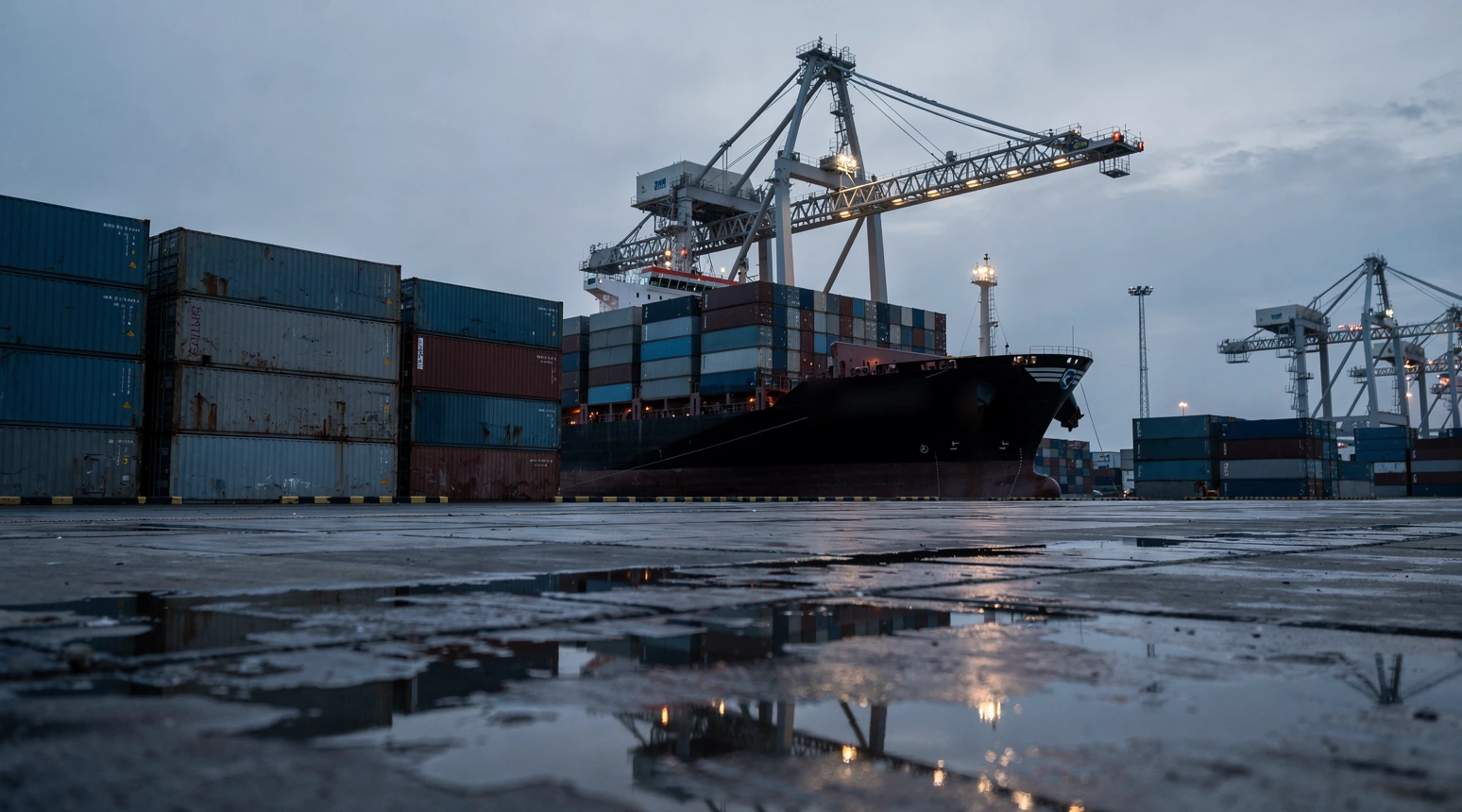
A coalition of more than 200 importers, exporters, carriers and transportation groups has asked the Office of the United States Trade Representative to keep its Section 301 port fees on China-linked vessels switched off past November 9, the date the current one-year suspension runs out. The request landed on September 23, one day before President Donald Trump and President Xi Jinping met at the White House.
The signatories include the International Chamber of Shipping, the World Shipping Council and the Chamber of Shipping of America, alongside manufacturers, agricultural exporters, logistics providers and retailers. Their argument is narrow and practical: China-built tonnage is embedded across the global container fleet, so a fee aimed at Chinese shipbuilding lands on almost every US import lane.
For retail importers the stake is a line item, not a headline. The published schedule prices the fee on operators of China-built vessels at either a per net ton rate or a per container rate, whichever produces the larger number, assessed per rotation of US port calls. Carriers recovered it as a surcharge during the four weeks the fee was live in late 2025, and there is no reason to expect a different mechanism if it returns.
The September 24 summit produced a two-month extension of the trade truce, soybean purchases and a delay to Chinese rare-earth export restrictions. Public reporting of the outcome did not describe any action on the vessel fees. That leaves the maritime clock running on its own schedule, roughly six weeks ahead of the newly extended truce.
In short
- The deadline is November 9, 2026. The Section 301 fees on China-linked vessels were suspended on November 10, 2025 for one year. Absent USTR action, the suspension lapses.
- More than 200 groups asked for an extension on September 23, including the World Shipping Council, the International Chamber of Shipping and the Chamber of Shipping of America.
- The headline number for container importers is per box. Operators of China-built vessels face a per container charge that the published schedule sets at $153 in 2026 and $195 in 2027, or a per net ton alternative, whichever is higher.
- The September 24 Trump-Xi summit did not visibly move the maritime file. Reporting centred on a two-month truce extension, soybeans and rare earths.
- Exemptions decide who actually pays. Vessels under 4,000 TEU, empty arrivals, Great Lakes and short sea traffic sit outside the fee as published.
What the coalition actually asked USTR to do
The September 23 submission does not ask USTR to abandon the Section 301 shipbuilding action. It asks for the suspension to continue past November 9 while negotiations with Beijing carry on. That is a deliberately modest request, and it reflects how the industry read the last twelve months.
The signatories accept the premise that US shipbuilding capacity has a structural problem. Their objection is to the instrument. As the coalition put it, vessel fees alone will not address the structural challenges facing the US shipbuilding sector. The fees raise the cost of moving cargo through American ports without adding a single hull to a domestic yard in the near term.
The second argument is about incidence. “Because China-built vessels represent a meaningful share of global ocean carrier capacity, the practical effect of the tariffs and fees would not be limited to a narrow set of market participants,” the groups wrote. A fee framed as pressure on Chinese operators reaches non-Chinese carriers running Chinese-built ships, which is most of the market.
Where retail trade bodies sit
The National Retail Federation and the Retail Industry Leaders Association, which represents more than 200 members, filed joint comments during the original rulemaking warning that the measures would push up both import and export prices. That position has not changed with the suspension.
The American Apparel and Footwear Association has been blunter. Nate Herman, the group’s senior vice president for policy, has argued that the fees risk job losses for American workers, higher costs on exports and imports, and scarcity that feeds through to household prices. Apparel and footwear are among the most container-intensive retail categories, so the per box structure hits them harder than it hits high-value, low-volume goods.
How the Section 301 vessel fees are built
USTR finalised the action on April 17, 2025, following its Section 301 investigation into China’s targeting of the maritime, logistics and shipbuilding sectors. The fees took effect on October 14, 2025. They were suspended less than a month later, on November 10, 2025, after the Trump and Xi meeting in late October and the White House fact sheet that followed.
The structure is not one fee but several, separated by who owns the vessel, who built it and what it carries. Importers who have followed the older Section 301 tariffs on China imports will recognise the statutory basis but not the mechanics: this action charges the vessel, not the cargo’s country of origin.
Chinese owners and operators
The heaviest tier applies to vessels owned or operated by Chinese entities. The published schedule prices this at $50 per net ton from October 2025, stepping to $80 in April 2026, $110 in 2027 and $140 in 2028. The charge is capped at five assessments per vessel per year.
Operators of China-built vessels
This is the tier that matters most for retail freight, because it captures non-Chinese carriers whose fleets include Chinese-built tonnage. It is assessed as the higher of two calculations: a per net ton rate of $18 from October 2025, $23 from April 2026, $28 in 2027 and $33 in 2028, or a per container rate of $120 from October 2025, $153 in 2026, $195 in 2027 and $250 in 2028.
How USTR would re-enter that escalation after a one-year pause has not been set out publicly. An importer modelling the downside should treat the 2026 and 2027 steps as the plausible range rather than assume a reset to the opening rate.
Vehicle carriers and LNG
Foreign-built vehicle carriers face a separate charge reported at $150 per car arriving on the vessel. A third component phases in US-built tonnage requirements for LNG exports: 1% from 2028, rising by 2 percentage points every two years toward 15% by 2047. Neither touches general merchandise retail directly, but both shape carrier economics on the routes that do.
What the fee would cost per container
The per container tier is the figure retail finance teams can actually use. It attaches to containers discharged during a rotation of US port calls, so a single box crossing the Pacific picks up one charge rather than one per port.
Set against prevailing trans-Pacific spot rates, the charge is material without being catastrophic. Freight pricing has already absorbed several structural shocks this cycle, including the rerouting captured in our earlier look at ocean freight rates and the Red Sea effect. The vessel fee stacks on top of whatever the market is charging.
| Period | China-owned or operated (per net ton) | China-built, other operator (per net ton) | China-built, other operator (per container) |
|---|---|---|---|
| October 2025 (original effective date) | $50 | $18 | $120 |
| April 2026 step | $80 | $23 | $153 (2026 tier) |
| 2027 | $110 | $28 | $195 |
| 2028 | $140 | $33 | $250 |
The per net ton and per container calculations are alternatives, with the operator paying the higher of the two. On a large container vessel the net tonnage route often produces the bigger number, which is why carrier submissions during the rulemaking focused on tonnage rather than box counts.
Why the September 24 summit did not settle this
The Washington meeting ran roughly three hours and produced an extension of the existing truce by two months, additional Chinese soybean purchases and a delay to rare-earth export restrictions until January 10. A Congressional Research Service assessment cited alongside the summit put average tariffs on Chinese goods entering the US at 36.5%, and on US goods entering China at 31%.
What the summit readouts did not contain was a maritime decision. Our preview of the meeting, Trump hosts Xi on September 24, flagged the truce extension as the central retail question, and that is where the outcome landed. The vessel fee suspension sits on a separate USTR instrument with its own expiry.
Analysts were unimpressed by the durability of the arrangement. One characterised the deal to Al Jazeera as a temporary sandbag holding back a structural flood rather than a bridge to a grand bargain, noting that successive extensions have been getting shorter.
Two clocks, two dates
The practical consequence is a sequencing problem. The trade truce now runs into January. The vessel fee suspension expires November 9. Unless USTR acts separately, the maritime measure reactivates inside a period the two governments have nominally agreed to keep calm.
| Instrument | Legal basis | Current status | Next date |
|---|---|---|---|
| China-linked vessel port fees | Section 301, maritime and shipbuilding investigation | Suspended since November 10, 2025 | Expires November 9, 2026 |
| Bilateral tariff truce | Negotiated, Busan framework | Extended at the September 24 summit | Roughly two months from the summit |
| Chinese rare-earth export controls | Chinese export administration | Delayed at the summit | January 10 |
| China’s retaliatory vessel fees | Chinese Ministry of Transport | Suspended in parallel | Tracks the US suspension window |
How a vessel fee reaches a retail importer
Ocean carriers do not absorb regulatory charges of this type. They publish them as a named surcharge on the bill of lading, and the charge flows to whoever holds the freight terms. Under most retail contracts that is the importer.
This is the same pass-through pattern visible elsewhere in the parcel and freight market this month, including the FedEx US import demand surcharges that took effect on September 21. Named surcharges move faster than base rates and are harder to negotiate away mid-contract.
Who actually absorbs it
Large retailers with annual carrier contracts and volume commitments have some ability to push back, or at least to defer the charge to the next contract cycle. Small and mid-sized importers buying on spot or through forwarders typically see it appear in full on the next invoice.
That asymmetry matters for the incidence argument the coalition is making. A fee designed to change Chinese industrial policy is, at the retail end, a regressive cost that falls hardest on the importers with the least negotiating leverage.
The timing problem for holiday freight
A November 10 reactivation would land after the bulk of holiday inventory has already been discharged. The exposure is therefore to first quarter replenishment and to spring 2027 buys, not to goods already on the shelf. Importers with Q1 purchase orders still open have a live decision.
Which retail categories are most exposed
Exposure to a per container charge tracks cubic volume rather than value. The categories that fill containers cheaply carry the charge as a larger share of landed cost.
| Category | Container intensity | Relative exposure to a per box fee |
|---|---|---|
| Apparel and footwear | High volume, moderate value density | High |
| Furniture and home goods | Very high volume, low value density | Very high |
| Toys and seasonal goods | High volume, low value density | Very high |
| Consumer electronics | Moderate volume, high value density | Low |
| Jewellery and small accessories | Low volume, very high value density | Minimal |
A $153 charge on a container of televisions is a rounding error against the cargo value. The same charge on a container of patio furniture or plush toys is a real margin event, particularly for sellers operating on thin keystone markups.
What China did in response, and what it would do again
When USTR activated the fees in October 2025, China’s Ministry of Transport imposed retaliatory port charges on US-built, US-owned and US-operated vessels. When Washington suspended its measure on November 10, 2025, Beijing suspended its own for the same one-year period.
The symmetry is the point. A lapse on the US side would reactivate the Chinese measure on a similar timetable, adding cost to US agricultural and industrial exports moving through Chinese ports. Exporters signed the September 23 submission for exactly that reason.
The bilateral machinery for handling this kind of file now exists. The mechanism described in our coverage of the US-China Board of Trade and its consumer goods relief list is the natural venue for a maritime carve-out, though nothing public suggests the vessel fees have been tabled there.
The exemptions that decide who pays
The published action carries a substantial set of carve-outs, and they do more work than the headline rates suggest. Vessels with capacity below 4,000 TEU sit outside the fee. So do empty vessels arriving to load US exports, Great Lakes traffic, short sea shipping, certain specialised vessels and participants in Maritime Administration programmes.
There is also a relief valve tied to domestic shipbuilding. Operators that place orders for US-built replacement tonnage can obtain a suspension of the charge for up to three years. That provision is the clearest statement of what the action is actually for.
Why the 4,000 TEU threshold matters
Mainline trans-Pacific services run vessels far above 4,000 TEU, so the exemption does not shelter the primary retail import lanes. It does protect feeder and regional services, which is why the incidence lands on long-haul Asia to US West Coast and Asia to US East Coast strings.
Importers routing through transhipment hubs should not assume the exemption travels with the box. The charge attaches to the vessel calling at the US port, whatever the earlier legs looked like.
What the fee is designed to fix
The Section 301 investigation behind the action found that China’s targeting of the maritime, logistics and shipbuilding sectors had produced a dominance that burdens US commerce. The remedy USTR chose pairs a cost on China-linked tonnage with incentives to order American hulls.
The diagnosis is not seriously contested. US commercial shipbuilding output is a rounding error against Chinese, South Korean and Japanese yards, and the domestic order book for large container vessels is effectively empty. The dispute is about whether a port charge can change that.
The three-year order relief
The most revealing provision is the suspension available to operators that place orders for US-built replacement vessels, which can run up to three years. It converts the fee from a punishment into a bargaining chip: order American tonnage and the charge goes away for the duration of the build.
Critics point out that the capacity to absorb such orders does not currently exist at scale. A carrier that wanted to take the deal would be queueing for yard slots that have not been built. That gap is the substance behind the coalition’s line that vessel fees alone will not address the structural challenges facing the sector.
Why the LNG clause is in the same action
The escalating US-built tonnage requirement for LNG exports, starting at 1% in 2028 and rising toward 15% by 2047, is a demand-side instrument rather than a penalty. It guarantees a future order book in a segment where US yards have a plausible path to competing. Container shipping received no equivalent guarantee, which is part of why the container industry reads the fee as cost without corresponding investment logic.
The legal ground under Section 301 is being tested
The vessel fees rest on Section 301 of the Trade Act of 1974, and that statute is under unusually heavy litigation pressure this year. The pressure is indirect, but importers modelling the November deadline should understand the backdrop.
On February 20, 2026 the Supreme Court held in a 6-3 ruling that the International Emergency Economic Powers Act does not authorise presidential tariffs, invalidating the reciprocal and trafficking tariffs imposed under that statute. The administration responded by rebuilding tariff coverage on other authorities, with Section 301 carrying much of the load.
That shift drew its own challenges. Coalitions of small-business importers and a group of 25 state attorneys general have separately sued over the Section 301 forced-labor tariffs imposed on 60 economies in July, and the US Court of International Trade has set oral argument in those consolidated cases for September 30.
Why the maritime action sits on firmer ground
The forced-labor cases attack a specific theory: that Section 301 can be used to impose near-uniform duties on substantially all imports from substantially all countries at preestablished rates. The maritime action is narrower and looks more like a conventional Section 301 case, with a single named country, an identified practice and a remedy aimed at that practice.
That distinction matters for planning. A ruling against the forced-labor tariffs would not automatically reach the vessel fees. Importers should not treat the September 30 hearing as a route out of the November 9 problem.
What a bad ruling would change anyway
An adverse decision on the breadth of Section 301 would still alter the negotiating climate. If the administration’s most expansive use of the statute is narrowed, the appetite to reactivate a second contested Section 301 measure inside a live truce is likely to fall. That is a political read rather than a legal one, but it is the one carriers appear to be making.
How this compares with the other import cost increases of 2026
The vessel fee is not arriving into a calm cost base. Retail importers have absorbed a sequence of separate charges this year, each introduced on its own timetable and each recovered as a named line item rather than through base rates.
| Measure | Who sets it | Status in late September 2026 | Typical unit |
|---|---|---|---|
| Section 301 China-linked vessel fees | USTR | Suspended, expires November 9 | Per container or per net ton |
| Express carrier import demand surcharges | Carriers | Live since September 21 | Per pound, by origin |
| EU parcel handling fee | European Union | Arrives November 1 | Per parcel |
| Section 301 forced-labor tariffs | USTR | Live, under challenge | 10% or 12.5% ad valorem |
Read together, the pattern is a shift from ad valorem duties toward per unit charges. Ad valorem tariffs scale with the value of goods and therefore fall lightly on cheap, bulky merchandise. Per container and per parcel fees invert that, and they land hardest on the low-value, high-volume segments that define discount and mass-market retail.
The compounding problem
Each individual charge is small enough to be survivable. The difficulty is that retail buying decisions for spring 2027 are being made now, against a cost base where four separate charges could all be live simultaneously and none of them appeared in last year’s models.
Merchandising teams that priced Q1 assortments in August did so without the vessel fee in the landed cost. If the suspension lapses, the gap shows up as margin compression rather than as a price increase, because retail prices for that season are largely already set.
What a lapse would mean for sourcing decisions
The fee attaches to the vessel, not to the cargo’s origin, which produces an unusual result: moving production out of China does not avoid it. A container of goods made in Vietnam and carried on a Chinese-built vessel is exposed, while a container of Chinese goods on a Korean-built vessel is not.
That breaks the standard tariff-mitigation playbook. The usual responses to a China tariff, which are origin shifting, tariff engineering and first sale valuation, have no effect on a charge levied against the ship.
The lever that does work
The only meaningful mitigation available to an importer is carrier and service selection. That requires fleet-level information most importers do not currently collect, and it runs against the grain of contracts built around rate and reliability rather than hull provenance.
Forwarders are the practical route to that information for small and mid-sized importers. A forwarder booking across multiple carriers can steer volume toward services with lower China-built exposure, assuming capacity allows and the rate differential does not exceed the fee it avoids.
What importers can do before November 9
There is no exclusion process for a vessel fee in the way there is for a product tariff, so the available responses are commercial rather than legal.
- Read the surcharge clause. Check whether current carrier contracts allow a new regulatory surcharge to be introduced mid-term, and on what notice.
- Ask carriers for their fleet exposure. Carriers know what share of the tonnage on each string is Chinese-built. That determines whether a given service is exposed at all.
- Model the per box case, not the per ton case. The per container figure is the one an importer can forecast without vessel-level data.
- Move the decision point on Q1 orders. Goods discharging before November 10 are outside the exposure window entirely.
- Watch the Federal Register, not the summit coverage. An extension would arrive as a USTR notice, not as a leaders’ statement.
USTR’s original announcement of the shipbuilding action remains the reference document for scope and rates, and is published on the agency’s shipbuilding action fact sheet.
What to watch next
The decision point is USTR’s. The agency said when it suspended the fees that it would consider, in advance of the November 10, 2026 expiry, whether China’s negotiating posture justified continuing the suspension or taking other action. That language leaves three outcomes open: a clean extension, a lapse, or a modified action at different rates.
The two-month truce extension agreed on September 24 is the most useful signal available. A government preparing to let a maritime measure snap back inside a freshly extended truce would be sending a mixed message, but the extension was short and the summit was thin on substance, so nothing is settled.
For retail importers the practical horizon is the next six weeks. If a USTR notice extending the suspension has not appeared by late October, Q1 landed cost models should carry the surcharge as a live assumption rather than a tail risk.
FAQ
When exactly does the suspension end?
The suspension took effect on November 10, 2025 and runs for one year, expiring November 9, 2026. Without a further USTR action the fees become applicable again from November 10, 2026.
Do these fees apply to the cargo or to the ship?
To the ship. Unlike a Section 301 tariff on goods, this action charges the vessel operator based on where the vessel was built and who owns or operates it. The country of origin of the cargo inside the containers is not the trigger.
How much would it add to a 40-foot container?
The published per container tier is $120 from October 2025, $153 in 2026, $195 in 2027 and $250 in 2028. The operator pays the higher of the per container or per net ton calculation, so the amount a carrier chooses to recover per box may differ from the schedule figure.
Which carriers are affected?
Any operator running Chinese-built tonnage on US port rotations, not only Chinese carriers. That is the core of the coalition’s argument, since China-built vessels make up a meaningful share of global container capacity.
Did the September 24 Trump-Xi summit resolve it?
No. Reporting on the summit described a two-month truce extension, additional soybean purchases and a delay to rare-earth export restrictions until January 10. No public action on the vessel fees was described.
Is there an exclusion process importers can file?
Not in the product-exclusion sense. The action carries categorical exemptions, including vessels below 4,000 TEU, empty arrivals for export loading, Great Lakes and short sea traffic, and relief for operators ordering US-built replacement vessels. Individual importers cannot apply for relief from a vessel charge.
Would China retaliate again?
China imposed matching port charges on US-built, US-owned and US-operated vessels when the US fees went live in October 2025, then suspended them in parallel in November 2025. A US lapse would be expected to reactivate the Chinese measure, which is why US exporters joined the September 23 submission.
Does this affect holiday 2026 inventory?
Largely no. Holiday goods for the 2026 season are already landed or in transit ahead of a November 10 reactivation. The exposure sits in first quarter 2027 replenishment and spring buys.
Who signed the September 23 request?
More than 200 organisations, including the International Chamber of Shipping, the World Shipping Council and the Chamber of Shipping of America, together with importers, exporters, manufacturers, retailers, agricultural groups and logistics providers.