
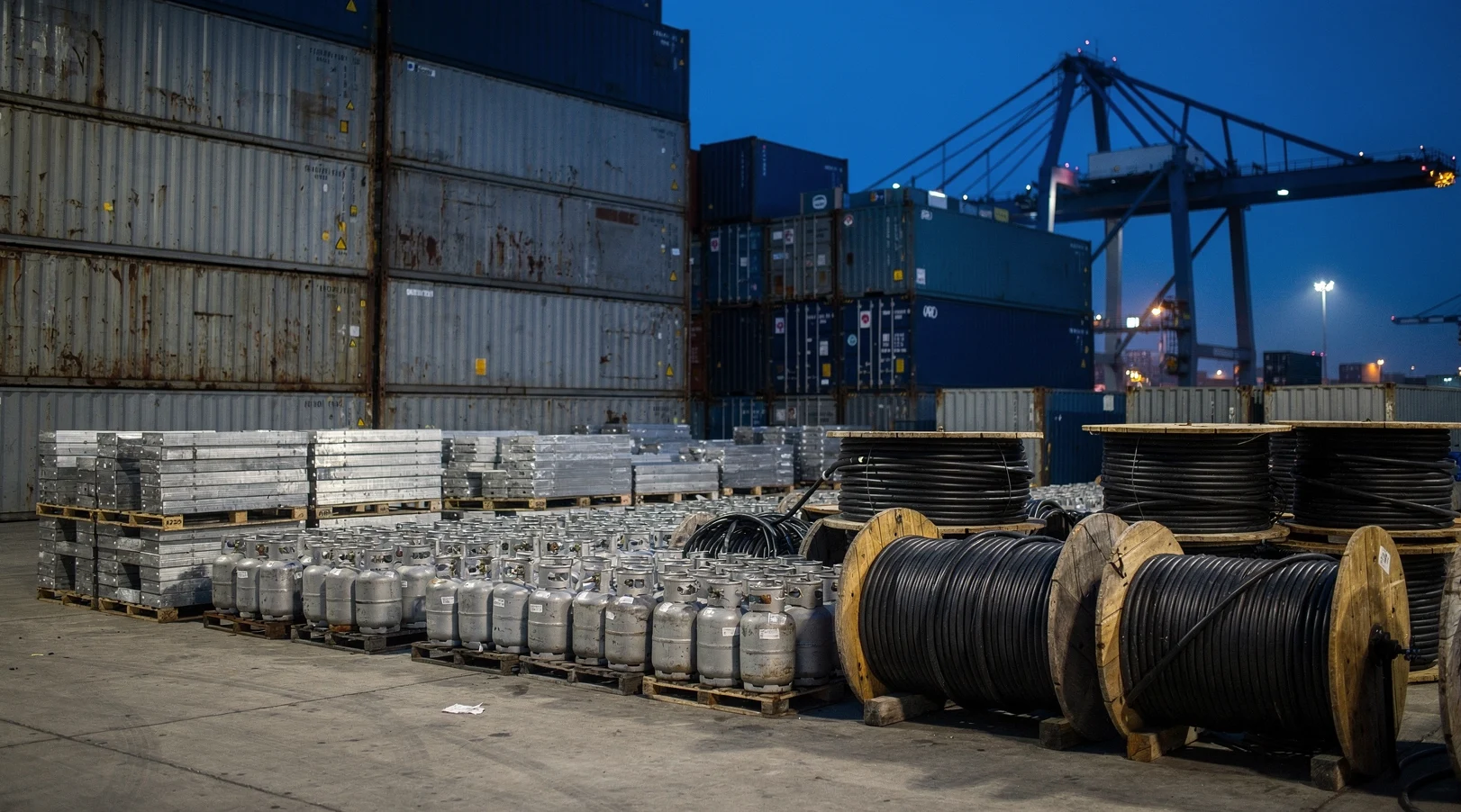
The US Commerce Department has proposed pulling fourteen more product groups into the Section 232 tariffs on aluminum, steel and copper, and the public has until August 27, 2026 to say anything about it. The list is unusual because it reaches past raw metal and industrial inputs into goods that sit on retail shelves: fire extinguishers, floor safes, extension cords, propane cylinders and brass-wind instruments.
The Bureau of Industry and Security (BIS) released the notice on August 4, 2026. It was published in the Federal Register on August 6 under document number 2026-15961, opening a 21-day comment window on docket BIS-2026-0331. Most of the proposed additions would carry a 25% duty.
For retailers and marketplace sellers, the deadline matters more than the proposal itself. Once the comment window closes, the mechanics of the inclusions process move quickly and largely out of public view.
The proposal also arrives at a specific moment in US trade policy. Six months after the Supreme Court removed one major tariff authority, Section 232 is carrying more weight than at any point since it was revived, and its scope is now widened through a standing administrative process rather than one-off executive action.
In short
- What happened: BIS proposed adding 14 derivative article groups to the Section 232 aluminum, steel and copper tariffs on August 4, 2026, published in the Federal Register on August 6.
- The deadline: Comments close August 27, 2026 on docket BIS-2026-0331 at regulations.gov, 21 days after publication.
- The rates: Most groups would face 25%. Filled steel gas containers would face 50% on the container value only. Certain cranes and agricultural trailers would sit at 15% under existing proclamation terms.
- Why retail cares: Unlike earlier rounds, this list includes consumer-facing SKUs sold through hardware, grocery, farm supply, music and general merchandise channels, not only industrial inputs.
- The bigger picture: After the Supreme Court struck down IEEPA tariffs in February 2026, Section 232 is the durable tariff authority still standing, and the inclusions process is how its scope keeps widening.
What Commerce actually proposed on August 4
The notice is a request for public comment on a proposed implementation, not a final rule. BIS is asking whether fourteen categories of goods should be treated as derivative articles of aluminum, steel or copper, and therefore made subject to the Section 232 duties already in force on those metals.
According to the Federal Register notice, BIS is seeking input on four specific questions: the aluminum, steel and copper content of each product, current import volumes, domestic production capacity, and the likely economic effects of inclusion. Those are the criteria the agency weighs when deciding whether a derivative product belongs inside the tariff perimeter.
KPMG, which published an analysis of the notice on August 5, described the action as a proposal to add fourteen additional derivative articles across all three metals. Trade advisory firms including Mallory Group and Sobel Network Shipping published parallel breakdowns, each listing the same fourteen groups and the same August 27 cutoff.
The inclusions mechanism itself is not new. Commerce adopted it through a rule published in the Federal Register on May 2, 2025, which established a standing procedure for adding derivative products to the Section 232 metal tariffs without running a fresh national security investigation each time.
That procedural shortcut is what makes the current notice consequential. A traditional Section 232 action requires a Commerce investigation and a presidential proclamation, a sequence that typically runs many months. The inclusions process reaches the same outcome for a derivative product on a far shorter timetable.
What BIS is not asking about is equally telling. The notice does not reopen the question of whether aluminum, steel or copper imports threaten national security, because that finding is already settled in the underlying proclamations. The only live question is whether these fourteen product groups are derivative articles of metals already inside the perimeter.
That narrows what an effective comment can address. Arguments about the merits of metal tariffs generally are outside the scope of this docket. Arguments about metal content, import volumes, domestic capacity and economic effect are squarely inside it.
Which fourteen product groups are on the list
The proposed additions span consumer hardline goods, industrial components and heavy transport equipment. The table below sets out each group with its HTSUS classification and the rate that would apply if the product is included.
| Product group | HTSUS classification | Proposed rate |
|---|---|---|
| Aluminum powder | 7603.10.0000 | 25% |
| Brass-wind instruments and parts | 9205.10.0000, 9209.99.4080 | 25% |
| Welding machine parts | 8515.90.2000 | 25% |
| Floor safes | 8303.00.0000 | 25% |
| Electric conductor cables | 8544.49.2000/.3040/.3080, 8544.60.4000 | 25% |
| Fire extinguishers | 8424.10.0000 | 25% |
| Heat exchange unit parts | 8419.90.3000 | 25% |
| Hydraulic engine and motor parts | 8412.90.9005 | 25% |
| Mobile lifting frames, straddle carriers | 8426.12.0000 | 15% to 25% |
| Self-propelled cranes | 8426.41.0090 | 15% to 25% |
| Tanker trailers and semi-trailers | 8716.31.00 | 25% |
| Agricultural self-loading trailers | 8716.20.00 | 15% |
| Other trailers and semi-trailers | 8716.40.00 | 25% |
| Filled propane, oxygen, propylene containers | 2711.12.0020, 2804.40.0000, 2901.22.0000 | 50% (container value only) |
The consumer-facing SKUs
Six of the fourteen groups map directly onto products stocked by mainstream retailers. Fire extinguishers and floor safes are staples of home improvement and general merchandise assortments. Electric conductor cables cover a range of cord and cable products sold through hardware and online channels.
Filled propane cylinders are the most visible of the group. They sit in exchange cages outside grocery stores, hardware chains and farm supply retailers across the country, and they turn over on a high-frequency replacement cycle rather than a considered-purchase cycle.
Brass-wind instruments are the outlier that illustrates the reach of the proposal. Trumpets, trombones and their parts are sold through specialist music retail and rented through school band programs, a channel with pronounced late-summer seasonality that overlaps with the comment window itself.
Agricultural trailers round out the retail-adjacent set. They move through farm and ranch retail chains where the customer is often a small business owner rather than a pure consumer, which changes how quickly a duty gets passed through to the sticker price.
The industrial and logistics equipment
The remaining groups sit further upstream. Welding machine parts, heat exchange unit parts and hydraulic engine components are maintenance, repair and operations inventory, typically sold through industrial distributors rather than consumer storefronts.
Self-propelled cranes, mobile lifting frames and straddle carriers are capital equipment for ports, yards and distribution centers. A 15% to 25% duty on this category lands on warehouse and terminal capex at a point when many operators are already mid-cycle on automation investment. Retailers running their own fulfillment networks would feel this as a project cost rather than a cost of goods.
Tanker trailers and the residual trailer category affect carriers and private fleets. Distribution costs tend to reach shelf prices with a longer lag than direct product duties, but they do reach them. The pattern is familiar from earlier rounds, and it echoes the equipment and distribution spending that surfaced in Lowe’s Pro distribution build-out this quarter.
How the duty is actually calculated
The rate headline understates the complexity. Section 232 derivative duties are assessed either on the full customs value of the imported product or on the value of its metal content, and which method applies depends on the HTSUS classification of the specific article.
That distinction is the single most consequential detail for anyone modeling landed cost. A 25% duty on the full value of a fire extinguisher is a materially different number from 25% on the steel content of the same unit. Importers who assume the wrong basis will misprice the entire category.
Getting the classification right is therefore the first step, not an administrative afterthought. Readers working through their own exposure may want to revisit the fundamentals of HTS classification for retail goods before attempting a landed-cost model on these lines.
Reduced rates can also apply based on country of origin and US metal content thresholds under the terms of the existing proclamations. Those adjustments are not uniform across the fourteen groups, which is part of why the proposed rates in the table are not all the same number.
There is a further wrinkle for products that already carry duties from other programs. Section 232 duties generally stack on top of ordinary customs duties rather than replacing them, so the effective landed rate on an affected line is the sum of the applicable measures rather than the Section 232 figure alone.
For importers building a forecast, that means the relevant comparison is total landed cost before and after inclusion, not the 25% headline in isolation. A line already carrying a meaningful most-favored-nation rate reaches a different total than one entering duty-free today.
The filled-container carve-out
The treatment of filled gas containers is the clearest example of basis mattering more than rate. The proposal would apply a 50% duty, but only to the value of the steel container itself. The propane, oxygen or propylene inside is excluded from the Section 232 calculation.
The practical effect depends on the ratio of cylinder value to gas value in a given shipment. For a standard consumer propane exchange cylinder, the steel vessel represents a substantial share of the unit’s cost, so a 50% duty on that portion is not a rounding error.
This structure also creates a compliance burden that did not previously exist on these lines. Importers would need to separate and substantiate the container value from the commodity value at entry, which requires documentation that many shippers on these HTS codes have never had to produce.
Why August 27 is the date that matters
The comment period is the only phase of this process with a guaranteed public voice. Comments may be submitted at any time before the cutoff through the federal rulemaking portal at regulations.gov under docket BIS-2026-0331.
Twenty-one days is a short window by rulemaking standards. It is short enough that trade associations, rather than individual retailers, tend to carry most of the substantive submissions, because assembling import volume data and domestic capacity evidence takes longer than most companies have.
The asymmetry matters. Inclusion requests are typically filed by domestic producers seeking tariff protection, and those parties arrive with prepared evidence. Importers and retailers who oppose an inclusion are responding on a compressed clock to a proposal they may have learned about only when the Federal Register notice published.
Companies that want to be heard on this docket have days, not weeks. Anyone intending to file can review the procedural requirements on the BIS Section 232 inclusions process page.
A comment that carries weight looks different from a general objection. BIS named four criteria in the notice, and submissions that address them directly with figures tend to shape the record more than statements of position.
Import volume data is the most accessible of the four for a retailer, because it comes from the company’s own entry records. Domestic production capacity is harder, since it usually requires industry-level data that only associations hold.
Economic effect is where retail has a distinct contribution to make. Domestic producers can speak to production economics, but only importers and retailers can document what a duty does to assortment decisions, shelf prices and category demand.
How the inclusions process works and how fast duties land
The standing inclusions procedure was adopted on April 30, 2025 and published in the Federal Register on May 2, 2025. It replaced ad hoc scope expansion with a repeatable administrative cycle.
The 60-day clock
Under the procedure, BIS reviews each inclusion request and issues a positive or negative determination within 60 days of receiving it. The determination memorandum must be signed before the close of that 60-day processing period, as directed in the underlying inclusions proclamations.
That is a firm administrative deadline rather than an aspirational target. It means the interval between a proposal becoming public and duties becoming real is measured in weeks, not the multi-year horizon typical of trade remedy cases.
When a determination is positive, BIS issues a Federal Register notice modifying the annexes to the inclusions proclamations, adding the product at the eight-digit or ten-digit HTSUS subheading. Duties on newly included derivative articles take effect shortly afterward through coordination with US Customs and Border Protection.
The three annual windows
The steel and aluminum inclusions process accepts requests in two-week windows three times per year, in January, May and September. The first submission period opened on May 1, 2025. A separate process for automobile parts operates on a four-times-yearly cadence under a distinct rule published in September 2025.
The windowed structure has a consequence that is easy to miss. Scope expansion is now continuous and scheduled, which means any given product category can be proposed for inclusion three times a year indefinitely. A category that survives one window is not permanently outside the perimeter.
For merchandising and sourcing teams, that turns Section 232 scope from a one-time shock into a recurring calendar item. The September window follows closely behind the current comment deadline.
Why Section 232 matters more after the IEEPA ruling
The strategic context for this proposal is a Supreme Court decision handed down six months earlier. On February 20, 2026, the Court held that the International Emergency Economic Powers Act does not authorize the president to impose tariffs, invalidating a large block of duties built on that authority.
Section 232 was not affected by that ruling. It rests on the Trade Expansion Act of 1962 and requires a Commerce Department finding that imports threaten to impair national security, a procedural foundation the Court did not disturb. The practical result is that Section 232 became the primary surviving instrument for import restriction.
| Feature | IEEPA tariffs | Section 232 tariffs |
|---|---|---|
| Legal status | Struck down February 20, 2026 | In force |
| Statutory basis | International Emergency Economic Powers Act | Trade Expansion Act of 1962 |
| Prerequisite | Declared national emergency | Commerce national security finding |
| Scope expansion | Executive action | Inclusions process, three windows per year |
| Speed to effect | Immediate on proclamation | 60-day determination, then CBP implementation |
| Refund exposure | Approximately $128.68bn in CAPE processing | None arising from the 2026 ruling |
The refund line in that table is not hypothetical. In an August 4, 2026 declaration to the Court of International Trade, CBP Trade Policy and Programs executive director Brandon Lord reported that as of July 31, more than 75,000 CAPE declarations had been submitted and 17.69 million validated entries had been liquidated without IEEPA tariffs. Roughly $128.68 billion in potential and certified refunds had been accepted for processing.
Those refunds flow to importers of record and their brokers rather than to retailers who absorbed the cost downstream, per CIT rulings on the question. The distinction has already shaped how large chains report the money, as seen when Walmart redirected its tariff refund into price cuts alongside second quarter results this week.
Section 232 activity has accelerated in parallel. A proclamation signed August 6, 2026 imposed 15% duties on polysilicon and downstream derivatives including solar cells and modules, effective December 4, and separately established a minimum import price regime. The pattern of expansion also runs through the Section 232 tariffs on drones taking effect September 3.
How this round fits the wider Section 232 build-out
The fourteen-product proposal is one thread in a broader expansion running through 2026. Read alongside the other actions of the past month, it shows an authority being extended on several fronts at once rather than in a single sweeping move.
The polysilicon proclamation signed on August 6 is the clearest parallel. It imposed a 15% duty on downstream products including ingots, wafers, solar cells and modules, and it paired the tariff with a minimum import price regime, a tool that had not featured in earlier metal actions. Those measures take effect on December 4, 2026, exactly 120 days after signature.
The drone measures follow a similar template on a different timetable, with rates differentiated by product tier rather than applied uniformly. Together the three actions suggest an approach that increasingly tailors the instrument to the category instead of applying a single rate across a metal.
The derivative inclusions process differs from both in one respect that matters for planning. Proclamations arrive with a stated effective date and substantial lead time. Inclusions arrive through an annex amendment on a 60-day administrative clock, which compresses the window for repricing and resourcing.
The direction of travel is consistent across all three. Coverage keeps moving downstream, away from raw metal and toward finished goods, and the fourteen groups on the current list sit further down that chain than any previous inclusions round.
What this costs retailers at shelf level
The retail impact depends less on the headline rate than on category margin structure and sourcing concentration. A 25% duty on a category sourced primarily from domestic suppliers is close to irrelevant. The same duty on a category with 80% import penetration and a 30% gross margin is a pricing event.
| Category | Primary retail channel | Purchase pattern | Pass-through pressure |
|---|---|---|---|
| Filled propane cylinders | Grocery, hardware, farm supply | High-frequency replacement | High: visible unit price |
| Fire extinguishers | Home improvement, general merchandise | Infrequent, compliance-driven | Moderate: low price sensitivity |
| Electric conductor cables | Hardware, online marketplaces | Impulse and project-driven | High: price-comparison heavy |
| Floor safes | General merchandise, online | Considered purchase | Moderate: absorbed in ticket |
| Brass-wind instruments | Specialist music retail, rental | Seasonal, education-linked | Low to moderate: rental buffers |
| Agricultural trailers | Farm and ranch retail | Capital purchase | Moderate: business buyer |
Categories with thin margins face the sharpest choice
Cable and cord products are the clearest pressure point. They are heavily price-compared on marketplaces, they carry modest margins, and a 25% duty on full customs value cannot be absorbed quietly at that structure.
Propane exchange is the second. The unit price is posted on the cage, customers buy on a repeat cycle, and any increase is immediately legible to the shopper in a way that a price change on a considered purchase is not.
Fire extinguishers sit at the opposite end. Purchase is often driven by code compliance or replacement schedule rather than discretionary demand, which historically supports pass-through with limited volume loss.
The timing of any pass-through is its own variable. Duties apply at entry, so the effect appears in cost of goods only as tariffed inventory cycles through, which is one reason tariff costs reach shelf prices weeks after the policy change rather than on the effective date.
Inventory position determines the length of that lag. A retailer holding several months of cover on an affected SKU sells through pre-tariff cost for a full cycle before the new duty appears in reported margin, while a fast-turning category feels it within weeks.
Private label complicates the picture further. When a retailer imports directly rather than buying from a domestic wholesaler, the duty lands on its own entry and shows up in gross margin immediately, with no supplier to absorb any part of it.
Marketplace sellers face the least room to maneuver. They rarely have the volume to renegotiate supplier terms, they compete on price-comparison surfaces where increases are immediately visible, and they typically hold thinner working capital buffers than chain retailers.
What retailers and sellers should do before the deadline
The immediate task is exposure mapping, and it is narrower than it sounds. The proposal is defined at specific HTSUS subheadings, so the question is binary for any given SKU: does its classification appear in the list or not.
Sourcing and compliance teams can answer that from existing entry summaries without waiting for a final determination. Pulling the last twelve months of entries against the fourteen listed classifications produces a defensible import volume figure in hours.
That figure has two uses. It sizes the cost exposure for planning, and it is exactly the kind of evidence BIS has asked for in the comment docket. A company with the data can file something substantive rather than a general objection.
Beyond the docket, the practical levers are the usual ones: verifying classification accuracy, reviewing country of origin and US metal content for any reduced-rate eligibility, and confirming whether contracts with suppliers allocate new duties to the buyer or the seller. Marketplace sellers operating on thin margins should treat the last point as urgent.
Classification review deserves particular attention because the proposal is drawn at specific subheadings. A product that is misclassified today may sit outside the listed codes on paper while belonging inside them in substance, which converts a pricing question into a compliance exposure.
Contract language is the lever with the shortest payback. Many supply agreements written before 2025 are silent on newly imposed duties, and where they are silent the cost typically falls on the importer of record by default.
Assortment planning is the slower lever but often the larger one. If a category is likely to carry a 25% duty from late in the year, decisions about next season’s buy, private label versus branded mix, and domestic sourcing alternatives are better made before the determination than after it.
What happens after August 27
Once the window closes, BIS reviews the submissions and issues determinations. Neither the Federal Register notice nor the BIS process documentation specifies a fixed public date for the final decision on this particular proposal, so the timeline should be read against the 60-day determination requirement rather than treated as certain.
If a product is included, the mechanism is a Federal Register notice amending the proclamation annexes, followed by CBP implementation. Importers should expect limited lead time between publication and duty collection, because the annex modification is the operative step and CBP coordination follows it closely.
There is no indication in the notice that inclusion would be retroactive. Duties would apply to entries made on or after the effective date established in the amending notice.
A negative determination is also a real outcome. BIS issues positive or negative determinations on each request, and inclusion is not automatic simply because a product was proposed and published for comment.
Companies should nonetheless plan on the assumption that some subset of the fourteen groups is included. Planning for the affirmative case costs little if it does not materialize, while the reverse leaves no time to react.
The September inclusions window is the next scheduled opportunity for additional requests, which means sourcing teams should treat scope review as a standing quarterly exercise rather than a response to individual headlines.
Frequently asked questions
What is the deadline to comment on the proposed Section 232 additions?
Comments must be received by August 27, 2026. They are submitted through the federal rulemaking portal at regulations.gov under docket number BIS-2026-0331. The window is 21 days from Federal Register publication on August 6, 2026.
How many products would be added and at what rate?
Fourteen derivative article groups are proposed. Most would carry a 25% duty. Filled steel gas containers would face 50% on the container value only, and certain cranes, lifting frames and agricultural trailers would sit at 15% under existing proclamation terms.
Is the duty charged on the full product value or just the metal content?
It depends on the HTSUS classification of the specific article. Section 232 derivative duties are assessed either on full customs value or on the value of the steel, aluminum or copper content. Importers should confirm the basis for each classification before modeling landed cost.
Why are propane cylinders treated differently?
The proposed 50% duty applies only to the value of the steel container, not to the propane, oxygen or propylene inside it. That requires importers to separate container value from commodity value at entry, a documentation step not previously required on those lines.
Does the Supreme Court IEEPA ruling affect these tariffs?
No. The February 20, 2026 decision held that IEEPA does not authorize tariffs, but Section 232 rests on the Trade Expansion Act of 1962 and was not disturbed. Section 232 duties remain fully in force and are not subject to the refund process now running through CBP.
How quickly could these duties take effect?
BIS must issue a determination within 60 days of receiving an inclusion request. If positive, a Federal Register notice modifies the proclamation annexes at the eight-digit or ten-digit HTSUS level, and duties take effect shortly afterward through coordination with CBP.
Can a product be proposed for inclusion again if it is rejected?
Yes. The steel and aluminum inclusions process accepts requests in two-week windows three times per year, in January, May and September. A category that avoids inclusion in one window can be proposed again in a subsequent window.
Who typically files inclusion requests?
Inclusion requests generally come from domestic producers and trade associations seeking tariff protection for their product lines. Importers and retailers usually participate on the opposing side during the comment window rather than initiating the request.
What should a small marketplace seller do right now?
Check whether any imported SKU falls under the fourteen listed HTSUS classifications, using existing entry summaries. If so, review supplier contracts to establish who bears new duties, and confirm classification accuracy before assuming exposure or the lack of it.
The bottom line
The August 27 deadline is a narrow procedural moment inside a much larger shift. Section 232 has become the load-bearing tariff authority in US trade policy, and its inclusions process has turned scope expansion into a scheduled, recurring event with a 60-day clock attached.
What distinguishes this particular round is where the list reaches. Fire extinguishers, propane cylinders, extension cords and school band instruments are not industrial inputs, and their appearance signals that the derivative perimeter now extends to goods a shopper picks up without any thought of trade policy.
Retailers with import exposure on the fourteen listed classifications have days to file evidence and months to reprice. The first of those windows closes on August 27.