
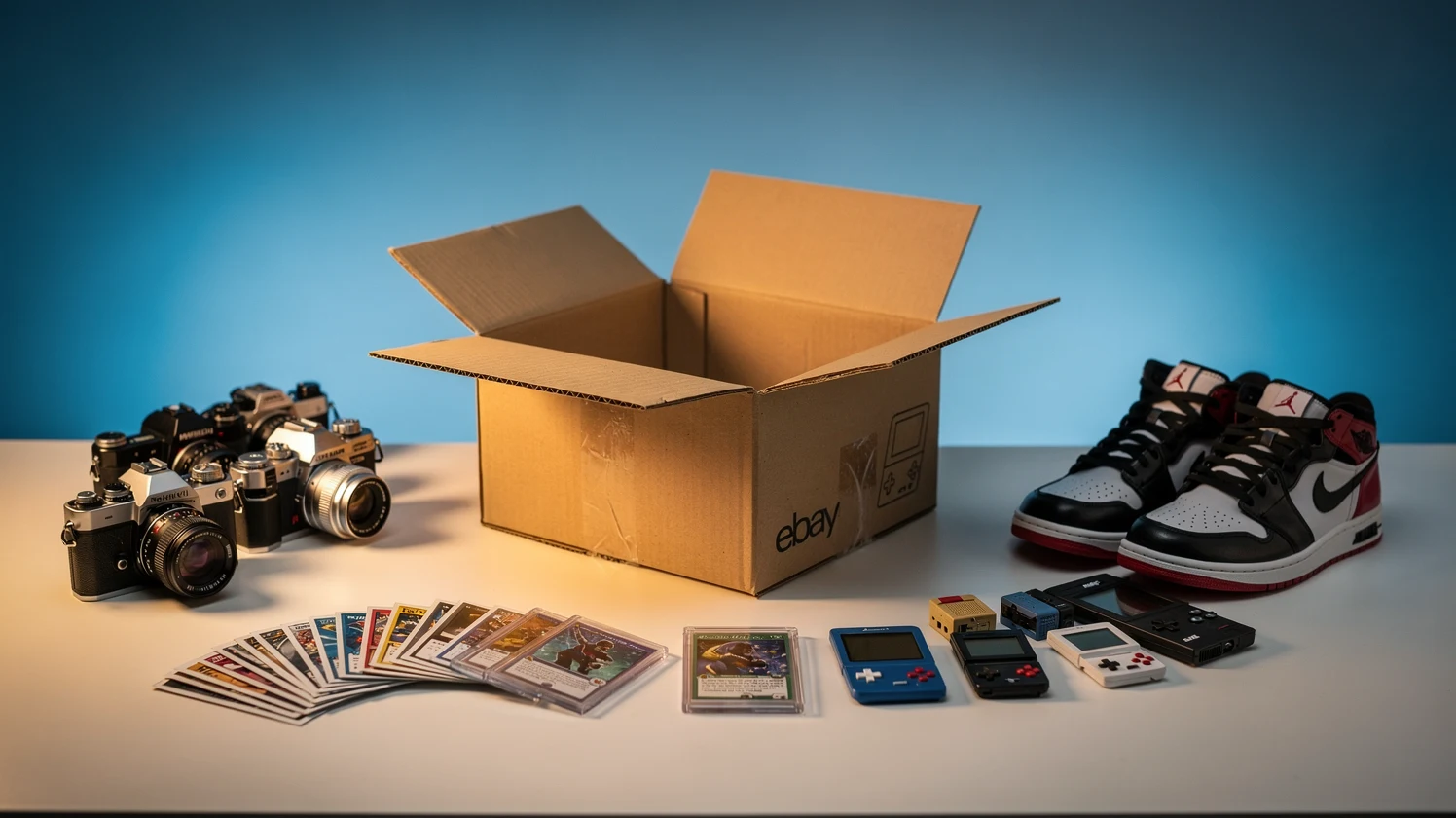
eBay turned 30 in 2025, and the obvious question for anyone selling online in 2026 is whether the original internet marketplace still deserves a place in the plan. The short answer is yes, but not for the reasons that made it famous in the first place. The auction format that once defined eBay is now a minority of listings, while fixed-price inventory, managed payments, authenticated collectibles and a maturing recommerce economy have quietly reshaped what the platform is good for. For resellers chasing margin and collectors chasing scarcity, eBay in 2026 remains one of the deepest liquidity pools in US e-commerce, provided you understand where it wins and where it loses.
This guide breaks down the current state of eBay for two audiences that still rely on it heavily: independent resellers who treat sourcing and flipping as a business, and collectors who buy, sell and value scarce goods. It covers how the platform actually works today, the fees and mechanics that decide whether a sale is profitable, the mistakes that quietly drain a reseller’s margin, and the tools worth knowing. The aim is a working playbook, not nostalgia. For the wider context on where eBay sits among global platforms, this fits inside our complete guide to selling on global e-commerce marketplaces.
In short
- eBay is still relevant in 2026, but as a fixed-price marketplace with a strong used, refurbished and collectible core rather than the auction site of its origins. Auctions are now a niche format best reserved for genuinely scarce items.
- Resellers use eBay for liquidity and reach: it moves hard-to-categorize, used and long-tail inventory that struggles on Amazon or a standalone store, with buyers who actively search for specific items.
- Collectors get authentication and price discovery: eBay’s Authenticity Guarantee now covers watches, sneakers, trading cards, handbags and jewelry above set thresholds, reducing counterfeit risk in the categories where it matters most.
- Fees decide profitability: final value fees, payment processing, promoted listings and shipping all compress margin, so the winning skill is pricing and cost control, not just sourcing.
- eBay is a channel, not a business: the strongest sellers treat it as one node in a multi-platform strategy alongside their own store, Amazon, and specialist resale sites, matching each item to the venue that pays best.
Why does eBay still matter in 2026?
The case for eBay in 2026 rests on three durable advantages that newer platforms have not replicated. The first is category breadth. eBay lists everything from a used graphics card to a 1960s pocket watch to industrial machinery parts, which means buyers arrive expecting to find the odd, the used and the discontinued. That expectation is the whole point for resellers who deal in items that do not fit neatly into a modern retail catalog.
The second advantage is search intent. Unlike discovery-driven feeds where products are pushed to browsing users, most eBay traffic still comes from people typing a specific query: a part number, a model name, a card set. That intent converts. A buyer searching “Sony WH-1000XM4 used” is close to a purchase decision, and eBay captures that demand in categories where Google Shopping and Amazon either lack supply or lack trust in used condition.
The third advantage is the installed base. eBay reported roughly 132 million active buyers globally in its most recent filings, a number that has been broadly stable rather than growing, but stability is itself valuable. These are repeat buyers who understand condition grades, bidding, and the quirks of buying used online. For a reseller, that is a warm audience that does not need to be educated about why a used item is worth buying.
Where the growth actually is
eBay’s own strategy in 2026 concentrates on what it calls focus categories: trading cards, luxury watches, sneakers, handbags, motors parts and refurbished electronics. These are the segments where the company has invested in authentication, dedicated buyer experiences and consignment features. Growth in these verticals outpaces the marketplace average, which tells resellers and collectors exactly where the platform is putting its weight.
The strategic logic is defensive and offensive at once. Trading cards and sneakers are categories where dedicated competitors like StockX, Goldin and specialist card marketplaces built momentum, and eBay’s authentication push is a direct response. The recommerce boom, driven by younger buyers who treat secondhand as a first choice rather than a compromise, gives eBay a tailwind it has not enjoyed in years. We covered this shift in our analysis of why recommerce consolidation accelerates in 2026.
What are the key terms every eBay seller should know?
eBay has its own vocabulary, and misunderstanding it costs money. The terms below are the ones that most directly affect whether a listing is profitable and whether an account stays in good standing.
Final value fee (FVF) is eBay’s commission, charged as a percentage of the total sale amount including shipping and tax. It varies by category and typically lands between 10% and 15% for most goods, with lower rates in some high-value categories. This is the single largest platform cost and the number that pricing must account for first.
Managed Payments is eBay’s integrated payment system, which replaced PayPal as the default settlement method. Sellers are paid directly to a linked bank account, and payment processing is bundled into the fee structure rather than charged separately by a third party.
Promoted Listings is eBay’s advertising product. Sellers pay an additional percentage, set as a bid or a fixed rate, to surface listings higher in search results. In competitive categories it has shifted from optional to near-mandatory for visibility, which is a real cost that eats into the margin math.
Top Rated Seller and Seller Level describe eBay’s performance tiers. Top Rated status, earned through low defect rates, on-time shipping and fast handling, unlocks fee discounts and search visibility. Falling below standard triggers penalties, including higher fees and suppressed listings.
Authenticity Guarantee is eBay’s authentication service. For eligible items above set price thresholds, the item ships to an eBay authentication partner who verifies it before forwarding to the buyer. It is free to buyers and sellers on covered categories and is central to eBay’s collectibles strategy.
Condition grades and why they matter
eBay’s condition taxonomy runs from New to For Parts or Not Working, with several grades in between for used and refurbished goods. In 2026 the Certified Refurbished and eBay Refurbished programs carry their own badges and warranty requirements, and misgrading an item is one of the fastest ways to earn a return or a defect. Accurate grading protects both the sale and the seller’s account health.
How does selling on eBay actually work in practice?
The mechanical flow of an eBay sale is straightforward, but the decisions inside each step separate profitable sellers from those who churn inventory at breakeven. It starts with listing format. Fixed-price listings, called Buy It Now, now dominate and suit resellers who know an item’s market value and want predictable revenue. Auction format still exists and works well for genuinely scarce or hard-to-value items where competitive bidding discovers a price the seller could not set confidently.
Pricing is the decision that matters most. The winning approach is data-driven: eBay’s completed and sold listings show what identical or comparable items actually fetched, not what optimistic sellers are asking. Setting price against sold comps rather than active listings is the core discipline, and it is where most new resellers leave money on the table. We go deep on this in our guide to how to price items on eBay without leaving money on the table.
Listing quality drives conversion. That means clear titles packed with the exact keywords buyers search, a full set of item specifics that feed eBay’s structured search filters, honest condition descriptions, and multiple sharp photos. eBay’s search algorithm rewards complete item specifics heavily, and an incomplete listing simply will not surface for the filtered searches where buyers with intent are looking.
Shipping and fulfillment choices
Shipping strategy shapes both conversion and margin. Offering free shipping, with the cost built into the price, converts better than adding a separate shipping charge at checkout, because buyers sort and compare on the headline price. eBay Labels gives discounted carrier rates, and calculated shipping passes real cost to distant buyers without penalizing local ones.
For sellers moving volume, fulfillment discipline is account health. eBay tracks handling time, on-time delivery and tracking upload, and these metrics feed directly into Top Rated status and search placement. A reseller who ships same-day with uploaded tracking earns visibility that no amount of Promoted Listings spend can fully replace.
Payments and payout timing
Under Managed Payments, funds settle to the seller’s bank account on a schedule that depends on account standing, typically within a couple of business days of the sale for established sellers, longer for new accounts held in reserve. Cash-flow planning matters for resellers who reinvest proceeds into new inventory, because a held payout can stall a sourcing cycle.
What are the most common eBay mistakes and how do you avoid them?
Most reseller losses on eBay come from a small set of repeatable errors. Naming them is the fastest way to protect margin.
The first is ignoring the full fee stack. New sellers price against the final value fee alone and forget that Promoted Listings, shipping cost, packaging, and returns all stack on top. A 12% FVF can easily become an effective 25% cost load once promotion and a modest return rate are included. The fix is to model the fully loaded cost before listing, not after the payout arrives.
The second is pricing against active listings instead of sold comps. Active listings show what sellers hope to get, which is often aspirational and stale. Sold listings show what buyers actually paid. Anchoring to asking prices leads to overpricing, slow sell-through and dead capital tied up in inventory.
The third is thin listings. Missing item specifics, vague titles and a single dark photo suppress a listing in search and depress conversion when it does appear. eBay’s structured data fields are not optional decoration; they are how the search engine matches supply to filtered buyer intent.
Account health and return handling
The fourth mistake is treating returns as a loss to be fought rather than a metric to be managed. eBay’s Money Back Guarantee sits heavily on the buyer’s side, and a seller who disputes reasonable returns risks defects that damage account standing far more than the cost of the refund. The disciplined approach is accurate listings up front to minimize returns, then fast, frictionless handling of the ones that occur.
The fifth is inconsistent handling time. Listing a one-day handling window and then shipping in three is a direct path to late-shipment defects and lost Top Rated status. Setting realistic handling times and beating them is worth more than promising fast dispatch and missing it.
Sourcing discipline
The sixth mistake sits upstream of the platform entirely: buying inventory without a clear exit price. Resellers who source emotionally, paying too much at an estate sale or liquidation lot because an item looks interesting, discover the margin was never there once fees and shipping are deducted. Sourcing against known sold comps is the same discipline as pricing, applied at the buy rather than the sell.
What does eBay look like for collectors specifically?
Collectors are a distinct audience with different needs from resellers, and eBay has invested heavily to serve them. The central concern for any collector buying online is authenticity, and eBay’s response is the Authenticity Guarantee, which now covers trading cards, luxury watches, sneakers, handbags, fine jewelry and select streetwear above category-specific price thresholds.
The mechanism is a routed inspection. When a covered item sells, it ships first to an eBay-appointed authentication partner who verifies it against condition and legitimacy standards, then forwards it to the buyer with a tamper-evident tag. For high-value collectibles this removes the largest single risk of buying online, the counterfeit, and it does so without adding cost to either party in covered categories.
Price discovery is the second draw. Because eBay’s sold-listing history is public and deep, collectors use it as a de facto price index for scarce goods. A vintage watch reference or a graded card population can be tracked across years of completed sales, giving collectors a data source that specialist auction houses rarely match for transparency. This same depth is what makes eBay a useful sell venue when a collector needs liquidity.
Cards, watches and sneakers
The trading card resurgence, driven by both nostalgia and speculative interest, made cards one of eBay’s fastest-moving categories. Features like vault storage, where a bought card can remain in eBay’s custody for instant resale, and graded-card integration with population data have kept eBay competitive against dedicated card marketplaces.
Luxury watches sit at the high-value end, where the Authenticity Guarantee threshold and specialist authentication matter most. eBay competes here with dedicated grey-market platforms by leaning on breadth and price transparency rather than boutique curation. For sneakers, the same authentication logic applies, positioning eBay directly against StockX and GOAT in a category where fakes are endemic.
Where collectors should be cautious
Not every collectible is covered by authentication, and below the price thresholds the buyer carries the usual due-diligence burden. Seller feedback, detailed photos of flaws and provenance still matter for uncovered items. Collectors also weigh eBay’s fees and shipping against the tighter curation of specialist houses, choosing eBay for breadth and price discovery, and specialists for the very top of the market. The broader dynamics of this market are covered in our piece on the luxury resale boom that legacy brands fear.
How does eBay compare to Amazon and specialist resale platforms?
No serious reseller uses eBay in isolation, so the practical question is which channel to match to which item. Each platform has a shape, and margin comes from routing inventory to the venue that pays best for it.
| Platform | Best for | Typical fee load | Key weakness |
|---|---|---|---|
| eBay | Used, refurbished, long-tail, collectibles, parts | 10–15% FVF plus promotion | Fee stack and buyer-friendly returns |
| Amazon | New, commoditized, high-velocity goods | 15% referral plus FBA fees | Restricted used categories, brand gating |
| Own store (Shopify) | Brand building, repeat customers, margin control | Payment fees plus ad spend for traffic | No built-in demand, must buy traffic |
| StockX / GOAT | Sneakers, streetwear, watches | Roughly 9–12% plus payment | Narrow categories only |
| Poshmark / Depop | Fashion, apparel resale | Flat or percentage commission | Category limited, social selling model |
The pattern is clear. eBay wins on breadth and used-goods trust, Amazon wins on velocity for new commoditized products, and a self-hosted store wins on margin and customer ownership at the cost of having to generate its own demand. Specialist platforms beat all of them inside their narrow lanes but cannot serve the long tail. We compared two of these head to head in eBay versus Amazon for used and refurbished retail goods.
When to use each channel
The routing logic is item-specific. A used camera lens with a small buyer pool and high search intent belongs on eBay. A case of new, branded, fast-moving consumer goods belongs on Amazon where velocity and Prime shipping win. A curated brand a reseller wants to build long-term equity in belongs on an owned store, which is why understanding how to build one matters even for marketplace sellers. Our guide to choosing a Shopify theme that converts without custom code is a useful starting point for that owned channel.
What does the fee math look like, and how do you protect margin?
Profit on eBay is decided at the spreadsheet, not the sourcing table. The fully loaded cost of a sale is the number that determines whether a flip is worth doing, and it is consistently underestimated by sellers who look only at the headline final value fee.
Consider a used item that sells for 100 dollars with 10 dollars of shipping charged to the buyer. The table below shows how a nominal 12% fee becomes a much larger effective cost once the full stack is applied.
| Line item | Amount | Notes |
|---|---|---|
| Sale price | $100.00 | Buy It Now, fixed price |
| Shipping collected | $10.00 | Charged to buyer at checkout |
| Final value fee (12% of $110) | -$13.20 | Fee applies to total including shipping |
| Fixed per-order fee | -$0.40 | Flat charge per transaction |
| Promoted Listings (6%) | -$6.60 | If promotion was used to win the sale |
| Actual shipping cost | -$12.00 | Carrier plus packaging |
| Cost of goods | -$40.00 | What the reseller paid to source it |
| Net profit | $37.80 | Before income tax and return risk |
The lesson is that a 40 dollar item sold for 100 dollars does not yield 60 dollars of profit. After the full fee stack, real shipping and a modest promotion spend, the net is under 38 dollars, and that is before accounting for the occasional return that wipes out the margin on several successful sales. Sellers who reinvest without modeling this find their cash pile shrinking despite steady sales volume.
Levers that actually move margin
Three levers matter most. Sourcing cost is the largest and most controllable: buying at 30 rather than 40 dollars in the example above lifts net profit by more than a quarter. Promotion discipline is second: treating Promoted Listings as a targeted tool for slow inventory rather than a blanket default protects margin on items that would have sold anyway. Shipping efficiency is third: right-sized packaging, negotiated label rates and accurate weight estimates recover dollars on every order.
Which tools, partners and services are worth knowing?
A reseller running eBay at any scale relies on a stack of tools beyond the native seller dashboard. The categories below cover what experienced sellers actually use.
Listing and cross-posting tools let a seller list once and syndicate to eBay, an owned store and other marketplaces, with inventory synced so a sale in one place delists everywhere. For resellers running eBay alongside other channels, this prevents the oversell problem where the same one-of-a-kind item sells twice.
Repricing and analytics tools track sold comps, suggest prices against real market data, and flag stale inventory that should be discounted or promoted. The strongest sellers treat pricing as a continuous process rather than a one-time listing decision, and analytics tools make that feasible at volume.
Shipping and label software integrates carrier rates, prints labels in bulk, and uploads tracking automatically to protect the on-time metrics that feed Top Rated status. At volume, the time saved and the discounted rates justify the subscription cost quickly.
Sourcing services and marketplaces supply inventory: liquidation platforms, wholesale lots, estate sales and returns pallets. The skill is matching source cost to eBay sold comps so that the margin exists before the item is ever bought. eBay itself offers consignment and vault services for high-value collectibles that remove the seller’s fulfillment burden entirely.
What eBay provides natively
eBay’s own toolset has improved. Seller Hub consolidates listings, orders and performance metrics. Terapeak, eBay’s research tool, provides sold-listing data and demand trends directly inside the platform. The eBay app supports listing from a phone with image recognition that pre-fills item specifics, which lowers the time cost of listing used goods one at a time. For most sellers, the native tools cover the basics, and third-party software becomes worthwhile only at scale.
Is eBay worth it for a new reseller starting in 2026?
For someone starting fresh, eBay remains one of the lowest-barrier entry points into resale, but it rewards a specific approach. The platform suits sellers who deal in used, refurbished, collectible or long-tail goods, who can source below sold-comp prices, and who treat pricing and account health as disciplines rather than afterthoughts. It is a poor fit for anyone hoping to sell new commoditized products at scale, where Amazon’s velocity and logistics win decisively.
The realistic starting playbook is narrow and data-driven: pick a category you understand, price every item against sold comps, model the fully loaded fee before listing, ship fast with uploaded tracking, and reinvest only the profit that survives the real cost stack. Scale comes from repeating that discipline across more inventory, not from chasing volume at thin margin.
eBay in 2026 is neither the dominant force it once was nor the fading relic some assume. It is a mature, liquid, search-driven marketplace with a defensible niche in used goods and authenticated collectibles. For resellers and collectors who match the right items to the platform and respect the fee math, it earns its place in the channel mix. The mistake is expecting it to be a business on its own rather than one well-chosen node in a broader strategy, a point we develop across our complete guide to selling on global e-commerce marketplaces.
Frequently asked questions
Is eBay still relevant for sellers in 2026?
Yes. eBay remains one of the largest used, refurbished and collectible marketplaces in US e-commerce, with roughly 132 million active buyers and strong search intent. Its relevance now comes from fixed-price and authenticated-collectible sales rather than the auction format that made it famous.
Are eBay auctions still worth using?
Auctions are now a minority of listings and work best for genuinely scarce or hard-to-value items where competitive bidding discovers a price the seller could not set confidently. For most standard inventory, fixed-price Buy It Now listings convert better and give predictable revenue.
How much does eBay charge sellers?
The core cost is the final value fee, typically 10% to 15% of the total sale including shipping, plus a small fixed per-order fee. Optional Promoted Listings adds a further percentage. The effective cost load, once promotion, shipping and returns are included, is often well above the headline fee.
Does eBay protect buyers from counterfeits?
In covered categories, yes. The Authenticity Guarantee routes eligible trading cards, luxury watches, sneakers, handbags and fine jewelry above set price thresholds through a third-party authenticator before delivery. Below those thresholds and outside covered categories, standard buyer due diligence still applies.
How should I price items to sell on eBay?
Price against sold listings, not active ones. Sold comps show what buyers actually paid, while active listings show only what sellers hope to get. Model the fully loaded fee, shipping and sourcing cost before setting a price so the margin is real rather than aspirational.
Is eBay better than Amazon for resellers?
It depends on the item. eBay wins for used, refurbished, long-tail and collectible goods with specific search demand. Amazon wins for new, commoditized, fast-moving products where velocity and Prime logistics matter. Most experienced resellers use both and route each item to the channel that pays best.
What are the biggest mistakes new eBay sellers make?
The most common are ignoring the full fee stack, pricing against active rather than sold listings, writing thin listings without complete item specifics, and sourcing inventory without a known exit price. Each quietly erodes margin, and all are avoidable with basic discipline.
Can collectors trust eBay for high-value purchases?
For items covered by the Authenticity Guarantee, eBay offers strong protection through third-party inspection before delivery. Its deep sold-listing history also gives collectors reliable price discovery. For uncovered or lower-value items, seller feedback, detailed photos and provenance remain the collector’s main safeguards.
Do I need to pay for Promoted Listings to sell on eBay?
Not always, but in competitive categories promotion has become close to necessary for visibility. The disciplined approach is to use Promoted Listings as a targeted tool for slow or competitive inventory rather than a blanket default on every listing, protecting margin on items that would sell anyway.