
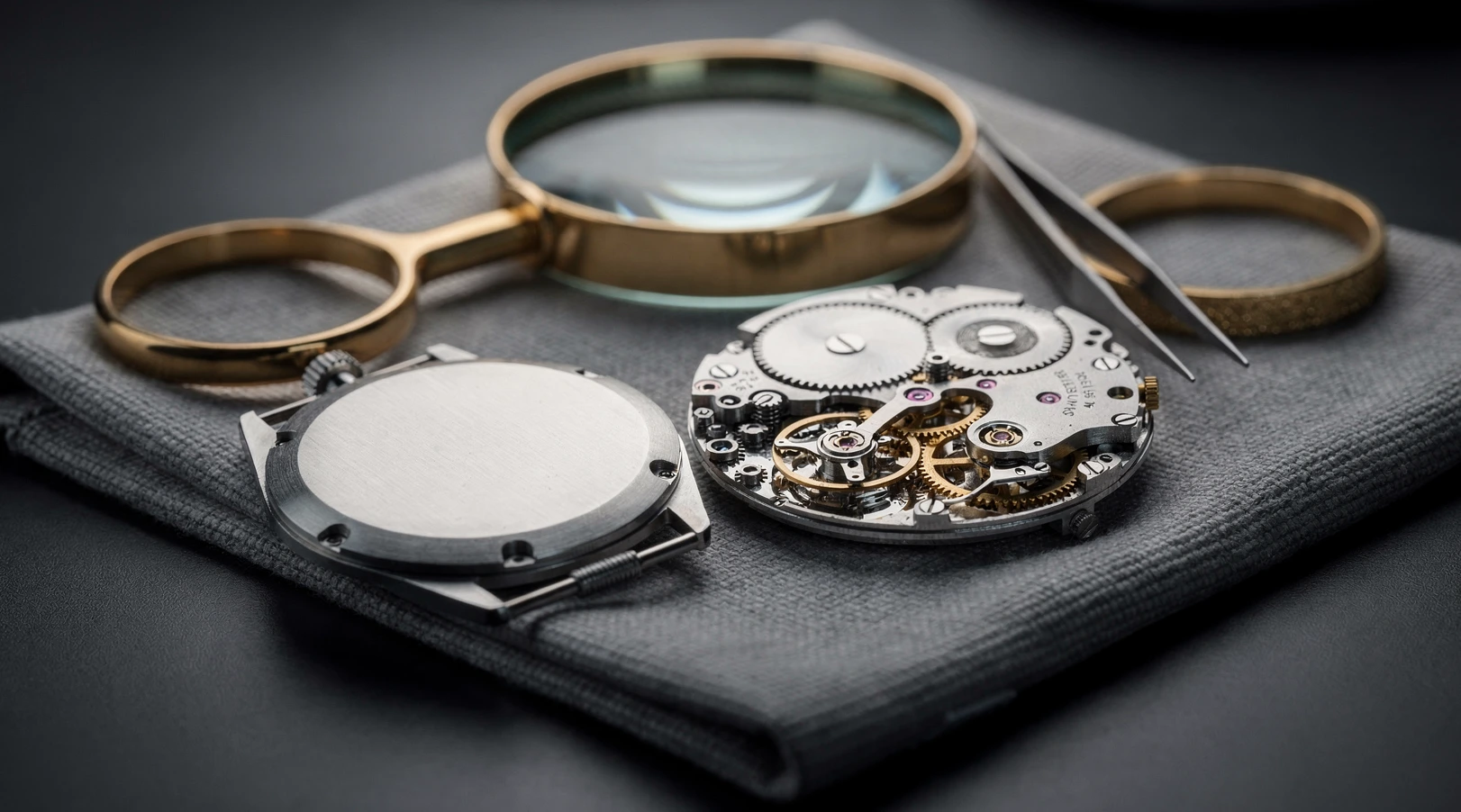
Counterfeit watches and jewelry used to fail on the obvious things. A misaligned logo, a battery inside a piece sold as mechanical, a clasp that felt like a soda can. Those tells still exist at the bottom of the market, but they no longer describe the pieces that actually cost buyers money.
The fakes that matter now are assembled from genuine or near-genuine parts, weigh the right amount, carry plausible paperwork and pass a casual inspection by someone who owns three of the real thing. Authentication has shifted from spotting a bad copy to proving a specific object is what a specific seller says it is. Those are different problems and they need a different order of operations.
This piece walks through the sequence experienced buyers actually use: what they check first, what each check can and cannot prove, where jewelry differs from watches, and the point at which paying a professional stops being optional. It is written for buyers and resellers working in the secondary market, not for gemologists.
In short
- Start with the numbers, but never end there. Serial and reference numbers confirm a piece is plausible; they cannot confirm the object in front of you is the one those numbers belong to.
- The movement is still the hardest part to fake well. Finishing, jewel placement and rotor engraving defeat most counterfeiters long after the exterior has become convincing.
- Jewelry runs on hallmarks and metal testing, not serial numbers. In the UK a full hallmark is a legal requirement above set weight thresholds; in the US the system is voluntary and quality-stamp based.
- Papers and boxes add resale value, not proof. They are the easiest component of a listing to source separately, and a full set attached to the wrong watch is a known scam pattern.
- Marketplace guarantees cover money, not truth. They are a refund mechanism with deadlines and exclusions, so read the window before you rely on it.
Why authentication got harder in the last few years
Three things changed at once. Manufacturing tolerances at contract factories improved, the secondary market moved online at scale, and the profit margin on a convincing fake grew large enough to fund real tooling. The result is a category of counterfeit that the trade calls a superfake, priced at a few thousand dollars and built to survive inspection rather than a glance.
The shift matters because most buyer checklists were written for the previous generation of fakes. Advice like “check the date magnification” or “listen for the sweep of the second hand” assumed a counterfeiter who could not afford a decent movement. That assumption no longer holds at the top of the fake market, and repeating the old checklist gives buyers false confidence rather than protection.
Superfakes changed the baseline
The Office of the United States Trade Representative publishes an annual Notorious Markets List identifying marketplaces reported to facilitate substantial counterfeit trade. Trade coverage has increasingly focused on the channels through which higher-grade counterfeits reach buyers, a shift we cover in our reporting on how the Notorious Markets List treats superfake channels. Enforcement attention is a useful signal of where risk concentrates, though it is a description of reported activity rather than a verdict on any individual seller.
For a buyer, the practical consequence is simple. A single passed check is no longer evidence of anything much. Authentication now works as a stack of independent tests, where confidence comes from the fact that a forger would have had to get all of them right simultaneously and at a cost that would eat the fraud’s margin.
The secondhand market got bigger and faster
Volume is the other half of the story. More pieces change hands, more of them change hands between strangers, and the time between listing and payment has collapsed to minutes on some platforms. Fraud scales well under those conditions because the seller does not need a high success rate, only a low cost per attempt.
Buyer behavior shifted alongside it. Spending on discreet, unbranded luxury pulled demand toward pieces that are harder to identify on sight, a dynamic we unpack in our analysis of quiet luxury versus loud luxury and the consumer split. At the same time, the premium tier at mainstream retailers expanded, and the way premium private label is reshaping department stores has blurred where a “serious” purchase is even expected to come from. Both trends widen the space in which a plausible fake can sit without looking out of place. The broader demand picture behind these shifts sits in our overview of the state of consumer behavior in retail and e-commerce.
Serial numbers, reference numbers and where they live
Numbers are where everyone starts, and that is correct as far as it goes. A reference number identifies the model and configuration. A serial number identifies the individual unit. Together they let you check whether a claimed combination is even possible before you spend time on anything else.
The checks are fast. Does the reference number correspond to a model that was produced in the stated material, dial color and bracelet configuration? Does the serial number fall inside a production range consistent with the claimed year? Does the engraving sit where that manufacturer put it in that period? A mismatch here ends the conversation cheaply, which is exactly what you want from a first-pass test.
Where the numbers sit on a watch
Placement varies by brand and era, which is itself a check. Common locations include the case back exterior, the case back interior, between the lugs beneath the bracelet, and on the inner bezel ring visible under the crystal. Some manufacturers moved locations in specific years, so a number in the “wrong” place for the claimed production date is a meaningful flag.
Quality of engraving matters as much as position. Factory engraving on a high-end case is typically crisp, evenly spaced and cut to consistent depth, with clean edges under magnification. Acid-etched or laser-marked numbers with fuzzy edges, uneven baselines or visible dot matrix structure indicate rework at best. Removing a bracelet to view lug engravings requires a spring bar tool and some care, so ask the seller for photographs rather than doing it on a piece you do not own.
What a number can and cannot prove
Here is the trap. A serial number that checks out proves that the number is valid, not that the object carrying it is. Counterfeiters copy real numbers from published listings, auction archives and social media photographs, then stamp them onto fakes. Sometimes the same real number appears on dozens of counterfeit units in circulation simultaneously.
Manufacturer databases are also not generally open to the public. Most brands will confirm details only to an authorized service center handling the physical watch, and some decline to confirm anything at all over email or phone. Treat any third-party “serial checker” website with heavy skepticism, because most are scraping public data or guessing from production ranges rather than querying anything authoritative.
Movement and case details that fakes get wrong
If the numbers survive, the next layer is physical construction. This is where cost asymmetry works in the buyer’s favor. Exterior parts can be copied with tooling investment that amortizes across thousands of units, but a finished in-house movement represents decades of manufacturing capability that a counterfeit operation cannot replicate economically.
The movement is still the hardest part to copy
Opening a case back is not something to do casually, and on water-resistant models it can void a service warranty. That said, a photograph of the movement is a reasonable request from a dealer, and many reputable sellers provide one as standard. What experienced buyers look at: the pattern and depth of decorative finishing such as perlage or Geneva stripes, the count and seating of jewels, the shape and engraving of the rotor, the screw slots, and whether the text on the bridges is engraved or printed.
Counterfeit movements often get the layout approximately right and the execution visibly wrong. Finishing applied by stamping rather than machining has a flattened, repetitive look. Jewel settings sit slightly proud or show adhesive. Engraving that should be cut reads as surface printing under magnification. None of these individually settle the question, but together they are difficult to fake at scale.
Case, crystal and bracelet tells
The exterior still offers checks worth running, provided you treat them as supporting evidence rather than proof. Weight is one: precious metal cases have a density that steel with plating cannot match, and a gold piece that feels light is a serious flag. Machining quality is another, particularly on lug chamfers, bracelet link edges and the transition where a case band meets a lug.
Crystal behavior gives a quick test on sapphire versus mineral glass. A water droplet on sapphire tends to bead tightly rather than spread, and sapphire resists scratching from materials that will mark mineral glass. Luminous material is also informative: quality lume charges quickly under a strong light and glows evenly across all markers, while a fake often shows patchy output and fades noticeably faster.
Clasp and bracelet construction reward attention because they are handled constantly and cheap versions fail there first. Check that link screws are actual screws rather than friction pins if the model uses screws, that the clasp closes with a defined action rather than a vague click, and that end links meet the case with consistent tolerance on both sides.
| Check | What it can prove | What it cannot prove | Difficulty to fake |
|---|---|---|---|
| Serial and reference number | The claimed configuration is plausible and internally consistent | That this specific object is the unit the number belongs to | Low: numbers are copied from public listings |
| Engraving quality and placement | The marking method matches factory practice for the period | Origin, if the case itself is a genuine donor part | Medium |
| Movement finishing and layout | Manufacturing capability consistent with the claimed maker | That the movement and case started life together | High |
| Case weight and material density | The metal is broadly consistent with the claim | Purity, karat or the composition of plated layers | Medium |
| Hallmark on precious metal | An assay office record exists for that sponsor and standard | That the mark was applied to this piece legitimately | Medium |
| XRF metal analysis | Surface composition to a measurable tolerance | Core composition under a thick plated layer | High |
| Original papers and box | That a matching document set exists | That the documents were issued for this object | Low |
Hallmarks and metal testing for jewelry
Jewelry authentication works differently because most pieces carry no serial number at all. The question is usually not “is this the specific object claimed” but “is this metal what the seller says it is, and is this stone what the seller says it is”. Those are answerable with instruments, which makes jewelry in some ways more tractable than watches.
Reading a hallmark
Hallmarking systems vary by jurisdiction and the difference matters. In the United Kingdom, articles of precious metal above statutory weight thresholds must be hallmarked by an assay office before being described as gold, silver, platinum or palladium in trade, under the Hallmarking Act 1973 as administered by the British Hallmarking Council. A UK hallmark carries a sponsor’s mark, a fineness number and an assay office mark, with optional date letter and traditional standard marks.
In the United States there is no compulsory assay system. Quality stamps such as 14K or 925 are applied by manufacturers, and the National Gold and Silver Stamping Act requires that a quality stamp be accompanied by a registered maker’s mark and that the stamped fineness be accurate within defined tolerances. The Federal Trade Commission’s Jewelry Guides set out how precious metal, gemstone and treatment claims may be described in US advertising. Both frameworks change over time, so verify current thresholds and tolerances at the relevant official source rather than relying on a summary. A general overview of the practice and its history is available on Wikipedia’s hallmark entry, and the FTC publishes its guidance for the jewelry industry at ftc.gov.
The practical takeaway: a stamp is a claim, and its legal weight depends entirely on which system produced it. A UK assay hallmark reflects testing by an independent office. A US quality stamp reflects what the maker asserted. Neither prevents someone from stamping a fake, which is why testing exists.
Non-destructive metal tests
X-ray fluorescence analysis is the standard non-destructive method. An XRF instrument reads surface composition in seconds and reports the alloy breakdown, which catches plated base metal, underkarat gold and silver sold as platinum. Most established jewelers and pawn operations have access to one, and a test typically costs little or nothing if you are already transacting.
XRF has a real limitation worth understanding. It measures the surface and a shallow depth beneath it, so a heavily plated item with a thick gold layer can read as solid on a single surface point. Serious testing therefore takes readings at multiple points, including worn areas, edges and the inside of a shank where plating tends to be thinner. Specific gravity testing complements it by measuring density of the whole object, which plating cannot disguise.
Acid testing still has a place for quick triage on low-value items, but it is destructive in a small way and inaccurate on plated pieces. Magnetic testing is a crude but fast screen, since gold, silver and platinum are not meaningfully magnetic while many substitute alloys are. Use it to rule things out, never to rule them in.
Stones are a separate problem
Metal and stone authentication are distinct workflows and a piece can be genuine in one and not the other. The dominant issue in the current market is laboratory-grown diamond sold as natural, which is undetectable by eye and by most handheld testers because the material is chemically and optically the same thing. Distinguishing the two requires instruments that read growth patterns and trace features, which in practice means a gemological laboratory.
Treatments are the second issue. Fracture filling, heat treatment, irradiation and diffusion all change the value of a stone substantially, and disclosure requirements exist precisely because the appearance does not reveal them. If a stone is a material part of the price, the honest answer is that only a laboratory report settles it, and a report from a recognized laboratory should be cross-checked against the laboratory’s own online report lookup rather than accepted as a printed document.
Papers, boxes and service history: worth what exactly
The trade phrase “full set” describes a watch accompanied by its original box, warranty card, booklets, tags and often a receipt. Full sets command a premium, and the premium is real. What the premium reflects, however, is resale liquidity and collector preference rather than proof of authenticity.
The reason is mechanical. Boxes and papers are separable from watches, they are traded independently, and they are counterfeited as a product category in their own right. A warranty card for a given reference can be bought, and a card whose serial matches a watch you are looking at proves only that the card matches. Pairing a fake watch with a genuine card taken from a different unit is a recognized scam, and it is cheaper to execute than improving the watch.
Service history is more useful than the original paperwork because it is harder to fabricate and more informative. A service record from an authorized center indicates that the piece passed through a facility with the tooling and the incentive to notice a counterfeit. It also tells you what has been replaced, which matters for value: a replaced dial, hands or bezel insert can reduce a collector piece’s price significantly even when the watch is entirely genuine.
Provenance carries similar logic. Documented ownership history, auction records and dated photographs build a chain that a forger would have to reconstruct rather than simply purchase. None of this is dispositive on its own, and the way brands are restructuring their own certified pre-owned programs is part of a wider shift we cover in how luxury retail is repositioning for the next decade.
| Accompanying item | Effect on resale value | Evidential weight | Ease of sourcing separately |
|---|---|---|---|
| Original box and outer packaging | Moderate uplift on collector references | Very low | High: sold openly as accessories |
| Warranty card with matching serial | Significant uplift, often the largest single component | Low on its own | Moderate to high |
| Authorized service records | Modest uplift, larger if recent | Moderate to high | Low |
| Purchase receipt from an authorized dealer | Modest uplift | Moderate | Low to moderate |
| Documented ownership chain or auction record | Large on notable pieces, negligible otherwise | High | Very low |
| Third-party authentication certificate | Small, varies by issuer reputation | Depends entirely on the issuer | Moderate |
Marketplace guarantees and what they really cover
Platform authentication programs have become the default safety net for online purchases, and they genuinely reduce risk. They also get misread. A guarantee is a commercial promise by the platform to make you whole under stated conditions, which is a different thing from a guarantee that the item is authentic.
Read the terms for four specific things. What is the claim window, measured from delivery rather than purchase? What evidence does the platform require, and does it demand a report from a specific authenticator at your expense? Does the remedy cover the full purchase price, fees and shipping, or only the item price? And what is explicitly excluded, which commonly includes aftermarket modification, previously serviced pieces with replaced parts, and sales conducted off-platform?
The claim window is where most buyers get caught. Several programs measure in days, and the practical effect is that a piece bought as a gift and opened months later can fall outside the window before anyone inspects it. If you buy something you do not intend to examine immediately, inspect it anyway on arrival, because the deadline runs regardless.
Understand also what the platform’s own authentication step involves. Programs vary from photographic review to physical inspection by trained staff at a processing center, and the depth of that inspection is rarely disclosed in detail. Physical inspection is substantially stronger than a photo review, so it is worth establishing which one applies before treating the badge as decisive.
When to pay for independent authentication
Independent authentication costs money and time, so the sensible question is when the expected loss exceeds that cost. A practical threshold used by many buyers is roughly two to five percent of the purchase price. Below that ratio, paying for a report is straightforwardly rational; above it, the calculation depends on how much the other evidence has already reduced your uncertainty.
There are situations where it is worth paying regardless of ratio. A private sale with no platform protection. A seller with no traceable history, or one pushing for speed. A piece where the value is concentrated in something you cannot assess, such as a dial variant, a stone grade or a claimed provenance. Any transaction where you would not comfortably absorb a total loss.
Understand the difference between the routes. A brand service center will not usually issue an authentication opinion, but it will refuse to service a counterfeit and will often say why, which functions as a strong signal. An independent watch authenticator provides a written opinion, often with movement photographs. A gemological laboratory grades and identifies stones but does not authenticate a watch. Matching the route to the actual question is most of the work, and the operational side of doing this repeatedly at volume is covered in our piece on grading and authenticating used goods at scale.
One last piece of process advice. Agree the authentication step with the seller in writing before payment, including who pays, which authenticator is acceptable to both sides, and what happens if the opinion is negative. A legitimate seller will generally accept a reasonable version of this. Resistance to an independent check on a high-value piece is information in itself, and it fits the broader pattern of trust-building we discuss across consumer behavior in retail and e-commerce.
| Route | Best suited to | Typical turnaround | What you receive |
|---|---|---|---|
| Platform authentication program | Marketplace purchases within the claim window | Built into fulfillment | A badge plus a refund right under stated terms |
| Brand authorized service center | Watches where a service is due anyway | Weeks to months | Service outcome and an implicit signal, rarely a certificate |
| Independent watch authenticator | Private sales and high-value secondary market pieces | Days | Written opinion, usually with detailed photography |
| Gemological laboratory | Stones where grade or origin drives the price | Days to weeks | Identification and grading report with online verification |
| Local jeweler with XRF | Fast metal composition screening | Minutes | A surface composition reading, usually informal |
A note on scope
This article is general information and education about how authentication practices and precious metal marking systems work. It is not legal, tax, customs or professional appraisal advice, and it is not a substitute for examination of a specific object. Rules on hallmarking, quality stamping, disclosure and import of goods differ by jurisdiction and change over time.
Anyone dealing with a specific piece, a disputed transaction or a cross-border purchase should consult a qualified professional: a licensed appraiser, a recognized gemological laboratory, a trade attorney or a licensed customs broker as the situation requires. Where this piece refers to statutory frameworks such as the UK Hallmarking Act, the US National Gold and Silver Stamping Act or Federal Trade Commission guidance, the current text and thresholds should be verified directly with the British Hallmarking Council, the FTC or the relevant regulator, because summaries go out of date. Nothing here should be read as an allegation of wrongdoing against any named company or marketplace.
FAQ on authenticating watches and jewelry
Can a serial number alone prove a watch is genuine?
No. A valid serial number shows the number itself is plausible for the claimed model and production period, but counterfeiters routinely copy real numbers from public listings and auction archives. The same genuine number can appear on many fakes at once, so the serial is a screening step rather than a verdict.
Is it safe to open a case back to photograph the movement?
Not without the right tooling and some experience. Opening a water-resistant case back can break the gasket seal and may affect a service warranty, and a slipped case wrench leaves permanent marks. Ask the seller for movement photographs instead, or have a watchmaker open it as part of a paid inspection.
What does a full set actually add to the price?
It adds resale liquidity and collector appeal, and the warranty card is usually the largest single component of that uplift. What it does not add is proof, because boxes and cards are traded separately and can be paired with the wrong watch. Treat a full set as a value factor, not an authentication result.
How do I tell a lab-grown diamond from a natural one?
Not by eye, and generally not with a handheld tester, because the two materials are chemically and optically the same. Reliable separation relies on instruments that read growth structure and trace features, which in practice means sending the stone to a gemological laboratory. If the price depends on the stone being natural, a laboratory report is the only real answer.
Does a hallmark mean the same thing everywhere?
No, and the difference matters. A UK assay office hallmark reflects independent testing required by statute above set weight thresholds, while a US quality stamp such as 14K is applied by the manufacturer under the National Gold and Silver Stamping Act. Verify the current requirements with the British Hallmarking Council or the FTC, since both frameworks are periodically revised.
Will XRF testing catch a heavily plated fake?
Sometimes, but not reliably from a single reading. XRF measures surface composition to a shallow depth, so a thick gold plating can read as solid at one point. Ask for readings at several points including worn areas and the inside of a shank, and pair it with a specific gravity test, which measures the density of the whole object.
How long do marketplace authenticity guarantees last?
It varies by platform and is usually measured in days from delivery rather than from purchase. Check the specific claim window, the evidence the platform requires, whether the refund covers fees and shipping, and what is excluded. Inspect anything valuable the day it arrives, because the deadline runs whether you opened the box or not.
When is paying for independent authentication worth it?
A common rule of thumb is when the cost sits below roughly two to five percent of the purchase price. Beyond that ratio, pay for it anyway when there is no platform protection, when the seller has no traceable history, when the value hinges on something you cannot assess, or when a total loss would hurt. Agree who pays and which authenticator is acceptable before money moves.
Does a service record prove a watch is authentic?
It is stronger evidence than a box and papers, but it is still not proof. A record from an authorized center means the piece passed through a facility that had both the tooling and the incentive to spot a counterfeit, which is meaningful. It also discloses replaced parts, which can reduce a collector piece’s value even when the watch is entirely genuine.