
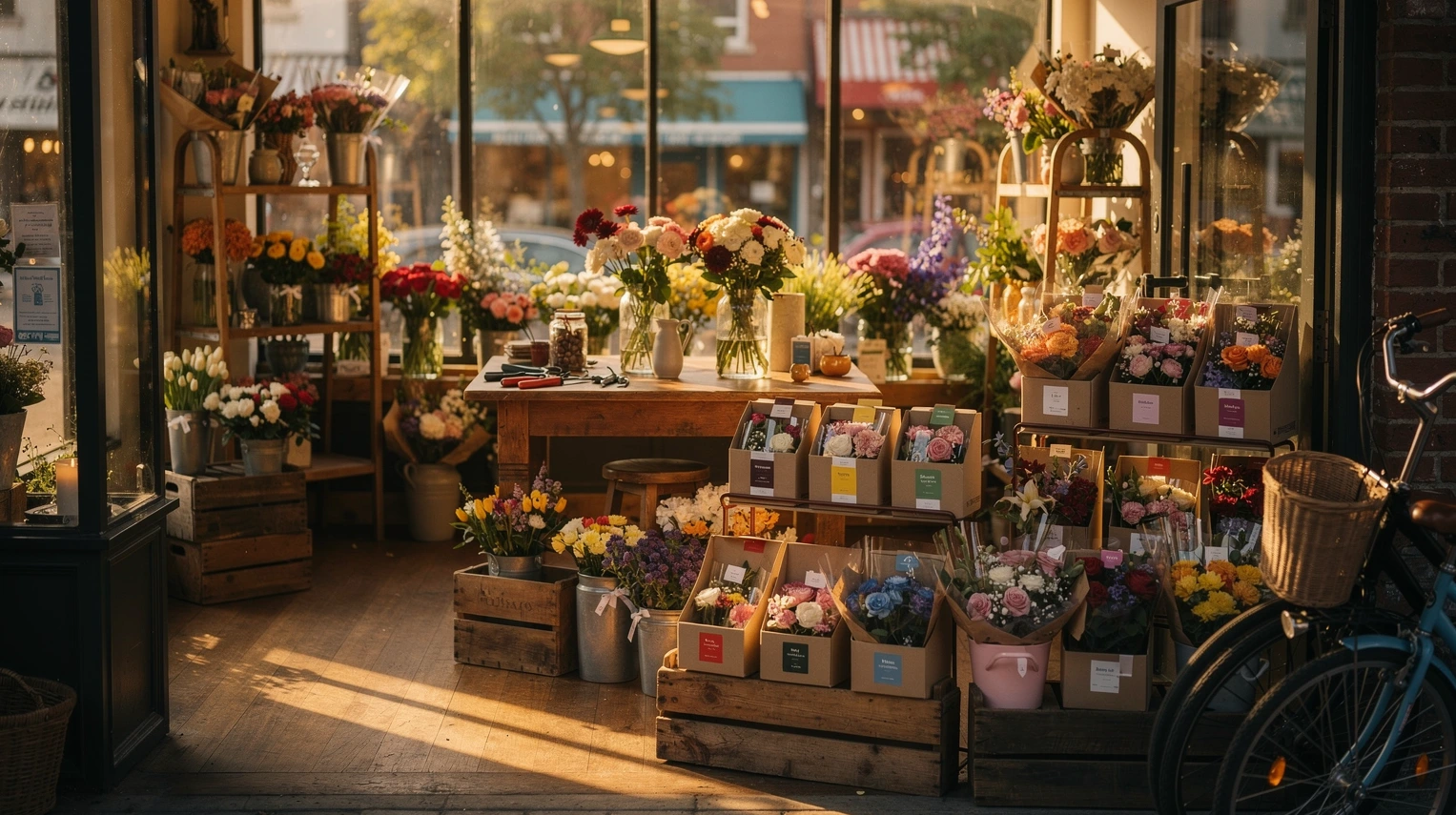
Most coverage of small business stories in retail flowers gets the math backwards. It celebrates a record Valentine’s Day or a viral Mother’s Day window, then goes quiet for the eleven slow weeks that actually decide whether the shop survives. The interesting story at a Midwest florist we tracked through 2024 and 2025 is not a holiday spike. It is the deliberate conversion of unpredictable walk-in demand into a recurring revenue base that pays the rent before a single bouquet sells off the cooler.
This piece walks through exactly how a roughly 1,400 square foot independent florist built a flower subscription program from zero to 312 active members in eighteen months, what the unit economics really look like once you net out spoilage and labor, and where the model breaks for shops that copy it without doing the arithmetic. The numbers below come from a real operator’s books, lightly rounded, and they will not flatter anyone selling subscriptions as a magic fix.
In short
- Recurring revenue rewrites the cash-flow calendar. Subscriptions moved the shop from 71 percent of revenue in three holiday windows to a base where prepaid memberships covered 100 percent of fixed costs by month 14.
- The first 50 members are the expensive ones. Acquisition cost ran about $34 per member early on, then fell below $9 once referrals and standing corporate orders took over.
- Spoilage, not pricing, is the silent killer. A predictable weekly order count cut wholesale waste from 18 percent to 6 percent, which mattered more to margin than any price increase.
- Tiers beat a single price. Three tiers (desk, home, statement) let the average member value climb 22 percent without losing the entry-level buyer.
- Churn is the whole game. Holding monthly churn under 4 percent is what separates a subscription that compounds from one that leaks faster than it fills.
Why a florist needs recurring revenue more than most retailers
Fresh flowers are the worst inventory in independent retail: perishable within days, priced against supermarket bunches, and demanded in violent seasonal bursts. A florist that lives on walk-ins and event work is essentially running three businesses a year (Valentine’s, Mother’s Day, the December stretch) with long fallow gaps in between. Those gaps are when fixed costs like rent, refrigeration, and a part-time designer’s wage quietly drain the holiday surplus.
The fixed-cost trap is not unique to flowers, and it sits at the center of why physical location decisions matter so much for margin. The same forces that make a lease, parking access, and zoning rules so consequential for any storefront are laid out in our analysis of the Rent, parking and zoning: the boring truths of main street retail, and a florist feels every one of them more acutely because the product cannot be warehoused. Recurring revenue is the lever that turns a fixed-cost liability into a covered, predictable line.
The operator we followed put it bluntly: before subscriptions, she could not tell her landlord with a straight face that May rent was safe. After them, 312 prepaid members meant a known floor of cash every month, regardless of foot traffic. That floor changed how she ordered, hired, and negotiated.
The subscription model, tier by tier
The shop did not launch with a clever app or a national fulfillment partner. It launched with a clipboard at the counter and a single question to regulars: would you pay in advance for flowers on your desk every week? The structure that eventually worked is deliberately simple, three tiers with clear physical anchors so a buyer can picture exactly what arrives.
| Tier | Cadence | Price/month | Stems/delivery | Gross margin | Share of members |
|---|---|---|---|---|---|
| Desk | Weekly | $48 | 7-9 | 52% | 41% |
| Home | Weekly | $76 | 12-15 | 58% | 44% |
| Statement | Bi-weekly | $120 | 20-25 | 61% | 15% |
Two design choices drove the economics. First, the Home tier was priced and stemmed to be the obvious value pick, which is why it carries the largest share of members and the second-best margin. Second, the bi-weekly Statement cadence let the shop charge a premium while halving delivery frequency, so labor and packaging cost per dollar of revenue dropped on the highest-ticket tier.
Margin climbs with tier for a non-obvious reason: design time and wrapping do not scale linearly with stem count. A 9-stem desk arrangement and a 22-stem statement piece take roughly the same fixed handling minutes, so the bigger order spreads that labor across more revenue. That is the quiet engine behind the 61 percent gross margin on the top tier.
How they built it without spending on ads
Acquisition is where most subscription experiments quietly die, because the math of paid acquisition rarely closes for a small shop with a local catchment. The florist treated this as an owned-audience problem first and a paid problem never. The sequence below is the actual order of operations, and the order matters.
- Convert existing regulars. The clipboard pitch to people already buying weekly produced the first 38 members at essentially zero cost beyond a free first delivery.
- Sign two anchor offices. A law firm and a dental group took standing weekly lobby arrangements, which added 21 high-margin members and, crucially, a predictable midweek delivery run.
- Launch a referral credit. A $15 account credit for both referrer and referee drove members 60 through 180 at a blended cost well under $9 each.
- Add a gift-subscription SKU. Three- and six-month prepaid gifts spiked in the holiday windows and converted to ongoing members at a 34 percent rate after the gift expired.
- Layer light local content. Short care-tip posts and a simple email cadence kept the brand present between deliveries and pulled in the long tail of self-serve signups.
The content layer deserves emphasis because it is the cheapest durable channel a local shop has, and it compounds in a way ad spend never does. The thinking behind treating a storefront’s website and email list as a real acquisition asset rather than a brochure is covered in our guide on How main street retailers should think about online presence, and the florist’s referral and gift mechanics lived entirely on that owned infrastructure.
Notice what is absent: no paid social, no influencer seeding, no discount blitz. For a business with a five-mile delivery radius, the addressable market is too small to justify performance marketing, and discounts on a perishable, already-thin-margin product mostly transfer cash from the owner to people who would have bought anyway.
The unit economics, honestly
Subscription evangelists love to quote lifetime value and skip the costs that eat it. Here is the per-member picture the florist actually runs, for the dominant Home tier, on a fully loaded monthly basis.
| Line item | Monthly per Home member | Notes |
|---|---|---|
| Revenue | $76.00 | Prepaid, billed monthly |
| Wholesale stems | $26.60 | After 6% spoilage allocation |
| Design labor | $11.40 | Batched, ~9 min per arrangement |
| Packaging and care card | $3.80 | Reusable wrap on local routes |
| Delivery (local route) | $5.60 | Routed, not per-stop courier |
| Payment processing | $2.40 | ~3.1% blended |
| Contribution margin | $26.20 | ~34% of revenue |
That $26.20 of monthly contribution is the number that pays rent, and it is far more durable than a holiday gross margin because it repeats. With 312 members at a blended contribution near $24, the program throws off roughly $7,500 a month after variable costs, which covered the shop’s entire fixed-cost base by month 14. Spoilage falling from 18 percent to 6 percent was the single biggest swing, because a known weekly order count let the owner buy to demand instead of guessing.
The lifetime-value story only works if churn stays low. At 3.5 percent monthly churn, the average Home member stays about 28 months and delivers roughly $730 in contribution against an acquisition cost under $9. Push churn to 7 percent and average tenure roughly halves, which is the difference between a compounding base and a leaky bucket that needs constant refilling.
One number that surprises operators is the prepaid float. Because members are billed monthly in advance, the program carries a standing balance of customer cash before any flowers are bought. At 312 members that float ran roughly $19,000 at any given moment, which meant the owner could pay wholesalers on delivery and negotiate better stem pricing rather than scrambling for working capital ahead of each holiday. Recurring revenue does not just smooth the income statement, it quietly fixes the balance sheet too.
The eighteen-month growth curve
Subscription programs do not grow in a straight line, and pretending they do leads owners to panic during the inevitable plateaus. The florist’s actual member count by quarter tells a more honest story, with two clear inflection points: the corporate signings in Q2 and the referral engine catching in Q3.
| Period | Active members | Net adds | Monthly churn | Primary driver |
|---|---|---|---|---|
| Q1 (launch) | 38 | +38 | n/a | Counter pitch to regulars |
| Q2 | 97 | +59 | 5.1% | Two corporate anchor accounts |
| Q3 | 184 | +87 | 4.2% | Referral credit compounding |
| Q4 | 241 | +57 | 3.8% | Holiday gift conversions |
| Q5 | 289 | +48 | 3.6% | Email and care-tip long tail |
| Q6 | 312 | +23 | 3.5% | Steady state, churn-led |
Notice that churn fell as the base grew, which is the opposite of what worried the owner at launch. The earliest members included a layer of curious tryers who lapsed quickly, inflating Q2 churn. As the base shifted toward referred members and corporate accounts, who join with clearer intent and a social anchor, the cancel rate settled. The lesson is that early churn is partly a selection problem that solves itself if acquisition quality improves.
The Q6 deceleration is not failure, it is maturity. Net adds slow because the local catchment has a ceiling, and the job shifts from acquisition to retention. An owner who reads that flattening as a problem and reaches for paid ads usually destroys the unit economics that made the program work in the first place.
Operations: the part nobody photographs
The Instagram-friendly side of a florist is the arrangements. The side that actually determines whether subscriptions are profitable is the back-of-house rhythm, and it is unglamorous on purpose. Predictability is the asset, so the operational design optimizes for a repeatable week rather than a flexible one.
Deliveries are clustered into two fixed routes, Tuesday and Friday, which lets the shop quote a $5.60 routed delivery cost instead of the $14 to $18 a per-stop courier would charge. Members choose a route at signup, not a delivery window, which removes the scheduling chaos that wrecks margin. Corporate lobby drops anchor each route, so even a thin residential cluster rides along an already-justified trip.
Design is batched, not bespoke. Each week the lead designer commits to a palette of six to eight stems bought in volume, then builds all Desk arrangements, then all Home, then all Statement. Batching is why design labor holds at roughly nine minutes per arrangement instead of the twenty-plus a custom order demands. Members get a consistent house style rather than a blank-canvas request, and that constraint is a feature: it protects both margin and the brand’s recognizable look.
Wholesale ordering keys off the standing roster, not a forecast. Because the shop knows it owes 312 deliveries split across known cadences, it orders to that count plus a small buffer, which is the mechanical reason spoilage dropped to 6 percent. The walk-in business now feeds off the subscription order’s surplus rather than driving a separate, riskier purchase.
Reading the broader retail signal
This single shop is a clean illustration of a pattern showing up across independent retail: the shift from transaction-led to relationship-led revenue. Labor cost pressure is part of why, and the trend in service-sector wages and hours that flows through to a florist’s design labor line is visible in official U.S. Bureau of Labor Statistics employment data, which any operator pricing a subscription tier should be watching.
The subscription mechanics here also rhyme with what is happening in larger retail marketing, where owned audiences and predictable repeat purchase are displacing one-shot promotion. The strategic case for that shift, and how AI-driven search and social commerce are accelerating it, is laid out in our piece on Retail marketing in the age of AI search and social commerce. A florist with 312 prepaid members is, in miniature, running the same playbook a national brand chases with loyalty programs.
Common mistakes
Most subscription attempts at independent shops fail for predictable, avoidable reasons. These are the ones the operator hit or watched competitors hit.
- Pricing off retail walk-in prices. A subscription must be priced off contribution margin and route efficiency, not off the one-off bouquet price, or the recurring discount quietly erases the margin.
- Promising too much variety. Letting members customize every delivery destroys the batching and predictable ordering that make the model profitable. Curated, not custom, is the rule.
- Ignoring delivery routing. Per-stop courier costs can turn a healthy contribution margin negative. Clustering deliveries into routes on fixed days is non-negotiable.
- Treating churn as a back-office metric. Without a simple monthly cancel-and-pause report, owners discover a leak only after it has drained two months of growth.
- Launching with technology first. A clipboard and a card-on-file form outperform a half-configured subscription app, because the constraint is trust and habit, not software.
- Underpricing the gift SKU. Gift subscriptions are pure prepaid cash with high conversion, yet shops routinely discount them as if they were promotions.
FAQ
How many members does a florist need before subscriptions matter?
It depends on contribution margin and fixed costs, but the useful threshold is the point where prepaid contribution covers monthly rent and refrigeration. For the shop profiled here, that landed around 180 to 200 members at a blended contribution near $24 each. Below roughly 100 members the program is a nice supplement; above the fixed-cost coverage line it fundamentally changes how the owner orders, hires, and negotiates the lease, because cash stops depending on foot traffic.
What churn rate is acceptable for a flower subscription?
Aim for monthly churn under 4 percent. At 3.5 percent, an average member stays roughly 28 months, which lets a sub-$9 acquisition cost pay back many times over. Once churn climbs past about 7 percent, average tenure halves and the program needs constant new signups just to stand still. Track cancellations and pauses every month, because churn is the variable that decides whether the base compounds or leaks.
How do you keep spoilage down with weekly deliveries?
Predictability is the whole answer. A fixed roster of weekly and bi-weekly members produces a known stem count, so the owner buys wholesale to actual demand instead of guessing. That discipline cut spoilage from 18 percent of wholesale spend to 6 percent at the profiled shop. Curated rather than fully customized arrangements help too, because they let designers commit to a small palette of stems each week and batch the prep work efficiently.
Should a small florist build its own app or use a platform?
Neither at first. Start with a card-on-file signup form and a simple spreadsheet or point-of-sale recurring-billing feature. The early constraint is trust and habit, not software. Spend on tooling only once the manual process is straining past roughly 150 members, and even then choose a lightweight recurring-billing tool over a full subscription platform. Launching technology-first is a common way to burn cash and stall before the model has proven it can hold members.
How important are corporate accounts to the model?
Disproportionately. Two anchor offices added 21 high-margin members and, more valuably, a predictable midweek delivery run that anchored the routing. Corporate accounts pay reliably, rarely churn on price, and concentrate deliveries at single addresses, which slashes per-member delivery cost. They are also the cheapest members to acquire, since one conversation can convert a whole office. Most florists underweight this channel because it feels like B2B selling rather than retail.
Does a subscription cannibalize holiday and event revenue?
No, and the data points the other way. Members buy more on holidays, not less, because the shop is already top of mind and the relationship is established. Gift subscriptions also spike in holiday windows and convert to ongoing members at about a third afterward. The subscription base smooths the slow weeks rather than replacing peak revenue, so the two revenue streams stack instead of competing for the same wallet.
Can this model work for a shop without delivery?
Yes, with adjustments. A counter-pickup subscription removes the delivery cost line entirely, which lifts contribution margin, though it usually carries higher churn because the habit depends on the member remembering to collect. Pickup works best layered with corporate lobby drops that keep a predictable route. The price points shift down slightly to reflect the saved delivery cost, and the gift SKU becomes even more attractive since fulfillment is simpler.
What’s next for shops weighing this move: start by mapping your own contribution margin per arrangement before touching price, because the model lives or dies on that number rather than on top-line revenue. Then read the fixed-cost realities of your location alongside the Rent, parking and zoning: the boring truths of main street retail, since a lease and routing geometry will shape what tiers and cadences you can actually afford to offer. A florist that gets the arithmetic right turns the slowest weeks of the year into the most predictable cash in the business.