
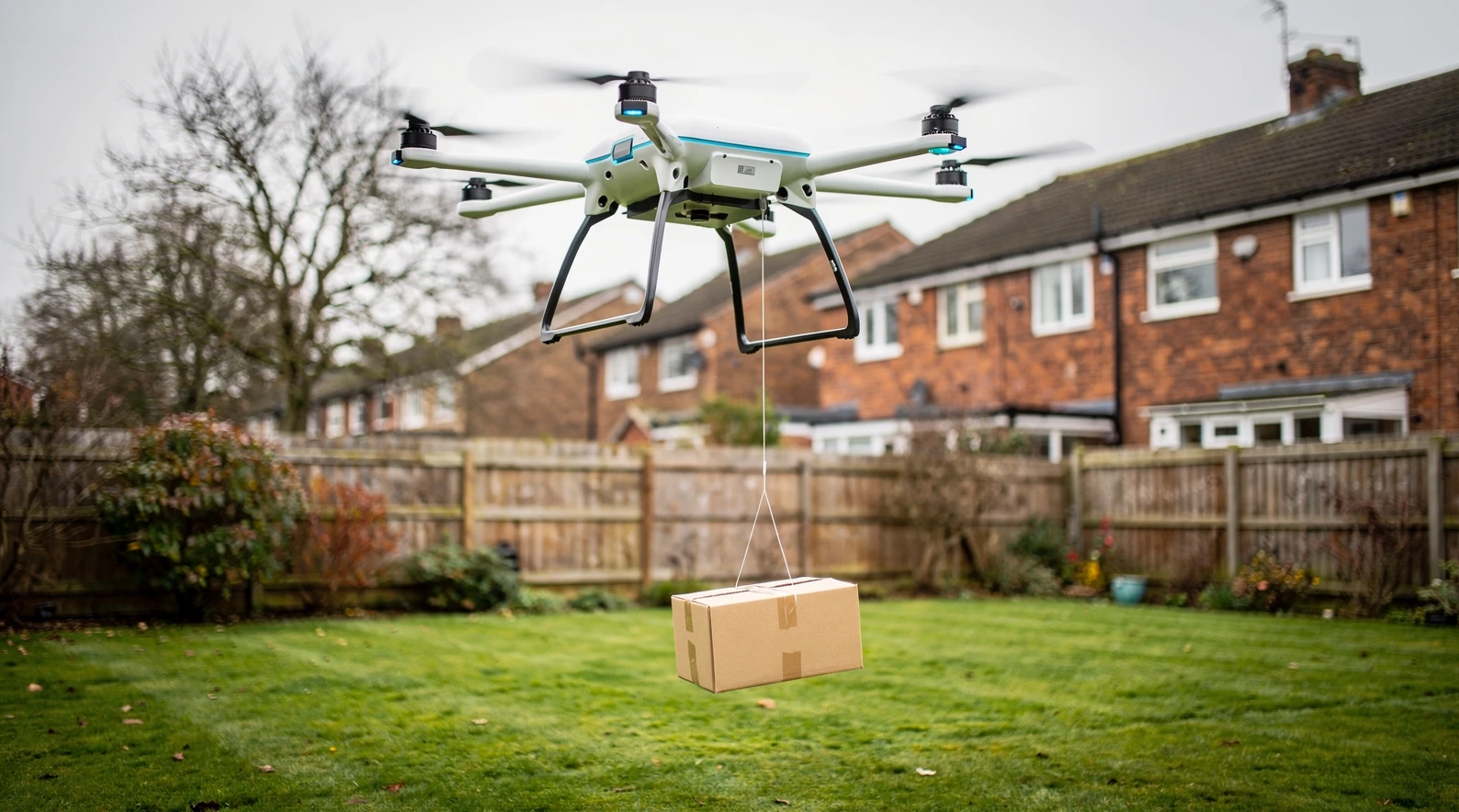
Amazon’s Prime Air drone delivery service in Darlington can now reach roughly 8,000 households, up from about 600, after the UK Civil Aviation Authority (CAA) granted the company what it calls the world’s first SAIL 4 Operating Authorisation and Flightworthiness Validation. The announcement, made on About Amazon UK on 10 November 2026, lets the MK30 drone fly over more densely populated parts of the County Durham town. It is the biggest change to drone delivery for British online shoppers since the service went live earlier this year.
The expansion does not redraw the map. Deliveries remain limited to homes with a garden, yard or driveway inside a 7.5-mile (12km) radius of Amazon’s fulfilment centre at Symmetry Park, and only for items of 5lb (2.2kg) or less that fit a large shoebox. What has changed is which streets inside that circle the drones are allowed to cross, and with a trial permission reportedly due to expire on 31 December, the next seven weeks will decide whether Darlington becomes a template for the rest of the UK.
In short
- SAIL 4 approval: the CAA has granted Amazon Prime Air a SAIL 4 Operating Authorisation and Flightworthiness Validation, which Amazon describes as a world first.
- 8,000 households: eligible Darlington homes rise from around 600 to roughly 8,000, all inside the same 7.5-mile radius of the Symmetry Park fulfilment centre.
- No extra fee: drone delivery is included in an Amazon Prime membership for items up to 5lb (2.2kg) that fit a large shoebox.
- Caps still unclear: trade title DroneXL reports trial limits of 10 flights an hour and 100 deliveries per weekday; Amazon’s announcement does not say whether they have changed.
- Open questions: the AAIB has not yet published its report on a July crash in a Beaumont Hill garden, and the trial permission is reported to run until 31 December 2026.
What has Amazon announced for Darlington?
According to Amazon’s UK newsroom, Prime Air has become the first operator in the world to obtain both a SAIL 4 Operating Authorisation and a SAIL 4 Flightworthiness Validation from the CAA. The company said the approval followed “the most thorough safety assessment of any drone system in the UK” and that, from 10 November, thousands more customers in and around Darlington could receive drone deliveries. The BBC, the Northern Echo and PA Media, in copy carried by the Evening Standard, all reported the expansion on the same day.
The headline number is the jump in eligible customers. Amazon said the service would grow “from around 600 eligible customers to roughly 8,000”, which is more than a thirteen-fold increase in the pool of households that can choose drone delivery at checkout. The BBC described it as a “huge extension” of the licence covering a wider area of Darlington, where drones have been operating since May.
Theunis Scheepers, director of Prime Air Europe, said in the company statement: “Prime Air is the first in the world to receive a SAIL 4 approval from the UK Civil Aviation Authority. Earning it took years of disciplined engineering and a commitment to safety from day one.” He added that the approval was “the foundation for bringing Prime Air to more of the UK”. PA Media quoted him separately saying: “This is just the beginning for Prime Air in the UK.”
The CAA’s comment was carried in Amazon’s release and repeated by the BBC and the Northern Echo. Sophie O’Sullivan, the CAA’s director of future safety and innovation, said: “Innovation is transforming aviation, and the UK Civil Aviation Authority’s role is to ensure that happens safely.” She called the decision a “first in-kind announcement” and said it marked “another important step towards safely integrating new technologies into UK airspace”.
DroneXL, which has tracked the Darlington operation since before launch, noted that the “world first” description is Amazon’s claim and that the CAA’s newsroom had not published its own release on the approval when the title checked on 11 November. It also said it had not seen the authorisation document itself. That matters because the detailed operating conditions, rather than the headline approval, will decide how many parcels actually arrive by air.
What does SAIL 4 actually mean?
SAIL stands for Specific Assurance and Integrity Level. It is the risk score that comes out of a UK SORA assessment, the CAA’s version of the Specific Operations Risk Assessment used for advanced drone flights in the so-called specific category. In simple terms, SORA weighs the risk to people on the ground against the risk to other aircraft in the air, and the resulting SAIL level sets how much technical and organisational proof an operator must provide.
Amazon’s own explainer describes a SAIL 4 operation as “medium to high-risk”, the point at which the regulator expects “significant technical and organisational safety assurance to be demonstrated”. The higher the number of people beneath a flight path, the higher the ground-risk score. That is why the same MK30 aircraft, already flying in Darlington, needed a higher approval before it could cross the town’s busier residential streets.
Why the circle did not grow
DroneXL’s headline on the story was blunt: the homes went from 600 to 8,000 but “the circle didn’t grow”. Its reading is that the 8,000 households were always inside the 7.5-mile radius, and the original authorisation simply kept the drones over the less crowded parts of it. Amazon’s announcement supports that interpretation, saying Prime Air had previously operated under CAA permission for beyond-visual-line-of-sight flights “in less densely populated areas”.
For shoppers, the practical effect is that a household which could see the Symmetry Park site on a map but was told the service was unavailable may now find the drone option appearing at checkout. For anyone outside the radius, nothing has changed yet. The town has a population of about 107,000, according to DroneXL, so even 8,000 eligible households is a minority of Darlington addresses.
The aircraft behind the approval
The MK30 is Amazon’s current delivery drone. According to the company, it uses machine-learning models to monitor surrounding airspace throughout each flight, recognising other aircraft, people, animals and obstacles, and it is designed to avoid hazards such as clotheslines or trampolines that would not show on a satellite map. An independent monitoring computer oversees the main flight-control system and can hand control to a secondary system, triggering a return to base or a controlled landing if it detects an irregularity.
Amazon says the aircraft has six motors and a three-cell battery, and that it is all-electric with no emissions in flight. DroneXL adds that the MK30 weighs about 83lb (roughly 37.6kg to 37.8kg depending on the figure quoted) at take-off to carry a 5lb payload, and that it carries no parachute. Those specifications form the core of the safety case the CAA has now accepted at SAIL 4.
| Feature | Before 10 November 2026 | After the SAIL 4 approval |
|---|---|---|
| Eligible households | About 600 | Roughly 8,000 |
| Service area | 7.5-mile (12km) radius of Symmetry Park | Same 7.5-mile radius |
| Areas overflown | Less densely populated parts | More densely populated parts of Darlington |
| Authorisation | CAA beyond-visual-line-of-sight permission | SAIL 4 Operating Authorisation and Flightworthiness Validation |
| Parcel limits | 5lb (2.2kg), fits a large shoebox | Unchanged |
| Delivery fee | Included in Prime | Included in Prime |
| Hourly and daily caps | 10 flights an hour, 100 deliveries per weekday (per DroneXL) | Not stated by Amazon |
| Permission end date | 31 December 2026 (per DroneXL) | Not stated by Amazon |
Who can get Amazon drone delivery in Darlington?
Eligibility rests on three tests. You need to live within 7.5 miles of the Darlington fulfilment centre, you need a garden, yard or driveway that can act as a clear drop zone, and the item must weigh 5lb (2.2kg) or less and fit within a large shoebox. Amazon says customers will see which items qualify as they shop and at checkout, and will confirm the delivery point when they place the order.
The drop-zone rule quietly excludes a large share of the population. Flats, terraced homes without a front garden and households whose only parking is on the street cannot receive drone parcels under the current model, as DroneXL has pointed out. Amazon has not published how many Darlington addresses inside the radius fail that test, so the 8,000 figure is best read as households that are both in the right place and have the right kind of outdoor space.
Prime membership is the final condition. In the UK, Amazon says Prime Air delivery is included as part of a Prime membership with no additional delivery fee. That makes the drone option a perk for existing members rather than a paid add-on, which mirrors how Amazon has positioned other recent UK launches such as Alexa for Shopping in the UK, where the new feature also sits inside the existing membership.
What you can and cannot order
Amazon lists baby products, household essentials, beauty, health and wellbeing items, and office and tech supplies among the eligible categories. Its own example customer is a new parent who needs nappies, or a carer who needs health products without leaving the house. Bulky items, multi-item baskets that exceed the weight limit and anything that will not fit the shoebox-sized payload bay are out.
The size rule is tighter than it sounds. DroneXL reported that Prime Air vice president David Carbon put the share of Amazon orders eligible for drone delivery at about 68 per cent, citing PA Media, while Amazon has long said the 5lb weight limit alone covers roughly 85 per cent of what it ships. The gap of around 17 percentage points is the volume constraint of the large shoebox, before any address restrictions are applied.
How fast is the service, and why do the claims differ?
The delivery promise depends on which source you read. Amazon’s 10 November announcement and the Northern Echo both say “under two hours”. PA Media’s copy, carried by the Evening Standard, says “under an hour”, and the BBC wrote that customers had been able to get deliveries “in less than an hour”. Shoppers should treat the two-hour window in Amazon’s own release as the formal promise.
The figure has moved before. DroneXL has documented at least four versions of the speed claim over 20 months, from a 30-minute promise when Tees Valley Combined Authority announced the project in January 2025, to 60 minutes or less in an August 2026 Amazon feature, to the two-hour window used at launch and again now. Carbon has said, according to DroneXL, that Darlington’s fastest single delivery took 39 minutes, against an average of 36 minutes in Amazon’s US drone markets.
| Source and date | Delivery promise quoted |
|---|---|
| Tees Valley Combined Authority, January 2025 (per DroneXL) | 30 minutes |
| Launch coverage, May 2026 (per DroneXL) | Up to two hours |
| Amazon site feature, August 2026 (per DroneXL) | 60 minutes or less |
| Amazon UK announcement, 10 November 2026 | Under two hours |
| PA Media via Evening Standard, 10 November 2026 | Under an hour |
| Best single Darlington delivery (Carbon, per DroneXL) | 39 minutes |
Weather and daylight are the other constraints. DroneXL reports that the MK30 flies in Darlington only in daylight and fair weather under the current permission. In late November and December, with sunset before 4pm in the North East and frequent wind and rain, the hours in which a drone parcel is possible are shorter than at any other time of year.
How many drone deliveries can Amazon actually make?
This is the number Amazon’s announcement leaves out. DroneXL reports that the CAA capped the Darlington trial at 10 flights an hour and 100 deliveries per weekday when it authorised the service, and that the SAIL 4 announcement says nothing about whether those limits have moved. The BBC also described the drones as able to “drop off 100 parcels a day” within the 7.5-mile radius, which is consistent with the cap still applying.
If the 100-a-day ceiling holds, the arithmetic is stark. DroneXL calculates that each of the 8,000 eligible households would receive one drone delivery roughly every 16 weeks if the capacity were shared evenly. For comparison, Amazon reported more than 500 flights and deliveries from the start of the year to September, which DroneXL works out at about three a weekday, well below the cap.
The planning permission behind the hourly limit
The 10-an-hour figure has a local planning history. DroneXL, citing the Telegraph, reported in December 2025 that Amazon cut its planned maximum from 21 flights an hour to 10 after Darlington Borough Council granted only temporary planning permission for the Prime Air facility. Instead of a dedicated launch area with two launchpads, Amazon was to operate from a temporary structure with a single launchpad.
The council’s concern at the time was noise. Planning documents cited by DroneXL specified a maximum of 72 decibels, which Amazon’s consultants compared to a washing machine, while a residents’ group argued that the “sharp, tonal, and high-pitched overflights” would change the character of the area. Amazon’s SAIL 4 announcement does not mention any change to the planning position, and the company has not said whether it intends to seek permanent consent.
Airspace was also contested. DroneXL reported that the Ministry of Defence warned the project presented “a significant risk to flight safety”, that hot air balloon operators raised concerns, and that the Teesside Model Flying Club said Amazon “cannot take over” shared airspace. Those objections preceded the launch; none has been reported as reopened by the latest approval.
What happened in the Beaumont Hill drone crash?
An MK30 came down in a residential garden in Beaumont Hill, Darlington, on the morning of 29 July 2026. The BBC reported that the Air Accidents Investigation Branch (AAIB) launched an investigation and that nobody was injured, with Amazon saying the drone “responded as designed”. According to DroneXL, the damage was limited to a privet hedge and a paved driveway.
Amazon’s account, given to GB News and reported by DroneXL, is that the aircraft made contact with “an object extending above the roof of a moving vehicle” during a delivery and then came down safely. The MK30 descends to around 12 feet over a garden to release a parcel, which DroneXL notes is the height band occupied by vans, ladders, aerials and roof loads. A static obstacle map cannot contain a moving vehicle carrying something tall.
The timing has drawn comment. DroneXL said a search of AAIB reports for “MK30” and “Darlington” on 11 November found nothing on the accident, meaning the CAA approved denser flights before the AAIB had published its findings. The AAIB writes safety recommendations and cannot ground an aircraft, so its report was never a legal precondition for the CAA’s decision, but it remains the only public record of a British MK30 accident.
How does Darlington compare with Amazon’s US drone markets?
Darlington is Prime Air’s first operation outside the United States, and the regulatory contrast is sharp. In the US, Amazon has said it plans drone delivery in nearly 500 cities and towns by the end of 2026, up from 11 sites across seven states, according to DroneXL. Our earlier analysis of Amazon’s 500-town drone target set out why the live count on 31 December is likely to be far smaller.
The UK approach front-loads the limits. The CAA set hourly and daily caps before the first flight and, according to DroneXL, gave itself a renewal date at the end of the year. In the US, the Federal Aviation Administration’s long-awaited Part 108 rule for routine beyond-visual-line-of-sight flights has been in White House regulatory review since July, and investigations tend to follow incidents rather than precede them.
| Measure | Darlington, UK | Richardson, Texas (US example) |
|---|---|---|
| Regulator | Civil Aviation Authority | Federal Aviation Administration |
| Latest approval | SAIL 4 under UK SORA | FAA operating approval |
| Daily cap | 100 deliveries per weekday (per DroneXL) | 1,000 a day allowed (per DroneXL) |
| Reported volume | About 3 a weekday to September | About 150 orders a day, as told to the city council in March |
| Scheduled review | Trial permission reportedly ends 31 December 2026 | No equivalent scheduled date reported |
| Recorded incidents | Beaumont Hill garden crash, 29 July 2026 | Apartment building strike, February 2026 |
The MK30’s US record is part of the context British regulators had in front of them. DroneXL reports that two MK30s struck the same construction crane in Tolleson, Arizona in October 2025, and that one clipped an internet cable in Waco, Texas seven weeks later, drawing a second FAA probe. Amazon has said its systems are designed to handle such cases and that each incident has been investigated.
What does this mean for UK online shoppers and sellers?
For the vast majority of British shoppers, the immediate answer is nothing. Prime Air remains a single-site operation in one North East town, and the households that qualify are a fraction of Darlington’s. Anyone planning Christmas orders elsewhere in the country should still work from carrier cut-offs, such as the Royal Mail Christmas 2026 last posting dates, and from Amazon’s standard Prime delivery promises.
For eligible Darlington households, the drone is best understood as a top-up option for small, urgent items. It will not carry a full basket, it will not fly after dark or in poor weather, and, if the reported cap still applies, capacity will be thin during the busiest weeks. The timing is notable all the same: the expansion arrives just ahead of Amazon’s Black Friday Week from 19 to 30 November, when demand for fast delivery of small gifts and essentials peaks.
Your rights if a drone parcel goes wrong
Ordering by drone does not change your consumer rights. Under the Consumer Rights Act 2015, goods remain at the seller’s risk until they come into your physical possession or that of someone you nominate, so a parcel damaged in a drop or left in the wrong garden is the retailer’s problem, not yours. The Consumer Contracts Regulations still give you 14 days to cancel most online orders after delivery.
If a drone parcel lands somewhere other than your confirmed drop zone, report it to Amazon customer service as you would any missed delivery. Keep a note of the time and any photos. Damage to property caused by an aircraft is a separate matter that may involve the operator’s insurance; Amazon has not published a specific Prime Air complaints route for UK customers.
What marketplace sellers should watch
Third-party sellers have no direct lever over drone eligibility. Items qualify based on weight, packaging size and stock location in the Darlington fulfilment centre, so a seller using Fulfilment by Amazon whose small products happen to sit in that building could, in principle, see orders flown. Amazon has not published how eligibility is applied to marketplace stock or whether sellers can opt in or out.
The wider signal for sellers is about delivery speed as a competitive standard. Amazon, Royal Mail and the parcel carriers are under pressure this Christmas, as our report on Royal Mail delays and what they mean for online sellers set out, and every new rapid option raises shopper expectations. Drones will not shift that balance this year, but a successful renewal would put a second British town on the table.
What happens next for Prime Air in the UK?
The next fixed point is 31 December 2026. DroneXL reports that the trial permission covering Darlington expires on that date, giving the CAA a scheduled moment to renew, vary or refuse it. Amazon’s 10 November announcement does not mention an expiry date for the new SAIL 4 authorisation, and it is not clear from public material whether the SAIL 4 approval supersedes or sits alongside the earlier trial terms.
Three things are worth watching between now and then. The first is whether the hourly and daily caps change, because those numbers decide whether Darlington operates as a service or as a demonstration. The second is the AAIB’s report on Beaumont Hill, and the third is any planning application to Darlington Borough Council for a permanent launch facility.
Beyond Darlington, Amazon has been explicit about its ambitions. Scheepers called the approval “the foundation for bringing Prime Air to more of the UK”, and Carbon said in September, according to DroneXL, that the target beyond Darlington was the rest of the country. Amazon has not named a second UK site. It cites the service as part of its £40 billion UK investment and its £300 million contribution to the Teesside economy in 2024.
A genuine national rollout would leave a paper trail. Expect planning applications for drone facilities at other fulfilment centres, CAA airspace change or operating authorisation notices for new locations, and local recruitment for drone pilots and ground crew. None of those has been reported for any site other than Darlington.
Until they appear, drone delivery in Britain remains a local service with national headlines. For the 8,000 households now inside its reach, the question is how often the drone option actually shows up at checkout once the caps, the weather and the December daylight are factored in.
Frequently asked questions
Where is Amazon drone delivery available in the UK?
Only in and around Darlington, County Durham. Prime Air serves homes within a 7.5-mile (12km) radius of Amazon’s fulfilment centre at Symmetry Park. Amazon has not announced a second UK location.
How many homes can get Amazon drone deliveries in Darlington?
Roughly 8,000 households, up from about 600, following the CAA’s SAIL 4 approval announced on 10 November 2026. The radius has not changed; the drones can now fly over more densely populated parts of it.
How much does Prime Air drone delivery cost?
Amazon says drone delivery is included in an Amazon Prime membership with no additional delivery fee. You need an active Prime membership and an eligible item and address.
What can be delivered by Amazon drone?
Items weighing 5lb (2.2kg) or less that fit within a large shoebox. Amazon lists baby products, household essentials, beauty, health and wellbeing items, and office and tech supplies. Eligible items are flagged as you shop and at checkout.
Do I need a garden to get drone delivery?
Yes. Amazon says the service is available to customers with a garden or driveway, and the BBC also mentions a yard, within the radius. Flats and homes with only on-street parking cannot currently receive drone parcels.
How quickly do Amazon drones deliver?
Amazon’s official promise is under two hours. Some reports, including PA Media’s, said under an hour. According to DroneXL, the fastest recorded Darlington delivery took 39 minutes, and flights only operate in daylight and fair weather.
What is a SAIL 4 approval?
SAIL 4 is a risk level within the CAA’s UK SORA framework for advanced drone operations. Amazon describes it as medium to high risk, requiring significant technical and organisational safety assurance. It allows flights over more populated areas than Amazon’s earlier Darlington permission.
Has an Amazon drone crashed in Darlington?
Yes. An MK30 came down in a garden in Beaumont Hill on 29 July 2026 and the AAIB opened an investigation. Nobody was hurt, and Amazon said the drone responded as designed after contacting an object on a moving vehicle. The AAIB had not published a report as of 11 November.
Will Amazon drone delivery come to other UK towns?
Amazon says the approval is the foundation for bringing Prime Air to more of the UK, but it has not named a second site. Watch for planning applications at other fulfilment centres and for the CAA’s decision on the Darlington permission, reported to expire on 31 December 2026.