
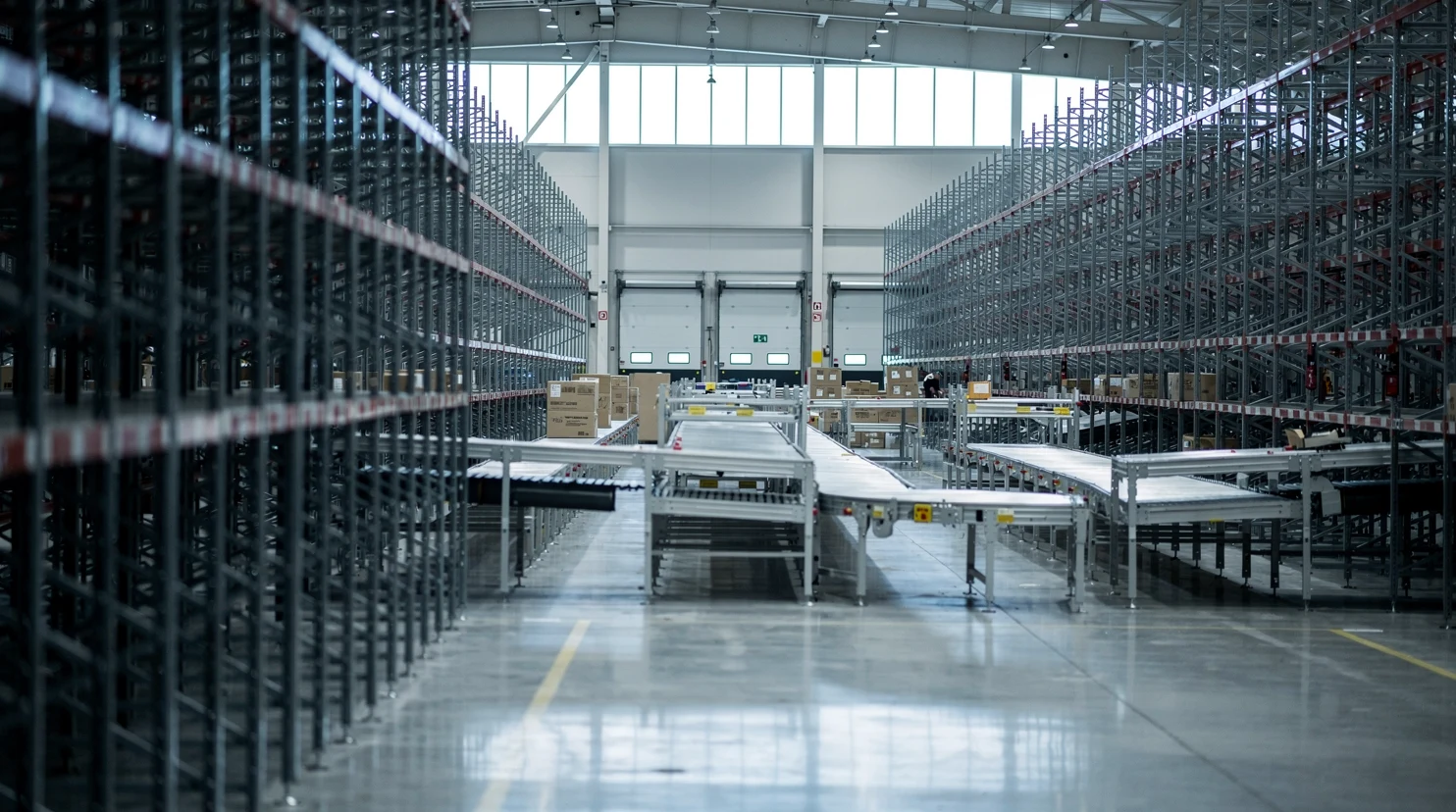
Debenhams Group, the online retailer that still carries the legal name Boohoo Group plc, has drawn a line under one of the most expensive missteps of its overseas expansion. The company told the market on Friday that it has completed a sublease of its 1.1 million square foot distribution centre in Elizabethtown, Pennsylvania, handing the keys to third-party logistics operator ID Logistics. According to a regulatory filing, the deal mitigates roughly USD 100 million of future lease and holding costs and triggers an unaudited non-cash exceptional credit of about GBP 40 million (around USD 54 million at recent exchange rates near 1.35 dollars to the pound).
The move closes the book on a warehouse that opened in August 2023, ran for roughly 15 months, and was mothballed in November 2024 when the group pulled its US fulfilment back to the United Kingdom. It is a small transaction in cash terms, yet it speaks to a much larger story: a one-time fast-fashion challenger retrenching to its home market, rebranding around a heritage department-store name, and trying to convince investors that its turnaround is real while its largest shareholder watches from across the table.
In short
- The deal: Debenhams Group has subleased its idle 1.1 million square foot US distribution centre in Elizabethtown, Pennsylvania to ID Logistics, a French-headquartered third-party logistics firm.
- The money: The sublease mitigates about USD 100 million of future lease and holding costs, covers roughly USD 20 million of other lease obligations, and generates average annual rent income of about USD 9.5 million.
- The accounting: The transaction produces an unaudited non-cash exceptional credit of around GBP 40 million and cuts the annual lease bill from GBP 13 million this year to GBP 8 million in FY28 and GBP 6 million in FY29.
- The context: The Pennsylvania site absorbed roughly USD 124 million in rent, operating costs and capital before the group abandoned its US fulfilment ambitions in November 2024.
- The backdrop: The company rebranded from Boohoo to Debenhams Group in 2025 over the objections of top shareholder Frasers Group, and is pivoting toward a marketplace model under chief executive Dan Finley.
What did Debenhams Group announce about its US warehouse?
In a statement released through the London Stock Exchange regulatory news service, the company confirmed that it has completed a sublease of its US distribution centre to ID Logistics. The facility sits in Elizabethtown, Pennsylvania, spans about 1.1 million square feet, and has stood largely unused since the group ceased operating it in November 2024. ID Logistics is expected to take occupation from 1 August 2026 and to hold the space until the end of the group’s underlying lease.
The framing in the filing was unambiguous: this is a liability-management exercise, not a growth announcement. Chief executive Dan Finley described the site as “a major contributor to the challenges that the company has faced,” adding that the sublease “mitigates a material future liability.” That language matters because it positions the warehouse as a legacy problem inherited from a previous strategy rather than a live part of the business.
For a company whose shares trade at a fraction of their pandemic-era peak, removing a known cash drain is the kind of incremental win management needs to string together. The market read it that way, with the stock ticking higher in London trading after the announcement. The reaction was modest, consistent with a deal that improves the balance sheet without changing the revenue trajectory.
It is worth separating the two numbers that headline the release. The roughly GBP 40 million exceptional credit is a non-cash accounting entry, reflecting the reversal of provisions previously booked against the onerous lease. The cash benefit, spread over years, comes from the sublease income and the avoided holding costs, which the company pegs at close to USD 100 million across the remaining term.
Why did the US distribution centre become a liability?
The Pennsylvania warehouse was conceived during a very different chapter for the business. When the group committed to a large US fulfilment hub, the strategy was built on rapid international growth, with American shoppers expected to drive a meaningful slice of demand for brands such as boohoo, PrettyLittleThing and Nasty Gal. That thesis did not survive contact with the post-pandemic reality of softening demand, rising returns and intensifying competition from ultra-low-cost rivals.
The 2023 build-out
The site opened in August 2023 as the physical anchor of the group’s US ambitions. A 1.1 million square foot facility is a serious commitment of capital and fixed cost, the kind of infrastructure that only pays off at scale. The bet was that US order volumes would rise quickly enough to fill the building and justify the rent.
The November 2024 retreat
Instead, US trading deteriorated and the economics never matured. By November 2024 the group had stopped operating the centre and shifted American fulfilment back to its UK network, accepting longer delivery times for US customers in exchange for shedding a large operating cost. The decision effectively conceded that the standalone US fulfilment model had failed, leaving the company with an expensive, empty building and years left on the lease.
What 124 million dollars bought
According to the company, the site absorbed approximately USD 124 million in cumulative costs across rent, operating expenses and capital investment over its short life. That figure is the real measure of the misadventure: more than a hundred million dollars spent on a facility that ran for barely 15 months before being shut. The sublease does not recover that sunk cost, but it stops the meter running on what would otherwise have been years of additional rent on a dormant asset.
The broader lesson tracks a pattern seen across apparel e-commerce, where overbuilt fulfilment capacity has repeatedly turned from competitive advantage into balance-sheet ballast when demand normalised. The same forces squeezing margins at mid-market apparel sellers, visible in results such as J.Jill’s tariff-pressured first quarter, left little room for carrying idle infrastructure on another continent.
What does the sublease to ID Logistics actually change?
The transaction reshapes the cost profile of the lease without erasing the underlying obligation. Debenhams Group remains the head tenant, but ID Logistics now takes on occupation and pays rent that offsets a large part of the group’s liability. The net effect is a steadily falling annual lease bill and a recurring income stream that did not exist while the building sat empty.
The 40 million pound exceptional credit explained
The roughly GBP 40 million credit is an accounting consequence, not a cash windfall. When a company holds a lease it can no longer use productively, it books an onerous-lease provision against expected future losses. Subletting the space reduces those expected losses, so part of the provision is released back through the income statement as an exceptional credit. Investors should treat it as a one-off item that flatters reported profit in the period rather than as operating cash generation.
The lease-cost glide path
The more durable benefit is the trajectory of the annual lease cost. The company guided that the US lease burden falls from GBP 13 million in the current financial year to GBP 8 million in FY28 and GBP 6 million in FY29. Layered on top is average annual sublease income of about USD 9.5 million from ID Logistics. Together, those flows convert a pure cash drain into a managed, declining cost.
Who is ID Logistics
ID Logistics is a French-headquartered contract logistics group that operates warehousing and fulfilment for retail and e-commerce clients across Europe and the Americas. For a third-party operator, a 1.1 million square foot building in central Pennsylvania is a usable asset: the state sits within reach of dense East Coast consumer markets and major freight corridors. Taking it on a sublease lets ID Logistics add capacity without committing to a ground-up build, while giving Debenhams a counterparty with the scale to honour a multi-year commitment.
How does this fit the Boohoo-to-Debenhams turnaround?
The warehouse exit is one piece of a wider reinvention. The group that built its name on cheap, fast online fashion has spent the past two years trying to reposition itself as a multi-brand platform, with the Debenhams department-store name at the centre of the new identity. Cleaning up legacy liabilities like the US lease is part of clearing the runway for that pivot.
From fast fashion to marketplace
Management has signalled that Debenhams, acquired out of administration in 2021, is the template for the group’s future. Rather than holding inventory on every line, the marketplace model lets third-party brands sell through the platform while the group takes a commission, lightening working-capital needs and reducing markdown risk. Shedding an oversized owned-fulfilment asset is consistent with that asset-lighter direction.
That strategic logic mirrors a broader move across retail toward capital discipline and outsourced infrastructure, a theme visible in deals as varied as Starbucks weighing an asset-light pivot in Japan. The common thread is a willingness to give up direct control of physical or operational assets in exchange for lower fixed costs and a cleaner balance sheet.
The rebrand fight with Frasers
The shift to the Debenhams Group identity was not smooth. The company adopted the new name and the DEBS ticker in 2025, but its largest shareholder, Mike Ashley’s Frasers Group, voted against the formal legal name change. With about 62 percent of shareholders backing the resolution, the vote fell short of the two-thirds threshold needed to alter the legal entity, so the company trades as Debenhams Group while remaining Boohoo Group plc on paper.
That split identity is more than a curiosity. It is a visible marker of the governance tension that hangs over every strategic decision the company makes, including how it disposes of legacy assets like the Pennsylvania warehouse.
What does the Frasers Group overhang mean for the stock?
Frasers Group has steadily built a stake of close to 29 percent, having raised its holding in early 2025, and has clashed repeatedly with the board led by co-founder and executive chairman Mahmud Kamani. Ashley’s vehicle has criticised the direction of the business and pushed for boardroom representation, framing itself as a frustrated large owner seeking to protect value.
For minority investors, the Frasers position is a double-edged feature. On one hand it puts a motivated, deep-pocketed operator on the register who has every incentive to see the equity re-rate. On the other, the persistent friction creates uncertainty about strategy and control that can weigh on the share price independent of trading performance.
Frasers itself has been on an acquisitive run across European retail, including its move on a major apparel group detailed in Frasers’ takeover approach for Hugo Boss. That pattern of stake-building and consolidation is part of why the Boohoo register is watched so closely: the line between an engaged shareholder and a prospective acquirer is thin.
The US warehouse deal does not resolve that overhang, but it does remove one more line of attack. A cleaner liability profile is harder to criticise, and every legacy problem the management team neutralises strengthens its hand in the longer governance contest.
How does Debenhams’ US exit compare with other retail retreats?
Pulling back from an overseas market is a well-worn move in modern retail. The specifics differ, but the underlying calculus is consistent: when a foreign operation cannot reach the scale needed to cover its fixed costs, the disciplined choice is to retreat and redeploy capital at home. The table below sets the Debenhams decision against comparable strategic reversals.
| Company | Market exited or shrunk | Core reason | Approach |
|---|---|---|---|
| Debenhams Group (Boohoo) | United States fulfilment | US volumes too low to fill a 1.1m sq ft hub | Closed 2024, subleased the warehouse in 2026 |
| Many UK fast-fashion peers | US and EU direct operations | Returns, duties and competition eroded margins | Reverted to UK-based cross-border shipping |
| Department-store chains | Loss-making international stores | Local scale insufficient versus incumbents | Store closures and franchise or licensing deals |
| Global brands rationalising assets | Owned regional infrastructure | Capital discipline and focus on home markets | Sale-and-leaseback or asset-light partnerships |
What distinguishes the Debenhams case is the speed of the round trip. The warehouse opened and closed inside roughly 15 months, a compressed timeline that underscores how quickly the US growth thesis unravelled. Many retreats play out over years of gradual decline; this one was abrupt.
What are the economics of the deal, line by line?
Because the announcement mixes cash and non-cash figures, and pounds with dollars, it helps to lay the numbers out in one place. The table below summarises the key disclosed metrics, with sterling figures converted to dollars at a rate near 1.35 for illustration only.
| Metric | Disclosed figure | Type |
|---|---|---|
| Cumulative cost of the US site to date | ~USD 124 million | Historic, sunk |
| Future lease and holding costs mitigated | ~USD 100 million | Cash benefit over term |
| Other lease obligations covered | ~USD 20 million | Cash benefit |
| Average annual sublease rent income | ~USD 9.5 million | Recurring cash inflow |
| Exceptional credit on the transaction | ~GBP 40 million (about USD 54 million) | Non-cash, one-off |
| Annual lease cost, current year | GBP 13 million (about USD 17.5 million) | Cash cost |
| Annual lease cost, FY28 | GBP 8 million (about USD 10.8 million) | Cash cost |
| Annual lease cost, FY29 | GBP 6 million (about USD 8.1 million) | Cash cost |
The single most important takeaway is the gap between the sunk cost and the recovery. The group spent about USD 124 million and is not getting that back; what it has bought with the sublease is the avoidance of perhaps USD 100 million more in costs it would otherwise have carried. In other words, the deal is about stopping future bleeding rather than healing past wounds.
There is also a presentational benefit worth naming. Because the exceptional credit is non-cash and one-off, analysts will strip it out when assessing underlying profit, so it does not inflate the quality of earnings in any meaningful way. What it does is signal progress on the balance sheet at a moment when the company needs to show momentum. Investors who have grown weary of repeated provisions and write-downs will read a provision release, for once moving in their favour, as a modest positive inflection.
The currency mix adds a layer of complexity that is easy to overlook. The lease obligations and sublease income are denominated in US dollars, while the group reports in sterling, so the eventual sterling value of the savings will move with the exchange rate. A weaker pound would flatter the reported value of the dollar income; a stronger pound would trim it. None of that changes the strategic logic, but it means the precise sterling figures the company books in future periods will carry a translation effect on top of the underlying cash flows.
The sublease income of roughly USD 9.5 million a year does not, on its own, transform the group’s finances. But set against an annual lease cost that falls toward GBP 6 million, it turns the building from a pure cost centre into something close to cost-neutral over time. For a company watching every line of fixed cost, that is a meaningful swing.
What does it signal for fast fashion and cross-border fulfillment?
The wider message is about the limits of owned international fulfilment for mid-sized online retailers. Building dedicated warehouses in distant markets only works when order density is high and durable. When demand is volatile, the fixed cost of that infrastructure becomes a trap, and the flexible alternative of cross-border shipping or third-party logistics looks far more attractive.
Fast fashion in particular faces a brutal competitive backdrop. Ultra-low-cost cross-border platforms have reset price expectations and pressured the unit economics of legacy online sellers, a dynamic explored in our analysis of how new de minimis rules may fail to slow Temu and Shein. Against rivals that ship directly from low-cost manufacturing bases, carrying expensive owned warehouses abroad is a structural disadvantage.
There is also a domestic cost angle. UK retailers have been absorbing higher labour and tax costs that squeeze margins across the board, a pressure documented in coverage of job cuts driven by tax rises on the high street. In that environment, freeing up tens of millions of pounds tied to an unused foreign asset is exactly the kind of self-help measure investors want to see.
For the logistics sector, the deal is a reminder that the secondary market for large fulfilment buildings remains active. Operators like ID Logistics can absorb capacity that retailers no longer need, recycling overbuilt warehouses into shared infrastructure. That flexibility is increasingly central to how retail supply chains adjust to shifting demand, with idle capacity in one company’s network becoming usable space in another’s.
The episode also illustrates a quieter shift in how online retailers think about geography. The pandemic-era instinct was to plant fulfilment in every target market, on the theory that proximity to the customer was a moat. The current instinct is the opposite: concentrate inventory where volumes are reliable, and serve thinner markets through cross-border shipping or partners. Speed of delivery still matters, but not enough to justify stranded fixed costs in markets that never reached scale.
For Debenhams Group specifically, the warehouse exit reinforces a narrative of disciplined retrenchment. The company is smaller, more UK-focused and more cautious than the growth-at-all-costs operator of a few years ago. Whether that discipline translates into a sustainably profitable business depends on the marketplace pivot, but removing a USD 100 million overhang is a credible step in that direction and one that management can point to as evidence of follow-through.
What happens next for Debenhams Group?
The immediate sequence is straightforward. ID Logistics is due to take occupation of the Pennsylvania site from 1 August 2026, at which point the sublease income begins and the lease-cost glide path takes hold. The exceptional credit will be recognised in the relevant reporting period, flattering headline profit even as underlying trading remains the real test.
| Date | Event |
|---|---|
| August 2023 | US distribution centre opens in Elizabethtown, Pennsylvania |
| November 2024 | Group ceases US operations, returns fulfilment to the UK |
| 2025 | Rebrand to Debenhams Group and adoption of DEBS ticker |
| June 2026 | Sublease to ID Logistics completed and announced |
| 1 August 2026 | ID Logistics expected to begin occupation |
| FY28 and FY29 | Annual US lease cost falls to GBP 8m, then GBP 6m |
Beyond the warehouse, the questions investors will track are familiar. Can the marketplace pivot lift gross margin and reduce inventory risk fast enough to offset declining own-brand sales? Will the Debenhams name draw enough third-party brands and shoppers to anchor the new model? And how will the standoff with Frasers Group evolve, given Ashley’s appetite for consolidation across European retail?
The sublease answers none of those questions directly. What it does is remove a recurring distraction and demonstrate that management can execute on the unglamorous work of liability cleanup. In a turnaround, that credibility compounds. Investors looking for evidence that the company can do what it says will count this as a small but tangible data point.
It is also a useful lens on the trade-offs the group still faces. Returning US fulfilment to the United Kingdom lowered fixed costs but lengthened delivery times for American shoppers, which can dampen conversion and raise the rate of cancelled or returned orders. The company has effectively chosen balance-sheet safety over US service quality, a defensible call given the scale problem, but one that caps how much the American market can contribute to growth from here. Any future US ambition would have to be rebuilt on a lighter, partner-led model rather than owned bricks and mortar.
For the sector at large, the clean-up underscores how the economics of online fashion have hardened. Cheap capital and pandemic demand once made aggressive fulfilment build-outs look prudent; higher rates, normalised demand and relentless price competition have made them look reckless in hindsight. The companies that emerge strongest from this cycle are likely to be those that treat fixed cost as the enemy and flexibility as the asset, exactly the posture the Pennsylvania sublease embodies.
The official corporate disclosures, including the full regulatory filing, are available via the group’s London Stock Exchange company page for readers who want the primary numbers in full.
Frequently asked questions
Is Debenhams Group the same company as Boohoo?
Yes. The group rebranded its public identity to Debenhams Group in 2025 and trades under the DEBS ticker, but its legal entity remains Boohoo Group plc after shareholders, led by Frasers Group, blocked the formal name change. The portfolio includes the Debenhams, boohoo and PrettyLittleThing brands among others.
How much did the US warehouse cost the company?
According to the company’s filing, the Elizabethtown site absorbed approximately USD 124 million in cumulative rent, operating costs and capital investment before it was shut in November 2024. That figure is a sunk cost and is not recovered by the sublease.
What is the GBP 40 million exceptional credit?
It is a non-cash accounting entry. When a company holds a lease it cannot use, it books a provision against expected losses. Subletting the space reduces those expected losses, so part of the provision is released back through profit as a one-off exceptional credit. It flatters reported earnings but is not operating cash.
Who is taking over the warehouse?
ID Logistics, a French-headquartered contract logistics operator that runs warehousing and fulfilment for retail and e-commerce clients across Europe and the Americas. It is expected to begin occupying the Pennsylvania site from 1 August 2026 under the sublease.
How much will the deal save Debenhams Group?
The company says the sublease mitigates roughly USD 100 million of future lease and holding costs and covers about USD 20 million of other lease obligations. It also generates average annual rent income of about USD 9.5 million, while the annual lease cost falls from GBP 13 million this year to GBP 6 million by FY29.
Why did the company exit the US market?
US order volumes were too low to justify the fixed cost of a dedicated 1.1 million square foot fulfilment hub. Facing softening demand, high returns and intense low-cost competition, the group closed the site in November 2024 and shifted US fulfilment back to its UK network.
What role does Frasers Group play?
Frasers Group, controlled by Mike Ashley, is the largest shareholder with a stake of close to 29 percent. It has clashed repeatedly with the board, opposed the legal name change, and pushed for influence, creating a governance overhang that shadows the company’s strategy.
Does the deal change the company’s revenue or growth outlook?
No. It is a balance-sheet and cost-management transaction, not a trading update. It reduces a fixed cost and removes a liability, but it does not alter sales or the pace of the group’s marketplace turnaround, which remain the key tests for investors.
When will the financial benefits show up?
The exceptional credit is recognised in the relevant reporting period, while the cash benefits build over the lease term. Sublease income and the lower lease-cost profile take effect once ID Logistics begins occupation, expected from 1 August 2026, with annual lease costs stepping down through FY28 and FY29.