
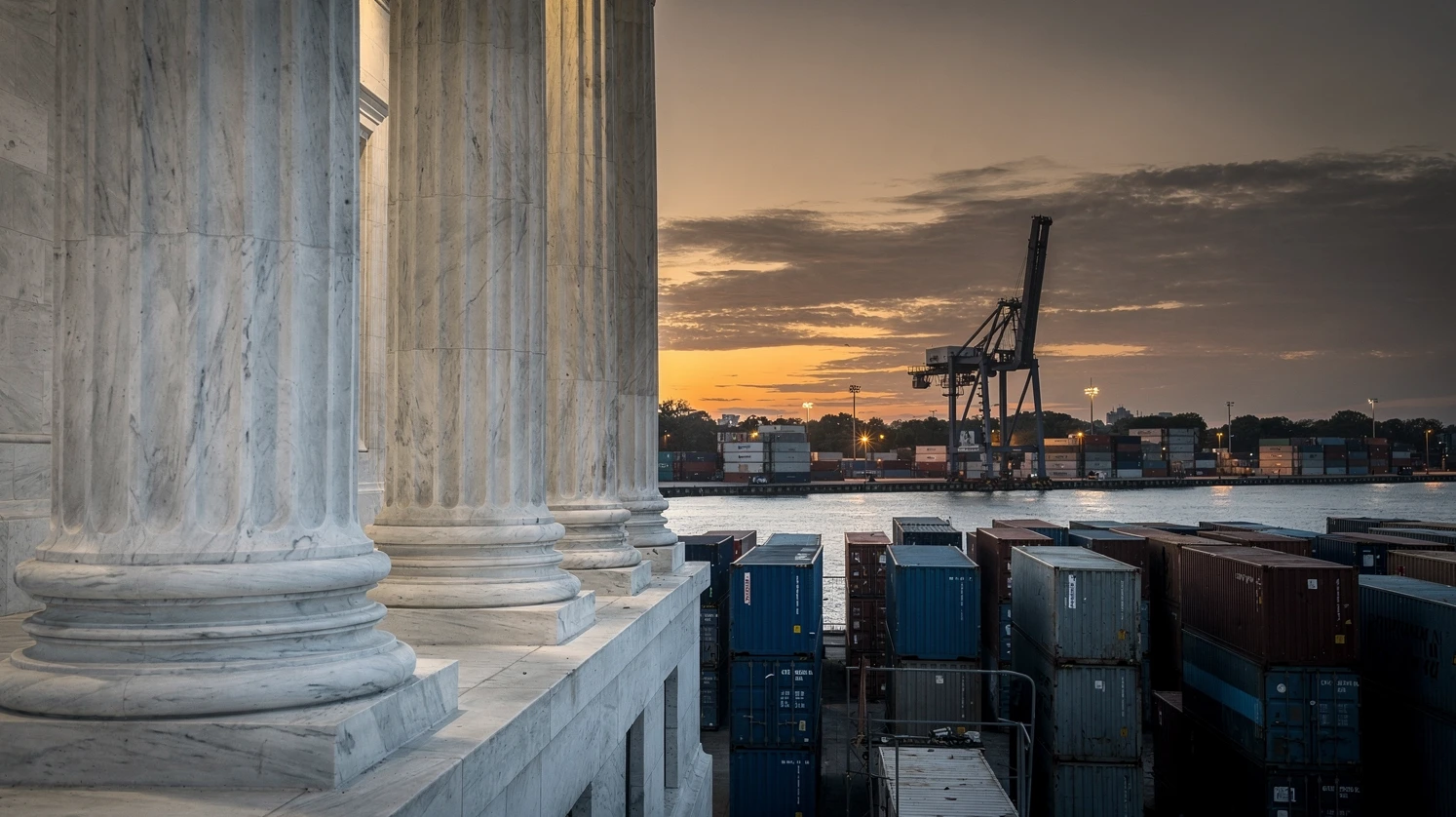
The US House of Representatives voted 214-211 on the evening of September 15 to adopt the rule governing debate on the Lindsey O. Graham Sanctioning Russia and Iran Act of 2026, clearing the last procedural obstacle before a final passage vote scheduled for September 16. The Senate passed the same bill 86-11 in August. If the House clears it unchanged, the measure goes to the president’s desk, and with it a new statutory power to impose tariffs of up to 100 percent on the largest buyers of Russian oil and gas: a list that, by every published reading, starts with China, India and Turkey, three of the most important sourcing countries for US retail.
For retail and e-commerce importers, this is not a Ukraine story. It is a tariff story. The bill would hand the executive branch a tariff authority that Congress has explicitly authorized, which is exactly the feature the Supreme Court found missing when it struck down the emergency-powers tariffs in February. Everything the sector has been litigating since then, from refund deadlines to the Section 301 forced-labor duties, has rested on the argument that the president exceeded what Congress allowed. This bill closes that gap for one specific trigger, and the trigger points at the countries that fill US shelves with apparel, home textiles, jewelry, electronics and generic medicines.
In short
- What happened: The House adopted the rule 214-211 on September 15, with two Democrats (Jared Golden and Marie Gluesenkamp Perez) joining Republicans, per Kyiv Independent reporting. The Rules Committee had advanced the bill 7-3 the day before, according to RFE/RL. Final passage is expected September 16, before an extended recess.
- What the bill does: Beyond mandatory sanctions on Russian banks, officials and the shadow fleet, it lets the president impose duties of up to 100 percent on the five largest buyers of Russian crude and natural gas and on five countries judged to be helping Moscow evade sanctions, with the lists recalculated every 180 days, per bill summaries published by the National Taxpayers Union and Kyiv Independent.
- Who is exposed: China, India and Turkey are the largest buyers of Russian crude; the EU, China and Turkey lead on gas. A Democratic amendment debated in committee named ten countries: China, India, Azerbaijan, Turkey, the UAE, Hungary, Slovakia, Singapore, Kazakhstan and Kyrgyzstan.
- Why retail cares: US goods imports from India reached $103.8 billion in 2025 and from China $308.7 billion, per USTR. Both already pay Section 301 forced-labor duties of 10 or 12.5 percent. A 100 percent tariff would stack on top, and unlike the IEEPA duties it would be hard to challenge in court.
- What is unresolved: The president can waive the tariffs with a certification to Congress, the rates are discretionary rather than mandatory, and India’s unfinished bilateral trade deal, which the White House framed around India ending Russian oil purchases, is now the obvious bargaining chip.
What exactly did the House vote on September 15?
The September 15 vote was on the rule, the procedural resolution that sets the terms of floor debate for a bill. Rules are normally party-line formalities, but this one was not. According to Kyiv Independent, the measure passed 214-211, with Democrats Jared Golden of Maine and Marie Gluesenkamp Perez of Washington crossing the aisle to supply the margin. The Hill reported the same two-Democrat crossover in its account of the vote, published at 5:29 p.m. Eastern.
The narrow tally reflects two separate revolts. Several House Republicans had threatened to vote against the rule over the tariff chapter, and the Democratic leadership, in the person of House Foreign Affairs ranking member Gregory Meeks, opposed the bill outright in the Rules Committee on Monday. Per RFE/RL, the committee advanced it 7-3, with Democrats offering amendments to strip the secondary tariff provisions and to tighten the presidential waiver. Those amendments did not make it into the rule.
The vote came a day after the Rules Committee session and roughly a month after the Senate acted. The Senate cleared the bill 86-11 in August, a bipartisan margin that House leaders have used as the argument for taking it up without changes. Any House amendment would send it back to the Senate, which is why the leadership chose a closed process and why the final passage vote on September 16 is expected to be on the Senate text as passed.
Why the vote is scheduled before the recess
RFE/RL reported that the House expects to consider final passage on September 16 before an extended recess, ahead of the November midterm elections. That timing is the whole reason the rule vote was so tight: members who dislike the tariff chapter were being asked to decide now or leave the bill until after the election. Former ambassador to Russia Michael McFaul, quoted by Kyiv Independent, put the case for passing it as “the positive symbolism of it passing outweighs the negative symbolism of it failing.”
What does the Graham act actually authorize?
The bill is named for the late Senator Lindsey Graham, who championed it from April 2025 until his death, and its core is a package of mandatory sanctions. Per Kyiv Independent’s summary of the text, those cover President Putin and senior officials, the Central Bank of Russia, Sberbank and Gazprombank, state-owned enterprises, foreign entities supplying Russia’s defense industrial base, the Yamal LNG and Arctic LNG projects, and the shadow fleet that moves Russian crude. It also extends US sanctions on Iran that are due to expire at the end of the year, per RFE/RL.
The chapter that matters for retail is the tariff title. The National Taxpayers Union, which opposes the bill, summarized it in July as authorizing tariffs of up to 500 percent on imports from Russia itself, and up to 100 percent on goods from the top five export markets for Russian crude oil and natural gas, plus the top five facilitators of sanctions evasion. The rates are set by the president, not by Congress, and the bill sets no sunset date. The US Trade Representative must recalculate the top-five lists every 180 days.
Two carve-outs soften the reach. Countries that import less than 15 percent of Russia’s natural gas exports are exempt if they are actively reducing those imports, a provision widely read as protecting EU member states and Japan. And the president can waive the sanctions and tariffs, per Kyiv Independent’s reading of the July text, upon “justification and certification to Congress that the waiver is in the national interest.”
How the tariff chapter shrank from 500 percent to 100 percent
The version Graham introduced in 2025 carried a blanket 500 percent tariff on any country buying Russian energy. Kyiv Independent reported in July that the updated text cut that to a maximum of 100 percent and narrowed the target from all buyers to the five largest, while adding the gas-importer exemption. The Indian National Congress, the opposition party in New Delhi, attacked the carve-out at the time: “Trump fully backs the bill threatening 100% tariff on buying Russian oil. BUT their new bill will exempt European allies,” a party spokesman said, per NTU’s account.
The narrowing matters because it converts an unworkable headline into a usable instrument. A 500 percent tariff on every Russian energy buyer would have covered most of Asia and the Gulf; a 100 percent tariff on five named countries is something Customs and Border Protection can actually collect. That is the reading trade lawyers have applied, and it is why the Democratic amendment in committee tried to fix the list in statute rather than leave it to a 180-day recalculation.
Who ends up on the list?
The bill does not name countries; it names a formula. But the formula has an obvious output. Kyiv Independent identified China, India and Turkey as the largest buyers of Russian crude and the EU, China and Turkey as the largest gas buyers. NTU’s July analysis, working from trade data, listed the top crude markets as China, India, Turkey, the EU and Myanmar; the top LNG markets as the EU, China, Japan, South Korea and Turkey; and the top pipeline gas markets as the EU, China, Turkey, Serbia and Moldova.
The Democratic amendment offered in the Rules Committee made the list explicit. Per RFE/RL, it named ten countries that could face tariffs under the bill: China, India, Azerbaijan, Turkey, the United Arab Emirates, Hungary, Slovakia, Singapore, Kazakhstan and Kyrgyzstan. The second five are the sanctions-evasion candidates: transshipment hubs and Central Asian intermediaries rather than energy buyers. The amendment failed, but it is the clearest published statement of whom the bill’s authors expect to be targeted.
For a US retailer the list collapses to three names. The UAE, Singapore and the Central Asian states are not material sources of consumer goods. Hungary and Slovakia ship through the EU and would almost certainly fall inside the gas exemption. China, India and Turkey are different: together they supplied roughly $429 billion of US goods imports in 2025, per USTR country data, and they dominate the categories that sit on a general-merchandise shelf.
| Country | US goods imports 2025 (USTR) | Why it is on the list | Current Section 301 tier | Retail categories at stake |
|---|---|---|---|---|
| China | $308.7 billion (down 29.9% from 2024) | Largest buyer of Russian crude, gas and LNG | 12.5% above MFN | Electronics, toys, furniture, apparel, small appliances, marketplace parcels |
| India | $103.8 billion | Second-largest crude buyer; Russia remains its top supplier | 10% above MFN | Apparel, home textiles, cut diamonds and jewelry, generic pharmaceuticals, footwear |
| Turkey | $16.4 billion (down 1.7%) | Third-largest crude buyer; major gas importer | 12.5% above MFN (per published tier tables) | Apparel, denim, home textiles, carpets, ceramics, food |
| EU member states | Not targeted individually | Largest gas buyer as a bloc | 10% net of MFN | Exempt in practice under the 15 percent gas clause if reducing imports |
India is the retail pressure point
India is where the bill collides with an unfinished trade deal. The February 6 United States-India joint statement published by the White House set a reciprocal tariff rate of 18 percent on Indian goods under Executive Order 14257, committed India to buy $500 billion of US energy, aircraft, precious metals, technology and coking coal over five years, and promised that Washington would remove reciprocal tariffs on generic pharmaceuticals, gems, diamonds and aircraft parts once the agreement was concluded. Per the White House at the time, the additional 25 percent duty tied to India’s Russian oil purchases was dropped in recognition of India’s commitment to end those purchases.
Seven months later, the deal is not concluded and the oil is still flowing. India’s commerce minister Piyush Goyal told Bloomberg on September 4 that New Delhi would sign only once Washington offered a rate better than its competitors: “We have to see the rate that Vietnam pays in another country, what Bangladesh goods are charged. Our rates will be better.” He is due to meet USTR Jamieson Greer at the G20 trade ministers’ meeting later this month. Russia remains India’s largest crude supplier, and tanker-tracking data cited in the trade press show Indian refiners taking a larger share of Russia’s Far East cargoes through mid-2026 as the Hormuz disruption redirected flows.
That is the context in which the 100 percent tariff authority lands. The February framework was already stalled on tariff rates; the Graham act gives the US side a lever far larger than the 18 percent reciprocal rate that the Supreme Court has since voided. It also revives the exact demand, stop buying Russian oil, that India’s government publicly rejected in March, when officials said the country did not need US permission to choose its suppliers, per the Moscow Times’ report of the exchange.
Why does this tariff power differ from every tariff Trump has used so far?
The answer is the Supreme Court. On February 20, 2026, the Court ruled 6-3 in the consolidated VOS Selections and Learning Resources cases that the International Emergency Economic Powers Act does not authorize tariffs, striking down both the fentanyl orders on Canada, China and Mexico and the reciprocal order covering all countries, per the Council on Foreign Relations’ analysis of the ruling. Since then the administration has cycled through fallback statutes: a Section 122 balance-of-payments tariff at 10 percent, capped by law at 150 days and expired July 24, and then the Section 301 forced-labor action that took effect the same day at 10 or 12.5 percent on 60 economies.
Each fallback has been challenged on the same theory, that the president is using a narrow statute to do what Congress never authorized. The Section 301 duties are before a three-judge panel of the Court of International Trade, with the statute’s own drafters arguing in amicus briefs that Section 301 was designed as a country-by-country negotiating tool, not a global tariff; oral argument is set for September 30. California’s attorney general filed the state’s brief on September 15 calling the action the president’s “third attempt” at an unlawful tariff regime, per the state’s press release.
The Graham act removes that line of attack for its own tariffs. A duty imposed under a statute that says, in terms, that the president may impose tariffs of up to 100 percent on named categories of countries is a duty Congress has delegated on purpose. Importers could still contest how the lists are calculated or whether a waiver was properly refused, but the core question that has produced $166 billion of IEEPA refund liability, whether the tariff was authorized at all, would be settled by the text.
| Instrument | Rate | Legal status (Sept 2026) | Court-proof? | Retail effect |
|---|---|---|---|---|
| IEEPA reciprocal and fentanyl tariffs | 10% to 50% by country | Struck down Feb 20, 2026; refunds in progress via CAPE | No; voided | ~$166 billion of duties being refunded across 53 million entries |
| Section 122 | 10% | Expired July 24, 2026 after 150 days | Statutory cap; extension needs Congress | Bridged the gap; largely refunded or offset |
| Section 301 forced-labor action | 10% or 12.5% above MFN on 60 economies | In force since July 24; CIT oral argument Sept 30 | Contested; drafters say it is a pretext | Roughly $100 billion a year, per the Gresser amicus brief |
| Section 232 | Product-specific (steel, aluminum, copper, furniture, drones) | Unaffected by the IEEPA ruling | Yes, on national-security findings | 25% on upholstered furniture; 100% on thermal drones |
| Graham act secondary tariffs | Up to 100% on ten countries; up to 500% on Russia | Pending final House vote Sept 16 | Yes, if enacted: explicit delegation | Discretionary; stacks on Section 301 and 232 |
The refund precedent cuts both ways
The IEEPA experience taught importers that a tariff later found unlawful is not a loss but a receivable. Large chains booked their refunds as margin or price cuts; smaller importers are still fighting CBP’s 90-day refund filing window. A Graham act tariff would not generate that receivable. Duties paid under an explicit congressional authorization stay paid, which changes how a sourcing team should price the risk: not as a temporary cash-flow hit but as a permanent landed-cost change.
What would a 100 percent tariff do to landed costs?
The arithmetic is blunt. A cotton T-shirt from India currently enters at the most-favored-nation duty of roughly 16.5 percent plus the 10 percent Section 301 forced-labor surcharge, for an effective rate near 26.5 percent. Add a 100 percent secondary tariff and the duty on a $3.00 FOB garment rises from about $0.80 to about $3.80. The retail price would need to move by more than the tariff, because retailers mark up on landed cost, and every cost element downstream of the border (freight, fulfillment, returns) is calculated on a higher base.
Apparel is the category where India, China and Turkey overlap most. The Section 301 rate bands already create a 2.5-point gap between Bangladesh at 10 percent and Vietnam at 12.5 percent, and US apparel importers have spent the summer waiting for tariff-rate quotas that USTR promised but has not delivered, as apparel importers keep paying the full Section 301 duty. A 100 percent tariff on India and Turkey would push more programs to Bangladesh, Vietnam, Cambodia and Central America, exactly the migration that the 2025 tariff cycle already started.
Jewelry is the category where India has no substitute. The country cuts and polishes the large majority of the world’s natural diamonds by volume, and the February framework was supposed to take the reciprocal duty on loose stones to zero and on finished jewelry to 18 percent. Signet, the largest US specialty jeweler, has told investors it is managing a “dynamic tariff, commodity and consumer environment,” and its Q2 results earlier this month were read partly through the India diamond tariff overhang. A 100 percent duty would not shift diamond cutting to another country in any time frame that matters for holiday 2026; it would simply raise prices.
Generic medicines are the political tripwire
India supplies a large share of the generic prescriptions dispensed in US pharmacies, and the February joint statement specifically promised to remove reciprocal tariffs on generic pharmaceuticals. Grocery and drugstore chains with pharmacy counters have the least ability of any retailer to pass a tariff through, because reimbursement rates are set by payers. This is the category most likely to be carved out through the waiver mechanism if the bill is enacted, and the one that Democratic opponents have used to argue the tariff chapter is unworkable.
Why are Democrats and some Republicans opposed?
The Democratic objection is about who pays. Gregory Meeks, the House Foreign Affairs Committee’s top Democrat, told the Rules Committee on Monday that “American families will pay the cost of this bill. Vladimir Putin will not,” per RFE/RL. Democrats offered amendments to strip the secondary tariff provisions and to narrow the president’s waiver power; they argued the bill hands the White House a tariff tool with no congressional check while leaving Putin sanctions dependent on a waiver the president can grant at will. Axios reported on September 15 that the caucus was divided, with some members unwilling to vote against a Russia sanctions bill on any grounds.
The Republican objection is about delegation. A group of House Republicans threatened to oppose the rule, per The Hill, on the argument that Congress should not be voting to expand executive tariff authority seven months after the Supreme Court told the executive it had overreached. The Cato Institute, in commentary published this week ahead of the vote, cited its own polling that 70 percent of voters, including 56 percent of Republicans, say the president should need congressional approval before imposing new tariffs, and framed the bill as authorizing “potentially hundreds of billions of dollars” in new import taxes less than two months before an election in which prices dominate.
Supporters answer that the tariff is leverage, not policy. “Putin is watching,” Foreign Affairs chairman Michael McCaul told the committee, per RFE/RL. “Without leverage on Mr. Putin, he’ll never come to the negotiating table.” The White House supports the bill; the president said in July, per Kyiv Independent, that “there is a good chance it gets done.” The 214-211 rule vote suggests the final passage margin will be wider, since some members who vote against a rule on procedural grounds vote for the underlying bill, but the two-Democrat crossover shows how few votes the leadership had to spare.
| Date | Step | Result | Source |
|---|---|---|---|
| April 2025 | Graham and Blumenthal introduce the Sanctioning Russia Act with a 500% secondary tariff | Stalls in the Senate | Kyiv Independent |
| July 2026 | Updated text cuts the tariff to 100% on the top five buyers; 60 co-sponsors | Cleared for floor | Kyiv Independent; Axios |
| August 2026 | Senate passage | 86-11 | RFE/RL |
| September 14, 2026 | House Rules Committee | 7-3; Democratic amendments rejected | RFE/RL |
| September 15, 2026 | House rule vote | 214-211; Golden and Gluesenkamp Perez vote yes | Kyiv Independent; The Hill |
| September 16, 2026 | Final House passage vote | Pending; Senate text unchanged | RFE/RL |
| After passage | Presidential signature; USTR builds the top-five lists; 180-day recalculation cycle begins | Not scheduled | NTU bill summary |
How does this interact with India’s EU deal and the rest of the sourcing map?
The bill arrives at an awkward moment for India’s trade diplomacy. On September 11 the European Commission sent the EU-India free trade agreement to the Council for signature, with a December signing target and implementation in 2027. That pact takes EU duties on Indian apparel, footwear, leather and gems to zero. If the US is simultaneously threatening a 100 percent tariff on the same goods, the incentive for Indian exporters to reorient toward Europe is obvious, and the US retail buyers who have spent two years diversifying away from China toward India would find their second-largest alternative under a cloud.
China is the mirror image. US goods imports from China fell 29.9 percent in 2025 to $308.7 billion, per USTR, as the reciprocal and fentanyl tariffs pushed volume to Vietnam, Mexico and India. Much of what remained is in categories with no near-term substitute: consumer electronics, toys, small appliances, and the low-value parcel flow through Temu, Shein and AliExpress. A 100 percent tariff on China would be the largest single trade action of the Trump presidency by value, which is precisely why most analysts expect the authority to be waived or held in reserve for China and used, if at all, as pressure on India and Turkey.
Turkey is the smallest exposure but the hardest to replace within Europe-facing supply chains. It is a top-three apparel supplier to the EU and a growing near-shore source for US brands that want short lead times on denim and home textiles. At $16.4 billion of US imports it is not a headline number, but a 100 percent tariff would end the near-shoring case overnight.
What the 180-day recalculation means in practice
The lists are not fixed. USTR must recalculate the top-five buyers and top-five facilitators every 180 days, which means a country can rotate on or off the list twice a year based on its energy purchasing. For a sourcing director that is a planning nightmare: a program placed with a Turkish mill in September could be exposed in March if Turkey’s crude intake rises relative to a competitor’s. It also creates the incentive the bill’s authors intend, which is for India and Turkey to cut Russian volumes just enough to fall below fifth place.
What should importers and retailers do before the final vote?
Nothing in the bill takes effect on passage. The tariffs are discretionary, the lists have to be built, and the president can waive them. But the sequence from enactment to a proclamation could be short, and the administration has shown in every tariff cycle since 2025 that it will use new authority quickly. Three actions are defensible now.
- Map exposure by origin and by tier. Every program sourced from China, India or Turkey should carry a line for the maximum secondary-tariff scenario, layered on the existing Section 301 and Section 232 rates. Finance teams that built IEEPA refund models already have the entry-level data to do this.
- Separate substitutable from non-substitutable categories. Cotton apparel can move to Bangladesh or Central America over two seasons. Diamonds, generic drugs and most consumer electronics cannot. The non-substitutable list is the one to raise with trade counsel and, through associations, with the administration, because it is the list most likely to attract a waiver.
- Watch the India-US bilateral talks, not the House floor. The bill’s practical effect on India will be decided at the Goyal-Greer meeting later this month and in whatever the White House offers on the 18 percent reciprocal rate, which the Supreme Court ruling has in any case left without a legal base. A concluded deal with an energy-purchasing commitment is the most likely path to an India waiver.
The larger point for the sector is that Congress, having spent the year arguing that tariff power belongs to the legislature, is about to exercise that power by delegating it. The next time a court asks whether Congress authorized a tariff, the answer, for these ten countries, will be yes.
Frequently asked questions
Did the House pass the Russia sanctions bill?
Not yet. On September 15 the House adopted the rule for debate, 214-211. The final passage vote is scheduled for September 16, per RFE/RL and Kyiv Independent. The Senate passed the bill 86-11 in August, so House passage without amendment would send it to the president.
What tariffs does the Graham act allow?
Up to 100 percent on goods from the five largest buyers of Russian crude oil and natural gas and from five countries found to be helping Russia evade sanctions, plus up to 500 percent on imports from Russia itself, according to summaries by the National Taxpayers Union and Kyiv Independent. The rates are set by the president, and the lists are recalculated every 180 days.
Which countries would face the 100 percent tariff?
The bill uses a formula rather than names, but China, India and Turkey are the largest buyers of Russian crude and would be first in line. A Democratic amendment in the House Rules Committee listed ten candidates: China, India, Azerbaijan, Turkey, the UAE, Hungary, Slovakia, Singapore, Kazakhstan and Kyrgyzstan, per RFE/RL.
Is the EU exempt?
Effectively, yes. Countries that import less than 15 percent of Russia’s natural gas exports are exempt if they are actively reducing imports, a clause written with EU member states in mind, per Kyiv Independent’s July report on the revised text.
Can the president decline to impose the tariffs?
Yes. The tariff authority is discretionary, and the bill lets the president waive sanctions and tariffs with a justification and certification to Congress that the waiver is in the national interest. Democrats tried to tighten that waiver in committee and failed.
How is this different from the tariffs the Supreme Court struck down?
The February 20 ruling held that IEEPA does not authorize tariffs at all. The Graham act would authorize them explicitly, so an importer could not challenge a resulting duty on the ground that Congress never delegated the power. That is why a Graham act tariff, unlike the IEEPA duties now being refunded, should be treated as a permanent cost.
What does India currently pay on exports to the US?
India sits in the 10 percent tier of the Section 301 forced-labor action that took effect July 24, on top of normal MFN duties. The 18 percent reciprocal rate agreed in the February framework was imposed under IEEPA and has no legal base after the Supreme Court ruling. The bilateral trade agreement that would formalize India’s terms remains unsigned.
Would the tariff hit Temu, Shein and other China parcel flows?
If the president imposed a 100 percent tariff on China, it would apply to all Chinese-origin goods regardless of channel, including low-value parcels, which lost de minimis treatment in 2025. Most analysts expect the China authority to be held in reserve rather than used, given the value of trade involved.
When could tariffs actually be collected?
There is no fixed date. After enactment USTR must calculate the top-five lists, and the president must decide whether to impose duties and at what rate. In prior cycles the administration has moved from new authority to proclamation within weeks, so importers should plan for a fourth-quarter decision rather than a 2027 one.