
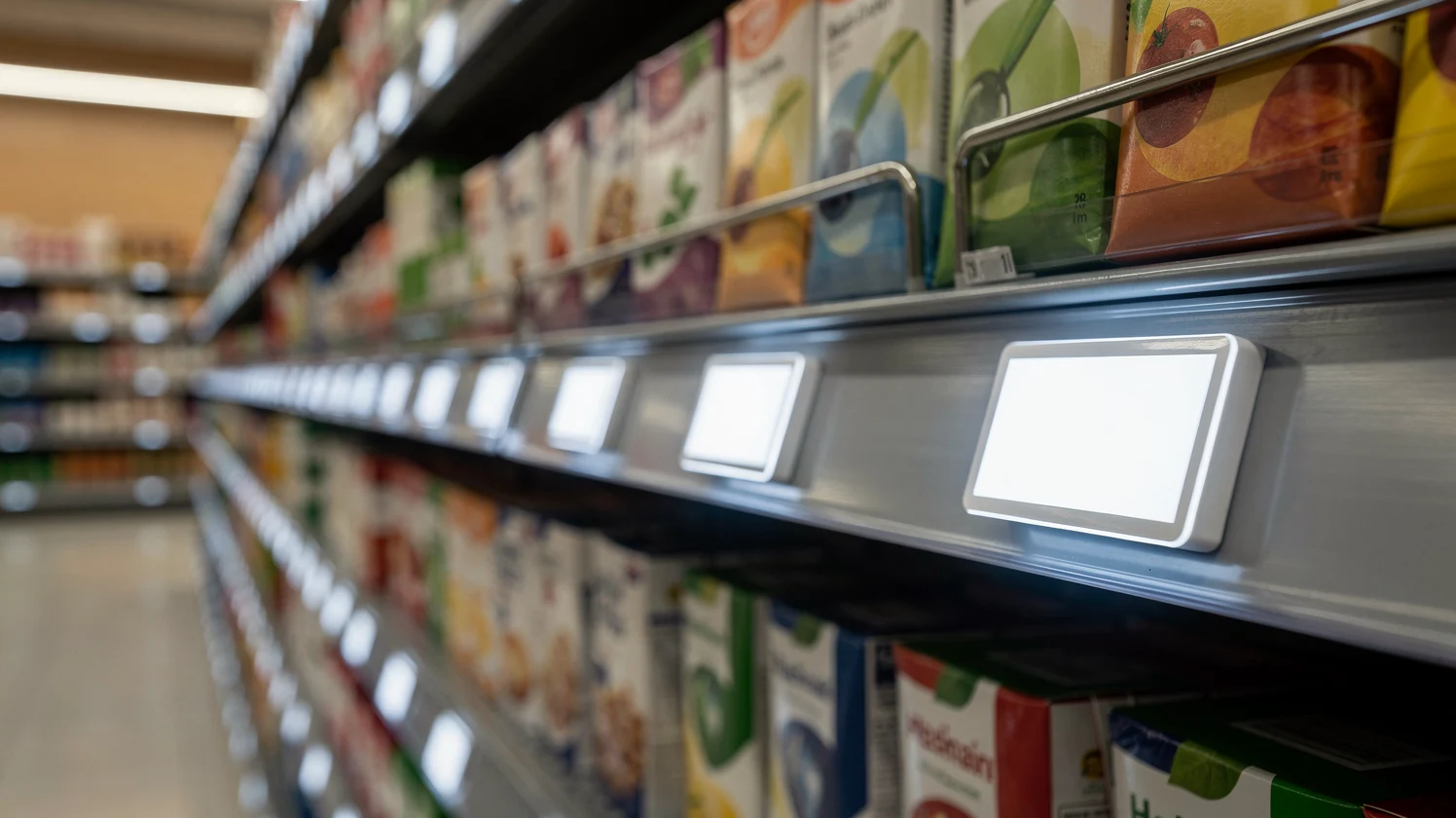
Electronic shelf labels cost more than most grocers expect on day one and pay back faster than most skeptics expect by year three. The honest answer to “what do electronic shelf labels cost” is a range, not a number: a mid-size US supermarket with 30,000 to 40,000 price points is commonly quoted somewhere between $200,000 and $500,000 for hardware and installation, with software and support fees layered on top. What determines whether that spend pays back is not the sticker price of a label. It is how many manual price changes the store currently absorbs, how many pricing errors it currently ships to the register, and whether the operator intends to use the screens for accuracy or for theater.
In short
- Per-label hardware cost is commonly quoted in the $5 to $15 range depending on screen size, color capability and volume, before installation, rails, access points and software licences are added.
- Labor savings on price changes and audits carry most of the payback case; a store that prints and hangs several thousand paper tags a week is the profile that recovers its investment fastest.
- Pricing accuracy is the second leg: shelf-to-register mismatches cost margin, generate refunds at the front end and expose the operator to weights-and-measures scrutiny that paper tags make hard to defend.
- Dynamic pricing is not the business case. Every major US grocer that has rolled out digital labels has publicly said it will not use them for surge pricing, and the shopper research explains why.
- A single-store payback model built on measured price-change volume, measured error rates and measured audit hours beats any vendor ROI deck, and it should be built before a chain-wide contract is signed.
What electronic shelf labels replace and what they do not
An electronic shelf label (ESL) is a small battery-powered e-paper display clipped to the shelf edge that shows the price, unit price, product name and often a barcode or QR code, updated wirelessly from the store’s pricing system. The direct replacement is the paper tag: the printed strip that a clerk hangs, checks, peels and rehangs every time a price, promotion or facing changes. The vendors that dominate the category, including Vusion Group (formerly SES-imagotag), Pricer, Hanshow and SoluM, sell broadly similar hardware and compete on software, battery life and integration depth.
What the label does not replace is the pricing decision itself. Price files still come from the merchandising and category teams, promotions still originate in the promotions calendar, and the point-of-sale system remains the system of record for what the customer actually pays. The ESL system is a display and synchronization layer. It makes the shelf reflect the file in minutes instead of days, but a wrong price in the file becomes a wrong price on the shelf just as fast.
That distinction matters when reading vendor claims. Digital labels do not by themselves lower prices or raise margins. They remove a manual process, close a timing gap between register and shelf, and open a channel for information a paper tag cannot carry: stock status, allergen flags, pick-to-light for online orders. The broader question of how grocers are reallocating labor and capital is covered in how supermarket strategy is shifting in 2026, and the industry-wide picture of where store technology sits in the capital plan is in the state of retail: department stores, grocers and experiences.
Three generations of shelf label technology
The first generation, sold from the late 1990s, used segmented LCD screens that showed a price and little else. The second moved to e-paper, which holds an image without power and pushes battery life to five to ten years in vendor specifications. The current generation adds color accents for promotions, NFC and QR support, LED flash for picking and, in some lines, shelf-monitoring sensors.
The generational choice is a cost choice. Monochrome e-paper labels sit at the bottom of the price band; color or larger labels for meat, produce and bakery sit at the top, and a mixed estate of roughly 80 to 90 percent standard labels is normal.
Hardware, install and software cost per store
The full cost of an ESL program has five components, and vendor quotes often lead with only the first. Hardware is the label itself. Infrastructure is the shelf rail, the ceiling-mounted access points or gateways that talk to the labels, and any network work needed to connect them. Installation is the labor to fit rails and clip labels to every price point, which in a large supermarket is a multi-day job for a crew.
Software is the licence for the management platform, usually billed per label per year or per store per month. Support covers replacement labels, battery replacement at end of life and integration maintenance.
| Cost component | Typical basis | Commonly quoted range (US, per store) | What moves it |
|---|---|---|---|
| Labels (hardware) | Per label, 30,000 to 40,000 per supermarket | $150,000 to $450,000 | Screen size, color, volume discount, generation |
| Rails, gateways, network | Per store | $15,000 to $50,000 | Shelf types, ceiling height, existing Wi-Fi |
| Installation labor | Per store, crew days | $20,000 to $60,000 | Store size, night vs day install, rail retrofit |
| Software licence | Per label per year or per store per month | $10,000 to $40,000 per year | Vendor, feature tier, integration scope |
| Ongoing support and replacement | Percent of hardware per year | 2 to 5 percent of hardware per year | Damage rate, battery life, warranty terms |
These ranges are indicative rather than quoted prices. They reflect figures commonly cited by vendors, industry analysts and grocers in public rollout announcements, and any single contract can fall outside them. The clearest public signal on scale came in June 2024, when Walmart announced plans to expand digital shelf labels to roughly 2,300 US stores by 2026 after a pilot in Grapevine, Texas, using Vusion Group hardware. Walmart did not disclose the contract value, but a program of that size sits comfortably in the hundreds of millions of dollars.
Why the per-label price is the wrong anchor
Grocers who negotiate hard on the label price and lightly on everything else typically pay more over five years. A per-label annual licence on 35,000 labels compounds quickly even at a few dollars each. Installation quotes that assume a clean rail retrofit can double on mixed gondola types, wire shelving and freezer doors. Integration work is often quoted separately by a systems integrator and is easy to leave out of the first-year budget.
The right anchor is total cost of ownership per price point over the label’s expected life. On a seven-year life and a fully loaded cost of $12 to $18 per price point including infrastructure, software and install, that works out to well under $3 per price point per year. That is the number to compare against the labor and error cost of the paper tag on the same shelf. A snapshot of the vendor landscape, including the ESL platforms and the pricing and planogram tools they connect to, sits in tools and vendors for supermarkets and grocers in 2026.
Labor saved on price changes and audits
Labor is where the payback case lives or dies, and the arithmetic is straightforward once the store measures its own volume. A US supermarket running weekly circulars, temporary price reductions, vendor-funded promotions and regular cost pass-throughs commonly processes several thousand price changes per week. Each paper change means printing the tag, walking it to the shelf, finding the old tag, swapping it and, in stores that audit, having a second person check it. Industry estimates for the time per manual tag change cluster around one to two minutes including print, walk and hang, before rework for tags hung in the wrong place.
Multiply that out. At 4,000 changes per week and 1.5 minutes per change, the store spends 100 labor hours a week hanging tags. At a fully loaded hourly cost of $20 to $25, that is $2,000 to $2,500 a week, or $100,000 to $130,000 a year, on a task the ESL system reduces to a batch update pushed from the pricing file.
Stores with heavier promotional calendars run higher; a discount format with a stable everyday-price ladder runs lower. That difference is exactly why the discounters have been slower adopters, a point that comes through in how discount grocers Aldi and Lidl run their playbook with far fewer price events per week than a conventional supermarket.
The audit hours nobody budgets
Price-change labor is visible. Price-audit labor is usually hidden inside department manager time, as teams walk aisles checking that the shelf matches the register ahead of weights-and-measures inspections. In a paper-tag store that audit is a physical scan of every tag; in an ESL store it collapses to an exception report, because the system already knows what every label displays.
The labor case has a ceiling, and it is worth being honest about it. The hours saved on tag hanging do not disappear from the payroll unless the operator actually reduces scheduled hours or redeploys the time to tasks that generate revenue, such as online order picking or fresh department service. A store that keeps the same headcount and simply absorbs the freed time into slack has spent capital to buy nothing measurable. The payback model should assume a redeployment plan, not just a theoretical saving.
| Store profile | Price changes per week | Manual labor hours per week | Annual labor cost at $22 per hour | Indicative payback on a $350,000 program |
|---|---|---|---|---|
| Conventional supermarket, heavy promo | 5,000 | 125 | $143,000 | Roughly 2.5 years on labor alone |
| Conventional supermarket, moderate promo | 3,000 | 75 | $86,000 | Roughly 4 years on labor alone |
| Discount format, everyday low price | 800 | 20 | $23,000 | Over 10 years on labor alone; needs other benefits |
| Small urban format, 12,000 SKUs | 1,500 | 38 | $43,000 | Roughly 3 years on a proportionally smaller $130,000 program |
The table is illustrative: 1.5 minutes per change, no audit or accuracy gains, and a mid-range capital figure. Its point is that promotional intensity, not store size, decides whether digital labels pay back on labor.
Pricing accuracy, compliance and shrink of a different kind
The second leg of the payback case is the cost of being wrong. When the shelf says one price and the register charges another, the customer either overpays (a pricing-accuracy exposure), underpays (lost margin) or catches it at the register (a correction, a refund and often a goodwill gesture). Paper-tag stores carry all three at rates they rarely measure.
Pricing accuracy is also a regulatory matter, and this is where the topic moves into territory that needs a clear caveat. This article is general information about how shelf-label programs and pricing rules typically work. It is not legal, tax or compliance advice, and the rules on price display, unit pricing and price verification differ by country, by US state and sometimes by county. Operators considering an ESL rollout should verify current requirements with their weights-and-measures authority and, where the stakes justify it, with a trade attorney or compliance advisor who knows the jurisdictions involved.
What the price-display rules generally cover
In the United States, the National Institute of Standards and Technology publishes Handbook 130, which contains model regulations that many states adopt, including the Uniform Regulation for the Method of Sale of Commodities and a price verification procedure used in scanner accuracy inspections. Inspectors typically sample items, compare the shelf or advertised price to the price charged at the register, and score the store on error rate, with overcharges treated more seriously than undercharges. A number of states also have unit pricing requirements, and a few, including Michigan and Massachusetts, have item pricing laws with specific provisions on when electronic displays or in-store scanners may substitute for a price marked on each item. These provisions change, and the current text at the relevant state agency is the only reliable reference.
In the European Union, the Price Indication Directive (98/6/EC) requires a clear selling price and unit price for products offered to consumers, and the 2019 Omnibus Directive added a requirement, transposed into member state law from 2022, that any announced price reduction show the lowest price applied in the preceding 30 days. The European Commission’s guidance on that provision is the authoritative source, and the national consumer authorities enforce it. In the United Kingdom, the Competition and Markets Authority and the Chartered Trading Standards Institute publish guidance on pricing practices, including how promotional and reference prices are displayed. None of this is specific to digital labels, but digital labels change the compliance picture in one important way: they make the shelf price a database record with a timestamp, which can help an operator demonstrate what was displayed and when, and can equally expose an operator whose price file was wrong.
Shrink that is not theft
Grocers track shrink as lost inventory, but pricing shrink, the gap between intended and realized margin caused by display and register mismatches, is a related leak. A promotion that ended in the price file but stayed on a paper tag for two extra days sells at the discounted price by policy in most stores, because the displayed price is honored. A cost increase that reached the register before the shelf generates overcharge complaints.
Both are timing failures, and timing is precisely what an ESL system fixes. The category-management side of that problem, including how promotional slots and shelf position are negotiated with suppliers, is covered in grocery category management: planograms, slotting fees and shelf space.
Dynamic pricing: what shoppers accept and what they punish
The single most damaging misconception about electronic shelf labels is that their purpose is dynamic pricing. When Walmart announced its 2024 rollout, US coverage immediately raised the prospect of grocery prices rising during peak hours, ride-hailing style.
In August 2024, US Senators Elizabeth Warren and Bob Casey sent a public letter to Kroger asking how its digital labels and a facial-recognition pilot might be used for personalized or surge pricing. Kroger responded, as reported at the time, that it does not and would not engage in surge pricing and that its digital labels were used to lower prices more often than raise them. Walmart made a similar public statement. Both are attributed company positions rather than audited facts, but they set the industry tone.
The reason grocers have been so quick to disavow surge pricing is that the shopper research on price fairness is consistent and old. Consumers accept price changes they can explain by cost or by clear, stable rules: end-of-day markdowns on fresh food, loyalty pricing tied to a card, everyday-low-price formats. They react badly to price changes they cannot explain or that appear to exploit their situation.
Raising the price of ice cream when the weather is hot, or of umbrellas when it rains, is the textbook case of a demand-based increase that shoppers read as opportunism and remember for years. Grocery, where the same customer visits weekly and compares the same basket, is the retail category least able to absorb that kind of trust damage. The competitive dynamic between the two largest US grocers, and how each positions price perception, is worked through in Kroger versus Walmart for grocery in the US.
The pricing rules that keep a digital shelf trustworthy
Operators that have run ESL programs for years, particularly in Northern Europe where adoption started earlier, tend to converge on a short set of internal rules. Prices change on a predictable schedule, typically overnight or at a fixed morning hour, rather than continuously through the trading day. Any price change during trading hours is a decrease, most often a markdown on short-dated fresh product, and never an increase. The label shows the same price to every shopper; personalized offers live in the app or on the receipt, not on the shelf.
The display records enough history that a customer complaint about a price can be answered from a log rather than from a manager’s memory.
The regulatory direction reinforces these rules. Several US states have moved on so-called surveillance pricing, where an individual’s data is used to set the price shown to them, and the Federal Trade Commission opened a study of the practice under its Section 6(b) authority in 2024. The specifics of which states have enacted what, and how the rules define personalized versus dynamic pricing, are changing quickly and should be checked at the relevant state attorney general or consumer protection office.
The state-led trajectory of those rules is analyzed in why US surveillance-pricing rules will come from states, not Washington. For an ESL program, the practical takeaway is that a label that shows one price to everyone and changes on a schedule is well outside the conduct those rules target, while any plan to vary the shelf price by shopper or by moment needs legal review before it is designed, not after.
What the evidence on fresh markdowns shows
The one form of intraday price change that shoppers demonstrably accept is the fresh markdown. Reducing bakery, prepared food and short-dated produce late in the day is a decades-old practice; the ESL simply removes the yellow sticker and the clerk with a label gun. Grocers that have automated fresh markdowns through digital labels report, in vendor case studies and trade press, lower waste and higher sell-through on the marked-down lines, and the mechanism is plausible: the markdown reaches the shelf at the moment the rule triggers rather than when a clerk gets to it. Those figures come from interested parties and should be read as directional, but the direction is not in dispute.
Integration with POS and promotions systems
The technical work in an ESL rollout is mostly integration, not hardware. The label platform needs a reliable price feed for every item in every store, updated whenever the source changes. In a chain with a modern central pricing system that feed is an API call; in a chain where store overrides, department promotions and a legacy POS all hold pieces of the truth, integration is where the timeline slips.
Three integration points decide whether the system works. The item master: the label needs name, size and unit of measure to show a unit price, and grocery item data is notoriously inconsistent. The promotion engine: multi-buy and loyalty offers need a display template the label can render. The planogram: the label has to sit at the right facing, so the ESL platform needs a shelf map that is updated at every reset.
Common failure modes in the first six months
- Labels that display the file, not the register. When the register applies a store-level override the ESL feed does not see, shelf and till disagree. Feed the label from the record the register reads, or reconcile daily.
- Promotion templates that cannot render the offer. A mix-and-match or multi-buy offer needs more characters than a standard price; an undesigned template shows a confusing partial message.
- Battery and gateway coverage gaps. Freezer aisles and dense metal shelving degrade the radio link. Labels that fail to update silently are a compliance exposure, and the platform’s exception report has to be checked daily.
- Reset drift. After a planogram reset some labels end up on the wrong facing; without a re-mapping process the accuracy benefit erodes within months.
Beyond price, the integration can extend to online order picking, stock status and supplier content such as recipe QR codes. Each is a separate project and should be scoped after the price integration, which is the one that must work first.
Building a payback model for a single store first
The disciplined approach is to build the model for one representative store with measured inputs before negotiating a chain agreement. Vendor ROI calculators are useful for structure but default to assumptions that favor the sale; a store-level model on the operator’s own data produces a number the finance team can defend.
The inputs that matter, in order of impact:
- Measured price changes per week over at least eight weeks, counted from the pricing system rather than estimated.
- Measured minutes per manual change, timed on the floor across at least two clerks and two departments.
- The store’s price accuracy error rate from its own audits or the last inspection, with an estimated cost per overcharge and per undercharge.
- Fresh waste in the departments where markdowns would be automated, as a percentage of sales.
- Fully loaded capital and annual software cost from a firm vendor quote for that specific store, including install and integration.
A worked single-store example
Consider a conventional 45,000 square foot supermarket with 36,000 price points, 3,800 price changes a week measured over ten weeks, and 1.6 minutes per change timed on the floor. That is roughly 101 hours a week of tag labor, or about $116,000 a year at $22 an hour fully loaded. Suppose the store’s last price-verification audit showed a 1.5 percent error rate, and the operator estimates the cost of overcharge corrections and undercharge margin leakage at $18,000 a year. Suppose automating fresh markdowns in bakery and deli is projected, conservatively at half the vendor’s case-study figure, to cut waste by $14,000 a year.
Total annual benefit in that example is about $148,000 against a vendor quote of $370,000 capital and $24,000 a year in software and support. Net annual benefit is $124,000, and simple payback is just under three years. On a seven-year label life, the cumulative net benefit is over $500,000 on a $370,000 outlay, before any value from picking assistance, supplier-funded content or reduced inspection risk.
If the operator cannot redeploy the freed labor hours and treats them as unavailable, the benefit drops to $32,000 a year and the project does not pay back within the label life. That single sensitivity, the labor redeployment assumption, is the one to stress-test hardest.
The wider context for that decision is the capital competition inside a grocer: digital labels sit alongside self-checkout, micro-fulfillment, retail media screens and loyalty platforms in the same store-technology budget, and each has a different payback profile. The framing for how grocers are prioritizing that spend against margin pressure sits in the state of retail: department stores, grocers and experiences, which is the hub for this cluster.
What to negotiate once the model holds
If the single-store model pays back inside the label life on conservative assumptions, the negotiation with the vendor should focus on the items that compound rather than the label unit price. A software licence capped per store rather than per label protects against SKU growth. A warranty that covers battery replacement and a defined annual failure rate protects against the tail cost. Integration deliverables with acceptance criteria tied to shelf-to-register accuracy, not just system go-live, protect the accuracy benefit.
A staged rollout with a measured checkpoint after the first ten to twenty stores gives the operator a documented basis to renegotiate or stop before the full chain commitment.
FAQ on electronic shelf labels
How much does an electronic shelf label cost per unit?
Standard monochrome e-paper labels are commonly quoted between $5 and $15 each at volume, with larger or color labels above that. The unit price is only part of the cost: rails, gateways, installation, software licences and support typically add 40 to 80 percent to the hardware figure. A fully loaded cost per price point of $12 to $18 over the program is a more useful planning figure than the bare label price, and any specific quote depends on volume, generation and vendor.
How long do electronic shelf labels last?
Vendor specifications for current e-paper labels typically claim five to ten years of battery life, on the basis that the display only draws meaningful power when it changes. Stores with very high change frequency, or that use LED flash heavily for picking, will see the lower end. Physical damage from carts and resets is the more common cause of replacement, and a 2 to 5 percent annual replacement rate is a reasonable budgeting assumption until the store has its own data.
Do electronic shelf labels mean grocery prices will change during the day?
They can technically, but the major US grocers that have rolled them out, including Walmart and Kroger, have publicly stated they do not use them for surge or dynamic price increases. The common industry practice is scheduled overnight changes plus intraday decreases such as fresh markdowns. Raising prices during the day in response to demand is widely regarded in the industry as a trust risk that outweighs any margin gain, and some jurisdictions are now regulating personalized pricing practices directly.
What is the typical payback period on ESLs in grocery?
For a conventional supermarket with a heavy promotional calendar, models built on measured price-change volume commonly land between two and four years, driven by labor saved on tag changes and audits plus pricing accuracy gains. Discount formats with few weekly price changes often cannot justify the spend on labor alone. The single largest sensitivity is whether the freed labor hours are actually removed from the schedule or redeployed to revenue-generating work.
Are electronic shelf labels legal for price display?
In general, yes: an electronic display that clearly shows the selling price and, where required, the unit price satisfies price-display rules in most jurisdictions. Some US states with item pricing laws have specific conditions on when electronic shelf displays or in-store scanners may substitute for individually marked items, and the EU and UK have rules on how reference and promotional prices must be shown. This is general information rather than legal advice; the current text at the relevant weights-and-measures or consumer protection authority is the reference.
Which companies make electronic shelf labels?
The largest vendors by installed base are Vusion Group (formerly SES-imagotag, and Walmart’s supplier for its US rollout), Pricer, Hanshow and SoluM. They compete on software platform, battery life, radio technology and integration support more than on the label hardware, which is broadly comparable across the leading lines.
How many labels does a supermarket need?
One per price point, which is usually slightly more than one per SKU because some items have multiple facings or locations. A conventional US supermarket with 30,000 to 40,000 SKUs typically needs roughly the same number of labels, while a small urban format may need 10,000 to 15,000 and a supercenter can exceed 100,000. The label count is the main driver of both hardware cost and installation time.
What is the biggest risk in an ESL rollout?
Integration, not hardware. Labels that display a price from the pricing file while the register applies a different store-level override create exactly the shelf-to-register mismatch the system was meant to eliminate, and they do it at scale. The second risk is silent update failures in radio dead zones such as freezer aisles. Both are managed by feeding the label from the same record the register reads and by checking the platform’s exception report every day.
What to read next
Electronic shelf labels are one line in a much larger store-technology budget, and the decision to fund them competes with self-checkout, retail media and fulfillment automation for the same capital. The hub article on the state of retail sets out how grocers and other formats are making those tradeoffs, and the companion piece on planograms and slotting fees explains the shelf-space economics that a digital label estate has to sit inside.