
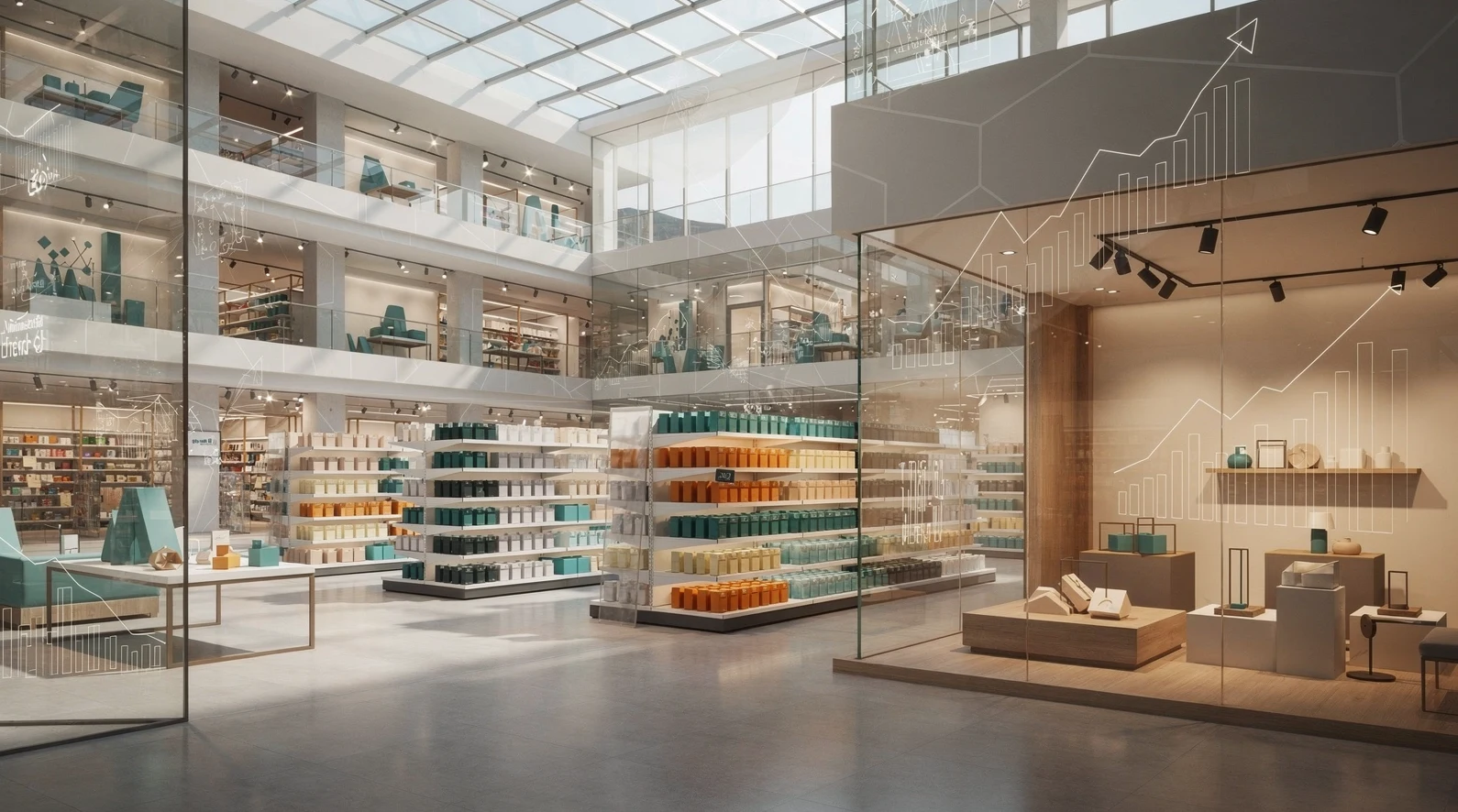
Physical retail spent the early 2020s being written off, then quietly staged one of the more interesting comebacks in modern commerce. Stores did not disappear. They changed jobs. A location that once existed only to move units now doubles as a fulfillment node, a media channel, a returns desk for online orders, and, increasingly, a place people visit on purpose because the experience is worth the trip.
This pillar maps the state of retail in 2026 across the four segments that define it: department stores, supermarkets and grocers, everyday brick and mortar, and the fast-growing world of pop-ups and experiential retail. The goal is a panoramic view that connects the segments to each other, because the smartest operators no longer treat them as separate disciplines. They borrow tactics across the whole floor plan.
In short
- Stores are multipurpose now. The best-performing locations blend selling, fulfillment, returns, and brand experience rather than chasing sales per square foot alone.
- Value and premium are both winning. The squeezed middle is the danger zone, while discount grocers and elevated experiences pull shoppers in opposite, profitable directions.
- Private label is the margin story. Across department stores and grocery, owned brands are the clearest path to defensible profit and customer loyalty.
- Experience is measurable, not fluffy. Pop-ups and experiential formats now report on foot traffic, social reach, and new-customer acquisition with the same rigor as e-commerce.
- Data ties it together. The retailers gaining share run their physical and digital channels off one view of inventory, customers, and demand.
Defining the retail territory
Retail, in the sense this pillar uses, means the business of selling goods to end consumers through physical and physically-anchored channels. That includes the pure e-commerce layer, but the emphasis here is on the store: the box, the shelf, the aisle, the pop-up, and everything that happens when a shopper is standing in front of product rather than a screen.
The territory is easiest to understand as four connected segments. Department stores and chains represent the legacy anchor model, built around breadth of assortment under one roof. Supermarkets and grocers cover the highest-frequency retail category, where households return weekly and margins are thin. Brick and mortar is the broad base of specialty and independent stores that make up most of the retail landscape by count. Pop-up and experiential retail is the newest layer, where physical space is used as a marketing and testing instrument rather than a permanent sales channel.
These segments share customers, real estate, staff, and increasingly technology. A private-label strategy that works for a grocer informs one for a department store. A pop-up that a direct-to-consumer brand runs to test a city teaches the same brand how to design a permanent store. Reading the segments in isolation misses the cross-pollination that defines modern retail. For the wider context of how these shifts get reported and interpreted, our companion pillar on how retail news shapes the global e-commerce industry is a useful parallel read.
What unites the four segments is a single underlying shift in what a store is for. For most of retail history the answer was simple: a store existed to hold inventory and convert visitors into buyers, and it was judged almost entirely on sales per square foot. That metric is now insufficient. A store in 2026 might convert a fraction of the walk-in sales of its predecessor while creating more total value through fulfillment, returns processing, brand impressions, and customer data. The territory has not shrunk; the scoreboard has changed.
The four forces reshaping every segment
Four forces cut across all of retail regardless of segment. The first is channel convergence, where the boundary between online and in-store dissolves into a single customer journey that starts on a phone and ends at a shelf, or the reverse. The second is the barbell effect, which pulls demand toward the value and premium extremes and hollows out the middle in category after category.
The third is the rise of owned brands, where private label moves from margin tactic to strategic core across grocery, department stores, and specialty. The fourth is the data imperative, the growing requirement that a retailer see inventory, customers, and demand through one lens rather than several disconnected systems. Every segment discussion below is really a local expression of these same four forces.
Why the store survived the e-commerce wave
The simple explanation is that stores do things screens cannot. Immediate gratification, tactile evaluation, human help, and the social act of shopping all remain valuable. The more strategic explanation is that stores became cheaper to operate as fulfillment points than dedicated warehouses in many markets, because they already sit close to customers.
Ship-from-store, buy-online-pick-up-in-store, and in-store returns turned fixed retail costs into shared infrastructure. A location that captures both a walk-in sale and three online-order fulfillments in a day looks very different on a spreadsheet than one measured on walk-in sales alone. That reframing is the quiet engine behind the physical retail recovery.
The department store reinvention
No format absorbed more obituaries than the department store, and none has worked harder to earn a second act. The core problem was structural: enormous boxes anchored to malls, carrying broad assortments that shoppers could find cheaper online or more specifically at a category specialist. The response has been a deliberate reinvention rather than a defense of the old model, a shift we cover in depth in our look at why department stores are reinventing themselves in 2026.
Smaller footprints, sharper edits
The clearest change is size. New and remodeled department stores are smaller, with tighter, more curated assortments and more space given to services, cafes, and experiences. The logic is that a well-edited 40,000 square foot store can outperform a sprawling 140,000 square foot one on profit, even if it loses on raw sales.
This edit-down also solves an inventory problem. Fewer, better-chosen units mean less markdown risk and cleaner turns. The winners treat curation as the product, not a constraint. How two of the biggest US names approach that trade-off is the subject of our comparison of Macy and Nordstrom strategy for the next decade.
Private label as the profit engine
The most durable department store advantage is owned brands. Private label carries higher margins, cannot be price-shopped against Amazon, and builds a reason to return that no national brand can. Retailers that treat private label as a core competency rather than a bargain bin have the clearest path to defensible profit, a case we make in full in private label as the department store survival strategy.
The discipline required is real. Good private label needs its own design, sourcing, and quality-control muscle, closer to a brand company than a merchant. When it works, it reframes the whole store around products only that retailer can offer.
The mall question and store closures
Department stores have historically been mall anchors, and the fate of the two is entangled. As anchor economics shift, both landlords and retailers are rethinking the relationship, a dynamic we unpack in mall anchor tenants in the post-mall era. Some anchors are being replaced by entertainment, medical, or residential uses that draw traffic in different ways.
Closures remain part of the story, but they are easy to misread. A retailer closing weak stores while investing in strong ones is pruning, not dying. Learning to tell the difference between managed contraction and terminal decline is a skill we walk through in reading department store closure signals correctly. The outlet channel, meanwhile, keeps outperforming full-line stores for reasons we detail in why outlet chains beat full-line stores, and operators evaluating their technology stack can start with our roundup of tools and vendors for department stores and chains in 2026.
Grocery and supermarkets: retail’s highest-frequency battleground
Groceries are where retail happens most often. Households shop for food weekly or more, which makes the grocery aisle the single most valuable habit in physical retail. It is also brutally competitive, with net margins that would terrify most other categories, which forces a discipline the rest of retail can learn from. The strategic shifts underway are the subject of how supermarket strategy is shifting in 2026.
Scale versus discount: two winning models
Two grocery models are pulling ahead, and they sit at opposite ends of the spectrum. The scale model, exemplified by the largest US chains, wins on breadth, data, and buying power. The discount model, led by hard discounters, wins on a ruthlessly edited assortment and rock-bottom operating costs. The head-to-head between the biggest players is covered in Kroger versus Walmart for grocery in the US.
The hard-discount playbook deserves special attention because it is the most disruptive force in grocery. A limited assortment, heavy private label, small stores, and lean labor produce prices that traditional supermarkets struggle to match. We break down exactly how it works in the Aldi and Lidl discount playbook explained.
Private label wins the shelf
Grocery is the category where private label has advanced furthest, and it keeps gaining ground on national brands as quality improves and shoppers stay value-conscious. Owned grocery brands now span budget tiers and premium lines, and they are central to both loyalty and margin, as we cover in how grocery private label is winning shelf space.
Delivery economics and fresh supply chains
Grocery delivery is the category’s hardest financial puzzle. Low basket margins collide with high picking and last-mile costs, and many models still struggle to make money at the unit level. The honest accounting of who actually profits is in grocery delivery economics: who actually makes money.
Fresh food is where grocers earn their reputations. Produce, meat, bakery, and prepared foods drive perception of quality and pull shoppers away from pure-price competitors. The supply chains that support fresh are a genuine competitive moat, explored in fresh food supply chains and where grocers compete on quality. Operators building out their systems can reference our list of tools and vendors for supermarkets and grocers in 2026.
Loyalty, data, and retail media
Grocery generates more customer data than any other retail category simply because of frequency, and the leaders have turned that data into a business of its own. Loyalty programs capture purchase history at the household level, which powers personalization, targeted promotions, and increasingly a retail media network that sells advertising back to the brands on the shelf. For thin-margin grocers, that advertising income can matter as much as the markup on groceries.
The strategic point is that the data flywheel compounds. More frequency means more data, which means better personalization and more valuable ad inventory, which funds lower prices and better experiences, which drives more frequency. Grocers who fail to build this loop compete on price alone against rivals who effectively subsidize their shelves with media revenue, which is an increasingly untenable position.
Brick and mortar: not dead, just different
Outside the anchors and the grocers sits the broad base of retail: specialty stores, independents, franchises, and chains that make up most locations by count. This is where the store-is-dead narrative was loudest and most wrong. The reality is a format that survived by getting more deliberate about what a store is for, a theme we set out in brick and mortar retail in 2026 is not dead, just different.
Design and merchandising that convert
Store design has become a conversion discipline rather than a decorating exercise. Layout, sightlines, and flow measurably affect what shoppers buy, and the best stores are designed backward from the behavior they want, as we explain in store design that drives conversion. The fundamentals of arranging product still matter enormously, which is why classic visual merchandising rules that still work remain required reading for any operator.
The people problem: staffing and shrink
Two operational challenges dominate physical retail today: finding staff and controlling loss. A tight labor market makes hiring and retaining good store associates harder and more expensive, a topic we treat practically in staffing brick and mortar retail in a tight labor market. At the same time, shrink from theft and error has climbed up the priority list, and the challenge is reducing it without turning stores into fortresses that alienate honest shoppers, balanced carefully in theft, shrink and loss prevention without scaring shoppers.
Location and technology
For smaller retailers, few decisions matter more than where to put the store. Location determines traffic, rent, and the customer base in ways that are hard to fix later, which is why we devote a full guide to how small retailers should choose a location. The systems that run the modern store, from point of sale to inventory to clienteling, are covered in our roundup of tools and vendors for brick and mortar in 2026.
Pop-ups and experiential retail: the store as media
The newest layer of retail treats physical space as a marketing and testing instrument. Pop-ups, experiential installations, and temporary formats let brands appear where their customers are, generate social content, and gather real-world data without the commitment of a permanent lease. This is where digitally native brands and legacy retailers increasingly meet.
Pop-ups as a growth lever
For a growing brand, a pop-up is one of the highest-leverage moves available. It builds awareness, generates content, tests demand in a new market, and does it all with a short, bounded commitment, as we lay out in pop-up retail as a brand growth lever. Direct-to-consumer brands in particular use pop-ups to test whole cities before signing a lease, a tactic detailed in how D2C brands use pop-ups to test new cities.
Experiences worth posting about
Experiential retail works when the experience is genuinely worth sharing. The bar is high: a space has to earn a photo, a post, or a repeat visit, not just display product. What clears that bar is the subject of experiential retail that people actually post about, and the specific formats gaining traction this year are collected in the 2026 experiential retail trends worth borrowing.
Making the numbers work
Experiential retail is often accused of being unmeasurable, which is no longer true. Modern pop-ups report on cost, revenue, foot traffic, and new-customer acquisition with real rigor, and clear benchmarks exist for a typical run, gathered in costs and revenue benchmarks for a 30-day pop-up. Choosing the right city and site is as consequential here as for a permanent store, which we cover in choosing a pop-up location in a major US city, with the supporting systems listed in tools and vendors for pop-up and experience in 2026.
The technology layer that ties it together
Underneath every segment sits a technology stack that determines whether a retailer can actually execute the strategies above. The single most important capability is unified commerce: one system of record for inventory, customers, and orders across physical and digital channels. Without it, ship-from-store breaks, buy-online-pick-up-in-store frustrates customers, and personalization stays theoretical.
The retailers that struggle most are usually not the ones with the wrong strategy but the ones whose systems cannot support the right one. A brilliant clienteling program is worthless if store associates cannot see online purchase history. A ship-from-store initiative fails if inventory accuracy is too low to promise a shopper the item is really there. Technology is where retail strategy either becomes real or quietly dies.
Inventory accuracy as the hidden foundation
The least glamorous capability in retail may be the most consequential: knowing, precisely, what is where. Inventory accuracy underpins every omnichannel promise, and the gap between a retailer that knows its stock to the unit and one that guesses is the gap between a working fulfillment network and a stream of cancelled orders and disappointed customers.
This is why investments in radio-frequency identification, computer vision, and better inventory processes keep paying off even though they never make headlines. They convert the store from a black box into a reliable node in a larger system, which is the precondition for treating physical space as multipurpose infrastructure rather than a simple point of sale.
Personalization and the store associate
Technology in retail is often framed as replacing human interaction, but the more powerful pattern is augmenting it. Give a store associate a tablet with the customer’s purchase history, preferences, and real-time inventory across the network, and a routine transaction becomes a genuinely helpful, personalized encounter. The human plus the data outperforms either alone.
This clienteling model is where physical retail has a structural advantage over pure e-commerce that it has only begun to exploit. A screen can personalize, but it cannot read a room, offer a considered opinion, or build a relationship the way a well-equipped associate can. The stores winning at the premium end of the barbell understand that technology’s best role is to make their people better, not to remove them.
Market sizing and growth signals
Retail is one of the largest sectors in any developed economy, and physical stores still account for the clear majority of total retail sales even after two decades of e-commerce growth. The headline for 2026 is not decline but redistribution: value and premium ends growing, the middle under pressure, and channel lines blurring as stores and screens merge into single customer journeys.
The most reliable public anchor for US retail data remains official government statistics, and readers who want primary numbers can start with the US Census Bureau retail trade data rather than secondary summaries. The table below sketches the relative posture of the four segments this pillar covers.
| Segment | Purchase frequency | Margin profile | 2026 growth posture | Primary battleground |
|---|---|---|---|---|
| Department stores and chains | Occasional | Moderate, private-label-lifted | Stabilizing via curation | Differentiated assortment |
| Supermarkets and grocers | Weekly or more | Very thin | Growing at value and premium ends | Price, fresh, and private label |
| Brick and mortar specialty | Variable | Category-dependent | Selective growth | Experience and convenience |
| Pop-up and experiential | One-time or seasonal | Marketing-blended | Fastest-growing format | Attention and acquisition |
Reading the signals that matter
The most useful growth signals are not aggregate sales but leading indicators: store productivity trends, private-label penetration, fulfillment mix, and new-customer acquisition cost. A retailer growing private-label share while holding traffic is healthier than one growing sales through discounting. These second-order metrics separate durable operators from ones renting growth.
Foot traffic remains a core signal, but it now needs context. Fewer, higher-intent visits can beat more low-intent ones, especially where the store also serves online fulfillment. Judging a location on total value created, not just walk-in conversion, is the analytical shift that defines modern retail measurement.
Where the growth is actually coming from
The growth in physical retail is not evenly distributed, and averages hide the real story. Discount and value formats are taking share as households stay price-conscious, while premium and experiential formats grow by offering something worth paying up for. The categories struggling most are those stuck in between, offering neither the lowest price nor a distinctive experience.
Grocery growth skews toward discount and premium-fresh simultaneously, department store growth concentrates in curated and off-price formats, and the fastest-growing format overall is experiential and temporary retail measured off a small base. For operators, the implication is to look past sector-level growth rates and ask where within a segment the demand is really flowing, because that is where capital and attention should follow.
Major players and competitive dynamics
The competitive map of retail is not a single race but several overlapping ones. Grocers compete with grocers, but also with mass merchants and discounters that sell food as a traffic driver. Department stores compete with each other, with specialty brands, and with the outlet channel. The lines are porous, and the most dangerous competitors often come from an adjacent segment.
The clearest pattern across every segment is the barbell: strength at the value end and the premium end, weakness in the middle. Discounters and warehouse clubs anchor one side, elevated and experiential retail the other, and the undifferentiated middle absorbs the pressure. The table below maps how the barbell plays out by segment.
| Segment | Value-end winner | Premium-end winner | Squeezed middle |
|---|---|---|---|
| Grocery | Hard discounters | Fresh-led premium and specialty grocers | Conventional mid-tier supermarkets |
| Department stores | Outlet and off-price | Curated, service-rich flagships | Full-line mid-market stores |
| Apparel and specialty | Fast-value chains | Brand-experience boutiques | Generic mall specialty |
| Experiential | Low-cost seasonal pop-ups | High-production brand installations | Undifferentiated events |
The lesson for operators is to pick a side of the barbell and commit. Trying to be moderately cheap and moderately nice is the position under the most sustained attack. Clarity about which end you serve drives every downstream decision, from assortment to store design to staffing.
Practical playbooks for retailers and brands
Strategy is only useful if it survives contact with a store floor. The playbooks below distill what consistently works across the segments this pillar covers, aimed at operators who need to act rather than admire the landscape.
For established retailers
First, treat every store as multipurpose infrastructure and measure it that way, counting fulfillment, returns, and brand value alongside walk-in sales. Second, invest in private label as a core capability, not a bargain line, because it is the most defensible margin available. Third, edit assortments down and lean into curation, since a tighter, better-chosen range usually beats a sprawling one on profit and inventory health.
Fourth, unify the data. A single view of inventory, customers, and demand across channels is the precondition for everything else, and its absence is the most common reason good strategies fail in execution. Retailers still running physical and digital as separate businesses are competing with one hand tied.
For growing and direct-to-consumer brands
Use temporary formats to learn before you commit. A pop-up or two teaches you which cities respond, what a store should feel like, and whether physical retail earns its cost, all before a lease locks you in. Design permanent stores backward from the experience you want customers to have and share, not forward from a fixture catalog.
Pick a clear position on the value-to-premium barbell and let it govern location, price, and service. Ambiguity about where you sit is expensive, because it confuses customers and dilutes the reasons to choose you over a sharper competitor.
A sequenced approach for the next twelve months
For operators who want a concrete order of operations, the sequence matters as much as the moves themselves. Start by fixing the data foundation, because unified inventory and customer views unlock everything downstream and their absence quietly caps the return on every other investment. This is unglamorous work, but it is the difference between strategies that execute and strategies that stall.
With the foundation in place, redeploy underused space toward fulfillment, services, and experience rather than simply cutting it. Then invest in private label as a genuine capability, and finally use temporary and experiential formats to test new markets and ideas cheaply before committing capital. Retailers who invert this order, chasing experiential flash before the plumbing works, tend to produce impressive launches that fail to compound into durable advantage.
Risks, regulation and what to watch
The risk landscape for physical retail is broad, and the operators who navigate it treat risk as a planning input rather than a surprise. Labor costs and availability top the list, since stores are people-intensive and wage pressure flows straight to already-thin margins. Shrink and organized retail crime follow closely, forcing investment in loss prevention that must not degrade the shopping experience.
Real estate is a structural risk in both directions: legacy operators carry too much of the wrong space, while growing brands face rising rents in the locations they actually want. Supply chain volatility, tariff shifts, and input-cost swings continue to test the fresh and imported-goods categories most exposed to them.
Regulation and compliance
Retail sits inside a dense regulatory frame covering labor law, consumer protection, product safety, data privacy, and payments. The direction of travel is toward more disclosure and more accountability, particularly around pricing transparency, data handling, and sustainability claims. Operators should assume compliance costs rise, not fall, and build that into planning rather than treating each new rule as a shock.
Data privacy deserves specific attention because retail’s move toward personalization depends on customer data that regulators increasingly protect. The retailers that win here treat privacy as a design constraint and a trust asset, not a box to check, which turns a compliance burden into a differentiator.
The changing shopper behind every segment
Every trend in this pillar ultimately traces back to how people have changed the way they shop. The modern shopper is channel-agnostic, moving between phone, laptop, and store within a single purchase without thinking of them as separate. They research online and buy in store, or browse in store and buy online, and they expect the retailer to keep up with both without friction.
They are also more value-conscious and more experience-hungry at the same time, which is the demand-side root of the barbell. The same household that buys staples from a hard discounter will pay a premium for a memorable experience or a product that signals identity. Retailers who assume a customer is either a value shopper or a premium shopper misread a person who is comfortably both, depending on the category and the moment.
Trust, transparency, and sustainability
Shoppers increasingly factor trust into where they spend, and that trust rests on transparency about pricing, sourcing, and data. Vague sustainability claims now invite skepticism rather than goodwill, and shoppers reward retailers who are specific and honest over those who market broadly. The direction is toward proof over promise.
This raises the bar for retailers but also creates an opening. A retailer that handles customer data respectfully, prices honestly, and backs its claims with substance earns a durable loyalty that discounting cannot buy. In a landscape where products and prices are easy to copy, trust is one of the few advantages that compounds over time and resists imitation.
Convenience as the baseline expectation
Convenience has shifted from a differentiator to a baseline expectation, and its absence is now actively punishing. Shoppers expect to buy how they want, receive goods how they want, and return them without hassle, and a retailer that adds friction at any of these steps loses to one that does not. The bar set by the most convenient players resets expectations for everyone.
The strategic response is not to match the most convenient competitor at every point, which is often impossible, but to remove friction where it matters most to your specific customer. A premium retailer competes on a considered, human experience rather than raw speed, while a value retailer competes on frictionless efficiency. Knowing which kind of convenience your position demands is part of committing to a side of the barbell.
Recommended deep dives and case studies
This pillar is the map; the supporting guides are the terrain. For department stores, the reinvention thesis is grounded in real strategy in our pieces on the 2026 reinvention and the Macy versus Nordstrom comparison. For grocery, start with shifting supermarket strategy and the discount grocer playbook.
For everyday store operations, the fundamentals live in conversion-focused store design and staffing in a tight labor market. For the experiential frontier, the practical entry points are 30-day pop-up benchmarks and the 2026 experiential trends worth borrowing. Together these guides turn the panorama above into concrete, operator-ready decisions.
Outlook for the year ahead
The through-line for 2026 is convergence. The distinction between a store, a fulfillment center, a media channel, and a data-collection point keeps eroding, and the retailers gaining share are the ones who stopped defending those boundaries and started managing the whole system as one. Physical space is being redeployed, not retired.
Expect the barbell to sharpen, with value and premium both growing while the middle keeps thinning. Expect private label to keep advancing across every segment as the clearest route to margin and loyalty. Expect experiential and temporary formats to move from experiment to standard part of the toolkit, complete with the metrics to justify them.
The retailers who thrive will not be the ones with the most stores or the fewest, but the ones with the clearest answer to a simple question: what is each location actually for. Answer that with conviction, wire the whole operation off one view of the customer, and physical retail in 2026 looks less like a sector in decline and more like one being rebuilt on purpose.
Frequently asked questions
Is physical retail actually growing or just surviving?
It is growing selectively. Physical stores still account for the majority of total retail sales, and value and premium formats are expanding even as the undifferentiated middle contracts. The headline is redistribution within retail, not overall decline.
Why are department stores closing if the format is recovering?
Closing weak locations while investing in strong ones is pruning, not failure. A retailer that shuts underperforming stores and remodels its best ones is managing its footprint, which looks like decline in headlines but is often a sign of discipline. The signal to watch is whether the remaining stores are improving.
What makes private label so important across retail?
Owned brands carry higher margins, cannot be price-compared against other retailers, and give customers a reason to return that no national brand provides. Across department stores and grocery, private label is the single clearest path to defensible profit and loyalty.
How do discount grocers like Aldi and Lidl undercut everyone?
They run a limited assortment, lean heavily on private label, operate small efficient stores, and keep labor costs low. That combination produces prices conventional supermarkets struggle to match, which is why hard discount is grocery’s most disruptive force.
Do pop-up and experiential stores actually make money?
They can, but the return is usually measured in acquisition, awareness, and content value alongside direct sales, not sales alone. Modern pop-ups track cost, revenue, foot traffic, and new customers with real rigor, and clear benchmarks exist for a typical 30-day run.
What is the biggest operational risk for stores right now?
Labor is the leading challenge: stores are people-intensive, and a tight market makes hiring and retaining good associates harder and more expensive. Shrink and loss prevention follow closely, with the difficulty being reducing theft without degrading the experience for honest shoppers.
How should a small retailer choose where to open?
Location drives traffic, rent, and the customer base in ways that are hard to fix later, so it deserves disciplined analysis rather than instinct. Match the site to your position on the value-to-premium spectrum, and weigh visibility, access, and the surrounding customer mix before committing to a lease.
What single change most improves a retail operation?
Unifying data across channels. A single view of inventory, customers, and demand is the precondition for treating stores as multipurpose infrastructure, running private label well, and measuring locations on total value created. Its absence is the most common reason sound strategies fail in execution.