
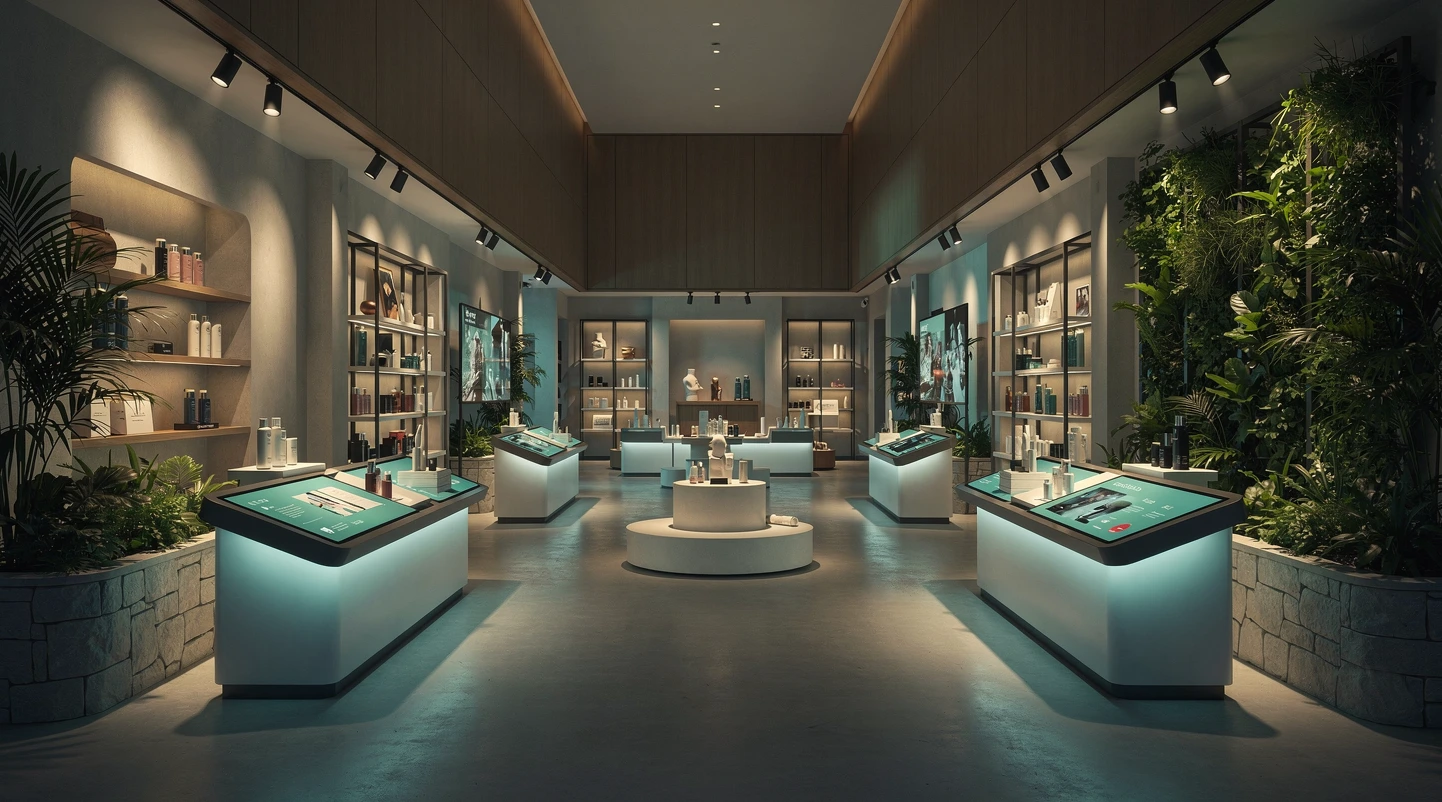
Experiential retail stopped being a novelty sometime around 2023, and by 2026 it has hardened into a discipline with budgets, benchmarks, and a growing bench of specialist vendors. The stores that draw crowds now are not the ones with the deepest discounts. They are the ones that give shoppers a reason to walk in, linger, and tell someone else about it afterward.
That shift matters for anyone selling physical goods in the United States, where store visits still anchor the majority of retail spending even as online grows. The experiential trends 2026 has produced are practical, measurable, and mostly affordable, which is why they are spreading from luxury flagships to regional chains and independent shops. This guide breaks down which ideas are worth borrowing, how they work in practice, and where teams tend to get them wrong.
What are the experiential trends 2026 actually rewarding?
The headline shift is from experiences designed to impress to experiences designed to convert. Early experiential retail leaned on spectacle: giant installations, influencer-only launches, and photo walls that generated posts but rarely receipts. The 2026 version keeps the shareable moment but ties it directly to a product decision, a sign-up, or a repeat visit.
Retailers are also treating the store as media. A physical location now doubles as a content studio, a data-collection point, and a channel that competes with paid ads for attention. That reframing is the through-line behind almost every trend below, and it explains why so many teams are pulling experiential design out of visual merchandising and into marketing and analytics.
For a wider view of how stores, grocers, and experience formats fit together, our overview of the state of retail sets the context for the specific plays in this article. The short version: footfall is finite, so the goal is to make each visit worth more.
In short
- Conversion over spectacle: the winning experiences in 2026 are measured by sales lift, sign-ups, and repeat visits, not just impressions.
- The store as media: physical space is being budgeted like an advertising channel, with content, data capture, and attribution attached.
- Small, repeatable formats: modular pop-ups, in-store events, and seasonal refreshes beat one-off mega-installations on cost and learning speed.
- Service is the experience: expert staff, personalization, and frictionless payment now outrank flashy tech in shopper surveys.
- Measurement is the moat: the retailers pulling ahead can tie an in-store moment to a specific dollar, and they iterate weekly.
Why does experiential matter more in 2026 than it did five years ago?
Three forces have converged. Rising customer acquisition costs online have made every store visit more valuable as a lower-cost channel to convert and retain. At the same time, shoppers have grown numb to generic promotions, so a memorable visit does more to build loyalty than another 10% coupon. And retail media has taught operators to measure everything, which finally gives experiential a language executives respect.
The economics are not abstract. When paid social and search costs climb, a store that converts browsers at a high rate becomes one of the cheapest acquisition engines a brand owns. That is why direct-to-consumer names that started online are now the most aggressive experimenters in physical space.
The acquisition-cost squeeze
Digital advertising has become more expensive and less certain as signal loss from privacy changes reduces targeting precision. Brands that once relied on cheap performance ads are diversifying into channels they control. A store, a pop-up, or a branded event is one of the few places where a brand owns the full customer interaction end to end.
This is the logic behind the surge in temporary retail. We covered the mechanics of how D2C brands use pop-ups to test new cities before committing to leases, and the same playbook now anchors experiential strategy for established chains testing new concepts.
The attention arbitrage
Attention is scarcer and pricier than ever, and a striking physical experience still earns organic reach that money cannot reliably buy online. A single well-designed installation can generate thousands of user posts, each functioning as a peer recommendation. The catch is that the moment has to lead somewhere, which is exactly what separates the 2026 approach from the era of empty photo walls.
The retention dividend
Acquisition gets the headlines, but retention is where experiential quietly pays off. A shopper who has a good time in a store forms an emotional association that a pure price relationship never builds. That association shows up later as a higher repeat rate, a larger share of wallet, and a greater tolerance for the occasional out-of-stock or price bump.
Loyalty programs amplify the effect when they are wired into the experience rather than bolted on at checkout. A styling session that saves a profile, or a workshop that enrolls attendees in a members-only calendar, turns a single visit into an ongoing relationship. The store becomes a habit, and habits are the cheapest revenue a retailer can own.
Which experiential formats are worth borrowing first?
Not every trend fits every retailer, but a handful have proven flexible enough to work across categories and budgets. The best starting points share three traits: they are modular, they generate data, and they can be measured against a control. Below are the formats with the strongest 2026 track record.
Think of these as building blocks rather than a menu to copy wholesale. Most successful programs combine two or three, then refine based on what the numbers say. The table that follows compares them on the dimensions that decide whether a format earns its keep.
Format comparison at a glance
| Format | Typical cost to test | Best for | Primary payoff | Measurement difficulty |
|---|---|---|---|---|
| Modular pop-up | Low to medium | New markets, launches | Sales lift and market learning | Low |
| In-store event or workshop | Low | Community and loyalty | Repeat visits, sign-ups | Medium |
| Interactive product demo zone | Medium | Considered purchases | Conversion rate lift | Medium |
| Personalization or styling service | Medium | Apparel, beauty, home | Average order value | Medium |
| Immersive installation | High | Brand building, flagships | Reach and awareness | High |
Modular pop-ups and shop-in-shops
The modular pop-up is the workhorse of 2026 experiential. It is cheap enough to run several tests a year, contained enough to measure cleanly, and portable enough to travel between cities and host locations. Brands use them to validate demand, gather local data, and build a shareable moment without signing a multi-year lease.
If you want the underlying numbers before committing, our breakdown of costs and revenue benchmarks for a 30-day pop-up gives realistic targets for footfall, conversion, and payback. Those benchmarks are the fastest way to sanity-check a proposal before budget gets approved.
Events, workshops, and classes
In-store events turn a store into a reason to make a special trip. Cooking classes at a kitchenware shop, repair clinics at an outdoor retailer, and styling nights at an apparel store all convert a passive location into an active community hub. The format is inexpensive, repeatable, and unusually good at driving repeat visits from the same customers.
Seasonal refreshes over permanent builds
One quiet shift in 2026 is the move away from permanent fixtures toward spaces that change with the calendar. A store that refreshes its experiential zone every quarter gives regulars a reason to keep coming back and gives the brand repeated chances to earn new posts. It also spreads cost over time instead of sinking it into a build that dates within a year.
Seasonality is not just decoration. Aligning experiences with the shopping calendar, from back-to-school to the winter peak, lets a retailer ride demand it does not have to manufacture. The best programs plan the year as a sequence of themed moments, each measured on its own terms, rather than one static environment that slowly loses its novelty.
How do you make experiential retail convert, not just impress?
The difference between a costly stunt and a profitable experience comes down to intent and instrumentation. Every experiential element should have a job, and that job should be observable in the numbers. When teams skip this step, they end up with beautiful spaces that generate applause and no attributable revenue.
Start by naming the single outcome the experience exists to produce. It might be a sale, an email capture, a loyalty sign-up, or a booked appointment. Everything else, from layout to staffing to the shareable moment, should be arranged to nudge visitors toward that outcome.
Design the moment around a next step
A shareable installation is wasted if it does not point somewhere. The best 2026 experiences pair the photo moment with a low-friction action: a QR code that saves a cart, a staff member ready to book a follow-up, or a same-day incentive to buy. The lesson from years of empty photo walls is that spectacle without a path to purchase is a marketing cost, not a channel.
Our deeper look at experiential retail that drives sales, not just footfall walks through how to wire that path from moment to money. The framework applies whether the space is a 200-square-foot pop-up or a full flagship floor.
Instrument everything you can
You cannot improve what you do not measure, and experiential has historically been measured badly. In 2026 the leaders track footfall, dwell time, conversion, average order value, and post-visit behavior, then compare against a baseline or control store. The instrumentation does not need to be expensive; a clean before-and-after with a holdout location often tells you most of what you need.
Staff for expertise, not just coverage
Shoppers consistently rank knowledgeable, helpful staff above flashy technology when asked what makes a store worth visiting. Experiential budgets that go entirely to screens and installations while leaving the floor understaffed tend to underperform. Training and empowering associates to solve problems and personalize service is often the highest-return experiential investment a retailer can make.
What role does technology play without becoming a gimmick?
Technology in 2026 experiential retail is judged by whether it removes friction or adds delight that leads to a sale. The gimmick era, when augmented-reality mirrors and gesture walls were installed mainly for press coverage, has largely passed. What remains is technology that quietly makes the visit better.
The most durable investments are unglamorous. Fast, flexible payment options, accurate inventory visibility, and lightweight personalization tools consistently outperform showpiece tech on return. The rule of thumb: if a shopper notices the technology more than the product, it is probably a gimmick.
Payment and checkout as experience
Nothing kills a good experience faster than a slow or awkward checkout. Mobile point-of-sale, tap-to-pay, and buy-online-pick-up-in-store have moved from nice-to-have to baseline expectations. Reducing the time between decision and purchase is one of the least glamorous and most reliable experiential upgrades available.
Data capture that respects the shopper
Experiential spaces are excellent data-collection points when handled with care. A loyalty sign-up in exchange for a genuine perk, or an opt-in styling profile, gives the retailer first-party data that is increasingly valuable as third-party signals fade. The line to watch is consent, and the regulatory context matters here; our explainer on what the FTC actually regulates in retail is a useful reference for teams building data capture into the experience.
What are the common mistakes, and how do you avoid them?
Most experiential failures are predictable and avoidable. They usually stem from treating the experience as decoration rather than as a channel with a target. The following mistakes show up again and again in post-mortems, along with the fixes that prevent them.
The pattern across all of them is a missing feedback loop. When a team cannot say what an experience was supposed to do or whether it did it, the project drifts toward cost. Building measurement in from the start is the single best inoculation.
| Mistake | What it looks like | The fix |
|---|---|---|
| Spectacle without a next step | Photo-ready installation, no path to purchase | Attach a QR action, staff prompt, or same-day offer |
| No measurement plan | Success judged by vibe or press clips | Define one KPI and a control before launch |
| Under-staffing the floor | Great space, no one to help or close | Budget for trained associates, not just fixtures |
| Copying a luxury flagship | Overspending on tech a smaller store cannot recoup | Start with a modular, low-cost format and scale what works |
| One-and-done thinking | Single big event, no iteration | Run repeatable formats and refine weekly |
| Ignoring the follow-up | No plan to re-engage visitors after they leave | Capture opt-ins and build a post-visit sequence |
Avoid the copy-the-flagship trap
Regional chains and independents often look at a luxury flagship and try to replicate its most expensive elements. That rarely pencils out, because the flagship is amortizing its spend across brand value the smaller store does not have. The smarter move is to borrow the principle, a memorable moment tied to a purchase, and execute it at a fraction of the cost.
Do not skip the follow-up
An experience that ends the moment the shopper leaves has thrown away most of its value. The retailers winning in 2026 treat the visit as the start of a relationship, capturing consent to follow up and building sequences that bring people back. The follow-up is where a one-time event becomes repeat revenue.
What does this look like in US retail and e-commerce right now?
The clearest signal is where money and talent are moving. Direct-to-consumer brands that grew up online are opening physical space at pace, using it as a lower-cost acquisition and retention channel. Established chains are converting underused store square footage into event space, service counters, and shop-in-shop partnerships.
Grocers and big-box retailers are adding experiential layers to defend against online erosion, from in-store dining and demos to community events that make a weekly trip feel less like a chore. Beauty and apparel remain the most advanced categories, where personalization and service have always driven a premium, and their tactics increasingly set the template that other categories adapt.
D2C brands leading the experimentation
Online-native brands treat stores as a testing ground and a media channel, not a legacy cost. They open small, measure obsessively, and close or relocate quickly when the numbers do not work. Our piece on experiential retail that people actually post about covers how these brands engineer shareable moments that still ladder up to sales.
Chains and grocers playing defense
For larger retailers, experiential is partly a hedge against the shift of routine purchases online. If the commodity basket moves to delivery, the store has to justify the trip with something delivery cannot match. Demos, classes, service counters, and community events are the tools of choice, and they lean on the store’s existing footprint rather than expensive new builds.
Beauty and apparel set the pace
Beauty and apparel remain the proving grounds because their margins support service and their products reward trial. A fragrance bar, a fit consultation, or a shade-matching station converts uncertainty into confidence, and confidence into a sale. The lessons these categories learn tend to migrate outward to home goods, electronics, and even grocery within a season or two.
What travels is the principle, not the fixture. A grocer will not build a fragrance bar, but it can borrow the idea of expert-led trial through a tasting counter or a recipe demo. The underlying move is the same: reduce the risk of buying something unfamiliar by letting the shopper experience it first.
Measuring the halo on e-commerce
A frequently missed payoff is the lift a physical experience gives to online sales in the same market. When a brand opens a pop-up or runs an event, its e-commerce orders in that region often rise, even among people who never bought in the store. Attributing that halo takes discipline, but ignoring it undersells the true return of an experiential program.
Which tools, partners, and vendors are worth knowing?
The experiential ecosystem has matured, and 2026 offers a fuller bench of specialists than the DIY era. You no longer have to build everything in-house. The trade-off is choosing partners who understand measurement, not just aesthetics, so the experience remains accountable to numbers.
Below is the rough shape of the vendor landscape. The right mix depends on budget and category, but most programs touch three or four of these categories. Reliable market data on category size and consumer behavior is worth sourcing too; the retail sections at the US Census Bureau and aggregate consumer statistics on Statista are common starting points for sizing a market before you commit.
The vendor categories to know
- Pop-up and retail-space brokers: match brands to short-term locations and handle build-out logistics.
- Experience design studios: translate a brand story into a physical layout and shareable moment.
- Retail technology providers: mobile point-of-sale, inventory visibility, and lightweight personalization.
- Measurement and analytics tools: footfall counting, dwell tracking, and attribution back to sales.
- Event and staffing agencies: supply trained associates and run in-store programming.
Choosing partners who measure
The best filter when evaluating a vendor is whether they talk about outcomes or only about looks. A design studio that asks what the experience should achieve, and how you will know it worked, is worth more than one that leads with mood boards. Insist on a measurement plan as part of any engagement.
How should a team get started on a budget?
You do not need a flagship budget to borrow the best of 2026’s experiential trends. The most effective starting move is a single, small, measurable test rather than a grand relaunch. Pick one format, define one outcome, and run it against a control before scaling.
A practical first project is a modular pop-up or a recurring in-store event, both of which are cheap to run and fast to learn from. Give it a clear goal, staff it well, capture opt-ins, and compare the results against a normal week or a comparable location. What works, you repeat and expand; what does not, you drop cheaply.
Resist the urge to launch everything at once. A single format run cleanly teaches more than five formats run at the same time, because you can actually tell what caused the result. Once one test proves out, layering a second format on top becomes a controlled experiment rather than a guess, and the program compounds from there.
Budget for the follow-up before the launch, not after. The email sequence, the loyalty perk, and the plan to bring visitors back are what convert a good afternoon into a durable revenue line. This disciplined, iterative approach is what separates the retailers pulling ahead, and it is the same logic that runs through our broader guide to the state of retail heading into the second half of the decade.
Frequently asked questions
What is experiential retail in simple terms?
Experiential retail is the practice of designing a store or temporary space to deliver a memorable experience, not just a transaction. The goal is to give shoppers a reason to visit, linger, and return, then tie that engagement to measurable outcomes like sales, sign-ups, or repeat visits.
How is 2026 experiential different from earlier versions?
The main shift is from spectacle to conversion. Earlier experiential retail chased impressions and press coverage with big installations, while the 2026 approach keeps the shareable moment but attaches it to a clear next step and measures the result against a control.
Do you need a big budget to try experiential retail?
No. The strongest starting formats, modular pop-ups and recurring in-store events, are deliberately low-cost and easy to measure. The recommended approach is a single small test with one defined outcome, scaled only after the numbers prove it works.
How do you measure whether an experience worked?
Define one primary metric before launch, such as sales lift, email captures, or repeat visits, and compare against a baseline or a control location. Track supporting signals like footfall, dwell time, conversion, and average order value to understand why the number moved.
Does technology matter in experiential retail?
Technology helps when it removes friction or adds delight that leads to a sale, and hurts when it is installed mainly for show. Fast payment, accurate inventory, and lightweight personalization consistently outperform showpiece tech on return.
What is the most common experiential mistake?
Building spectacle with no next step. A striking installation that gives visitors no clear path to purchase, sign up, or book generates posts but little revenue, which turns the experience into a marketing cost rather than a channel.
Which retail categories benefit most from experiential?
Beauty, apparel, and home are the most advanced because personalization and service naturally command a premium there. That said, grocers, big-box chains, and direct-to-consumer brands are all finding measurable returns by adapting the formats to their own categories.
How do pop-ups fit into an experiential strategy?
Pop-ups are the low-cost workhorse of experiential retail. They let a brand test demand, gather local data, and build a shareable moment without a long lease, which is why both online-native brands and established chains use them to validate new concepts and markets.
What is the single highest-return experiential investment?
Well-trained, empowered staff. Shoppers repeatedly rank knowledgeable and helpful associates above flashy technology, so budgets that fund expertise on the floor tend to outperform those spent entirely on fixtures and screens.