
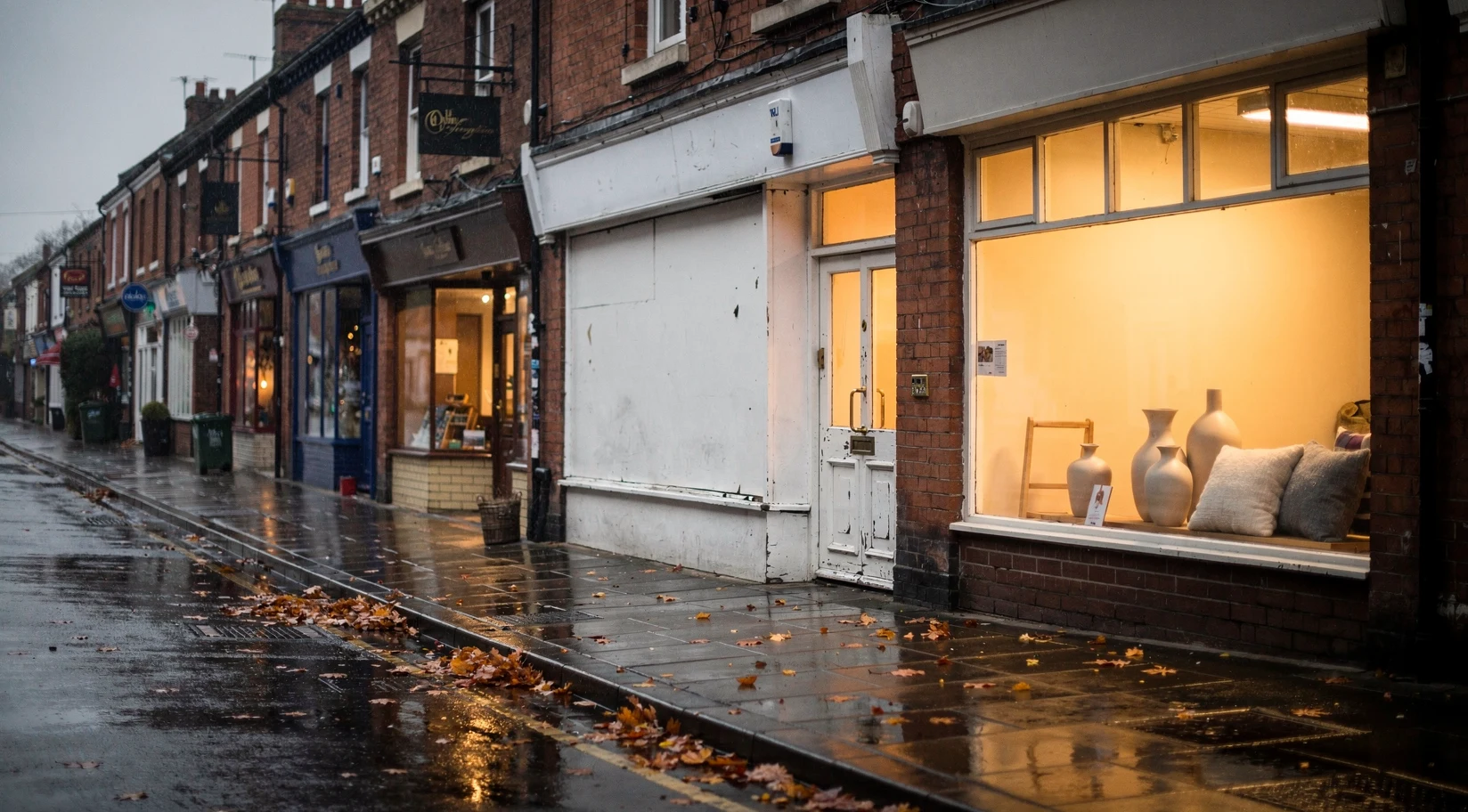
Three in 10 small high street businesses in the UK considered closing during the past year, according to a new survey of 526 small firms published by Enterprise Nation with the payments company Square UK and EDF Small Business. The report, covered by the Mirror, Startups Magazine and Energy Live News between 11 and 12 September 2026, lands six and a half weeks before Chancellor John Healey’s first Budget on Wednesday 28 October, and it arrives with a specific shopping list: a decision on hospitality VAT, higher Small Business Rate Relief thresholds, flat cost-support grants paid through councils and funded enforcement of the late payment rules. For independent shop owners, cafe operators and the town-centre landlords who depend on them, the numbers describe a trading environment in which growth has stalled and survival has become the planning horizon.
In short
- Three in 10 high street small businesses considered closing in the past 12 months, per the Enterprise Nation, Square and EDF survey of 526 UK firms reported on 12 September 2026.
- 77% of high street businesses delayed or cancelled a growth plan such as hiring or buying equipment, against 69% across the whole sample; half of all respondents cut investment.
- VAT is the single heaviest pressure for 29% of respondents, ahead of wages and staff costs at 24%; six in 10 put VAT in their top three alongside employer National Insurance, business rates, energy and rent.
- Empty units are now visible from the shop door: 41% estimate that between a tenth and a quarter of nearby premises are vacant, and one in five say more than a quarter of neighbouring shopfronts stand empty.
- The asks for the 28 October Budget are a hospitality VAT decision, higher Small Business Rate Relief thresholds, council-paid flat grants, a pilot that pays landlords to re-let empty shops, and enforcement money for the late payment laws.
What did the Enterprise Nation survey actually find?
The headline figure is the one the Mirror led with on Saturday: three in 10 small high street businesses said they had considered closing in the past year. The sample is 526 UK small businesses, gathered by Enterprise Nation, the membership network for start-ups and small firms, in partnership with Square UK and EDF Small Business. Enterprise Nation has not published fieldwork dates in the coverage seen so far, so the “past year” should be read as roughly the 12 months to late summer 2026.
Beneath the closure figure sits a broader growth freeze. Across the full sample, 69% of respondents said they had delayed or cancelled a growth plan during the past year, and half said they had reduced investment. Among high street businesses specifically, the delayed-growth share rises to 77%, and 42% said they had cut customer-facing staff, according to Energy Live News. The survey also found that 64% of owners consider the UK a harder place to operate than European peers.
The cost ranking is the part that policymakers will read most closely. VAT was named the single heaviest pressure by 29% of respondents, followed by wages and staff costs at 24%. Six in 10 placed VAT in their top three. Employer National Insurance, business rates, energy bills and rent filled out the rest of the list, and the report notes that businesses able to estimate the effect said rising energy bills had reduced their margins by around 18% on average.
| Survey finding | All 526 respondents | High street businesses |
|---|---|---|
| Considered closing in the past year | Not broken out | 3 in 10 |
| Delayed or cancelled a growth plan | 69% | 77% |
| Reduced investment | 50% | Not broken out |
| Cut customer-facing staff | Not broken out | 42% |
| VAT named the single heaviest pressure | 29% | Not broken out |
| Wages named the single heaviest pressure | 24% | Not broken out |
| UK harder to operate in than European peers | 64% | Not broken out |
Source: Enterprise Nation, Square UK and EDF Small Business survey as reported by the Mirror, Startups Magazine and Energy Live News, 11 to 12 September 2026.
Who ran it and why the partners matter
The three partners each bring a different lens. Enterprise Nation is a policy voice for the smallest firms and runs government-backed programmes for start-ups. Square UK processes card payments for tens of thousands of small merchants and has visibility of cash flow patterns, which explains the report’s emphasis on money management. EDF Small Business sells energy to small commercial customers and used the survey to highlight that three quarters of owners are unaware of the efficiency grants and reliefs open to them.
That mix means the findings sit somewhere between an advocacy document and a market read. The sample of 526 is modest, and the coverage does not state the weighting or the split between retail, hospitality and services. Readers should treat the percentages as directional rather than as a census, in the same way that the ACS Local Shop Report 2026 published earlier this month gives a convenience-sector view rather than a whole-economy one. The two reports point the same way: rising fixed costs, stalled investment and a Budget that is now the only near-term event large enough to change the arithmetic.
Why is VAT the number one complaint rather than business rates?
For years the standard high street grievance was business rates. This survey puts VAT first, and the reason is structural. VAT is charged on turnover, not profit, so a shop or cafe that grows its sales while its margins fall pays more VAT even as it earns less. The registration threshold in the UK has been GBP 90,000 (about USD 121,700 at the current rate of 1.35) since April 2024, and any business crossing it must add 20% to its prices or absorb the tax.
The report’s case studies show how that threshold bites. Louise Miller-Chalk opened her first permanent homewares shop on Towcester high street in February 2026, having started the business online in August 2020 selling handmade cushions, curtains and blinds. She shares the unit with another local producer to spread the rent. By the end of the year she expects to cross the GBP 90,000 threshold, which would put 20% on everything she sells, and as quoted by the Mirror she cannot raise prices by 20% because nobody would buy, so she plans a small increase and will absorb the rest, losing money per item.
Hospitality has the same arithmetic on a larger scale, which is why the report asks the Chancellor to make a decision on hospitality VAT at the Budget and to design any cut around what businesses say they would do with it. Asked how they would use a VAT reduction, 46% of respondents said they would absorb other rising costs, 44% would reinvest in the business, 29% would hire staff and 23% would cut prices. A VAT reduction was the preferred policy measure for 37% of respondents, the largest single group.
The threshold cliff versus the rate
Two separate VAT debates get muddled in coverage. One is the rate for hospitality, where trade bodies have campaigned for a permanent reduction since the temporary 5% and 12.5% rates lapsed after the pandemic. The other is the registration threshold, which affects the smallest shops that are not registered at all, and the Enterprise Nation data speaks mainly to the first, through hospitality operators such as Broken Eggs in Fitzrovia, but the Towcester example shows the threshold cliff is the more immediate fear for micro-retailers with a single unit. Both would be expensive for the Treasury, and the sources do not suggest the Chancellor has signalled a preference on either.
How much have staffing costs risen for a small shop since 2024?
The wages line at 24% and the employer National Insurance complaints are the same story told twice. Since April 2025 employer National Insurance contributions have been charged at 15% above a lower per-employee threshold of GBP 5,000, a change that fell hardest on businesses with many part-time staff, which describes most shops and cafes. The National Living Wage rose to GBP 12.71 an hour on 1 April 2026 (about USD 17.16), according to the official GOV.UK announcement, following the increase to GBP 12.21 the year before.
Victoria Cozens, co-founder of Perky Blenders, provides the report’s clearest before-and-after. The company grew from a coffee roaster in a North London garden into a six-shop independent chain employing 40 people, and two years ago was preparing to franchise and open more sites. She told the survey authors that the employer National Insurance changes, the related wage increases and, most recently, the increase in business rates for hospitality changed the plan. The company’s annual employer National Insurance bill alone has risen by more than GBP 20,000 (about USD 27,000) since 2024.
Her broader point is one the sector has been making since the 2024 Budget: an owner-operator can still find a way, but the step from one site to several has become far harder. That is precisely the growth the government says it wants and the survey says is not happening. Gabriel Larraz, the 29-year-old former City banker who founded the 30-seat Spanish restaurant Broken Eggs in Fitzrovia, put it more bluntly: the extra volume his 14-person business added this year has, in his words, basically all gone to paying extra costs, from the minimum wage and employer contributions to business rates and energy, with suppliers passing on the same pressures.
The staffing squeeze does not end with pay. From 1 October 2026 the first tranche of Employment Rights Act changes for shops takes effect, including a longer window for tribunal claims and, from 30 October, a duty to take all reasonable steps to prevent harassment of staff by customers. None of that is a payroll line, but it adds compliance time to businesses where the owner is also the HR department.
What does the 2026 business rates system look like for a high street unit?
Business rates did not top the survey, but they sit in almost every respondent’s top three, and the report’s second Budget ask is to raise the Small Business Rate Relief thresholds. That request only makes sense against the new regime that took effect on 1 April 2026, when the government replaced the old Retail, Hospitality and Leisure relief scheme in England with permanently lower multipliers for RHL properties below GBP 500,000 rateable value, alongside the 2026 revaluation.
| Property type in England (from 1 April 2026) | Rateable value band | Multiplier |
|---|---|---|
| Small business RHL (retail, hospitality, leisure) | Below GBP 51,000 | 38.2p |
| Standard RHL | GBP 51,000 to GBP 499,999 | 43p |
| Large property (all sectors) | GBP 500,000 and above | 50.8p |
| Small Business Rate Relief (unchanged scheme) | 100% relief up to GBP 12,000 RV, tapering to nil at GBP 15,000 | n/a |
| Cap on bill rises for those losing SBRR or rural relief | Higher of GBP 800 or transitional relief cap | n/a |
Source: local authority business rates guidance for 2026 to 2027 (Camden, BCP, Cambridge, Amber Valley) and UKHospitality’s revaluation briefing.
The catch for the Enterprise Nation respondents is that the lower multipliers help a shop that already pays rates, while the Small Business Rate Relief thresholds, unchanged at GBP 12,000 and GBP 15,000 for a decade, decide whether a micro-business pays anything at all. The 2026 revaluation lifted rateable values in many town centres, which is why some owners who used to sit inside full relief now face bills for the first time. The government’s answer was a transitional relief package worth GBP 3.2bn and the GBP 800 cap on increases for those losing SBRR, but a cap is still a new cost for a business that previously paid nothing.
What the government has already done for high streets
The Mirror’s report lists the measures ministers point to when challenged. Vape shops now need planning permission for the first time, which stops them opening near schools and closes the loophole that let them trade as general convenience stores. Adult gaming centres, the 24-hour fruit and slot machine lounges, also need planning permission. In January the government announced a GBP 150m (about USD 203m) cash injection targeted at the areas hardest hit in recent years, and in July it announced a 20% cut in business rates for pubs, clubs and live music venues in England, excluding the largest venues.
None of those measures touch a homewares shop in Towcester or a coffee chain in North London, which is the report’s point. The planning changes deal with what fills empty units, not with why they empty, and the pub rates cut is sector-specific. The GBP 150m is capital for place-making rather than revenue support for traders. The survey respondents are asking for measures that reach the profit and loss account of an ordinary shop, which is a different and more expensive category of intervention.
How bad is the empty-shop problem in the respondents’ own streets?
The survey asked owners to look out of the window. Some 41% estimated that between a tenth and a quarter of the premises near them were empty, and 20% said more than a quarter of nearby shopfronts stood vacant. That second figure is striking because it comes from owners describing their own trading environment rather than from a national vacancy index, and it matches what local reporters have been documenting town by town, from the Sayers and Poundbakery closures across the North West to Bon Marche leaving Llandrindod Wells after 117 years, as County Times reported this weekend.
Vacancy is contagious in a way the report explains carefully. An empty unit reduces footfall for the survivors either side of it, which lowers their takings, which makes the next closure more likely. That is why the report’s third ask, a pilot scheme that pays landlords to re-let empty shops, is framed as an economic measure rather than a cosmetic one. Details are thin in the coverage, but the logic is to make it cheaper for a landlord to accept a lower rent from a new independent than to leave a unit dark while waiting for a national tenant that may never arrive.
Cash flow confidence as the dividing line
The Square contribution to the report is a segmentation by cash flow confidence, and it is the most actionable data in the release. Among businesses uncertain about their cash flow, 86% had delayed growth, 62% had cut investment and 48% had considered closing. Among businesses confident about their cash flow, the equivalent figures were 50% for delayed growth and 12% for considering closure. Only 2% of respondents said they were paid mostly in cash.
| Behaviour in the past year | Cash flow uncertain | Cash flow confident |
|---|---|---|
| Delayed or cancelled growth plans | 86% | 50% |
| Reduced investment | 62% | Not stated |
| Considered closing the business | 48% | 12% |
Source: Enterprise Nation, Square UK and EDF Small Business survey, as reported by Startups Magazine, 11 September 2026.
Robert White of Square UK summarised the finding in the report: the small businesses on the front foot are those with the clearest sight of their money and the quickest access to capital. That is a commercial message from a payments provider, but the gap between 12% and 48% on the closure question is large enough to survive the sales pitch. The report’s fifth ask, backing small business lending through non-bank and community lenders, follows directly from it.
What is the energy angle and why does it matter more than it looks?
EDF’s portion of the survey concentrates on awareness rather than price. Three quarters of respondents, 75%, said they were unaware of the energy efficiency grants or reliefs available to them, and 69% did not know that a 20% reduction in energy costs would have roughly the same effect on the bottom line as a 5% increase in sales. Claire Nutt, Director of Small Business at EDF, said independent retailers and small businesses are the engine of the high street, yet three quarters are unaware of the efficiency support available.
The 18% average margin reduction attributed to energy bills is the figure that should worry landlords as much as tenants. A shop that loses nearly a fifth of its margin to power and heating has less room to absorb any other shock, whether that is a rates revaluation or a wage increase. The report’s recommendation is to roll out the West Midlands Business Energy Advice Service across England, a scheme that gives small firms a free audit and grant support for efficiency measures. Energy Live News reported the recommendation as a low-cost intervention because the model already exists.
For shop owners reading this before the Budget, the practical step is not to wait for Westminster. Regional energy advice services, local growth hubs and supplier-run efficiency schemes exist now, and the survey’s own numbers suggest most owners have never asked. Cutting kilowatt hours is one of the few cost lines where the decision sits entirely inside the business.
What exactly is Enterprise Nation asking the Chancellor to do on 28 October?
The report sets out a list of recommendations, and the coverage across the Mirror, Startups Magazine and Energy Live News is consistent on all of them. They are listed here in the order the report presents them, with the corresponding survey evidence.
- Decide on hospitality VAT at the Budget and design the measure around what businesses say they would do with the saving (46% absorb costs, 44% reinvest, 29% hire, 23% cut prices).
- Raise the Small Business Rate Relief thresholds and pilot payments to landlords who re-let empty shops (41% see 10 to 25% local vacancy; 20% see more than 25%).
- Pay cost support as flat grants through councils rather than through complex reliefs that small owners do not claim.
- Fund enforcement of the late payment laws and name the businesses that break them, because late payment is a cash flow problem and cash flow uncertainty is the strongest predictor of closure in the data.
- Back small business lending through non-bank and community lenders.
- Roll out the West Midlands Business Energy Advice Service across England, and raise awareness of the existing energy efficiency support that 75% of owners do not know exists.
Aaron Asadi, chief executive of Enterprise Nation, framed the list in the language the government uses about itself. Businesses are not asking for a bailout, he said, they simply want the opportunity to grow, and for a government that prioritises growth, a quick look at the high street should show that it has been anything but for the last few years. His summary, quoted by the Mirror, was that far from growing, the high streets are shrinking: empty shops, fewer staff, traders fighting to stay afloat.
How the asks compare with what other trade bodies want
Enterprise Nation is not alone in the queue. The Association of Convenience Stores presented its Local Shop Report in Parliament on 9 September with its own rates and employer National Insurance figures. The British Independent Retailers Association has spent the past week arguing that the new mayoral overnight visitor levy powers must return money to high streets. UKHospitality has campaigned on VAT and the RHL multipliers for two years, so the Chancellor will hear the same three words, VAT, rates and NICs, from every direction, and the question is not whether he has heard them but which, if any, he can afford.
| Budget ask | Enterprise Nation survey | Already announced by government |
|---|---|---|
| Hospitality VAT decision | Top ask; 37% prefer a VAT cut | No decision signalled in the sources |
| Higher SBRR thresholds | Second ask | Thresholds unchanged; GBP 800 cap on rises for those losing relief |
| Flat cost-support grants via councils | Third ask | GBP 150m targeted place funding announced January |
| Late payment enforcement funding | Fourth ask | Not addressed in the sources |
| Rates relief for hospitality venues | Implicit in VAT and rates asks | 20% rates cut for pubs, clubs and live music venues from July |
| Energy advice roll-out across England | Sixth ask | West Midlands scheme only |
What should an independent shop owner do between now and the Budget?
The survey is a lobbying document, but its data also describes a set of decisions an owner can take without waiting for 28 October. The first is to know the numbers that the confident cohort knows: weekly cash position, the VAT liability accruing on each sale, the point in the year at which the GBP 90,000 threshold will be crossed, and the rateable value of the unit against the GBP 12,000 and GBP 15,000 relief bands. Owners who could not estimate their energy cost impact in the survey were, by definition, unable to act on it.
The second is to check the reliefs already in place. A shop with a rateable value below GBP 51,000 in England should be on the 38.2p small business RHL multiplier from April 2026, and one below GBP 15,000 should be receiving some Small Business Rate Relief, which must be claimed from the council rather than applied automatically in every authority. Transitional relief and the GBP 800 cap apply to those who lost relief at the revaluation. Getting a bill wrong in the ratepayer’s favour is rare; getting it wrong the other way is not.
The third is timing. The ONS retail sales figures for August arrive on 18 September, and the Bank of England decision the day before will set the borrowing cost for any owner considering the community lending route the report recommends. Christmas ordering decisions for most independents fall in the same window. A survey in which half of respondents have already cut investment suggests many of those orders will be smaller than last year, which is its own kind of demand signal for suppliers.
What to watch on Budget day
Three signals will tell shop owners whether the report landed, starting with any mention of hospitality VAT, even a consultation, since a consultation would confirm the Treasury is costing it. The second is the Small Business Rate Relief thresholds, which have not moved since 2017 and would show up in the Budget red book as a change to the GBP 12,000 and GBP 15,000 figures. The third is whether any cost support is routed as grants through councils, the report’s third ask, or through the existing reliefs the survey suggests owners do not claim. The absence of all three would leave the high street where the report found it, with 30% of owners having considered closing and 77% having shelved growth.
Frequently asked questions
What did the Enterprise Nation survey find about small shops closing?
Three in 10 small high street businesses said they had considered closing in the past year, according to the survey of 526 UK small firms run by Enterprise Nation with Square UK and EDF Small Business and reported on 12 September 2026. A further 77% of high street businesses said they had delayed or cancelled a growth plan.
How many businesses took part and who ran the research?
The sample was 526 UK small businesses. Enterprise Nation, the small business membership network, ran the survey in partnership with the payments company Square UK and the energy supplier EDF Small Business. Fieldwork dates were not stated in the published coverage.
What is the biggest cost pressure on UK small shops in 2026?
VAT, according to 29% of respondents, followed by wages and staff costs at 24%. Six in 10 placed VAT among their top three pressures, alongside employer National Insurance, business rates, energy bills and rent.
When is the 2026 Budget and what is the report asking for?
The Autumn Budget is on Wednesday 28 October 2026, the first delivered by Chancellor John Healey. The report asks for a decision on hospitality VAT, higher Small Business Rate Relief thresholds, flat cost-support grants paid through councils, a landlord re-letting pilot for empty shops, funded enforcement of late payment laws, support for community lenders and a national roll-out of business energy advice.
What is the VAT threshold for a small shop in the UK?
The VAT registration threshold has been GBP 90,000 of taxable turnover since April 2024. A business crossing it must charge 20% VAT on its sales, which the survey’s Towcester homewares case study describes as a cost she expects to absorb rather than pass on.
How did business rates change for shops in April 2026?
In England, the Retail, Hospitality and Leisure relief scheme was replaced with permanently lower multipliers: 38.2p for RHL properties with a rateable value below GBP 51,000 and 43p for those between GBP 51,000 and GBP 499,999, while properties at GBP 500,000 and above pay 50.8p. The 2026 revaluation took effect at the same time, supported by GBP 3.2bn of transitional relief.
How much has the National Living Wage risen for shop staff?
The National Living Wage rose to GBP 12.71 an hour on 1 April 2026, according to GOV.UK, following the increase to GBP 12.21 in April 2025. Employer National Insurance has been charged at 15% above a GBP 5,000 per-employee threshold since April 2025.
Why does cash flow confidence matter so much in the findings?
Businesses uncertain about their cash flow were four times as likely to have considered closing (48% against 12% for confident businesses) and far more likely to have delayed growth (86% against 50%). The report treats late payment enforcement and access to lending as closure-prevention measures for that reason.
What energy support are small shops missing?
Some 75% of respondents did not know about the energy efficiency grants and reliefs available to them, and 69% were unaware that cutting energy costs by 20% has roughly the effect of a 5% sales increase. The report recommends rolling out the West Midlands Business Energy Advice Service across England.