
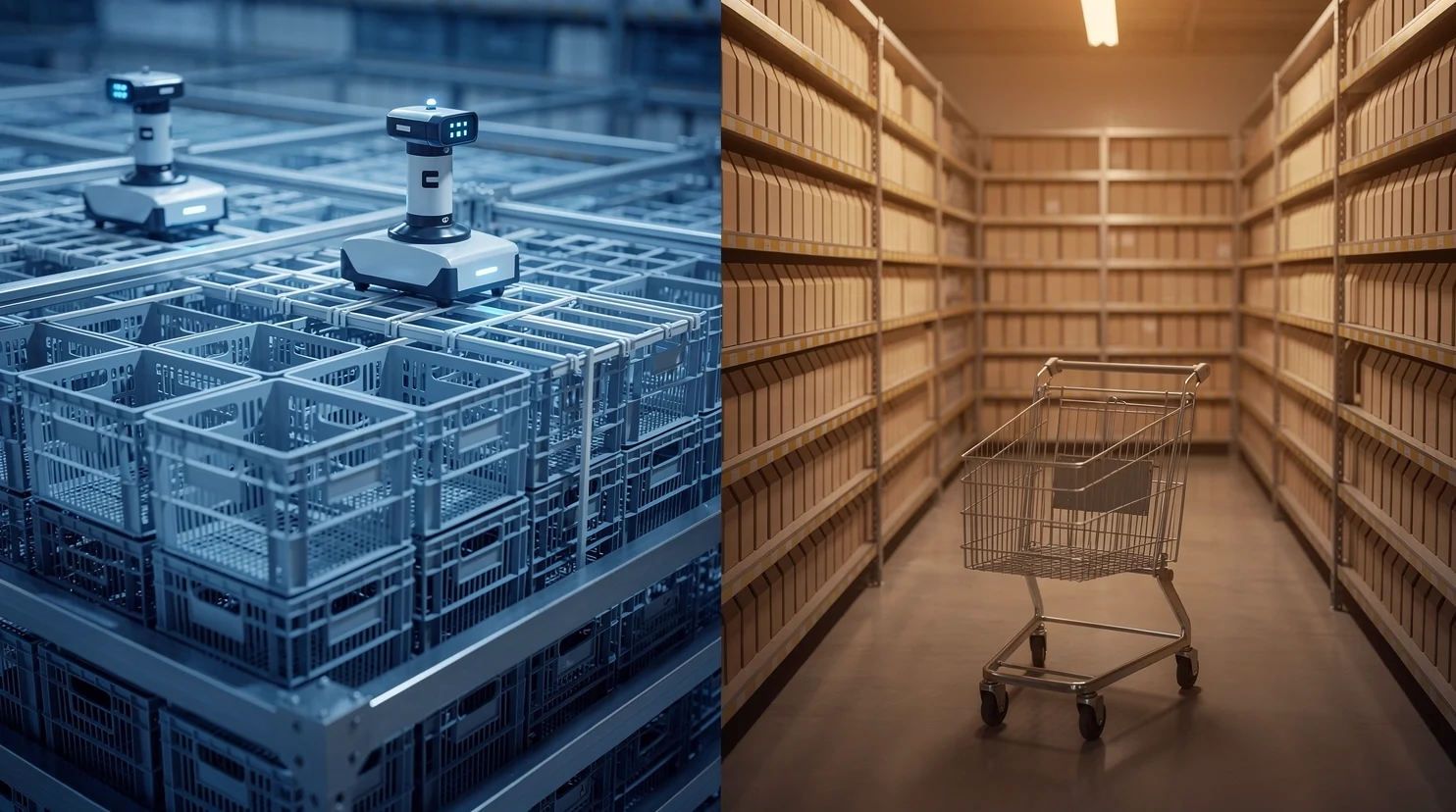
A grocer deciding between a micro-fulfillment center and a dark store is really choosing between two capital profiles, two labor models and two very different failure modes. Both formats exist to put picked orders closer to the customer than a regional warehouse can. Beyond that shared purpose, the micro fulfillment vs dark store question turns on order volume per site, the breadth of the range a shopper expects, and how much a chain is willing to commit before the demand curve is proven.
This guide lays out how each model works, where the money goes, what breaks at peak, and how to structure a pilot that ends in a decision rather than another year of debate. It is written for grocery operators and analysts evaluating a network, not for a single store.
In short
- Micro-fulfillment centers (MFCs) automate storage and retrieval with goods-to-person systems; dark stores keep a conventional shelf layout and rely on human pickers with handhelds.
- Capex is the dividing line: an MFC front-loads several million dollars per site, while a dark store can open on a fit-out budget closer to a small supermarket refurbishment.
- Throughput favors automation once a site clears a sustained daily order floor; below that floor, the robots sit idle and the payback math collapses.
- Range favors the dark store: bulky, fragile, loose and temperature-mixed items are exactly what automated grids handle worst.
- Pilot design matters more than vendor selection: a pilot without a pre-agreed kill threshold produces a story, not a decision.
What does a micro-fulfillment center actually automate?
An MFC automates the storage, retrieval and sequencing of totes so that a human picker never walks an aisle. Stock lives in a dense grid or shuttle system, robots bring the right tote to a fixed pick station, and software decides the order in which totes arrive so one operator can assemble several customer orders at once. The picker still touches every item, but the walking, searching and re-slotting disappear.
The common vendor architectures are cube storage (a grid with robots running on top, the AutoStore pattern), shuttle-and-lift systems (Ocado and Fabric style), and hybrid designs that pair an automated ambient module with manual chilled and frozen zones. Amazon’s reported deal to deploy AutoStore modules, covered in our analysis of why modular automation is likely by early 2027, points to where the market is heading: smaller, repeatable modules rather than bespoke mega-sites.
The parts that are not automated
Receiving and decanting inbound cases into totes is manual in nearly every MFC design, and it is often the hidden labor sink. Chilled and frozen ranges are frequently left outside the grid because refrigerated automation is expensive to build and maintain. Bagging, staging by delivery slot and handing over to drivers also stay human. A useful way to read any vendor pitch is to ask which of these four zones the automation covers, and which the site still staffs conventionally.
What the software layer changes
The real productivity gain comes from the warehouse control system rather than from the robots. Batching multiple orders per picker, sequencing totes so heavy items land first, and holding fast movers in the top layer of the grid are software choices. This is the same logic that runs a good manual site, and it is worth reading our breakdown of dark store operations, pick paths and staffing before assuming that automation is the only way to get it.
How does a manual dark store trade capex for labor?
A dark store is a retail-format space closed to the public and laid out purely for picking. It takes a conventional store’s fixtures, compresses the aisles, slots stock by pick velocity rather than by merchandising logic, and staffs the floor with pickers carrying handhelds or pushing multi-order carts. There is no automation to depreciate, so the capital cost is dominated by lease, refrigeration and racking.
The trade-off is structural. Every incremental order at a dark store costs roughly the same labor as the last one, because a human still walks, scans and packs it. At an MFC, the marginal order is cheaper once the fixed system is in place, but the fixed system has to be paid for whether the orders arrive or not. That distinction drives almost every other comparison in this article, and it is the same tension explored in our guide to quick commerce economics and dark stores.
Where dark stores win on flexibility
A dark store can change its range overnight. New SKUs get a shelf slot, seasonal items move in and out, and a promotional pallet can sit at the end of an aisle. It can also flex staffing by hour: three pickers at 10am, twelve at 6pm. Neither of these is easy in an automated grid, where every new SKU needs a tote profile and every peak needs the same number of pick stations the site was built with.
Where dark stores lose on cost per order
Labor productivity in a manual site tops out. Operators commonly quote manual pick rates in the range of roughly 60–120 items per picker-hour depending on layout and cart design, while goods-to-person stations are marketed at several hundred items per hour. Those vendor figures deserve skepticism, but the direction is consistent: at high sustained volume, the dark store’s labor line grows faster than the MFC’s depreciation line.
How do throughput and peak scaling compare?
Throughput is where the two models separate most sharply, and it is also where the comparison is most often done wrong. The right question is not “how many orders per hour can the site do” but “how many orders per hour can it do in the two hours that matter, at what marginal cost, and how much of the day is it running below half capacity.”
The daily order floor
Every automated site has a break-even order floor below which the fixed cost per order becomes uncompetitive with manual picking. Where that floor sits depends on capex, system lifetime and local wages, but the shape is universal: the MFC line is flat and high, the dark store line starts low and rises with volume. A site that will run at 400 orders a day for the first year and might reach 1,500 in year three is a manual site today and possibly an automated one later.
Peak behavior
Dark stores handle peak by adding people. That works until the aisles are congested, at which point each additional picker adds less than the last. MFCs handle peak by running pick stations at maximum, which is only useful if the number of stations was sized for the peak in the first place. Grocers that sized their automation for the average day and then met a Saturday morning, a holiday week, or a weather event have found that the robots cannot be asked to work overtime.
Illustrative throughput comparison
The table below uses illustrative ranges for a neighborhood-scale site of roughly 10,000 square feet. The numbers are assumptions for planning, not benchmarks; every network should replace them with its own pilot data.
| Dimension | Manual dark store | Micro-fulfillment center |
|---|---|---|
| Typical daily orders where the model makes sense | Roughly 150–1,000 | Roughly 800–3,000 and above |
| How peak capacity is added | More pickers, more carts, extended shifts | Limited by installed pick stations and grid speed |
| Marginal cost of the next order | Flat (labor-driven) | Falling (fixed system already paid for) |
| Cost behavior on a slow day | Send staff home, cost falls | Depreciation continues, cost per order rises |
| Time to add capacity | Days (hire and train) | Months (procure, install, commission) |
| Time to reduce capacity | Days | Practically never |
The operational lesson from the table is that manual sites absorb forecasting mistakes and automated sites punish them. That is why the discipline described in our piece on forecasting demand without an enterprise tool is a prerequisite for automation, not a nice-to-have.
What range limits does automation struggle with?
Automated grids are built around a standard tote. Anything that does not fit a tote, damages easily inside one, or needs a temperature the grid does not offer has to be handled outside the system. In grocery, that describes a large share of the basket.
The problem categories
- Bulky items: multi-packs of water, large bags of pet food, diapers, paper towels. These either take a whole tote or do not fit at all.
- Fragile and loose produce: bananas, soft fruit, leafy greens. Tote handling bruises them and the grid cannot inspect quality.
- Frozen: most MFC deployments keep frozen manual because sub-zero automation carries higher build and maintenance cost.
- Variable-weight items: meat and deli lines priced by weight need a scale in the pick path, which automation complicates.
- Hazardous and restricted goods: alcohol, aerosols and some cleaning products need separate handling rules.
The practical consequence is that most grocery MFCs run as hybrids: an automated ambient core surrounded by manual chilled, frozen and bulky zones. Once the manual share of the pick is above a third of items, the site’s labor curve starts to look a lot like a dark store’s again, with the automation cost sitting on top of it.
Range breadth versus range depth
A rapid-delivery dark store carrying 2,000–3,000 SKUs is a different animal from a full-basket grocery site carrying 15,000 or more. Automation gets more attractive as the range narrows and velocity per SKU rises, which is why the SKU selection logic in our guide to choosing the quick commerce SKUs that actually sell feeds directly into the format decision. A broad, slow-moving range in a small grid is the worst of both worlds: high fixed cost and low tote utilization.
What do capex, opex and payback really look like?
Capital cost is the number most vendors lead with and the one that matters least in isolation. The decision turns on cost per order across the system’s lifetime, which depends on volume, wages, utilization and how long the equipment actually runs before it is obsolete or the site closes.
Capex profiles
Industry commentary and vendor case studies have generally placed a grocery MFC of neighborhood scale in the low-to-mid single-digit millions of dollars for the automation alone, before building works, refrigeration and integration. Dark store fit-outs are typically discussed in the hundreds of thousands to low millions depending on refrigeration and location. Both figures vary widely by market and vendor, and any grocer should treat published numbers as order-of-magnitude guides rather than quotes.
The opex lines that get underestimated
For MFCs, the usual surprises are software licensing and support contracts, spare parts, the decant labor at inbound, and the engineering headcount needed on site. For dark stores, they are labor turnover and training, shrink from a fast-moving manual environment, and refrigeration energy in a space never designed for a picking floor. Neither model’s brochure includes the cost of the demand forecast being wrong.
Illustrative cost structure comparison
| Cost line | Manual dark store | Micro-fulfillment center | What moves it |
|---|---|---|---|
| Upfront automation and integration | Minimal | Dominant line, front-loaded | Grid size, stations, cold zones |
| Fit-out, racking, refrigeration | Dominant line | Significant, plus structural works | Site condition, cold range share |
| Pick labor per order | High and flat | Lower at scale, higher below floor | Volume, wages, hybrid share |
| Inbound and decant labor | Moderate (shelf stocking) | Moderate to high (tote decant) | Case sizes, SKU count |
| Maintenance and software | Low | Recurring annual contract | Vendor terms, uptime SLA |
| Depreciation exposure if site closes | Fixtures, mostly writable-off | Large stranded asset | Lease length, relocatability |
| Realistic payback window | Often inside two years if volume holds | Commonly modeled at several years, sensitive to volume | Sustained orders per day |
Why payback models fail
Most MFC business cases that missed did so for one of three reasons: the site never reached the order floor, the hybrid manual share ended up higher than modeled, or the equipment was written off early when the strategy changed. The wave of standalone automated sites being paused or closed in the US, examined in our analysis of why standalone automated grocery fulfillment is losing the US market, is largely a story of volume assumptions rather than of technology that did not work. Store-based fulfillment, meanwhile, has kept winning on the simpler math of an asset the grocer already pays for.
Stock turn is the underappreciated variable in both models. A site that turns inventory faster needs less storage, less working capital and fewer write-offs, which is why inventory turnover and why retailers obsess over it belongs in the format model, not just in the merchandising review.
Should a grocer retrofit a store back room or build a standalone site?
The retrofit question cuts across both formats. A grocer can carve a dark-store picking area out of an existing store’s back of house, or install a compact MFC module behind an existing store, or take a standalone lease for either. Each option has a different relationship with the store’s own operations, the landlord and the delivery map.
In-store retrofit
Retrofitting uses space the grocer already leases and stock the store already receives. It shortens the path to launch and keeps the inventory pool shared. The costs are operational: picking traffic competes with store replenishment, back-room space is often awkwardly shaped for a grid, and store managers now run two businesses under one roof. Automation vendors have increasingly designed modules for exactly this footprint, with the bet that the store’s existing inbound and cold chain do the hard work.
Standalone site
A standalone dark store or MFC can sit where the delivery density is, not where the retail footfall is, which can cut drive time per drop substantially. It also removes conflict with store operations. The price is a second lease, a second inbound flow and a separate inventory pool that needs its own forecasting. For a chain without a mature warehousing discipline, that second flow is a real risk; the fundamentals in our guide to warehousing basics for brands that just outgrew the garage apply at this scale too.
Decision factors for retrofit versus standalone
- Delivery density: if existing stores already sit inside the dense delivery zones, retrofit first.
- Back-room geometry: ceiling height, column spacing and floor loading decide whether a grid is even possible.
- Store operations tolerance: a store already stretched on labor will not absorb a picking operation gracefully.
- Lease terms: a standalone MFC needs a lease at least as long as the equipment’s payback horizon.
- Inventory pooling: shared stock reduces working capital but complicates availability promises to online shoppers.
How does the delivery model change the answer?
Fulfillment format and delivery model are usually decided separately and should not be. A site’s cost per order includes the trip to the door, and the trip depends on where the site sits and how orders are batched. A dark store inside a dense urban zone can justify a rider fleet; an MFC on a retail park usually needs van routes and longer delivery windows.
Rapid-delivery promises push operators toward many small dark stores close to demand, because the drive time dominates. Scheduled next-day or same-day windows tolerate a larger, more automated site farther out, because batching by route recovers the distance cost. Our piece on rider batching and drop density works through that math in detail. The broader framing of the whole chain, from inbound to doorstep, lives in our guide to modern retail logistics from warehouse to doorstep.
A simple pairing rule
- Rapid delivery (under an hour), narrow range: dark stores, many and small, manual picking.
- Same-day scheduled, full basket: store-based or in-store MFC retrofit, hybrid picking.
- Next-day scheduled, full basket, high density: standalone MFC or larger automated site with van routes.
- Mixed promise in one market: a dark store for the rapid tier and a store or MFC feeding scheduled windows, with shared forecasting.
How do you run a pilot that produces a decision?
The most expensive mistake in this space is not choosing the wrong format; it is running a pilot that cannot fail. A useful pilot has a pre-agreed order-volume threshold, a defined measurement window, a cost-per-order target, and a named decision that will be taken if the target is missed. Without those four elements, the pilot becomes a permanent experiment that consumes budget and management attention.
Set the questions before choosing the vendor
A grocer should write down, in one page, what it would need to see to commit to a network of ten sites. Typical questions: sustained orders per day at month six, hybrid manual share of items picked, pick accuracy, cost per order fully loaded, and downtime hours per month. The vendor’s job is to prove those numbers on the grocer’s range, not on a demo range.
Run a manual control
The cleanest pilot design pairs one automated site with one manual dark store serving a comparable catchment, launched in the same quarter and measured on the same metrics. The comparison strips out the market effect (both sites see the same demand growth) and leaves the format effect. It also gives the grocer a working dark store either way, which is a cheap hedge.
Measurement window and kill thresholds
Six months is usually enough to see whether the demand curve is real; twelve is enough to see a seasonal peak. The kill threshold should be set at the start: for example, if the automated site is below 60% of its modeled order floor at month six, the second site is not ordered. Writing that sentence down before the pilot starts is the single most valuable thing an executive sponsor can do.
What to report
- Orders per day, weekly, with the modeled curve overlaid.
- Fully loaded cost per order, split into labor, depreciation, maintenance and delivery.
- Hybrid share: percentage of items picked outside the automation.
- Availability and substitution rate as seen by the customer.
- Downtime hours and the cause of each event.
- Labor hours per 100 orders, for the manual control and the automated site side by side.
Common mistakes grocers make when comparing the two
The recurring errors cluster around volume optimism, brochure throughput and ignored stranded-asset risk. A few of the most frequent:
- Modeling the peak as the average. Automation sized for the Saturday morning is idle the rest of the week; automation sized for the average fails the Saturday.
- Trusting vendor pick rates. Station rates in a demo with a tidy ambient range rarely survive contact with produce, frozen and multi-packs.
- Forgetting decant labor. The tote has to be filled by someone; that cost sits upstream of the “automated” pick.
- Ignoring what happens if the site closes. A dark store’s fixtures can be sold or moved; an installed grid mostly cannot.
- Letting the format decide the delivery model. The two must be modeled together, or the delivery leg quietly erases the picking saving.
- Skipping the manual control. Without a comparable dark store, the pilot proves only that the vendor’s equipment switches on.
Broader context helps here. The dark store format has a short and volatile history, from pandemic-era rapid-delivery startups to the consolidation that followed; the background is summarized on Wikipedia’s dark store entry. Demand-side data such as the US Census Bureau’s monthly retail trade releases is a useful sanity check on whether the online grocery growth assumed in a business case matches what the wider market is actually doing.
FAQ on micro-fulfillment and dark stores
What is the difference between a micro-fulfillment center and a dark store?
A micro-fulfillment center uses automated storage and retrieval (robots, grids or shuttles) to bring totes to a fixed pick station, so the picker does not walk the aisles. A dark store is a conventional shelved space closed to the public where human pickers walk and pick with handhelds. The MFC front-loads capital and lowers labor per order at scale; the dark store keeps capital low and pays for each order in labor. Both sit close to customers; they differ in how the picking is done and who bears the volume risk.
At what order volume does an MFC beat a dark store?
There is no universal number because it depends on capex, wages, system lifetime and how much of the range stays manual. The consistent pattern is that an automated site needs a sustained daily order floor, often modeled in the high hundreds to low thousands of orders per day for a neighborhood-scale site, before its fixed cost per order falls below manual picking. Below that floor the dark store is cheaper. A grocer should derive its own floor from a pilot rather than from a vendor’s model.
Why do most grocery MFCs still have manual zones?
Automated grids are designed around a standard tote at ambient temperature. Frozen goods, loose produce, bulky multi-packs and variable-weight items either do not fit, get damaged, or need a temperature the grid does not provide. Most operators therefore run a hybrid: an automated ambient core with manual chilled, frozen and bulky areas. The larger that manual share, the more the site’s cost curve resembles a dark store’s with automation cost added on top.
Is it better to retrofit an existing store or open a standalone site?
Retrofitting uses space and inbound flows the grocer already has and gets to market faster, but it competes with store operations and back rooms are rarely shaped for a grid. A standalone site can be placed for delivery density and runs without conflict, at the cost of a second lease and a second inventory pool. Chains whose stores already sit inside the dense delivery zones usually retrofit first; chains with stores in the wrong places for delivery lean standalone.
How long does payback take for each model?
Dark store fit-outs are often modeled to pay back within roughly two years if volume holds, because the capital is modest. MFC business cases are commonly modeled over several years and are highly sensitive to reaching the order floor on schedule. The biggest risk to an MFC payback is not equipment failure but a volume forecast that does not materialize, or a strategy change that strands the asset before it has earned out.
What should a grocer measure in a fulfillment pilot?
Orders per day against the modeled curve, fully loaded cost per order split by labor, depreciation, maintenance and delivery, the percentage of items picked outside the automation, customer-facing availability and substitution rates, downtime hours with causes, and labor hours per 100 orders. Measuring the same metrics at a manual control site launched in the same quarter isolates the format effect from the market effect.
Can a dark store be converted into an MFC later?
Sometimes, if the building has the ceiling height, floor loading and power for a grid and the lease runs long enough to justify the install. Many grocers now plan for this path deliberately: open manual, prove the volume, then automate the ambient core once the order floor is sustained. The reverse conversion, removing automation and returning to shelves, is rare and expensive because the grid is a stranded asset.
How does the delivery promise affect the format choice?
Rapid promises under an hour push toward many small dark stores close to demand, because drive time dominates cost. Scheduled same-day and next-day windows tolerate larger, more automated sites farther out, because batching by route recovers the distance. Modeling the picking format without the delivery leg is a common mistake; the saving from automation can be erased by a longer trip to the door.
What’s next
For most grocers the sequence is clear: open manual, measure hard, and automate only the part of the range and the sites where the volume has been proven. The wider economics of rapid delivery, including the rider and marketing costs that sit outside the fulfillment site, are laid out in our quick commerce guide on dark stores, rapid delivery and the real economics. Readers who want the format primer before the decision framework can start with our earlier overview of dark stores and micro-fulfillment for grocery delivery.