
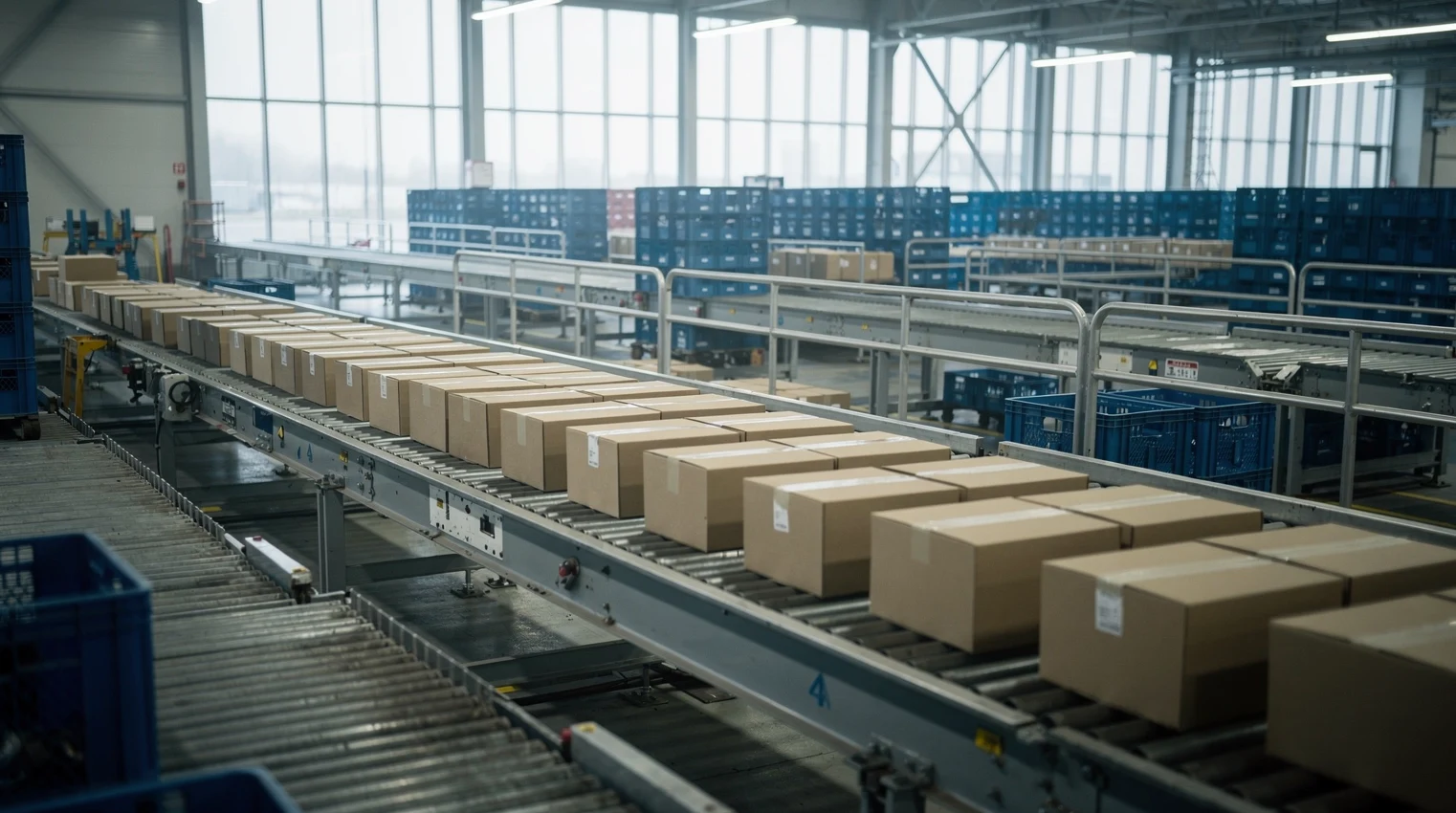
The European Union’s overhaul of its customs framework entered into force on September 21, 2026, converting three years of negotiation into binding law and starting the clock on a compliance calendar that runs to the middle of the next decade. The regulation creates a new EU Customs Authority, mandates a central EU Customs Data Hub, and makes online platforms legally responsible for the duties on goods they sell into the bloc.
For retailers and marketplace sellers, the immediate consequence is not the agency or the data hub. It is the EU-wide handling fee on small parcels scheduled to apply from November 1, 2026, layered on top of a flat customs duty that has already been in force since July.
In short
- Entry into force: the EU customs reform became law on September 21, 2026, after Council approval on September 3 and a European Parliament vote on September 16.
- Next live deadline: an EU-wide handling fee on small parcels from November 1, 2026, separate from the existing duty, with the amount to be set by the European Commission.
- Already in effect: the EUR 150 duty exemption (about USD 172) disappeared on July 1, 2026, replaced by a temporary flat duty of EUR 3 per tariff code (about USD 3.45) running until July 1, 2028.
- Liability shifts: platforms and distance sellers are now the deemed importer, responsible for customs formalities and duty payment instead of the consumer.
- Measured impact: low-value parcel volumes have fallen by roughly half since July, with Belgium down 53% and the Netherlands down 46% year over year.
What actually entered into force on September 21
The reform rewrites the Union Customs Code, the legal backbone that governs how goods cross the EU’s external border. The Council of the European Union gave final approval on September 3, 2026, and the European Parliament approved the text on September 16. Publication in the Official Journal followed, with the regulation taking effect on September 21.
The package has four load-bearing components. It establishes a decentralised EU Customs Authority, mandates a single EU Customs Data Hub for import and export declarations, redefines who counts as the importer in e-commerce transactions, and creates a privileged “Trust and Check” category for the most transparent traders.
Entry into force is not the same as full application. Most of the operational machinery arrives on a staged timetable stretching to 2034, which is why the reform reads as a framework rather than an immediate shock to daily customs practice.
Why the September date matters despite the long runway
Legal certainty is the practical change. Until September 21, importers and platforms were planning against a text that could still shift in trilogue or at the implementing-act stage. The obligations are now fixed in law, which means compliance budgets, ERP integrations and customs broker contracts can be committed against dates rather than drafts.
The vote that locked the text is covered in our report on the European Parliament customs reform vote, which set out the final parcel provisions before publication. What changed on September 21 is enforceability, not substance.
The scale problem the reform was written to solve
According to European Commission figures, 4.6 billion e-commerce consignments valued under EUR 150 entered the EU in 2024. That works out to roughly 12 million parcels a day. The Commission has reported that approximately 91% of those shipments originated in China.
Customs administrations across the bloc were never designed for that volume at that value. The old system assumed a small number of high-value commercial consignments, not a continuous stream of individually declared low-value packages routed directly to consumers.
Why the EUR 150 exemption disappeared before the reform landed
The duty relief threshold for consignments under EUR 150 was removed on July 1, 2026, ahead of the wider reform. The Commission and the Council agreed to decouple that measure because the customs agency and data hub were not due until 2028, and waiting would have left the revenue and enforcement gap open for two more years.
In its place sits a temporary flat customs duty of EUR 3, applied per tariff classification rather than per item. A consignment containing five identical products incurs a single EUR 3 charge. A consignment containing two different product types incurs EUR 6.
The Commission has been explicit that this is a customs duty, not a consumer tax, and that the declarant carries the obligation. In practice the declarant is the seller, the importer, the holder of an Import One-Stop Shop registration, or their customs representative.
What the flat duty does not cover
Goods benefiting from preferential trade agreements or customs union arrangements sit outside the flat duty, provided VAT was not collected through the Import One-Stop Shop and the items are declared under the standard H1 dataset. The measure is explicitly temporary and expires on July 1, 2028, when the full tariff treatment under the reformed code takes over.
| Charge | Amount | In force | Who pays | Basis |
|---|---|---|---|---|
| Old de minimis relief | EUR 0 duty under EUR 150 | Until June 30, 2026 | Nobody | Value threshold |
| Temporary flat duty | EUR 3 (about USD 3.45) | July 1, 2026 to July 1, 2028 | Declarant | Per tariff code |
| Union handling fee | To be set by the Commission | From November 1, 2026 | To be confirmed | Per consignment |
| Full reformed tariff | Standard duty rates | From July 1, 2028 | Deemed importer | Classification and value |
What the November 1 handling fee will cost
The reform provides for an EU-wide handling fee on small parcels applying from November 1, 2026. It is legally distinct from the EUR 3 duty: the duty is a tariff on the goods, while the handling fee is intended to recover the administrative cost of processing and monitoring the parcel flow.
The precise amount has not been fixed in the regulation itself. It falls to the European Commission to determine the level before member states implement it, which leaves sellers pricing against a known date but an unknown number.
Earlier Commission proposals floated a figure in the region of EUR 2 per parcel (about USD 2.30 at current rates). Industry guidance has generally planned around that order of magnitude, though no final figure has been confirmed as of publication.
Why an unfixed amount is still a planning problem
A parcel that carried zero duty in June 2026 now carries EUR 3, and from November will carry EUR 3 plus a handling fee. On a EUR 12 fashion item, that stack represents a meaningful share of the order value before shipping and VAT.
Sellers running EU-bound direct-to-consumer flows face a choice between absorbing the charge, surfacing it at checkout, or restructuring the flow entirely. Each option has a different conversion cost, and none can be finalised until the Commission publishes the number.
The restructuring response
The most common structural answer is to stop shipping individual parcels across the border and instead import in bulk, clear once, and fulfil from inside the bloc. That converts thousands of dutiable low-value consignments into a small number of commercial imports.
We examined this pattern in our analysis of how the EU handling fee pushes Temu and Shein toward local fulfilment. The November date has been the forcing function for that pivot since the fee was first proposed.
Who counts as the importer now
The reform’s most consequential legal change for marketplaces is the deemed importer rule. Platforms and businesses selling into the EU by distance sale are treated as the importer of the goods, making them responsible for ensuring that customs formalities are completed and duties are paid.
Previously the final consumer frequently ended up as the nominal importer of record, often without knowing it, which produced surprise charges on delivery and left customs authorities chasing individuals rather than commercial operators. The reform moves that liability to the party with the commercial relationship and the data.
This reallocation of responsibility was the central feature when the Council signed off the package, as covered in our report on how the EU customs overhaul makes platforms the importer of record. The September 21 entry into force makes that obligation enforceable.
What platforms have to supply
Deemed importer status carries a data obligation as well as a payment obligation. Platforms must be able to provide product classification, value, origin and consignee details in a form customs authorities can process, and they must be able to do so at the volume of their order book.
For large marketplaces that means treating customs data as a first-class product requirement rather than a logistics afterthought. Seller onboarding flows increasingly have to collect HS codes and origin declarations at listing time.
The Trust and Check tier
The reform creates a new category of trusted operator described as “Trust and Check” traders. Businesses that provide comprehensive information on the movement and compliance of their goods, and that meet additional stringent criteria, gain access to simplified procedures.
At the top of that tier, the most reliable companies will be able to release goods into free circulation in the EU without active customs intervention. The trade-off is transparency: the simplification is paid for with continuous data access.
What the EU Customs Authority in Lille will do
The reform establishes a decentralised EU agency for customs, to be based in Lille, France. Reporting indicates it is expected to employ around 250 staff and that it was formally established on the day the overarching regulation entered into force.
Its mandate is coordination rather than direct enforcement at the border. National customs administrations continue to run checks; the authority analyses the constantly updated import and export data held in the data hub and directs risk management across the union.
Full operational capacity is targeted for 2028, aligning with the point at which the data hub becomes mandatory for e-commerce. Until then the agency is standing up governance, staffing and technical infrastructure.
Why a central risk layer changes enforcement odds
Under the current arrangement, a seller facing strict scrutiny at one member state’s border can route through a more permissive entry point. Belgium and the Netherlands between them handle roughly half of all low-value parcels entering the bloc, a concentration that reflects routing decisions as much as geography.
A central data layer is designed to remove that arbitrage by applying consistent risk scoring regardless of entry point. Whether it achieves that depends on member state adoption, which is precisely what the staged mandatory dates are meant to force.
When the data hub becomes mandatory
The EU Customs Data Hub is the technical core of the reform. Rather than each member state operating its own declaration systems, traders submit data once to a central hub that national authorities draw from.
Adoption is phased, and the phasing is deliberately asymmetric. E-commerce businesses, the source of the volume problem, are brought in first. Other traders follow years later.
| Date | Milestone | Who is affected |
|---|---|---|
| July 1, 2026 | EUR 150 duty relief removed, EUR 3 flat duty begins | All low-value distance sellers |
| September 21, 2026 | Reform enters into force, EU Customs Authority established | All importers and platforms |
| November 1, 2026 | EU-wide small parcel handling fee applies | Low-value consignment flows |
| 2028 | EU Customs Authority reaches full operations | National customs administrations |
| July 1, 2028 | Data hub mandatory for e-commerce, flat duty expires | Marketplaces and distance sellers |
| 2034 | Data hub mandatory for all remaining traders | All commercial importers and exporters |
The gap between 2028 and 2034 is the reform’s main concession to traditional importers, who argued that rebuilding declaration infrastructure on a shorter timetable was not feasible. E-commerce operators did not receive the same runway.
How the EUR 3 duty already reshaped parcel flows
The July measure produced a measurable volume response within weeks, which makes it a useful leading indicator for what the November fee may do. Customs authorities in Belgium and the Netherlands reported sharp year-over-year declines in low-value consignments after the duty took effect.
Belgium recorded a 53% fall in small parcels against the prior year. The Netherlands recorded a 46% decrease in e-commerce parcels, with the decline concentrated in shipments from China. Across the bloc, low-value parcel volumes fell by close to half.
We reported the initial figures in our coverage of how the EUR 3 parcel duty halved China parcel flow. The subsequent data has held that direction rather than reverting.
| Market | Change in low-value parcels | Period | Reported driver |
|---|---|---|---|
| Belgium | Down 53% | Since July 1, 2026, year over year | Flat duty on sub-EUR 150 goods |
| Netherlands | Down 46% | Since July 1, 2026, year over year | Fall concentrated in China-origin flow |
| EU aggregate | Down roughly 50% | Since July 1, 2026 | Duty plus routing changes |
Volume decline is not the same as demand decline
The headline percentages overstate the commercial damage. Dutch customs has noted that companies appear to be choosing bulk imports and storage inside the EU so they can resell goods to consumers from within the bloc.
That is a change in customs treatment, not a change in consumer appetite. A container cleared once and broken down in a Polish or Dutch warehouse removes thousands of parcels from the low-value import statistics while delivering the same goods to the same buyers.
The implication for November is that the handling fee is likely to accelerate warehousing decisions already in motion rather than suppress cross-border demand. Operators that have not yet localised inventory face the sharpest cost delta.
Who gains from the new rules
The reform’s design effect is to narrow the cost gap between goods shipped directly from outside the bloc and goods already held inside it. Retailers with EU warehousing and EU-cleared inventory do not pay the per-parcel charges on each consumer order.
Reuters reported on September 22 that the finance chief of Polish fashion group LPP said the EU parcel duty has supported online sales at its value brand Sinsay. LPP’s most recent quarterly results, for the three months to July 31, 2026, showed revenue growth of 18.4% to about USD 1.73 billion (converted at roughly PLN 3.79 to the dollar at current rates).
That is the clearest public claim so far from a listed European retailer that the customs measures are shifting share. It should be read as one company’s account rather than sector-wide evidence, but it is directionally consistent with the volume data.
The cost side for cross-border platforms
On the other side of the ledger, operators built on direct-from-China parcel economics have absorbed a margin hit. PDD Holdings, Temu’s parent, reported a 12% profit decline in the quarter that first contained the EU parcel duty, as covered in our report on PDD’s results against the EU parcel duty.
The strategic response has been to build EU-based fulfilment and recruit local sellers, which is expensive but structurally removes exposure to per-parcel charges. That transition is the reason the reform’s advocates describe it as levelling rather than protectionist.
Logistics operators sit in the middle
Carriers and postal operators face a mixed outcome. Volume declines in cross-border parcel lanes reduce revenue, while the shift to bulk import and domestic fulfilment moves work to freight forwarding and domestic last-mile networks.
Express integrators with customs brokerage arms are better positioned than pure parcel carriers, because the reform increases the value of declaration and classification services. Complexity that frustrates sellers is billable for brokers.
What sellers should do before November 1
The immediate task is determining exposure. Sellers should quantify what share of EU-bound orders currently arrive as individual low-value consignments cleared at the border, because that is the volume the handling fee will hit.
Second, classification data needs to be accurate at the SKU level. Because the flat duty applies per tariff code rather than per item, catalogues with sloppy or duplicated HS classifications incur charges they could otherwise avoid by consolidating.
Third, checkout presentation needs a decision. Duty and fee surprises on delivery drive refusals and chargebacks, so landed-cost calculation at checkout is increasingly the defensive minimum rather than a premium feature.
Questions worth putting to logistics partners now
- Which entity will be named as declarant on EU-bound consignments after November 1?
- Does the carrier or broker have a confirmed process for collecting the handling fee once the amount is published?
- What is the cost per order of bulk import and EU warehousing against the current per-parcel charge stack?
- Is the platform prepared to act as deemed importer, and what seller data does it require to do so?
- What is the roadmap for data hub readiness ahead of the July 1, 2028 mandate?
The 2028 deadline is closer than it looks
July 1, 2028 carries two changes at once: the flat duty expires and the data hub becomes mandatory for e-commerce. Sellers will move from a simple EUR 3 charge to full tariff classification at exactly the moment their declaration infrastructure has to change.
That combination argues for building classification capability now rather than treating the flat duty as a durable arrangement. Official guidance and legal texts are maintained on the European Commission’s EU customs reform page.
How the EU rules compare with the US and UK
The EU is not acting alone, and the sequencing matters for sellers running multi-market flows. Three of the largest consumer import markets have each moved to close low-value duty relief within roughly three years of each other, but on different timetables and with different mechanics.
The United States moved first and moved hardest. The USD 800 de minimis threshold was removed in August 2025, and the repeal has since survived legal challenge, with a trade court upholding it in 2026. There is no transitional flat charge in the US model: goods move directly to standard tariff treatment.
The United Kingdom has taken the slowest path. The Autumn Budget 2025 announced removal of customs duty relief on low-value imports below GBP 135 (about USD 181), with the change now expected to take effect by October 2028, brought forward from a previously announced March 2029 date.
Why the UK timetable is the outlier
HMRC data cited in the consultation response indicates around 1.6 million low-value parcels entered the UK each day in 2024. Declared trade value on that flow rose from GBP 3.8 billion in 2023 to 2024 (about USD 5.1 billion) to GBP 5.9 billion in 2024 to 2025 (about USD 7.9 billion).
The stated reason for the longer runway is system design. The UK is building new import arrangements specifically for high-volume low-value e-commerce rather than pushing those parcels into existing declaration infrastructure.
The common thread across all three jurisdictions is liability. Each is shifting the obligation away from the consumer and onto sellers and marketplaces, which converges on the same operational requirement regardless of the local rate or date.
| Market | Old relief threshold | Removal date | Transitional mechanism | Liability target |
|---|---|---|---|---|
| United States | USD 800 | August 2025 | None, straight to standard tariffs | Importer of record |
| European Union | EUR 150 (about USD 172) | July 1, 2026 | EUR 3 flat duty to July 2028 | Deemed importer (platform) |
| United Kingdom | GBP 135 (about USD 181) | By October 2028 | New low-value import system | Sellers and marketplaces |
What multi-market sellers should take from the divergence
A seller shipping to all three markets now faces three different charge structures on the same GBP 20 product. Attempting to run one global pricing rule across them produces either margin leakage in the US or overcharging in the UK.
The practical answer most operators have reached is market-specific landed-cost logic at checkout, fed by a single classification dataset. The classification work is shared; the duty calculation is not.
What changes by seller business model
The reform does not fall evenly. The cost of the November handling fee and the EUR 3 duty depends almost entirely on where inventory sits when the consumer places the order.
Direct-from-origin sellers
Operators shipping individual parcels from outside the EU to EU consumers carry the full charge stack on every order. For low average order values, the combined duty and fee can exceed the gross margin on a single item.
These sellers have the strongest incentive to restructure, and the least time to do it. The November 1 date arrives before the peak trading season, which compresses the decision window further.
Sellers with EU warehousing
Businesses holding cleared stock inside the bloc are largely unaffected at the point of consumer sale, because the goods were imported commercially rather than as low-value consignments. Their exposure sits upstream, in bulk import classification and duty rates.
The competitive position of this group improves in relative terms, which is the outcome the reform’s supporters intended. The cost is working capital tied up in forward-positioned inventory.
Marketplace operators
Platforms face the heaviest compliance burden under the deemed importer rule, regardless of whether they hold inventory. They must collect classification and origin data from third-party sellers and stand behind its accuracy to customs authorities.
That creates a new seller-quality requirement. Marketplaces that cannot obtain reliable HS codes from a long tail of small sellers may find it simpler to restrict cross-border listings than to carry the liability.
Brands selling wholesale into EU retail
This group is least affected in the near term. Goods move as commercial consignments to EU-based retail partners, well outside the low-value parcel regime, so neither the flat duty nor the handling fee applies.
Their exposure arrives in 2028, when the data hub becomes mandatory for e-commerce and, in 2034, for remaining traders. The reporting obligation is the change, not the charge.
What is still unresolved
Three material uncertainties remain. The handling fee amount has not been published, which prevents precise pricing for November. The division of fee revenue between the EU budget and member state administrations has also drawn political attention without a settled answer.
The second open question is enforcement capacity. A deemed importer rule only functions if authorities can identify and pursue non-compliant platforms, particularly those without an EU establishment.
The third is behavioural. If the dominant response continues to be bulk import and EU warehousing, the reform will have changed where goods are cleared without materially changing what European consumers buy or what they pay. Whether that counts as success depends on whether the objective was revenue, control, or competitive rebalancing.
Frequently asked questions
When did the EU customs reform enter into force?
The reform entered into force on September 21, 2026, following Council approval on September 3 and a European Parliament vote on September 16, and publication in the Official Journal.
Is the EUR 150 duty-free threshold gone?
Yes. The EUR 150 customs duty relief (about USD 172) was removed on July 1, 2026, ahead of the wider reform. Low-value consignments now attract duty regardless of value.
How much is the EUR 3 parcel duty and how is it calculated?
It is EUR 3 (about USD 3.45) per tariff classification, not per item. A parcel with five identical products is charged EUR 3; a parcel with two different product types is charged EUR 6. It runs until July 1, 2028.
What is the November 1 handling fee and how much will it cost?
It is an EU-wide fee intended to cover the administrative cost of processing small parcels, applying from November 1, 2026. The amount is set by the European Commission and had not been confirmed as of publication, though earlier proposals discussed a figure near EUR 2.
Who pays the duty now, the seller or the customer?
The declarant is liable, meaning the seller, importer, IOSS holder or their customs representative. Under the deemed importer rule, platforms selling into the EU by distance sale carry responsibility for formalities and payment rather than the final consumer.
What is the EU Customs Authority and where is it based?
It is a new decentralised EU agency based in Lille, France, reported to be staffed at around 250 people. It coordinates customs governance and risk management across member states and is targeted to reach full operations in 2028.
When does the EU Customs Data Hub become mandatory?
It becomes mandatory for e-commerce businesses on July 1, 2028, and for all remaining traders from 2034.
Have the new rules actually reduced parcel volumes?
Yes, substantially. Low-value parcel volumes fell by close to half after July 1, 2026, with Belgium down 53% and the Netherlands down 46% year over year. Dutch customs attributes part of the fall to firms switching to bulk import and EU-based storage rather than to lower consumer demand.
Does this mean prices go up for European shoppers?
Not necessarily by the full charge. Sellers can absorb the duty, pass it through, or restructure into bulk import and local fulfilment, which avoids per-parcel charges entirely. The observed shift toward EU warehousing suggests many are choosing restructuring over pass-through.