
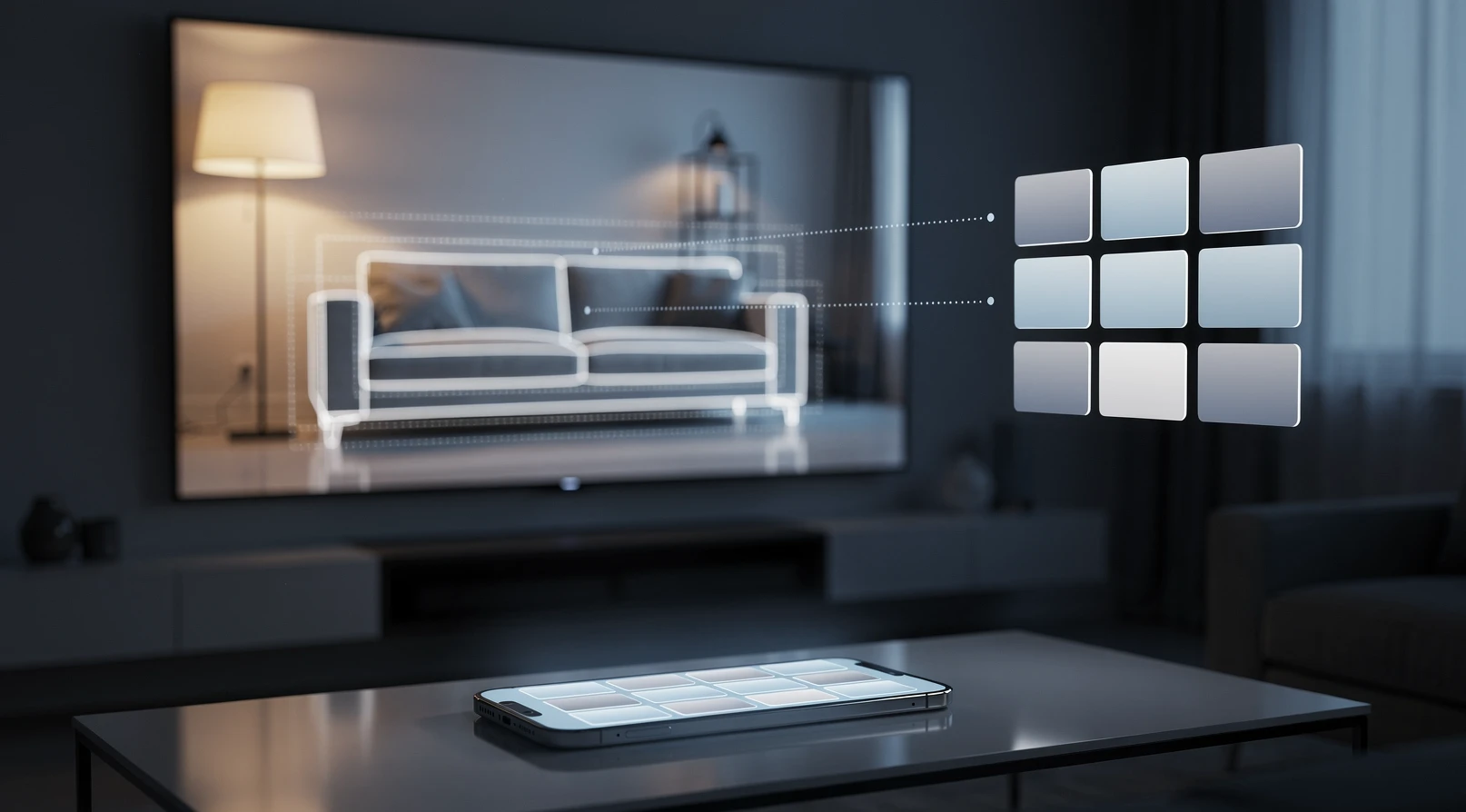
Shoppable television is about to change what it means. The pattern in the last four weeks suggests that by the 2027 NewFronts window (late April to the end of May 2027), Walmart and its Vizio smart-TV unit will announce an automated, catalog-wide shopping layer over streamed content, one that matches what is on screen to Walmart’s product catalog without a brand paying for the placement. Amazon has already crossed that line on Prime Video, YouTube has just handed its creators Amazon’s catalog as a tagging layer, and Walmart has spent 2026 assembling the operating system, the ad platform, and the shopping agent that such a feature requires. The signals point to Walmart following within roughly eight months, most likely announced with the NewFronts or Cannes Lions cycle where it has staged its last three CTV announcements.
In short
- Prediction: Walmart and Vizio are likely to announce a catalog-wide, automated shoppable layer for streamed content (scene-level or metadata-level product matching tied to a Walmart account, not brand-by-brand sponsored placements) by May 31, 2027, with the NewFronts as the most probable venue.
- Signal 1: On September 10 Amazon expanded Prime Video’s Shop the Show from roughly 1,300 to more than 8,000 titles and launched Shop the Scene, which uses Amazon Lens to identify look-alike products on screen across 600-plus titles, according to the company’s press release.
- Signal 2: Walmart closed its Vibe.co self-serve CTV acquisition on August 4, and on September 9 Walmart Connect’s Ryan Mayward told the Goldman Sachs Communacopia conference that Vizio’s OS is now, by Walmart’s account, the leading smart-TV operating system in the US, with YouTube data targeting in beta and a DV360 integration expected.
- Signal 3: On August 27 YouTube added Amazon to its Shopping affiliate program in the US, letting creators tag a curated Amazon catalog in Shorts, long-form videos and livestreams, which turns the retailer’s catalog into the tagging layer for a third-party video platform.
- Main caveat: Walmart’s CTV business is built on closed-loop measurement that sells best with a named sponsor attached, and Vizio’s automatic content recognition carries a 2017 FTC consent-order history; either could keep Walmart on the deal-by-deal model through 2027.
Why this matters now
Shoppable TV has existed for a decade as a sales format: a brand pays for a QR code, an overlay, or a product placement, and a retailer or platform stitches the click to a purchase. What changed on September 10 is that Amazon removed the sponsor from the loop. Shop the Scene reads the frame, finds a similar item in Amazon’s catalog, and routes the viewer to it, whether or not the brand on screen paid for anything. That is a different product economically, because the inventory becomes every scene in the library rather than the handful of scenes a marketer has bought.
The timing matters because retail media networks have spent 2026 pushing off their own properties and into streaming, and a retailer that owns a television operating system has more to gain from an automated layer than one buying inventory from someone else. Walmart is the only US retailer that owns a smart-TV OS, an ad-buying platform for streaming, a shopping agent, and a retail catalog of that size. The question this piece tries to answer is not whether Walmart wants a Shop the Scene equivalent but whether the pieces now in place make an announcement likely on a specific timeline. We covered the June scramble in why a second retail media network is likely to buy into connected TV before year-end 2026; the Vibe.co close in August is the deal that call anticipated, and the pattern has moved on since.
A second reason to look at this now is calendar. Walmart staged its 2026 CTV news at the NewFronts on March 23 (the L’Oréal placement deal and the unified Walmart login on Vizio and onn TVs), at Cannes Lions in June, and at the Vibe.co close in August. Amazon’s own upfront lands in May. If Walmart is going to match Amazon, the window that gives it maximum buyer attention is the same NewFronts-to-Cannes window it has used before, which is why the prediction is timed to the end of May 2027 rather than left open-ended.
Signal 1: Amazon takes Shop the Show from 1,300 titles to 8,000, and adds computer vision
Amazon’s September 10 press release, published on its US press center, describes three moves at once. The Shop the Show experience expanded from around 1,300 titles to more than 8,000, covering Prime Originals, licensed catalog titles and live sports. A dedicated Shop tab was added to X-Ray, alongside the existing Cast, Trivia and Music tabs, so that merchandise tied to a title sits one remote click away on supported devices in the US. And a new feature called Shop the Scene went live on more than 600 titles.
Shop the Scene is the part worth reading twice. According to the release, it is powered by Amazon Lens, the company’s visual search technology, and identifies products “inspired by” character outfits, home décor and other objects on screen, then surfaces similar items in a feed inside the Amazon Shopping app on iOS and Android that syncs with what is playing. Michelle Rothman, VP of Prime Video Shopping, framed it as a response to customer demand for discovering products inspired by content. The release gave no usage figures and confirmed the new features are US-only at launch.
Two details make this a strong adoption signal rather than a press-release flourish. First, the six-fold title expansion means the feature is being treated as a catalog property rather than a marketing stunt: 8,000 titles cannot be curated by hand, which implies metadata pipelines and automated matching are already in production. Second, Shop the Scene explicitly does not require the on-screen product to be for sale on Amazon; it finds a look-alike. That severs the link between a brand deal and a shoppable moment, which is precisely the link on which every prior shoppable-TV product, including Walmart’s, has depended.
| Element | Before September 10 | After September 10 | What it implies |
|---|---|---|---|
| Shop the Show coverage | About 1,300 titles | More than 8,000 titles | Automated title-level merchandising at library scale |
| Discovery surface | Title pages, promotions | Shop tab in X-Ray on supported US devices | Shopping placed at the same level as cast and trivia |
| Scene-level matching | Not available | Shop the Scene, Amazon Lens, 600-plus titles | No sponsor needed for a scene to be shoppable |
| Checkout path | Amazon app or site | Synced feed in the Amazon Shopping app, iOS and Android | Second screen carries the transaction, TV stays clean |
| Geography | US | US only for new features | International expansion is a future marker to watch |
Signal 2: Walmart has assembled the OS, the ad stack and the agent
Walmart’s side of the pattern is spread across four dated events. On March 23, at the NewFronts, Walmart and Vizio announced what they called a first-to-market product placement integration with L’Oréal inside premium content on Vizio OS, plus a unified Walmart account login rolling out on new Vizio and onn TVs. On August 4 Walmart completed the acquisition of Vibe.co, a self-service CTV advertising platform founded in 2021, with Walmart Connect’s Ryan Mayward saying the goal was to make streaming TV advertising accessible to businesses of all sizes, per the company’s announcement. And on September 9, Mayward, who is GM and SVP of Walmart Connect US, laid out the strategy at the Goldman Sachs Communacopia + Technology Conference.
The September 9 remarks, as reported by conference coverage, included several claims that bear directly on the prediction. Mayward said Vizio’s operating system became the leading smart-TV OS in the US in the first half of 2026 (a Walmart claim we have not been able to verify independently against third-party OS share data), that the footprint is expanding through onn private-label TVs, that a YouTube integration using Walmart data targeting is in beta, and that a DV360 integration is expected on top of a live Yahoo DSP connection and a Magnite partnership. He also described the ambition as bringing search-and-social style campaign setup, goal-based buying and automated optimization to television, which is the Vibe.co thesis in one sentence.
The same session carried the Sparky numbers: weekly active customers of Walmart’s shopping agent doubled year over year, grew 60% quarter over quarter, and produced an average order value about 40% higher than non-Sparky trips, alongside early, small-scale collaborations with Google and OpenAI. Sparky matters here because a catalog-wide shoppable layer is only useful if there is a conversational or visual-search surface to receive the match. Amazon uses Lens plus the Shopping app; Walmart has Sparky plus a Walmart account already being pre-linked to new Vizio TVs.
What Walmart does not yet have, on the public record, is the automated step. Every shoppable content product it has announced so far, from the L’Oréal placement to Walmart Live on Vizio devices in June, is either a brand deal or a Walmart-produced program. That gap is the thing the prediction says closes. We laid out why Walmart, Target and Amazon each moved into the format at Cannes in why another US retailer will buy into shoppable CTV before Q3 earnings close; the question now is what Walmart does with the assets it bought.
Signal 3: YouTube makes Amazon’s catalog the tagging layer for creators
The third signal comes from outside both companies’ walls. On August 27 YouTube CEO Neal Mohan announced that Amazon had joined the YouTube Shopping affiliate program in the US. Eligible creators in the YouTube Partner Program with an active Amazon Influencer or Associates account can now tag products from a curated Amazon catalog in Shorts, long-form videos and livestreams, request additions to that catalog, and receive commissions through their existing AdSense payouts on a monthly cycle, according to YouTube’s and Amazon’s published program terms.
This is a tech adoption signal for two reasons. First, YouTube is the largest single streaming application on US television screens by watch time, so tagged products now travel to the living room by default rather than staying on phones. Second, the mechanism is the same one Amazon uses on Prime Video: a retailer’s catalog exposed as a structured tagging layer that a video surface can call. Once a catalog is available as a tagging primitive on one platform, the marginal cost of exposing it to another surface, or to an automated matcher, falls sharply.
The creator angle also shows the competitive squeeze on Walmart. Walmart’s Creator program and Walmart Live already pay creators to feature Walmart products, but YouTube’s move gives Amazon’s catalog a distribution channel on the one screen where Walmart’s Vizio strategy is supposed to give it home advantage. Mayward’s own disclosure that Walmart’s YouTube integration is in beta suggests the company is aware that the living-room screen is contested on both the ad-buying and the shopping side. Live and creator commerce more broadly has been scaling all year, as we noted when Whatnot hit a $20 billion valuation.
What the pattern suggests
Put the three signals side by side and a sequence appears. Amazon has demonstrated that scene-level matching works at library scale and that the second screen can carry the transaction. YouTube has demonstrated that a retailer catalog can be exposed as a tagging layer to a third-party video surface and to creators. Walmart has, by its own account, the top smart-TV OS in the US, a self-serve CTV buying platform, a shopping agent with a rising order value, and a Walmart account pre-linked to new TVs.
The missing piece is the automated matcher, and the company that owns the TV has the easiest path to building it because Vizio’s automatic content recognition already knows what is on screen across inputs.
The prediction, stated precisely: by May 31, 2027, Walmart or Vizio publicly announces a shoppable content capability on Vizio OS or onn TVs that applies across a catalog of content (an ad-supported library such as WatchFree+, licensed programming, or partner apps) and matches on-screen items or scene metadata to Walmart products without a per-scene brand sponsorship. The announcement is likely to include a second-screen path through the Walmart app or Sparky, and is likely to be pitched to advertisers as an inventory expansion rather than to consumers as a feature. Two companion markers that would confirm the direction: Amazon expanding Shop the Scene well beyond the launch 600 titles or into a first non-US market by the same date, and Walmart’s YouTube data-targeting integration moving from beta to general availability.
| Signal | Date | Source type | What it shows | Strength |
|---|---|---|---|---|
| Prime Video Shop the Show to 8,000-plus titles; Shop the Scene via Amazon Lens on 600-plus titles | Sep 10, 2026 | Amazon US press center release | Automated, sponsor-free shoppable content in production at library scale | High |
| Walmart closes Vibe.co self-serve CTV acquisition | Aug 4, 2026 | Walmart announcement | Self-serve buying layer for streaming inventory in-house | Medium |
| Mayward at Goldman Sachs Communacopia: Vizio OS leading in US H1 2026 (company claim), YouTube beta, DV360 expected, Sparky AOV up 40% | Sep 9, 2026 | Conference remarks, reported | OS reach, ad distribution and agent surface all in place | Medium-high |
| YouTube adds Amazon to Shopping affiliate program in US | Aug 27, 2026 | YouTube CEO announcement, program terms | Retailer catalog exposed as a tagging layer on a third-party video surface | High |
| Walmart-Vizio L’Oréal placement and unified login at NewFronts | Mar 23, 2026 | Walmart corporate release (context, outside window) | Walmart’s current model is still deal-based | Context |
Wider context: from sponsored placements to catalog matching
Shoppable TV’s history is a list of formats that needed a sponsor. NBCUniversal’s shoppable ad units, Roku’s partnership with Walmart in 2022, Vizio’s own branded home-screen takeovers, and the Walmart and NBCU Thanksgiving programming of 2024 all followed the same template: a brand buys a moment, a retailer closes the loop. The results were often good for the brands that bought them, but the inventory never scaled beyond the number of deals a sales team could close.
Two adjacent developments changed the economics. Retail media networks discovered that on-site inventory saturates, which sent them off-site and into streaming, a shift we tracked in why retail media and the independent DSP layer converge before year-end 2026. And visual search became reliable enough to run in real time: Amazon Lens, Google Lens and Pinterest Lens all now match objects to catalog items at a quality retailers are willing to put in front of customers. Automated matching converts a sales-limited product into a catalog-limited one, and the retailer with the largest catalog and the most screens wins that conversion.
The consolidation of the CTV platforms themselves pushes in the same direction. Fox’s acquisition of Roku, which we covered when the $22 billion deal was announced, put the largest independent US TV OS inside a media company, and Samsung has been selling shoppable ad inventory to Amazon. Walmart’s Vizio is the only major US TV OS owned by a retailer, and the strategic logic of owning it was never the ad inventory alone; it was the ability to make the whole screen shoppable with the retailer’s own catalog.
| Precedent | Year | Model | Outcome | Lesson for the prediction |
|---|---|---|---|---|
| Amazon X-Ray on Prime Video | 2012 onward | Metadata overlay (cast, trivia, music) | Became the default second-screen layer; Shop tab added 2026 | Overlay habits compound; commerce slots into existing behavior |
| Roku and Walmart shoppable ads | 2022 | Sponsored overlay with Walmart checkout | Limited scale, format-dependent | Deal-based inventory does not scale |
| Walmart acquires Vizio | Closed 2024 | Retailer buys the TV OS | Vizio OS in Walmart Connect measurement in 2025 to 2026 | Ownership of the screen precedes catalog-wide features |
| Instagram Checkout | 2019 to 2023 | Platform-native checkout | Rolled back in 2023 | Automated shoppability fails if checkout friction is on the wrong surface |
| Walmart and Vizio L’Oréal placement | March 2026 | Brand-funded in-content placement | Live, single-brand | Walmart’s current step; the automated step is what remains |
| Prime Video Shop the Scene | September 2026 | Catalog-wide computer vision matching | 600-plus titles at launch, US only | The template Walmart is likely to follow |
Implications for retailers, brands, platforms and investors
Retailers
For retailers without a TV OS, the implication is that shoppable content is becoming a catalog-exposure question rather than an ad-buying question. The practical move is to make product data machine-matchable: clean images, structured attributes, and GTIN-level identifiers so that a Lens-style matcher resolves to your listing rather than a look-alike. Retailers selling on Amazon already benefit from Shop the Scene by default; those on Walmart Marketplace are likely to benefit from whatever Walmart ships next, provided their listings are complete.
Brands
Brands face a subtler shift. When matching is automated, a competitor’s product can be surfaced against your product placement, because the matcher looks for visual similarity rather than the licensed item. Brand teams that have paid for in-content placements should ask what happens when the retailer’s matcher also shows three cheaper look-alikes below the licensed item. The likely answer, based on how sponsored slots work on retail sites, is that “own the match” becomes a paid product, and it is plausible that Amazon Ads or Walmart Connect sells that slot before the end of 2027.
Platforms and streamers
For streamers that do not own a retailer, the YouTube-Amazon deal is the template: expose a retailer’s catalog as a tagging layer and take an affiliate cut. Expect more of these arrangements, and expect the retailer with the most complete catalog API to be the default partner. That dynamic favors Amazon on third-party platforms and Walmart on its own screens, which is another reason Walmart is likely to move on its home turf first.
Investors
Walmart’s advertising margins run above 70% by Mayward’s account, against roughly 5% for core retail, so any feature that expands sellable inventory on Vizio without a per-deal sales cost is accretive at the margin. The number to watch is not a feature announcement but whether Walmart starts disclosing Vizio-attributed advertising or GMV lines in fiscal 2028 reporting. For Amazon, Shop the Scene’s economics show up in Prime Video advertising revenue and in the Amazon Ads upfront in May, where a sponsored version of the feature would be the natural product to unveil.
Caveats: what could go wrong
The strongest counter-signal is Walmart’s own sales pitch. Everything Walmart Connect has said about CTV, including the September 9 remarks, centers on closed-loop measurement that ties an ad to a purchase in a Walmart store or on Walmart.com. That model is easiest to sell with a named sponsor attached, and it is possible Walmart concludes that automated, unsponsored shoppability dilutes the case for paid placements rather than expanding it. Under that reading, Walmart spends 2027 scaling Vibe self-serve and sponsored placements and leaves catalog matching for later.
The second caveat is regulatory. Vizio’s automatic content recognition, the technology that would most naturally power on-screen matching, was the subject of a 2017 FTC and New Jersey settlement over collecting viewing data without adequate consent. State privacy laws have tightened since, and several states now regulate the use of personal data in pricing and offers, a track we covered in the personalized pricing series. Walmart’s legal team may reasonably decide that a catalog matcher fed by ACR data needs a consent architecture that is not ready by May 2027, which would push the announcement out or confine it to Walmart-owned content such as Walmart Live.
Third, content licensing is not symmetric. Amazon owns or licenses everything Shop the Scene runs on, and Prime Video controls the player. Vizio’s WatchFree+ library is licensed FAST content, and partner apps on Vizio OS control their own players, so a catalog-wide layer might in practice be limited to Walmart-controlled and FAST inventory rather than premium streaming. A narrower launch would still satisfy the prediction as written, but it would be a smaller product than Amazon’s.
Finally, the Instagram Checkout precedent is a reminder that automated shoppability can fail on checkout friction. Amazon avoided the problem by keeping the transaction on the phone in the Amazon app. If Walmart tries to put checkout on the TV screen rather than in the Walmart app or Sparky, conversion could disappoint and the feature could be quietly deprioritized after launch. The prediction is about an announcement by May 2027; it does not claim the feature succeeds.
| Scenario | Rough likelihood | What it looks like | How to check by May 31, 2027 |
|---|---|---|---|
| Base case: catalog-wide shoppable layer announced | About 55 to 60% | Walmart or Vizio announces automated product matching across Vizio OS content with a Walmart app or Sparky path, most likely at the NewFronts | Walmart corporate news, NewFronts coverage, Vizio OS release notes |
| Deal-based model persists | About 25 to 30% | More sponsored placements, more Walmart Live programming, Vibe self-serve scale, no automated matcher | Absence of any catalog-wide feature; NewFronts pitch stays sponsor-led |
| Narrow or delayed launch | About 10 to 15% | Matching limited to Walmart-owned content, or announced after May 2027 for privacy or licensing reasons | Feature confined to Walmart Live or WatchFree+ originals; timing slips past the window |
FAQ
What exactly did Amazon launch on September 10, 2026?
According to Amazon’s press release, Prime Video expanded Shop the Show from about 1,300 to more than 8,000 titles, added a Shop tab inside X-Ray next to Cast, Trivia and Music on supported US devices, and launched Shop the Scene, which uses Amazon Lens to identify look-alike products from outfits and décor on screen across more than 600 titles, delivered through a synced feed in the Amazon Shopping app on iOS and Android.
Why is Shop the Scene different from earlier shoppable TV?
Earlier formats required a brand to sponsor a moment. Shop the Scene matches any scene to similar catalog items whether or not the on-screen product’s maker paid for anything, which makes the sellable inventory the whole library rather than the deals a sales team closes.
Hasn’t Walmart already launched shoppable content on Vizio?
Yes, but in deal-based form. The March 2026 NewFronts announcement placed L’Oréal products inside Vizio OS content with Walmart linking them to shoppable pages, and Walmart Live arrived on Vizio devices in June. Neither is automated or catalog-wide, which is the step this piece predicts.
What is the exact prediction and how would someone check it?
By May 31, 2027, Walmart or Vizio publicly announces a shoppable capability on Vizio OS or onn TVs that matches on-screen items or scene metadata to Walmart products across a library of content, without a per-scene brand sponsorship. Check Walmart’s corporate newsroom, NewFronts and Cannes coverage, and Vizio OS release notes.
Could Amazon’s move simply fail, taking the thesis with it?
It could. Amazon disclosed no usage metrics, and the second-screen path means the feature competes for attention with the phone. If Amazon quietly narrows Shop the Scene, Walmart’s incentive to copy it weakens. That said, the six-fold title expansion suggests Amazon is treating it as infrastructure rather than an experiment.
Why would Walmart prefer sponsored placements over automated matching?
Because Walmart Connect’s pitch rests on closed-loop measurement, which is simplest to sell with a named sponsor. An unsponsored matcher might be seen internally as diluting the case for paid placements. This is the main reason the base case is only about 55 to 60% rather than higher.
What role does Vizio’s automatic content recognition play?
ACR identifies what is on screen across inputs, which is the natural input for a matcher. Vizio settled with the FTC and New Jersey in 2017 over ACR data collection without adequate consent, so any catalog-wide feature would need a consent design that satisfies current state privacy laws, a plausible source of delay.
Does the YouTube-Amazon affiliate deal matter for Walmart?
It does, in two ways. It shows a retailer catalog being exposed as a tagging layer to a third-party video platform, and it puts Amazon’s catalog on the largest streaming app on US television, including on Vizio sets. Walmart’s own YouTube integration is only in beta, per Mayward’s September 9 remarks.
What should a brand do before any of this ships?
Audit product data for machine matchability (clean imagery, structured attributes, GTIN-level identifiers) on both Amazon and Walmart Marketplace, and ask placement partners how their inventory will behave once a matcher can surface look-alikes beside a licensed product. “Owning the match” is likely to become a paid product on both platforms.