
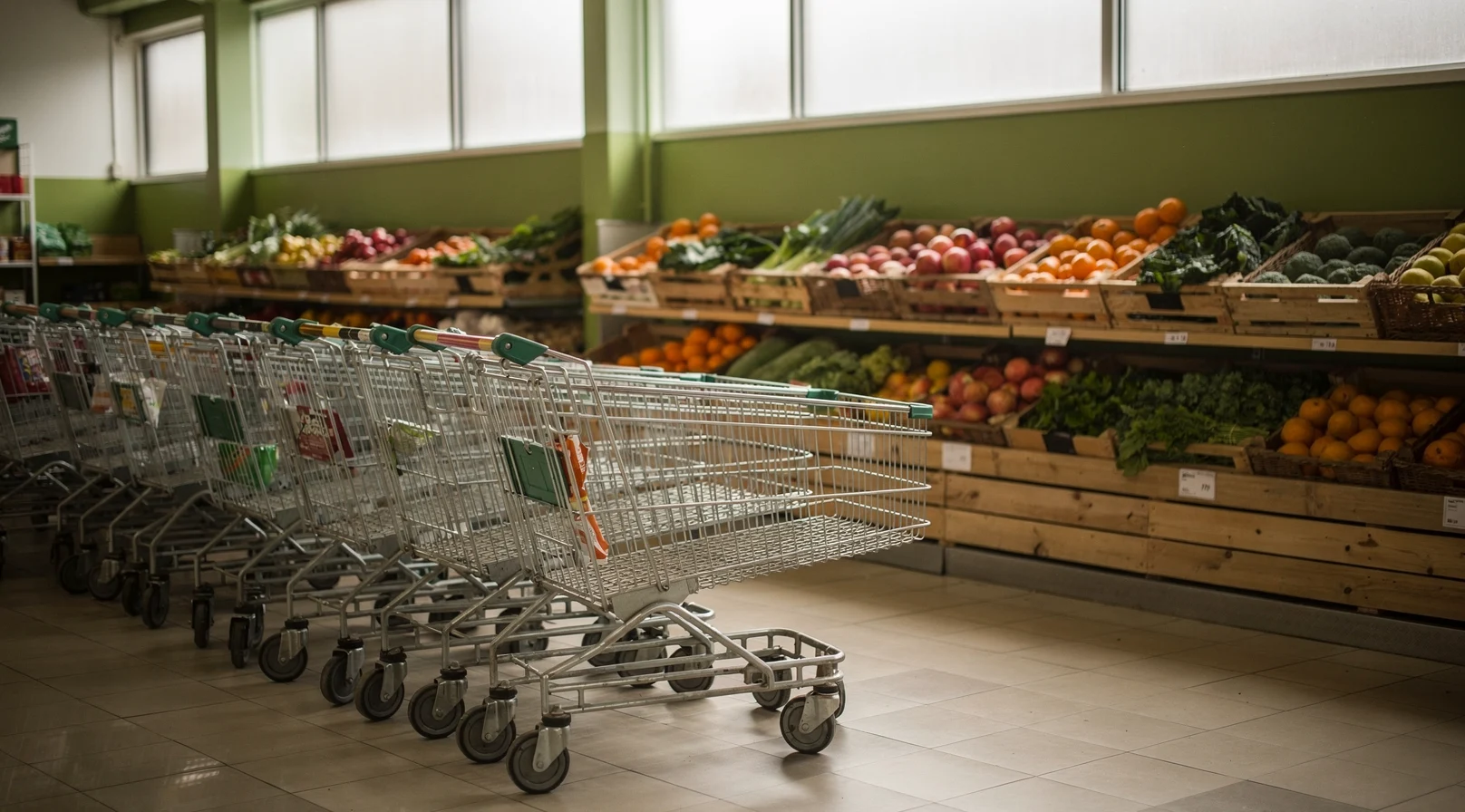
Morrisons is ending its trial of AI-powered smart trolleys at its Riversway store in Preston, three months after it became the first UK supermarket to put the technology in front of shoppers. The decision follows a move by its technology partner, Instacart, to wind down its entire Caper Carts business worldwide, citing slow take-up among retailers.
The trolleys, which recognise products as they are dropped into the basket, weigh loose fruit and vegetables on the spot and show a running total on a built-in screen, were launched at the end of July. Morrisons says the single-store pilot was nearing its planned end anyway and that Instacart’s decision carries no financial or operational consequences for the grocer. Shoppers elsewhere in the country should not expect to see the carts arrive at their local branch.
In short
- Trial ending: Morrisons is closing its single-store Caper Cart pilot in Preston, launched in late July 2026 as a UK first.
- Why: US firm Instacart is winding down Caper Carts globally because retailer adoption “has not scaled quickly enough”, according to an SEC filing on 26 October.
- Cost to Instacart: pre-tax charges of USD 55m to USD 80m (about £41m–£60m at current rates), with the wind-down largely done by the end of June 2027.
- No national roll-out: Morrisons says there are no financial or operational implications for the supermarket and it will keep testing other in-store ideas.
- Bigger picture: UK shoppers already have widespread scan-as-you-shop handsets and apps at rivals; analysts argue the trolley was an expensive answer to a problem UK grocers had largely solved.
What exactly has Morrisons announced?
Morrisons confirmed to The Grocer that its trial of Instacart’s Caper Carts at the Preston store is coming to an end. The trolleys arrived at the Riversway site, close to Preston Docks, on 29 July 2026, in what both companies billed as the first commercial deployment of the technology by a British grocer.
A Morrisons spokesperson told The Grocer: “The trial has given us greater insight into the continued evolution of our customers’ shopping habits and we will continue to pilot and develop solutions to meet those needs.” The supermarket added that there were no financial or operational implications arising from Instacart’s move.
In a separate statement to Retail Technology Innovation Hub, the retailer said: “We note that Instacart has announced a strategic decision to wind down its Caper Cart business. Our single store trial is due to complete shortly as planned and we’ll continue to test and learn until the end of the trial period.” The story has since been picked up by regional titles and, on Sunday 1 November, by the Daily Express.
Which store was involved?
Only one branch took part: the Riversway store in Preston, Lancashire, which TechRadar locates in the Ashton-on-Ribble area. No other Morrisons supermarket received the trolleys, and the company has not suggested that any will. Shoppers in Preston can expect the carts to disappear once the pilot formally closes, although Morrisons has not given a precise end date.
When did the trial start and how long did it run?
Instacart and Morrisons announced the launch on 28 July 2026, with the trolleys in use from the following day. That makes the pilot roughly three months old at the point the end was confirmed in late October. Instacart, for its part, says its global Caper Cart wind-down will be largely completed by the end of June 2027.
Why is Instacart pulling the plug on Caper Carts?
The decision came from Instacart, not Morrisons. In a regulatory filing with the US Securities and Exchange Commission on Monday 26 October, the company said it would wind down all Caper Cart operations to “re-align resources to support the company’s strategic priorities”.
In a blog post explaining the move, Instacart described the trolleys as “a great product” but said “the business reality is that retailer adoption has not scaled quickly enough to justify our continued investment”. It insisted that “the opportunity in physical grocery is enormous, and we’re just getting started”.
What does it cost Instacart?
According to the filing, Instacart expects pre-tax charges of USD 55 million to USD 80 million (about GBP 41 million to GBP 60 million at current rates of roughly 0.747 pounds to the dollar). The Grocer reports that these cover contract terminations, impairment of assets and employee termination costs, and are expected to fall in the final quarter of this year. Any savings, the company said, will be reinvested in “strategic growth initiatives”.
Where does Instacart go next in stores?
Instacart says it will now concentrate on software and data tools that help grocers and consumer brands monitor store conditions, manage inventory and improve merchandising. Retail Technology Innovation Hub reports that the reinvestment includes smart price tags and computer vision systems that track stock on the shelf. That is a pivot from a shopper-facing gadget to back-of-house technology, a shift that mirrors how many UK grocers have spent their own technology budgets. Shopappy has looked at the economics of one of those tools in its guide to electronic shelf labels in grocery.
Is the DoorDash takeover connected?
The timing is striking. On 29 October, three days after the Caper Cart filing, DoorDash announced an agreement to buy Instacart in a deal valued at around USD 17 billion (about GBP 12.7 billion). DoorDash, which bought Deliveroo for GBP 2.9 billion last year according to The Grocer, has said it plans to keep Instacart’s brand, its enterprise technology products and its app. The companies expect the deal to close towards the end of 2027 or in the first half of 2028, subject to shareholder and regulatory approval.
Neither company has said the smart trolley closure was a condition of the sale, and it would be speculation to draw that link directly. What is clear is that Instacart has trimmed a capital-heavy hardware line at the same moment it was negotiating its future ownership. For UK shoppers, the more relevant point is that Instacart’s technology relationship with Morrisons goes beyond trolleys.
There is a second British thread worth noting. DoorDash already owns Deliveroo, which has delivered Morrisons groceries on rapid delivery for several years, and it is now buying the technology company that supplies Morrisons’ in-store picking app. Neither Morrisons nor DoorDash has commented on what, if anything, that means for the grocer’s delivery or fulfilment partnerships, and any combined deal is unlikely to complete before late 2027 at the earliest.
How did the Morrisons smart trolley actually work?
The Caper Cart looked like a conventional trolley with a tablet-style screen fixed to the handle. Cameras and sensors built into the frame identified items as shoppers placed them in the basket, while integrated scales weighed loose produce so that a bag of apples or a bunch of bananas could be priced without a trip to a separate scale.
A running basket total appeared on the touchscreen throughout the shop. Morrisons said at launch that this would “help customers stay on budget”, a pitch that landed at a time when UK shop price inflation was climbing back above 2%. When shoppers had finished, the trolley generated a barcode that was scanned at a dedicated Caper checkout lane to complete payment.
Loyalty savings in the aisle
One of the features Morrisons highlighted was integration with its More Card loyalty scheme. Shoppers could scan their card at the start of the trip and see member prices and promotions as they went, rather than only at the till. The screen also showed product recommendations, which, as The Grocer noted in August, made the trolley a potential new surface for personalised offers and supplier advertising.
Security and the “what if it ends up in the canal” question
When the carts first appeared in Preston, social media users questioned what would happen if expensive-looking trolleys with screens were stolen or dumped. According to What’s The Jam, the trolleys were weatherproof, carried anti-theft features and could reportedly flash red to alert staff if someone tried to leave without paying. Neither Morrisons nor Instacart has published loss figures from the pilot.
Gordon Macpherson, productivity director at Morrisons, said at launch: “Caper smart trolleys do exactly that, giving customers real-time visibility of their spending, instant access to their More Card savings, and a more seamless experience in the aisle. We’re proud to be the first UK retailer to bring this technology to our customers.”
What does the end of the trial mean for Morrisons shoppers?
For the vast majority of Morrisons customers, nothing changes. The trolleys were only ever available in one store, so shoppers elsewhere will continue to use staffed tills or self-service checkouts as before. Shoppers at the Riversway store will revert to the same options once the Caper carts are withdrawn.
More Card prices and offers are unaffected. The loyalty scheme runs independently of the trolley, so member discounts will still apply at the till and through the Morrisons app. Nothing reported so far suggests any change to prices, opening hours or staffing at the Preston branch as a result of the trial ending.
What if a trolley charged you the wrong price?
Shoppers who used the Caper carts in Preston and believe they were overcharged have the same rights as at any other checkout. The price paid should match the price displayed, and anyone who spots a discrepancy on a receipt can raise it with customer services in store, ideally with the receipt and, where possible, a photo of the shelf price. The end of the trial does not affect purchases already made.
Loose produce weighed in the trolley is subject to the same weights and measures rules as produce weighed at a till scale, which trading standards officers enforce. If a weight looked wrong, the store should be able to reweigh the item. As with any new checkout technology, keeping receipts for a few days is sensible.
Will Morrisons bring in scan-as-you-shop instead?
That is the open question. The Grocer pointed out in August that Morrisons “is among the few major UK supermarkets without a scan & go option”, the handheld scanner or phone app that lets shoppers scan items as they shop at rivals. Morrisons has not announced any plan to introduce one, and its statements so far commit only to continuing to “pilot and develop solutions” that meet changing habits.
If Morrisons does move in that direction, it would be adopting a cheaper and better-established model. Shoppers who want to track spend in the meantime can use the running total on the Morrisons app or simply keep a list, unglamorous as that sounds.
How does Morrisons compare with other UK supermarkets on in-aisle checkout tech?
The UK is unusual in how widely scan-as-you-shop has spread. Richard Hammond, chief executive of customer analytics firm Uncrowd, told The Grocer that scan and go is “vanishingly rare” in the US, which helps explain why American grocers were more open to a trolley that did the scanning for them. In Britain, most of the big chains already offer some form of the service.
| Retailer | In-aisle checkout option | Status in UK stores | Smart trolley experience |
|---|---|---|---|
| Morrisons | No scan and go service, per The Grocer | Staffed tills and self-checkout | Caper Cart pilot in one Preston store, July to late 2026, now ending |
| Waitrose | Quick Check handsets and app | Available in hundreds of stores, per The Grocer | Ended a one-store smart cart trial with Israeli firm Shopic |
| Tesco | Scan as you Shop | Long-established in larger stores | No smart trolley trial reported |
| Sainsbury’s | SmartShop handsets and app | Long-established across many supermarkets | No smart trolley trial reported |
| Amazon (Whole Foods Market) | Own Dash Cart smart trolley | Dash Cart rolling to 25 Whole Foods sites in 2026, under 5% of the chain, per The Grocer | Amazon’s own hardware, separate from Instacart |
The comparison makes Morrisons’ position clearer. It was the only big UK grocer trying to jump straight to the most expensive form of in-aisle checkout without first offering the cheaper one. That made the trial a genuine test of whether British shoppers wanted a trolley that did the work, but it also left Morrisons with no fallback once its partner pulled out.
Why scan and go caught on in Britain
Handheld scanners require little more than a charging rack and a dedicated payment point, and phone-based versions need no hardware at all. Shoppers can pack as they go, and the occasional rescan check by staff keeps losses in check. Hammond put the comparison bluntly, describing smart carts to The Grocer as “the equivalent of a naval battleship, bristling with sensors and weapons, where a $100 drone would do the job better, faster, easier”.
Self-service tills, meanwhile, remain the default alternative for shoppers who do not want to queue for a staffed checkout. Shopappy’s explainer on when self-checkout pays and when it hurts staff morale sets out the trade-offs retailers weigh when deciding how far to automate the front end.
What did the industry make of the trial?
Reaction has ranged from polite to pointed. Retail analyst Steve Dresser wrote on LinkedIn, as quoted by Retail Technology Innovation Hub: “Not one to mock innovation, it’s vital. But this was always overplayed and seemed to be a chance for people to get their name in lights, rather than a meaningful trial to scale.”
When the trial launched, Toby Pickard, senior partner for retail futures at IGD, told The Grocer the carts were “very easy to use” and that shoppers “could save themselves a significant amount of time”. He also warned that “high deployment and maintenance costs, the need for store-wide technology integration, and concerns around shopper adoption have limited rollouts”, adding that adoption had “often been confined to pilots and selective store deployments rather than network-wide implementation”.
The shopper-burden argument
TechRadar’s analysis framed the problem from the customer’s side. Piloting a smart cart, it argued, “puts the onus on shoppers to learn another way of scanning items and paying for them at a checkout”, and it is not obvious how much faster the process is than scanning at the till. People, it noted, usually prefer the familiar.
The same piece contrasted the trolley with Morrisons’ AI shelf cameras, which monitor stock levels, place orders when lines run low and alert staff to problems. TechRadar reported that those systems have been more successful and have won awards. The implication is that shoppers care more about finding what they came for on the shelf than about the trolley they push.
What was in it for Morrisons and its suppliers?
Smart trolleys are not only about speed at the till. Their screens sit at the point where shoppers decide what to buy, which makes them valuable advertising space. The Grocer cited research from the University of London that found smart cart shoppers at an unnamed major German supermarket spent an average of 32% more, bought 25% more items and spent 23% longer in store.
The Grocer also referenced a Tesco Media study of 7,000 shoppers, which found that for seven in ten, “the final decision on what to buy overwhelmingly happens in the moment”. An always-on screen in the trolley is, in theory, the ideal place to influence that decision. Shopappy has tracked how in-store retail media became a battleground for grocers, and the trolley was one of the more ambitious attempts to claim that space.
| Option | Who scans the goods | Hardware cost to retailer | Live basket total | Screen for offers and ads |
|---|---|---|---|---|
| Staffed till | Colleague | Low per lane, high labour cost | No | No |
| Self-service checkout | Shopper, at the end | Moderate per lane | Only at the end | Limited |
| Scan and go handset or app | Shopper, in the aisle | Low (handsets) to minimal (app) | Yes | Yes, on device |
| Smart trolley (Caper Cart) | Trolley cameras and scales | High, per trolley | Yes | Yes, large screen |
Why the economics did not stack up
The table shows the dilemma. A smart trolley offers the richest screen and the least effort for the shopper, but it needs cameras, scales, a screen, a battery and security features on every single cart, plus integration with store systems. Scan and go delivers most of the same benefits, including a live total and a channel for offers, at a fraction of the cost. Instacart’s own conclusion, that retailer adoption did not scale quickly enough, suggests grocers on both sides of the Atlantic reached a similar view.
How widely were Caper Carts used elsewhere?
Instacart bought Caper AI, the start-up behind the trolley, in 2021. According to The Grocer, the carts were in use in more than 100 cities and with “more than a dozen” retailers in the US. The best-known adopters show how patchy that footprint was.
| Retailer | Market | Extent of Caper use, as reported |
|---|---|---|
| Morrisons | UK | One store (Preston), from July 2026; trial ending |
| Wakefern | US | Around 70 stores, nearly a fifth of its estate, after a 2023 debut |
| Kroger | US | Trial began in 2021; few pilots since |
| Schnucks | US | Withdrawn from some locations in recent months |
TechRadar reports that the trolleys will also be withdrawn from US stores. Other reporting, including from Bytes Europe, suggests a Caper deployment at Carrefour in Belgium is set to end too, although that has not been confirmed by Carrefour in the sources reviewed for this article. For British readers, the key point is that Morrisons was never the outlier: the technology struggled to scale wherever it went.
The Amazon parallel
Amazon’s experience offers a useful comparison for UK shoppers. Its Dash Cart, launched in 2020, is still being rolled out to only 25 Whole Foods Market sites this year, according to The Grocer. In September 2025, Amazon proposed closing its UK Amazon Fresh convenience stores, which used camera-based “just walk out” technology, with five sites earmarked for conversion to Whole Foods and around 250 jobs at risk, according to Grocery Gazette and City AM reports at the time. High-tech, checkout-free formats have so far struggled to justify their cost in British grocery.
Does this change Morrisons’ wider technology plans?
Probably not in any dramatic way. The Caper trial was one strand of a broader relationship with Instacart. In September 2026, Morrisons expanded the partnership by adopting Instaleap, Instacart’s in-store picking app, so that store staff can manage the picking and fulfilment of online orders more efficiently, The Grocer reports.
That matters because online grocery is where Morrisons has been growing. In its third-quarter update published on 17 September 2026, covering the quarter to 26 July, the company reported group like-for-like sales growth of 3.2%, its fifteenth consecutive quarter of growth, with total sales of around GBP 4.1 billion and double-digit online growth, according to Talking Retail and The Retail Bulletin. Chief executive Rami Baitiéh linked the stronger performance partly to warm weather and the football World Cup.
Money is going into stores, not gadgets
Morrisons, owned by private equity group Clayton, Dubilier & Rice since 2021, has been focused on improving store standards, availability and convenience expansion while managing a heavy debt load. Shopappy has previously reported on Morrisons weighing a £600m store financing deal, a reminder of how carefully the grocer has to allocate capital. Against that backdrop, a fleet of expensive trolleys for a single store was always going to be a test rather than a commitment.
Morrisons’ fourth quarter closed around the start of November, and its next trading update, likely to cover Christmas trading, is expected in the new year. Any statement on in-store technology is more likely to emerge then than in the coming weeks.
What should UK shoppers watch for next?
The end of the Preston trial does not mean supermarket technology is standing still. Instacart’s own pivot points to what is more likely to reach British stores: electronic shelf-edge labels that change prices remotely, shelf cameras that spot gaps and trigger replenishment, and more data-driven personalised offers through loyalty apps rather than trolley screens.
Those changes raise their own questions for shoppers. Digital price labels can be updated in seconds, which supports quick promotions but has also prompted concern about dynamic pricing. Personalised offers depend on loyalty data, and the gap between member and non-member prices has drawn attention from consumer groups. These are likely to be the in-store technology debates of 2027, not smart trolleys.
Key dates
| Date | Event |
|---|---|
| 2021 | Instacart acquires Caper AI |
| 28–29 July 2026 | Morrisons and Instacart launch Caper Carts at the Riversway store, Preston |
| September 2026 | Morrisons extends the partnership with Instaleap picking app |
| 26 October 2026 | Instacart SEC filing confirms Caper Cart wind-down; USD 55m–80m charges |
| 27 October 2026 | Morrisons confirms to The Grocer that the Preston trial is ending |
| 29 October 2026 | DoorDash agrees to buy Instacart for around USD 17bn |
| By end of June 2027 | Instacart expects the global Caper wind-down to be largely complete |
Frequently asked questions
Is Morrisons getting rid of smart trolleys?
Yes. Morrisons is ending its trial of Instacart’s AI-powered Caper Cart smart trolleys at its Riversway store in Preston, the only branch that had them. The supermarket says the single-store pilot was nearing its planned end anyway.
Why did the Morrisons smart trolley trial end?
Instacart, the US company that makes the Caper Cart, is winding down the product worldwide. In an SEC filing on 26 October 2026 it said retailer adoption “has not scaled quickly enough to justify our continued investment”.
Will smart trolleys come to other Morrisons stores?
No roll-out is planned. Morrisons has said there are no financial or operational implications from Instacart’s decision and that it will continue to pilot other solutions, but it has not announced any replacement trolley or wider deployment.
How did the Caper smart trolley work?
Cameras and sensors in the trolley recognised items as they were placed inside, built-in scales weighed loose produce and a touchscreen showed a running total. Shoppers scanned a barcode from the trolley at a dedicated checkout lane to pay.
Do I lose my More Card savings now the trial is over?
No. More Card prices and offers are part of Morrisons’ loyalty scheme and continue to apply at staffed tills, self-checkouts and through the Morrisons app. The trolley only displayed those savings during the shop.
Does Morrisons have scan and go like Tesco or Sainsbury’s?
According to The Grocer, Morrisons is among the few major UK supermarkets without a scan and go option. Rivals such as Waitrose, Tesco and Sainsbury’s offer handheld scanners or app-based scanning in many stores.
How much is the decision costing Instacart?
Instacart expects pre-tax charges of USD 55 million to USD 80 million, about GBP 41 million to GBP 60 million at current exchange rates, covering contract terminations, asset write-downs and staff costs.
Is the DoorDash takeover of Instacart linked to the trolleys ending?
Neither company has said so. DoorDash announced its roughly USD 17 billion deal for Instacart on 29 October, three days after the Caper Cart filing, and plans to keep Instacart’s brand, app and enterprise technology products.