
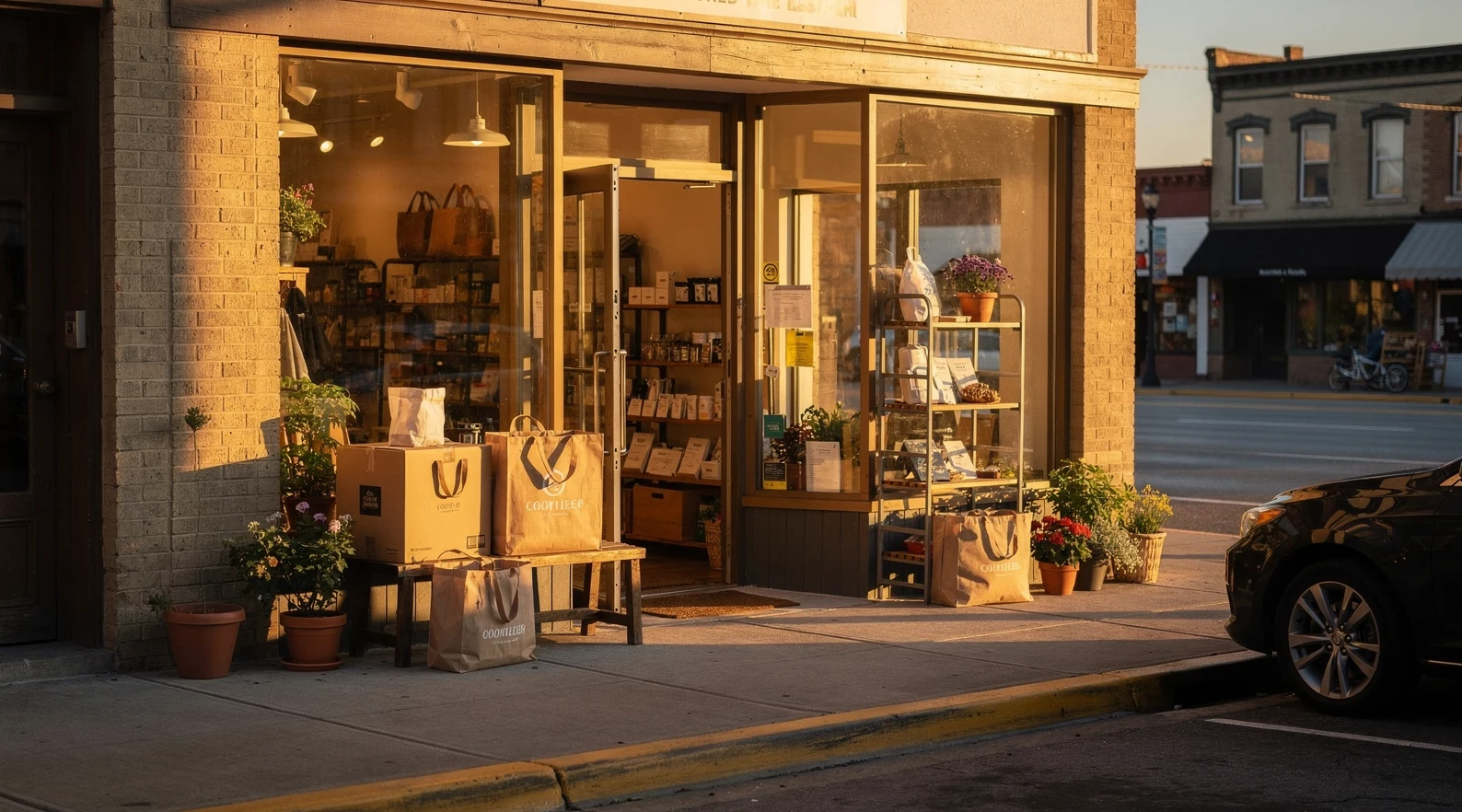
Local delivery and curbside pickup stopped being pandemic stopgaps and became permanent revenue lines for independent retailers. A 2026 single-location boutique that offers same-day local drop-off and a clean curbside lane is quietly capturing orders that used to leak to Amazon and big-box chains, and it is doing so without a warehouse, a fleet, or a venture round. The catch is that most independents bolt these services onto an existing point-of-sale system, lose money on every third order, and never measure whether the effort pays. This guide fixes that with concrete fulfillment math, staffing models, and the operational details that separate a profitable local program from an expensive favor to your customers.
The thesis is simple. Community commerce rewards merchants who treat a five-mile radius as a defensible market, and local delivery plus curbside is the cheapest way to lock in that radius before a competitor does. The rest of this piece walks through pricing, zone design, courier choices, and the failure modes that sink first attempts.
In short
- Charge a real delivery fee. Sub-$30 orders almost never absorb a courier cost, so set a free-delivery threshold (typically $35 to $50) and flat-fee everything below it.
- Curbside is the higher-margin channel. It carries near-zero variable cost, so push customers toward pickup with faster ready times and small incentives rather than discounting delivery.
- Design zones, not a blanket radius. A tight Zone A (under 2 miles) at one price and a Zone B (2 to 5 miles) at another protects margin and keeps promise times honest.
- Measure cost per delivered order weekly. If your blended fulfillment cost exceeds 12 to 15 percent of order value, the program is leaking and needs a fee or threshold change.
- Own the customer data. Third-party marketplaces take 15 to 30 percent and hide who bought; your own delivery and curbside flow keeps the relationship and the reorder.
Why local fulfillment pays for independents in 2026
The short answer: proximity is your only structural advantage over national e-commerce, and local delivery converts that proximity into orders a warehouse 800 miles away cannot fill before dinner. An independent retailer sitting inside a customer’s neighborhood can promise two-hour or same-day handoff at a cost a national 3PL would charge triple for, because there is no line-haul, no sortation center, and no last-mile broker taking a cut.
This is the practical core of the boring truths of main street retail: the rent you pay for a high-traffic storefront also buys you a fulfillment node that is already staffed and stocked. Curbside and local delivery simply monetize square footage you are paying for regardless. The merchants who win read their lease as a logistics asset, not just a display window.
There is also a defensive case. When a customer learns they can order from your shop at 1 p.m. and have it at their door by 5 p.m., the convenience gap that drove them to Amazon collapses. You are not competing on catalog breadth, you are competing on speed and locality, and on that axis a focused independent can beat a multibillion-dollar logistics network inside its own zip code.
The two services do different jobs
Curbside pickup removes friction for customers already willing to drive, and it costs you almost nothing beyond a few minutes of staff time. Local delivery removes the trip entirely and commands a fee, but it carries real variable cost. Treating them as one program is the first mistake; they need separate pricing, separate promise times, and separate metrics.
They also attract different customers, which matters for how you market each. Curbside skews toward time-pressed regulars who know exactly what they want and value a thirty-second handoff over browsing. Delivery skews toward customers trading money for convenience, often on larger or heavier baskets they would rather not haul. Reading those two intents lets you tune your messaging: promote curbside on speed and certainty, promote delivery on the value of getting your weekend back. The same order value can mean two very different shoppers, and the retailer who sees the difference prices and pitches each correctly.
The unit economics: what each order actually costs
Answer first: a typical local delivery costs an independent retailer between $6 and $14 in fully loaded variable cost, while curbside costs $1 to $3. If your average order value is $40 and your gross margin is 45 percent, you have roughly $18 of margin to work with, which means an $11 delivery cost consumes more than half your profit on that order. That is why pricing and thresholds are not optional.
The table below shows representative all-in costs for the three common fulfillment paths a small retailer runs. Numbers assume a US mid-size metro and a 40 dollar average order.
| Fulfillment method | Variable cost per order | Typical promise time | Margin impact at $40 AOV |
|---|---|---|---|
| Curbside pickup (staff bring out) | $1 to $3 | 15 to 60 minutes | Minimal, under 8 percent |
| Owner or staff delivery (own vehicle) | $6 to $10 | Same day, scheduled window | Moderate, 15 to 25 percent |
| On-demand courier (DoorDash Drive, Uber Direct) | $8 to $14 | 30 to 120 minutes | Heavy, 20 to 35 percent |
| Third-party marketplace fulfillment | 15 to 30 percent commission | Varies | Severe, can exceed 35 percent |
The lesson reads straight off the table. Curbside should be your default ask, owned delivery is the sweet spot for scheduled batches, and on-demand couriers are a premium service you charge for in full. Marketplace fulfillment is a customer-acquisition channel at best, never a margin channel, a point worth weighing alongside how Nextdoor and Facebook Marketplace compare for local sellers when you decide where demand should originate.
One number hidden in the table deserves emphasis: variable cost is not your only cost. Every delivery and pickup carries a labor tail that does not show up on a courier invoice. Someone picks the order, confirms stock, bags it, prints a label, stages it, and answers the inevitable “is it ready yet” text. On a busy Saturday that overhead can add three to five minutes of staff time per order, and at a $16 loaded labor rate that is another dollar or more you rarely count. Independents who price purely off the courier fee discover the leak only when their monthly labor hours creep up with no matching revenue. Fold a realistic pick-and-pack minute estimate into your fee math from day one.
The flip side is that this same labor is largely fixed if you batch well. A staffer who stages six orders in one twenty-minute window costs far less per order than one who handles each as it arrives. Batching is the single highest-leverage operational habit for a small fulfillment program, and it is why scheduled delivery windows beat always-on promises on margin every time.
Setting fees and thresholds that hold margin
Use a stepped structure rather than a single flat fee. Here is a tested sequence to build one.
- Set the free-delivery threshold first. Take your variable delivery cost ($10) and divide by your gross margin rate (0.45); you need roughly $22 of additional order value to break even, so a $35 to $50 threshold protects you while still feeling generous.
- Flat-fee everything below the threshold. A $5 to $7 fee recovers part of the cost and nudges basket size upward toward the free tier.
- Price curbside at zero. Its cost is trivial and a free, fast pickup option steers volume away from paid delivery.
- Add a rush surcharge for on-demand courier windows. If a customer wants it in under an hour, charge the full courier cost plus a small handling margin.
- Review the threshold quarterly. As courier rates and fuel move, your break-even point moves with them.
Zone design, courier choice, and promise times
Answer first: draw two concentric zones, staff curbside in-house, and outsource only the delivery legs you cannot batch profitably. A blanket five-mile free-delivery promise is the most common way independents bleed cash, because the order to a customer 4.8 miles away costs the same to fulfill as ten orders inside one mile but pays the same fee.
Zone A covers the dense ring closest to your store, usually under two miles, where owned delivery on a batched afternoon route is cheap and reliable. Zone B stretches to roughly five miles and should either carry a higher fee or route through an on-demand courier so you never send your own staff on a 25-minute round trip for a single $30 order. Beyond five miles, ship it or decline; the local advantage evaporates and you are subsidizing a delivery a national carrier does better.
Draw these zones with real geography, not a compass circle. A river, a highway with few crossings, or a one-way grid can turn a two-mile straight-line trip into a fifteen-minute drive, so let drive time, not map distance, define your boundaries. Many independents discover that their true Zone A is lopsided: tight on the side of town choked by traffic and generous in the direction where roads run clean. Plotting your last quarter of delivery addresses on a map usually reveals the natural cluster you should be optimizing around, and it often sits a few blocks off from where you assumed your customers lived.
Promise times are a margin lever, not just a service promise. A two-hour curbside window lets you fold pickups into existing staff flow; a 30-minute window forces you to keep someone on standby, which is expensive. Set the loosest promise customers will accept, then beat it. Under-promising and over-delivering on pickup readiness is the cheapest loyalty tool in retail, because a reliable handoff builds the kind of trust that turns a one-time buyer into a weekly regular.
Reliability is also where independents quietly out-execute the giants. A national carrier optimizes for average performance across millions of deliveries; a neighborhood shop can optimize for the specific block it serves, learning that the apartment complex on Third Street needs a buzzer code and that the cafe owner prefers a back-door drop before 9 a.m. Those micro-details cost nothing to record and compound into a service moat that no algorithm replicates. Build a simple notes field into your delivery records and treat each successful handoff as data you keep, not a transaction you forget.
Choosing a courier model
For owned delivery, batch orders into one or two daily routes and use simple route-sequencing so a single driver clears a zone efficiently. For on-demand needs, integrate a white-label courier API rather than listing on a consumer marketplace, so the customer experiences your brand and you keep the data. According to the US Small Business Administration’s guidance on managing finances, tracking variable cost per transaction is the foundation of any service-line decision, and delivery is exactly that kind of variable-cost line.
Map your local demand against where your customers already discover you, because the macro shifts described in the main street retail outlook for 2026 in mid-size US cities are pushing foot traffic toward hybrid in-store and at-home patterns. A retailer who reads that trend builds zones around where customers live, not just where the store sits.
Common mistakes that kill local delivery programs
Most failed programs share the same handful of errors. Each one is fixable, but only if you name it.
- Free delivery with no threshold. The single fastest way to turn a growth channel into a loss leader. Every sub-threshold order erodes margin and trains customers to expect free service forever.
- One promise time for everything. Offering 30-minute delivery and 30-minute curbside forces standby staffing that the order volume rarely justifies. Tier your windows.
- Leaning on consumer marketplaces for fulfillment. The 15 to 30 percent commission plus hidden customer data is a tax on your most loyal buyers; use marketplaces to acquire, then migrate repeat customers to your owned flow.
- No cost-per-order tracking. If you cannot state your blended fulfillment cost this week, you are flying blind. The number should live on a dashboard, not in your head.
- Treating curbside as an afterthought. Slow, disorganized pickup wipes out the convenience that made the customer choose you. A dedicated lane, clear signage, and a two-minute handoff are non-negotiable.
- Ignoring packaging cost and time. Bagging, labeling, and staging eat staff minutes; build that labor into your fee math or it silently erodes the margin you thought you protected.
Frequently asked questions
How much should I charge for local delivery?
Set a free-delivery threshold roughly equal to your variable delivery cost divided by your gross margin rate, which for most independents lands between $35 and $50. Below that threshold, charge a flat $5 to $7 fee to recover part of the cost and nudge customers toward larger baskets. For rush or on-demand courier windows, pass the full courier cost to the customer plus a small handling margin. Review these numbers quarterly because courier and fuel rates move, and a fee that protected margin last spring may not cover cost six months later.
Is curbside pickup worth it for a small shop?
Yes, and it is usually your most profitable fulfillment channel. Curbside carries near-zero variable cost, often $1 to $3 in staff time, while removing the parking and checkout friction that pushes customers to online giants. Offer it free, keep ready times short with a dedicated pickup lane and clear signage, and use small incentives to steer customers toward pickup instead of paid delivery. The data ownership is a bonus: every curbside order keeps the customer relationship inside your own system rather than a third party’s.
Should I use DoorDash or my own driver for delivery?
Use your own driver for batched, scheduled routes inside your dense Zone A, where owned delivery runs $6 to $10 per order and you control the experience. Use an on-demand courier such as DoorDash Drive or Uber Direct for one-off or rush orders you cannot batch, and charge the customer the full $8 to $14 cost. The decision is purely about batching: if you can group several orders into one route, owned delivery wins on cost; if you cannot, a white-label courier API keeps your brand front and center while outsourcing the leg.
What delivery radius makes sense for an independent retailer?
Design two zones rather than one blanket radius. Zone A under two miles supports cheap batched owned delivery; Zone B from two to five miles should carry a higher fee or route through an on-demand courier so a single small order does not consume a 25-minute round trip. Beyond five miles, ship the order or decline it, because your local proximity advantage disappears and a national carrier handles long hauls more cheaply. Tight zones keep promise times honest and protect the margin that makes the whole program viable.
How do I measure whether my local program is profitable?
Track blended fulfillment cost as a percentage of order value every week. Add up all variable costs (courier fees, driver labor, packaging, staging time) and divide by total delivered and picked-up order value. If that blended number exceeds 12 to 15 percent, the program is leaking and you need to raise a fee, lift the free-delivery threshold, or shift volume toward curbside. Put the figure on a dashboard so it is visible, not buried; a program you cannot measure is a program you cannot fix.
Can local delivery compete with Amazon same-day?
On breadth, no; on speed and locality within your own zip code, often yes. Amazon’s same-day depends on regional fulfillment centers and broad SKU coverage, but it cannot beat a neighborhood store that promises a two-hour handoff from a storefront the customer already trusts. The winning play is not matching catalog size, it is owning the convenience and relationship inside a five-mile radius where your proximity is a structural advantage Amazon’s logistics network cannot replicate cheaply. Compete where you are strong, not where you are outgunned.
What’s next
Start by pulling your last 90 days of orders and calculating a single number: blended fulfillment cost as a share of order value. That figure tells you whether to tighten thresholds, push curbside, or rethink zones before you spend on couriers, and it sits downstream of the fixed-cost realities laid out in the boring truths of main street retail, since your rent and labor base set the margin you have to defend. As local demand patterns keep shifting, treat your delivery and pickup program as a living system you tune monthly, and keep one eye on how broader coverage like how retail news shapes the global e-commerce industry today reshapes customer expectations around speed and convenience. The independents who measure, price, and zone deliberately are the ones who will still own their neighborhood in 2027.