
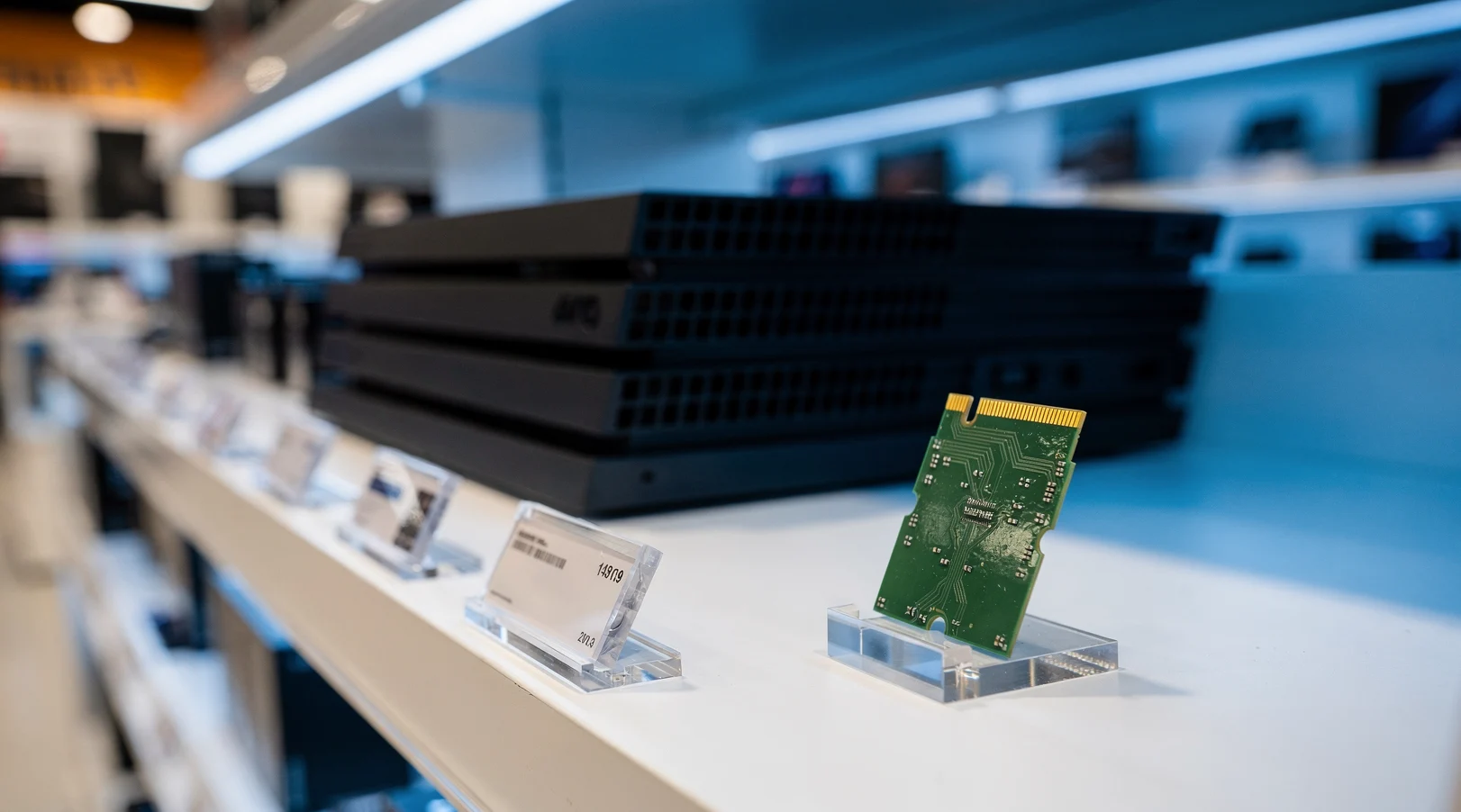
Microsoft confirmed a worldwide increase in Xbox console prices on June 25, 2026, becoming the most concrete consumer-facing sign yet that the artificial-intelligence memory crisis is reaching retail shelves. The company said prices will rise from August 1, with 512 GB models going up by USD 100 and 1 TB models by USD 150. The move landed on the same trading day that Apple chief executive Tim Cook’s warning of “unavoidable” price increases rippled through markets, sending shares of both companies lower even as a broad chip-sector rally lifted major indexes.
For retailers and e-commerce sellers, the news matters well beyond the gaming aisle. Consumer electronics is one of the largest online categories by value, and a synchronized round of price increases from the industry’s biggest brands is arriving just as the 2026 holiday season takes shape. The trigger is a shortage of memory chips that has been redirected toward AI data centers, leaving phones, laptops, tablets, and game consoles competing for what is left.
In short
- Xbox prices rise August 1: Microsoft will add USD 100 to 512 GB consoles and USD 150 to 1 TB consoles worldwide, and it is discontinuing the 2 TB model.
- Cause is the AI memory crisis: Microsoft says console storage and memory costs have climbed more than 2.5 times, with another doubling expected by fall 2027.
- Apple signals iPhone increases: Tim Cook called price increases “unavoidable” and likened the memory squeeze to a “hundred-year flood” he has not seen in 40 years.
- Markets split: Apple and Microsoft shares fell on June 25 (Apple about 6.35 percent, Microsoft about 3.78 percent) while broad indexes rose on strong memory-maker earnings.
- Holiday pressure builds: Industry forecasts point to consumer electronics price increases of 10 to 20 percent by year-end, pushing financing tools and early shopping into focus.
What did Microsoft and Apple announce on June 25?
Microsoft published an updated console price schedule through its official Xbox channel on June 25, 2026, confirming a global increase that takes effect on August 1. The 512 GB tier rises by USD 100 and the 1 TB tier by USD 150, while the 2 TB configuration is being retired. The company framed the change as a response to component costs rather than demand, noting that console storage and memory prices have risen by more than 2.5 times.
The announcement is detailed on the company’s official Xbox console price update page, which also outlines financing options for buyers. Microsoft pointed to interest-free installment plans through its own store and to third-party financing at major retailers. That pairing of a price increase with payment plans is itself a signal of how brands expect shoppers to absorb higher tickets.
Apple did not issue a formal price list on June 25, but the market reaction crystallized around Cook’s recent comments that increases across the company’s product range are now unavoidable. Together, the two announcements turned an abstract supply-chain story into a concrete consumer-price story in a single session. For a sector that had spent 2025 worrying about tariffs, the new pressure point is silicon, not customs duties.
Why the timing stood out
The Xbox increase takes effect on August 1, ahead of the traditional back-to-school window and the long build toward the winter holidays. That places the higher prices in market for the entire peak selling season rather than only the final weeks. Retailers that planned promotional calendars around stable hardware pricing now face a moving cost base.
The clustering of Microsoft’s confirmation and Apple’s warning on the same day amplified the message. Investors read it as evidence that the memory shortage has moved from supplier warnings to retail reality. The framing shifted from “if” prices rise to “by how much” and “how fast.”
How much will Xbox prices rise, and when?
The increases apply worldwide from August 1, 2026, and they scale with onboard storage. Based on pricing that was already in place after earlier rounds of increases, the changes reshape the lineup as shown below. Figures for the prior tier reflect recent list prices; the new prices add the confirmed increase, and exact regional pricing will vary.
| Model | Storage | Prior list price (USD) | Confirmed increase | Approx. new price (USD) |
|---|---|---|---|---|
| Xbox Series X | 1 TB | 649.99 | +150 | 799.99 |
| Xbox Series S | 1 TB | 599.99 | +150 | 749.99 |
| Xbox Series S | 512 GB | entry tier | +100 | entry tier plus 100 |
| Xbox Series X (special edition) | 2 TB | 799.99 | discontinued | withdrawn |
This is not the first increase of the current console generation. Industry coverage describes it as a third upward revision, reflecting how persistently component costs have climbed. The retirement of the 2 TB model removes the most memory-intensive configuration from the catalog, a practical way to limit exposure to the priciest chips.
Microsoft has been candid about the underlying economics. Xbox leadership has acknowledged that consoles are typically sold at or below cost, with the business model recovering margin through games, subscriptions, and accessories. When the bill of materials rises faster than software revenue, hardware losses widen, and price increases follow.
The margin math behind the decision
Reporting on the console business suggests Microsoft has been losing hundreds of dollars on each Series X and Series S unit sold as memory costs climbed. Xbox executives have described an “unsustainable hardware gap” that “cannot continue,” and have warned that the company expects to pay several times more for memory and storage by 2027 than it did two years earlier. Asha Sharma, who leads the Xbox business, has stated plainly that “memory costs will impact pricing” and “will impact availability.”
That candor reframes the price increase as defensive rather than opportunistic. The company is passing through a fraction of cost inflation it cannot absorb, while still subsidizing hardware to protect its installed base. For competing platform holders, the same arithmetic applies, which is why the market read the news as an industry signal rather than a single-company event.
Why is the AI memory crisis pushing consumer prices higher?
The root cause is a structural reallocation of the world’s memory production toward artificial intelligence. High-bandwidth memory, or HBM, used in AI accelerators commands far higher margins than the DRAM and NAND flash that power phones, laptops, and consoles. Faced with that gap, the three dominant memory makers, Samsung Electronics, SK Hynix, and Micron Technology, have steered cleanroom capacity and capital spending toward enterprise-grade parts.
The scale of the shift is striking. Analysts at IDC have noted that data centers are forecast to consume roughly 70 percent of all memory chips produced worldwide in 2026, up from about 20 to 30 percent as recently as 2022. When the bulk of new supply is committed to AI servers, consumer devices are left bidding for a shrinking remainder. Prices respond accordingly.
The price moves are steep and broad. Industry trackers report that average DRAM prices were expected to rise between 50 and 55 percent in a single quarter against the fourth quarter of 2025. The squeeze has reached older standards as well, with even legacy DDR2 memory reportedly seeing increases of around 60 percent as buyers scramble for any available supply.
What makes this cycle different from past memory gluts and shortages is its source. Previous swings were driven by the boom-and-bust rhythm of consumer demand, where oversupply eventually corrected prices downward. This time the demand is industrial and strategic, anchored by multi-year AI infrastructure commitments from hyperscalers that show no sign of easing. Suppliers have little incentive to add low-margin consumer capacity when every wafer can serve a higher-value buyer.
When could the shortage ease?
The honest answer is not soon. Microsoft itself expects memory and storage costs to keep climbing into 2027, and Apple’s leadership has framed the squeeze as the worst it has seen in four decades. New fabrication capacity takes years to build and qualify, so supply cannot respond quickly to the demand shock.
That timeline matters for planning. Retailers cannot treat the increases as a transient blip to be absorbed for a quarter or two; they are a multi-year cost reset. Pricing, financing, and assortment decisions made for the 2026 holidays will likely carry into 2027, which raises the stakes on getting the strategy right now.
Why consoles feel it first
Game consoles are unusually exposed because they are sold close to or below cost and carry generous storage. A price increase that a high-margin product could quietly absorb becomes unavoidable for hardware that already runs at a loss. That is why a console maker, rather than a phone or PC brand, delivered the first concrete consumer price increase tied explicitly to the memory crisis.
The same logic that hit consoles is now working through other categories on a lag. PC makers including Lenovo, Dell, HP, Acer, and ASUS have warned customers of tougher conditions, with reports of 15 to 20 percent increases and contract resets. The difference is timing, not direction.
What did Tim Cook say about iPhone prices?
Apple’s chief executive has been unusually direct about the pressure. Cook said that “price increases are unavoidable,” adding that the company had tried to shield customers but that “the situation has become unsustainable.” He attributed the squeeze specifically to the expansion of HBM production for AI servers crowding out consumer memory supply.
His framing emphasized the severity. Cook likened the shortage to a “hundred-year flood,” saying he had “never seen anything like it in any area in over 40 years.” For a company that rarely signals price moves in advance, the candor underscored how little room even the largest buyers have to negotiate.
Apple has not published specific new iPhone prices, and any changes would most plausibly surface around its usual fall product cycle. The market, however, did not wait for details. Investors treated Cook’s comments as confirmation that flagship smartphone pricing is set to rise into the holiday season, with knock-on effects for carriers, marketplaces, and trade-in programs.
How did markets react on June 25?
The session split along a clear line. Broad indexes rose, helped by strong results from memory maker Micron, which is a direct beneficiary of the very shortage squeezing device brands. The S&P 500 and the Nasdaq advanced, reflecting enthusiasm for AI-exposed suppliers.
The device makers told the opposite story. Apple shares fell about 6.35 percent and Microsoft about 3.78 percent as investors digested the prospect of higher prices feeding into softer unit demand. The divergence captured the core tension of the memory crisis: what is a windfall for chip suppliers is a cost shock for the brands that buy from them.
| Company | Role in memory chain | June 25 share move (approx.) | Read-through |
|---|---|---|---|
| Micron | Memory supplier | Higher (strong earnings) | Pricing power from AI demand |
| Apple | Device maker and buyer | Down about 6.35 percent | Cost pass-through risk to demand |
| Microsoft | Device maker and hyperscaler | Down about 3.78 percent | Console margin and demand risk |
The reaction also showed how quickly investors now price consumer demand risk. A price increase that protects margin can still hurt a stock if the market believes it will dent unit sales, particularly for discretionary hardware bought heavily during the holidays. That is the calculation behind the sharp moves in Apple and Microsoft shares despite the broadly positive session.
The contrast also highlights Microsoft’s dual position. As a hyperscaler, it is among the buyers of HBM driving the shortage; as a console maker, it is among the consumer brands paying the price. That tension sits at the center of why the company’s hardware economics have become so strained, a dynamic that mirrors the cost pressures seen when input prices squeezed apparel sellers and other retailers reporting tariff pressure on margins earlier in the year.
What does this mean for retailers and e-commerce this holiday season?
Electronics is a high-value, high-traffic online category, and a coordinated round of price increases reshapes the holiday playbook. Retailers that built promotional plans around stable hardware costs must now decide whether to protect margin or hold price to defend share. With the Xbox increase live from August 1, sellers face higher costs across the entire peak window rather than only at the end.
The most immediate effect may be a pull-forward of demand. Shoppers who learn of an August 1 increase have a clear incentive to buy before it lands, compressing some console sales into July. That pattern reinforces a broader shift toward earlier seasonal buying, a trend that is already producing the earliest US holiday season on record as retailers move events forward.
Margins are the second pressure point. Online electricals specialists run on thin margins and high volumes, so input-cost inflation lands quickly on the bottom line. The dynamics resemble those at an online electricals retailer that scaled up while managing cost discipline, where pricing power and supplier terms decide whether higher costs erode profit.
How sellers can respond
Merchants have several levers, none of them painless. They can pass through the full increase and lean on financing to soften the sticker, hold price selectively on hero products to defend traffic, or shift mix toward higher-margin accessories and services. Each choice trades margin against volume in a season where both matter.
Inventory timing becomes a competitive weapon. Sellers that secured stock at older cost bases can price aggressively in July before the increase, then reset in August. Those caught short will be buying into a rising market, a disadvantage that compounds through the holiday peak.
The marketplace and reseller dimension
Third-party marketplaces add another layer of complexity. When a brand raises its official price, independent sellers holding older inventory can either undercut the new price to win share or hold near the old level and pocket a wider margin. That creates short-lived arbitrage windows that price-comparison tools and shoppers will move quickly to exploit.
Platforms also face a signaling problem. A visible price increase on a flagship item can dampen category traffic even for unaffected products, so merchandising teams may rework search and recommendation surfaces to steer shoppers toward value bundles. The goal is to protect basket size when individual hero items become harder to sell at full price.
Will buy now, pay later cushion the price shock?
Microsoft paired its price increase with financing, promoting interest-free installments through its own store and pointing buyers to multi-month financing at major retailers. That is a deliberate demand-management tactic: when the headline price climbs, splitting it into installments protects conversion. Expect the same pattern across phones, laptops, and premium accessories as their increases arrive.
The move fits a structural trend. As average tickets rise, financing migrates from a niche option to a default checkout feature, a shift already visible as in-store buy now, pay later goes mainstream before the 2026 holidays. Higher electronics prices give that adoption another push, both online and at the point of sale.
There is a regulatory wrinkle. Buy now, pay later is under tighter scrutiny in several markets, which could shape how aggressively brands lean on installments during peak season. The interplay between rising prices and tighter credit rules is one of the season’s open questions for payments teams.
How exposed are other electronics categories?
The console increase is the leading edge of a category-wide move. Industry forecasts point to consumer device price increases of roughly 10 to 20 percent by the end of 2026, with the steepest pressure on the most memory-heavy products. The table below summarizes where the pressure is building and what is driving it, based on supplier guidance and analyst estimates.
| Category | Primary cost driver | Reported or expected increase | Holiday exposure |
|---|---|---|---|
| Game consoles | DRAM and NAND storage | USD 100 to 150 per unit (Xbox, from Aug 1) | High, sold near or below cost |
| Smartphones | HBM-driven DRAM squeeze | “Unavoidable” increases signaled | High, peak fall cycle |
| PCs and laptops | DDR5 and module pricing | 15 to 20 percent reported by makers | High, back-to-school and holiday |
| Tablets and handhelds | DRAM and NAND | 10 to 20 percent estimated | Medium to high |
The breadth matters for assortment planning. A retailer cannot easily steer shoppers away from the increase by switching categories, because the same memory squeeze touches nearly every connected device. That removes a familiar merchandising escape valve and pushes the conversation toward financing, trade-in, and timing.
The trade-in and refurbished angle
As new-device prices climb, the relative value of certified refurbished and trade-in programs improves. Marketplaces and brands that run robust pre-owned channels gain a lever to retain price-sensitive shoppers without discounting new stock. Expect more prominent placement of refurbished options through the holiday season.
Returns and reverse logistics also gain importance. A stronger secondary market depends on efficient intake, grading, and resale, so operational capability becomes a pricing strategy. The brands that convert returns into resale inventory fastest will hold the most flexibility on price.
What should shoppers and sellers watch next?
The near-term signals are concrete. Watch whether competing console and device makers match Microsoft’s increase, how Apple frames any fall pricing, and whether memory contract prices stabilize or push higher into 2027. Each data point tells sellers how durable the cost shock will be.
For shoppers, the calendar is the key variable. The August 1 console increase rewards buying earlier, and any fall smartphone changes will reward the same behavior. The broader lesson is that the memory crisis has shifted from a supplier story to a checkout story, and it is unlikely to ease before the holidays.
Vendors and platforms will also watch elasticity closely. If console and smartphone unit sales hold despite higher prices, brands will gain confidence to pass through more of the increase; if volumes soften, the burden shifts back to manufacturers and retailers through promotions and absorbed margin. The first clean read on that elasticity will come from July console sales ahead of the August 1 change.
There is a competitive wildcard as well. Any device maker that can secure memory at favorable terms, or that designs around lower memory requirements, gains a pricing edge precisely when rivals are forced to raise. Supply-chain skill, long treated as a back-office function, becomes a front-line marketing advantage in a constrained market.
For the wider retail sector, the episode is a reminder that input-cost shocks now arrive through silicon as readily as through tariffs or freight. Pricing power, financing options, and inventory timing will separate winners from losers in a season defined less by demand and more by cost. Grocers and other categories have shown how quickly price decisions squeeze margins when cost bases move, and electronics is now entering the same test.
Frequently asked questions
When do the new Xbox prices take effect?
Microsoft confirmed the increase takes effect worldwide on August 1, 2026. The 512 GB models rise by USD 100 and the 1 TB models by USD 150, while the 2 TB configuration is being discontinued.
Why are Xbox prices going up?
Microsoft attributes the increase to component costs, saying console storage and memory prices have risen by more than 2.5 times and could double again by fall 2027. The underlying cause is the AI-driven memory shortage that has redirected supply toward data-center chips.
Is Apple raising iPhone prices too?
Apple has not published new iPhone prices, but chief executive Tim Cook has said price increases are “unavoidable” because of soaring memory costs. Any specific changes would most plausibly appear around the company’s usual fall product cycle.
What is causing the memory shortage?
Demand for high-bandwidth memory used in AI servers has pushed the major manufacturers to shift capacity away from consumer DRAM and NAND. Analysts estimate data centers will consume roughly 70 percent of memory chips produced in 2026, up from 20 to 30 percent in 2022.
How much could other electronics prices rise?
Industry forecasts point to consumer device increases of roughly 10 to 20 percent by the end of 2026. PC makers have reported 15 to 20 percent increases, while DRAM contract prices were expected to climb 50 to 55 percent in a single quarter.
Why did Apple and Microsoft shares fall if memory makers gained?
Memory suppliers such as Micron benefit from higher prices, while device makers must absorb those costs or pass them to shoppers at the risk of softer demand. On June 25, Apple fell about 6.35 percent and Microsoft about 3.78 percent even as broad indexes rose.
How does this affect holiday shopping in 2026?
Higher electronics prices arrive ahead of the peak season, encouraging earlier purchases and wider use of installment financing. Retailers face squeezed margins and must decide whether to hold price to defend share or pass through the full increase.
Will buy now, pay later help shoppers manage the increases?
Brands are pairing price increases with installment plans to protect conversion, and Microsoft promoted interest-free financing alongside its Xbox change. Adoption is likely to grow as average tickets rise, though tighter credit rules in some markets may shape how it is offered.
Should buyers purchase before August 1?
For Xbox specifically, buying before August 1 avoids the confirmed increase of USD 100 to 150 depending on storage. More broadly, the memory crisis is expected to keep pressure on prices into 2027, so waiting is unlikely to bring relief in the near term.