
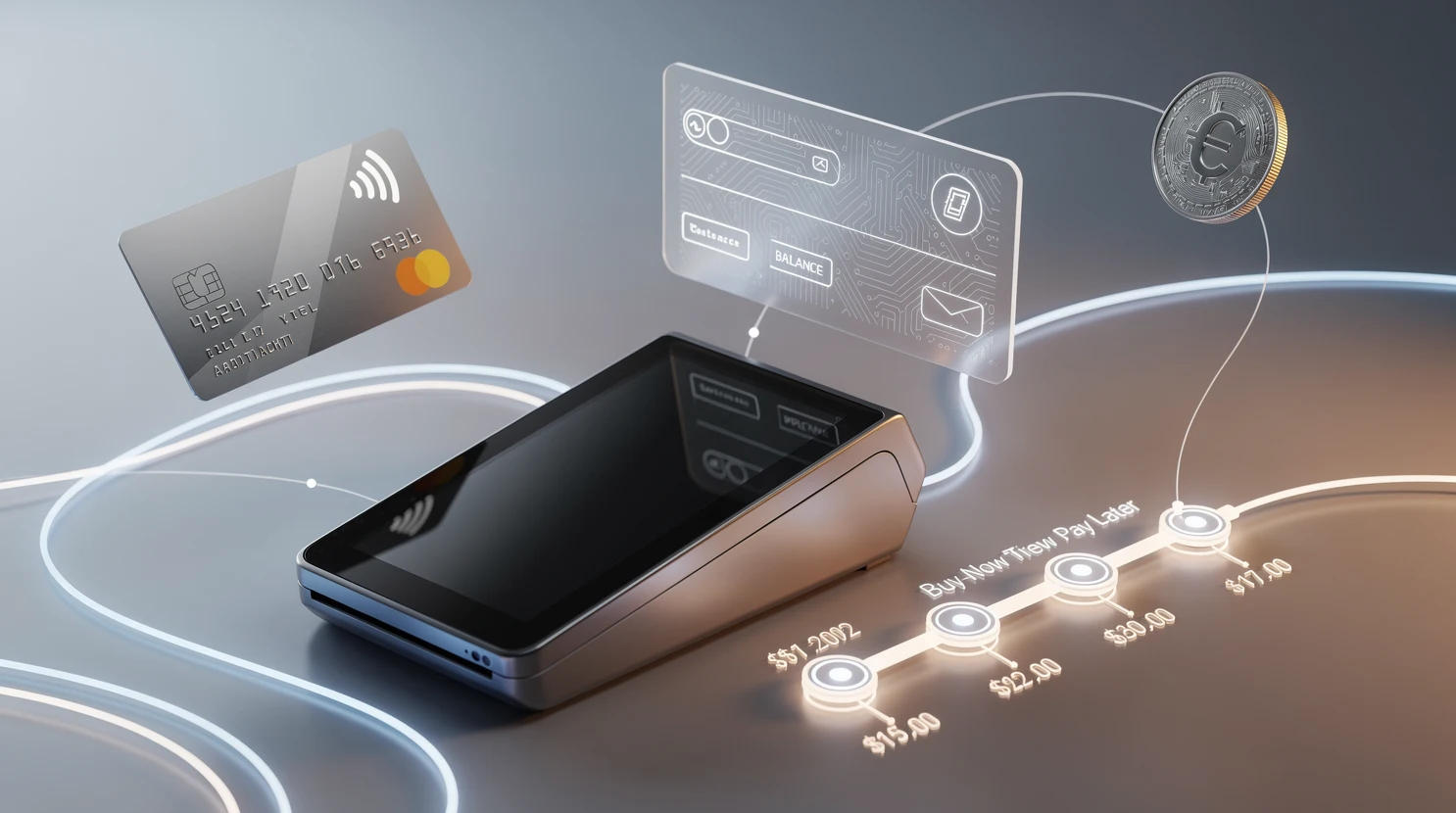
Retail payments in 2026 are no longer a back-office plumbing decision, they are a growth lever that sits at the center of the checkout experience. The last three years compressed a decade of change: cards absorbed contactless and tokenization, buy-now-pay-later (BNPL) moved from a fringe checkout button to a mainstream financing option, digital wallets became the default tap on billions of phones, and stablecoins started clearing real merchant volume across borders. For US and global retail operators, the question is no longer whether to accept a method, but how to orchestrate a stack of methods that maximizes conversion while holding down the cost of acceptance.
This guide is a hub for that whole territory. It walks through the modern payment rails (cards, BNPL, wallets, crypto and stablecoins, account-to-account, and in-store point of sale), how they interoperate at checkout, who the major players are, what the numbers look like directionally in 2024–2026, and the practical playbooks that separate a merchant losing 15 percent of carts at payment from one that clears the transaction cleanly. It closes with the regulatory pressure points every payments decision-maker should be tracking and a set of predictions for the year ahead. Wherever a topic deserves a deeper treatment, this article links out to a focused companion piece.
In short
- Method mix beats method choice: the merchants winning at retail payments are not picking cards or wallets or BNPL, they are orchestrating all of them and routing each transaction to the cheapest rail that still converts.
- Cost of acceptance is now a strategy: interchange, scheme fees, BNPL merchant discount rates, and stablecoin settlement costs vary by a factor of ten, so the acceptance mix directly moves gross margin.
- Wallets and tokenization won the front end: Apple Pay, Google Pay, and PayPal now sit in front of the card networks for a large share of e-commerce, improving both conversion and fraud rates because they carry device-level authentication.
- BNPL and stablecoins are maturing under regulation: the CFPB has pulled BNPL toward credit-card-style rules, and US stablecoin legislation is moving stablecoin acceptance from experiment to a governed payment method for cross-border retail.
- The playbook is measurable: reducing checkout friction, offering the right local methods, and matching the financing option to the basket size can lift conversion by a mid-single-digit to low-double-digit percentage, which usually dwarfs the fee savings from any single negotiation.
Introduction and the 2026 payments landscape
The payments landscape in 2026 is defined by fragmentation on the surface and consolidation underneath. A shopper sees a dozen ways to pay, but most of them ultimately settle over a small number of rails: the card networks, the ACH and real-time bank rails, the BNPL lenders, and a growing sliver of blockchain settlement. What changed is the layer sitting in front of those rails, where wallets, orchestration platforms, and processors now decide how a given transaction is authorized, routed, and priced.
For a retail operator, the practical consequence is that the checkout page has become the highest-leverage real estate in the business. A poorly ordered set of payment buttons, a missing local method, or a mandatory account creation step can quietly leak double-digit percentages of otherwise-ready buyers. The best operators treat the payment stack the way they treat the rest of the funnel: instrumented, tested, and optimized against conversion and cost at the same time.
Why the checkout stack is shifting now
Three forces are converging. First, mobile commerce crossed the point where the majority of e-commerce sessions happen on a phone, which makes one-tap wallet checkout the expected default rather than a nicety. Second, the cost of money rose and then plateaued, which made consumers more deliberate about financing and pushed BNPL from impulse convenience toward a considered credit decision. Third, regulation caught up: rules that used to lag the market by years are now landing while the products are still growing.
The fourth, quieter force is settlement. Stablecoins have made it technically possible to move value across borders in seconds at a fraction of the cost of correspondent banking, and enough regulatory clarity arrived to let serious merchants pilot it. None of these forces individually rewrites retail payments, but together they mean the acceptance decisions a merchant made in 2022 are almost certainly leaving money on the table in 2026.
There is a fifth structural change worth naming: the rise of the platform as the payments gatekeeper. A growing share of merchants no longer choose a processor directly, they inherit one through the commerce platform they build on, whether that is Shopify, a marketplace, or an all-in-one POS provider. This is convenient, but it means the payments decision is increasingly made upstream, at the platform level, and merchants who never revisit it accept whatever default mix and pricing the platform ships with. The operators who win treat even a platform-provided payments stack as something to instrument and negotiate rather than accept as fixed.
What counts as retail payments? Defining the territory
Retail payments is an umbrella that covers every way a buyer transfers value to a merchant, in store or online, plus the infrastructure that authorizes and settles that transfer. It is useful to break the territory into six families, because each has a different cost structure, conversion profile, and regulatory posture. Understanding the boundaries prevents the common mistake of treating a wallet like a network or a stablecoin like a card.
Cards and the network rails
Card payments still anchor the mix for most Western retailers. A card transaction runs across a network (Visa, Mastercard, American Express, or Discover), which sets the rules and routes authorization and clearing between the shopper’s issuing bank and the merchant’s acquiring bank. The merchant pays interchange (which flows to the issuer), a scheme fee (which flows to the network), and an acquirer markup. If you want the full mechanical walkthrough of who touches a card transaction and why, the companion explainer on how card networks work behind every retail checkout is the place to start.
Within the card family, the debit-versus-credit split matters more than most merchants realize. Debit interchange in the US is capped for large issuers under the Durbin Amendment, so a debit-heavy customer base carries a structurally lower cost of acceptance than a credit-heavy, rewards-chasing one. Premium and commercial cards sit at the opposite end, carrying the richest interchange because their rewards are funded out of the fees merchants pay. A merchant that never looks at its interchange mix by card type is effectively subsidizing airline miles and cashback it never sees.
BNPL and point-of-sale financing
BNPL splits a purchase into installments, most commonly four interest-free payments over six weeks (the “pay-in-four” model) or a longer monthly plan that may carry interest. The provider (Klarna, Affirm, Afterpay, PayPal, and others) pays the merchant in full up front, minus a merchant discount rate that is typically higher than card interchange, and takes on the credit and collection risk. BNPL is not a rail so much as a lending product layered on top of card and bank rails, which is exactly why it draws credit-style regulation.
The economics for the merchant are counterintuitive: you pay a higher fee, but the provider absorbs the credit risk, funds the receivable, and often returns a measurable lift in conversion and basket size. For a considered purchase, the ability to split a 300-dollar order into four 75-dollar payments changes the shopper’s affordability calculus at the exact moment of decision. The strategic question is not whether BNPL costs more than a card (it does), but whether the incremental margin dollars from higher conversion and average order value exceed the incremental fee, which they frequently do in the right categories. The full strategic treatment lives in the BNPL playbook for retail in 2026.
Digital wallets
Digital wallets (Apple Pay, Google Pay, PayPal, Shop Pay, and regional wallets) are a presentation and authentication layer, not a settlement rail. When a shopper pays with Apple Pay, a tokenized card underneath still runs over Visa or Mastercard in most cases. The wallet’s value is the tap-and-authenticate experience and the device-level biometric that reduces fraud, which is why wallets both lift conversion and lower chargebacks. Our deeper piece on Apple Pay, Google Pay and PayPal at checkout unpacks how to order and configure them.
Crypto and stablecoins
Crypto payments split into two very different things. Volatile assets like Bitcoin are rarely used as a direct medium of exchange for retail because the price moves too much between click and settlement, so most “crypto acceptance” actually converts instantly to fiat at the gateway. Stablecoins (USDC, USDT, and others pegged to the dollar) are the more consequential development, because a dollar-pegged token can settle merchant-to-merchant or cross-border in seconds without the volatility problem. The distinction matters enough that it gets its own treatment below, and the piece on crypto payments in retail, adoption versus hype separates the genuine use cases from the marketing.
The mechanics of stablecoin settlement are what make it interesting to operators. A dollar-pegged token moves on a blockchain in seconds, at a network cost typically measured in cents rather than the percentage points of card acceptance, and it settles with finality that does not depend on a multi-day banking cycle. The catch is at the edges: converting fiat to stablecoin and back, complying with know-your-customer rules, handling the tax treatment of any crypto touchpoint, and managing refunds in an asset that is not a card. Those edges are exactly where regulated issuers and specialist processors add value, which is why the winning pattern is a governed token plus a compliant on-ramp rather than raw crypto. For the cross-border settlement use case specifically, the guide to stablecoin settlement for cross-border retail is the practical reference.
Account-to-account and real-time rails
Account-to-account (A2A) payments move money directly from the buyer’s bank account to the merchant’s, bypassing the card networks. In Europe this runs on open banking and SEPA instant, in the US increasingly on the FedNow and RTP real-time rails and on pay-by-bank products. A2A is attractive because it can be dramatically cheaper than card acceptance, but it historically lacked the consumer protections and the frictionless experience that cards offer, which is the gap open-banking providers are now closing.
The reason A2A matters strategically is that it is the one method that structurally threatens card economics rather than riding on top of them. A card transaction always pays interchange to an issuer; an A2A transaction does not, so the savings are not a negotiation, they are architectural. The reason A2A has not already won is experience and protection: shoppers trust the chargeback safety net of a card, and typing bank credentials feels riskier than a saved card on file. Open banking closes the experience gap by letting the shopper authorize directly in their banking app, and the merchants most likely to push A2A are those with high-value or recurring payments where the fee savings are large enough to fund incentives that nudge shoppers toward it.
In-store POS and unified commerce
The point-of-sale (POS) system is where the physical and digital worlds meet. Modern POS platforms (Square, Shopify POS, Clover, Toast, and others) are no longer just card terminals, they are the inventory, customer, and payments hub that ideally shares a ledger with the e-commerce site. The strategic prize is unified commerce, where a shopper can buy online and return in store against a single record. The companion guide to modern POS systems for retail covers the landscape in detail.
How the rails interoperate at checkout
The single most important mental model for a payments decision-maker is that these methods are not competing silos, they are stacked layers that call each other. A single Apple Pay transaction can touch four of the six families at once: the wallet authenticates, a tokenized card authorizes over a network, a processor routes it, and the merchant settles into a bank account. Understanding the stack is what lets a merchant reason about cost and failure points instead of treating each button as a black box.
This layered view also explains why the “which method is best” question is usually the wrong one. A shopper does not choose a rail, they choose an experience (a tap, a saved card, an installment plan), and the merchant’s job is to make the highest-converting experience also land on an efficient rail underneath. The interoperation happens because the industry standardized the interfaces between layers: a wallet can present any tokenized card, a processor can route to any acquirer, and an orchestration layer can decide all of it in milliseconds. That standardization is precisely what lets a merchant improve one layer without ripping out the others.
The layers of a modern transaction
From top to bottom, a typical online transaction moves through a presentation layer (the wallet or hosted checkout the shopper sees), an authentication layer (biometrics, 3-D Secure, or the BNPL credit check), an authorization layer (the network or lender that approves the transaction), a routing layer (the processor or orchestration platform that decides where to send it), and a settlement layer (where funds actually land). A well-built stack lets a merchant swap components at each layer without rebuilding the others.
Why orchestration is the 2026 buzzword
Payment orchestration platforms sit at the routing layer and make real-time decisions: which acquirer to send a card to for the best approval rate, whether to retry a declined transaction over a different route, and which local method to surface based on the shopper’s country. The economic logic is straightforward, because a one-percentage-point improvement in authorization rate on a high-volume merchant is worth more than most fee negotiations. Orchestration is how large merchants extract that percentage point without being locked into a single processor.
Orchestration also changes the negotiating dynamic. When a merchant can route volume across multiple acquirers, no single processor holds all the leverage, and the merchant can direct traffic to whoever delivers the best approval rate and price at any moment. This is why orchestration is spreading from the largest enterprises toward the mid-market: the tooling that used to require a dedicated payments engineering team is increasingly packaged, and the approval-rate gains it unlocks are the same regardless of merchant size. The tradeoff is added complexity, so the smallest merchants are usually better served by a single strong processor until volume justifies the routing layer.
Tokenization as the connective tissue
Tokenization is the quiet technology that makes the whole stack interoperate safely. Instead of storing a raw card number, the merchant stores a token that is useless if stolen and can be routed across networks and wallets. Network tokens (provided by Visa and Mastercard) also improve approval rates and keep credentials fresh when a shopper’s card expires, which reduces involuntary churn on subscriptions. Tokenization is therefore both a security control and a conversion tool, which is unusual and worth exploiting.
Where transactions actually fail
Understanding the stack matters most when things break, because a declined transaction is a lost sale that the shopper often blames on the merchant. Declines fall into two buckets: hard declines (a genuinely invalid card, insufficient funds, or a closed account) that no retry will fix, and soft declines (issuer risk logic, a temporary hold, or a data mismatch) that a smarter retry or a different route frequently clears. A merchant that treats every decline as final leaves recoverable revenue on the table, and a merchant that blindly retries hard declines wastes processing and irritates issuers.
The practical discipline is to instrument decline codes, categorize them, and build retry logic that respects the difference. Network tokens reduce a large class of soft declines by keeping the credential current, 3-D Secure shifts liability and clears risk-flagged transactions, and account updater services quietly refresh cards behind subscriptions. On high-volume merchants, moving the approval rate from 88 to 91 percent is often worth more than any fee saving discussed elsewhere in this guide, which is why authorization optimization is the single most underrated lever in retail payments.
Market sizing and growth signals
Precise global figures for retail payments vary by source and definition, so treat everything in this section as directional estimates rather than audited numbers. What matters for planning is the relative size and the direction of travel, not a single headline figure. The consistent signal across the major payments research houses and the public disclosures of the big processors is that card volume keeps growing in absolute terms while its share of new checkout starts erodes to wallets and alternative methods.
Directionally, global card payment volume is measured in the tens of trillions of dollars annually, and it is still growing at a mid-to-high single-digit percentage rate. Digital wallets have become the leading e-commerce payment method by transaction share in many markets, with estimates commonly putting wallets at roughly half of global e-commerce value and rising. BNPL is a much smaller slice of total volume, in the low-to-mid single digits of e-commerce value, but it grew far faster off a small base and concentrates in specific categories like fashion, electronics, and home goods.
Stablecoins are the wild card in the sizing exercise. Annual stablecoin transfer volume is now measured in the trillions of dollars, but the overwhelming majority is trading, treasury, and crypto-native activity rather than retail purchases. The genuinely retail-relevant slice is still small, though cross-border B2B and remittance-adjacent flows are where merchant adoption is real today. For the broader e-commerce context these payment methods sit inside, the guide to selling on global e-commerce marketplaces maps the demand side.
Reading growth signals without getting fooled
Two traps recur in payments market analysis. The first is confusing transaction count with value, because wallets and BNPL skew toward smaller-ticket transactions, so their share of count overstates their share of dollars. The second is confusing gross transfer volume with retail spend, which is the mistake that makes stablecoin numbers look larger than the retail reality. A disciplined operator sizes each method by the value it actually settles in their own category and geography, not by global headlines.
The signals worth tracking
A handful of leading indicators tell a payments team where the puck is going. Wallet penetration by device on your own checkout is the clearest, because it shows how many shoppers arrive already able to pay in one tap. Approval-rate trends by issuer and by method reveal where friction is quietly growing. And the mix shift between debit and credit, or between guest and returning checkout, tells you whether your cost of acceptance is drifting up or down independent of any fee change. For context on where these numbers get reported publicly, aggregators like Statista and the disclosures of the listed networks and processors are the least biased starting points.
The macro backdrop also matters. Interest rates shape BNPL economics because the lender funds the receivable, so a higher-rate environment compresses provider margins and tends to firm up merchant discount rates. Consumer confidence shapes basket size and the appetite for financing. And regulatory milestones, from BNPL rules to stablecoin legislation, can change a method’s trajectory faster than any market trend, which is why the regulation section of this guide is not an afterthought but part of the sizing exercise.
| Method family | Directional 2026 share of e-commerce value | Growth trajectory | Where it concentrates |
|---|---|---|---|
| Digital wallets | Roughly 45–55 percent and rising | Fast, becoming the default | Mobile-first markets, all categories |
| Cards (direct entry) | Roughly 20–30 percent and shrinking as share | Growing in absolute dollars | Desktop, high-ticket, subscriptions |
| Account-to-account / bank | Roughly 5–15 percent, region dependent | Fast in Europe, early in US | Europe, high-value, bill pay |
| BNPL | Roughly 3–6 percent | Fast off a small base, maturing | Fashion, electronics, home |
| Crypto / stablecoins | Under 1 percent of retail value | Early, real in cross-border B2B | Cross-border, remittance-adjacent |
Major players and competitive dynamics
The retail payments map has four rough tiers: the networks that set the rules, the acquirers and processors that connect merchants, the consumer-facing wallets and lenders, and the newer settlement layers. The same company sometimes shows up in multiple tiers, which is exactly how the incumbents defend their position. Knowing who does what prevents the mistake of negotiating with the wrong party over the wrong line item.
It also clarifies where value is captured. The networks earn scheme fees on volume they do not lend against; the issuers earn interchange funded by merchants; the processors earn markup on top of interchange; and the wallets and lenders earn by owning the shopper relationship. When a merchant wants to reduce cost, the target depends on the line item: interchange is set by the network and issuer, the markup is negotiable with the processor, and the method mix (which shifts how much volume runs through the expensive lanes) is the merchant’s own lever. Confusing these is how merchants end up negotiating hard on the smallest number.
The card networks
Visa and Mastercard are the two dominant global networks, operating a four-party model where they set interchange and rules but do not lend to consumers directly. American Express and Discover run closer to a three-party model, where they can be the network and the issuer, which lets Amex court premium spenders with rewards but usually at a higher merchant cost. For a side-by-side on acceptance economics and where each fits, the comparison of Visa, Mastercard, Amex and Discover for merchants lays out the tradeoffs.
The strategic point for merchants is that acceptance is not all-or-nothing. Historically some merchants declined Amex over cost, but Amex has narrowed the gap and its cardholders skew toward higher spend, so refusing it can cost more in lost sales than it saves in fees. Discover has a smaller footprint but competitive economics, and its network also carries Diners Club and several partner networks. The right posture is to accept broadly, then use routing and card-type analysis to manage cost, rather than to refuse a whole network and lose the customers who carry it.
| Network | Model | Relative merchant cost | Global reach | Merchant note |
|---|---|---|---|---|
| Visa | Four-party (network only) | Baseline | Widest | Default acceptance everywhere |
| Mastercard | Four-party (network only) | Similar to Visa | Very wide | Comparable economics to Visa |
| American Express | Three-party (network and issuer) | Historically higher, gap narrowing | Strong in US and travel | High-spend cardholders, worth accepting |
| Discover | Three-party plus partner networks | Competitive | Smaller, growing via partners | Low-cost acceptance, US-centric |
The BNPL lenders
Klarna, Affirm, and Afterpay (owned by Block) are the pure-play BNPL leaders, each with a slightly different center of gravity: Klarna is the broadest and most app-driven, Affirm leans into longer-term and higher-ticket financing with transparent interest, and Afterpay is tightly integrated with Block’s merchant and Cash App ecosystem. PayPal folded BNPL into its wallet, which gives it enormous distribution without a standalone brand. The head-to-head on Klarna, Afterpay and Affirm compared gets into the merchant fees and consumer terms.
The wallets and super-apps
Apple Pay and Google Pay dominate device-based wallets in Western markets, riding the near-universal installed base of iPhones and Android phones. PayPal (with Venmo) remains the largest standalone wallet by user count and is uniquely accepted across a huge merchant base. Shopify’s Shop Pay has quietly become one of the highest-converting accelerated checkouts by memorizing shopper details across its merchant network, which is a reminder that distribution, not technology, usually decides wallet winners.
What the wallets share is that they compress the checkout from a form into a tap and carry a trust signal the merchant cannot manufacture on its own. A biometric confirmation on a device the shopper already trusts reduces both abandonment and fraud, which is why wallets frequently show a conversion lift and a lower chargeback rate at the same time. The strategic implication is that wallet ordering and prominence is a first-class conversion decision, not a checkbox: an Apple Pay user who has to scroll past a card form to find the button is a partial defeat.
The processors and platforms
Stripe and Adyen are the two enterprise-grade processors that also act as orchestration and platform layers, letting a merchant accept nearly any method through one integration. Square (Block) and Clover (Fiserv) dominate the small-and-mid-business POS-plus-payments bundle, while Shopify Payments (built on Stripe) captures the D2C long tail. Coinbase Commerce, Circle (issuer of USDC), and Tether (issuer of USDT) anchor the crypto settlement layer, with Circle in particular positioning USDC as a regulated dollar rail for merchants.
How the dynamics actually play out
The defining competitive move of the era is bundling. Block is the clearest example: it owns Square (merchant POS and payments), Cash App (a consumer wallet), and Afterpay (BNPL), which lets it capture a shopper on both sides of a transaction. PayPal plays the same game with Venmo and its BNPL product, and Shopify plays it by owning the merchant relationship and steering volume into Shop Pay and Shopify Payments. The lesson for a merchant is that the platform you choose is rarely neutral about which methods it nudges you toward.
The processors, meanwhile, compete on breadth and approval rate rather than headline price. Stripe wins developers and the D2C long tail with tooling and a clean API; Adyen wins large enterprises and omnichannel retailers with a single global platform and strong in-store hardware. Both increasingly monetize orchestration, network tokens, and value-added services rather than pure processing, which tells you where the margin is moving. A merchant negotiating today should price the whole bundle (approval rate, tokens, fraud tools, reporting), not just the per-transaction rate.
| Provider | Signature model | Typical merchant discount rate | Center of gravity | Ecosystem hook |
|---|---|---|---|---|
| Klarna | Pay-in-four plus longer financing, app-led | Roughly 3–6 percent plus fixed fee | Broad retail, fashion, app shopping | Shopping app and rewards |
| Affirm | Transparent-interest, longer-term, higher ticket | Varies widely by term and risk | Electronics, travel, big-ticket | Direct merchant integrations |
| Afterpay (Block) | Pay-in-four, no interest to shopper | Roughly 4–6 percent plus fixed fee | Fashion, beauty, younger shoppers | Square and Cash App integration |
| PayPal (Pay Later) | Pay-in-four and monthly, inside the wallet | Bundled into PayPal acceptance | Enormous existing merchant base | PayPal and Venmo distribution |
Practical playbooks for retailers and brands
Everything above is context for the part that actually moves the business: what to do at the checkout. The core insight is that payments optimization is a conversion project first and a cost project second, because for most retailers the revenue recovered from fewer abandoned carts exceeds the fees saved from any single negotiation. The right sequence is to fix conversion leaks, then optimize the method mix, then attack the cost of acceptance.
Optimize the checkout for conversion
The highest-return moves are unglamorous. Offer guest checkout, because forcing account creation is one of the largest single causes of abandonment. Surface the wallet buttons the shopper’s device supports at the top of the page, so an Apple Pay user never sees a card form. Preserve the cart on failed authorization and retry intelligently instead of dumping the shopper back to an empty page. Each of these is a small change with an outsized effect on completion rate.
Get the method mix right for the market
Method mix is geography and category specific. A US fashion D2C brand needs Apple Pay, Google Pay, PayPal, a BNPL option, and cards; the same brand selling into Germany needs pay-by-bank and local methods it can ignore at home. Offering BNPL on the right categories can lift both conversion and average order value, which is the mechanism explored in the piece on how BNPL affects retail conversion rate. The failure mode is offering too many buttons, which creates choice paralysis, so curate rather than pile on.
Manage the cost of acceptance deliberately
Cost of acceptance is where discipline pays off once conversion is handled. Understand your effective rate per method, not the headline rate, because a “2.9 percent” processor rate hides a wide spread once interchange and premium cards are blended in. Interchange is the largest and least visible component (see the neutral background on the Wikipedia entry for interchange fees), and the explainer on interchange fees explained shows where it can be optimized through routing and card-type steering. For high-volume merchants, network tokens, least-cost routing, and A2A or stablecoin rails for specific flows can each shave real basis points.
Pricing models are the other lever, and they are more consequential than most merchants assume. A blended or “flat-rate” model (a single percentage on everything) is simple but hides the fact that you pay the same on a cheap debit card as on a premium rewards card, which overcharges you on low-cost transactions. Interchange-plus pricing exposes the true interchange, scheme fee, and processor markup separately, which is almost always cheaper at scale and, just as importantly, lets you see where the cost actually sits. Moving from flat-rate to interchange-plus is frequently the single largest cost-of-acceptance win a growing merchant can make.
Surcharging, steering, and the fine print
Beyond pricing, merchants have limited but real tools to shape cost at the register. Surcharging (adding a fee for credit card use) and cash discounting are permitted in many US states within network rules, and can push cost-sensitive shoppers toward cheaper methods. Steering (nudging shoppers toward debit, A2A, or a preferred wallet) is subtler and less risky to the customer relationship. Both are governed by network rules that change with each settlement cycle, so the tactic that is compliant today may not be tomorrow, which is why this belongs on the regulatory-watch list as much as the playbook.
A worked example of the tradeoff
Consider a merchant doing 100 million dollars in annual online sales at a blended 2.5 percent cost of acceptance, which is 2.5 million dollars in fees. Shaving the effective rate by 20 basis points saves 200,000 dollars, a genuine win. But lifting checkout conversion by two percentage points on that same base can add several million dollars in gross sales, which is why the sequencing (conversion first, cost second) is not arbitrary. The discipline is to pursue both, in that order, and to measure each independently.
| Method | Typical cost of acceptance | Conversion effect | Settlement speed | Best fit |
|---|---|---|---|---|
| Credit / debit cards | Roughly 1.5–3.5 percent blended | Neutral baseline | 1–2 business days | Universal default |
| Digital wallets | Similar to underlying card, sometimes less | Positive (fewer form fields, biometric trust) | Same as underlying card | Mobile, one-tap checkout |
| BNPL | Roughly 3–8 percent merchant discount rate | Positive on right categories, lifts AOV | Merchant paid up front, next-day-ish | Considered, higher-ticket purchases |
| Stablecoins | Well under 1 percent on-chain, plus conversion | Neutral to positive in cross-border | Seconds to minutes | Cross-border, B2B, remittance-adjacent |
| Account-to-account | Often well under 1 percent | Neutral to slightly negative on friction | Instant to same-day on real-time rails | High-value, bill pay, Europe |
Point of sale is part of the same playbook
For omnichannel retailers, the in-store POS decision is a payments decision. Choosing between Square, Shopify POS, and Clover shapes not just card acceptance but inventory, customer data, and how cleanly the store shares a ledger with the website. The comparison of Square vs Shopify POS vs Clover covers the tradeoffs, and the piece on integrating POS with the e-commerce stack covers the unified-commerce plumbing that makes buy-online-return-in-store actually work.
The unified-commerce payoff is concrete: a single customer and inventory record across channels lets you offer buy-online-pickup-in-store, ship-from-store, and cross-channel returns without reconciliation headaches. It also gives you one view of a customer’s lifetime value regardless of where they buy, which sharpens marketing and loyalty. The common failure is bolting a separate POS onto a separate e-commerce platform and then spending engineering effort keeping two ledgers in sync, which is exactly the tax that a unified stack (or a well-integrated pair) avoids.
Risks, regulation, and what to watch
Payments is one of the most heavily regulated corners of retail, and the rules are tightening across every method family at once. A payments decision-maker who ignores the regulatory calendar risks building on a method whose economics or compliance burden change underneath them. The five areas below are where the pressure is greatest in 2026.
The interchange debate
Interchange is a perennial battleground because it is the largest merchant cost and it flows to issuers rather than the visible network. In the US, the long-running fight over swipe fees continues through legislation and litigation, with periodic settlements that adjust rates and rules at the margin. Merchants should not build a business case on interchange falling, but they should track the rule changes, because each settlement tends to shift what steering and surcharging is permitted.
BNPL under the CFPB
BNPL spent its early years in a regulatory gray zone, and that era is ending. The Consumer Financial Protection Bureau has moved to treat certain BNPL products more like credit cards, extending dispute rights, refund handling, and disclosure requirements to installment plans. This raises the compliance bar for lenders and, indirectly, for the merchants that surface them. The detail and the direction of travel are covered in the piece on regulatory pressure on BNPL.
PCI DSS 4.0 and card security
The Payment Card Industry Data Security Standard reached version 4.0, and its requirements are now in force after a phased ramp. The headline changes tighten authentication, expand requirements around client-side scripts (a direct response to digital-skimming attacks on checkout pages), and push toward continuous rather than annual compliance. Any merchant that touches card data, even through a hosted field, needs to confirm its stack and its service providers meet the new standard.
Chargebacks and fraud
Chargebacks remain the operational tax on card acceptance, and friendly fraud (where a legitimate buyer disputes a real purchase) has grown alongside e-commerce. The networks periodically revise their dispute rules and evidence requirements, and staying current is the difference between winning and losing representments. The mechanics of how the networks adjudicate disputes are laid out in the guide to how card networks handle chargebacks, and the broader set of 2026 card network rule changes covers the current cycle.
Fraud and disputes are two sides of the same coin, and the tooling to manage them has matured. On the prevention side, 3-D Secure (in its frictionless, risk-based version) shifts liability to the issuer and clears risk-flagged transactions without adding friction to good customers, while device signals, velocity checks, and machine-learning scoring catch the rest. On the dispute side, network programs now let merchants share transaction and delivery evidence earlier in the flow, sometimes deflecting a dispute before it becomes a chargeback. The merchant that instruments both, prevention and representment, keeps its dispute ratio below the thresholds that trigger network monitoring programs and the punitive fees that come with them.
The regulatory calendar as a planning tool
The cadence of these changes is predictable enough to plan around. Card network rules update on a roughly semi-annual cycle, PCI DSS moves in multi-year versions with phased enforcement, BNPL and stablecoin rules are landing now as first-generation frameworks, and interchange shifts arrive through settlements and legislation on their own timeline. Treating this as a calendar rather than a series of surprises lets a payments team schedule its compliance and its opportunism, upgrading security ahead of a deadline and adjusting steering or surcharging the moment a rule permits it.
| Regulatory or rule track | Typical cadence | Direction of travel | Planning horizon |
|---|---|---|---|
| Card network rules | Roughly semi-annual updates | Tighter dispute and data rules, evolving steering | Review each cycle |
| PCI DSS | Multi-year versions, phased enforcement | Continuous compliance, client-side controls | Plan 12–24 months ahead |
| BNPL regulation | First-generation rules landing now | Credit-card-style protections extending | Confirm with provider each renewal |
| Stablecoin legislation | Framework forming | Licensed issuers, reserve mandates | Track before scaling acceptance |
| Interchange | Settlements and legislation, irregular | Pressure down, rules on steering shift | Do not budget on cuts; react to changes |
Crypto tax, refunds, and stablecoin regulation
Crypto acceptance carries tax and refund complications that fiat does not, because a crypto payment can be a taxable disposal event and refunds in a volatile asset are legally and operationally messy. Stablecoins reduce the volatility problem but introduce their own questions about reserves, redemption, and who is a permitted issuer. US stablecoin legislation has been moving toward a framework that licenses issuers and mandates full reserve backing, which is what turns stablecoins from a gray-area experiment into a governed payment method. The practical handling is covered in the piece on crypto chargebacks, refunds and tax, and useful neutral background lives on the Wikipedia entry for stablecoins. For consumer-protection rulemaking generally, the CFPB is the primary US source to track.
| Area | What is changing | Who is affected | Merchant action |
|---|---|---|---|
| Interchange | Ongoing litigation and settlements adjusting fees and steering rules | All card-accepting merchants | Track settlements, revisit routing and surcharge policy |
| BNPL | CFPB extending credit-card-style protections to installment plans | BNPL lenders and their merchants | Confirm dispute and refund flows with providers |
| PCI DSS 4.0 | Tighter authentication, client-side script controls, continuous compliance | Anyone touching card data | Re-validate stack and service providers |
| Stablecoins | US legislation licensing issuers, mandating reserves | Merchants accepting or settling in stablecoins | Use regulated issuers, plan tax and refund handling |
| Fraud / chargebacks | Rising friendly fraud, evolving network dispute rules | All e-commerce merchants | Strengthen evidence, adopt tokenization and 3-D Secure |
Recommended deep dives and case studies
This hub is intentionally broad, so the companion pieces linked throughout are where a decision-maker goes to actually implement. The card-networks explainers, the interchange and rules pieces, and the network-comparison guide together form the reference set for anyone rebuilding card economics; read them in the order that matches your biggest current leak, not front to back. The BNPL cluster (the 2026 playbook, the provider comparison, the conversion analysis, and the regulation piece) is the sequence to work through before signing any BNPL merchant agreement, because the business case and the compliance reality need to be understood together.
For the emerging rails, the crypto-adoption and stablecoin-settlement pieces separate the real use cases from the hype and are the ones to read if you have international suppliers or customers. On the physical side, the POS overview, the Square-versus-Shopify-versus-Clover comparison, and the POS-to-e-commerce integration guide frame the market for anyone selecting or replacing a point-of-sale platform. The three case studies below stitch these threads together into concrete decisions, showing how a real payments project sequences conversion, mix, and cost.
A composite case study: the mid-market D2C brand
Consider a composite mid-market apparel brand doing most of its volume online with a growing store footprint. Its first fix was conversion: adding Apple Pay and Google Pay above the fold and enabling guest checkout lifted completion by several percentage points almost immediately. Its second move was method mix: adding a BNPL option on baskets above a threshold raised average order value on that segment without cannibalizing card sales. Its third, slower project was cost, where least-cost routing and network tokens trimmed the effective rate and reduced involuntary subscription churn.
The instructive part is the sequencing and the measurement discipline. The brand did not attempt all three at once; it ran the conversion changes as controlled experiments, confirmed the lift, then moved to mix, then to cost. It also resisted the temptation to add every wallet and every BNPL provider, because a cluttered checkout depresses conversion. The net result was a compounding effect: each layer built on a checkout that was already cleaner, and the finance team could attribute a specific revenue or margin change to each project rather than guessing at a blended outcome.
A composite case study: the cross-border seller
Now consider a brand sourcing from overseas suppliers and selling into multiple currencies. Its pain was not the consumer checkout but supplier settlement, where correspondent banking was slow and expensive. Piloting stablecoin settlement (in a regulated dollar-pegged token) with willing suppliers cut multi-day cross-border transfers to minutes at a fraction of the cost. On the consumer side, it localized the checkout with pay-by-bank in Europe, which lowered acceptance cost on high-value orders where card fees stung most.
The lesson from this case is that the highest-value payments innovation often sits away from the consumer button. Stablecoin settlement here was not a marketing gimmick; it was a treasury efficiency that freed up working capital by shortening the cash-conversion cycle. The brand kept the consumer experience conservative (cards and wallets, plus local A2A where it converted) while being aggressive on the back-end rails where the risk was lower and the savings were concrete. That split, conservative on the front, opportunistic on the back, is a repeatable pattern.
A composite case study: the subscription D2C brand
The third composite is a subscription brand whose main problem was involuntary churn, meaning customers lost not because they wanted to cancel but because a card expired or a renewal was declined. Its single biggest win was operational, not consumer-facing: adopting network tokens and an account-updater service so that expiring cards refreshed automatically behind the scenes. That alone recovered a meaningful slice of renewals that would otherwise have failed silently.
The brand then layered on intelligent retry logic that distinguished soft declines (worth retrying at a smarter time) from hard declines (worth prompting the customer to update payment), and added a dunning flow that used the wallet the customer originally paid with. The combined effect on retention outweighed anything it could have achieved by discounting or by acquiring more customers. For a recurring-revenue business, authorization optimization and credential freshness are not payments hygiene, they are growth.
Outlook for the year ahead
The safe prediction for 2026 into 2027 is continuity of the trends already in motion, accelerated by regulation finally landing. Wallets will keep taking share of new checkout starts, which means any merchant not treating wallet ordering as a first-class conversion lever will keep losing ground. Cards will remain the settlement backbone even as their front-end share erodes, because the networks own the rules and the tokenization infrastructure that everything else rides on.
BNPL will consolidate and professionalize under the new regulatory regime, which is healthy: fewer, better-capitalized providers with clearer consumer protections make BNPL a durable checkout option rather than a compliance risk. Expect the merchant discount rates to hold or firm slightly as lenders price in the added compliance cost, and expect the strongest providers to compete on approval rates and merchant tooling rather than on being the cheapest.
Where stablecoins actually land
Stablecoins will not replace the card at the consumer checkout in 2026, and any vendor pitch claiming otherwise should be treated skeptically. Where they will matter is settlement: cross-border B2B, supplier payments, marketplace payouts, and remittance-adjacent flows, where the speed and cost advantage is real and the volatility problem is solved. As US stablecoin legislation firms up the issuer framework, expect more processors to offer stablecoin settlement as a quiet back-end option rather than a consumer-facing button.
The orchestration and A2A wildcard
The two developments most likely to surprise are payment orchestration going down-market and account-to-account payments finally getting a consumer-grade experience in the US. Orchestration was an enterprise luxury, but processors are packaging routing and retry logic for smaller merchants, which spreads the approval-rate gains. A2A, powered by real-time rails and open banking, could take meaningful share from cards on high-value and recurring payments if the experience closes the gap, which is the single biggest structural risk to card economics over the medium term.
What to do about it now
The action for 2026 is not to bet the business on any one method, it is to build a stack that lets you add and route methods cheaply as the landscape shifts. Instrument your checkout, know your effective cost per method, keep your card security current under PCI DSS 4.0, and pilot the emerging rails in the specific flows (cross-border, high-value, recurring) where they win today. The merchants who treat retail payments as an orchestration problem rather than a procurement decision will keep compounding small advantages into a real edge.
A concrete 2026 checklist
If this guide compresses into a short list of actions, it is this. Audit your checkout on a phone and confirm the wallet buttons your visitors’ devices support appear above the fold, with guest checkout on by default. Pull your effective rate by method and by card type, and if you are on flat-rate pricing at any meaningful volume, price out interchange-plus. Confirm your stack and every payment vendor meets PCI DSS 4.0, and make sure your BNPL provider’s dispute and refund flows are current with the new rules.
Then look at your specific flows for a rail upgrade: recurring revenue almost always benefits from network tokens and an account updater, cross-border settlement is where stablecoins earn their keep, and high-value or bill-pay transactions are where A2A can cut cost meaningfully. Instrument decline codes and build retry logic that respects the soft-versus-hard distinction. None of these require a rip-and-replace, and each one compounds, which is the entire thesis of treating retail payments as a continuous optimization rather than a one-time vendor choice.
FAQ on retail payments
What are the main types of retail payments in 2026?
The main families are cards (running over Visa, Mastercard, Amex, and Discover), digital wallets (Apple Pay, Google Pay, PayPal, Shop Pay), buy-now-pay-later financing (Klarna, Affirm, Afterpay, PayPal), account-to-account bank transfers on real-time rails, and crypto or stablecoin settlement. Most merchants offer a curated mix rather than all of them, because the right selection depends on geography, category, and average order value.
Which payment method is cheapest for merchants to accept?
Account-to-account and stablecoin rails are typically the cheapest, often well under one percent, while BNPL is usually the most expensive at a merchant discount rate in the mid-single digits. Cards sit in the middle at roughly 1.5 to 3.5 percent blended, and digital wallets generally cost about the same as the underlying card they tokenize. The catch is that the cheapest rail is not always the highest-converting, so cost and conversion have to be weighed together.
Does offering BNPL actually increase sales?
On the right categories it usually does, by lifting both conversion and average order value on considered, higher-ticket purchases like fashion, electronics, and home goods. The mechanism is that spreading payment reduces the perceived cost at the moment of decision. The tradeoff is a higher merchant discount rate than cards, so the net benefit depends on whether the incremental sales and larger baskets outweigh the added fee.
Are stablecoins ready for retail checkout?
For consumer checkout in most markets, not yet at meaningful scale, because wallets and cards already offer a frictionless experience and stablecoin acceptance adds tax and refund complexity. Where stablecoins are genuinely useful today is settlement: cross-border B2B, supplier payments, and marketplace payouts, where they clear in seconds at a fraction of correspondent-banking cost. As US stablecoin legislation firms up, expect adoption to grow on the back end faster than at the front-end button.
How does tokenization improve retail payments?
Tokenization replaces the raw card number with a token that is useless to a thief, which reduces the merchant’s security burden and breach risk. Network tokens go further by keeping credentials fresh when cards expire and by improving authorization rates, which lifts conversion and reduces involuntary churn on subscriptions. It is one of the few payments tools that improves security and revenue at the same time, so it is worth prioritizing.
What is payment orchestration and do I need it?
Payment orchestration is a routing layer that decides in real time which acquirer or method to use, whether to retry a declined transaction over a different route, and which local methods to surface by geography. High-volume merchants use it to squeeze out approval-rate gains that are worth more than most fee negotiations. Smaller merchants increasingly get a packaged version through their processor, so the answer is moving from “only if you are large” toward “increasingly yes.”
How is BNPL regulation changing in the US?
The CFPB has moved to treat certain BNPL products more like credit cards, extending dispute rights, refund handling, and disclosure requirements to installment plans. This raises the compliance bar for lenders and, indirectly, for the merchants that offer them, but it also makes BNPL a more durable and trusted checkout option. Merchants should confirm with their BNPL provider that dispute and refund flows meet the newer requirements.
What should I do about PCI DSS 4.0?
Confirm that your payment stack and every service provider that touches card data meets the version 4.0 requirements, which tighten authentication and add controls around client-side scripts on checkout pages. The client-side script requirement is a direct response to digital-skimming attacks, so it matters even if you use hosted payment fields. Treat compliance as continuous rather than an annual box-check, which is the direction the standard itself pushes.
How should a merchant prioritize payment improvements?
Sequence it: fix conversion leaks first (guest checkout, wallet buttons above the fold, cart preservation on failed authorization), then optimize the method mix for your geography and category, then attack the cost of acceptance through routing, tokens, and cheaper rails for specific flows. This order matters because recovered revenue from higher conversion usually dwarfs the fee savings from any single negotiation. Measure each layer independently so you know which change produced which result.