
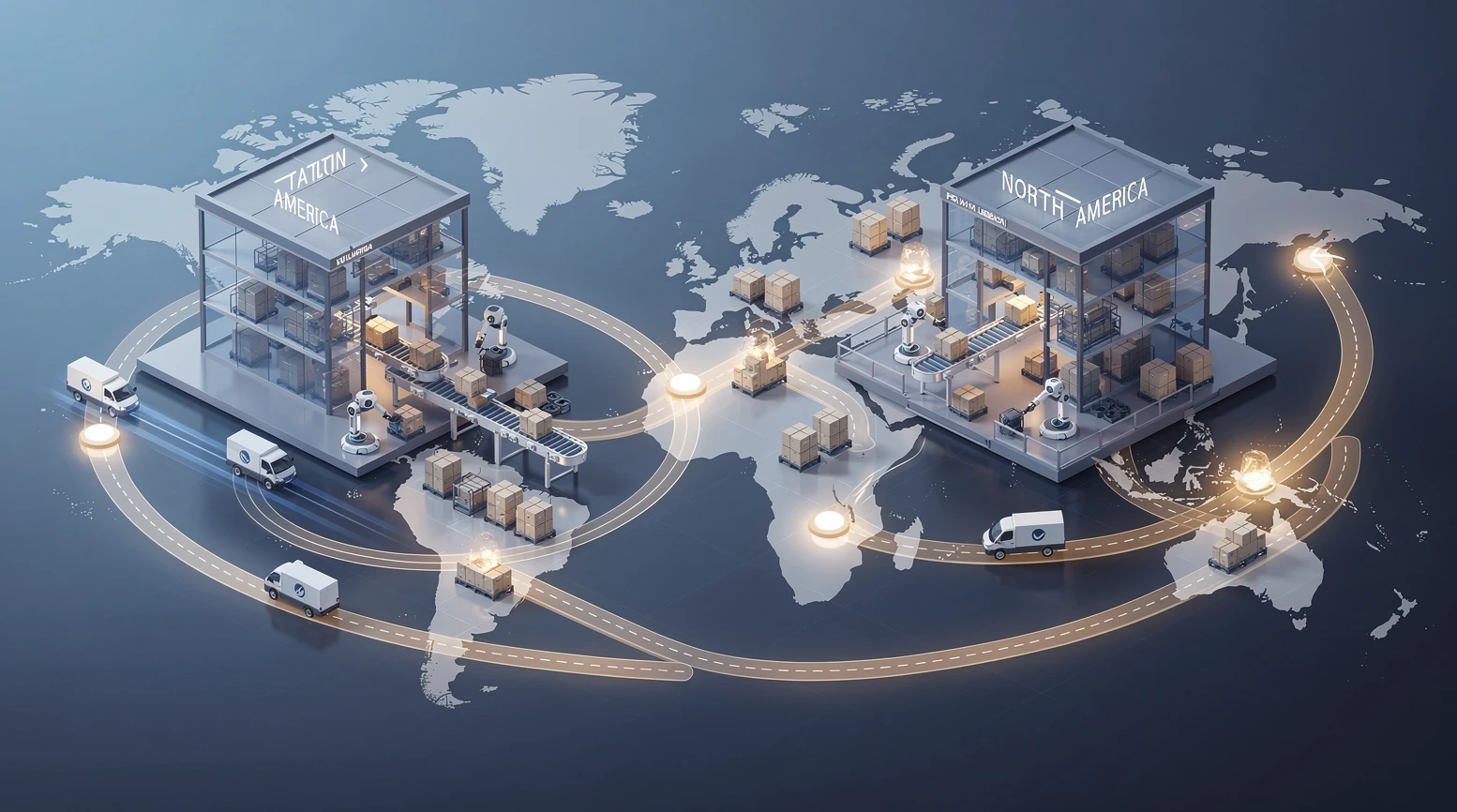
Mercado Libre fulfillment and Amazon FBA solve the same problem in two very different retail worlds. Both let a seller hand inventory to the marketplace, then let the marketplace pick, pack, ship and handle returns. The difference is that Amazon FBA was built to scale across the United States and Western Europe, while Mercado Libre built Mercado Envíos Full to conquer the roads, customs desks and payment habits of Latin America. For any brand weighing a move into Mexico, Brazil, Argentina or Chile, understanding how the two systems diverge is the difference between a profitable expansion and a warehouse full of stranded stock.
This guide breaks down how Mercado Libre fulfillment actually works, where it mirrors Amazon FBA, and where the two part ways on fees, delivery speed, reputation mechanics and returns. It is written for US and global e-commerce teams who already know FBA and want a clear map of the Latin American equivalent before committing budget.
In short
- Mercado Envíos Full is the FBA equivalent: sellers ship inventory into a Mercado Libre fulfillment center, and the marketplace handles storage, picking, packing, last-mile delivery and returns across its Latin American network.
- Reputation is tied to logistics far more tightly on Mercado Libre than on Amazon, so using Full directly lifts a seller’s reputation color and search placement rather than just delivery speed.
- Fee structures differ in shape: Amazon FBA charges separate fulfillment and monthly storage fees, while Mercado Libre bundles more of the cost into commission and offers free shipping thresholds that shift the economics toward lower-priced goods.
- Geography drives the design: FBA optimizes for dense, address-standardized markets, while Mercado Envíos engineers around informal addresses, cash habits and long-haul freight between Latin American cities.
- The right choice is rarely either or: many cross-border sellers run FBA in North America and Mercado Envíos Full in Latin America, treating each as the native rail for its region.
If you are mapping this decision as part of a wider expansion, it sits inside the same playbook covered in our complete guide to selling on global e-commerce marketplaces, which frames how fulfillment choices ripple through pricing, tax and channel strategy.
Why this topic matters in 2026
Latin America remains one of the fastest-growing e-commerce regions in the world, and Mercado Libre is its clear gateway. The company operates across 18 countries and dominates the three largest markets of Brazil, Mexico and Argentina. For a US brand, that scale is impossible to reach through Amazon alone, because Amazon’s Latin American footprint is meaningful only in Mexico and Brazil and trails Mercado Libre in both.
Fulfillment is where the two platforms compete most directly. A marketplace listing is worthless if the parcel takes two weeks to arrive or never clears customs. Mercado Libre understood early that logistics, not catalog, was the moat, and it poured capital into fulfillment centers, cross-docks and its own delivery fleet. By 2026, the majority of items sold on the platform in its core markets move through managed logistics rather than seller-arranged shipping.
For sellers, that shift changes the math. A product that ships through Mercado Envíos Full qualifies for the fastest delivery badges, ranks higher in search, and inherits buyer trust that an off-platform shipment cannot match. The same dynamic made FBA nearly mandatory on Amazon over the past decade. The question for 2026 is not whether to use managed fulfillment, but how to run both systems well at once.
There is also a demand-side reason the topic matters now. Latin American shoppers have grown accustomed to the fast, tracked delivery that managed fulfillment enables, and their tolerance for slow or opaque shipping has fallen sharply. A seller who cannot meet that expectation loses not only the sale but the repeat purchase, because buyers increasingly filter listings by delivery speed before they compare price. Fulfillment quality has quietly become a gatekeeper to visibility rather than a tie-breaker.
The competitive backdrop
Chinese cross-border players have intensified the pressure. Temu and Shein pushed aggressively into Latin America, forcing Mercado Libre to defend on price and speed simultaneously. We covered how that battle is unfolding in our analysis of why Shein and Temu’s Latin America pivot likely stalls against MercadoLibre, and fulfillment sits at the center of that defense. Faster, cheaper local delivery is the weapon Mercado Libre uses to blunt low-cost imports.
Key terms and definitions
Mercado Libre’s logistics arm is branded Mercado Envíos, and it contains several distinct programs that map loosely onto Amazon’s fulfillment tiers. Getting the vocabulary straight prevents costly mistakes when you configure listings.
- Mercado Envíos Full: full fulfillment by the marketplace. Inventory is stored in a Mercado Libre fulfillment center, and the platform handles everything downstream. This is the direct Amazon FBA analog.
- Mercado Envíos Flex: the seller stores and hands off parcels, but delivery is arranged and tracked through Mercado Libre, often via same-day local couriers. It resembles Amazon’s Seller Fulfilled Prime concept.
- Mercado Envíos Places (Colecta): Mercado Libre collects parcels from the seller’s location on a scheduled route, then moves them through its network. There is no clean Amazon equivalent.
- Reputation color: a seller-level score shown as green, yellow, orange or red that governs search visibility and buyer trust. Fulfillment method feeds directly into it.
- Amazon FBA: Fulfillment by Amazon, where inventory sits in an Amazon warehouse and Amazon handles pick, pack, ship, customer service and returns. The Fulfillment by Amazon model is the reference point most Western sellers already understand.
The critical mental shift is that Mercado Libre treats fulfillment as an input to seller ranking, not merely a service you buy. On Amazon, FBA improves your Buy Box odds; on Mercado Libre, Full improves your entire account standing.
How it works in practice
The operational flow of Mercado Envíos Full will feel familiar to any FBA seller, with a few important twists. You create listings, generate inbound shipping labels, send inventory to the assigned fulfillment center, and let the platform take over from there.
Inbound is where the first difference appears. Mercado Libre is stricter about appointment scheduling and labeling in several markets, and rejected shipments are more common than on Amazon for sellers new to the region. Each unit must carry a platform-generated code, and cartons need to match the declared manifest closely. Sloppy inbound work triggers delays that Amazon might absorb but Mercado Libre often will not.
Once inventory is live, the platform assigns delivery promises based on stock location and buyer address. Items in Full earn the fastest badges, which is the single biggest conversion lever on the platform. A listing that loses its Full badge because stock ran out will see orders fall within days, so replenishment discipline matters even more than on Amazon.
Storage, replenishment and stranded stock
Both platforms penalize slow-moving inventory, but they do it differently. Amazon uses aged-inventory surcharges and inventory performance metrics that can cap how much you send in. Mercado Libre leans on storage fees and, in busy centers, on caps that limit how much older stock you can keep in Full. Overstocking a slow seller is expensive in both systems, yet the recovery paths differ.
On Amazon you can usually create a removal order and get units back or disposed. On Mercado Libre, retrieving inventory from Full can be slower and less predictable in some countries, which raises the cost of a forecasting error. The practical rule is to send narrower, faster-moving assortments into Mercado Envíos Full than you might risk with FBA.
Returns handling
Returns are managed by the platform in both models, which protects the buyer experience but removes seller control. Mercado Libre’s buyer-protection culture is strong, and disputes tend to resolve in the buyer’s favor, similar to Amazon’s A-to-z stance. The difference is that Mercado Libre folds return performance into reputation color, so a spike in returns can drag down search placement across your whole catalog, not just the affected listing.
Mercado Envíos Full versus Amazon FBA at a glance
The table below summarizes the structural differences that matter most when you model the two systems side by side. Treat it as a planning reference rather than a fee schedule, because exact rates vary by country, category and season.
| Dimension | Mercado Envíos Full | Amazon FBA |
|---|---|---|
| Primary region | Latin America (Brazil, Mexico, Argentina and others) | North America, Europe, Japan and other mature markets |
| Core cost model | Commission-weighted, with free-shipping thresholds and storage fees | Separate fulfillment fee plus monthly and aged storage fees |
| Reputation impact | Directly lifts seller reputation color and ranking | Improves Buy Box and Prime eligibility, not account-wide reputation |
| Delivery badges | Full badge drives search visibility and conversion | Prime badge drives conversion and Buy Box share |
| Address handling | Engineered for informal and non-standard addresses | Assumes standardized, validated addresses |
| Returns policy | Buyer-favorable, folded into reputation score | Buyer-favorable via A-to-z, tied to listing metrics |
| Inventory retrieval | Slower and less predictable in some countries | Removal orders generally reliable |
The headline takeaway is that FBA is a service you bolt onto a listing, while Full is closer to a status you earn for your account. That framing should shape how aggressively you commit inventory to each.
How the fees really compare
Fee comparisons between the two platforms mislead when they stop at headline percentages. Amazon FBA breaks cost into a per-unit fulfillment fee that scales with size and weight, a monthly storage fee per cubic foot, and long-term storage surcharges on aged units. A seller can read those numbers off a rate card and model a unit before it ever ships.
Mercado Libre is harder to model because more of the cost hides inside commission and shipping subsidies. Commission rates vary by category and by listing type, and the free-shipping threshold means the platform effectively taxes lower-priced items by absorbing their delivery cost through the seller’s margin. Two SKUs at similar cost can carry very different true economics depending on which side of the threshold they sit.
The practical consequence is that a US seller cannot port an FBA profit model straight into Latin America. The winning approach is to rebuild the unit economics from scratch per country, treating commission, shipping subsidy and currency exposure as a single blended cost of fulfillment. Sellers who skip that step often discover that their best FBA performers are their worst Mercado Libre performers, purely because of where they land against the shipping threshold.
Seasonality and peak surcharges
Both platforms raise the cost of holding inventory during peak seasons, but the calendars differ. Amazon’s peak storage surcharges cluster around the Western holiday quarter. Mercado Libre’s demand peaks track Latin American shopping events, including local dates that a North American planner would never think to hedge. Aligning replenishment to the right regional calendar is a small detail that separates smooth peaks from stranded stock.
Common mistakes and how to avoid them
Sellers who succeed on Amazon often stumble when they treat Mercado Libre as a translated copy of the same playbook. The platforms reward different behaviors, and the fulfillment layer is where the gap is widest.
The first mistake is overstocking Full with a wide catalog. Because retrieval is harder and storage caps can bite, a broad assortment that would be fine in FBA can trap capital in a Mercado Libre center. Send your proven winners first and expand only once sell-through data confirms demand.
The second mistake is ignoring reputation color. New sellers fixate on price and forget that a yellow or orange reputation suppresses visibility no matter how sharp the pricing. Using Full is one of the fastest ways to protect and lift that color, so treating it as optional is a strategic error.
The third mistake is underpricing against free-shipping thresholds. Mercado Libre subsidizes shipping above certain price points, which changes the true margin on a unit. A price set just below the threshold can quietly destroy profitability, while nudging above it can flip a listing from loss to gain.
Currency and payment traps
Latin American markets carry currency volatility that North American sellers rarely price in. Argentina in particular has seen swings that wipe out margin between the sale and the payout. Mercado Pago, the platform’s wallet, settles in local currency, so repatriating funds and hedging exposure belong in your fulfillment cost model, not as an afterthought.
Customs and cross-border missteps
Sending inventory into a Mercado Libre center from abroad means clearing customs first, and the paperwork is unforgiving. Many sellers underestimate duties and end up with stock stranded at the border. If you are new to this, our walkthrough of cross-border selling tax and duty setup for first exports covers the groundwork you need before a single carton ships south.
Examples from US retail and e-commerce
Consider a mid-sized US beauty brand that already runs a mature FBA operation. In North America it sends a full catalog into Amazon warehouses, relies on removal orders to manage slow movers, and treats Prime as a conversion tool. When it opens on Mercado Libre in Mexico, copying that approach directly would be a costly error.
The smarter path is to select the top ten SKUs by North American velocity, send a conservative quantity into Mercado Envíos Full, and watch how reputation color and Full badges move. Because those SKUs already have proven demand, the brand earns fast-delivery placement quickly and builds a green reputation before widening the assortment. The fulfillment method becomes the engine of the launch rather than a back-office decision.
A second example is a US electronics accessories seller facing Temu and Shein on price. On Amazon it competes on Prime speed. On Mercado Libre, the same speed advantage is available through Full, but the free-shipping threshold means the seller must price deliberately to keep margin. By clustering products just above the subsidized threshold and leaning on Full badges, the seller defends conversion without racing imports to the bottom on price.
A third example is a US home goods seller with bulky, low-margin items. On Amazon, size-based FBA fees make oversized products expensive to fulfill, so the seller carefully prunes its FBA catalog. On Mercado Libre, the same bulk interacts with free-shipping thresholds and long-haul freight between cities, which can make oversized goods even harder to ship profitably in some countries. The lesson is that product dimensions, not just demand, should drive which SKUs enter each managed program.
Where the two systems reinforce each other
Brands that treat FBA and Mercado Envíos Full as regional rails rather than competitors tend to win. The forecasting discipline learned in FBA transfers well, and the reputation focus learned on Mercado Libre often improves how a seller thinks about customer experience back on Amazon. The most sophisticated operators run parallel dashboards, one per region, and resist the urge to force one playbook onto both.
Tools, partners and vendors worth knowing
Running fulfillment across two marketplaces and multiple countries is not a spreadsheet job. The right tooling layer keeps inventory, pricing and reputation visible in one place, and the right partners handle the messy parts of customs and freight.
Multichannel listing and inventory tools that support both Amazon and Mercado Libre let you manage stock across regions without double entry. Freight forwarders with Latin American customs experience are worth more than their fee, because a single stuck shipment can cost weeks of Full availability. Local tax advisors matter too, since each country treats imports and marketplace sales differently.
The table below maps common needs to the type of partner that solves them, which is a useful starting point when you assemble a vendor stack for a dual-platform operation.
| Need | Partner type | Why it matters |
|---|---|---|
| Cross-marketplace inventory sync | Multichannel listing platform | Prevents stockouts that kill Full and Prime badges |
| Customs clearance into Latin America | Regional freight forwarder | Stops stock stranding at the border |
| Local tax and duty compliance | In-country tax advisor | Each market treats imports and sales differently |
| Currency repatriation and hedging | Cross-border payments provider | Protects margin against local currency swings |
| Storefront and catalog operations | Marketplace operations agency | Handles reputation, disputes and listing hygiene |
If your operation runs on a store platform that feeds these marketplaces, the extension ecosystem matters as well. Our overview of the Magento extension marketplace shows how connector plugins bridge a central catalog into marketplace channels, which is often the cleanest way to keep Amazon and Mercado Libre listings in sync from one source of truth.
Getting the lay of the land first
Before you commit inventory, it pays to understand how selling on Mercado Libre works beyond fulfillment alone. Our primer on Mercado Libre for sellers expanding into Latin America covers account setup, category rules and the reputation system in more depth, and it pairs naturally with the fulfillment decision covered here.
How AI and automation are reshaping both models
Managed fulfillment is increasingly wrapped in automation, and both platforms are moving fast. Amazon has begun opening its marketplace to external AI agents that can browse, compare and buy, which changes how listings surface and how fulfillment speed feeds ranking. We explored that shift in our coverage of why Amazon opens its marketplace to external AI agents before the 2026 holidays.
Mercado Libre is investing on a parallel track, using machine learning to route parcels, predict demand and place inventory closer to buyers. For sellers, the practical effect is that clean data and disciplined replenishment matter more every quarter. Automated systems reward consistency and punish erratic stock levels, which raises the value of treating fulfillment as a core competency rather than an outsourced afterthought.
The strategic implication is clear. As agents and algorithms mediate more of the buying journey, the fulfillment badge becomes an even stronger ranking signal on both platforms. Sellers who master Full and FBA together will hold an advantage that price alone cannot buy, which loops back to the broader thesis in our global e-commerce marketplaces guide: logistics is the durable moat, and the marketplace that controls delivery controls the customer.
Frequently asked questions
Is Mercado Envíos Full the same as Amazon FBA?
They are close analogs. Both store your inventory in a marketplace fulfillment center and handle pick, pack, ship and returns. The key difference is that Mercado Envíos Full feeds directly into your account-wide seller reputation, while FBA mainly improves Buy Box and Prime eligibility on individual listings.
Which is cheaper, Mercado Libre fulfillment or FBA?
Neither is universally cheaper, because the fee shapes differ. Amazon separates fulfillment and storage fees, while Mercado Libre weights more cost into commission and uses free-shipping thresholds. The true comparison depends on your price points, category and country, so model each SKU rather than assuming one wins.
Do I need to use Full to succeed on Mercado Libre?
It is close to mandatory for competitive categories. Full unlocks the fastest delivery badges and lifts your reputation color, both of which drive search visibility and conversion. You can sell without it, but you will usually lose placement to sellers who use it.
How does reputation color relate to fulfillment?
Mercado Libre folds delivery performance, cancellations and returns into a color score shown as green, yellow, orange or red. Using Full shifts much of that performance to the platform, which protects and improves your color. A poor color suppresses visibility across your entire catalog, not just one listing.
Can I run FBA and Mercado Envíos Full at the same time?
Yes, and most cross-border sellers do. The common pattern is FBA in North America and Mercado Envíos Full in Latin America, treating each as the native rail for its region. Multichannel inventory tools keep stock and pricing synced across both.
What are the biggest risks with Mercado Envíos Full?
The main risks are stranded inventory from harder retrieval, storage caps on slow movers, currency swings on payouts, and customs delays on inbound cross-border stock. Sending narrow, proven assortments and pricing above free-shipping thresholds mitigates most of them.
How do returns work on each platform?
Both platforms manage returns to protect the buyer, and disputes tend to favor the buyer. On Amazon this shows up in listing-level metrics and the A-to-z process. On Mercado Libre, return performance feeds your reputation color, so a return spike can hurt visibility across your whole account.
Does Full help against Temu and Shein on price?
It helps on speed and trust rather than raw price. Full badges signal fast, reliable delivery that low-cost imports often cannot match, which lets sellers defend conversion without racing to the bottom. Pricing just above the free-shipping threshold while keeping the Full badge is a common defensive tactic.
The bottom line
Mercado Libre fulfillment and Amazon FBA rhyme without repeating. Both hand the hardest parts of logistics to the marketplace, but Mercado Envíos Full is woven into reputation and search in a way FBA is not, and it is engineered for the geography and payment habits of Latin America rather than the standardized addresses of the United States. For a US or global brand, the winning move is rarely to pick one over the other. It is to run FBA where it is native, run Full where it is native, and let disciplined forecasting and clean data carry across both. The seller who treats fulfillment as a core competency, not a checkbox, will out-rank and out-convert rivals who still see it as a cost to minimize.